
Zionism: Dismantling the Cross, the Judeo-Christian Deception

Standard

There was an act of vandalism in Wales.  A Christian cross made of stones, which had been on a hill in the countryside for half a century, was torn apart by Jewish tourists who used the stones to create the ‘Star of David’ or hexagram shape.  This act goes beyond total disrespect and destruction of a Christian display, but it is also symbolic of what Zionism is and what it has been doing to Christianity in the West.  

Zionism isn’t Jewish.  Many Jews, even who live in the Holy Lands, are as fully opposed to the ethno-supremacist state called Israel as their Christian and Muslim neighbors.  It is not something allowed by their religion, they insist, and I’ll let Jewish people debate their theology for themselves.  But the vast majority of Zionists aren’t Jews nor do they live in Israel.  Most Zionists were American Protestants who have become ensnared in this political ideology that rearranges parts of the Bible to justify taking property from a population who have lived in the birthplace of Christ since his birth.

Christian Zionism is an oxymoron.  It takes two opposites, the kingdoms of the world offered to Jesus during his temptation that he rejected and acts like Gehazi, the servant of Elisha, who goes back deceptively to get the gifts Naaman tried to give to his master and was then struck down with leprosy by the curse of his master.  There are many in church pews today who have betrayed their master and have rearranged the timeline of Scripture to embrace an evil replacement of the way of Christ.  They dismantle the cross and support Zionism instead.

Schofield’s Coup: Dismantling the Cross

In 1909 a new Bible was published.  It used the same English translation of the popular King James version and yet added notes of commentary written by a man named Cyrus Ingerson Scofield.  Dispensationalism is a relatively new interpretation of Biblical texts that started in the early to mid 19th century, initially invented by John Nelson Darby and the Plymouth Brethren in Britain, but it took Scofield’s in text commentaries distributed widely to finally sell it.

We could get into questions of exactly who Scofield was, his character, that he was a Confederate soldier (deserter?); who was an alcoholic who abandoned his family; a man who had defrauded several prominent Republicans with a railroad scam; who was arrested and jailed in St Louis for forgery and embezzlement, then had a dramatic conversion to Christianity and yet this essay will stick to the work he was known for: His popularization of a novel theological stance dividing Israel and the church in Scripture.

In the Christian Bible there’s a fairly obvious shift in tone between the Old Testament (or Jewish Torah, prophets, etc) and teachings of Jesus in the Gospels.  The conventional Christian perspective is that Jesus came as fulfillment of the law and supercedes the covenant that was given to Abram who became Abraham.  But Scofield turns the clock back, he ignores what the Epistles tell us about correct understanding, and he adds an idea that there are essentially two paths to God—one going through Jesus and the cross, the other by the Old Covenant.

Christianity, according to the Apostles, is the faithful remnant.  Israel is now the Church and the Church is the true Israel.

Where this was just an amateur mistake or an intentional deception doesn’t matter.  It has resulted in a battle between those who basically claim that “one way, Jesus” is anti-Semitic statement and smear it as being “Replacement Theology” (ironic, given this was, is, and will remain the only orthodox Christian perspective) for saying that the New Covenant continuation of God’s plan and necessary for salvation.  It ignores the New Testament books where St Paul and others give a correct Christian perspective of the covenant given to Abraham.

Always Through Faith, Never Bloodlines…

Jesus answered, “I am the way and the truth and the life. No one comes to the Father except through me.

(John 14:6 NIV)

I’m not nearly as dogmatic as some when it comes to passages like John 14:6 (above) and yet do see it as foundational to correct application of Scripture from the Christian perspective.  Jesus was making a definitive statement about who he is and the absolute requirements for salvation.  

The promises were spoken to Abraham and to his seed. Scripture does not say “and to seeds,” meaning many people, but “and to your seed,” meaning one person, who is Christ.

 (Galatians 3:16 NIV)

1) The passage above makes it very clear that the seed of Abraham is singular: Christ Jesus.  St Paul is saying that Jesus is that promise given to Abraham, that the promise is what bestows grace and continues:

So in Christ Jesus you are all children of God through faith, for all of you who were baptized into Christ have clothed yourselves with Christ. There is neither Jew nor Gentile, neither slave nor free, nor is there male and female, for you are all one in Christ Jesus. If you belong to Christ, then you are Abraham’s seed, and heirs according to the promise.

(Galatians 3:26-29 NIV)

2) We all become Abraham’s seed though faith in Christ and there is no distinction by religion (keeping the law) or race.  In other words, Jews and Gentiles are both saved in the exact same way and the old distinctions become moot in fulfillment of the promise:

It was not through the law that Abraham and his offspring received the promise that he would be heir of the world, but through the righteousness that comes by faith.  For if those who depend on the law are heirs, faith means nothing and the promise is worthless, because the law brings wrath. And where there is no law there is no transgression.  Therefore, the promise comes by faith, so that it may be by grace and may be guaranteed to all Abraham’s offspring—not only to those who are of the law but also to those who have the faith of Abraham. He is the father of us all.  As it is written: “I have made you a father of many nations.” He is our father in the sight of God, in whom he believed—the God who gives life to the dead and calls into being things that were not. 

(Romans 4:13-17 NIV)

3) Faith in Christ, nothing else, saves.

The Church and true Israel are the same, it is a group that is defined by faith both when those the Jews looked forward towards the promise and also in the Gospel fulfillment of the promise in the seed of Abraham that is Jesus.

Scofield, however, to justify Zionism, tries to drive a wedge between Christ and being the full fulfillment of promise or the seed of Abraham.  His footnotes take a passage like Genesis 12:3, addressed specifically to Abraham, about blessing those who bless him and cursing those who curse and then just hallucinate that it is speaking about all who ever have descended (but only through Isaac) from Abraham—no matter if they are faithful or not.  But this is in direct and total contradiction to the passages quoted above and simply meaning inserted into the text by a man fooled himself or just a fraud.

The Judeo-Christian Deception 

Do not be yoked together with unbelievers. For what do righteousness and wickedness have in common? Or what fellowship can light have with darkness? What harmony is there between Christ and Belial? Or what does a believer have in common with an unbeliever? 

(2 Corinthians 6:14-15 NIV)

Judeo-Christian is a term originally coined to describe a Jewish convert to Christianity, a Jewish Christian, but the usage has since evolved to become an oxymoronic coupling of religious traditions that formed up in full opposition to each other.  There is overlap, certainly, both started as religions rooted in the Hebrew Bible.  But one of the sides has rejected Christ, and is anti-Christ, while the other believes that the Torah can truly only be understood through the lens of Christ.  If your values start with something other than Christ then they’re not the same values as a Christian.

Starting with Jesus instructing his followers to let their ‘yes’ be ‘yes’ and ‘no’ be ‘no’ (Matt 5:37) or to use simple honest language.  So much dishonesty comes in from of a subtle twist of words.  For example, calling majorly invasive surgeries and hormone treatments “gender-affirming care” is just not the plain reality of what is being done.  Semantics is all about describing reality, but can also be about distorting the perspective and an art of deception.  There is no similar rule about using honest speech in Talmudic or Zionist Judiasm.  Mossad, the intelligence agency of Israel, used “By way of deception, thou shall do war.

Stratagem is part of war theory and tactics.  But it is not part of Christianity.  St Paul tells us:

For our struggle is not against flesh and blood, but against the rulers, against the authorities, against the powers of this dark world and against the spiritual forces of evil in the heavenly realms. 

(Ephesians 6:12 NIV)

The Christian doesn’t overcome the ‘enemy’ with deception.  They overcome them with good, with honesty and love, this is to reject the methods and means of those who see those outside their religio-political group as being terrorists to be destroyed or resource to exploited.  We are not required to reason with animals, we herd them, slaughter them, shoot them for sport, and impose our will—and is exactly what the Zionists do to those who get in their way.  There is no command to love enemies or good to those who those who hate you as there is in Christianity:

But to you who are listening I say: Love your enemies, do good to those who hate you, bless those who curse you, pray for those who mistreat you. If someone slaps you on one cheek, turn to them the other also. If someone takes your coat, do not withhold your shirt from them. Give to everyone who asks you, and if anyone takes what belongs to you, do not demand it back. Do to others as you would have them do to you. 

(Luke 6:27-31 NIV)

Interestingly enough, Islam has a similar teaching, but we would never call this area of confluence Islamo-Christian values.  So why do we attempt to add the leaven of the Pharisees through this linguistic maneuver that marries us to a religion that has values completely different despite a similar origin point?  The “Synagogue of Satan” (Rev 2:9, 3:9) has never stopped hating Christ or His followers, they have simply committed to a long-game strategy of subversion or using the naive to do their bidding.  This isn’t even a value judgment, I’m not saying you should not be Jewish if that is what you believe is, but you can’t be a Judeo-Christian because it is a contradiction of terms.

If a suggestion of “Islamo-Christian values” causes you to erupt in riotous laughter, then the combo of the way of Jesus with that of Zionism is doubly as ridiculous.  

Philosophically there is zero compatibility in these perspectives.  It is impossible to love and bomb your enemies.  You cannot claim to follow Jesus, who rejected worldly power, and then support the violence being done in the name of Israeli statehood.  Zionism is a “blood and soil” nationalist movement, and is all about land, all about ethnicity, whereas the kingdom of heaven is about repentance, self-sacrifice and meekness.  The only thing that is sacrificed in ‘Christian’ Zionism is the Gospel of Jesus Christ and the credibility of our collective witness—so our partners can slather themselves in misguided pride for being the chosen race.
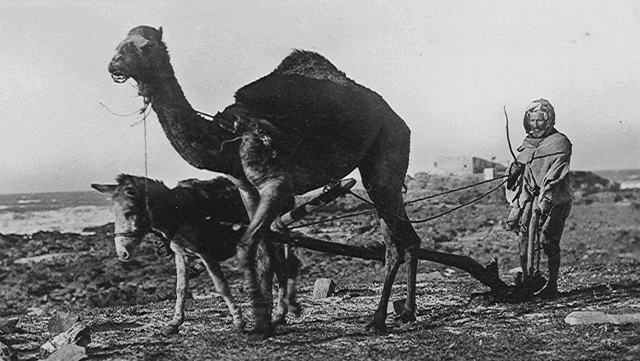
Not good, especially when one is pulling the other backwards…

The real purpose of a term “Judeo-Christian values” is political and propaganda.  It is to throw a yoke on the neck of Christians and force them to work together.  It is simply a way to control one side and normalize the other.  There is no backward compatibility, a believer in Christ does not share values with those who reject him, with those who cling to national pride rather than the cross, and subjugate rather than serve.  Jesus opened his arms to children—Zionists justify killing children by starvation, by denying them care or even by burning them alive and gunning them down.

Origen, who is considered to be a church Father, may have toyed with universalism—an idea that all would be saved in the end.  But there is no parallel path that is given for anyone according to Jesus or the Apostles, most especially not for those who are far removed from Jesus as the Nazis—despite their claims to the contrary.  We cannot let the cross of Christ be rearranged into the symbol of a worldly kingdom.  Having some things in common with those who rejected Christ doesn’t make us the same.

North-South, East-West

Standard

One of my favorite love stories, the BBC adaptation of a Victorian era novel, North & South, features two very strong and compelling characters.  

The first, Margaret Hale, the cherub-faced daughter of an English clergyman, is forced to move to the industrial North after her father’s resignation over a matter of conscience.  The other is John Thornton, a mill-owner, a handsome man with piercing eyes, brooding and intense, and interest in the demure young woman.

Things started fairly well.  But, that doesn’t last as the differences in their perspectives becomes clear.  Margaret, compassionate and having lived a sheltered life, interprets the actions of John in a negative light and pulls away after witnessing his harshness towards an employee caught smoking.  What she sees as just cruelty was actually Thornton’s concern for the safety and wellness of his workers given the extreme risk of fire.

It is in the last and final act where there’s a scene where the tension between the two finally disappears.  Throughout the middle-act Thornton’s truly good character is slowly revealed.  And, Margaret, having returned South, has reconsidered her own idealistic notions, now sees the merits to living in Milton, and decided to return North again.  Meanwhile, John is going South, the two cross paths at a station near the midpoint and cue the music.

North & South

There is this wonderful part of the soundtrack in this climatic station scene, Northbound Train (listen here), that so perfectly accompanied the moment.  It is understated and elegant, reflective, that builds in waves to crescendo and then slips away as wistfully as it came.  Thornton’s steadfast devotion is finally rewarded with a kiss and happily ever after begins despite the painful struggle to get there.

When the Story Goes South…

During my pursuit of the impossibly (a preacher’s daughter, like Margaret) this story brought a little hope with the similarities to my own.  It wasn’t that we were so terribly different in our desires as it was she never heard me.  Her conclusions formed before the conversation even began.  She had pronounced “you’re thirty years old living in Milton” (the actual name of the town) meaning, in translation, that I would hinder her big plans.  And could not understand it was her boldness and ability to get out that attracted me.

My thesis then was that a composite of our unique strengths, seemingly incompatible, bound together by Christian love, would exceed what those of similar abilities could accomplish. My thinking outside the box combined with her represention of the Mennonite standard.  And, while I’m never good at getting things started (hence being stuck in Milton) I’m extremely loyal and willing to sacrifice for the team.  I knew my age and life experience was an asset.  But she could not see my value.

Still, for the year or so following her initial rejection I believed.  What a wonderful story we would have when all was said and done, right?

Anyhow, that music, Northbound Train, had seemed like the perfect bridal march.  Partly in innocent faith, partly to bolster my failing confidence against the deluge of rational fears, this image of the impossibly walking the church aisle dressed in white.  As would be the case in real life, tears would stream down my cheeks as the nightmare of the past decade was replaced by this wonderful dream of marital companionship and completeness.  

The strong emotions that came with that gentle harp being replaced with one violin and then two, have now disappeared.  The music is still beautiful, but my feelings of numbness have long replaced that panging desire for a well-defined conclusion to over a decade of struggle.  What I got instead was a world more complex.  The cynicism that I had fought tooth and nail was confirmed.  

The sunshine through the clouds, endings sweet and perfect are not for everyone.  And the reason we tell such lovely tales is probably because they’re so uncommon, the exception, and not the rule.  Sure, we can see ourselves as the characters.  But the impossibly will likely go on seeing me as the villain in her movie, her conventional guy as the hero, and has never once shared in my fairytale that love would prevail over our differences.

As Far As the East is From the West

It is hard to believe that nearly another decade has passed and I’m still alone.  I’ve moved from Milton, left the religion of my childhood behind, even traveled to the complete opposite side of the world twice, and have changed from that guy perpetually unsure of how to find direction.  No, I’m not a missionary, but I do genuinely love people and probably accomplish more of actual value than those duty-bound Evangelical types who see ‘the lost’ as their get-into-heaven projects.

More importantly, I’ve found another impossibly, a beautiful Filipina flower, a little lost sheep when I found her (struggling abroad, in Taiwan, to support her son back home) and now the one who keeps me strong despite our torturous wait.  Unlike the Mennonite impossibility, we do not share a cultural or ethnic identity, our lives have been very different, yet we have our simple and devoted love in common—which has been just enough to sustain us through these past years.

East & West

However, after all I’ve been through, holding on to hope is hard.  Could my visions of her arrival at the airport, on American soil, with Y-dran in tow, also be a delusion?  

It has been over two years and eight months since we’ve held each other that one last time before we parted ways in Taoyuan International Airport.  I had known the immigration process would be difficult, but could not have anticipated the pandemic and travel bans that make it nearly impossible to be with Charlotte.  It really does start to bring those worries that I might be cursed to the forefront again and sometimes the despair does win.

The eternal optimism of youth wiped away by the rejection of the Mennonite ideal, now facing my rational fears and the fact that I’ve been hoping longer than Jacob worked for Rachel and without so much as a Leah in between, I can now fully identify with the wife of Job, “Are you still trying to maintain your integrity? Curse God and die.”  The frustration is real.  How long does one go on dreaming?  When is it justified to wither away into bones, with life never to return again?

As far as the East is from the West is an expression, in Psalms 103:12, used to describe an impossible distance that cannot be bridged.  And it could seem that, despite the abiding love of my bhest to encourage me onwards, I’ve jumped straight from the frying pan into the fire.  We have had a bit of good news since I’ve last published a blog here, the USCIS approved the application, and yet will this impossibly ever become possible?

I see the successful couples. So lovely together. To them it feels preordained, meant to be, a dream come true. For me, on the outside looking in, there is now more uncertainty than certainty, not everyone gets that music at the end.

Joachim and Anna and the Curse of Childlessness

Standard

For those raised in the conservative Mennonite culture big families are a given. There were nineteen children in my dad’s family (sixteen biological, three adopted) and, while that is the extreme, it would be very unusual for a married couple not to have any children. In a culture where blessing is practically synonymous with children, a childless home would likely produce some whispers and infertility a very unpleasant matter.

Children have traditionally been a retirement plan and marriage commitment the first step. A person without any offspring would likely have nobody to care for them in their old age. Even in a time when the state has taken over that role of social security there is still need of a new generation of children to keep that kind of system solvent. As many industrialized nations have below-replacement fertility rates, childlessness could soon be the crisis for us that it would have been in the ancient times when this was written:

Children are a heritage from the Lord, offspring a reward from him. Like arrows in the hands of a warrior are children born in one’s youth. Blessed is the man whose quiver is full of them. They will not be put to shame when they contend with their opponents in court. (Psalm 127:3‭-‬5 NIV)

Indeed, who will contend for the childless?

If you think that democratic institutions, in the hands of young people raised in a culture that values youth, will continue to provide for the elderly who have no familial connection to them then someday you’ll have a rude awakening. If anything the elderly are seen as a political obstacle in our modern times, a waste of limited resources when we have Google to provide our answers, and many of these youthful ignorant social engineers—rather than contend with a bunch of has-beens they don’t care to know—would delight in giving you a push to an early grave.

The Childless In Scripture

In ancient times, perhaps for the reason that there would be nobody to care for you in old age without children, there was a social stigma attached to being childless. In the case of Saul’s daughter Michal, who was critical of her husband David’s celebration antics, and her childlessness is expressed (2 Samuel 6:20-23) as if being a punishment. We are never told if that was simply a result of her relationship with her husband or not, but either way she did not produce an heir to David’s throne—which would be a serious setback to say the least.

There are patterns in Scripture and one of those patterns being that those most notably childless early on are often the most greatly blessed later. The most notable of those couples with a deferred blessing is Abraham and Sarah. They were elderly and had remained childless. We are told “she was not able to concieve” (Genesis 11:30) yet Abraham was promised to be “the father of my nations” (Genesis 17:4) and this seemed plain ridiculous given the advanced age of the couple. But, they were blessed by God, Sarah did bear Issac and was childless no more.

There is also the account of childless Hannah. In the first book of Samuel we read how she was treated especially well by her husband (who had two wives) because he loved her. And yet her rival would torment her over the fact that she could not bear children and this made her miserable to the point she couldn’t eat. Finally she cried out to God, weeping bitterly, she vowed:

Lord Almighty, if you will only look on your servant’s misery and remember me, and not forget your servant but give her a son, then I will give him to the Lord for all the days of his life, and no razor will ever be used on his head. (1 Samuel 1:11 NIV)

In other words, she promised her son would be a man dedicated to God.

The account goes on to say that Eli, the priest, who was watching her pray yet couldn’t hear her words, thought she was drunk and tells her to put away her wine. But she responds that this isn’t the case, that she is simply deeply in anguish, to which the priest tells her: “Go in peace, and may the God of Israel grant you what you have asked of him.” (1 Samuel 1:17 NIV) This answer seems to have consoled Hannah who we are told began to eat again and would later become pregnant, bear a son Samuel—a name which basically means “heard by God” and he would, as a result of her commitment, become a great prophet.

Finally, before we move on to Joachim and Anna, there is this assurance given to the childless who remain faithful:

And let no eunuch complain, “I am only a dry tree.” For this is what the Lord says: “To the eunuchs who keep my Sabbaths, who choose what pleases me and hold fast to my covenant—to them I will give within my temple and its walls a memorial and a name better than sons and daughters; I will give them an everlasting name that will endure forever. (Isaiah 56:3‭a-‬5 NIV)

There are many who would love to have children and cannot. This is one of those terrible ironies given the numbers of abortions and abused or neglected children in the world. We will never know, at least on this side of eternity, why some who long to be mothers and fathers are denied the blessing of children. However, we do see that those who suffer this despite their righteousness will be rewarded in the end and therefore should always put their hope in God who will make all things good for those who love and obey Him.

Who Are Joachim and Anna?

These two, mentioned at the conclusion of each liturgy, “the holy and righteous ancestors of God, Joachim and Anna,” despite being mostly forgotten in the religious tradition I was born into, have one of those great stories.

Joachim was from the tribe of Judah and a descendant of King David. His wife, Anna, was from the tribe of Levi, the same as the High Priest Aaron and the daughter of the priest Matthan. They had lived fifty years, as a married couple, and were unable to have children despite their devotion to God.

Joachim had faithfully, since his teenage years, given two-thirds of his income, one third to the poor and another third to the Temple, and were financially blessed for this. However, their childlessness finally became a cause of harassment. The High Priest, Issachar, confronted Joachim and told him, “You are not worthy to offer sacrifice with those childless hands.” And, with that pronouncement, he was pushed back by others, who had children.

Rejected and despairing in this disgrace, Joachim studied and found that, indeed, every righteous man in Israel had been blessed with children. He and his wife left with Jerusalem with profound sadness because of this. They began to pray for a miracle, like that which happened for Abraham and Sarah, him going into the mountains with his flocks and Anna returning home. Then the archangel Gabriel visited them both, promising them “a daughter most blessed, by whom all the nations of the earth will be blessed, and through whom will come the salvation of the world.” The picture is of them meeting again, at the city gates, upon hearing this.

Their daughter, Mary, the mother of Jesus our Lord, was specially dedicated to God and, like Hannah’s son Samuel, was brought up at the Temple at the age of three to be raised with other girls there. Their righteousness was finally rewarded having waited those many years. Their story is one that is a good reminder to those who have been faithful yet have not been blessed like others. They are the grandparents of our Lord and Savior.

Anyhow, by coincidence, the conception of Mary is celebrated today, December 9th, which is something I didn’t know when I began writing this blog.