When I was in elementary school we sang a song with lyrics, “Martin Luther King, Martin Luther King, was a great man.” Looking back it was even strange then. Why were we, in a rural Pennsylvania public school, instructed to heap such adoring praise on this man? It was a weird indoctrination.
One explanation is that this was atonement ritual. Dr. King was murdered. Thus maybe the weight of guilt on the generation of the Civil Rights Era was just that high that this was a way they try to correct the injustice. And it is sufficient to explain why the rank-and-file liberals, such as Mrs. Lawrence, my elementary music teacher, would promote his legacy or turn him into a legend.
But was it all well-intentioned?
I don’t have a black and white view of MLK Jr. I think he was a complex character, he advocated for peaceful protest and yet was also a sexual deviant despite his status as a Baptist Reverend. He’s probably as worthy of honor as any other figure in the American pantheon. However, the big question is why is he there? Why was there a holiday put on the calendar to celebrate this man?
The answer to how is that there was a bipartisan effort, after a significant campaign, to put him there. Everyone, except a few racist hold out Democrats, supported this move. Jimmy Carter endorsed it, and Ronald Reagan signed it into law, lauding King as being “a drum major for justice” in a Presidential proclamation. So it is a reminder to carry on the mission of the man who preached a brotherhood that goes beyond race and reconciliation.
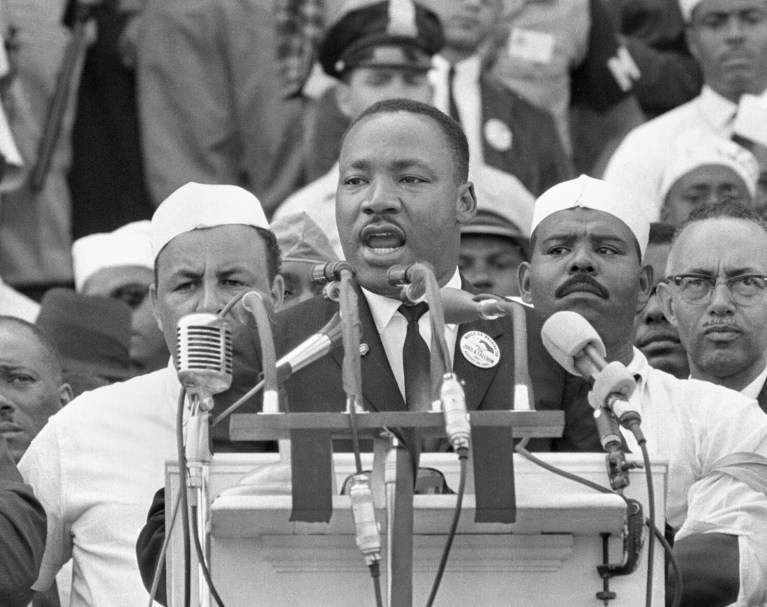
As a child of the 1990s, I was indoctrinated into an ideal of a colorblindness—a society that made the dream of Dr MLK Jr a reality:
“I have a dream that my four little children will one day live in a nation where they will not be judged by the color of their skin but by the content of their character.”
It had worked. Racial tensions had dropped off and it had really felt then like a new post-racial epoch had begun.
Unfortunately, since then the progress has been backwards. Or at least as far as sentiment. Many are convinced that race relations are worse than before. And that what MLK had preached is impossible, that we must see color, and many advocate that we discriminate in favor of racial minorities—or against them. Both the far-right and far-left agree with racism. They both refuse the multi-variant analysis, one which considers factors like fatherless homes apart from race, and have decided that race determines all.
The left claims that the content of character speech is misused and that we must force equal outcomes or we are disingenuous—while the right uses disparity in outcomes as the proof of inferiority at a genetic level. It is truly amazing how the same data can be read so differently. However, I disagree with both sides and put far more weight on culture and messaging than they do. Telling people they need our help in order to reach their full potential is disempowering and the worst kind of political opportunism.
Which does make me wonder if this is the real reason why we celebrate MLK? Would we ever turn him into an immortal figure if he were alive to speak for himself?
No, I don’t believe so. I believe that MLK Jr. became much more useful to the political establishment in his death. No matter what side you’re on, Republican or Democrat, you can make use of his words. And the reason they recognize him is to use his legacy as a tool for their own ends. This is the beauty of all those made maytrs for a cause, they always get turned into whatever the current owners of their image want them to be. I would contend the holiday is intended as a way to co-opt his legacy—both as a way to pacify and to bend it to their own agenda.
MLK was silenced. His legacy of words and of speeches are now open to interpretation. He’s a national hero only because he’s dead and cannot oppose those employing his name on all sides of the debate. Those who made his birthday into a holiday were likely doing it as a virtue signal, a way to prove (to those who cared in the voting public) how they are better than his killers.
These same people would likely have destroyed him—for his sins—if he were alive and opposed them. Only dead heroes are useful in politics.
Let’s talk about consciousness and infant Baptism, shall we?
My entire life, as a child of Anabaptism, I was taught a doctrine called “Believer’s baptism” (or credobaptism) which a) tied Baptism to church membership and b) teachings that Baptism requires a conscious or adult decision. The irony of that is that many Mennonites are Baptized as children, as a result of indoctrination, and not after an exhaustive search for truth that ends with Christ.
It makes sense, at one level, that a believer in Christ must be able to “count the cost” (Luke 14) of discipleship, right?
And yet, if we look at the Apostles themselves, were any of them actually ready when they were picked by Jesus?
No, if Peter had counted the cost, if he truly understood what it meant to enter the kingdom, he would never have denied Christ. The doubts of Thomas, and the betrayal of Judas, all point to a group of men who did not fully comprehend the words of Jesus prior to their Baptism.
#1) We don’t choose, we’re chosen and drawn to Christ:
No one can come to me unless the Father who sent me draws them, and I will raise them up at the last day. It is written in the Prophets: ‘They will all be taught by God.’ Everyone who has heard the Father and learned from him comes to me. […] The Spirit gives life; the flesh counts for nothing. The words I have spoken to you—they are full of the Spirit and life. Yet there are some of you who do not believe.” For Jesus had known from the beginning which of them did not believe and who would betray him. He went on to say, “This is why I told you that no one can come to me unless the Father has enabled them.”
(John 6:44-45,63-65 NIV)
#2) We did not decide the hour of our first birth nor do we decide the second birth:
Jesus replied, “Very truly I tell you, no one can see the kingdom of God unless they are born again.”
“How can someone be born when they are old?” Nicodemus asked. “Surely they cannot enter a second time into their mother’s womb to be born!”
Jesus answered, “Very truly I tell you, no one can enter the kingdom of God unless they are born of water and the Spirit. Flesh gives birth to flesh, but the Spirit gives birth to spirit. you should not be surprised at my saying, ‘You must be born again.’ The wind blows wherever it pleases. You hear its sound, but you cannot tell where it comes from or where it is going. So it is with everyone born of the Spirit.”
(John 3:2-8 NIV)
#3) We were dead, dead people aren’t conscious to make adult decisions:
As for you, you were dead in your transgressions and sins, in which you used to live when you followed the ways of this world and of the ruler of the kingdom of the air, the spirit who is now at work in those who are disobedient. All of us also lived among them at one time, gratifying the cravings of our flesh and following its desires and thoughts. Like the rest, we were by nature deserving of wrath. But because of his great love for us, God, who is rich in mercy, made us alive with Christ even when we were dead in transgressions—it is by grace you have been saved. And God raised us up with Christ and seated us with him in the heavenly realms in Christ Jesus, in order that in the coming ages he might show the incomparable riches of his grace, expressed in his kindness to us in Christ Jesus. For it is by grace you have been saved, through faith—and this is not from yourselves, it is the gift of God—not by works, so that no one can boast. For we are God’s handiwork, created in Christ Jesus to do good works, which God prepared in advance for us to do.
(Ephesians 2:1-10 NIV)
By adding the requirement of adult comprehension, the teachers of credobaptism turn Baptism into a work and base salvation on our consciousness of the need. That’s rational, yet humanistic and not the process we see outlined in Scripture. Lazarus, dead for four days, did not have the mental capacity to listen to the command of Jesus, “Lazarus, come out!” No, we understand that this would be impossible. And, likewise, when the Rich Young Ruler (asks “what must I do to be saved,” the final answer is not “sell all and give to the poor,” as some Anabaptists believe—it is “with man this is impossible, with God all things are possible.”
The real problem with this idea that Baptism requires a certain level of consciousness (and the invented concept of an “age of accountability”) is that it is totally arbitrary and would exclude those not fully capable of making an adult choice. I mean, truly, will we refuse to Baptize the mentally disabled because they can’t count the cost of discipleship? Should we have an IQ test? Maybe make applicants provide proof of their faith? At the very least, if this notion of Believer’s baptism is correct, and adult consciousness necessary to appreciate Christ, then should we cut this silliness of a baby leaping in the womb (Luke 1:41) out of the Gospel narrative?
There is evidence, in Scripture, of whole households being Baptized. But there is little to support this idea that one must reach a certain level of consciousness to be Baptized. It is really like some people think they’ve saved themselves and this misunderstanding of the significance of Baptism, starting five centuries ago, got turned into theological hubris. If Baptism is about being born again or spiritual rebirth—and our first physical birth was not a willful choice—why would we ever conclude that Baptism must be a choice, a matter of age or adult comprehension?
What is Baptism truly about?
Baptism is the start of a journey of faith, like birth, and something to accompany repentance.
But wait, there’s more…
Baptism and the Nuptial Bath
Up until very recently, being unfamiliar with Jewish wedding traditions, I would never have made the connection between Baptism and a Jewish bride’s nuptial bath. A friend of mine shared a podcast that dove into that topic (listen here) and the parallels seem to be very real. Upon further research, this ‘other” meaning is also something understood historically by the church and quite clearly implied in this passage:
Husbands, love your wives, just as Christ loved the church and gave himself up for her to make her holy, cleansing her by the washing with water through the word, and to present her to himself as a radiant church, without stain or wrinkle or any other blemish, but holy and blameless.
(Ephesians 5:25-27 NIV)
Baptism, in effect, is a symbolic representation of the start of this ritual cleansing that doesn’t end with the act. The Christian life is a life of repentance, of continually turning towards Christ. Our spiritual cleansing doesn’t end with the water of our physical Baptism either.
After this, Jesus and his disciples went out into the Judean countryside, where he spent some time with them, and baptized. Now John also was baptizing at Aenon near Salim, because there was plenty of water, and people were coming and being baptized. (This was before John was put in prison.) An argument developed between some of John’s disciples and a certain Jew over the matter of ceremonial washing. They came to John and said to him, “Rabbi, that man who was with you on the other side of the Jordan—the one you testified about—look, he is baptizing, and everyone is going to him.”
To this John replied, “A person can receive only what is given them from heaven. You yourselves can testify that I said, ‘I am not the Messiah but am sent ahead of him.’ The bride belongs to the bridegroom. The friend who attends the bridegroom waits and listens for him, and is full of joy when he hears the bridegroom’s voice. That joy is mine, and it is now complete. He must become greater; I must become less.”
(John 3:22-30 NIV)
It was directly prior to this that we have the encounter between Jesus and Nicodemus where we get the phrase “born again” and where Jesus tells the perplexed Jewish religious leader about this rebirth “of water and the Spirit” like the wind that goes wherever it pleases. That is an indication of the mysterious origin of Baptism, that it is not something that comes about through our own rational thought processes.
So what is this “ceremonial washing” about?
And how does Baptism relate to brides and bridegrooms?
A few months back I worked on a truss layout for a religious building project, a Mikvah bath, and learned more about the Jewish ritual cleaning process and something observant women of that religion must do on a regular basis.
Mikvah bath
However, most significantly, it is something they do prior to marriage, which seems to be the connection between the quarrel about everyone getting this ceremonial washing and the response of John the Baptist.
The point and purpose of John’s ministry, like the pre-marital ritual washing of a bride when her groom arrived, Baptism was to make people ready for the marriage to Christ. It was not symbolic of the commitment itself—rather it was only a part of the process leading up to the commitment. So, sure, Baptism is the start of an important transitionary moment and yet our salvation comes through a life-long Theosis, through our being washed, sanctified, and justified by the Spirit of God until the time we depart this world.
One last point, and related to this nuptial bath tradition and the parallels to Baptism. Jewish brides did choose their partners nor the time of their wedding like we do. No, they practiced arranged marriage and the arrival of the groom was at the appointed time of his father once the preparations were complete. So again, where does this idea come from that the bride must choose the time or place of this meeting and bath? Wouldn’t responsible Christian parents want to prepare even infant children for their groom?
The expanded consciousness that comes through our prearranged nuptials with Christ can come after the ritual washing of Baptism—as it did for the disciples who didn’t know what they were being signed up for when they began their journey of faith.



 Irregular Ideation