
Coddled to Death—How the West Made Weakness a Virtue

Standard

My son complains that he doesn’t get paid enough for household chores.  He feels he is somehow entitled to everything that we’re giving him and more.  It is a struggle trying to explain why we won’t simply hand him all that he wants.  We have plenty, in his eyes, and can just share our wealth with him.  But the reason we hold back isn’t our greed or that we don’t want him to have the best life has to offer.  No, quite the contrary, in fact, it is because we want him to do well life that we resist the urge to coddle him.

What is coddling?

On the surface it is being overprotective and indulgent.  It stems from distrust of another other person’s ability to deal with normal life situations and emotions on their own.  And, while it may appear to be motivated by love or compassion, it only ever empowers those who keep the other confined to the bubble wrapped world.  It is the devouring mother, the one who uses their nurture as a tool of control.  They only care about the target of their efforts so far as it feeds their ego or feelings of self-importance.  It is a virtue signal and degrades those coddled.

Bigotry of Low-expectations

Along with thoughts about parenting and the goal, some of the inspiration for writing this came from the governor of the state of New York, Kathleen Hochul, who declared:

Young black kids growing up in the Bronx, who don’t even know what the word a computer is, they don’t know. They don’t know these things. And I want the world open up to all of them, because when you have their diverse voices, innovating solutions through technology, then you’re really addressing societies broader challenges.

Other than to call this statement what it is: Bigotry (or racism) of low expectations and patronization.  I’ll not pile on.

Many, like Hochul, are isolated.  They have not spent much time in urban communities nor met the people who live there.  From my own first hand experience her claim (which she now claims was misspoken) is absurd, none of the black I met were unfamiliar with or incapable of using computers.  Many of my acquaintances there could afford to go to college and more credentialed than I am, so where does this notion come from that they’re hapless ignorant people in desperate need of government assistance?

The answer, in this case at least, is that it is hard to maintain a bloated state budget (let alone greedily expand it) without somehow justifying it and what better way to do that convince people that they need you to get somewhere in life?

Condescending political elites are not moral paradigms and minority voters are not stupid.  I believe those pandered to know it is insincere and coming from someone who sees them as dumb.  But they also understand it works to their advantage and don’t say no to it.  We naturally take the path of least resistance and rationalize why we are deserving of the help.  By playing up the consequences of slavery and impacts of racial prejudice, a little wealth redistribution (looting or theft) can be redeemed as social justice.

Unfortunately, low expectations produces what it is supposed to remedy, it gives an excuse to wait around for a handout and kills initiative.  This contributes to racism in that it creates the impression that the only way some can compete is by lowering the bar or a double standard.  It diminishes the accomplishments of those who knew what a computer is without the help of those in the the benevolent class.  Now, because of politicians meddling, there is the question, did they earn it by being the best candidate or are they a diversity hire?

Woke is Weak

My conservative friends wouldn’t likely see the link between Christianity and wokism, but it is definitely there.  The woke glorify the victim and reframe accomplishment as unearned privilege.  For those who started a business, “You didn’t build that” they reason, and nullify the hard work and the sacrifice of those who followed the entrepreneurial spirit to success.  Likewise, in church we’re encouraged to tithe generously and be charitable since it is giving back a portion of all that is given to us by God.  The difference being that the woke want us to give to the government, the religious their own organizations.

And there’s nothing wrong with our helping those in need.  I provide for my son and my wife as well.  However, when I give I give to empower rather make them dependent and weaker.  My hope is for my son to grow his strength and ability so that in time he does not need me to survive.  And the same thing is true of my wife, she is my partner not my patron, we both contribute different things to the whole and neither of us is entitled to what the other gives to the relationship.  It is how a real community works, we give and take as necessary, and we do it for the good of the common project.

Wokism, by contrast, is motivated by envy and pity, it encourages fragility by marking off space spaces and enforcement of strict language codes.  Again, this strict regulation has a parallel in religious fundamentalism.  Home schooling parents are terrified of the influence of the ‘world’ on their children.  They, like the woke, overemphasize the role of the environment in the formation of the individual.  The one exempts swaths of the population from the normal civil expectation (while increasing the burden on others) and the other thinks salvation of poor little Johnny depends on them.  Bad behavior always blamed on an external influence rather than a lack of will to do better on the part of their designated eternal victims.
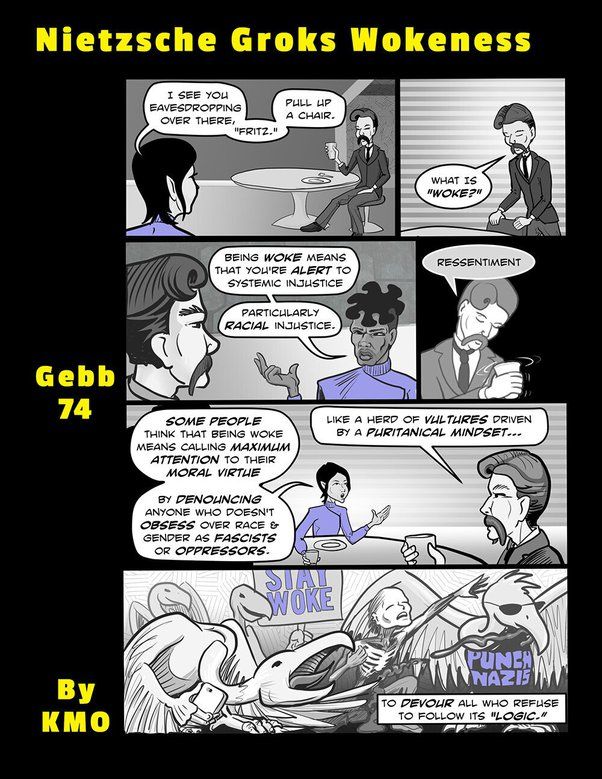
This is what Friedrich Nietzsche critiqued as being a hatred for life.  When we remove temptation rather than ever teach children to resist it—when we are constantly vilifying strength rather than encourage it—when we follow after reasoning or rationality instead of developing our instincts, we are promoting the weakness of our society and degeneration. 

Woke is weak.  It attempts to foster spirits of ressentiment and forms an identity around a person’s fear of being disenfranchised for things completely out of their control.  And in the end it destroys the incentive to find a way to overcome by our own means.

The Meek Shall Inherit 

Neitzsche could be accused of painting with too broad a brush for the dismissal of the Christian ethic as slave morality and an opposition to the powerful.

The message of Jesus and his Apostles was, in part, freedom from those human laws of “Do not handle! Do not taste! Do not touch!” (Colossians 2:21) and very nearly could be the “will to power” that the German philosopher championed once unpacked.  Hedonism wasn’t the goal of the departure from “slave-morality,” the aim was instead for people to exercise will-power and resolve.  In the same manner Jesus and St Paul preached freedom from the law that brought only bondage and death:

But now, by dying to what once bound us, we have been released from the law so that we serve in the new way of the Spirit, and not in the old way of the written code.

(Romans 7:6 NIV)

This is not to suggest that there is any kind of compatibility between the Spirit-led and the Übermensch.  Nevertheless, both would have us abandon a lower morality based on restrictions for a pursuit of our own ultimate form.  To St. Paul the Gospel means we are free from “the flesh” or the unbridled urges, while Nietzsche thinks we’re instinctively at our best, and both men are not opposed to impulse control.  The big difference is that the Apostle’s answer is spiritual whereas the philosopher says that additional layer is not needed and morality a hindrance.  Both would disagree devaluing the attitudes and culture that lead to success.  Being master of ourselves requires strength and never allows for excuses.  

Furthermore, the Jesus of the Bible wasn’t weak, he spoke with authority and we are told that he had power over all things, but he chose a meek posture rather than wield this power destructively.  Now it is a matter of faith if you accept this or not.  I could say that I could strangle Mike Tyson yet choose not to.  Talk is cheap.  But meekness is the ability to restrain ourselves.  Having the power to impose our will is always desirable, nobody wants to be at the mercy of the elements or other people.  However, sacrifice for sake of the next generation is better, to parent is to live beyond ourselves, that is why this is an instinct for those who have children, and it is the role of the Father.

When I wrestle with my son I don’t use all of my strength.  I would hurt him if I employed full power.  My goal is not to destroy him, he is not my enemy or threat to obliterate, but it is to train and strengthen him.  I restrain to protect him currently and also challenge to protect him in the future.  That is the real Biblical kind of meekness, it submission to the greater role we can serve as protectors and builders of civilization.  It is the having all things in balance, which Nietzsche might agree, and using our strength to take on the burden of creating the future.  We do not retreat from life.  Faith requires the we go headlong into the fight rather than hide or be ruled by resentment.

Late-stage Protestantism

I can understand the campaign Nietzsche waged against morality in light of wokeism and virtue signaling nonsense.  Apparently he was very well-versed in theology and did not find answers there.  Which is correct, it is not intellect that brings us life, study for sake of study is vanity, and truth is more in the practical telos than in some theoretical construct.  Nietzsche attacks rationality and reason as an end and those things do implode upon themselves when no longer grounded in a higher life-serving purpose.

The current ideological push for wokeism, and the mindless promotion of diversity, equity and inclusion at the expense of standards, merit or competency, is simply another step down the path of trying to eliminate all suffering and in the process destroying excellence.  I want my son to face some hardship, even if it is only artificial, because his striving will build strength.  It is the thought behind Proverbs 13:24: 

Whoever spares the rod hates their children, but the one who loves their children is careful to discipline them.

Or, as Nietzsche postulates in Beyond Good and Evil:

The discipline of suffering, of great suffering – do you not know that only this discipline has created all enhancements of man so far? 

In the same vein, in The Will to Power, he wrote:

To those human beings who are of any concern to me I wish suffering, desolation, sickness, ill-treatment, indignities – I wish that they should not remain unfamiliar with profound self-contempt, the torture of self-mistrust, the wretchedness of the vanquished: I have no pity for them, because I wish them the only thing that can prove today whether one is worth anything or not – that one endures.

No, I don’t want my son to be last picked for his dark skin.  And yet I also don’t want him to live in a world so sanitized that he’ll need to invent offenses (in the same way that an autoimmune disorder is the body attacking itself) then expects me to always step in on his behalf rather than face it.  Success in life requires some voluntary submission or suffering for sake of our goals.  Coddling and bigotry of low expectations does not serve the long-term benefit of children or civilization.

We need to discard this ugly paradigm of late-stage Protestantism.  There are great men, powerful and worthy of our respect, then there are those in desperate need of improvement.  We don’t help the latter by going soft and changing the requirements to make everything easier.  There is nothing radical or reforming about the direction the church in the West has gone.  This “have it our way” drive has led to a fracturing of the church, a consumerist mentality in worship and a new religion without obligation to the fathers or their commands.

Woke is simply the latest development in the direction.  It is the child with imperfect parents now thinking they know better and don’t need the silly disciplines of their parents to thrive.  Whether Anglican or Anabaptist, it is always about rejection of authority and the hierarchies established by the early church and originating with Christ.  We think we can do better, that the home is better if there is equal with no patenting or need for development of conscience.  In the end we get the complete agnosticism which goes further and to destroy everything the generations of faithful built for our good. 

Attainment and success doesn’t need to be made more accessible.  My son may think he deserves everything without effort, that we’re hoarding a kind of wealth just given to us and undeserved.  But that’s his ignorance.  There are no shortcuts to heaven and you can only keep the benefits of civilization if you continue to maintain the very foundation it is built upon.  We think that we will be saved by technology and the vague notions of progress of those who think power comes from the stroke of a pen—but that’s not how we got here nor is it a path to a better future.

Path of [Least] Resistance…

Standard

One of my favorite players, while coaching ‘semi-pro’ was a guy named Jerry. The league knew him as this out-of-control and sort of dirty player. He would get wound up with his asthma attacks and get into verbal altercations on the field. But to me, despite his reputation as a loose cannon, he was actually more coachable than many on the team. The guy could’ve easily ripped my head off, he was a fairly large guy (playing defensive end) and a physical force on the field. However, in the few times when I did need to directly to intervene, he was surprisingly respectful. I mean, he would address me as “coach” and, every time, after a few mumbles, he would back down. He would even often apologize later.

Only once, with a little alcohol involved, did I catch a small glimpse of what was driving him. At the time, in his late forties or early fifties, he recalled how his own dad had pushed him. He was abusive and never satisfied. And football was the direction his dad was pushing him in. Jerry had D-1 offers as a younger man. Yet, ultimately, he walked away from the sport at that level and much to do with the pressure he had felt. Obviously, he was still very conflicted over all of this. He played as if a demon were biting at his ankles, a man on fire, and probably pushing a little too hard for a man his age. I’ve lost contact with him, not even sure if he lives in the area anymore, but his story is a cautionary tale for me as I try to navigate my son’s current involvement in athletic endeavors.

I love sports as a training ground for life. It is an opportunity for character development, to learn lessons about work and reward, teamwork, etc. I had my own regrets for having started competing only very late in high school and, therefore, have been very pleased that my own son wrestled over the winter and has been practicing for football season. He’s an amazing athlete for his age. He won his bracket in wrestling, his first year out, with a combination of will, natural strengths, and things learned from his coaches. It has not taken much encouragement to keep him going. He is an enthusiastic participant and seems to really enjoy himself with other kids his age. There have been a couple of times when he was upset and seemed ready to quit, but the next day he has always come back for more.

Desirous Distractions

Of the things I hate most, his tablet is probably in the top ten. We had successfully hidden it away (he didn’t miss it after a week or two) and yet brought it back out due to some current circumstances that make it better to keep him occupied. The result has been like an addict, or binge, where he would use the device non-stop if we allowed it. It turns him from an active and engaged kid, who loves to swim in the local pool and requires a ton of attention, to a slug barely moving for hours. It’s not healthy and that’s the reason why I’ve fought back against this and haven’t minced my words on this topic with him either. I’ve been glad that we had football practices to give that indisputable non-negotiable reason to separate him from the screen. However, the other day, after practice, he confessed that he wished that he didn’t play football so he could be on his tablet more!

One of my successes, so far, as a parent was to keep sports as his idea. Sure, I want him to play, I have done my part to facilitate his involvement as well, but I’ve mostly let him lead in what direction he wanted to go and was glad that his own desires lined up with my own. I’m sure my own hopes and expectations have found their way to influence, children likely know their parents better than their parents know them and generally want to please them. He knows that I’m a Penn State football fan and that, Charlie, the elementary wrestling coach was an old teammate. So it isn’t really surprising that he went down this path similar to my own. Still, I didn’t want to be one of those dads, the kind living vicariously through their son and putting undue stress on him. It does seem we’re too sports-obsessed, where youth leagues are year-round, there is this camp and that camp, which is driven by parents with glowing ambitions more than it is by the children themselves. I wouldn’t be all that surprised if many of these overworked and pushed too hard will quit. At the very least, it won’t be enjoyable.

The big question for me is what would I do if my son said “I don’t want to play anymore.” I’ve already assured him that not playing doesn’t mean he would get more time with his tablet and that he would probably be bored. And he seems to understand that he needs to finish what he started as far as the current season. Nevertheless, the chill I felt, all of my own dreams of watching him now threatened, could easily lead to my being more controlling. It is scary to me that a tablet, this path of least resistance, has so much appeal that he would sacrifice all for it. I’ve also had to question my own motives. Am I doing what is best for him? When I restrict access, when I push him to do things that make him uncomfortable, that’s the reason why I do. But as a parent, we really need to be careful not to project our own desires onto our children so much that they are stifled and not free to be themselves.

The Elusive Balance

My son would likely be completely happy if I just let him play on his tablet nonstop. Maybe he would eventually get over it on his own if we didn’t interfere? I mean, I doubt it. There are always new games to download and more distractions to occupy for hours and hours. And that’s my concern, that the hours he spends vegging out could be put to much better use. It would be negligence, on my part, to simply give him what he wants and never resist his short-sighted perspective. It is my job to develop him, to make him ready for life and sports are one of those tools used towards that end. I don’t want him to develop character, not to be a character in a video game. I want him to get exercise, experience the tactile and real world, and not just live in the fantasies that others created for him. I must resist him.

That said, football is also just a game. I don’t want to be that dad who ended up putting so much pressure on his son to be successful that it ruined our relationship and he quits in frustration. There is much more to life than statistics or the accomplishments that the world will notice. Yes, I would beam with pride if my son were to score a touchdown, be on a state championship team, and be good enough to compete at the next level. A college scholarship, of course, would be great. He doesn’t seem to be the type that will get that in the classroom, so why not encourage the path that he does have? Still, that is exactly the problem. I quickly get way out ahead of reality and with that could quickly destroy even my own enjoyment of the moment. He should, as a child, be involved because it is fun. Certainly, I must coach a little, put some restrictions here and incentives there, but ultimately he needs to choose.

I don’t want my son to go down the path of least resistance. I want him to be resilient, a leader, involved, pushing back, and growing his abilities rather than comfortable. I truly want him to be better than me in all regards. Or, at the very least, to be better for having had me be a part of his life. Sometimes this will require me to bump against his will, dig in my heels a bit, and not let him rest on his laurels or waste the opportunities he has. Other times I will need to step back, let him go his own way, learn at his own pace, and accept that his goals for life may not align with my own. The real struggle is the wisdom to know when to intervene and how. Hopefully, he knows my heart is oriented towards his good even if my execution is flawed. And, actually, I’m okay if we’re not always friends so long as what I’m offering him is a way to go beyond my own limits and reach his full potential as a man, that’s my reward.

Confessions of the Prodigal’s Older Brother—the Rough Road To Be Free Of Resentment

Standard

I do not call for the judgment of anyone, but it seems only right that good behavior is rewarded. And yet it is often unruly people who get the loving attention when they do bad and then the accolades when they begin to do what the well-behaved have been doing quietly for years.

The conscientious person feels bound to their duty to righteousness. They are driven by loyalties to people, motivated by moral obligation and take responsibility for the welfare of others. It was not out of a desire to be recognized, it is a burden they’ve been carrying since birth, it is never a choice for them, but rather is something inescapable, a prison and hell.

I’ve been that tortured soul. I’ve always wanted to do everything right and for the right reasons. While definitely wanting to be my own person and entitled to my own thoughts, I had no desire to be a troublemaker or disruption. I tried to be cooperative and compliant, to make the lives of my teachers and authorities easier, because I knew the greater social good was dependent upon this and would not be served by my selfish outbursts.

I could never live this ideal out perfectly. I had a standard for myself, a part of the religious inheritance I received as a Mennonite, that was impossible to live out. My frustration with this reality of my own failure would sometimes come bubbling up. Something would set me off and, in the privacy of my parent’s home, I would rage against this awful predicament and the unfairness of it all.

The carefree (and careless) younger brother…

A week or two ago some resentment returned. This change in mood was likely triggered by two things (or rather two conversations) and one of them being an encounter with David Bercot on the topic of divorce and remarriage. The other thing? I had a run-in with my own Prodigal side.

We claim there are consequences for sin. This is how we convince ourselves that our righteous inclinations are correct and there is really no other way to justify depriving oneself of hedonistic pleasure. If it doesn’t matter what we do, no real score kept for right or wrong in the end, then we might as well just have some fun, right?

I’m friends with one of those “bad boys” who (despite his heart of gold) doesn’t care what other people think and has done things at his age that were unimaginable for me. He is a ladies’ man, he’s that guy the young women (yes, even the ‘good’ ones) feel comfortable playing around with, and is basically my antithesis.

I can’t help but love him. He was my true friend a few years ago, heard me spout venom at those who had hurt me with their self-righteous indifference, and never said a word of condemnation. That said, his recklessness and lack of my seriousness, while I was fighting for all I was worth to stay glued together after a devastating announcement, had also sparked my most violent and evil imaginations.

I can’t hold him accountable, though. I look at his freedom with a bit of envy in that at any moment he could decide to settle down, marry the perfect girl (drawn by his charm) and carry no stigma. Me, however, I was always outside looking in, I wasn’t allowed (by character or circumstance) to partake of that “wild” youth nor given the legitimacy that is his for the taking once he decides to settle down.

I’m not jealous of or bitter toward him. Why should I be? But what I do struggle with is anger towards the religious culture that made me, that fed me a steady stream of false promises and left me feeling completely betrayed in the end. Specifically, I’m still upset with the fathers who dismissed me with their cynical calculations and their daughters who continually rejected my sincerest efforts—while meanwhile crawling all over the reckless and indifferent guys.

It is bad enough to go unrecognized. But we seem to live in a world where no good deed goes unpunished, where caring (when others do not) is mischaracterized as creepiness and doing right for the right reasons is often stigmatized. It seems my obeying conscience doesn’t allow me the freedom of rebellion nor does it gain me the approval of those who told me that my conscientious is a good thing when I do what is right in spite of their opinions.

The daddy issues of the Prodigal’s older brother…

The problem with the older brother, in the parable Jesus told about the Prodigal son who returns home, was deeper than his resentment over the celebration for his wayward brother. His indignation was towards his father:

“The older brother became angry and refused to go in. So his father went out and pleaded with him. But he answered his father, ‘Look! All these years I’ve been slaving for you and never disobeyed your orders. Yet you never gave me even a young goat so I could celebrate with my friends. But when this son of yours who has squandered your property with prostitutes comes home, you kill the fattened calf for him!’ (Luke 15:28‭-‬30 NIV)

This anger is likely due to a misconception the older brother had about his father. He obeyed. However, he obeyed for fear of consequences rather than purely as a matter of conscience. His motivation, while in some respects a devotion to his father, was also a desperate effort to secure his place in the family and a mistrust of father’s love. He, like the servant who buried his talent for fear of punishment, couldn’t comprehend being loved for anything other than his performance and had lived in fear rather than faith.

Can you imagine having spent years trying to hold up your own end of the bargain, working hard to produce because that’s how your father’s love is earned, only to have the bubble burst?

In my own case, it was not entirely my own fault that I saw God, my heavenly Father, as this sort of vengeful tyrant. As one raised in a fundamentalist setting there is plenty of reason why I would assume that God’s love is based on my own performance rather than something freely shared to all who accept it and that’s because my earthly fathers often did keep me in limbo. Revivalistic preaching undermined any assurance of salvation, my life could never measure up to their purity standards, and their love for me was limited by what I was able to provide for them.

For years my hopes for love outpaced my resentments. I would tell myself that next time will be different, that my fears of always being on the margins of their paradise were unfounded, and eventually Christian love would triumph over my inadequacies. However that paradigm came crashing down in spectacular fashion when a young woman, someone to whom my hope against hopes (in respect for her professed devotion) were fully invested, said “I can’t love you like that,” which was to say that she really could not love me at all, and destroyed that last hope of a way to her or rather her father’s world.

Trying to please the lawyer’s God…

Over the past weeks, I’ve felt whipsawed. That is to say, I’ve felt pulled between two seemingly opposed views that together undermine my peace with God and the ability to live a victorious life. The first being how the Prodigal gets the embrace while I’ve often been ignored or, worse, had those whose love I had desired recoil as if I was some sort of monster. The second being the inescapable legalistic mindset that is at complete odds with true Christian love.

I have nothing against men like David Bercot personally. In fact, I see them as men very much like myself a few years ago, they diligently search Scripture trying to find their salvation, and yet they are far more capable than I’ll ever be. Their dedication and discipline would seem to be commendable and even something enviable. However, their standard is something I’ve found to be out of my own reach and their religious prescriptions often come at the expense of love.

Bercot, like so many others including myself, is law rather than love oriented. By this I mean we prioritize precise legal interpretation and application of law above the loving purpose behind it. In other words, we are like those religious experts Jesus encountered, who do things like tithe spices, are more concerned with the day someone is healed than the fact that they have been healed, remained as dogmatic even when entering the church and had to be put in their place:

It is for freedom that Christ has set us free. Stand firm, then, and do not let yourselves be burdened again by a yoke of slavery. Mark my words! I, Paul, tell you that if you let yourselves be circumcised, Christ will be of no value to you at all. Again I declare to every man who lets himself be circumcised that he is obligated to obey the whole law. You who are trying to be justified by the law have been alienated from Christ; you have fallen away from grace. For through the Spirit we eagerly await by faith the righteousness for which we hope. For in Christ Jesus neither circumcision nor uncircumcision has any value. The only thing that counts is faith expressing itself through love. You were running a good race. Who cut in on you to keep you from obeying the truth? That kind of persuasion does not come from the one who calls you. “A little yeast works through the whole batch of dough.” I am confident in the Lord that you will take no other view. The one who is throwing you into confusion, whoever that may be, will have to pay the penalty. Brothers and sisters, if I am still preaching circumcision, why am I still being persecuted? In that case the offense of the cross has been abolished. As for those agitators, I wish they would go the whole way and emasculate themselves! (Galatians 5:1‭-‬12 NIV)

Paul’s pun at the end does not take away from the serious warning in his words. Those trying to please God through their careful obedience to the law “have fallen away from grace” and are thus obligating themselves to an impossible standard. They will either end up deluded (like the Pharisee praying loudly about his own superiority to others) or desperately trying to cross all the T’s and dot all of the I’s and ending up in despair when his/her effort falls woefully short of God’s perfection.

Where I’ve found God’s love…

My goal is not to be the rebellious Prodigal son or the one whose careful dedication ended in bitter disappointment. Both of them have fallen short in love for their father or in understanding their father’s love for them and have suffered consequences as a result. The story isn’t intended so that we go out to sow our wild oats, enjoying the pleasures we are afforded us as a result of our inheritance, and then come back to our father’s house again. It isn’t just a warning against a superficial closeness either.

The true meaning of the story is for us to be more like our heavenly Father, who is perfect in mercy and loves even when His love is not reciprocated. Yes, there is a law, not the kind of law that pleases a sanctimonious religious lawyer, but a law summed up by Jesus:

“‘Love the Lord your God with all your heart and with all your soul and with all your mind.’ This is the first and greatest commandment. And the second is like it: ‘Love your neighbor as yourself.’ All the Law and the Prophets hang on these two commandments.” (Matthew 22:37‭-‬40 NIV)

When we love God we do not worry about being stigmatized like Jesus and his disciples were for breaking with the harsh and unloving application of the law. We stop trying to please those impossible to please, stop believing God is some tyrant finger over the “smite” key waiting for us to slip up, and start doing what is possible to do out of love for our neighbors. It is in remembering that Jesus came to save and not to condemn the world—that through his love even the vilest of sinners can find eternal life.

I still struggle with my hurts despite God’s grace towards me. I still find myself trying to please people who have made pretty much zero real investment in my well-being spiritual or otherwise—who absolutely refused to reciprocate my love for them. I could easily become unsettled again, reject the greater blessing I’ve received by pursuing the promises of those who attempt to live by a standard impossible to please.

But I choose to love those whom God has entrusted to me instead and even if it costs me what little remains of my Mennonite reputation. I would rather lose it all for sake of the kingdom than to return to the bondage of fundamentalist expectations. Jesus loved despite the disapproval of his religious peers and that’s the love that will overcome my feelings of resentment as one who followed the rules and got burnt. It is a rough road some days, but we are called to suffer rejection and carry our cross.

Zero Tolerance and the Trolley Problem — The Law Demands Perfection

Standard

This is the first part of a four part series on law, legalism, church authority and economia. Stay tuned!

When I was out on the road hauling commodities there was a mill receiver who always did an excellent job keeping trucks moving through the bulk unloading area. In fact, he was so dedicated to good service that he would voluntarily open the pit early to keep things running smoothly and help us truckers get on our way again. He was a fixture, a competent employee with a great attitude and good sense of humor.

One week I arrived at the mill and the place was a total disaster. There were trucks jammed everywhere waiting to be unloaded, there was an industrial vacuum truck at work near some of the storage bins, and, as I would discover upon entering the receiving office, a familiar face was gone. When I asked what had happened, the other mill workers told me he had put an ingredient in the wrong bin and the management fired him on the spot.

It was a costly mistake. The ingredients he accidentally mixed were expensive and now unusable as feed. Hiring a crew to suck out the contents of a bin is not cheap and the company policies were clear—it was his job to make sure the equipment was set up right. It was nothing personal. He has been warned about their zero-tolerance policy for this kind of mistake and had violated established procedure by starting to unload before checking the driver’s paperwork.

From the company’s standpoint, there was no other option. The rules were established for a reason. If they let everyone get away with doing things his or her own way it would most likely result in more mistakes like this and could not deliver the same quality of product at the same price. If their competition did better they would lose customers and eventually be unable to stay in business. The result would be everyone losing their jobs. So firing him was simply loss prevention and a move to ensure profitability in the long-term.

Furthermore, making an exception here would undermine the effectiveness of their corporate policies. Other employees, observing that these rules were not always strictly enforced, might decide to disregard the procedures and incur more losses in the future. Not only that, but selective enforcement is discrimination and could open them up to accusations of favoritism and lawsuits. In an organization of hundreds, one-size-fits-all solutions often prevail over true justice.

From my own perspective, knowing the quality of the individual and considering the replacements, this seemed wrong. I had to think what this might do for employee morale when you show no loyalty to someone who went above and beyond what was required on so many occasions. Surely his good contributions outweighed the bad. Besides, he was conscientious, it was the truck driver who had misinformed him, and would likely learn from the experience, right?

Doing what I would hope others would do for me in a similar circumstance, I contacted the corporate office and pled his case. But, their decision had been made, his employment was terminated, there would be no grace shown, rules are rules.

Old Testament Law and the Trolley Question

From a modern American perspective, the law of Moses is unusually excessive and unnecessarily harsh. Under that law, everything from adultery to uttering profanity and disrespect for parents was punishable by death. We even have an account of a man being executed for merely picking up sticks on the wrong day of the week:

While the Israelites were in the wilderness, a man was found gathering wood on the Sabbath day. Those who found him gathering wood brought him to Moses and Aaron and the whole assembly, and they kept him in custody, because it was not clear what should be done to him. Then the Lord said to Moses, “The man must die. The whole assembly must stone him outside the camp.” So the assembly took him outside the camp and stoned him to death, as the Lord commanded Moses. (Numbers 15:32‭-‬36 NIV)

In those days it really paid to pay close attention in Sunday school class.

By that standard, would any person living today *not* be condemned to death?

Why would they punish a man so severely for what seems like a very minor infraction?

The answer to that is two-fold.

First, having come out of slavery in Egypt, the Israelites were without a strong cultural identity or social structure, they were in an extremely harsh environment and thus would need to quickly become cohesive as a group to survive. Second, those who couldn’t follow instructions or fall under the authority of the leaders could easily cost the entire group and therefore had to be weeded out. The journey they were on required cooperation, order needed to be established, and thus a zero-tolerance policy was instituted.

Read the story of Achan’s disobedience in the book of Joshua:

Israel has sinned; they have violated my covenant, which I commanded them to keep. They have taken some of the devoted things; they have stolen, they have lied, they have put them with their own possessions. That is why the Israelites cannot stand against their enemies; they turn their backs and run because they have been made liable to destruction. I will not be with you anymore unless you destroy whatever among you is devoted to destruction. “Go, consecrate the people. Tell them, ‘Consecrate yourselves in preparation for tomorrow; for this is what the Lord, the God of Israel, says: There are devoted things among you, Israel. You cannot stand against your enemies until you remove them. (Joshua 7:11‭-‬13 NIV)

There is a connection being made in that story between lack of individual discipline leading to group failure.

The account continues that Joshua went through the camp to find the offending party. They find one man, Achan, who confesses to having brazenly violated clear commands. His actions reflected a disrespectful attitude towards the authority above him. It was representative of a general problem that was causing the Israelites to lose in battle. They had to make an example of Achan or there would be little chance of their survival as a group. They put him and his family to death for the good of the group.

This is a case where the Trolley problem applies:

If there is a Trolley going down a track that will end up killing multiple people and could switch it to a track that kills only one—what would be the moral thing to do?

That is the dilemma underlying every attempt at governance. Laws are written as a means to save the group from the sins of the individual. Sometimes it is very clear who is dangerous to the group. For example, when someone murders another member of the group they—through their established pattern of behavior—present an existential threat to the group and must somehow be removed. In lean times, when there is a lack of resources to be spent on unruly people, it is simply more practical to execute those who present a potential threat to the group. So, rather than kill the many through inaction, they kill the one.

The Old Testament law is similar to the hardline policies of the story I told about the fired mill employee. Chaos is costly in the corporate world and very dangerous to a group struggling to survive in a wilderness. In these cases, when there’s a very real chance of group extinction, the collective concerns take precedence over the rights of the individual. Poorer countries, or those that lack the resources to mete out justice the way more developed nations do, are often very harsh because they cannot afford to do otherwise and would rather sacrifice a few individuals than the entire group.

Does the New Testament change this?

Many modern-day Christians, especially in Protestant denominations, dismiss the importance of the law and play up the importance of grace. There is good reason for this bias given what Jesus taught about our right (as individuals) to judge others and God’s grace.

But this is not the dramatic departure from the Old Testament law that some people imagine it to be. Nearly everything Jesus taught in the Sermon on the Mount was a restatement of what was already written and, in some cases, Jesus made the standard even higher. There was never a time when it was okay to take personal vengeance. The words “vengeance is mine” (meaning only God has the right to judge) come directly from the Old Testament and do not do away with the institutions responsible for measuring out justice.

The apostle Paul, in the book of Romans, very clearly instructs Christians not to oppose punishment of the evildoer by civil authorities. He also commanded the Corinthian church to remove evil people from amongst them:

I wrote to you in my letter not to associate with sexually immoral people—not at all meaning the people of this world who are immoral, or the greedy and swindlers, or idolaters. In that case you would have to leave this world. But now I am writing to you that you must not associate with anyone who claims to be a brother or sister but is sexually immoral or greedy, an idolater or slanderer, a drunkard or swindler. Do not even eat with such people. What business is it of mine to judge those outside the church? Are you not to judge those inside? God will judge those outside. “Expel the wicked person from among you. (Corinthians 5:9-12 NIV)

If the Old Testament were entirely nullified by the Gospel of Jesus Christ, why is Paul quoting from Deuteronomy? Paul uses the expression “a little yeast leavens the whole batch of dough” in his rebukes of the church—what this means is that individuals and their actions or attitudes affect the entire group. He makes the case that is better to remove those who are sinfully disruptive and unrepentant than to risk the entire group.

One might think that putting a badly behaved person with multiple good and conscientious people would influence them for the better. But it is more likely to work in reverse. When bad behavior is not adequately addressed in a group it causes others to lower their standards. I mean, why try so hard to live a disciplined and responsible life when you can join the riot and have a little fun? Troublemakers must be removed from a place where they could influence others negatively and dealt with or all chance of order will disappear.

So, yes, the law does still apply within the church and we should make every effort to obey it—because the penalty for breaking it is still death:

Now a man named Ananias, together with his wife Sapphira, also sold a piece of property. With his wife’s full knowledge he kept back part of the money for himself, but brought the rest and put it at the apostles’ feet. Then Peter said, “Ananias, how is it that Satan has so filled your heart that you have lied to the Holy Spirit and have kept for yourself some of the money you received for the land? Didn’t it belong to you before it was sold? And after it was sold, wasn’t the money at your disposal? What made you think of doing such a thing? You have not lied just to human beings but to God.” When Ananias heard this, he fell down and died. And great fear seized all who heard what had happened. Then some young men came forward, wrapped up his body, and carried him out and buried him. About three hours later his wife came in, not knowing what had happened. Peter asked her, “Tell me, is this the price you and Ananias got for the land?” “Yes,” she said, “that is the price.” Peter said to her, “How could you conspire to test the Spirit of the Lord? Listen! The feet of the men who buried your husband are at the door, and they will carry you out also.” At that moment she fell down at his feet and died. Then the young men came in and, finding her dead, carried her out and buried her beside her husband. Great fear seized the whole church and all who heard about these events. (Acts 5:1‭-‬11 NIV)

That story of instant justice is from the New Testament. And I believe it is there to underscore the point that God’s opinion of sin has not changed because of the availability of grace. We, as Paul says, cannot continue in sin that “grace may abound” (Romans 6:1) and that’s because sin still has serious consequences—it hurts both individuals and the group. It was better that one couple, Ananias and Sapphira, make an early trip to the grave (may God have mercy on them in eternity) and the whole church be warned—from that day until to now—than it would be to allow a casual view of lawlessness to spread and infect the whole body of the church.

God’s Zero-tolerance Policy Towards Sin Has Not Disappeared Because of Grace.

Grace is not an excuse for sin. It is not an exemption from the law or a way of saying that breaking the law has no consequences. No, it was that sin that (quite literally and also metaphorically) put Jesus on the cross. There is always a price to be paid for bad behavior and disobedience. The message of the Gospel is not that sin doesn’t matter anymore. The message is that Jesus switched the track and sacrificed himself in order to save humanity from certain death. The message is that Jesus paid the price on our behalf and there is only one way to show our gratitude—we must deny ourselves, take up our cross and follow him.

Jesus says: “Be perfect, therefore, as your Father in heaven is perfect.” (Matthew 5:48)

There is no excuse for sin.

Jesus Longs for His People (Matthew 23:37-39)

Standard

Jesus was not harsh out of hatred.

Behind his sharp rebuke in Matthew 23 was a deep love and longing for his people to hear his message, repent of their foolish pride, and live in faith.
The love of Jesus is evident in how he brings the sermon to a conclusion:

Jerusalem, Jerusalem, you who kill the prophets and stone those sent to you, how often I have longed to gather your children together, as a hen gathers her chicks under her wings, and you were not willing.  Look, your house is left to you desolate.  For I tell you, you will not see me again until you say, “Blessed is he who comes in the name of the Lord.” (Matthew 23:37‭-‬39)

Jesus uses the imagery of a hen to describe his own feelings toward those who rejected him.  It is significant that Jesus describes himself with feminine attributes—it is significant in that it shows a divine nature that transcends gender and also in the contrast it provides.  

Jesus finished a harsh message about coming destruction by describing his desire to nurture rather than judge.  His words express profound sadness and deep disappointment before ending with a promise: “For I tell you, you will not see me again until…”

Until what?

Before answering that, there are a couple​other points that can be extracted from the example of Jesus:

1) Criticism is more loving than indifference…

We live in a time when legitimate criticism is characterized as persecution or hateful.  Be too blunt or honest and pretty soon you’ll have the niceness police on your case.  Criticism feels unpleasant.  However, rebuke can be extremely beneficial to a person who is truly humble and open to correction.

The importance of receiving rebuke is mentioned in Proverbs:

My son, do not despise the Lord ’s discipline, and do not resent his rebuke, because the Lord disciplines those he loves, as a father the son he delights in. (Proverbs 3:11‭-‬12)

And expounded upon by the Apostle Paul:

Endure hardship as discipline; God is treating you as his children. For what children are not disciplined by their father? If you are not disciplined—and everyone undergoes discipline—then you are not legitimate, not true sons and daughters at all. Moreover, we have all had human fathers who disciplined us and we respected them for it. How much more should we submit to the Father of spirits and live! (Hebrews 12:7‭-‬9)

Paul says that if we are not disciplined by God then we are illegitimate and not true children of God.  Rebuke, according to Proverbs, shows love.  

Good parents discipline their children because they love and want the best for them.  They realize that uncorrected attitudes and behaviors will cause more future pain for their children than a rebuke.  Discipline, therefore, is a preventative medicine against a deeper more permanent harm.

It is easy to be nice to someone in order to avoid trouble.  In confrontation there is risk.  Many prophets lost their lives for speaking truth to power.  At very least criticism can come at the cost of loss of popularity and friendship.  As a result, people play nice for their own sake, to keep people off their case, and not out of love.

I personally do not waste my time trying to correct a person I do not love.  Why would I?

A good rebuke is not a hit-and-run attack.  No, rather it is part of a true concern for the well-being of another and a part of a longer term investment to help another person reach their better potential.  Sometimes, when an audience is especially stubborn and unreceptive, there is a need to ratchet up the rhetoric until there is a change.

2) The future is being created by us…

Many religious people are fatalistic.  Yes, they might claim to believe in “free will” or choice, but then revert to an “it is what it is” fatalism and using God’s sovereignty as an excuse.  

In Jesus we should be free—free to overcome our human limitations and able to create a better reality.  That’s what it means to created in the image of the Creator.  That’s what it means to partake of the divine nature.  And, therefore, with faith, there is agency and choice.

Those whom Jesus addressed also had a choice, and that choice is recorded in the last words of the Old Testament:

See, I will send the prophet Elijah to you before that great and dreadful day of the Lord comes. He will turn the hearts of the parents to their children, and the hearts of the children to their parents; or else I will come and strike the land with total destruction. (Malachi 4:5‭-‬6)

The “or else” in the passage above indicates two options.  Either their hearts will be turned or there will be total destruction.  History was dependent on their choice and the future depends on our choice—repent or die.

We know that many did not heed the warning and that Jerusalem was destroyed.  Many of those in the audience may have ended up in Gehenna (the literal “hell” Jesus spoke about) because they refused to hear and repent.  Many of us will follow them to our own destruction unless we choose the abundant life.

In the end, fatalism is simply another form of faithlessness.  Often when we say, “It is what it is,” the truth is that we are simply unwilling to put in the effort or step out in faith.  Life is what we make it.  The future we get is always a choice and we should choose Jesus.

3) When will we see Jesus again?

I don’t know.

That is your choice.

I believe Jesus will return in those who choose to turn, who acknowledge him as Lord, receive his Spirit and follow him. 

 Jesus gave this promise:

Whoever has my commands and keeps them is the one who loves me. The one who loves me will be loved by my Father, and I too will love them and show myself to them. (John 14:21)

Jesus longs to reveal himself to us today.

(Artwork: Stanley Spencer)