
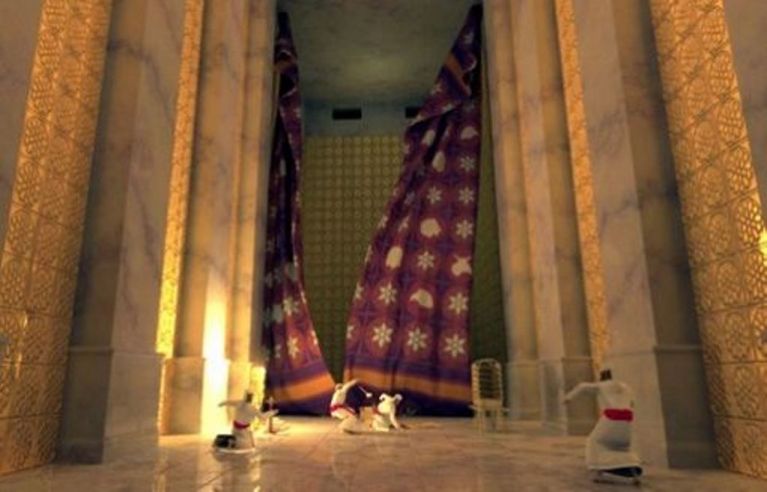
Seeing Behind The Veil

Standard

In storytelling, there is a plot device called a MacGuffin.  This is an object, character, or event used to push the narrative forward and yet isn’t all that important in and of itself.  In other words, a thing that creates motivation and yet never even needs to be revealed to the audience.  We are supposed to believe this is something significant or valuable and that’s all we need to be told.

The contents of the briefcase are left a mystery despite being pivotal in motivating the characters.

While reading through the Old Testament and pondering how temple worship worked, it is hard not to see the Ark of the Covenant as a sort of MacGuffin.  Sure, their God was not a thing.  And yet this sacred object, we’re told, contained something of God’s presence and would even strike dead those who innocently mishandled it.  Of course, most people may never have seen it, it was kept behind a veil in the temple where few had access, but all would be told of the sacredness.

“Then spake Solomon, The LORD said that he would dwell in the thick darkness. I have surely built thee an house to dwell in, a settled place for thee to abide in for ever.”

(1 Kings 8:12‭-‬13 KJV)

In fact, it was made sacred as much by this treatment as much as what actually dwelled within it.  The mythology surrounding it, as in the cultural or religious significance that was given to it, was extremely powerful.  Starting a special priestly class, Tabernacle and ritual practice, later the impressive structure of the Temple, there was a huge investment in this sacred object.  And yet, for all the attention it got, the Ark itself was usually kept hidden in darkness, guarded, within the Holy of Holies and behind a veil.

Holy Of Holies 

There are other things hidden behind a veil with significant motivational power.  One of them being the marriage MacGuffin.  For me this was a pursuit of something sacred, the church does consider the marriage bed to be sacred, and there is a whole mythology that is constructed around marriage.

This is what made it so jarring when, during my pursuit of the impossibly, a psychiatrist would classify it as “sexual attraction.”  They had just heard me describe a pure and faith-driven quest only to reframe it in such crass terms.  How dare they!  I was after love, not sex!  It really did offend me at the time.  With their clinical roughness, they had penetrated the veil of my marriage delusion.  It was an act of sacrilege.  

My childhood innocence is beyond recovery at this point.  For whatever reason, those of us born into a fundamentalist purity culture believe that we must be in denial of our own sexual urges that lead to marriage.  This is strange given how blunt St. Paul is on the topic, in 1 Corinthians 7:9, advising those who “burn with passion” to get married and basically get a room.  Why the veil of secrecy, these many euphemistic expressions to cover and mystify the bumping of uglies?

Speaking of erotic euphemism:

“Awake, O north wind; And come, thou south; Blow upon my garden, That the spices thereof may flow out. Let my beloved come into his garden, And eat his pleasant fruits.”

(Song of Solomon 4:16 KJV)

Why blush, be embarrassed or ashamed by this?

Could it be that without dressing this whole affair up with great ceremony, white bridal veils, teary-eyed parents, and such, we would have to face the reality of being creatures as hormone-driven as two ducks on a pond?  I mean, why aren’t we as honest as Solomon was in his poetry: “Roses are red, violets are blue, you have large breasts, that’s why I love you!”  Without white lies or half-truths, would our version of romance even survive?

So what is underneath the veil?

All of those things that I’ve discovered in the intervening years, that’s what…

To the extent I was in deep denial of my own sexuality, I was doubly in denial of the sexual nature of my female counterparts within the conservative Anabaptist culture.  The young lady who first propositioned, then made it all awkward and worried about somehow being ‘defiled’ if she got coffee with me has long since dropped the veil.  She has joined the others whom I had held in such high regard, revealed now as not being nearly as prudish or pure as I had once imagined.  That’s not a criticism or judgment either.  It is just the reality of the situation.

So, when the impossibly told me “I cannot not love that you the way that you wanted to be loved” what she was really saying the same thing as those Tinder girls with “must be 6′ or over to ride” in their profiles.  She wanted a guy who got her juices flowing, certainly someone a bit more rugged and traditionally masculine than me.  And, I mean, why not?  Why hide it?  Marriage is not only (or even primarily) about the high ideal that is advertised.  It is also about our scratching the itch.  Which is to say getting down and dirty with someone who meets the correct physical qualifications.

Also, perhaps it is that the fantasy is more satisfying than the act itself?  We read how Amnon, King David’s eldest son, had such an infatuation with his half-sister Tamar.  It tells us after having his way with her he despised her.  Or consider the disgust of Victorian-era art critic John Ruskin when, in marriage, he discovered that women aren’t like porcelain dolls.  You’ll have to forgive him, they put skirts over piano legs back then to keep the eyes of men safe from the unveiled feminine form.  Maybe there are some things that are better chased than caught?  If we find what we went looking for we might be shocked at what we found.

Sacred Fertility & Symbolism 

The final stop on this exploration of sacred and taboo has to do with something that I can’t unsee now that I’ve seen it.  I’m bound to lose half of my final two readers for going here. 

Nevertheless, I’m not here to please the pearl-clutching crowd. 

For me, this is not about toppling sacred cows or making people uncomfortable, it is about being honest enough to see reality for what it is and correcting our own perspectives of the cultural baggage we’ve inherited.

First, what drives much of the Old Testament Biblical narrative?  We know Abraham’s story, how he wanted an heir, and yet how Sarai, his wife, was unable to produce.  In this Genesis account we see various cases where wombs are opened or closed.  And the punishment of Michal, for rebuking her dancing husband, was that she had no child until the day of her death.  Being fruitful and multiplying was a high priority, as well as having sons to carry on the family line.

As an aside, we live in a very sterile world in comparison to our ancestors, we’ve become sheltered and sensitive to the point many do not eat meat or want their children exposed to death.  This wasn’t an option at the time when Scripture was written.  There is a kind of earthiness to their world and perspective, something more primal or real, a brutality of life difficult to stomach.  It is with this reality in mind, that we also have different sexual taboos and could be more prudish than they were about such things.

Second, I was sitting in church and taking a look at the colorful streams of light pouring through a stained glass image of Jesus pulling Adam and Eve from the grave.  My moment of appreciation for this beauty was interrupted by my noticing part of the symbolism.  Jesus is shown to be emerging from an oval shape, at the bottom of which are the covers of their opened tombs.  Requiring very little, if any, imagination, it bears striking resemblance to one Christian symbol even an iconoclastic Protestant would likely recognize, and that being a vertically arranged “Jesus fish” or Ichthys.

Light and life shining down…

However, concurrent to this, and a cause of some momentary shame, was the thought “That’s a vulva!”  I mean, how inappropriate to think that any part of the female anatomy, let alone those private nether regions, be put on prominent display or be associated with Christ!  

But is it really?

A mother, Mary, is necessary for the birth of Jesus.  Without her, and her womb that is miraculously made made more spacious than the heavens, there is no salvation for mankind.  It didn’t matter if God could have used any other way, all we know is that he used this young woman and all of the faithful since have followed the lead of Elizabeth, who full of the Holy Spirit loudly proclaimed:

“Blessed are you among women, and blessed is the child you will bear! But why am I so favored, that the mother of my Lord should come to me?”

(Luke 1:42‭-‬43 NIV)

As far as the symbolism, I would find that indeed my observation had basis in reality as the Ichthys is a version of Vesica Piscis (literally “fishes bladder” in Latin) or, in sacred geometry, the oval that two intersecting circles create an oval and said to be the place where spiritual and physical worlds interface. According to Syriac Press, in ancient Mesopotamia, it was used as a symbol of the combination of masculine and feminine energies that create a Divine Child.  Any pagan coincidence, like those with baptism, only serves to reinforce the power of the symbolism.

In a time when many settle for ‘fur babies’ over producing human offspring and the unique female contribution to the world is dismissed by feminists seeking male roles— when real women are mocked by men who pretend to menstruate—we need to start doubling down on our celebration of this reproductive role of women.  Phrases like “saved through childbearing” did not come into the Bible by accident.  The world was saved by the one who came out of Mary’s fertile womb and we ought not to downplay or be embarrassed by this.

Empty Vessel—Dying Corpse

Solomon’s Temple was destroyed in 586 BC, by the Babylonians, and the fate of the Ark within it is unknown.  This loss of sacred relics did not stop the Jewish faithful from rebuilding the temple, in 515 BC, but does make one wonder how much the contents mattered.  So long as the people were kept in awe that’s all that really seemed to be the point whether the edifice truly contained anything of real value or not.  With nothing behind the veil, the people still did the ritual and sacrifice. 

Why?

It seems sort of analogous to the US Dollar, a currency once backed by actual gold and now only by faith people continue to hold in the economic system it represents.  The harsh reality is that it has become merely a means to exploit. It is a way for a few elites to rob the value of the savings of other people by printing more money for themselves.  Those money changers Jesus chased out of the Temple were the amateurs. The real professionals never get caught.  The carefully maintained veil of secrecy around the Federal Reserve ensures that this particular scam continues for a long long time.

But, I digress.  

G. K. Chesterton once wrote, “a corpse crawling with worms has an increased vitality,” and that “a dead man may look like a sleeping man a moment after he is dead,” trying to describe the subtle yet significant difference between truly sacred tradition and a cheap gimmick version of this religion that was intended to replace it.  Perhaps this is what has me disillusioned?  With so many things, once the veil is lifted (which few ever dare to do) so much of the enticing mystery and popular mythology which propelled us forward falls apart.  And in this way some of the life I had felt early on feels more like decomposition.

Perhaps this is what is left when you’re the dog who has finally caught the car?  Nothing left to do but pee on the tire and continue on your way again.  The anticipation leading up to the day of revelation may be more exciting than the moment the veil is lifted and when all is seen.  Ruskin may have spent the rest of his life waxing eloquently about his female love interest.  Or maybe—just maybe—that MacGuffin which led us to the point we’re at today was merely a plot device to move the story forward and the only truly sacred part of the encounter is the fruit produced?

Sexual pleasure is fleeting.  We’re lured there by our imaginations, by our desire for what is beyond the veil of marriage, but it can all be a bit anti-climactic and even repulsive once you consider it after it is finally unwrapped from the flowery speech and those flawless air-brushed mental pictures.  But fatherhood, by contrast, seeing the great potential of my son, tending to his needs, pruning as needed, is something extremely fulfilling.  It is what has emerged from the womb that brings us renewed life and hope.  Pity the barren, the dying corpse who has lifted the veil and only saw the emptiness of their pursuits.

Joachim and Anna and the Curse of Childlessness

Standard

For those raised in the conservative Mennonite culture big families are a given. There were nineteen children in my dad’s family (sixteen biological, three adopted) and, while that is the extreme, it would be very unusual for a married couple not to have any children. In a culture where blessing is practically synonymous with children, a childless home would likely produce some whispers and infertility a very unpleasant matter.

Children have traditionally been a retirement plan and marriage commitment the first step. A person without any offspring would likely have nobody to care for them in their old age. Even in a time when the state has taken over that role of social security there is still need of a new generation of children to keep that kind of system solvent. As many industrialized nations have below-replacement fertility rates, childlessness could soon be the crisis for us that it would have been in the ancient times when this was written:

Children are a heritage from the Lord, offspring a reward from him. Like arrows in the hands of a warrior are children born in one’s youth. Blessed is the man whose quiver is full of them. They will not be put to shame when they contend with their opponents in court. (Psalm 127:3‭-‬5 NIV)

Indeed, who will contend for the childless?

If you think that democratic institutions, in the hands of young people raised in a culture that values youth, will continue to provide for the elderly who have no familial connection to them then someday you’ll have a rude awakening. If anything the elderly are seen as a political obstacle in our modern times, a waste of limited resources when we have Google to provide our answers, and many of these youthful ignorant social engineers—rather than contend with a bunch of has-beens they don’t care to know—would delight in giving you a push to an early grave.

The Childless In Scripture

In ancient times, perhaps for the reason that there would be nobody to care for you in old age without children, there was a social stigma attached to being childless. In the case of Saul’s daughter Michal, who was critical of her husband David’s celebration antics, and her childlessness is expressed (2 Samuel 6:20-23) as if being a punishment. We are never told if that was simply a result of her relationship with her husband or not, but either way she did not produce an heir to David’s throne—which would be a serious setback to say the least.

There are patterns in Scripture and one of those patterns being that those most notably childless early on are often the most greatly blessed later. The most notable of those couples with a deferred blessing is Abraham and Sarah. They were elderly and had remained childless. We are told “she was not able to concieve” (Genesis 11:30) yet Abraham was promised to be “the father of my nations” (Genesis 17:4) and this seemed plain ridiculous given the advanced age of the couple. But, they were blessed by God, Sarah did bear Issac and was childless no more.

There is also the account of childless Hannah. In the first book of Samuel we read how she was treated especially well by her husband (who had two wives) because he loved her. And yet her rival would torment her over the fact that she could not bear children and this made her miserable to the point she couldn’t eat. Finally she cried out to God, weeping bitterly, she vowed:

Lord Almighty, if you will only look on your servant’s misery and remember me, and not forget your servant but give her a son, then I will give him to the Lord for all the days of his life, and no razor will ever be used on his head. (1 Samuel 1:11 NIV)

In other words, she promised her son would be a man dedicated to God.

The account goes on to say that Eli, the priest, who was watching her pray yet couldn’t hear her words, thought she was drunk and tells her to put away her wine. But she responds that this isn’t the case, that she is simply deeply in anguish, to which the priest tells her: “Go in peace, and may the God of Israel grant you what you have asked of him.” (1 Samuel 1:17 NIV) This answer seems to have consoled Hannah who we are told began to eat again and would later become pregnant, bear a son Samuel—a name which basically means “heard by God” and he would, as a result of her commitment, become a great prophet.

Finally, before we move on to Joachim and Anna, there is this assurance given to the childless who remain faithful:

And let no eunuch complain, “I am only a dry tree.” For this is what the Lord says: “To the eunuchs who keep my Sabbaths, who choose what pleases me and hold fast to my covenant—to them I will give within my temple and its walls a memorial and a name better than sons and daughters; I will give them an everlasting name that will endure forever. (Isaiah 56:3‭a-‬5 NIV)

There are many who would love to have children and cannot. This is one of those terrible ironies given the numbers of abortions and abused or neglected children in the world. We will never know, at least on this side of eternity, why some who long to be mothers and fathers are denied the blessing of children. However, we do see that those who suffer this despite their righteousness will be rewarded in the end and therefore should always put their hope in God who will make all things good for those who love and obey Him.

Who Are Joachim and Anna?

These two, mentioned at the conclusion of each liturgy, “the holy and righteous ancestors of God, Joachim and Anna,” despite being mostly forgotten in the religious tradition I was born into, have one of those great stories.

Joachim was from the tribe of Judah and a descendant of King David. His wife, Anna, was from the tribe of Levi, the same as the High Priest Aaron and the daughter of the priest Matthan. They had lived fifty years, as a married couple, and were unable to have children despite their devotion to God.

Joachim had faithfully, since his teenage years, given two-thirds of his income, one third to the poor and another third to the Temple, and were financially blessed for this. However, their childlessness finally became a cause of harassment. The High Priest, Issachar, confronted Joachim and told him, “You are not worthy to offer sacrifice with those childless hands.” And, with that pronouncement, he was pushed back by others, who had children.

Rejected and despairing in this disgrace, Joachim studied and found that, indeed, every righteous man in Israel had been blessed with children. He and his wife left with Jerusalem with profound sadness because of this. They began to pray for a miracle, like that which happened for Abraham and Sarah, him going into the mountains with his flocks and Anna returning home. Then the archangel Gabriel visited them both, promising them “a daughter most blessed, by whom all the nations of the earth will be blessed, and through whom will come the salvation of the world.” The picture is of them meeting again, at the city gates, upon hearing this.

Their daughter, Mary, the mother of Jesus our Lord, was specially dedicated to God and, like Hannah’s son Samuel, was brought up at the Temple at the age of three to be raised with other girls there. Their righteousness was finally rewarded having waited those many years. Their story is one that is a good reminder to those who have been faithful yet have not been blessed like others. They are the grandparents of our Lord and Savior.

Anyhow, by coincidence, the conception of Mary is celebrated today, December 9th, which is something I didn’t know when I began writing this blog.

The Last Mennonite Standing — Is a Population Collapse Inevitable?

Standard

A few months ago a Christian friend of mine shared a link to a news story and asked my opinion.

The story, “UK Mennonites end Sunday services after numbers dwindle,” did not seem to apply to my own conservative branch of the Mennonite denomination.

My initial thoughts were that this was one of those wacky liberal churches and therefore not relevant.

However, upon further reflection, I realized that my own brand of Mennonite is not impervious to cultural trends and, despite all the babies crying on Sunday mornings now, we could face a similar population collapse down the road.

Headlines about record-low fertility rates in the US or an unprecedented population collapse in another nation might seem irrelevant to our own situation.  But they can also give some indication of the patterns, telltale signs and changes in behavior that come before such events.

I’ve heard people say that we, as conservative Mennonites, are “50 years behind society” and there seems to be some truth to that.  I know with the advance of technology (like that which makes this blog possible) the pace of change is now quicker than most would have imagined a generation ago.

The conditions that allowed the Mennonite tradition to continue for hundreds of years are disappearing, and quickly.  It does not seem we are in an especially strong position to cope with the new social, economic and technological realities.

This generation could very well be the last.

Here are some factors that could determine where things go from here…

#1) We grow mostly because we have big families and convert our own children.  Like it or not, “Mennonite” is an ethnic group—complete with unique genetic disorders and a game based on our common surnames.  Yes, we do have some converts from the “community folks” and yet most of us came from Mennonite or other established Anabaptist stock.  If our birth rates were to continue to drop (as they have been amongst Mennonites in North America), then there will likely be some problems down the road.

#2) Marriage is being postponed and even avoided altogether, thereby decreasing birth rates.  Mennonites seem to be taking cues from society when it comes to committed relationship.  But, unlike society, we do not have children outside of marriage and therefore our postponing of marriages means older mothers and fewer children, and that is assuming they will marry eventually.  I just had a young woman (maybe mid-twenties) ask me to do a blog to advise her and her friends on how to tell pesky guys to get lost—not an unusual sentiment.  It seems women from conservative backgrounds are becoming less interested in marriage and motherhood, and that is a death knell to a church that can’t bring in more than an occasional convert from outside our own existing gene pool.

#3) The feeder system from Old Order groups and elsewhere could dry up.  It is not a big secret that Mennonites migrate from conservative to liberal.  My own church has lost many born into it and the casualties have always been offset with those gained from other groups more conservative than our own, or those escaping expensive land prices in overdeveloped Lancaster County.  But this means of growth via a continued supply from upstream (or downstream?) is not guaranteed.  It could change as economic pressures increasingly encroach on the Old Order lifestyle.  It is harder to support big families with higher land values, a tougher regulatory environment, rising healthcare costs, etc.  We can’t count on migrants for growth.

#4) Urbanization and loss of an agricultural lifestyle results in cultural change.  My grandparents moved up out of the Franconia Conference territory (near Philadelphia) in the 1960s to begin farming where the land was cheaper and roads less congested.  My grandparents have remained relatively unchanged in the way they dress since that time.  However, their friends “back home” have changed dramatically both in dress and perspective.  There are still a small number of “breakaway” conservatives in that region, but the main body of Mennonite churches there are extremely progressive and their trends could give us some indication of our own future.

#5) The decline of meaningful brotherhood and rise of alternatives reduces interest.  The Amish were right to identify transportation technology as a threat to community.  We might pride ourselves for having stronger communities than the church down the road (a disputable claim) and yet would we compare favorably to prior generations?  I know that even in my own three-decade life span there has been a dramatic change.  We seem less closely knit and more quick to leave for the church up the road rather than come together as one community of diverse members.  We do more world travel, have more activities for every specialized interest or age group, and are kept very busy.  However, we are also fragmented with less vertical integration, more homeschooled children, and less everyday connection—resulting in weaker communities.  Our communities could eventually disintegrate completely as they lose relevance.

#6) Lack of foresight and appropriate faithful preparation is endemic.  Part of the reason I’m writing this blog is because nobody else is talking about this.  We are chronically unprepared for change.  It seems many conservative Mennonites have their heads buried in the sand (or simply buried in day-to-day business and family affairs) and do not see trends coming down the pike.  There appears to be very little effort on the part of the ordained leadership to account for changes in culture (or technology) and even less effort to respond in a positive or productive manner.  Few advocate for a faithful and deliberate approach to problems.  We miss opportunities to increase our effectiveness because we do not utilize the greater means available to us.  We perish for lack of vision.

#7) In the void of thoughtful preparation, what results is only fearful reaction and hasty retreat.  Mennonites, like other Christian fundamentalist groups, began to withdraw from strategic high ground after being blindsided by the pushback against the state endorsement of religion in public schools and the rise of secularism.  Many decry, “They took prayer out of school!” but the sad reality is they did not remove prayer and a faithful witness from schools—we did!  We trembled like King Saul facing the Philistine giant and removed our children and influence.  We did not read 1 John 4:4, “greater is he that is in you, than he is in the world,” and believe.  It is little wonder why nobody believes us when we try to convince them of our great God.

#8) Our missions are often without purpose and out of touch.  I know a young woman (a very sweet person and sincere Mennonite) who told me, “hearts don’t change,” in response to a circumstance outside her experience.  I was astonished at the cognitive dissonance on display and it made me wonder why she was spending thousands of dollars to be at IGo Adventures and Spouse Seeking Institute in Thailand.  It reminds me of the time when we formed a committee at my church to discuss local missions where mailing out more tracts seemed to be the idea with most traction and nothing practical ever came of the committee.  Needless to say, I am not very optimistic about our abilities to do effective outreach.

Is a Mennonite population collapse in North America inevitable?

I don’t know.

I’m not expecting our complete extinction.

I’m pretty sure the Mennonite name will continue on in one form or another.

For instance, we do have a list of genetic disorders that will carry on our legacy.

But, as a religious culture and tradition?

I believe that depends.

It depends on how we approach the issues listed in #1-8 above.

Will we address problems head-on and work through them deliberately or be blindsided?

Will we adjust our thinking and adapt our methods as needed?

Or will we (like the dying Shaker movement) use hope as a strategy?

Nothing is written in stone yet.  But I do know that the conservative Mennonite culture is a frustrating place for innovative and forward-thinking people.  Old habits, functional fixedness, inability to think outside the box and a “don’t rock the boat” mentality all stand in the way of a faithful and vibrant future.

We need to ask and answer the hard questions rather than avoid them.  We should be taking note of trends, and be confronting them collectively as a group.

Notice a growing number of older singles?

Look into the Moravian option or at the very least reconsider the faithless courtship teachings that have created the current mess.  There is no reason why we should pretend there’s nothing that can be done.

Wonder why our missions are ineffective?

It could be that we are isolating our children rather than trusting God and teaching them to live in fear rather than faith.  They can’t empathize or understand anyone outside the Mennonite culture.

Where do we go from here?

It is up to you.  But, if you don’t want to be the last Mennonite standing, I suggest it is time to remove the stale items from the shelves and introduce some fresh ideas.

Change is inevitable.

Be proactive.