

A religious fundamentalist might see Nietzsche’s “Madman” parable as an attack on faith. The German philosopher Friedrich Nietzsche’s mental decline and tragic end could seem like an obvious consequence. His bold claim that “God is dead” would naturally lead to madness, wouldn’t it?
Recently, I came across the story of Ruth Miller, an Amish woman whose religious convictions led to an unthinkable act. In a state of spiritual delusion, she drove her 4-year-old son, Vincen, to a lake and “gave him to God” by throwing him into the water resulting in his drowning. This awful tragedy following immediately after the accidental drowning of her husband Marcus during a failed attempt to swim to a sandbar in an effort to prove his faith.

Both belief in God or disbelief really does not make a difference as far as our mental health. We can attribute beliefs to actions, like the divisive assumption—of black and white thinkers—that Decarlos Brown Jr. was motivated by racial animus. Or realize that our human psyche is capable of dangerous misfires no matter our skin color category or ideological affiliation. Black, Amish or Atheist, all can have psychological breaks from reality originating from family history or environmental factors.
In the case of Nietzsche, who suffered from a breakdown at the age of 44—while seeing a horse being flogged—the theories of why he declined range from neurosyphilis to the possibility of frontotemporal dementia and a brain tumor. It could be a combination of factors, and maybe the very thing that made him brilliant also part of his downfall?

Nietzsche had a busy and relentless mind, his “will to power” philosophy itself perhaps a way to cope with a world that didn’t align with what his cultural heritage told him. He had to take things to their ends, he was not content with the answers he was given and this tendency of his mind being rooted deep in the composition of his brain—progressive disease and circumstances finally pushing him over the edge into insanity?
Likewise, the Amish mother, a pious woman by appearances, didn’t process her religious teachings the same as others in her church and tradition. For better or for worse, most claim to take the Bible literally would never attempt to do the things that they’ve read in the book. In a modern context a parent who is willing to sacrifice a child to God is rightly considered mad. But for Abraham it was a proof of his righteousness:
By faith Abraham, when God tested him, offered Isaac as a sacrifice. He who had embraced the promises was about to sacrifice his one and only son, even though God had said to him, “It is through Isaac that your offspring will be reckoned.” Abraham reasoned that God could even raise the dead, and so in a manner of speaking he did receive Isaac back from death.
(Hebrews 11:17-19 NIV)
That’s one way to explain away an irrational act of Abraham tying up his child, and then putting him pyre to be a sacrifice to God. It is just plain madness otherwise. Is it really any wonder a delusional mind would follow this pattern in the Holy texts? I mean, truly, the crazier part is how we can read through this in Sunday school class without being a bit disturbed. Only when someone starts to act in this kind of ‘faith’ does anyone notice it is completely unacceptable.

But then we’re all mad. Half of us claim it is okay to dismember a living human being in the womb because their existence is a big inconvenience for an adult woman. While the other half thinks it is okay dismember a living human being in Gaza because of what Hamas did a couple of years ago. All seem willing to sacrifice little children in the ‘right’ circumstances. We’ll praise those who end the life of the innocent when this aligns with an imagined ideal outcome or future. We’ll all say the other is irrational and evil while justifying our own violence.
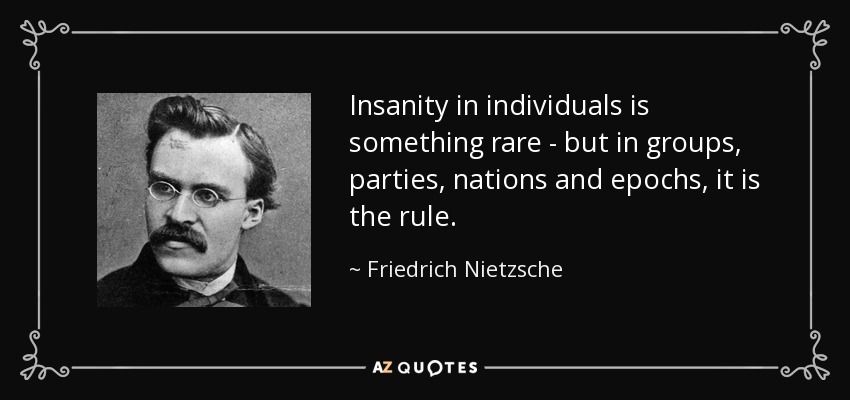
But, I digress, we should not blame the blackness of Decarlos Brown Jr. for his evil deed any more than the Amishness of Ruth Miller for what she did. The idea that we should not change our standards based on race should come with the general non-judgment based on race. Mental illness is mental illness, unbound by category. To judge actions without prejudice—based on race, faith, or even agnostic philosophy—requires us to comprehend the universal fragility of the human mind and our own susceptibility to delusion.
 Irregular Ideation