
The People Want a King, Part II: The Idolatry of the State and the Call to Self-Rule

Standard

A decade ago, in “The People Want a King, Part I,” I wrestled with the ancient cry of Israel—“Give us a king!”—from 1 Samuel 8, seeing in it a mirror to our own craving for centralized power. I cast Trump, then a looming figure on the horizon, as a Saul-like pretender—brash, self-absorbed, a king unfit for the throne. The heart of man, I argued, is frail and fearful, ever eager to trade liberty for the illusion of security. Now, ten years on, we revisit that cry, turning the lens inward and upward: what happens when the king we demand becomes a god we worship? And what might it mean to cast down that idol and govern ourselves under a higher law—one that admits no rival?

Let us begin with a heresy: government is not sacred. It is not a divine institution bestowed from on high, nor are its stewards a priestly caste anointed with heavenly oil. Scripture offers no such mandate. The state is a human construct—a tool, a mechanism, a servant of necessity. It is not the ekklesia, the called-out assembly of God’s people, nor the Kingdom of Heaven breaking through the veil. It is, at its core, a business: a transactional entity exchanging services for tribute. When it ceases to serve—when it grows fat and lazy, a Blockbuster Video in a Netflix world—it deserves no reverence, only replacement. To treat it otherwise is to fashion a golden calf from the scraps of bureaucracy.

Yet the cry persists: “The nation is too complex for such simplicity!” I encountered this objection recently, a rebuttal to my call for radical restructuring. The argument, draped in the garb of sophistication, insists that governance transcends mere commerce—that its intricacies demand a permanence beyond critique. This is a shade thrown at those, like the DOGE reformers, who dare to wield the axe of efficiency against the overgrowth of empire. It is a plea for the status quo, cloaked as concern for “public trust.” But trust in whom? The regime that has ruled longer than memory, entwined with corporate titans and special interests, bleeding the commons dry? The trust was shattered long before any billionaire CEO took the helm; it crumbled under tax rates that plunder and wars that pulverize the defiant.

Here lies the theological crux: complexity is not a virtue—it is a veil. In 1 Samuel 8, Samuel warned Israel that their king would take and take—sons, daughters, fields, flocks—until they were slaves in all but name. The modern state has fulfilled this prophecy with chilling fidelity, its mission creep a slow idolatry. What begins as a servant becomes a lord; what promises order delivers oppression. The labyrinthine bills, the thousand-page tomes of legislation—these are not signs of wisdom but of deceit, a Sanhedrin of scribes hiding corruption behind the law’s letter. To call this sacred is to confuse the Temple with the moneychangers’ tables.

Government as business is no mere metaphor—it is a functional truth. It trades protection and infrastructure for our coin and consent, a covenant not unlike the marketplace. Yet unlike the agora, where competition hones the blade of excellence, the state resists renewal. Private enterprise, for all its flaws, bends to the will of the consumer: Sears falls, Amazon rises. Governance, enthroned as monopoly, calcifies. Its priests—elected or appointed—crown themselves with divine right, decrying reform as sacrilege, a “threat to democracy.” But democracy is not their god; power is. And power, unchecked, builds altars to itself.

This is the sin of the political establishment: they have conflated the nation with their institution, the people with their rule. The nation is not the state, nor the state the nation—just as Israel was not its kings, nor its kings Israel. Government should reflect the imago Dei in its people, a stewardship of justice and flourishing. Instead, it mirrors Baal, demanding sacrifice from the many for the feast of the few. How is this sustained? Through a catechism of control—children reciting pledges, citizens taught to venerate the machine as eternal. To question it is to court excommunication.

Yet Scripture beckons us elsewhere. The restoration of governance requires a return to first principles: simplicity as clarity, transparency as righteousness, accessibility as the leveling of pride. The state’s convolution is no accident—it is a shroud for sin, a “you wouldn’t understand” that echoes the serpent’s whisper. To dismantle it is not anarchy but exorcism, a stripping back to the studs to expose what festers. The old guard, like Saul clinging to his throne, shriek at the loss of their sacred monopoly. But their divinity is a lie, and their temple must fall.

The Stagnation of the External, the Promise of the Internal

Consider the contrast: a business that squanders its capital dies; a government that squanders ours endures. This is the curse of external governance—its inertia defies the natural law of adaptation. Were it subject to the crucible of choice, only the fittest form would stand. Instead, it grows sclerotic, a Leviathan too holy to slay. And the people, seduced by its permanence, make it their idol. They crave a king to think for them, a mediator to absolve their agency. Politicians—prostitutes of the soul—oblige, peddling promises they half-believe, deluded into messiahs of their own making. Zelensky’s advisors call him mad with grandeur; Washington’s geriatrics are no different, mistaking their tenure for providence.

This is not governance but bondage, a learned helplessness masquerading as piety. The privately employed know their limits—life persists beyond their shift. But the state’s acolytes preach indispensability, as if only they can wield the scepter. Contrast this with self-governance: a people ruled not by fleshly lords but by principle, by the law written on their hearts. Jeremiah 31:33 whispers of such a day; Hebrews 8 seals it in Christ’s blood. At the civic level, this need not mean chaos but discernment—shuffling roles, pruning branches, trusting that micromanagement by fools yields only thorns.

Why, then, the sanctity of the status quo? It is the coward’s theology: easier to bow to mystery than to wrestle truth. As Israel preferred a king to the uncertainty of judges, so we prefer bureaucracy to responsibility. Samuel’s warning rings anew: the king takes, and we cry too late. External governance is not our salvation—it is our stagnation, a false god promising safety while forging fetters.

The Myth and Monuments of the Federal Cult

To cement this idolatry, the Federal government has woven a mythology and erected monuments rivaling the temples of old. Consider the Capitol, that domed sanctum of marble and myth, its steps ascending like an altar to a civic deity. The Lincoln Memorial, a brooding Parthenon, gazes over a reflecting pool as if to baptize the nation in its own reverence. These are not mere buildings—they are shrines, designed to awe, to whisper: “This is eternal, this is beyond you.” Like the ziggurats of Babylon or the temples of Rome, they fuse power with divinity, demanding obeisance from the pilgrim and the peasant alike. The Founding Fathers, recast as demigods, stare down from friezes and statues, their words carved into stone as if they were Moses descending Sinai. Big Brother is not God—yet here he looms, a surveillance state cloaked as savior, its all-seeing eye promising protection while its fist tightens the leash.

This cultic architecture is no accident—it sells the lie that the state is sacrosanct, its form immutable. The pledge of allegiance, recited by schoolchildren, is a liturgy; the flag, a totem; the Constitution, a holy writ too sacred to amend save by the high priests of amendment. Yet this is a sleight of hand. The Constitution, for all its brilliance, is a human document, not a divine oracle—its framers knew it, urging vigilance against its abuse. The Federal cult inverts this, turning a tool into a god, a means into an end. As the temples of Baal housed idols to blind the masses, so these monuments obscure the state’s frailty, its susceptibility to rot.

Enter January 6th, 2021—a day branded as a desecration, a violation of the “sacred ground” of democracy. The narrative drips with priestly indignation: rioters stormed the Capitol, profaned its halls, threatened the holy order. Politicians clutched their vestments, decrying the “insurrection” as an assault on the nation’s soul. But let us parse this claim with a smirk—how many have died at the hands of this government, overseas and at home, in the name of “protecting democracy”? Millions, if you tally the wars and drones, yet the single death of that day gets the sackcloth and ashes. If the Capitol is sacred, what makes it so? Not its service to the people—its corridors have long echoed with the clink of corporate coin and the murmur of self-interest. Not its fidelity to justice—its laws have sanctioned plunder at home and terror abroad, not least against Argentina, whose people still bear the scars of U.S.-backed meddling and economic strangulation. The sanctity, then, is a projection, a mythos guarding the idol. January 6th was chaos, yes—ugly, reckless, and lawless—but to call it a sacrilege assumes the temple was holy to begin with. It wasn’t. It was a house of power, not of God.

The true violation predates that day: the slow consecration of a bureaucracy into a deity, the elevation of marble over morality. Ancient temples hid their emptiness behind splendor; the Federal cult does the same, crying “blasphemy” when the curtain is pulled. January 6th didn’t defile a sacred space—it exposed a hollow one, a monument to a king the people demanded but never needed. And here’s where Argentina’s President Javier Milei enters, grinning like a Cheshire cat as he handed Elon Musk a chainsaw in 2025, etched with “Viva la libertad, carajo” (“Long live liberty, damn it”). Milei, who’s taken his own chainsaw to Argentina’s bloated state, wasn’t just gifting Musk a tool for bureaucracy—he was practically dancing with glee to see Musk turn it on the U.S. regime that’s bullied his nation for decades, from IMF debt traps to covert coups. It’s less a symbol of shared efficiency and more a middle finger to the empire, wrapped in a libertarian bow.

Trump’s Mandate and the Singular King

So where does Donald Trump fit in this unholy pantheon? In Part I, I cast him as a flawed Saul—brash, impulsive, a king more enamored with his own mirror than his people’s good. I stand corrected, or at least refined. Trump is no savior, nor should he be—Christians have but one King, enthroned above all earthly powers (Colossians 1:16-17). Yet he wields a mandate, both legal and theological, to tear down these idols, and therein lies his purpose—not as messiah, but as iconoclast.

Legally, Trump’s authority stems from the Constitution itself—a document that vests executive power in a president elected by the people (Article II, Section 1). His 2024 victory, a roar against the entrenched cult, grants him the democratic right to wield that power against inefficiency and corruption. The Federal government, swollen beyond its constitutional bounds, has no divine charter to resist pruning. The framers envisioned a lean state, not a Leviathan; Trump’s DOGE-inspired axe—however blunt—aligns with that original intent. He can shutter departments, slash budgets, and fire the high priests of waste, all within the law’s letter. The shrieks of “threat to democracy” from the old guard are the death rattles of a dethroned idol, not a defense of principle.

Theologically, his warrant runs deeper. Scripture abhors idolatry—Exodus 20:4-5 commands no graven images, no bowing to crafted gods. The Federal cult, with its temples and myths, is precisely that: a false deity usurping allegiance owed to Christ alone. When Jesus declared, “Render to Caesar what is Caesar’s, and to God what is God’s” (Matthew 22:21), He drew a line—Caesar gets coins, not worship. Trump, for all his bombast, serves as a wrecking ball to this blasphemy. He need not be pious to smash Baal’s altars; Gideon was a coward before he toppled the poles (Judges 6:27). If Trump’s tenure exposes the state’s hollow sanctimony—January 6th as symptom, not sin—then he fulfills a divine irony: a flawed vessel breaking a greater folly.

Yet here’s the correction to my 2015 take: Trump is not the point. I overstated his flaws as disqualifying, missing the forest for the trees. He’s no king to crown—Christians must reject all earthly thrones save one. “My kingdom is not of this world,” Christ said (John 18:36), and Paul echoed, “Our citizenship is in heaven” (Philippians 3:20). Trump’s role is transient—permitted, not ordained—to dismantle a false god, not to replace it. The Christian’s allegiance lies with the King of Kings, whose rule brooks no rival, be it Trump, Biden, or the marble gods of DC. Self-governance, then, is not just civic—it’s spiritual, a refusal to outsource our souls to any throne but His.

The Eschatological Hope

The people want a king, but the King we need refuses a throne of stone. To cling to the state as sacred is to repeat Israel’s folly, to trade the Spirit’s freedom for Saul’s spear. Self-governance is not utopia—it is obedience to a higher call, a shedding of idols for the stewardship God demands. Complexity is a liar’s refuge; trust is a martyr of our making. Let Trump tear down the temples—legally, he can; theologically, he should—but let us not crown him in their place. Overturn the tables, tear the veil, and build anew—not a kingdom of men, but a commonwealth of the free, under no crown but His.
Dead Men Talking—Why MLK Was Made Into A National Hero?

Standard

When I was in elementary school we sang a song with lyrics, “Martin Luther King, Martin Luther King, was a great man.” Looking back it was even strange then.  Why were we, in a rural Pennsylvania public school, instructed to heap such adoring praise on this man?  It was a weird indoctrination.

One explanation is that this was atonement ritual.  Dr. King was murdered.  Thus maybe the weight of guilt on the generation of the Civil Rights Era was just that high that this was a way they try to correct the injustice.  And it is sufficient to explain why the rank-and-file liberals, such as Mrs. Lawrence, my elementary music teacher, would promote his legacy or turn him into a legend.

But was it all well-intentioned?

I don’t have a black and white view of MLK Jr.  I think he was a complex character, he advocated for peaceful protest and yet was also a sexual deviant despite his status as a Baptist Reverend.  He’s probably as worthy of honor as any other figure in the American pantheon.  However, the big question is why is he there?  Why was there a holiday put on the calendar to celebrate this man?

The answer to how is that there was a bipartisan effort, after a significant campaign, to put him there.  Everyone, except a few racist hold out Democrats, supported this move.  Jimmy Carter endorsed it, and Ronald Reagan signed it into law, lauding King as being “a drum major for justice” in a Presidential proclamation.  So it is a reminder to carry on the mission of the man who preached a brotherhood that goes beyond race and reconciliation.

As a child of the 1990s, I was indoctrinated into an ideal of a colorblindness—a society that made the dream of Dr MLK Jr a reality:

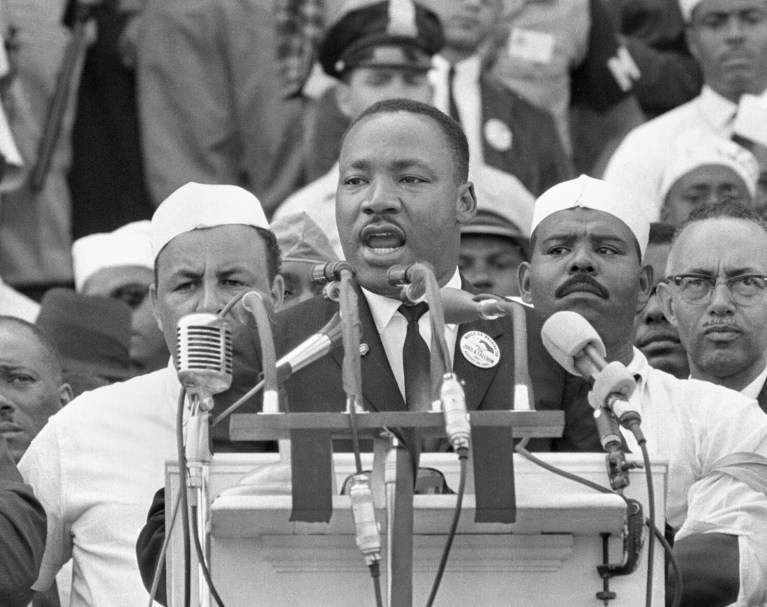
“I have a dream that my four little children will one day live in a nation where they will not be judged by the color of their skin but by the content of their character.”

It had worked.  Racial tensions had dropped off and it had really felt then like a new post-racial epoch had begun.

Unfortunately, since then the progress has been backwards.  Or at least as far as sentiment.  Many are convinced that race relations are worse than before.  And that what MLK had preached is impossible, that we must see color, and many advocate that we discriminate in favor of racial minorities—or against them.  Both the far-right and far-left agree with racism.  They both refuse the multi-variant analysis, one which considers factors like fatherless homes apart from race, and have decided that race determines all.

The left claims that the content of character speech is misused and that we must force equal outcomes or we are disingenuous—while the right uses disparity in outcomes as the proof of inferiority at a genetic level.  It is truly amazing how the same data can be read so differently.  However, I disagree with both sides and put far more weight on culture and messaging than they do.  Telling people they need our help in order to reach their full potential is disempowering and the worst kind of political opportunism.

Which does make me wonder if this is the real reason why we celebrate MLK?  Would we ever turn him into an immortal figure if he were alive to speak for himself?

No, I don’t believe so.  I believe that MLK Jr. became much more useful to the political establishment in his death.  No matter what side you’re on, Republican or Democrat, you can make use of his words.  And the reason they recognize him is to use his legacy as a tool for their own ends.  This is the beauty of all those made maytrs for a cause, they always get turned into whatever the current owners of their image want them to be.  I would contend the holiday is intended as a way to co-opt his legacy—both as a way to pacify and to bend it to their own agenda.

MLK was silenced.  His legacy of words and of speeches are now open to interpretation.  He’s a national hero only because he’s dead and cannot oppose those employing his name on all sides of the debate.  Those who made his birthday into a holiday were likely doing it as a virtue signal, a way to prove (to those who cared in the voting public) how they are better than his killers. 

These same people would likely have destroyed him—for his sins—if he were alive and opposed them.  Only dead heroes are useful in politics.

What Is Biblical Israel?

Standard

There is a nation in the world that identifies as Israel.  And, as we all know, if a person or group of people identify as something then this is what they are.  If I say that I’m a ham sandwich you better believe it!  Israel is what calls itself Israel.

That out the way, is that Israel the same as the Biblical Israel established by God?

If you were raised under Zionist teachings this isn’t even a question.  Of course, it is!  What else could it be?  Biblical criteria or qualifications, what are those?  I mean, how exciting would those end times novels be without our favorite backdrop???  And next, you’ll be telling us reality television is fake and that Caitlyn Jenner is a man and not a stunning and brave woman!?! 

Isn’t everyone who identifies as something that thing?

However, for those slightly more literate, and not born yesterday, the question of what the Biblical Israel is and if the state by the same name is the same thing is important.  For a Christian, up until the time of the reformation and a little after, this answer was quite clear and that is that Israel today is the remnant of the Jews who remained faithful—as well as those Gentiles converted. 

From the perspective of New Testament writers Israel is the Church or the body of those who believe—a religious affiliation and not a particular race.

About Religion, Not Race…

While still a member of a Mennonite church, I was not happy to have my religious identity be classified as an ethnic group.  In my own opinion I wasn’t born a Mennonite, it was my religion and something that I had to choose to participate in.  And yet there was truth to the claim.  There is was an ethnic component to being part of the group.  We shared a culture, and have our own common surnames, and many converts don’t fit in well.  

However, the most damning evidence, other than having unique genetic disorders, is the broad range of beliefs and practices under the Mennonite banner.  Those calling their church Mennonite span from those who are progressive and ordaining lesbian pastors to those very traditional still using horses and buggies for transportation.  So, when the only true common bond between all of these Mennonite groups is a sprinkling of Yoders, Gingrichs, Millers, or Barkmans, can it really be a religious belief system?  

Rev Michelle Yoder, a charismatic lesbian pastor of the Mennonite faith, sitting comfortably with partner in her electric Mennonite buggy as she makes her way through Africa

Okay, like a Facebook relationship status, it’s complicated.  People can and do convert to become Mennonite.  And, surprisingly enough, since a few decades ago, an African version of the Mennonite denomination has been growing rapidly to the point there are now more Mennonites in Congo than in Canada.  I mean, who knows if their doctrines or religious practices are anything that a North American conservative would recognize, nevertheless they do carry the name of Menno Simons in a direction he probably never imagined.

That’s one thing that the Orthodox generally put up front.  If you are Orthodox in Greece or a Greek community, then you’re a Greek Orthodox.  The liturgy and general practice are the same, established by canons, but there is also room for ethnic expression and use of the language common to the people.  In the Arabic world, for example, they use “Allah” where we use the Roman pagan word ‘God’ and have been using it before Islam even existed as a religion.  Anyhow, in Orthodoxy, unlike Mennonites, the identity is built from the substance of something established and a faith that is ancient.

Absurdly, when it comes to Judaism, we no longer care if they’re practicing or apostate, we slap that big ethnic label on them all and claim all of them have a claim to the land by their DNA.  To us, they’re all the same.  But that’s certainly not the case when it comes to Biblical Israel, not every part of the assembly was blessed, some were literally swallowed up by the earth, while others were put to death for disobedience, and the whole would end up in exile: 

But if you or your descendants turn away from me and do not observe the commands and decrees I have given you and go off to serve other gods and worship them, then I will cut off Israel from the land I have given them and will reject this temple I have consecrated for my Name. Israel will then become a byword and an object of ridicule among all peoples. This temple will become a heap of rubble. All who pass by will be appalled and will scoff and say, ‘Why has the Lord done such a thing to this land and to this temple?’ People will answer, ‘Because they have forsaken the Lord their God, who brought their ancestors out of Egypt, and have embraced other gods, worshiping and serving them—that is why the Lord brought all this disaster on them.’ ‭‭‭‭

1 Kings‬ ‭9:6‭-‬9‬ ‭NIV

It is quite clear that the covenant was even conditional for those who were biological offspring of Abraham.  Not only this, but people could become part of Israel who were not blood descendants of Abraham, Ruth the Moabite, or Rehab the prostitute, a Gentile, for example.  So it was never about ethnicity, it was always about obedience and the covenant conditional based upon obedience rather than bloodlines.

Chosen For Abraham’s Faith

The children of Israel were not picked for their superior genetics.  That’s not to say there aren’t very intelligent and extremely talented people of Jewish religious heritage.  Abraham was picked for being a righteous man:

And the LORD said, Shall I hide from Abraham that thing which I do; seeing that Abraham shall surely become a great and mighty nation, and all the nations of the earth shall be blessed in him? For I know him, that he will command his children and his household after him, and they shall keep the way of the LORD, to do justice and judgment; that the LORD may bring upon Abraham that which he hath spoken of him.

Genesis 18:17‭-‬19 KJV

It was Abraham’s righteousness and how he would guide his children to “keep the way of the Lord,” that God picked him.  God went on to set Israel aside through religion, not race, and those who did not keep the law would soon find themselves entirely cut off from the assembly of Israel.  There was never a blessing for simply being a blood relative of Abraham.  It was always conditioned on a faith that produced the work of obedience and this remains the case.  

Those born to keep the law of Moses must recognize their Lord and Savior or they’re no more blessed than the Benjamites put to the sword for their evil:

The tribes of Israel sent messengers throughout the tribe of Benjamin, saying, “What about this awful crime that was committed among you? Now turn those wicked men of Gibeah over to us so that we may put them to death and purge the evil from Israel.” But the Benjamites would not listen to their fellow Israelites. […] The Lord defeated Benjamin before Israel, and on that day the Israelites struck down 25,100 Benjamites, all armed with swords. […] The men of Israel went back to Benjamin and put all the towns to the sword, including the animals and everything else they found. All the towns they came across they set on fire.

Judges 20:12‭-‬13‭, ‬35‭, ‬48 NIV

If this were a Covenant merely about blood or genetics, then the Benjaminites really got shafted.  I mean, I’m not sure how anyone could construe being slaughtered wholesale as being a blessing or some special thing to be chosen for, “Congratulations, you’ve been selected to be purged!”  So this idea that anyone will ever be saved simply for their chosen race is wrong and there is only one true religion which is founded in Abraham’s seed, through the law of Moses, and is fulfilled in Christ.  

My favorite Jewish writer explains:

Those who want to impress people by means of the flesh are trying to compel you to be circumcised. The only reason they do this is to avoid being persecuted for the cross of Christ. Not even those who are circumcised keep the law, yet they want you to be circumcised that they may boast about your circumcision in the flesh. May I never boast except in the cross of our Lord Jesus Christ, through which the world has been crucified to me, and I to the world. Neither circumcision nor uncircumcision means anything; what counts is the new creation. Peace and mercy to all who follow this rule—to the Israel of God. 

Galatians 6:12‭-‬16 NIV

After Christ, even the law of circumcision becomes secondary to what St Paul describes as being “the new creation.” 

So it was the righteousness of Abraham, which was followed up with their being set aside by careful obedience to the law—which was the test of the Old Covenant—and finally, reconciliation through Christ that is salvation for all. 

It was NEVER only about ethnicity or race.  Modern descendants of the Jews must do the same as anyone else, repent and accept their King or perish. Repentance is the first step to salvation and that is what distinguishes true Israel from the counterfeit.  The first followers of Jesus were Jewish.  Christianity is the part of the assembly that remained faithful to their Lord while the others who rejected their rightful king are called anti-Christ:

Dear children, this is the last hour; and as you have heard that the antichrist is coming, even now many antichrists have come. This is how we know it is the last hour.  They went out from us, but they did not really belong to us. For if they had belonged to us, they would have remained with us; but their going showed that none of them belonged to us. […]  Who is the liar? It is whoever denies that Jesus is the Christ. Such a person is the antichrist—denying the Father and the Son.  No one who denies the Son has the Father; whoever acknowledges the Son has the Father also.” ‭‭

1 John‬ ‭2:18‭-‬19‬ ‭NIV‬‬

There are a great many who call themselves Christian today who have Scripture and yet no discernment whatsoever.  You don’t even need to believe in Jesus to understand what is being said in the passage.  Who is identified as the liar and anti-Christ?  1 John 2 very plainly tells us who: “It is whomever denies that Jesus is the Christ.”  That is to say those unfaithful to the covenant made with Abraham through their rejection of the Son—God in the flesh.

To say that some can deny the Son and still have a Covenant with the Father?  It is to basically throw out the entire Gospel of Jesus Christ.  It is completely moronic and a sign that someone was never truly part of the assembly of God.  If they truly belonged they would see their Lord as the fulfillment and not be so easily led astray.  When Jesus says “Salvation is from the Jews” he is not talking about an ethnic group, he is talking about himself and how he is the Messiah that was promised through the faithful seed of Abraham.

Chosen by Christ

It is really a form of idolatry to hold a race or ethnicity up as chosen by God for no reason other than their genetics.  That is not what the “Israel of God” ever was.  The assembly (or ‘ekklesia’) was always about those who were faithful, a remnant of Abraham’s seed that included Gentile converts, and turning it into an ethno-nationalist state is a perversion of what the original covenant between God and Abraham actually entailed.  A covenant is a two-edged sword, while it comes with blessings for those who obey there is also a list of curses for those who do not hold up their own end.

‭‭Jesus spoke to them again in parables, saying: “The kingdom of heaven is like a king who prepared a wedding banquet for his son. He sent his servants to those who had been invited to the banquet to tell them to come, but they refused to come. […] “But they paid no attention and went off—one to his field, another to his business. The rest seized his servants, mistreated them and killed them. The king was enraged. He sent his army and destroyed those murderers and burned their city. “Then he said to his servants, ‘The wedding banquet is ready, but those I invited did not deserve to come. So go to the street corners and invite to the banquet anyone you find.’ […] “For many are invited, but few are chosen.”

Matthew‬ ‭22:1‭-‬3‬,5-9,14 ‭NIV‬‬

Any guess which of those on the guest list killed the servants sent by the King?

The Biblical Israel, for those who believe in the Gospel of Jesus Christ, is that remnant of Jews who obey and follow after the Word of God incarnate.  This is always how Israel worked.  Some were pruned off the tree and others grafted in.  There were never special exceptions made for anyone merely on the basis of ethnicity or race.  The Church is the nation of those faith to the work of God that started with a Covenant with Abraham and needs no worldly state or rebuilt temple of stones.  Christians are the chosen people.

This essay doesn’t mean that there should be no modern state of Israel or that the mistreatment of any group of people in the world who have rejected Jesus is ever acceptable. We just need to know there’s a big difference between “identifies as’ and what is actually being referred to in the Bible.

Sheep Need Shepherds, Not Critics

Standard

Want to say “does not respond well to authority” without saying it?  Just post a meme proclaiming yourself as a lion and decrying others as sheeple.  Of course, the popular origin of this lion meme was a Trump retweet of the quote, “It is better to live a day as a lion than 100 years as a sheep.”  The irony being that these ‘lions’ who have used the phrase since are still following someone’s lead.

The reality is, even in this current age of individualism, we are social creatures and are more often responding to the pressure of the crowd than thinking for ourselves.  The ideas that motivate us, the narratives and interpretive overlays that we embrace, these aren’t things that we created in our own minds.  But rather we have inherited many base assumptions from our homes or communities and will continue to be influenced our entire life.

And, speaking of influence, there was a review of Downfall, a movie about the last days of Adolf Hitler, that got me thinking about leadership.  For obvious reasons, this is viewed from a negative light in regard to the Nazi dictator.  The faith of the German people in their government is what enabled the atrocities of the regime.  Viewing a flawed human being (or any collection of human authorities) as God is something very dangerous.

I’ve written frequently warning against the mob spirit and peer pressure.  We should learn how to think for ourselves, make our own decisions, or we may be swept up in the latest propaganda campaign and used for immoral ends.

However, I also had to think that this unique ability of humans to organize around one charismatic personality is also the strength of our species and has given us a great competitive advantage over the strongest individuals.  Our hunter-gather ancestors were only able to take down larger animals for food or to protect the themselves from deadly predators by working together.  This took leadership, it required someone to be the point man of the group or coordinator of the collective effort.

So, sure, as the video says, “those full of doubts are desperate to follow those who are sure of themselves,” and “view them as shortcuts to prosperity,” yet this urge to fall in behind the Alpha is not always such a bad thing and is actually key to our success in building civilizations.  A great leader can empower and get more from the group than the sum of the individual parts.  I see this in John, the co-owner and true boss man at my company, without his infectious ambition and decisive confidence I can’t see us being near where we are.

The truth is that there are extraordinary men, there are those who do better embody the collective hopes of their people and thus are granted a right to rule.  One only needs to consider the story of David, a lowly shepherd boy, who faced down the giant Goliath and through his courage inspired the armies of Israel to defeat the Philistines.  Of course, this is not only a role for men either, the confidence of Deborah (Judges 4) or faithful example of Joan of Arc is what led to the decisive victories of their people over occupiers and oppressors.

People Need Leadership, Not Lords

We can talk about the ideal and imagine a world where everyone is completely able to take initiative, where order is always 100% voluntary and there is no need of authority or a leadership position.  That is the design of the Israelite tribes before they demanded a king to rule over them.  But even then, in that sort of anarchist system, there were judges that were appointed by Moses to arbitrate disputes and Moses, for his Divine call and standing up to Pharaoh, was the defacto leader of his people.

Every human is flawed.  Moses fled into the wilderness after killing an Egyptian and, despite hearing from God, needed Aaron to speak for him.  King David, the great warrior leader he was, had a loyal companion, Uriah sent to die in battle in order to cover for his adultery with Bathsheba.  The temptation of every person given power over other people is to use it to their own personal advantage rather than for the good of the group.  That is why the children of Israel were given this stern warning before appointing a ruler:

Samuel told all the words of the Lord to the people who were asking him for a king. He said, “This is what the king who will reign over you will claim as his rights: He will take your sons and make them serve with his chariots and horses, and they will run in front of his chariots. Some he will assign to be commanders of thousands and commanders of fifties, and others to plow his ground and reap his harvest, and still others to make weapons of war and equipment for his chariots. He will take your daughters to be perfumers and cooks and bakers. He will take the best of your fields and vineyards and olive groves and give them to his attendants. He will take a tenth of your grain and of your vintage and give it to his officials and attendants. Your male and female servants and the best of your cattle and donkeys he will take for his own use. He will take a tenth of your flocks, and you yourselves will become his slaves. When that day comes, you will cry out for relief from the king you have chosen, but the Lord will not answer you in that day.” But the people refused to listen to Samuel. “No!” they said. “We want a king over us. Then we will be like all the other nations, with a king to lead us and to go out before us and fight our battles.”

(1 Samuel 8:10‭-‬20 NIV)

Sounds familiar, doesn’t it?

We don’t have kings today, but we do have an all-powerful political class, that is mostly exempted from the laws they apply to us, who never met a new tax they do not like, and always willing to send our children to die to defend their own bloated ego or for the financial gain of the ruling class.  Sure, call it ‘democracy’ as you vote for Tweedledee or Tweedledumb, but neither team red nor team blue actually represent you.  We’re ruled not even by these visibly elected, but by special interests and those behind the scenes who pull the purse strings.

And therein lies the difference between the good leaders and the bad.  The shepherd leader fills the role for the good of the flock, even willing to sacrifice themselves for the life of their sheep.  The corrupt leader uses their power and authority as a means to dominate those who are under them.  A good leader serves as an example, they encourage and try to get the best out of those looking to them for guidance.  The evil politician, on the other hand, delights in creating dependency and keeping others subject to their whims.

In the end, no man is actually worthy to lead of their own authority and it is only through understanding our own place before God, that we ourselves are not God, that we can ever fill the role.  Self-belief and narcissism, with a little psychopathy, is often what will get a person to the top spot.  But humility and faith, valuing all individuals enough to go find the one lost sheep, that is the mark of a Godly leader.  The only person fit to lead is one who is willing to submit to those who have authority over them.

The delusion of the Protestant independent spirit is that every man (or woman) and their Bible becomes their own king.  This “you’re not the boss of me” attitude, in response to flawed leadership or simply as rebellion, is precisely why the church is becoming increasingly impotent.  The Church, at least the one that Christ founded, had those given the authority to bind and loose, a council to decide important matters and those who acted as fathers.  This hierarchy was never comprised of those faultless.  No, what made them worthy, and the only thing that makes any of us worthy, is being clothed in the righteousness of the one Great Shepherd.

We need sheep who know they are sheep and shepherds, appointed to feed the flocks, like Peter:

When they had finished eating, Jesus said to Simon Peter, “Simon son of John, do you love me more than these?” “Yes, Lord,” he said, “you know that I love you.” Jesus said, “Feed my lambs.” Again Jesus said, “Simon son of John, do you love me?” He answered, “Yes, Lord, you know that I love you.” Jesus said, “Take care of my sheep.” The third time he said to him, “Simon son of John, do you love me?” Peter was hurt because Jesus asked him the third time, “Do you love me?” He said, “Lord, you know all things; you know that I love you.” Jesus said, “Feed my sheep.

(John 21:15‭-‬17 NIV)

In my own spiritual journey, after my own Bible-based authority failed me, God provided me with a man who would end his emails with the phrase “your unworthy priest” and is truly that.  Fr Anthony is a very well-educated man, a college professor, and one who could easily flaunt his credentials as a means to humiliate some like me.  But what has given him true authority, in my eyes, is how he humbly serves as a true example of Christian leadership. 

He is a shepherd and the Church really needs more who are like him.

The King (Government) Can’t Save You… (The Long Delayed Part 2 To “The People Want A King)

Standard

Originally, a few years ago, I had planned a multi-part series, “The People Want A King,” to discuss the establishment of rulers in the Biblical narrative and make it applicable to our own times. The short version is that God gave his people a king, while warning them of the costs, because they wanted to be like other nations.

The costs were great…

  • Kings demanded more and more for themselves.
  • The centralization of power from many to few only increased the magnitude of corruption without providing a solution.
  • And, ultimately, the king could not provide the protection the people had sought when they established the throne.

People then, like people now, wanted an authority figure, someone to lead them and take responsibility for their lives. They ended up with nothing but trouble: Higher taxes, more wars for the glory of the crown, and a growing number of rules that applied to them but never the ruler. Even the good kings did horrendous things with the power that had been entrusted to them and our modern-day governments not much different in that regard.

Despite this, most people can’t even imagine a world without governments and many still look to leaders to act as a wise fatherly figure in times of crisis. Some would even like the government to play a nurturing role, they fantasize about this motherly figure that gives them everything and asks nothing but love in return. It seems that a majority of people believe that government leaders (or at least those of their own political party) are imbued with special powers of discernment and serve a role that can’t be questioned.

“Put not your trust in princes, in a son of man, in whom there is no salvation.”

(Psalm 146:3)

Christians are told on multiple occasions to pray for and respect civil authorities. We are told by St. Paul that the punishment of evil is for our good and therefore we should not resist. But that said, this idea that government leaders, the representatives of bureaus and bureaucracies, have some sort of god-like infallibility and superior wisdom is plain wrong. We cannot trust them to save us any more than anyone else. And if we learn anything from their mistakes we should know:

The Myth of Special Knowledge or Abilities

For the amount of faith that some seem to have in our institutions, you may think that our leaders have a near-perfect batting average. It does not take long to compile a list of huge government blunders and starting with the handling of Covid-19. The virus wasn’t even on the radar of many of our elected officials before things got bad in Italy and when they finally did respond they did in a manner that did not make sense.

For example, state governments forced nursing homes to take Covid-19 patients. They literally took Covid-19 directly to our most vulnerable populations, where 2/3rds of the deaths in my state have occurred. And, simultaneously, they prevented those least threatened by the disease from working or going to school—which resulted in an uptick of overdoses and suicides. This also at the same time Pennsylvania Health Secretary, Dr. Levine, was removed their own 95-year-old mom from a personal care home.

So, take your pick, gross incompetence, or plain evil, either way, state officials responded the exact opposite of what would actually make sense, in a way that would actually maximize the harm done, and these are the people we trust with our collective welfare?

And then there is the not so small matter of shutting down rest areas in a time when truck drivers, always essential, were as essential as ever. You would think that if the goal were to stop the spread of the virus you would want your road warriors to have clean and easily accessible restroom facilities, along with a safe place to sleep. But, to this day, many rest areas remain closed and those open have dingy unheated porta-potties rather than open their regular restrooms to travelers. In a time when health and hygiene is supposedly our focus, they have forced unsanitary and stressful conditions on essential workers. Even after being confronted on this, they continue to persist with this asinine policy with absolutely no regard for the well-being of truckers.

Sure, this could be a mistake. There certainly is no reason to assume that there is some sort of malicious intention here. But it does demonstrate that they lack a special power of discernment over the rest of us. It should make us consider that maybe their whole perspective is wrong. I mean, if their judgment of small matters is so poor, why should we take their word on large matters?

Could it be that those who were elected for their charisma and/or party affiliation and are not truly qualified to lead anything?

Could it be that various government officials were appointed for political reasons, made their careers in places where job performance didn’t actually matter too much, and are incompetent?

Yes, government leaders can get caught up in hype and hysteria just like the rest of us. No, neither they nor their advisors have a special power of discernment. This reality may be disconcerting to those who want a benevolent dictator to tell them what to do, nevertheless, it is true.

The same leaders who nonsensically force truckers to use the least sanitary option could also be blissfully unaware of the severe (and deadlier) economic impact they are inflicting on us. The same leaders who forced nursing homes to take Covid-19 patients, evidently knowing the likely outcome, could be completely calloused to the pain that they are inflicting on you.

Myth That Only Government Can Do Great Things

There are many who are skeptical of government and yet default to the idea that we need to provide us with various services. I mean, who would build the roads if it wasn’t for PennDOT, right?

Of course, never mind that PennDOT doesn’t build roads, they take our money through taxes and then subcontract the actual building to private companies. The reason for this is very simple: The government can never match private for-profit enterprises for efficient use of resources because there is simply no incentive to do so. Therefore, due to this disconnect, when the government does do anything themselves it is insanely expensive and prone to failure.

Government funded and ready for launch!

A prime example, from a century ago, was the competition between Samuel Pierpoint Langley and two brothers from Ohio, Orville and Wilber Wright, to build the first powered flying machine. Langley, funded by the government and fawned over by the media, he had all the right connections and credentials, but his overwrought design ended up in the Potomac River. The Wrights, by contrast, had little to no attention, didn’t even have high school diplomas, ran a bicycle sales and repair business, and beat Langley to powered flight with a very low budget and simple design. But, despite this, it is Langley’s name that graces an Army airbase, the CIA headquarters, and a NASA center.

Oopsies!

Speaking of NASA, the agency has, at great taxpayer expense, done some amazing things. We take for granted the satellites in orbit, the trips to the moon and back, along with the many things this government agency had pioneered that have since become integrated into our own lives. Could one person ever rival these great accomplishments?

The answer is yes.

The answer is that Elon Musk, with SpaceX, can do everything NASA is doing and at a far lower price. It costs a fraction of what the government spent historically for Space X to launch:

“Between 1970 and 2000, the cost to launch a kilogram to space remained fairly steady, with an average of US$18,500 per kilogram. When the space shuttle was in operation, it could launch a payload of 27,500 kilograms for $1.5 billion, or $54,500 per kilogram. For a SpaceX Falcon 9, the rocket used to access the ISS, the cost is just $2,720 per kilogram.”

But it isn’t just space flight that is made easier and less expensive through private innovation. No, at a time when the US Postal Service, a government entity that is supposed to be self-sustaining, can barely make ends meet, there is Jeff Bezos and Amazon making a tremendous profit while delivering tons of products. Sure, Amazon uses the Postal Service, and yet the lack of ability of the government enterprise to modernize and adapt to the current market conditions that is proving to be a fatal flaw. As they beg for another taxpayer bailout, Bezos and others will continue to prove that the same task can be done better and with lower overhead costs.

The idea that there is any worthwhile project that is beyond the reach of the brilliant innovators of the present, without it being financed directly by the government, is completely bogus. Yes, certainly, unlike the Wright Brothers, the Musks and Bezos of this generation do take every tax break or advantage offered to them by government. But you could eliminate all of that entanglement and they would still do it better than any government agency at a fraction of the cost. The government never actually does great things. No, at best it is only ever a middleman that hires people or companies, supposedly on our behalf, that does the great things.

Myth That Only Government Can Keep Us Safe

If you look at the big problems of the past couple of decades that may require government sized intervention, from the 9/11 attacks to the viral outbreak originating in Wuhan, there is a disturbing pattern that emerges. Not only did this super expensive security apparatus not stop the various events and keep us safe, but it may also have actually been the cause of these events due to their prior interventions.

There likely would not be the Islamic Republic of Iran today had it not been for the CIA’s meddling in the domestic politics of Iran. Osama Bin Laden had been an ally in our government’s proxy war against the Soviet Union before he became a threat that cost trillions. Our top US health advisor, across multiple US administrations, Dr. Anthony Fauci, is linked to the organization that funded bat and coronavirus research in a lab in none other than (drumroll, please) Wuhan, China.

No, this is not a conspiracy theory, I’m not even convinced it was malicious in intent in any of the cases above. I agree with Hanlon’s Razor, “Never attribute to malice that which is adequately explained by stupidity.” But, regardless, there is certainly a strong case to make that high-ranking government officials do not comprehend the consequences of their actions, do not account for the blowback, and their solutions often create bigger problems.

Are you sure you want the same people who created the problem, in the first place, to manage the response as well?

Maybe it is time for a second opinion…

And then there is the inconvenient truth that many in government are the actual criminals!

Well, not that those truly guilty are ever prosecuted by the same standards applied to us or others of lower political status. Case and point: General Flynn was criminally prosecuted for what amounts to a perjury trap and in the context of an investigation that had no legal basis, to begin with, but a certain prominent US politician lied under oath to Congress and never faced any real threat of punishment.

No, we are no better today than in the time of kings when it comes to equal justice. Those with real power (usually the combination of media and government agencies sympathetic) are never held accountable or to nearly the same standard that is applied to the average person. Even in Pennsylvania, where nursing homes were forced by the state government to take Covid-19 patients, guess who is being investigated by the state Attorney General for the resultant deaths? If you guessed the governor’s administration that ordered the sick into the nursing homes, then you would be wrong. Nope, instead, they will investigate the nursing homes, which is a typical “smokescreen” strategy or means to distract from those who truly should be held accountable.

The Myth of the Significant Party Difference

One of the most persistent and most blinding myths of politics is that the two parties represent something vastly different. If you are one of those Obama fanboys who still believes that his administration was scandal-free even now, because he says so, even after the “Fast and Furious” gun-running scandal, after weaponization of the IRS against political rivals, and actually believe he didn’t know anything about the Watergate-esque spying under his watch, then you are a complete tool. Likewise, if you see Trump as being a saint because he says some Christian things and posed with some pastors, then you are an insufferable fool.

The real difference between the two men is that Obama is and expects to be catered to as one who can wax eloquent in a manner that sends shivers down the legs of other social elites, while Trump is a populist who knows how to work a crowd and is old (or rich) enough not to care what the talking heads think. If you don’t see Obama as being as narcissistic and corrupt as Trump then you probably also side against Biden’s accuser, with a corroborated allegation of sexual assault, while screaming #believewomen only a couple years ago because that is what you were told to do. Trump might be a bully, an unapologetic Twitter troll, but Obama is the popular snob who snickers behind the backs of those of lower status while knowing how to work the system in his own favor.

The only reason that I find Trump tolerable is that he offends who aren’t accustomed to being called out and is the underdog in the fight. The fact that Trump is loathed by the corporate media and political establishment, both Republicans and Democrats, is enough reason to like him. Most Trump ‘scandals’ amount to little more than elaborate misinformation campaigns. For example, when Trump suggested hydroxychloroquine had promise as a treatment option for Covid-19, something many doctors agree with, this was equated to telling people to drink poison and is still being ridiculed. Why? Well, because Trump said it and they hate him with a blinding passion. They would probably rather die than acknowledge that Trump is right.

But, in the end, I do not see Trump as a savior any more than any other politician. Sure, I am glad that he’s a challenge to the status quo. It’s fun to see his rivals become unglued and expose themselves as being as nasty under the thin veneer of their fancier, more sophisticated, language. However, the idea that any particular political party or person has all the right answers, or that Trump can be trusted with power more than anyone else, is balderdash. Trump should be mistrusted. He is as fallible as anyone else. My only complaint is that those attacking him, often for overtly political reasons, never face the same level of scrutiny nor are ever held accountable for their abuses.

The Myth of Having to Be Pro- or Anti-government

After writing all of that one might assume that I’m anti-government. I’m not. I believe that governments exist for a reason and abolishing them would not result in harmonious perfection. The same evils that plague government leaders would not simply go away because we eliminate the government and there is a moral order enforced by the state even if we do not fully agree with it. Sure, we may not like that a State Trooper gives us a speeding ticket and yet most of us are appreciative when a murderer is brought to justice in a way that we couldn’t do individually for ourselves.

In the Philippines, where the central state is relatively weak and law enforcement resources stretched thin, murderers often face no consequences. I know this from having experienced it first hand, the men who murdered uncle Roland are still free despite strong leads because the police there do not have the ability to follow up. By contrast, in the United States, even with the smallest leads, government investigators were able to find the killer of Sasha Krause recently and Marco Kauffman before that. That closure provided doesn’t bring back those loved ones taken away, but it certainly does help to take a killer off of the street and to provide some deterrence against others who would do evil.

If the United States government were to disband the relief from the tyranny we know would be extremely temporary and the peace short-lived as something would come in to fill the vacuum. A disorganized band of anarchists will do very little to stop even a Mexican cartel, let alone the People’s Republic of China, or anyone else who decided to take advantage. The peaceable folk who enjoy prosperity under the umbrella of government protection would either need to lose their disposition or learn to appreciate the taxation without representation of armed thugs who take whatever they want, including the innocence of their daughters, without ever needing to face consequences. We would be foolish not to consider the benefits of our imperfect order over the likely alternatives.

But, that said, I’m under no delusion as far as the righteousness of our social elites and governing authorities. They are as flawed and lacking in good discernment anyone else and often too often greedy for more power by any means.

Anyhow, I had sat on this post for a couple of weeks because I didn’t know how to finish. The tragic circumstances of George Floyd’s death, while in the hands of the Minneapolis Police, underscores the point of this blog quite well. No matter how intentioned or carefully formed, there is no escaping the reality that governments aren’t any better than the people that populate their nations. There is simply no escape for this reality, that no government in history or currently existing can save us from ourselves. The only hope for perfect justice is through faith in the kingdom where the fears, prejudice and greed, lust for power and lawlessness, are finally defeated in the hearts of men. Where we can govern ourselves according to the example of Jesus Christ.