
Philosophical Candidates

Standard

Remember, as a child, those day-dreams of a life unrestricted by parental control, where it would be video games all night, ice cream, pizza, and soda all day?  What is amazing is upon reaching adulthood the thought of this lifestyle is disgusting.  First off, it would be horribly unhealthy—in the sense that those who indulge bulge.  Second, a party every day is totally unsustainable, someone has to do the work to keep the lights on and put food on the table.

Many people become more conservative as they mature and start to realize the value of the limitations they once spurned.  Yes, an adult will modify what was taught to them by their parents and community.  And some grew up in social environments where there was not much worthy to be preserved.  But to totally throw away everything inherited from prior generations is a terrible mistake.  Only an ideological extremist believes stripping it all bare is necessary and good.  It is wiser to build on what works.

That is not to say that the tradition passed down can’t become stifling and overbearing or limiting our potential either.  There must be a bit of flexibility, some Oikonomia, or means to adapt the rules as the need arises.  However, the opposite ditch, of discarding everything and starting from scratch very quickly becomes chaotic, everyone does what is right in their own eyes, and it soon requires authoritarian measures to enforce the vision.  This is the thing Nietzsche warned about—our morality is not self-evident and we should think long and hard about those monsters that we will release with our neglect.
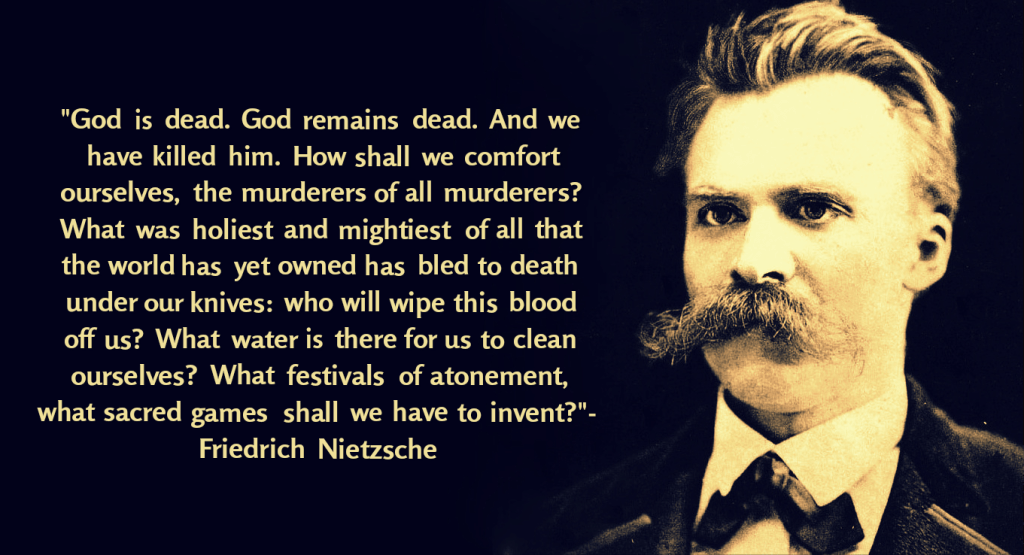
This wasn’t a sacrilege, it was a lament of what happens when you yank the foundational rug out from under a moral system.

Cultural revolution, while always promising to upend systems of oppression and usher in a new utopian age, ends up being worse than what it is replaced.  Yes, “All animals are equal” may be the founding cry, but is very soon after modified by opportunists who sadly are now unrestrained by those institutions despised and yet there for a reason.  The only good thing is that this out-of-balance off-kilter, ‘we know better than all who came before’ attitude, tends to implode on itself if given time.  The Soviet Union only lasted as long as it did because of Christian ethics within the population.

Two Visions For Our Future 

Recently, with the decline of Joe Biden and a failed assassination attempt against his rival, the Democrats decided it was time to make a change up top.  It is her time now—that is to say Vice President Kamala Harris—and there is plenty that could be said about her career thus far, but there is one peculiar repeat statement she has made that really deserves our attention:

“What can be, unburdened by what has been.”

This strange little mantra has been widely panned by the right.  This is more Kamala word salad, they chortle, and yet—while she does sometimes explain things like a school teacher talking to a kindergartener—it is not gibberish.  This is something Harris has apparently put some thought into and is something with a meaning that we should try to unpack.

What does it really mean to be unburdened by what has been?

I’m not going to sinisterize.

Most on the left I know have a glowing hope for the future and could never imagine that their philosophy could lead to Gulags.  I do not believe Harris intends it this way, but it does hint heavily of Marxist thought where we are to be liberated or emancipated from all that came before.  On the surface, this is an inviting thought.  Imagine a world with no abuse, no poor, everyone has their needs provided and has complete freedom.  This would be wonderful—and this is what every cookie-cutter college leftist has in mind as the end product of their efforts.

So how does the unburdening begin?  Well, it already has.  If you have been paying a bit of attention, everything normal is now being called fascist.  Believe that women exist as a category and isn’t something a man can ‘transition’ to?  Fascist!  Maybe you like the nuclear family and see it as a praiseworthy social convention?  Fascist!  How about a border where there is reasonable control over who is allowed in and who is kept out?  That makes you literally Hitler!  And Harris has embraced this side of the debate, she announced her pronouns and the nature of her politics.

None of this is to say that Harris is a terrible person.  I simply don’t want a leader unbound to existing ethics or any standard of decency, or who can write off Constitutional law as being a “what has been”  product of wealthy white men with some of them slave owners and thus should be discarded.  Sure, it may be a document with flaws, and could possibly use more amendments too, but it is better than nothing and represents the will of the people who signed onto this national project to this very day—white, black, Native, or immigrant alike.

What was established is for our benefit.  It is no more a burden than a wool coat in the blistering cold.  To think that we know more than every other generation that came before us, that science and technology have made us into gods, is delusional. 

Furthermore, the left’s unboundness means they do not care about precedents (except as a tool to restrict their rule-obeying opponents and the ends justify the means.  And they mean well.  They plan to fight injustice.  But this script has played out many times before and is the very thing that tradition is a bulwark against.  At the very least those who believe what “has been” has value will hesitate and consider before they destroy the foundations of civilization.

Make America Great Again

Donald Trump rolled out his red hats and MAGA slogan in his 2016 campaign.  The message was simple, a repeat of Ronald Reagan’s “Let’s make America great again” encouraging answer to the total economic disaster of the Carter years.  As he said, in the 1980 Republican convention:

For those without job opportunities, we’ll stimulate new opportunities, particularly in the inner cities where they live. For those who’ve abandoned hope, we’ll restore hope and we’ll welcome them into a great national crusade to make America great again.

Trump knows a good brand and borrowed it from the best Republican leader since a guy named Abraham Lincoln.  The progressives lost their minds.  They dug up the one time it was used by the KKK.  And couldn’t decide to condemn with “America was never great” or be offended because “America is already great and how dare Trump suggest anything otherwise!”  If you were playing a game of “wrong answers only” this harsh criticism of MAGA as white supremacy would make a bit of sense.  

MAGA is not hateful.

When the left says, “Do you know who else said make America great again?” and then goes on to associate this benign statement with all manner of evil, they’re poisoning the well.  There is zero reason to interpret this slogan as Trump’s desire to bring back Jim Crow or the racial policies that were once championed by Democrats.  But this does whip the left into a frenzy and it keeps them from deviating and making an independent decision whom to vote for based on the actual positions of candidates.

What does Trump mean by “make America great again”?

Trump is a businessman, his interests are mostly economic, rebuilding our industrial base, bringing back gainful employment for blue-collar workers lower taxes, and less red tape standing in the way of entrepreneurial spirit.  My wife, who opened a store in her home country, complains that the US is not a free country and is appalled by the many layers of taxes and requirements.  This is what dooms many to working for “the man” or corporations that can afford compliance costs while drowning their competitors with cheap imported foreign goods.

The legalism of US law would make a Pharisee uncomfortable.

From a 2016 Trump campaign speech on jobs and the economy:

Jobs can stop leaving our country, and start pouring in. Failing schools can become flourishing schools. Crumbling roads and bridges can become gleaming new infrastructure. Inner cities can experience a flood of new jobs and investment. And rising crime can give way to safe and prosperous communities.

Had Trump’s first term not been sabotaged by COVID and blue state shutdowns, there is no doubt this would have been fulfilled.  In fact, by the third year of his presidency the minority unemployment rate reached record lows.  Even NPR, while downplaying it, could not deny these numbers Trump touted were real.  Biden’s only success comes from not rolling back those tariffs the fear-mongering media had so roundly criticized.  It is strange how the success and failure of policies is determined only by who is employing them, isn’t it?

No, Trump’s not woke.  He believes in hiring based on qualifications.  He doesn’t want to continue world policing and the massive expansion of government programs.  This is why he is the enemy of those who derive all of their power from the administrative state and sap our resources.  He is keenly aware that a free flow of cheap labor, while it helps elites who want nannies and landscaping at a discount, pulls down wages for those who do not come from wealth.  Even a Senator named Barack Obama understood this:

If this huge influx of mostly low-skill workers provides some benefits to the economy as a whole—especially by keeping our workforce young, in contrast to an increasingly geriatric Europe and Japan—it also threatens to depress further the wages of blue-collar Americans and put strains on an already overburdened safety net.

Make America Great Again is not about a swerve in the direction of Nazism or some new form of ethno-nationalism.  It is about restoring the economic conditions that had allowed our grandparents to buy their home and a car on a single income.  Back in 2015, Bernie Sanders had blamed open borders on a right-wing conspiracy, that will make everyone poorer, but now the left is saying that normal border security is racist.  What changed?  Why are these Democrat policies, like the immigrant cages during the Obama administration, demonized under Trump?

Compassion means disincentivizing illegal crossings where human trafficking is a concern requiring sorting facilities.

It is really disorienting for those who soak propaganda like a sponge.  They never see that Democrats did this full 180 on multiple issues where they had been right.  Trump is right about the border.  It should be the top priority.  Just the Fentanyl overdoses alone are a reason.  I’ve lost a former high school classmate and football teammate this way— 83,000 Americans died in 2022 alone—and it had ironically played as much role in the death of George Floyd as a knee on his shoulder.  Why do we even talk about that dozen killed in a school shooting or Ukraine in light of this?

Reform, Not Revolution 

Progressives tear at the fabric of civilization without understanding the consequences of their actions.  They believe that the erasure of history, destruction of monuments, or the degrading of religion (see Paris Olympics) is a path to a better future.  But this amounts to cultural vandalism and is ignorance of the positive contribution of these religiously created values we’ve internalized.  There is truly nothing that is written on the substrate of the universe that says slavery is wrong or that genocide is evil—the stopping point to “unburdened by what has been” is a return to animalistic impulse.

By design, not accident.

The frontal lobe of the brain is developed by the myths and moralities that progressives do everything in their power to destroy with ridicule and sacrilege.  And it will inevitably go much further than anticipated.  We rarely have enough appreciation for what we have been given.  Everything is taken for granted until it is gone.  And when there is a vacuum that is left to fill, and the ‘demons’ waiting in the wings will come rushing in:

When an impure spirit comes out of a person, it goes through arid places seeking rest and does not find it.  Then it says, ‘I will return to the house I left.’ When it arrives, it finds the house unoccupied, swept clean and put in order.  Then it goes and takes with it seven other spirits more wicked than itself, and they go in and live there. And the final condition of that person is worse than the first. That is how it will be with this wicked generation. (Matthew 12:43-45 NIV)

Christianity led to equal rights in the West, the abolition movement, is a product of St Paul advocating for Onesimus or telling the Galatian church, “There is neither Jew nor Greek, there is neither slave nor free, there is neither male nor female; for you are all one in Christ Jesus.”  The left assumes the values it has are universal.  They see only the faults without giving credit.  

“You will not surely die!”

The progressive left, by contrast, denies all limits and conventions.  Their “can be” may seem good at first glance.  But is opening Pandora’s box, it is releasing what previous generations have built social structures to contain and could end up being more like a trip on Event Horizon.  America has been good and bad, had moments of greatness and failure.  We should tune the ideal it was founded on, not tear it down to start all over again.  There is much to conserve in “what is” with an eye to improvement.  Veer not too far to the right or left.

At least with Trump, morally corrupt as he may be, he comprehends that our inheritance is not a burden. For him, there is something that can be recovered “again” from the past generations even if those lessons were not perfectly applied to him.  He’s a grandpa, he has seen trends come and go, old enough not to care about what is currently popular.  Trump may have some narcissistic traits, at least that is the character he plays on television to the roar of the WWE crowd—but he isn’t trying to be God.

Divorce and the Purpose of the Law

Standard

Much of what we believe is inherited and that includes how we interpret certain passages of Scripture.  It is just the way things are, we do not independently arrive at our own conclusions and could very well have been taught wrong.  Those who believe that the ground they stand on is sacred simply because they’re standing on it have no potential for growth in understanding or perspective.

Many in a purity culture would squeal their displeasure at the term “legalism” being used to describe their ‘Biblical standards’ and hide behind mantras such as “God Said It, I Believe It, That Settles It!”  Unfortunately, while this kind of obstinate stance may be good as far as resisting temptation, it basically amounts to confirmation bias on steroids in a search for truth.

This is exactly the attitude of those who took issue with Jesus breaking the Sabbath and how they absolutely refuse to see their own application of Scripture as entirely missing the point:

At that time Jesus went through the grainfields on the Sabbath. His disciples were hungry and began to pick some heads of grain and eat them. When the Pharisees saw this, they said to him, “Look! Your disciples are doing what is unlawful on the Sabbath.” He answered, “Haven’t you read what David did when he and his companions were hungry? He entered the house of God, and he and his companions ate the consecrated bread—which was not lawful for them to do, but only for the priests. Or haven’t you read in the Law that the priests on Sabbath duty in the temple desecrate the Sabbath and yet are innocent? I tell you that something greater than the temple is here. If you had known what these words mean, ‘I desire mercy, not sacrifice,’ you would not have condemned the innocent. For the Son of Man is Lord of the Sabbath.” Going on from that place, he went into their synagogue, and a man with a shriveled hand was there. Looking for a reason to bring charges against Jesus, they asked him, “Is it lawful to heal on the Sabbath?” He said to them, “If any of you has a sheep and it falls into a pit on the Sabbath, will you not take hold of it and lift it out? How much more valuable is a person than a sheep! Therefore it is lawful to do good on the Sabbath.” Then he said to the man, “Stretch out your hand.” So he stretched it out and it was completely restored, just as sound as the other. But the Pharisees went out and plotted how they might kill Jesus.

(Matthew 12:1‭-‬14 NIV)

The Pharisees, like religious fundamentalists today, believed that they were the experts and examples of righteousness.  They would know that Moses, by order of the Lord according to Numbers 15:32-36, had a man put to death for picking up sticks on the Sabbath.  It is very likely that many of them were very sincere in their saying that Jesus was possessed by a demon.  How dare this teacher allow his followers to break the law and then defiantly double down in response to their concern!!!  Weren’t there six other days to heal?!?

Now some commentators may try to square this legalistically, by claiming that Jesus was not truly going against Scripture.  But I do not believe this is the case.  The Pharisees were obsessed with the letter of the law and technically right in their complaint against his breaking the Sabbath.  Jesus, by contrast, was focused on the reason behind the law, or spirit of the law, and pointed to Hosea 6:6, “I desire mercy, not sacrifice,” to establish the vast difference between the ritualistic devotion to a set of religious rules and genuine love for people.

Legalism, by this standard, is a use of the law that is negligent of the purpose.  What is the purpose of law?  The law is supposed to be for our own good, to protect us from harm, and thus the exceptions that Jesus mentioned in response to his critics.  A legalist, in their strict adherence to rules, loves their rules, and yet they lack love and mercy for people.  Thus, a legalist, in their no-compromise application of the law, defies the actual purpose for which the law was established and, therefore, are no longer under the law themselves:

Speak and act as those who are going to be judged by the law that gives freedom, because judgment without mercy will be shown to anyone who has not been merciful. Mercy triumphs over judgment.

(James 2:12‭-‬13 NIV)

Legalism: Divorced From the Issue

This blog is not meant to be a theological tome.  For a more exhaustive look at the divorce and remarriage topic, especially for those of an Anabaptist background, I would suggest reading Dwight Gingrich who has covered the issue exhaustively in a series of blogs.  I’ve already covered Biblical proof-texts in prior postings as well.  Instead, I’ll stick to a discussion of the hardness of hearts and economia (special exception) as it applies to divorce and remarriage.

First of all marriage, by original intent, is until death do they part and there’s no exception to this.  If men and women would live up to their vows, not make promises they not keep, this would solve the entire issue.  If people would act responsibly and remain faithful in relationships then there would be no broken homes.  That is certainly ideal, it was also the privilege of being born into conservative Mennonite culture for me—in that my parents were encouraged, through peer pressure, to overcome doubts and make it work.

However, this ideal simply is not available to many in the world.  Many do marry, or have children, with someone whom they intend as their soulmate and it doesn’t end in a happily ever after for them.  This failure of adults can have disastrous consequences for the next generation, the less desirable outcomes for children of single-parent homes are the evidence:

Children who live with only one of their parents do less well in school, obtain fewer years of education, and have trouble keeping a steady job as young adults. Children from single parent families are six times more likely to be poor.

“Single Parenthood and Children’s Well-being,” Wisconsin Family Impact Seminars

Now maybe this is genetic, that the children have the same commitment issues as their parents, and this strong correlation of single-parent homes with poor outcomes for children does not automatically equate to environmental causation.  Maybe we need an adopted twin study?  But it is pretty safe to say, without a complex analysis, that the insecurity and chaos of a home with one parent will have an impact on children that is undesirable.

So there’s a question: If the law is there for our good and single-parent homes are bad, what should happen after divorce or abandonment?

In the culture that I came from, there was a hardline stance on divorce and remarriage that even nullified the “exception clause” of Matthew 19:9.  This perspective, from my personal experience as one who defended it, is about the preservation of an ideal and even at the expense of people.  I could reason, like Moses having the man killed for picking up sticks, that allowing one exception would be a slippery slope and lead to far greater social disorder.

And yet this “greater good” logic is exactly why Jesus was put to death:

Then the chief priests and the Pharisees called a meeting of the Sanhedrin. “What are we accomplishing?” they asked. “Here is this man performing many signs. If we let him go on like this, everyone will believe in him, and then the Romans will come and take away both our temple and our nation.” Then one of them, named Caiaphas, who was high priest that year, spoke up, “You know nothing at all! You do not realize that it is better for you that one man die for the people than that the whole nation perish.” 

(John 11:47-50 NIV)

They both missed out on Jesus, their king, and also did not save temple worship. Also equally ironic is that the high priest unintentionally spoke the truth.

Anyhow, maybe, in the time of Moses, sacrifices of animals and the sons of Abraham were needed for the health of the nation.  But now, after the death and resurrection of Christ, we are clothed in his righteousness and thus free from the letter of the law that kills:

He has made us competent as ministers of a new covenant—not of the letter but of the Spirit; for the letter kills, but the Spirit gives life.

(2 Corinthians 3:6 NIV)

You’ll need to read further about the context of that statement to fully grasp what St Paul is saying in that letter.  But the short version is that he’s contrasting the understanding of the law prior to Christ with that which only comes with the Spirit and seeing the intent behind laws as being greater than the laws themselves.  This is different from the Pharisee men who carved out legalistic exceptions for themselves to divorce and were confronted by Jesus for their hardness of heart:

Some Pharisees came to him to test him. They asked, “Is it lawful for a man to divorce his wife for any and every reason?” “Haven’t you read,” he replied, “that at the beginning the Creator ‘made them male and female,’ and said, ‘For this reason a man will leave his father and mother and be united to his wife, and the two will become one flesh’? So they are no longer two, but one flesh. Therefore what God has joined together, let no one separate.” “Why then,” they asked, “did Moses command that a man give his wife a certificate of divorce and send her away?” Jesus replied, “Moses permitted you to divorce your wives because your hearts were hard. But it was not this way from the beginning. I tell you that anyone who divorces his wife, except for sexual immorality, and marries another woman commits adultery.”

(Matthew 19:3‭-‬9 NIV)

The audience is men.  The ideal is marriage until death do they part.  And the rebuke is against the hardness of hearts.  This is what makes it so egregiously wrong that men, in fundamentalist communities, will apply this passage (usually excluding the exception clause) to women who were abandoned by their husbands.  It is, at the very best, taking the words of Jesus out of context and it is too often used rather hard-hearted response to those who have no chance of restoring what is ideal.

Jesus was not answering the question of what a woman is supposed to do when left to raise her children alone.  And I’m also quite confident that he was not intending for his prescription to these men to be applied in the same dogmatic manner as they approached the Scriptures.  It was their lack of mercy and compassion, how these men would misuse of the law of Moses (which did allow divorce) to escape their own responsibilities, that is the focus of his words.

As was explained to me concerning the Orthodox position on divorce and remarriage in contrast to that of fundamentalists:

As to sticking with what is written, I think here you can see the difference in how the Orthodox view the Scriptures—as part and parcel—but never the entirely of the whole Tradition—all of which has been handed down to us. The Orthodox do not take divorce and re-marriage lightly—it’s a complicated process to get a bishop’s blessing to undertake second and third marriages and the blessing is not always given. But the primary issue here is that the Orthodox confess God to be a God of mercy, love, and forgiveness—not a law-obsessed judge who keeps a record of pluses and minuses in order to play “gotcha” with those who fail.

Father Anthony Roeber

That statement above, part of an email that so profoundly reframed my understanding of divorce and remarriage, cuts right to the heart of the issue.  Married or single, first marriage or second, what matters more than anything else is will if help us in the journey of faith or will it hinder.  And that’s the true intent behind the law, it was a tool to steer us in the direction of doing what is good and merciful, like our Father, and yet would never be sufficient to save us.

Be merciful, just as your Father is merciful.

Luke 6:36 NIV

How God’s Economy Differs From Our Own

Standard

In three prior blogs (on topics of law, legalism and church authority) I’ve tried to present the Biblical basis and lay the theological groundwork necessary to establish concepts I will introduce in this post. I wish to remind my readers once again that I do not speak in any official capacity, I am not ordained, and encourage y’all to investigate these matters for yourselves rather than just take my word for it.

There are several cases in Scripture of people asking what they must do to be saved. In Acts 2:37-39, when the crowd asks what they must do, Peter answers:

Repent and be baptized, every one of you, in the name of Jesus Christ for the forgiveness of your sins. And you will receive the gift of the Holy Spirit. The promise is for you and your children and for all who are far off—for all whom the Lord our God will call.

Later, in Acts 16:31-34, a Roman jailer asks: “Sirs, what must I do to be saved?”

This is how Paul and Silas replied:

“Believe in the Lord Jesus, and you will be saved—you and your household.” Then they spoke the word of the Lord to him and to all the others in his house. At that hour of the night the jailer took them and washed their wounds; then immediately he and all his household were baptized. The jailer brought them into his house and set a meal before them; he was filled with joy because he had come to believe in God—he and his whole household.

We read the testimony of the apostle Paul, in Acts 22, where he describes his dramatic conversion on the road to Damascus. He describes a blinding light, being confronted by Jesus, and how he asked what he should do. He is told to continue on the road and meet a man named Ananias who restores his sight and then tells him: “Get up, be baptized and wash your sins away, calling on his name.”

And we also have this explanation of salvation by Peter:

For Christ also suffered once for sins, the righteous for the unrighteous, to bring you to God. He was put to death in the body but made alive in the Spirit. After being made alive, he went and made proclamation to the imprisoned spirits—to those who were disobedient long ago when God waited patiently in the days of Noah while the ark was being built. In it only a few people, eight in all, were saved through water, and this water symbolizes baptism that now saves you also—not the removal of dirt from the body but the pledge of a clear conscience toward God. It saves you by the resurrection of Jesus Christ… (1 Peter 3:18-21 NIV)

All of those passages answer the question of what a person must do. All of them mention water baptism as a necessary step in this process. This emphasis on baptism reflects the preaching of John the Baptist who tied the practice with true repentance. It also is what Jesus clearly taught:

“Very truly I tell you, no one can enter the kingdom of God unless they are born of water and the Spirit. (John 3:5 NIV)

This is likely the reason why baptism is a sacrament that, traditionally, in an emergency or circumstance where there is nobody else, can be administered by anyone. One can repent and believe in their mind, but baptism should follow—because that is what Jesus taught, it is what the early Church believed and to this very day is still the tradition of the Church.

So, we can all agree that baptism is a requirement for salvation, right?

Probably not.

This is one point where legalists might carve out exemptions, turn Scripture against Scripture, or otherwise downplay the necessity of baptism. But no amount of theological twisting can overturn the rule. Baptism is absolutely a requirement for salvation and to argue against that is to deny what is clearly recorded in Scripture. Jesus says that “no one can enter the kingdom” without being “born of water” and we must assume that is exactly what he meant.

The Thief On the Cross, Judas, and the Kingdom

Of Thy Mystical Supper, O Son of God, accept me today as a communicant. For I will not speak of Thy Mysteries to Thine enemies, neither like Judas will I give Thee a kiss. But like the thief will I confess Thee: remember me O Lord, in Thy Kingdom.

One of the starkest contrasts in Scripture is between the thief on the cross beside Jesus and Judas who betrayed Jesus. It wasn’t a comparison I had considered before hearing the Orthodox liturgy (in the quotes above) and yet is a parallel that is quite poetic and very significant.

On one side of the comparison, we have the man who did everything right from a legalistic standpoint. Judas had followed Jesus for years, from all appearances he had done everything required of a disciple and was even trusted enough to carry the common purse. But Judas, despite his outward devotion, seems to have been full of bitterness and ends up betraying Jesus with a kiss—before he took his own life. His name has become synonymous with betrayal and treason.

On the other side we have the account of two criminals crucified beside Jesus on the cross:

One of the criminals who hung there hurled insults at him: “Aren’t you the Messiah? Save yourself and us!” But the other criminal rebuked him. “Don’t you fear God,” he said, “since you are under the same sentence? We are punished justly, for we are getting what our deeds deserve. But this man has done nothing wrong.” Then he said, “Jesus, remember me when you come into your kingdom.” Jesus answered him, “Truly I tell you, today you will be with me in paradise. (Luke 23:39-43 NIV)

This man called “the thief” was a criminal who acknowledged that his punishment was just and defends Jesus against the mocker on the other cross. We have no reason whatsoever to believe he lived an upright or righteous life. There is no evidence of this man being baptized. He doesn’t ask Jesus into his heart nor does he recite a creed. He simply pleas, with his dying breaths and a little faith, “remember me” and Jesus, in response, tells him: “Today you will be with me in paradise.”

Does this mean that we should stop baptizing people?

Does this mean that we can continue in sin that grace may abound?

No and no.

There is no excuse for sin and there is no exemption for baptism either. There is, however, an order or a hierarchical arrangement of priorities and at the top of it is something beyond mere religion. What matters most is God’s grace and having the faith to fully put our trust in Him as our salvation. This something the thief could do and that Judas could not. Judas, for all his outward displays of righteousness and despite doing everything that was required of a disciple, had faith in his own understanding rather than in Jesus.

There are many sincere folks today who try to reduce Christianity to a list of dos and don’ts. And, instead of an abundance of life or resembling Jesus, they are rigid, anxious, jealous, judgmental, unforgiving and too often a stumbling block to those young in the faith. They believe that they are receiving salvation as a trade for their own righteousness and careful obedience. They often end up like Judas, bitter and critical, and refuse to truly put their faith in Jesus.

No amount of ritual obedience or religion can save a person who has faith only in themselves. We should like the thief who knows they are doomed without God’s mercy and not Judas who was righteous by outward appearance and lacked faith. Being a lowly criminal with a repentant heart is eternally better than being a disciple who judges others by his own standards and betrays Jesus.

God’s Economy Is Different From Our Own

Those trying to earn God’s favor, like the Pharisee who boasted in prayer about his righteousness compared to another man, have a desperate need to justify themselves. And, like the Prodigal son’s older brother who was angry because of the grace shown to his openly rebellious younger sibling, many have an entitled attitude and believe that their obedience and works means they are owed. It is because they believe that God’s economy is merit-based like their own. They try to earn points by obeying the law and fail to comprehend their own woefully inadequate position before Almighty God.

Jesus, in the parable of the laborers in the vineyard, contrasts God’s economy and our own:

“For the kingdom of heaven is like a landowner who went out early in the morning to hire workers for his vineyard. He agreed to pay them a denarius for the day and sent them into his vineyard. “About nine in the morning he went out and saw others standing in the marketplace doing nothing. He told them, ‘You also go and work in my vineyard, and I will pay you whatever is right.’ So they went. “He went out again about noon and about three in the afternoon and did the same thing. About five in the afternoon he went out and found still others standing around. He asked them, ‘Why have you been standing here all day long doing nothing?’ “ ‘Because no one has hired us,’ they answered. “He said to them, ‘You also go and work in my vineyard.’ “When evening came, the owner of the vineyard said to his foreman, ‘Call the workers and pay them their wages, beginning with the last ones hired and going on to the first.’ “The workers who were hired about five in the afternoon came and each received a denarius. So when those came who were hired first, they expected to receive more. But each one of them also received a denarius. When they received it, they began to grumble against the landowner. ‘These who were hired last worked only one hour,’ they said, ‘and you have made them equal to us who have borne the burden of the work and the heat of the day.’ “But he answered one of them, ‘I am not being unfair to you, friend. Didn’t you agree to work for a denarius? Take your pay and go. I want to give the one who was hired last the same as I gave you. Don’t I have the right to do what I want with my own money? Or are you envious because I am generous?’ “So the last will be first, and the first will be last.” (Matthew 20:1‭-‬16 NIV)

It is easy to understand why those who started early in the morning and worked all day might feel slighted at the end. They had spent their entire day sweating it out, trying to earn their wage, only for some to come during the day or even at the last hour and receive the same compensation. From a laborer’s perspective, it seemed unfair. Shouldn’t those who did more also get paid more for their efforts?

But the landowner had not hired them to judge such matters for themselves. It was the landowner’s money to spend as he wished, he was not obligated to hire anyone, he had gone out to find them, they had all agreed to the wage they were paid and were truly owed nothing more than what they had received. It was a fair wage when they were hired and that fairness did not change because of the landowner’s generosity to those hired later.

But what point was Jesus trying to make with this story?

It is interesting that this story comes right in the heels of the account of the rich young ruler who asked what he must do to be granted eternal life—which contains the same “the first shall be last” refrain. This man had kept the law from his youth. But when he asked what he lacked, this is how Jesus replied:

“If you want to be perfect, go, sell your possessions and give to the poor, and you will have treasure in heaven. Then come, follow me.” (Matthew 19:21 NIV)

If you stopped reading there you might end up like Judas who used those words of Jesus as a means to criticize an extravagant act of worship and to hide his own corrupt self-centered motives. There are many today who read the words of Jesus legalistically, they see the story of the rich man then add one more item to their list of religious requirements, and entirely missing the point.

However, there’s more to what Jesus said. If you keep reading you will see how the disciples were “greatly astonished” and ask Jesus “who then can be saved?” They, even as those who had already left everything behind to follow Jesus, understood the severity of what Jesus told the inquiring rich man. If keeping the law wasn’t enough, what then?

How Jesus answers is clear: With man this is impossible, but with God all things are possible. (Matthew 19:‬26 NIV)

That is the answer to the rich man’s question.

It is impossible.

That is also what the parable of the laborers is about. Those who had started early in the day represent those relying on their own efforts and are completely lacking appreciation for the one who made their earning anything possible. They were upset that the landowner was paying those who came later the same as them because they felt their labor had been devalued and yet the only value their labor had was what the landowner was willing to pay them. They didn’t create the circumstances of their own employment, how could they possibly be in any position to judge what was fair compensation for someone else?

The point Jesus is making is only God can save us. If you believe your works can save you, even if you sell all and give to the poor, you are no better than that rich man. The rich man had kept the law and yet lacked true faith in Jesus. He had faith in himself as a good religious person, he thought he could do something to save himself, and yet salvation does not come from our own effort.

The reason why it is difficult for a rich man to enter the kingdom is that they are able to depend on their own effort and thus are adequate without faith in their own minds. It was that self-sufficiency, the idea that a human can earn their way into eternal life, that Jesus confronts in the rich man. A person relying on themselves does not understand that without faith it is impossible to please God (Hebrews 11:6) or that their salvation depends fully on God’s choice and not their own:

You did not choose me, but I chose you and appointed you so that you might go and bear fruit—fruit that will last—and so that whatever you ask in my name the Father will give you. (John 15:16 NIV)

Akribeia: We Cannot Please God Through Perfection on Our Own Terms

There are many trying to please God with their own righteousness. That is to assume that God will somehow want or need us if we are good enough and that is completely absurd. It is a path to misery or arrogance. If you try to win God’s favor through your works and have any grasp of how your own best efforts compare to absolute perfection, you will be miserable. And, if you can delude yourself into believing that you are able to live to a perfect divine standard you are an insufferable moron.

Our salvation is not based on our own effort and cannot be. The rich man’s perfect obedience to the law of Moses couldn’t please God. And those trying to save themselves by turning the words of Jesus into a new law will likewise fail. Being a Christian requires obedience to a standard that goes well beyond the law of Moses and even beyond a legalistic interpretation of Jesus. It requires absolute and impossible perfection.

This is where the word “Akribeia” comes in. It is a Greek word (ἀκρίβεια) that means exactness or precision and refers to strict adherence to the law in Christian usage. We are all judged according to Akribeia and found lacking in comparison to this absolutely perfect standard. Even if you have followed the words of Jesus perfectly as a law you will still have fallen infinity short of God’s glory and are no better than the rich man or Judas.

No amount of obedience to the law, outside of God’s grace, can save anyone. Salvation is not something we receive in trade for our works. Our perfection doesn’t come from our works. We can’t even know what perfection is at God’s level, let alone live it out, and even if we could, that would still not entitle us to anything and would still leave us condemned to death with no hope of eternal life.

This is our salvation:

For it is by grace you have been saved, through faith—and this is not from yourselves, it is the gift of God—not by works, so that no one can boast. For we are God’s handiwork, created in Christ Jesus to do good works, which God prepared in advance for us to do. (Ephesians 2:8‭-‬10 NIV)

Jesus is what gives us currency in God’s economy and not our own righteousness. A person who even begins to comprehend how their own righteousness stacks up compared to absolute perfection will know that even their best efforts to follow the law will fall infinitely short. The very idea of pleasing God through our own works of righteousness is an insult and is basically to try to put ourselves on the same level as Almighty God.

To please God you need to be on an equal basis with God and that is not something we as a created being can do for ourselves. Our own righteousness is nothing but a filthy rag by comparison to the glory of God. That is why we must be clothed in the righteousness of Jesus (Romans 13:14, Galatians 3:27) and are made worthy through his work rather than our own.

Legalism doesn’t comprehend Akribeia. Legalists believe they can win God’s favor and therefore are always trying to prove their righteousness compared to others. They seem to believe that being perfect is like outrunning a bear in that you only need to be faster or better than the guy beside them. That is why they are critical rather than helpful, judgmental rather than merciful, and self-righteous rather than humble. They are like that unrepentant thief on the other cross who continued to mock and ridicule despite being condemned.

However, when you serve a God who is impossible to please by your own efforts you will not be jealous or upset about the grace that is shown to others. Instead, you will come beside the weak, forgive their sins as you have been forgiven, and help them to bear their burdens rather than pile more on. A humble person understands “there but for the grace of God go I” and realizes that even by their best efforts they would only be condemned by the perfect law of God. It is then, and only then, after we have exhausted our own riches and righteousness, that we can be saved.

Oikonomia: The Economy Of Jesus and the Church

The Old Testament law is severe by our modern standards and many believe that Jesus relaxed these standards. But that is incorrect. The law of Moses only addressed outward behavior, but Jesus emphasized that even our thoughts could make us guilty of sin. The reality is that Jesus added to the severity of the standard. In the Sermon on the Mount, he taught that lust was comparable to the sin of adultery and equates hatefulness to murder. By that standard, we are all condemned to die.

Yet, while Jesus is making things literally impossible for the rich man and other good religious people, simultaneously he’s allowing his disciples to break the written law:

One Sabbath Jesus was going through the grainfields, and as his disciples walked along, they began to pick some heads of grain. The Pharisees said to him, “Look, why are they doing what is unlawful on the Sabbath?” He answered, “Have you never read what David did when he and his companions were hungry and in need? In the days of Abiathar the high priest, he entered the house of God and ate the consecrated bread, which is lawful only for priests to eat. And he also gave some to his companions.” Then he said to them, “The Sabbath was made for man, not man for the Sabbath. So the Son of Man is Lord even of the Sabbath.” (Mark 2:23‭-‬28 NIV)

What?!?

Didn’t Moses, by command of God, have a man executed for merely picking up sticks on the Sabbath?

Note Jesus did not take the Pharisees to task for their interpretation of the law. But he does give times when the law was set aside and then goes on to explain something that is key—he turns attention from the letter of the Sabbath law to the spirit or reason behind it. He tells these religious experts that the Sabbath was created for the man rather than man for the Sabbath. In other words, the Sabbath law was instituted for the good of men and that reason for the law triumphed over the strict legalistic application.

Jesus can do that. He can for the same reason he could heal the blind, walk on water or turn water into wine. The one who created all things is not subject to anything and that includes the moral laws he created. Furthermore, the purpose and or intent of the law always supersedes the letter and therefore the one who knows the reason behind the law perfectly is free from the letter. And, while the written law is essentially the God of the legalist, we (together, as the Church) who are clothed in Jesus are given the same authority over the law and this authority is demonstrated in the early Church.

Jesus, in giving his authority to bind and loose, through the promise of the Holy Spirit, made it possible for the Church to rule on circumcision in a way that went directly against what the written law taught. Physical circumcision is still an explicit requirement according to the book of Leviticus, yet physical circumcision was dismissed by the apostle Paul. That loosing from the law led to conflict in the early church. Some were teaching that circumcision was still necessary for new converts while others were saying that this Scriptural requirement could be ignored. So the Church held a council in Jerusalem (Acts 15) and decided to waive the requirement.

We, as individuals, can’t pick or choose for ourselves what Biblical requirements apply to us. However, the Church (collectively) has the same authority as Jesus on matters of the law and can show the same grace (in other areas of law) that was argued in Jerusalem as far as circumcision. The Church can also expel an unrepentant evildoer as Paul demanded to be done in a letter to the Corinthians. The word for this is Oikonomia (οἰκονομία or “economia”) and literally means “household management” and is basically the same concept that allows anyone to be saved. If the written law cannot be overruled by God’s economy, we would all be condemned to death—who then could possibly be saved?

It is for freedom that Christ has set us free. Stand firm, then, and do not let yourselves be burdened again by a yoke of slavery.

Mark my words! I, Paul, tell you that if you let yourselves be circumcised, Christ will be of no value to you at all. Again I declare to every man who lets himself be circumcised that he is obligated to obey the whole law. You who are trying to be justified by the law have been alienated from Christ; you have fallen away from grace. For through the Spirit we eagerly await by faith the righteousness for which we hope. For in Christ Jesus neither circumcision nor uncircumcision has any value. The only thing that counts is faith expressing itself through love. (Galatians 5:1-6)

The law is a means, not an end.

Love is the end.