
Biblical Reversionism

Standard

I’m dismayed by the number of people who profess Christ as their Lord and Savior yet fall for the most brazen of heresies.  The one which is the topic of this post turns the Bible on its head.  It diverts attention from what is important and undermines the Gospel Jesus preached first to the Jews, for their salvation, before it was spread throughout the world by way of his disciples.  Biblical reversionist heresy elevates the Old Covenant to be equal with the fulfillment of these promises in Christ. It is, in the end, a rejection and mockery of Christ.

The Resurrection of Old Defies the New…

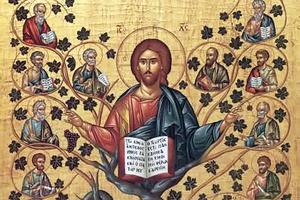
The reversionist believes that, despite Jesus coming to save both Jews and Gentiles, according to Romans 1:16, the Old Covenant continues in parallel for those who have rejected Christ. It is ignorant of the fact that the New Testament talks about both those who are cut off from the vine (which is Christ) and those who are grafted in:

If some of the branches have been broken off, and you, though a wild olive shoot, have been grafted in among the others and now share in the nourishing sap from the olive root, do not consider yourself to be superior to those other branches. If you do, consider this: You do not support the root, but the root supports you.  You will say then, “Branches were broken off so that I could be grafted in.” Granted. But they were broken off because of unbelief, and you stand by faith. Do not be arrogant, but tremble.  For if God did not spare the natural branches, he will not spare you either.

(Romans 11:17-21 NIV)
The Old Covenant law does not save:

For what the law was powerless to do because it was weakened by the flesh, God did by sending his own Son in the likeness of sinful flesh to be a sin offering. And so he condemned sin in the flesh, in order that the righteous requirement of the law might be fully met in us, who do not live according to the flesh but according to the Spirit.

(Romans 8:3-4 NIV)

It was only ever a shadow:

The law is only a shadow of the good things that are coming—not the realities themselves. For this reason it can never, by the same sacrifices repeated endlessly year after year, make perfect those who draw near to worship. Otherwise, would they not have stopped being offered? For the worshipers would have been cleansed once for all, and would no longer have felt guilty for their sins. But those sacrifices are an annual reminder of sins. It is impossible for the blood of bulls and goats to take away sins.

(Hebrews 10:1-4 NIV)

Which is made obsolete, in Christ:

But in fact the ministry Jesus has received is as superior to theirs as the covenant of which he is mediator is superior to the old one, since the new covenant is established on better promises. For if there had been nothing wrong with that first covenant, no place would have been sought for another. But God found fault with the people and said:

“The days are coming, declares the Lord, when I will make a new covenant with the people of Israel and with the people of Judah. It will not be like the covenant I made with their ancestors when I took them by the hand to lead them out of Egypt, because they did not remain faithful to my covenant, and I turned away from them, declares the Lord. This is the covenant I will establish with the people of Israel after that time, declares the Lord. I will put my laws in their minds and write them on their hearts. I will be their God, and they will be my people. No longer will they teach their neighbor, or say to one another, ‘Know the Lord,’ because they will all know me, from the least of them to the greatest. For I will forgive their wickedness and will remember their sins no more.”

By calling this covenant “new,” he has made the first one obsolete; and what is obsolete and outdated will soon disappear.

(Hebrews 8:6‭-‬13 NIV)

The outdated covenant *did* disappear with the destruction of the Temple.

From John the Baptist:

But when he saw many of the Pharisees and Sadducees coming to where he was baptizing, he said to them: “You brood of vipers! Who warned you to flee from the coming wrath? Produce fruit in keeping with repentance. And do not think you can say to yourselves, ‘We have Abraham as our father.’ I tell you that out of these stones God can raise up children for Abraham. The ax is already at the root of the trees, and every tree that does not produce good fruit will be cut down and thrown into the fire.

(John 8:7-10 NIV)

At no point does Jesus say that there will be multiple paths to salvation or that there will be a tree of salvation that stems only from being biologically linked to Abraham. There is one true vine, that is Jesus, some are cut off and destroyed, others are grafted in and saved. There is nowhere where it is said that the Old Covenant will be resurrected to provide another way for those who have rejected and continue to reject Christ. To preach that is heresy, it is reversionism, and replaces the true Israel (that is to say those who believed or the church) with a secular nation borrowing the name.

The New Covenant is not about an ethnostate or the Haaretz of Israel. No, it is about the heavenly kingdom, a kingdom where there is no Jew or Gentile, that is defined by faith rather than biological pedigrees. Our blessing, eternal life, comes through Christ Jesus alone.

Blessings of the Anti-Christ?

The reversionists base their entire interpretation on a misuse of this blessing given to Abram:

“I will make you into a great nation,
    and I will bless you;
I will make your name great,
    and you will be a blessing.
I will bless those who bless you,
    and whoever curses you I will curse;
and all peoples on earth
    will be blessed through you.”

(Genesis 12:2,3 NIV)

They ignore everything St Paul said to explain the seed of Abraham as being singular (Christ) in his rebuke of the foolish Galatians trying to revert back to the Old Covenant. Over and over again Scripture tells us of the failure of those who try to do things through means of the flesh and yet here we are again.

But even the passage itself is spoken specifically about Abram (later Abraham) and those who bless or curse him. It doesn’t say anything about those who bless or curse this “great nation” promised nor does it seem to be talking about nations period. It is a promise to Abraham specifically and then ends by saying that “all people on earth will be blessed through you” which is to say him or his seed, which again is Christ—who didn’t require blind allegiance to a worldly nation.

Furthermore, the modern state of Israel, with a powerful military and foreign backing, does fit the criteria of the nation God said must be fully dependent on Him. Israel is a progressive state, ranked 7th in the world for gay happiness, and one of the least religious countries in the world, and God’s Covenant with the nation of Israel was always conditional. Both Leviticus and Deuteronomy make this quite clear: If they obey God will bless them and if they do not they will be destroyed. Zionism, the Jewish version, makes the Jews themselves the saviors of the world and totally replaces Christ.

This being our own Christ and denying the true Christ is exactly what is being referred to when New Testament writers use the phrase anti-Christ:

Who is the liar? It is whoever denies that Jesus is the Christ. Such a person is the antichrist—denying the Father and the Son. No one who denies the Son has the Father; whoever acknowledges the Son has the Father also.

(1 John 22-23 NIV)

If there is a temple rebuilt, it will be the seat of the anti-Christ:

Don’t let anyone deceive you in any way, for that day will not come until the rebellion occurs and the man of lawlessness is revealed, the man doomed to destruction.  He will oppose and will exalt himself over everything that is called God or is worshiped, so that he sets himself up in God’s temple, proclaiming himself to be God. […] The coming of the lawless one will be in accordance with how Satan works. He will use all sorts of displays of power through signs and wonders that serve the lie, and all the ways that wickedness deceives those who are perishing. They perish because they refused to love the truth and so be saved.  For this reason God sends them a powerful delusion so that they will believe the lie and so that all will be condemned who have not believed the truth but have delighted in wickedness.

(2 Thessalonians 2:3,4,9-12 NIV)

And what a powerful delusion some believe, that puts the Church established by Christ behind the nation that rejected Him, this we’re told:

Dear children, this is the last hour; and as you have heard that the antichrist is coming, even now many antichrists have come. This is how we know it is the last hour.  They went out from us, but they did not really belong to us. For if they had belonged to us, they would have remained with us; but their going showed that none of them belonged to us.

(1 John 2:18-19 NIV)

Ultimately, choose whatever Israel you want. But you can’t have both. You can’t have your worldy Israel, that is rejected even by observant Jews who call it fraudlent, and then claim to be a part of the kingdom of Christ Jesus. Reversionism is in no way a Covenant with the God of Abraham. It is only a counterfiet of the original promise and one that draws many away from their only means of salvation. Don’t be one who is decieved by this new version of the same old heresy, don’t be like Judas looking for his worldly fulfilment. There is only one Israel where Christ is king and that’s His Church.

The saddest part about reversionism (or ‘Christian’ Zionism) is that it muddies the waters and sends mixed messages to those who need salvation. So many professing Christ and then supporting the brutal reality of what it takes to create a Jewish state on land that was inhabited is a slanderous and degrading witness of Christ who would have had no problem establishing a worldly kingdom through use of violence over two millenia ago. So many are like Gehazi, servant of Elisha, dishonoring the example of their master and inheriting the disease that was healed: “For what shall it profit a man, if he shall gain the whole world, and lose his own soul?”





Godly Men Should Honor (Not Patronize) Women

Standard

I woke up out of the ether with an utterly abandoned feeling and asked the nurse right away if it was a boy or girl. She told me it was a girl, and so I turned my head and wept. ‘All right,’ I’m glad it’s a girl. And I hope she’ll be a fool–that’s the best thing a girl can be in this world, a beautiful little fool.’

That quote of Daisy, from The Great Gatsby, about the birth of her daughter, sardonically expresses her resignation to the male-dominated society of her time. She is saying that it is better for a girl to be a fool—because for a girl to be anything other than that would be to live a frustrated and repressed life, like her own life.

It shows that Daisy, though always acting flighty and fake, a rich ‘privileged’ woman in the roaring 20’s, has far more depth to her character and real intelligence than she is allowed to openly display.

One might assume that someone in her position, all of her material needs met and sheltered from any responsibility, would be content. I mean, the wealth of her husband, the brutal Tom Buchanan, walled her off from the toils and freed her from work or consequences.

But, beneath the veneer of playfulness, she seems miserable. She was powerless beyond what her husband provided for her and merely acting out the role carved out for her by society, the part of a fool, rather than truly free.

There is only the slightest difference between walls intended to protect and walls that imprison, the smallest gap between guarding someone’s child-like faith and enabling their childish behavior, and a person can claim to be protecting others yet really only be protecting their position. There are many people, men in particular, who like to keep others around them weak so they can feel strong or needed.

A fundamental misunderstanding of the weaker vessel…

The idea that women can’t be expected to handle certain circumstances or rise to the same level of behavior as a man is not something new to me. I know in fundamentalist circles many men regard women to be wholly inferior to them (besides in child-bearing) and thus a comment to that effect was not completely unexpected. However, it was still a bit jarring, in the context it was given, to hear a woman being excused for her unsociable behavior because she, as the “weaker vessel” and thus somehow incapable of doing any better.

I had to wonder what women (conservative Mennonite women in particular) would think of that comment.

Is that what they really want?

Do they truly want to always be regarded as helpless, the perpetual damsel in distress, rather than be treated as an equal and emotionally/intellectually capable?

I have a feeling that is not the kind of male protection that most women want.

But then, I could be wrong, my lack of success in the realm of conservative Mennonite courtship could indicate that my treatment of women as an intellectual equal was a grave error. Perhaps this is why I’ve been described as “intimidating” by a couple intelligent Mennonite women? Could it be that women really do feel better being coddled and patronized?

I will say that many women, especially attractive women, expect to be catered to and this is because men (including yours truly) are generally nicer to them for a variety of reasons—some of those reasons less noble than those more often expressed.

Anyhow, these hidden wants, openly expressed opinions and general tendencies aside, the real question is whether or not this is what the “weaker vessel” of Scripture truly means. Yes, obviously, women are, on average, weaker than men in terms of some measures of physical strength. But does this make women more feeble and less capable in all regards? Are women generally inferior to men?

Here’s the text:

Likewise, ye husbands, dwell with them according to knowledge, giving honour unto the wife, as unto the weaker vessel, and as being heirs together of the grace of life; that your prayers be not hindered. (1 Peter 3:7 KJV)

I used the King James version because other translations replace “vessel” (σκεῦος) with “partner” or “sex” and potentially muddy the waters as far as this question more than they make things clearer. Again, I’m not an expert on the Greek language, but judging by how this word is translated elsewhere (John 19:29, Romans 9:21, Acts 9:15,10:11, etc), the word “vessel” seems to be a more literal, direct and appropriate translation.

That word “vessel” is an important qualifier to the word “weaker” (ἀσθενής) that precedes it. It is used in reference to objects or physical things and, in context of 1 Peter 3:7, would be reasonably understood to be a reference to a woman’s physical body rather than her person in general.

But more important is the rest of what is said. First, this passage is specifically about the relationship between husbands and wives. Second, the answer to a woman being the “weaker vessel” is for husbands to give “honour” (τιμή) to her, which means to value her, as one “being heirs together” with him, and it never suggests treating her like an inferior. If anything, this is an instruction not to use a woman’s lack of physical strength as means to diminish her other abilities or as a reason to otherwise patronize to her.

Yes, certainly we should protect what is valuable and Paul warns (similar to Malachi 2:13-15) about a man’s prayers being hindered if he mistreats his wife. However, that’s not the same thing as saying that we should be an enabler of weakness or should create unhealthy dependencies in our marriages. It is certainly not an excuse to allow a woman to act in an unChrist-like, inappropriate or otherwise unsisterly manner in the church.

The sexism of lower expectations is not honoring or Scriptural…

For the same reason we tell a bully “pick on someone your own size” we also say “don’t hit a woman” and should always take a clear stand against those who would exploit weaker people. Scripture always sides with the protection of the poor and against the oppression of the weak.

However, protection is not the same thing as pandering and nor does having Christian compassion mean we should coddle. No, a man should use his strength to encourage, empower and strengthen the weak. His role should be to give a space for his family to flourish. I believe that is the goal of our protection. Men protect the weak, in essence, by lending them our physical strength against external threats and that allows their abilities to shine rather than be crushed.

It is well-established that countries that protect the property and freedoms of their citizens prosper economically compared to those that exploit and/or do not. This is because people who know their work will likely be stolen have no reason to innovate or be ambitious. Likewise, a man who is a controlling tyrant, who sees his wife or children as wholly inferior, even if he does prevent their being exploited by others, will stifle and destroy the abilities of those entrusted to him.

Sure, maybe some women do employ their weakness as a means to get what they want in a relationship. I also know a couple cases of wives who can’t make their own decisions and depend on their husbands for everything besides picking the color of the drapes. But that level of dependency is not a good thing nor is it something we find in Scripture as an example of exemplary womanhood either:

A good wife who can find? She is far more precious than jewels. The heart of her husband trusts in her, and he will have no lack of gain. She does him good, and not harm, all the days of her life. She seeks wool and flax, and works with willing hands. She is like the ships of the merchant, she brings her food from afar. She rises while it is yet night and provides food for her household and tasks for her maidens. She considers a field and buys it; with the fruit of her hands she plants a vineyard. She girds her loins with strength and makes her arms strong. She perceives that her merchandise is profitable. Her lamp does not go out at night. She puts her hands to the distaff, and her hands hold the spindle. She opens her hand to the poor, and reaches out her hands to the needy. She is not afraid of snow for her household, for all her household are clothed in scarlet. She makes herself coverings; her clothing is fine linen and purple. Her husband is known in the gates, when he sits among the elders of the land. She makes linen garments and sells them; she delivers girdles to the merchant. Strength and dignity are her clothing, and she laughs at the time to come. She opens her mouth with wisdom, and the teaching of kindness is on her tongue. She looks well to the ways of her household, and does not eat the bread of idleness. Her children rise up and call her blessed; her husband also, and he praises her: “Many women have done excellently, but you surpass them all.” Charm is deceitful, and beauty is vain, but a woman who fears the Lord is to be praised. Give her of the fruit of her hands, and let her works praise her in the gates. (Proverbs 31:10‭-‬31 RSV)

That is not a limp-wristed wimp of a woman who follows two paces behind her man to keep in her place. No, that is a human dynamo, a force to be reckoned with and not that extremely anxious woman waiting for her husband’s input before doing anything on her own. No, the ideal woman, according to Proverbs, is the one who “makes her arms strong” and engages in commerce, a manager of a wide variety of affairs, and a wise teacher to boot.

Paul didn’t write so that men would lower their expectations for women. No, Paul has many expectations for women. Including in the verse prior (1 Peter 3:6) where he tells women not to be fearful. Telling a woman not to be fearful (φοβούμεναι) is the same as telling her to be emotionally strong and mentally capable.

It is not honoring of women to treat them as generally inferior or incapable.

How should men honor women?

Strengthen the weak hands, and make firm the feeble knees. Say to those who are of a fearful heart, “Be strong, fear not!” (Isaiah 35:3‭-‬5a RSV)

Honoring means to protect and protect means to strengthen.

A wise man knows that he might not always be able to provide for his wife and children. For that reason, he will protect them by making them strong and not only shelter them with his own strength.

Yes, there is a kind of man who likes to keep others around him permanently disabled so that he can feel strong and useful. There are also women who enjoy being fearful and hanging on the arms of any man who will give them attention. But there is nothing in Scripture that suggests we should encourage this kind of codependent behavior and plenty that indicates we should strengthen and bring out the best in each other.

Men and women may serve different roles in the church and home. After all, people are different, regardless of gender, with different strengths and weaknesses. However, acknowledging that the reality of our differences in strength and honoring the “weaker vessel” does not mean treating anyone as our intellectual, emotional, or spiritual lesser. What Paul is really teaching, in a fuller context of Scripture, is that we not use our own physical strength as a means to diminish the abilities of our wife and rather we should honor her as someone capable.

In the end, nothing good comes from pandering to the women. Instead, we should respect them as capable, despite their lack of physical strength, and should encourage them (as Paul does) to be free rather than fearful. Fundamentalist purity cultures do the opposite, they seek to subjugate the weak and twist Scriptures (sometimes ever so slightly) to justify their dishonoring treatment of women. It is very subtle in some cases, it can be as small as lowering expectations based on gender alone, yet it is pervasive and perverse.

Maybe these men need a reminder? The word “helpmeet” used in Genesis 2:19-20 denotes a “suitable helper” and uses the same Hebrew words used to describe God’s help in battle. It does not imply subordination. It implies capability and strength. So, if we do not honor God through our doubt, then we do we honor women by lowering our expectations for women. Instead, we use our own unique strengths to encourage and strengthen each other.

A woman can be so much more than “a beautiful little fool” and we should not deprive them of the opportunity to rise up to the challenge of meeting the standards of competency that we would expect from a man—so do not dishonor her with sexism of low expectations.