Saved In Childbearing

Standard

My own views have migrated from spiritual imagination to sustainable compared to the unsustainable.  Civilization was built by the participation of many who assumed roles that fit their qualifications and now is on the brink of collapse as we deny nature.  We’re on a path that is unsustainable because we deny nature.

What is nature?

Nature is that, as we mature beyond the age of childhood, inborn sexual desires lead us to seek a partner.  And, when successful, “A man leaves his father and mother and is united to his wife, and they become one flesh.” (Gen 2:24 NIV) The purpose of this joining of man and woman? A multiplication from two to three, four, five, or more.  That is to say that in marriage we’re fruitful.

The point of this blog is not to be preachy or tell anyone what to do, rather it is to outline a problem and share a few Bible references for fun.  Scripture is part of the tradition and foundation of our civilization and could help us to diagnose where things are possibly going wrong as we stumble.  All across the developed world population collapse looms and it will be a disaster for little old you.

This is a topic even more important if you’re irreligious, think this is all there is, and aren’t aiming for “treasures in heaven,” because it could impact your retirement plans.  This is purely a numbers game how it plays out, if there aren’t enough people to make stuff or provide services, there is nothing for you to buy—your current lifestyle might be the high point of your life.

But even if you are ‘heavenly-minded’ there is still plenty of reason to reconsider some of the attitudes that I’ve witnessed within conservative groups.  Truly, fundamentalists need to fix their courtship gambit more than anyone else.  There are plenty of women in those circles who are ‘married to Jesus’ and are really only married to themselves, their idealistic visions—and in total denial of the real cause of their lack of success.

I call out women, in particular, because they are the true gatekeepers of romance.  If you are a half-ambitious guy you just know this, I’ve been turned down so many times that I have lost count.  There were some, basically average, girls who would sooner get cancer and die than go on a first date with me or a man who did not fit a long list of superficial or social status requirements.

Yeah, it worked out for some of them, but a great many wasted their fertile years trying for unattainable perfection.

What does the Bible say?

This know also, that in the last days perilous times shall come. For men shall be lovers of their own selves, covetous, boasters, proud, blasphemers, disobedient to parents, unthankful, unholy, without natural affection, trucebreakers, false accusers, incontinent, fierce, despisers of those that are good, traitors, heady, highminded, lovers of pleasures more than lovers of God; having a form of godliness, but denying the power thereof: from such turn away. For of this sort are they which creep into houses, and lead captive silly women laden with sins, led away with divers lusts, ever learning, and never able to come to the knowledge of the truth. (2 Timothy 3:1-7 KJV)

I don’t think this is the end of all, but it might be the end of us.  Typically verses like those above get applied to those who are outside the group.  It is “the world” that is full of narcissistic self-seeking types.  And indeed the secular-minded have led the way as far as being unbound to any natural responsibility.  But the church is often guilty of the same things albeit covertly and wearing a righteous disguise—in the manner of the Pharisees:

And he continued, “You have a fine way of setting aside the commands of God in order to observe your own traditions!  For Moses said, ‘Honor your father and mother,’ and, ‘Anyone who curses their father or mother is to be put to death.’  But you say that if anyone declares that what might have been used to help their father or mother is Corban (that is, devoted to God)—then you no longer let them do anything for their father or mother. Thus you nullify the word of God by your tradition that you have handed down. And you do many things like that.” (Mark 7:9-13 NIV)

What Jesus is addressing is how the most pious of his day would use sanctimonious claims to override practical commands.  In the example he gives they were claiming to be saving their resources to give to God and thus not able to take care of their parents. It was an excuse.  They used the missional as a cover for their big neglects closer to home and, likewise, many today say that they are fully dedicated to God’s kingdom by doing fun projects in Uganda—but are they loving their brothers and sisters in Christ?

I suppose we could blame St Paul for being seemingly all over the map on marriage and if we should pursue it.  Then again, maybe the point of 1 Corinthians 7 where he makes singleness a higher calling is simply for the sake of encouraging those who did not find that special person and basically reminding them they have greater freedom to do God’s work while not married.  But it is abundantly clear that church growth comes through the production of children.  And women, those most likely to be led astray, play the most vital role in this: 

I do not permit a woman to teach or to assume authority over a man; she must be quiet. For Adam was formed first, then Eve. And Adam was not the one deceived; it was the woman who was deceived and became a sinner. But women will be saved through childbearing—if they continue in faith, love and holiness with propriety. (1 Timothy 2:12-15 NIV)

Again, I don’t expect anyone to believe this, this could simply be the misogynistic blathering of an entitled Jewish guy who found Jesus as a means to advance his social agenda.  But, if you’re a Christian, then what exactly does “Women will be saved through childbearing” mean so far as the church today?

First, this is an allusion to Mary and her role in the salvation of the world.  According to the Gospel, God chose to come into the world through the natural means of pregnancy and birth.  Second, it tells us something about the vital role of women in the church and matches or supersedes any speaking role.  This absurdity that shaping the world comes only through opening our mouths is why many women sacrifice their potential as the literal creators of the future.

Motherhood Is Most Important 

Feminism measures value in only the most masculine terms.  It tells us that the natural and traditional role of women is worthless and that women need to compete with men for money and political power.  But the core of this ideology is an attack on motherhood and doing that one thing no man could ever do—only a woman can give birth.

But the degrading of motherhood is not only a matter of women being told that they need to be toxically independent of men economically, but also in turning children into a burden, a parasite and something to be exterminated before they have a chance to say, “Momma.”  Birth control and abortion send a message that the next generation is not important, that it is a liability rather than an asset, and there is nothing further from the truth.

During COVID the same people who told us to mask up or we’re killing Grandma or had made shrines to George Floyd continued to lead the assault on the youngest and most vulnerable population.  It makes no sense, old people will die no matter what we do to protect them.  Black women terminate their pregnancies five times the rate that other women do, but the topic of the day is black lives matter and protecting others through our own self-sacrifice?

The reality is that the war on motherhood is sacrificing our own future.  We really should be thinking of our Grandma and what the world will be like if we don’t follow in her footsteps by raising the next generation.  The reality is that Social Security is a Ponzi scheme and can only be sustained through population growth.  Even if it were paid for, money has no value unless there is someone to offer their labor in exchange for it.  That savings of dollars is useless without any qualified people to fill positions.

Our narcissism will catch up to us one way or another.  The short-sighted pursuit of a career will have consequences.  Taking the pleasures while denying the responsibilities that nature has intended will inevitably lead to a snapback.  We can artificially cheat the system for only so long before nature starts to push back to eliminate a threat.  History is littered with those who thought themselves to be gods only to be humbled.

The Sustainable Church

Evangelicalism, in particular the focus on conversionism, the Bible out of context of the religious tradition that formed it, and a focus on activism, has eroded communities and put the primary conduit of the Gospel (children of Christians) in second place to information distribution efforts.  The true Church is about Communion, about bringing a little of the heavenly kingdom to Earth, it is about households being saved.  And that is where a woman’s role of bringing new life into the world—which is what sustains any ‘spiritual’ movement.

We need less talk.  Rather than push more speaking roles or more of those glamorous foreign adventures, as if this wasn’t only what St. Paul and a handful of others did in the early Church, there should be a move to what has been most effective for centuries and truly where grows a community of the faith.  We need to give the men who wish to be married and provide for their wives and families the opportunity to be fathers.  We do it by normalizing the natural good again.

There is an overabundance of glory-seeking men and women, desperate for higher social rank and more attention.  They love to have their name on a prayer card while living on the dime of others.  They’re too busy with information warfare to realize that the most powerful witness of Christ is love closer to home.  It was the ‘important’ people who Jesus had condemned for ignoring the bloodied man left for dead along their path or stepping over Lazarus as they went about their business—they thought themselves righteous and were on the road to hell.

There are many reasons why the Christian West is dying and declining birthrates are the biggest contributing factor.  This is partly due to the emphasis on missionary work rather than the ministry of motherhood.  We would save more people—save even our own future—if we shifted back to fruitfulness and being multiplied.  If you have a worldview to spread you don’t do it with tracts shoved in faces.  No, you do it by doing it or good old-fashioned procreation.  So get married young, have many babies, and you’ll be blessed in your old age.

The role of mothers is as important as any man in the church and most will find out too late why that is.  Don’t be one of those who has only regret to accompany them in their twilight years.  You’ll need to decide if holding out for Mr Right is truly worth postponing your greatest calling.  Many men, currently banished to singleness, would make good husbands and fathers if given a chance.

Watching Gran Torino With My Asian Son

Standard

After reading a review of Gran Torino, a Clint Eastwood movie from 2008, that dismissed it as shallow in its exploration of racism, I’ve decided to explore some of the depth of the movie that was missed.  It was a great story about finding common ground, that takes a bit of twist at the end from the typical Clint Eastwood film.  My family (mixed race and culture) could appreciate the themes more than the average viewer—yet is a beautiful redemption story that all people can enjoy as well.

“Get off my lawn!'”

The story is about an angry old man who is not dealing well with change.  Walter ‘Walt’ Kowalski, a Polish-American retired auto worker, Korean War veteran, and recent widower—his beloved wife passing right before the start of the narrative.

In the opening frame, he fits a stereotype of an elderly homeowner defending their patch of turf from an encroaching world.  It seems every small town has one.  That guy who trims his front lawn with scissors and does not deal well with the trespasses of the younger generation, the snarling “get off my lawn” line from the movie became an instant meme.  

Why?  

It is just too familiar. 

The expression captures the essence of a fading dream.  The American middle class values property ownership.  A lawn, once a complete luxury and exclusively for wealthy estates, had become the mark of post-WW2 affluence.  Walt was the beneficiary of this period of economic growth.  He had lived a quintessential suburban life.  

But now it had become a nightmare.  It is not the same neighborhood anymore. The once tidy little homes, owned by people like him, had fallen into disrepair as a new group of immigrants took over.  The woman who he built a home with was gone.  His sons bought foreign brand vehicles and betrayed the legacy their father had built working at Ford.  The world Walt had known was falling apart and he was bitter.

That patch of land, other than the ghosts of his past, was all Walt really had left.  To set foot on it was to violate his sacred space.  It was a shrine.  And his 1972 Gran Torino in the garage likely represented the pinnacle of his productive career.  Since the Korean War ended in 1953, this would put this car purchase around two decades into civilian life with a young family and point when the future looked bright.  So he was clinging to what was left of his identity and willing to defend it with deadly force.

Demons of the Past

Early on we see Walt, the tough guy, who is playing a part.  His racist language is a part of the facade—a barrier he puts up—because the alternative is to be vulnerable—or a victim.  He is still haunted by his war experience, in the beginning using it as a threat, saying he could kill without remorse:

“Yeah? I blow a hole in your face and then I go in the house… and I sleep like a baby. You can count on that. We used to stack fucks like you five feet high in Korea… use ya for sandbags.”

However, later, when it comes to stopping the neighbor boy from taking revenge, we see the reality under the surface:

You wanna know what it’s like to kill a man? Well, it’s goddamn awful, that’s what it is. The only thing worse is getting a medal… for killing some poor kid that wanted to just give up, that’s all. Yeah, some scared little gook just like you. I shot him in the face with that rifle you were holding in there a while ago. Not a day goes by that I don’t think about it, and you don’t want that on your soul.

Just like today, where Russians are called “Orcs” and portrayed as subhuman by propagandists, racial and ethnic slurs were used against various Asian enemies of US policy in the region.  But for Walt, he knew better, he knew that it was not a demon at the receiving end of his rifle.  He had murdered a human child and he felt immense regret.  Note how he says “poor kid” rather than all of the racist terms he used freely throughout his conversations.  It is almost as if, up to this point, he had to reinforce the dehumanizing descriptions to keep ahead of his shame. The truth is Walt didn’t sleep like a baby. No, he was running his sins his entire life and exhausted.

Walt’s racism was part of his pretty much equal-opportunity disdain for other people, including the young parish priest, and his own family.  He was a broken and hurting man, who had driven away his children and was hiding his own terminal illness.  What he needed was some compassion, a safe place where he could finally let his guard down, and it was the persistent effort of a young Hmong neighbor that finally broke through his wall of insults.

Finding Common Ground

The review, that sparked my response, tried to overlay a “white savior” trope on the story and completely missed that it was Walt who was being saved!

*spoiler alert*

Yes, ultimately, Walt sacrificed himself for the sake of the Asian family next door.  But this only after Sue, played by an actual Hmong actress (some critics panned the amateurism, others praised), went above and beyond to disrupt his dismal world.  

She was his savior.

It was by her effort that he would face the demons of his past and could be at peace with his Creator.  It was a redemption story, a story of an old man who had lost his wife, lost his children, lost his religion and even lost his neighborhood, but finds life again by learning to love his enemies.

I can feel this character.  My own life didn’t go as planned.  I had to leave the religious culture where my hopes had been built.  I had a beautiful Asian woman who was patient with me while I was still lost in delusion and did not give up when times were difficult.  Now we have a blended-culture home.  Yes, my Filipino wife and son are different from me in many regards.  However, after seven years of knowing each other and now over a year of being married, our love has only continued to grow.  Some of my happiest moments were with her family in the Philippines and recently while visiting her relatives in Canada.

I am Walt.

My ‘Sue’ did save me.

The real story of Gran Torino is an old man who finds more common ground with those he had thought were strange than he does with his own children.  Once Walt had got past the superficial differences he realized he had more connection to these Hmong people than many who looked like him.  Unlike the war, he was now defending real people and not political ideologies.  He was fighting for the local community, against those within who are destroying it, and not gunning down random boys thrown into a conflict not truly their own.  The storyline is a comparison between perspectives and shows us what really matters in the end.

It is about relationships, not race.

It is about building bridges.

The ongoing dialogue between Walt and his priest demonstrates this.  The priest, who is of European descent based on appearance, is at first scoffed at by the grizzled military veteran for his youthfulness.  The baby-faced “Padre” is bluntly rejected by him: 

I think you’re an overeducated 27-year-old virgin who likes to hold the hands of superstitious old ladies and promise them everlasting life.

But, despite this insult, Father Janovich will not go away.  And eventually, with his persistence, he does earn the respect of Walt.  The bond, built over a few beers, culminates with Confession and Walt is finally able to have the guilt that had plagued him since Korea absolved.  Now he is free and at peace, ready for a last act that goes contrary to expectations and confirms the redemptive arc.  

It was faith that saved Walt, both that of the young woman who withheld judgment and didn’t allow his wall of nastiness to stop her and finally of the persistent outreach of the Church.  And it is only because of this concerted effort that we get to see the protagonist do what is right. By the end of the film, Walt has overcome those demons driving his anti-social behavior and also has gained a son worthy of his prized Gran Torino.

Now To Review the Reviewer…

Why did the critic miss the obvious?

The reviewer who inspired me to write my own was projecting their own worldview onto the script. Eastwood is a rare conservative Hollywood producer.  In fact, so conservative he spoke at a Republican National Convention and gave a mock interview with an empty chair, used to represent Obama, and he calls Biden “a grin with a body behind it.”  Perhaps it is this that the review is responding to?  But I think it goes a bit deeper than that.

The Marxist left sees the world as being a zero-sum game, or that for some people to gain others must lose, and thus everything is a competition for power.  But, not only this, but everything is divided up into strictly bounded categories based on their skin color, financial status, or sexual classification.  If someone cooperates across these lines then they are an “Uncle Tom” or traitor.  So the themes of Gran Torino just do not compute.  Asians are collaborators. Walt is an irredeemable privileged white man, he needs to be canceled—not humanized.

So, since we can’t have everyone come out as a winner, the only thing the woke reviewer has left is to hallucinate something color-coded and negative.  Thus they see a movie that tells us to reach across lines of age, culture, and race as just another “white savior” trope.  It is bizarre, such a narrow and distorted perspective, to entirely miss everything and then to insert what is not actually there.  Yes, Walt saves, but in the context of others saving him, and that’s not even the point.  The point of is that color (or age) doesn’t matter, finding our common ground and community does.

Gran Torino isn’t a perfect movie.  It may go a bit overboard with ethnic slurs at times.  But, then again, the comedic relief of the barber and Walt exchanging these insults as terms of endearment is also great commentary.  Why do we let words be “violence” when the same utterances can be laughed at in another context? It is because these words have the power we give them.  What this is suggesting is that we can go further when we reframe the conversation. 

The left wants to believe that our behavior is determined by what others have done to us—Eastwood says we can be free to live above their rules.

Politics may be all about power, in-group and out-group, but love overcomes all. 

Salvation from the Dark Cave — 5 Parallels Between the Rescue in Thailand and Spiritual Transformation

Standard

When I first heard the news about the Wild Boars, a youth soccer team, having gone missing in Thailand, I assumed these twelve boys along with their young coach were hopelessly lost in the flooded cave system and probably already dead or likely would be before anyone reached them. It had been over a week since they had disappeared and there seemed to be little hope of finding them alive.

For that reason, I was very happy to read the news of their being discovered by two British divers who were aiding the rescue efforts. Somehow, despite their ordeal of having to flee deeper into the cave to avoid the rising flood waters and having been trapped in the pitch blackness without food or light for over a week, these players and their coach were still alive. And what a great relief it must’ve been for them to see a person from the outside emerge from those murky waters that had entombed them.

However, that moment of joy was soon replaced by a new fear when considering the perilous journey they now had to face in order to make their escape. The divers who found them were some of the best in the world and many of these boys didn’t even know how to swim—let alone swim in conditions that experts described as extremely dangerous and conditions that tragically did cost one of their rescuers his life.

The question became one of could these boys be saved without a miracle?

This World Is A Dark Cave

We, unlike those boys who had been outside the cave, have never been beyond this world. While we can imagine that there could be something beyond, we are truly bound by what we can touch, taste, see or perceive in our minds. For many reality only extends as far as they are able to fathom. And yet science has discovered spectrums of light beyond our vision and philosophy has long challenged us to go beyond even ourselves, our rational minds, in our thinking.

Greek philosopher Plato imagined a scenario, the Allegory of the Cave, in which we were all born bound in a cave where most are chained where they can only see a shadow of greater reality projected onto the wall in front of them and some of these life-long prisoners are eventually freed. Those freed, we discover, have great difficulty explaining this greater perspective to those still bound. This scenario is pretty much describing our own perception of reality in a nutshell.

Some desire to look beyond the shadows and find a measure of freedom. However, there are many others who are content to live with the shadows and in denial. They are bound by religion, ensnared by the entertainment industry, distracted the pursuit of wealth, blinded by the daily grind or unable to see for any number of reasons and never realize that they are in a cave and chained to a wall and only seeing shadows of something greater.

There are also those who have realized they are trapped in a cave and yet also see the waters, have probed the escape routes from this reality and have understood the true impossibility of their predicament. They have lost hope. They are depressed and living in despair because they know that they are trapped and there’s nothing they can do about it.

Jesus Emerged From the Murky Waters

Those Thai boys and their coach had to know that they were doomed without divine intervention or outside help. During the rainy season (that started early and caught them by surprise) lasts into October and they only had supplies for an afternoon. The coach seems to have did his best to look after the boys, withholding rations from himself to give them a better chance of survival, and yet what he could provide was never going to save them from death in the darkness.

Even a strong swimmer had no chance to escape the under water labyrinth that separated them from the outside world. To find another path or dig their way out was impossible given their lack of necessary tools and provisions. Their resources (besides the water they could lick off the walls) were already exhausted. Even their oxygen supply was starting to dwindle and would disappear long before the flood waters would recede. They only had their prayers and hope for a rescue mission to hold back despair—without a savior were doomed.

That is essentially the story for all of humanity and the background for the Gospel of Jesus Christ. We are born, our forefathers having wandered deep into a cave of sin and our escape from this blocked by the waters of death. This whole world, the entire universe, in fact, is bound by physics to eventually run out of energy and our descendants, no matter how technologically advanced, will not escape that. This is a reality that can cause an intelligent forward-thinking person to wonder what is the point of living if death is all the future holds.

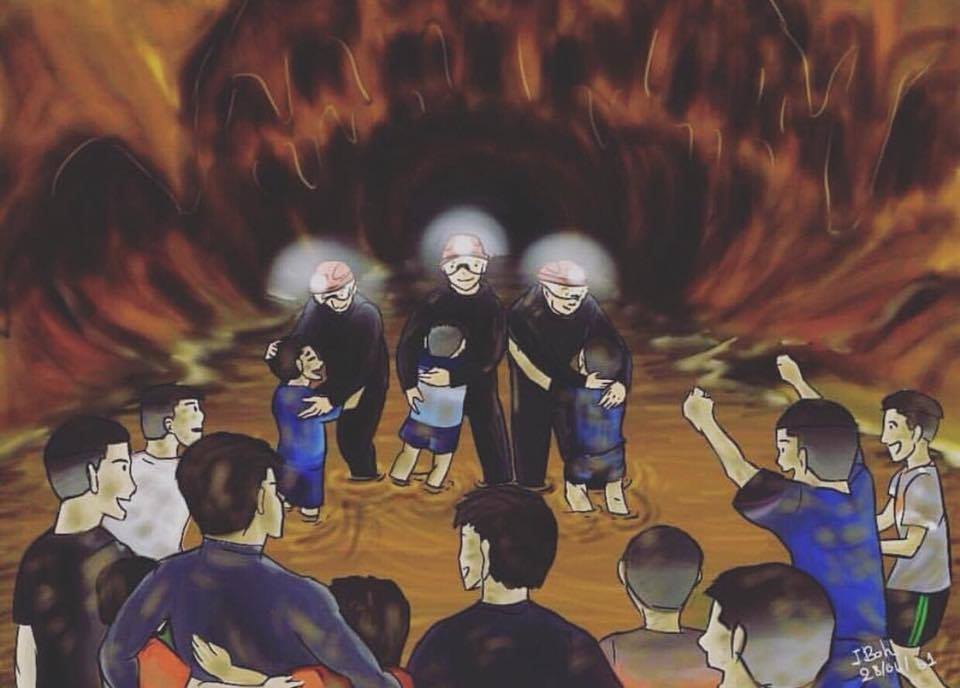
Drawing by Manatsawin Mungsungnoen

If one can imagine how welcomed a sight those British cave divers were for the boys and coach trapped in complete darkness and facing imminent death, then they can also imagine the feeling of elation that the disciples of Jesus felt having seen him after his emergence from the murky waters of death—His resurrected body, their resurrected hopes, and proof positive of his claim that there is eternal life for those who follow after Him.

We Must Take the Plunge of Faith

The happiness about those lost being found was soon replaced with a big question about how to get them from the cave to freedom. How could this half starved group of youngsters and their coach (who was even worse for the wear after selflessly giving his rations to the boys) get out of their subterranean prison?

Many options were discussed and ruled out one by one. There simply was not enough time for other solutions when oxygen levels began to drop, with the fullness of the monsoon season about to begin, and the consensus became clear: They would need to dive out like their saviors or die in the cave. This was something that had been impossible for them before, it was something extremely dangerous even for a veteran cave diver, and would be absolutely terrifying for someone claustrophobic. None of them were swimmers, let alone in any physical condition to match the world class athletes who found them, and I’m sure their fears could keep them paralyzed.

Where does one find the faith to do the impossible?

That was my question a few years ago.

You jump in, that’s how…

We Cannot Save Ourselves

The truth is, while we must take the plunge under the murky waters and swim for all we are worth, the journey out of the cave is not one we are able to do on our own strength. Like the rescue in Thailand took the coordinated effort of many men and women, we cannot possibly complete our journey to freedom without a community or the help of others. Rather we need to partake of the provisions left for us by those who have followed after Christ. We need to firmly grasp the guiding rope of the written and spoken tradition that the Church (2 Thessalonians 2:15) has left for us. And must also submit to those ordained to lead us to safety and who are responsible for leading us to salvation:

Have confidence in your leaders and submit to their authority, because they keep watch over you as those who must give an account. Do this so that their work will be a joy, not a burden, for that would be of no benefit to you. (Hebrews 13:17 NIV)

We live in an age where purported authorities are questioned, and rightly, for their abuses. There are many self-proclaimed (and self-promoting) religious experts who claim to have spiritual knowledge and have yet to truly take the plunge of faith themselves. These false teachers. They are ordained only by themselves, by their own arrogance, and are whom Jesus describes as being blind guides. You can know them by their fruits:

“Watch out for false prophets. They come to you in sheep’s clothing, but inwardly they are ferocious wolves. By their fruit you will recognize them. Do people pick grapes from thornbushes, or figs from thistles? Likewise, every good tree bears good fruit, but a bad tree bears bad fruit. A good tree cannot bear bad fruit, and a bad tree cannot bear good fruit. Every tree that does not bear good fruit is cut down and thrown into the fire. Thus, by their fruit you will recognize them. (Matthew 7:15‭-‬20 NIV)

Be sure that those who lead you have a true connection to the world beyond. Do they shine a light that pushes back against the darkness? Do they bring you nourishment and spiritual air? For those trapped in the cave in Thailand, it is clear who came from the outside and why they are there. The rescuers come with provisions, they administered first aid to those in need and built the trust of the boys to follow their lead and instructions.

These teachers, without a doubt, played a critical role in the salvation of those trapped in the cave and we too need those who have experience beyond our own to provide calm and guide us through the fog, currents, and confusion of life.

We Must Die to Save Others

As I entered the church building on Sunday the final act of the rescue mission started. The Gospel text was, interestingly enough, about some friends of a paralytic and their faith that carried him to Jesus:

Jesus stepped into a boat, crossed over and came to his own town. Some men brought to him a paralyzed man, lying on a mat. When Jesus saw their faith, he said to the man, “Take heart, son; your sins are forgiven.” (Matthew 9:1‭-‬2 NIV)

The account goes on with Jesus first addressing the naysayers and critics for their evil thoughts before going on to fully heal this man. But this detail about Jesus seeing the faith of these men is something I had missed before. It was their carrying him, like the divers leading the boys out of the hopeless depths, that led to this man being forgiven and freed from his paralysis. It is our job to carry each other back to Christ and that is the purpose of a Christian community and the Church. It is our faith that leads to the healing of others.

Like these men carrying their friend or the “buddy system” of experienced divers leading the young boys through the darkness to the light, we too must serve a role in the salvation of others. The Christian mission is to participate in the salvation of others in much the same way as those, who came from around the world and volunteered to risk their own lives—not for financial gain, not for their own biological children and not compelled by force. They simply saw a need, a desperate need, and became the solution.

Sgt Major Saman Kunan

Many have sacrificed time and volunteered their talents to aid in the search and rescue effort in Thailand. But one man, Sgt Major Saman Kunan, a retired Thai Navy diver, gave his own life so those boys could be saved. This hero, after delivering oxygen canisters needed for the daring escape, ran out of oxygen himself and perished.

And that is the responsibility of all Christians. We are to find lost sheep, feed them, heal their wounds, lead them out of harm’s way, and even give our lives for them. We are to be Christ in every sense of the word and that means dying to ourselves and saving the lost from their dark cave.

We need to be faithful to those who are lost without a hope.

How God’s Economy Differs From Our Own

Standard

In three prior blogs (on topics of law, legalism and church authority) I’ve tried to present the Biblical basis and lay the theological groundwork necessary to establish concepts I will introduce in this post. I wish to remind my readers once again that I do not speak in any official capacity, I am not ordained, and encourage y’all to investigate these matters for yourselves rather than just take my word for it.

There are several cases in Scripture of people asking what they must do to be saved. In Acts 2:37-39, when the crowd asks what they must do, Peter answers:

Repent and be baptized, every one of you, in the name of Jesus Christ for the forgiveness of your sins. And you will receive the gift of the Holy Spirit. The promise is for you and your children and for all who are far off—for all whom the Lord our God will call.

Later, in Acts 16:31-34, a Roman jailer asks: “Sirs, what must I do to be saved?”

This is how Paul and Silas replied:

“Believe in the Lord Jesus, and you will be saved—you and your household.” Then they spoke the word of the Lord to him and to all the others in his house. At that hour of the night the jailer took them and washed their wounds; then immediately he and all his household were baptized. The jailer brought them into his house and set a meal before them; he was filled with joy because he had come to believe in God—he and his whole household.

We read the testimony of the apostle Paul, in Acts 22, where he describes his dramatic conversion on the road to Damascus. He describes a blinding light, being confronted by Jesus, and how he asked what he should do. He is told to continue on the road and meet a man named Ananias who restores his sight and then tells him: “Get up, be baptized and wash your sins away, calling on his name.”

And we also have this explanation of salvation by Peter:

For Christ also suffered once for sins, the righteous for the unrighteous, to bring you to God. He was put to death in the body but made alive in the Spirit. After being made alive, he went and made proclamation to the imprisoned spirits—to those who were disobedient long ago when God waited patiently in the days of Noah while the ark was being built. In it only a few people, eight in all, were saved through water, and this water symbolizes baptism that now saves you also—not the removal of dirt from the body but the pledge of a clear conscience toward God. It saves you by the resurrection of Jesus Christ… (1 Peter 3:18-21 NIV)

All of those passages answer the question of what a person must do. All of them mention water baptism as a necessary step in this process. This emphasis on baptism reflects the preaching of John the Baptist who tied the practice with true repentance. It also is what Jesus clearly taught:

“Very truly I tell you, no one can enter the kingdom of God unless they are born of water and the Spirit. (John 3:5 NIV)

This is likely the reason why baptism is a sacrament that, traditionally, in an emergency or circumstance where there is nobody else, can be administered by anyone. One can repent and believe in their mind, but baptism should follow—because that is what Jesus taught, it is what the early Church believed and to this very day is still the tradition of the Church.

So, we can all agree that baptism is a requirement for salvation, right?

Probably not.

This is one point where legalists might carve out exemptions, turn Scripture against Scripture, or otherwise downplay the necessity of baptism. But no amount of theological twisting can overturn the rule. Baptism is absolutely a requirement for salvation and to argue against that is to deny what is clearly recorded in Scripture. Jesus says that “no one can enter the kingdom” without being “born of water” and we must assume that is exactly what he meant.

The Thief On the Cross, Judas, and the Kingdom

Of Thy Mystical Supper, O Son of God, accept me today as a communicant. For I will not speak of Thy Mysteries to Thine enemies, neither like Judas will I give Thee a kiss. But like the thief will I confess Thee: remember me O Lord, in Thy Kingdom.

One of the starkest contrasts in Scripture is between the thief on the cross beside Jesus and Judas who betrayed Jesus. It wasn’t a comparison I had considered before hearing the Orthodox liturgy (in the quotes above) and yet is a parallel that is quite poetic and very significant.

On one side of the comparison, we have the man who did everything right from a legalistic standpoint. Judas had followed Jesus for years, from all appearances he had done everything required of a disciple and was even trusted enough to carry the common purse. But Judas, despite his outward devotion, seems to have been full of bitterness and ends up betraying Jesus with a kiss—before he took his own life. His name has become synonymous with betrayal and treason.

On the other side we have the account of two criminals crucified beside Jesus on the cross:

One of the criminals who hung there hurled insults at him: “Aren’t you the Messiah? Save yourself and us!” But the other criminal rebuked him. “Don’t you fear God,” he said, “since you are under the same sentence? We are punished justly, for we are getting what our deeds deserve. But this man has done nothing wrong.” Then he said, “Jesus, remember me when you come into your kingdom.” Jesus answered him, “Truly I tell you, today you will be with me in paradise. (Luke 23:39-43 NIV)

This man called “the thief” was a criminal who acknowledged that his punishment was just and defends Jesus against the mocker on the other cross. We have no reason whatsoever to believe he lived an upright or righteous life. There is no evidence of this man being baptized. He doesn’t ask Jesus into his heart nor does he recite a creed. He simply pleas, with his dying breaths and a little faith, “remember me” and Jesus, in response, tells him: “Today you will be with me in paradise.”

Does this mean that we should stop baptizing people?

Does this mean that we can continue in sin that grace may abound?

No and no.

There is no excuse for sin and there is no exemption for baptism either. There is, however, an order or a hierarchical arrangement of priorities and at the top of it is something beyond mere religion. What matters most is God’s grace and having the faith to fully put our trust in Him as our salvation. This something the thief could do and that Judas could not. Judas, for all his outward displays of righteousness and despite doing everything that was required of a disciple, had faith in his own understanding rather than in Jesus.

There are many sincere folks today who try to reduce Christianity to a list of dos and don’ts. And, instead of an abundance of life or resembling Jesus, they are rigid, anxious, jealous, judgmental, unforgiving and too often a stumbling block to those young in the faith. They believe that they are receiving salvation as a trade for their own righteousness and careful obedience. They often end up like Judas, bitter and critical, and refuse to truly put their faith in Jesus.

No amount of ritual obedience or religion can save a person who has faith only in themselves. We should like the thief who knows they are doomed without God’s mercy and not Judas who was righteous by outward appearance and lacked faith. Being a lowly criminal with a repentant heart is eternally better than being a disciple who judges others by his own standards and betrays Jesus.

God’s Economy Is Different From Our Own

Those trying to earn God’s favor, like the Pharisee who boasted in prayer about his righteousness compared to another man, have a desperate need to justify themselves. And, like the Prodigal son’s older brother who was angry because of the grace shown to his openly rebellious younger sibling, many have an entitled attitude and believe that their obedience and works means they are owed. It is because they believe that God’s economy is merit-based like their own. They try to earn points by obeying the law and fail to comprehend their own woefully inadequate position before Almighty God.

Jesus, in the parable of the laborers in the vineyard, contrasts God’s economy and our own:

“For the kingdom of heaven is like a landowner who went out early in the morning to hire workers for his vineyard. He agreed to pay them a denarius for the day and sent them into his vineyard. “About nine in the morning he went out and saw others standing in the marketplace doing nothing. He told them, ‘You also go and work in my vineyard, and I will pay you whatever is right.’ So they went. “He went out again about noon and about three in the afternoon and did the same thing. About five in the afternoon he went out and found still others standing around. He asked them, ‘Why have you been standing here all day long doing nothing?’ “ ‘Because no one has hired us,’ they answered. “He said to them, ‘You also go and work in my vineyard.’ “When evening came, the owner of the vineyard said to his foreman, ‘Call the workers and pay them their wages, beginning with the last ones hired and going on to the first.’ “The workers who were hired about five in the afternoon came and each received a denarius. So when those came who were hired first, they expected to receive more. But each one of them also received a denarius. When they received it, they began to grumble against the landowner. ‘These who were hired last worked only one hour,’ they said, ‘and you have made them equal to us who have borne the burden of the work and the heat of the day.’ “But he answered one of them, ‘I am not being unfair to you, friend. Didn’t you agree to work for a denarius? Take your pay and go. I want to give the one who was hired last the same as I gave you. Don’t I have the right to do what I want with my own money? Or are you envious because I am generous?’ “So the last will be first, and the first will be last.” (Matthew 20:1‭-‬16 NIV)

It is easy to understand why those who started early in the morning and worked all day might feel slighted at the end. They had spent their entire day sweating it out, trying to earn their wage, only for some to come during the day or even at the last hour and receive the same compensation. From a laborer’s perspective, it seemed unfair. Shouldn’t those who did more also get paid more for their efforts?

But the landowner had not hired them to judge such matters for themselves. It was the landowner’s money to spend as he wished, he was not obligated to hire anyone, he had gone out to find them, they had all agreed to the wage they were paid and were truly owed nothing more than what they had received. It was a fair wage when they were hired and that fairness did not change because of the landowner’s generosity to those hired later.

But what point was Jesus trying to make with this story?

It is interesting that this story comes right in the heels of the account of the rich young ruler who asked what he must do to be granted eternal life—which contains the same “the first shall be last” refrain. This man had kept the law from his youth. But when he asked what he lacked, this is how Jesus replied:

“If you want to be perfect, go, sell your possessions and give to the poor, and you will have treasure in heaven. Then come, follow me.” (Matthew 19:21 NIV)

If you stopped reading there you might end up like Judas who used those words of Jesus as a means to criticize an extravagant act of worship and to hide his own corrupt self-centered motives. There are many today who read the words of Jesus legalistically, they see the story of the rich man then add one more item to their list of religious requirements, and entirely missing the point.

However, there’s more to what Jesus said. If you keep reading you will see how the disciples were “greatly astonished” and ask Jesus “who then can be saved?” They, even as those who had already left everything behind to follow Jesus, understood the severity of what Jesus told the inquiring rich man. If keeping the law wasn’t enough, what then?

How Jesus answers is clear: With man this is impossible, but with God all things are possible. (Matthew 19:‬26 NIV)

That is the answer to the rich man’s question.

It is impossible.

That is also what the parable of the laborers is about. Those who had started early in the day represent those relying on their own efforts and are completely lacking appreciation for the one who made their earning anything possible. They were upset that the landowner was paying those who came later the same as them because they felt their labor had been devalued and yet the only value their labor had was what the landowner was willing to pay them. They didn’t create the circumstances of their own employment, how could they possibly be in any position to judge what was fair compensation for someone else?

The point Jesus is making is only God can save us. If you believe your works can save you, even if you sell all and give to the poor, you are no better than that rich man. The rich man had kept the law and yet lacked true faith in Jesus. He had faith in himself as a good religious person, he thought he could do something to save himself, and yet salvation does not come from our own effort.

The reason why it is difficult for a rich man to enter the kingdom is that they are able to depend on their own effort and thus are adequate without faith in their own minds. It was that self-sufficiency, the idea that a human can earn their way into eternal life, that Jesus confronts in the rich man. A person relying on themselves does not understand that without faith it is impossible to please God (Hebrews 11:6) or that their salvation depends fully on God’s choice and not their own:

You did not choose me, but I chose you and appointed you so that you might go and bear fruit—fruit that will last—and so that whatever you ask in my name the Father will give you. (John 15:16 NIV)

Akribeia: We Cannot Please God Through Perfection on Our Own Terms

There are many trying to please God with their own righteousness. That is to assume that God will somehow want or need us if we are good enough and that is completely absurd. It is a path to misery or arrogance. If you try to win God’s favor through your works and have any grasp of how your own best efforts compare to absolute perfection, you will be miserable. And, if you can delude yourself into believing that you are able to live to a perfect divine standard you are an insufferable moron.

Our salvation is not based on our own effort and cannot be. The rich man’s perfect obedience to the law of Moses couldn’t please God. And those trying to save themselves by turning the words of Jesus into a new law will likewise fail. Being a Christian requires obedience to a standard that goes well beyond the law of Moses and even beyond a legalistic interpretation of Jesus. It requires absolute and impossible perfection.

This is where the word “Akribeia” comes in. It is a Greek word (ἀκρίβεια) that means exactness or precision and refers to strict adherence to the law in Christian usage. We are all judged according to Akribeia and found lacking in comparison to this absolutely perfect standard. Even if you have followed the words of Jesus perfectly as a law you will still have fallen infinity short of God’s glory and are no better than the rich man or Judas.

No amount of obedience to the law, outside of God’s grace, can save anyone. Salvation is not something we receive in trade for our works. Our perfection doesn’t come from our works. We can’t even know what perfection is at God’s level, let alone live it out, and even if we could, that would still not entitle us to anything and would still leave us condemned to death with no hope of eternal life.

This is our salvation:

For it is by grace you have been saved, through faith—and this is not from yourselves, it is the gift of God—not by works, so that no one can boast. For we are God’s handiwork, created in Christ Jesus to do good works, which God prepared in advance for us to do. (Ephesians 2:8‭-‬10 NIV)

Jesus is what gives us currency in God’s economy and not our own righteousness. A person who even begins to comprehend how their own righteousness stacks up compared to absolute perfection will know that even their best efforts to follow the law will fall infinitely short. The very idea of pleasing God through our own works of righteousness is an insult and is basically to try to put ourselves on the same level as Almighty God.

To please God you need to be on an equal basis with God and that is not something we as a created being can do for ourselves. Our own righteousness is nothing but a filthy rag by comparison to the glory of God. That is why we must be clothed in the righteousness of Jesus (Romans 13:14, Galatians 3:27) and are made worthy through his work rather than our own.

Legalism doesn’t comprehend Akribeia. Legalists believe they can win God’s favor and therefore are always trying to prove their righteousness compared to others. They seem to believe that being perfect is like outrunning a bear in that you only need to be faster or better than the guy beside them. That is why they are critical rather than helpful, judgmental rather than merciful, and self-righteous rather than humble. They are like that unrepentant thief on the other cross who continued to mock and ridicule despite being condemned.

However, when you serve a God who is impossible to please by your own efforts you will not be jealous or upset about the grace that is shown to others. Instead, you will come beside the weak, forgive their sins as you have been forgiven, and help them to bear their burdens rather than pile more on. A humble person understands “there but for the grace of God go I” and realizes that even by their best efforts they would only be condemned by the perfect law of God. It is then, and only then, after we have exhausted our own riches and righteousness, that we can be saved.

Oikonomia: The Economy Of Jesus and the Church

The Old Testament law is severe by our modern standards and many believe that Jesus relaxed these standards. But that is incorrect. The law of Moses only addressed outward behavior, but Jesus emphasized that even our thoughts could make us guilty of sin. The reality is that Jesus added to the severity of the standard. In the Sermon on the Mount, he taught that lust was comparable to the sin of adultery and equates hatefulness to murder. By that standard, we are all condemned to die.

Yet, while Jesus is making things literally impossible for the rich man and other good religious people, simultaneously he’s allowing his disciples to break the written law:

One Sabbath Jesus was going through the grainfields, and as his disciples walked along, they began to pick some heads of grain. The Pharisees said to him, “Look, why are they doing what is unlawful on the Sabbath?” He answered, “Have you never read what David did when he and his companions were hungry and in need? In the days of Abiathar the high priest, he entered the house of God and ate the consecrated bread, which is lawful only for priests to eat. And he also gave some to his companions.” Then he said to them, “The Sabbath was made for man, not man for the Sabbath. So the Son of Man is Lord even of the Sabbath.” (Mark 2:23‭-‬28 NIV)

What?!?

Didn’t Moses, by command of God, have a man executed for merely picking up sticks on the Sabbath?

Note Jesus did not take the Pharisees to task for their interpretation of the law. But he does give times when the law was set aside and then goes on to explain something that is key—he turns attention from the letter of the Sabbath law to the spirit or reason behind it. He tells these religious experts that the Sabbath was created for the man rather than man for the Sabbath. In other words, the Sabbath law was instituted for the good of men and that reason for the law triumphed over the strict legalistic application.

Jesus can do that. He can for the same reason he could heal the blind, walk on water or turn water into wine. The one who created all things is not subject to anything and that includes the moral laws he created. Furthermore, the purpose and or intent of the law always supersedes the letter and therefore the one who knows the reason behind the law perfectly is free from the letter. And, while the written law is essentially the God of the legalist, we (together, as the Church) who are clothed in Jesus are given the same authority over the law and this authority is demonstrated in the early Church.

Jesus, in giving his authority to bind and loose, through the promise of the Holy Spirit, made it possible for the Church to rule on circumcision in a way that went directly against what the written law taught. Physical circumcision is still an explicit requirement according to the book of Leviticus, yet physical circumcision was dismissed by the apostle Paul. That loosing from the law led to conflict in the early church. Some were teaching that circumcision was still necessary for new converts while others were saying that this Scriptural requirement could be ignored. So the Church held a council in Jerusalem (Acts 15) and decided to waive the requirement.

We, as individuals, can’t pick or choose for ourselves what Biblical requirements apply to us. However, the Church (collectively) has the same authority as Jesus on matters of the law and can show the same grace (in other areas of law) that was argued in Jerusalem as far as circumcision. The Church can also expel an unrepentant evildoer as Paul demanded to be done in a letter to the Corinthians. The word for this is Oikonomia (οἰκονομία or “economia”) and literally means “household management” and is basically the same concept that allows anyone to be saved. If the written law cannot be overruled by God’s economy, we would all be condemned to death—who then could possibly be saved?

It is for freedom that Christ has set us free. Stand firm, then, and do not let yourselves be burdened again by a yoke of slavery.

Mark my words! I, Paul, tell you that if you let yourselves be circumcised, Christ will be of no value to you at all. Again I declare to every man who lets himself be circumcised that he is obligated to obey the whole law. You who are trying to be justified by the law have been alienated from Christ; you have fallen away from grace. For through the Spirit we eagerly await by faith the righteousness for which we hope. For in Christ Jesus neither circumcision nor uncircumcision has any value. The only thing that counts is faith expressing itself through love. (Galatians 5:1-6)

The law is a means, not an end.

Love is the end.