
My son complains that he doesn’t get paid enough for household chores. He feels he is somehow entitled to everything that we’re giving him and more. It is a struggle trying to explain why we won’t simply hand him all that he wants. We have plenty, in his eyes, and can just share our wealth with him. But the reason we hold back isn’t our greed or that we don’t want him to have the best life has to offer. No, quite the contrary, in fact, it is because we want him to do well life that we resist the urge to coddle him.
What is coddling?
On the surface it is being overprotective and indulgent. It stems from distrust of another other person’s ability to deal with normal life situations and emotions on their own. And, while it may appear to be motivated by love or compassion, it only ever empowers those who keep the other confined to the bubble wrapped world. It is the devouring mother, the one who uses their nurture as a tool of control. They only care about the target of their efforts so far as it feeds their ego or feelings of self-importance. It is a virtue signal and degrades those coddled.
Bigotry of Low-expectations
Along with thoughts about parenting and the goal, some of the inspiration for writing this came from the governor of the state of New York, Kathleen Hochul, who declared:
Young black kids growing up in the Bronx, who don’t even know what the word a computer is, they don’t know. They don’t know these things. And I want the world open up to all of them, because when you have their diverse voices, innovating solutions through technology, then you’re really addressing societies broader challenges.
Other than to call this statement what it is: Bigotry (or racism) of low expectations and patronization. I’ll not pile on.
Many, like Hochul, are isolated. They have not spent much time in urban communities nor met the people who live there. From my own first hand experience her claim (which she now claims was misspoken) is absurd, none of the black I met were unfamiliar with or incapable of using computers. Many of my acquaintances there could afford to go to college and more credentialed than I am, so where does this notion come from that they’re hapless ignorant people in desperate need of government assistance?
The answer, in this case at least, is that it is hard to maintain a bloated state budget (let alone greedily expand it) without somehow justifying it and what better way to do that convince people that they need you to get somewhere in life?

Condescending political elites are not moral paradigms and minority voters are not stupid. I believe those pandered to know it is insincere and coming from someone who sees them as dumb. But they also understand it works to their advantage and don’t say no to it. We naturally take the path of least resistance and rationalize why we are deserving of the help. By playing up the consequences of slavery and impacts of racial prejudice, a little wealth redistribution (looting or theft) can be redeemed as social justice.
Unfortunately, low expectations produces what it is supposed to remedy, it gives an excuse to wait around for a handout and kills initiative. This contributes to racism in that it creates the impression that the only way some can compete is by lowering the bar or a double standard. It diminishes the accomplishments of those who knew what a computer is without the help of those in the the benevolent class. Now, because of politicians meddling, there is the question, did they earn it by being the best candidate or are they a diversity hire?
Woke is Weak
My conservative friends wouldn’t likely see the link between Christianity and wokism, but it is definitely there. The woke glorify the victim and reframe accomplishment as unearned privilege. For those who started a business, “You didn’t build that” they reason, and nullify the hard work and the sacrifice of those who followed the entrepreneurial spirit to success. Likewise, in church we’re encouraged to tithe generously and be charitable since it is giving back a portion of all that is given to us by God. The difference being that the woke want us to give to the government, the religious their own organizations.
And there’s nothing wrong with our helping those in need. I provide for my son and my wife as well. However, when I give I give to empower rather make them dependent and weaker. My hope is for my son to grow his strength and ability so that in time he does not need me to survive. And the same thing is true of my wife, she is my partner not my patron, we both contribute different things to the whole and neither of us is entitled to what the other gives to the relationship. It is how a real community works, we give and take as necessary, and we do it for the good of the common project.
Wokism, by contrast, is motivated by envy and pity, it encourages fragility by marking off space spaces and enforcement of strict language codes. Again, this strict regulation has a parallel in religious fundamentalism. Home schooling parents are terrified of the influence of the ‘world’ on their children. They, like the woke, overemphasize the role of the environment in the formation of the individual. The one exempts swaths of the population from the normal civil expectation (while increasing the burden on others) and the other thinks salvation of poor little Johnny depends on them. Bad behavior always blamed on an external influence rather than a lack of will to do better on the part of their designated eternal victims.
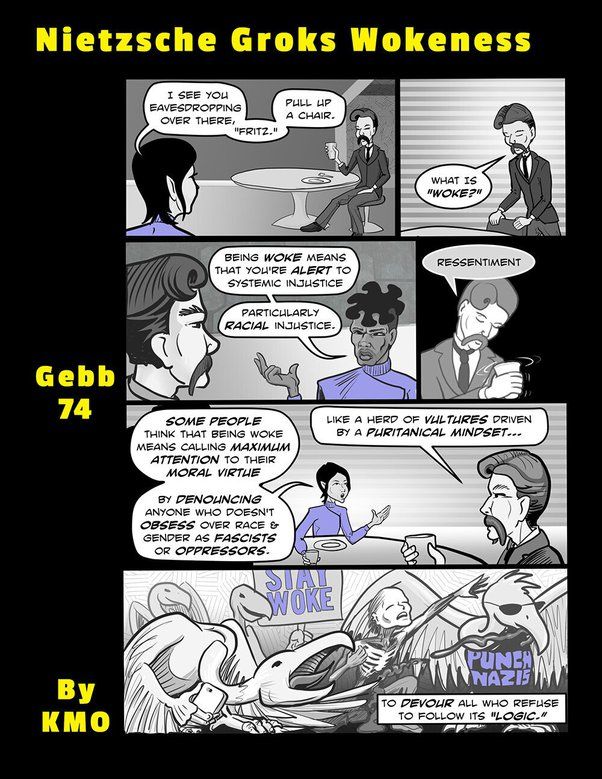
This is what Friedrich Nietzsche critiqued as being a hatred for life. When we remove temptation rather than ever teach children to resist it—when we are constantly vilifying strength rather than encourage it—when we follow after reasoning or rationality instead of developing our instincts, we are promoting the weakness of our society and degeneration.
Woke is weak. It attempts to foster spirits of ressentiment and forms an identity around a person’s fear of being disenfranchised for things completely out of their control. And in the end it destroys the incentive to find a way to overcome by our own means.
The Meek Shall Inherit
Neitzsche could be accused of painting with too broad a brush for the dismissal of the Christian ethic as slave morality and an opposition to the powerful.
The message of Jesus and his Apostles was, in part, freedom from those human laws of “Do not handle! Do not taste! Do not touch!” (Colossians 2:21) and very nearly could be the “will to power” that the German philosopher championed once unpacked. Hedonism wasn’t the goal of the departure from “slave-morality,” the aim was instead for people to exercise will-power and resolve. In the same manner Jesus and St Paul preached freedom from the law that brought only bondage and death:
But now, by dying to what once bound us, we have been released from the law so that we serve in the new way of the Spirit, and not in the old way of the written code.
(Romans 7:6 NIV)
This is not to suggest that there is any kind of compatibility between the Spirit-led and the Übermensch. Nevertheless, both would have us abandon a lower morality based on restrictions for a pursuit of our own ultimate form. To St. Paul the Gospel means we are free from “the flesh” or the unbridled urges, while Nietzsche thinks we’re instinctively at our best, and both men are not opposed to impulse control. The big difference is that the Apostle’s answer is spiritual whereas the philosopher says that additional layer is not needed and morality a hindrance. Both would disagree devaluing the attitudes and culture that lead to success. Being master of ourselves requires strength and never allows for excuses.

Furthermore, the Jesus of the Bible wasn’t weak, he spoke with authority and we are told that he had power over all things, but he chose a meek posture rather than wield this power destructively. Now it is a matter of faith if you accept this or not. I could say that I could strangle Mike Tyson yet choose not to. Talk is cheap. But meekness is the ability to restrain ourselves. Having the power to impose our will is always desirable, nobody wants to be at the mercy of the elements or other people. However, sacrifice for sake of the next generation is better, to parent is to live beyond ourselves, that is why this is an instinct for those who have children, and it is the role of the Father.
When I wrestle with my son I don’t use all of my strength. I would hurt him if I employed full power. My goal is not to destroy him, he is not my enemy or threat to obliterate, but it is to train and strengthen him. I restrain to protect him currently and also challenge to protect him in the future. That is the real Biblical kind of meekness, it submission to the greater role we can serve as protectors and builders of civilization. It is the having all things in balance, which Nietzsche might agree, and using our strength to take on the burden of creating the future. We do not retreat from life. Faith requires the we go headlong into the fight rather than hide or be ruled by resentment.
Late-stage Protestantism
I can understand the campaign Nietzsche waged against morality in light of wokeism and virtue signaling nonsense. Apparently he was very well-versed in theology and did not find answers there. Which is correct, it is not intellect that brings us life, study for sake of study is vanity, and truth is more in the practical telos than in some theoretical construct. Nietzsche attacks rationality and reason as an end and those things do implode upon themselves when no longer grounded in a higher life-serving purpose.
The current ideological push for wokeism, and the mindless promotion of diversity, equity and inclusion at the expense of standards, merit or competency, is simply another step down the path of trying to eliminate all suffering and in the process destroying excellence. I want my son to face some hardship, even if it is only artificial, because his striving will build strength. It is the thought behind Proverbs 13:24:
Whoever spares the rod hates their children, but the one who loves their children is careful to discipline them.
Or, as Nietzsche postulates in Beyond Good and Evil:
The discipline of suffering, of great suffering – do you not know that only this discipline has created all enhancements of man so far?
In the same vein, in The Will to Power, he wrote:
To those human beings who are of any concern to me I wish suffering, desolation, sickness, ill-treatment, indignities – I wish that they should not remain unfamiliar with profound self-contempt, the torture of self-mistrust, the wretchedness of the vanquished: I have no pity for them, because I wish them the only thing that can prove today whether one is worth anything or not – that one endures.
No, I don’t want my son to be last picked for his dark skin. And yet I also don’t want him to live in a world so sanitized that he’ll need to invent offenses (in the same way that an autoimmune disorder is the body attacking itself) then expects me to always step in on his behalf rather than face it. Success in life requires some voluntary submission or suffering for sake of our goals. Coddling and bigotry of low expectations does not serve the long-term benefit of children or civilization.
We need to discard this ugly paradigm of late-stage Protestantism. There are great men, powerful and worthy of our respect, then there are those in desperate need of improvement. We don’t help the latter by going soft and changing the requirements to make everything easier. There is nothing radical or reforming about the direction the church in the West has gone. This “have it our way” drive has led to a fracturing of the church, a consumerist mentality in worship and a new religion without obligation to the fathers or their commands.
Woke is simply the latest development in the direction. It is the child with imperfect parents now thinking they know better and don’t need the silly disciplines of their parents to thrive. Whether Anglican or Anabaptist, it is always about rejection of authority and the hierarchies established by the early church and originating with Christ. We think we can do better, that the home is better if there is equal with no patenting or need for development of conscience. In the end we get the complete agnosticism which goes further and to destroy everything the generations of faithful built for our good.

Attainment and success doesn’t need to be made more accessible. My son may think he deserves everything without effort, that we’re hoarding a kind of wealth just given to us and undeserved. But that’s his ignorance. There are no shortcuts to heaven and you can only keep the benefits of civilization if you continue to maintain the very foundation it is built upon. We think that we will be saved by technology and the vague notions of progress of those who think power comes from the stroke of a pen—but that’s not how we got here nor is it a path to a better future.



 Irregular Ideation