
Q: How do you enrage a narcissist?
A: Tell them they’re not the most important person in the world.
There’s this mess of entitlement, of eternal victimhood, self-admiration and severe lack of empathy we call narcissism. And it does seem to be everywhere, most especially in a situation where someone is able to escape normal pushback for their overinflated self-image and sense of importance. But this is not something new or merely a product of modern life—it is as old as the Bible.
What Jesus confronted most severely in the religious elites of his day was a narcissistic attitude. Indeed, he was not killed as threat to Rome. The Roman authority, despite the facilitation of the mob, did not buy into their reasoning and declared him to be innocent. The real issue is that Jesus offended an ideological cult of ethno-supremacists, those who believed a book (or rather their own errant and self-serving interpretation of the text) made them a cut above all other people.

They believed that they were God’s favorites and yet Jesus said even the rocks could accomplish the mission. He did not need their permission to speak and insulted them at every turn. How did he insult? Well, mostly by reminding them that God loved all people and not just their own tribe. In defiance of their narcissistic self-belief, he held up the good examples of Samaritans, Canaanites, Syrians and Romans—presenting the foreigner as a righteous contrast to them. And they could not argue with him, he knew their Scripture better than they did, so they killed him.
Here’s six examples of where Jesus took on the ethno-nationalist pride and narcissism of religious peers:
1. The Parable of the Good Samaritan (Luke 10:25-37)
In response to a lawyer asking about who is our neighbor, Jesus tells a parable where a Samaritan (despised as ethnic outsiders by Jews) acts heroically with mercy, while a Jewish priest and Levite ignore a wounded man. This framing of an answer intentionally swerves off the beaten path to offend his ethno-supremacist audience by portraying their loathed ‘enemy’ favorably and implying that true neighborliness is something that transcends ethnic boundaries:
In reply Jesus said: “A man was going down from Jerusalem to Jericho, when he was attacked by robbers. They stripped him of his clothes, beat him and went away, leaving him half dead. A priest happened to be going down the same road, and when he saw the man, he passed by on the other side. So too, a Levite, when he came to the place and saw him, passed by on the other side. But a Samaritan, as he traveled, came where the man was; and when he saw him, he took pity on him. […] “Which of these three do you think was a neighbor to the man who fell into the hands of robbers?” The expert in the law replied, “The one who had mercy on him.” Jesus told him, “Go and do likewise.”
Imagine that, this smug religious expert, who thought he was self-justified, getting shown up rhetorically by the outsider.
2. The Faith of the Roman Centurion (Matthew 8:5-13)
A Roman centurion (a Gentile military occupier) approaches Jesus to heal his servant. Jesus not only heals but praises the centurion’s faith as surpassing anything being found “in Israel,” and implicitly rebuking the Pharisees’ assumption of Jewish spiritual superiority. This favorable portrayal of this Gentile outsider was extremely offensive to these ethno-supremacists:
When Jesus had entered Capernaum, a centurion came to him, asking for help. “Lord,” he said, “my servant lies at home paralyzed, suffering terribly.” […] When Jesus heard this, he was amazed and said to those following him, “Truly I tell you, I have not found anyone in Israel with such great faith. I say to you that many will come from the east and west, and will take their places at the feast with Abraham, Isaac and Jacob in the kingdom of heaven. But the subjects of the kingdom will be thrown outside, into the darkness, where there will be weeping and gnashing of teeth.”
He’s stomping on their entitlement at the end, literally saying that they’ll be thrown out and then replaced by Gentiles in God’s kingdom!
3. The Faith of the Canaanite Woman (Matthew 15:21-28)
Jesus initially tests a Canaanite woman (a Gentile outsider) seeking healing for her daughter but he ultimately commends her persistent faith and grants the request. This interaction challenges Pharisaic purity laws and ethnocentrism by showing a non-Jew’s faith as exemplary, even using the language which highlights ethnic barriers only to overcome them:
A Canaanite woman from that vicinity came to him, crying out, “Lord, Son of David, have mercy on me! My daughter is demon-possessed and suffering terribly.” Jesus did not answer a word. So his disciples came to him and urged him, “Send her away, for she keeps crying out after us.” He answered, “I was sent only to the lost sheep of Israel.” The woman came and knelt before him. “Lord, help me!” she said. He replied, “It is not right to take the children’s bread and toss it to the dogs.” “Yes it is, Lord,” she said. “Even the dogs eat the crumbs that fall from their master’s table.” Then Jesus said to her, “Woman, you have great faith! Your request is granted.” And her daughter was healed at that moment.
This passage illustrates the ethnic-supremacist attitudes of even the disciples of Jesus. Whereas today, in the West, you can barely say people are different in ability without it being controversial, nobody cared that this woman was referred to as a dog in this audience. But his actions of love and compassion spoke louder than his words and this woman’s lack of narcissism was a stark contrast to the prideful racist disciples Her prayer was answered because she was humble.
4. The Healing of the Ten Lepers (Luke 17:11-19)
Jesus heals ten lepers, but only one—a Samaritan (an ethnic outsider)—returns to thank him. Jesus highlights this Samaritan’s faith, questioning where the other nine (presumably Jews) are, thus favoring the outsider and critiquing ingratitude among insiders:
As he was going into a village, ten men who had leprosy met him. They stood at a distance and called out in a loud voice, “Jesus, Master, have pity on us!” […] One of them, when he saw he was healed, came back, praising God in a loud voice. He threw himself at Jesus’ feet and thanked him—and he was a Samaritan. Jesus asked, “Were not all ten cleansed? Where are the other nine? Has no one returned to give praise to God except this foreigner?” Then he said to him, “Rise and go; your faith has made you well.”
The entitled can’t show gratitude. Perhaps, as the self-declared chosen, the others who never came back felt they deserved this healing—that it was their birth right? But Jesus was unimpressed by them and highlighted the foreigner who was thankful instead.
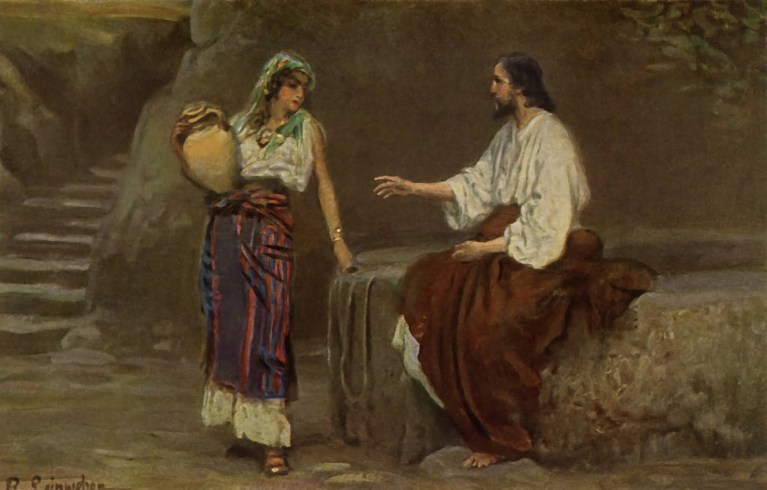
5. The Samaritan Woman at the Well (John 4:1-42)
Below Jesus initiates a conversation with a lowly Samaritan woman (an outcast on multiple fronts: Samaritan and female), he reveals himself as the Messiah, and leads to many Samaritans believing in him. This breaches ethnic and social barriers, totally offending Pharisaic norms of separation, as the Jews typically avoided Samaritans:
When a Samaritan woman came to draw water, Jesus said to her, “Will you give me a drink?” […] The Samaritan woman said to him, “You are a Jew and I am a Samaritan woman. How can you ask me for a drink?” (For Jews do not associate with Samaritans.) […] Many of the Samaritans from that town believed in him because of the woman’s testimony, “He told me everything I ever did.” So when the Samaritans came to him, they urged him to stay with them, and he stayed two days. And because of his words many more became believers.
This was Jesus deliberately breaking down a barrier. The Jews of this time weren’t just racist, but sexist as well, and would see this entire encounter as an egregious violation. Here Jesus was humanizing the Samaritan enemy and—even more scandalously—he was talking directly to a woman! While rebuking his own ethnic and religious tribe he hung out with the impure!
He’s practically as evil as Tucker Carlson…
6. Jesus’ Sermon in Nazareth (Luke 4:16-30)
In his hometown synagogue, Jesus reads from Isaiah and then references the Old Testament prophets helping Gentiles (a widow in Sidon and Naaman the Syrian) instead of Israelites during times of need. This enrages the crowd, who try to kill him right there and then, as it directly challenges their ethno-supremacist expectations that God’s favor is exclusive to Jews:
“Truly I tell you,” he continued, “no prophet is accepted in his hometown. I assure you that there were many widows in Israel in Elijah’s time, when the sky was shut for three and a half years and there was a severe famine throughout the land. Yet Elijah was not sent to any of them, but to a widow in Zarephath in the region of Sidon. And there were many in Israel with leprosy in the time of Elisha the prophet, yet not one of them was cleansed—only Naaman the Syrian.” All the people in the synagogue were furious when they heard this. They got up, drove him out of the town, and took him to the brow of the hill on which the town was built, in order to throw him off the cliff. But he walked right through the crowd and went on his way.
The passages all illustrate Jesus’ pattern of associating with and elevating of outsiders, which offended the Pharisees’ ethnocentric pride and their self-righteous “we’re chosen people” claims by his stubborn inclusion of sinners, tax collectors, and Gentiles.

Had it not been for a miracle Jesus may be remembered as being thrown off a cliff for praising the foreigners in front of a Jewish audience. He was hitting them directly in their Hindenburg sized egos. They had the most severe case our own [excrement] don’t stink that’s possible.
Ms. Rachel is an ‘anti-Semite’ for loving all children?
A Zionist organization, StopAntisemitism, has named Rachel Griffin Accurso, a very popular children’s content creator, a finalist for their “Antisemite of the Year” and for a very specific offense: Ms. Rachel dared to treat the suffering of Palestinian children as equal to that of Jewish people! How dare she humanize the child of an enemy! Those in this Zionist cult love themselves only and make a strict dichotomy between their own and the dogs. The spirit that Jesus rebuked is maintained in this perverse tradition.
I didn’t know much about Ms. Rachel prior to the birth of my daughter, but she’s not a Hamas apologist or sympathizer and has expressed similar sentiments about Israeli and African children. Only the arrogant Zio-bots used her concern as a cause for their vicious accusations and vile labels. They can be the only victims and treating Gaza’s children with the same love as their own is a terrible offense in their supremacist eyes—only their suffering can matter.

Ms Rachel committed their most grievous sin of believing children are not terrorists because of where they are born and now—as another enemy—she must be destroyed.
That is the narcissistic attitude of Zionism. You must choose between them and others, they cannot share your concern with those who are inferior beings. It’s an insult, as if they have been made equal to a dog, which is what they think of us Gentiles. Listen to what they say, they believe that they should be treated like gods—in the words of Jewish supremacist and the former chief Rabbi of Israel, Ovadia-Yosef:
“Goyim (gentiles, non-Jews) were born only to serve us. Without that, they have no place in the world – only to serve the People of Israel,” he said, according to the Jerusalem Post. “Why are gentiles needed? They will work, they will plow, they will reap. We will sit like an effendi and eat. That is why gentiles were created.”
Rabbi Ovadia-Yosef, in his own words
Treated as our lords. That is the nature of Zionism. It is about their narcissistic view that they deserve to be our masters and to do with us as they please—as they may an ox that plows their fields. Which is what is so disturbing about an Israel-Firster, Ben Shapiro, proclaiming that retirement is stupid and that Americans should work until they drop. Says a guy who sits around and talks as an occupation. This, of course, does not represent all Jews or Israeli citizens, but it is written in the Talmud and lines up with the Likud party leadership of Israel.

Zionists don’t just want to rule over the current territory of Israel or the Holy Lands. No, they want Jerusalem to be the hub of their Greater Israel and later one world government where their own version of a Messiah cleanses the world of all who defy them. They rule because you’re too stupid to live free.
Judas wanted an Israel like this. A worldly kingdom where he would be served. Jesus, by sharp contrast, taught a kingdom not of this world—where the greatest would serve rather than be served. He corrected heresy that made the blessing of Abraham only about a genetic inheritance rather than a matter of sharing the patriarch’s sincere and simple faith. It was the very opposite of what they believed they were owed as the self-declared special people. Jesus offended by telling them they weren’t special and calling the children of the Devil rather than of Abraham. Ethnic supremacy and self-righteous pride is the basis of Zionism, Christianity heralds repentance as the foundation of true faith in God, as John the Baptist declared:
But when he saw many of the Pharisees and Sadducees coming to where he was baptizing, he said to them: “You brood of vipers! Who warned you to flee from the coming wrath? Produce fruit in keeping with repentance. And do not think you can say to yourselves, ‘We have Abraham as our father.’ I tell you that out of these stones God can raise up children for Abraham. The ax is already at the root of the trees, and every tree that does not produce good fruit will be cut down and thrown into the fire.
(Matthew 3:7-10 NIV)
Water is wet. The sky is blue. You can’t be a Christian and a Zionist too. We must pick one or the other. There is no union between light and darkness, no yoking of believer to unbeliever, we either believe what we’re told in the Gospel about a “synagogue of Satan” (Rev 3:9) and who Jesus himself declared to be children of their father the Devil (John 8:44) or we deny that Christ is King. It’s just astounding to see so many who either never read the New Testament or had eyes glazed over in those sections where Jesus rebuked those who thought their Jewish supremacy and genetic ties to Abraham would save them.
The unrepentant narcissist will never enter the kingdom of heaven. Pride was the sin of Satan who thought he could rival God and it is also the sin of those who rejected Jesus for his acceptance of all and not caring about their ethnic pedigree. They hated him for exposing them as religious frauds. And the campaign they waged against him was very similar to that being used currently to try to silence critics of Israel. The role of a good Goy is to simply believe whatever they say and allow them to be the gods they believe they are—to kill or rape as they please.

 Irregular Ideation