
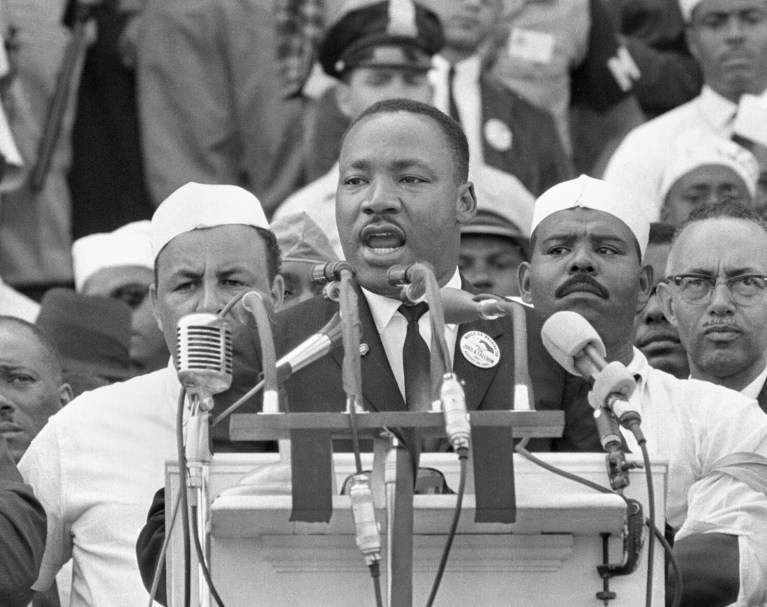
When I was in elementary school we sang a song with lyrics, “Martin Luther King, Martin Luther King, was a great man.” Looking back it was even strange then. Why were we, in a rural Pennsylvania public school, instructed to heap such adoring praise on this man? It was a weird indoctrination.
One explanation is that this was atonement ritual. Dr. King was murdered. Thus maybe the weight of guilt on the generation of the Civil Rights Era was just that high that this was a way they try to correct the injustice. And it is sufficient to explain why the rank-and-file liberals, such as Mrs. Lawrence, my elementary music teacher, would promote his legacy or turn him into a legend.
But was it all well-intentioned?
I don’t have a black and white view of MLK Jr. I think he was a complex character, he advocated for peaceful protest and yet was also a sexual deviant despite his status as a Baptist Reverend. He’s probably as worthy of honor as any other figure in the American pantheon. However, the big question is why is he there? Why was there a holiday put on the calendar to celebrate this man?
The answer to how is that there was a bipartisan effort, after a significant campaign, to put him there. Everyone, except a few racist hold out Democrats, supported this move. Jimmy Carter endorsed it, and Ronald Reagan signed it into law, lauding King as being “a drum major for justice” in a Presidential proclamation. So it is a reminder to carry on the mission of the man who preached a brotherhood that goes beyond race and reconciliation.
As a child of the 1990s, I was indoctrinated into an ideal of a colorblindness—a society that made the dream of Dr MLK Jr a reality:
“I have a dream that my four little children will one day live in a nation where they will not be judged by the color of their skin but by the content of their character.”
It had worked. Racial tensions had dropped off and it had really felt then like a new post-racial epoch had begun.
Unfortunately, since then the progress has been backwards. Or at least as far as sentiment. Many are convinced that race relations are worse than before. And that what MLK had preached is impossible, that we must see color, and many advocate that we discriminate in favor of racial minorities—or against them. Both the far-right and far-left agree with racism. They both refuse the multi-variant analysis, one which considers factors like fatherless homes apart from race, and have decided that race determines all.
The left claims that the content of character speech is misused and that we must force equal outcomes or we are disingenuous—while the right uses disparity in outcomes as the proof of inferiority at a genetic level. It is truly amazing how the same data can be read so differently. However, I disagree with both sides and put far more weight on culture and messaging than they do. Telling people they need our help in order to reach their full potential is disempowering and the worst kind of political opportunism.
Which does make me wonder if this is the real reason why we celebrate MLK? Would we ever turn him into an immortal figure if he were alive to speak for himself?
No, I don’t believe so. I believe that MLK Jr. became much more useful to the political establishment in his death. No matter what side you’re on, Republican or Democrat, you can make use of his words. And the reason they recognize him is to use his legacy as a tool for their own ends. This is the beauty of all those made maytrs for a cause, they always get turned into whatever the current owners of their image want them to be. I would contend the holiday is intended as a way to co-opt his legacy—both as a way to pacify and to bend it to their own agenda.
MLK was silenced. His legacy of words and of speeches are now open to interpretation. He’s a national hero only because he’s dead and cannot oppose those employing his name on all sides of the debate. Those who made his birthday into a holiday were likely doing it as a virtue signal, a way to prove (to those who cared in the voting public) how they are better than his killers.
These same people would likely have destroyed him—for his sins—if he were alive and opposed them. Only dead heroes are useful in politics.
 Irregular Ideation