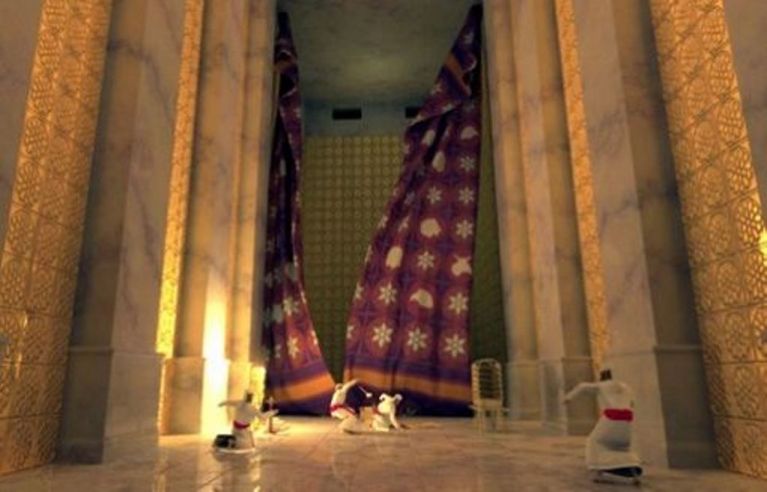
Seeing Behind The Veil

Standard

In storytelling, there is a plot device called a MacGuffin.  This is an object, character, or event used to push the narrative forward and yet isn’t all that important in and of itself.  In other words, a thing that creates motivation and yet never even needs to be revealed to the audience.  We are supposed to believe this is something significant or valuable and that’s all we need to be told.

The contents of the briefcase are left a mystery despite being pivotal in motivating the characters.

While reading through the Old Testament and pondering how temple worship worked, it is hard not to see the Ark of the Covenant as a sort of MacGuffin.  Sure, their God was not a thing.  And yet this sacred object, we’re told, contained something of God’s presence and would even strike dead those who innocently mishandled it.  Of course, most people may never have seen it, it was kept behind a veil in the temple where few had access, but all would be told of the sacredness.

“Then spake Solomon, The LORD said that he would dwell in the thick darkness. I have surely built thee an house to dwell in, a settled place for thee to abide in for ever.”

(1 Kings 8:12‭-‬13 KJV)

In fact, it was made sacred as much by this treatment as much as what actually dwelled within it.  The mythology surrounding it, as in the cultural or religious significance that was given to it, was extremely powerful.  Starting a special priestly class, Tabernacle and ritual practice, later the impressive structure of the Temple, there was a huge investment in this sacred object.  And yet, for all the attention it got, the Ark itself was usually kept hidden in darkness, guarded, within the Holy of Holies and behind a veil.

Holy Of Holies 

There are other things hidden behind a veil with significant motivational power.  One of them being the marriage MacGuffin.  For me this was a pursuit of something sacred, the church does consider the marriage bed to be sacred, and there is a whole mythology that is constructed around marriage.

This is what made it so jarring when, during my pursuit of the impossibly, a psychiatrist would classify it as “sexual attraction.”  They had just heard me describe a pure and faith-driven quest only to reframe it in such crass terms.  How dare they!  I was after love, not sex!  It really did offend me at the time.  With their clinical roughness, they had penetrated the veil of my marriage delusion.  It was an act of sacrilege.  

My childhood innocence is beyond recovery at this point.  For whatever reason, those of us born into a fundamentalist purity culture believe that we must be in denial of our own sexual urges that lead to marriage.  This is strange given how blunt St. Paul is on the topic, in 1 Corinthians 7:9, advising those who “burn with passion” to get married and basically get a room.  Why the veil of secrecy, these many euphemistic expressions to cover and mystify the bumping of uglies?

Speaking of erotic euphemism:

“Awake, O north wind; And come, thou south; Blow upon my garden, That the spices thereof may flow out. Let my beloved come into his garden, And eat his pleasant fruits.”

(Song of Solomon 4:16 KJV)

Why blush, be embarrassed or ashamed by this?

Could it be that without dressing this whole affair up with great ceremony, white bridal veils, teary-eyed parents, and such, we would have to face the reality of being creatures as hormone-driven as two ducks on a pond?  I mean, why aren’t we as honest as Solomon was in his poetry: “Roses are red, violets are blue, you have large breasts, that’s why I love you!”  Without white lies or half-truths, would our version of romance even survive?

So what is underneath the veil?

All of those things that I’ve discovered in the intervening years, that’s what…

To the extent I was in deep denial of my own sexuality, I was doubly in denial of the sexual nature of my female counterparts within the conservative Anabaptist culture.  The young lady who first propositioned, then made it all awkward and worried about somehow being ‘defiled’ if she got coffee with me has long since dropped the veil.  She has joined the others whom I had held in such high regard, revealed now as not being nearly as prudish or pure as I had once imagined.  That’s not a criticism or judgment either.  It is just the reality of the situation.

So, when the impossibly told me “I cannot not love that you the way that you wanted to be loved” what she was really saying the same thing as those Tinder girls with “must be 6′ or over to ride” in their profiles.  She wanted a guy who got her juices flowing, certainly someone a bit more rugged and traditionally masculine than me.  And, I mean, why not?  Why hide it?  Marriage is not only (or even primarily) about the high ideal that is advertised.  It is also about our scratching the itch.  Which is to say getting down and dirty with someone who meets the correct physical qualifications.

Also, perhaps it is that the fantasy is more satisfying than the act itself?  We read how Amnon, King David’s eldest son, had such an infatuation with his half-sister Tamar.  It tells us after having his way with her he despised her.  Or consider the disgust of Victorian-era art critic John Ruskin when, in marriage, he discovered that women aren’t like porcelain dolls.  You’ll have to forgive him, they put skirts over piano legs back then to keep the eyes of men safe from the unveiled feminine form.  Maybe there are some things that are better chased than caught?  If we find what we went looking for we might be shocked at what we found.

Sacred Fertility & Symbolism 

The final stop on this exploration of sacred and taboo has to do with something that I can’t unsee now that I’ve seen it.  I’m bound to lose half of my final two readers for going here. 

Nevertheless, I’m not here to please the pearl-clutching crowd. 

For me, this is not about toppling sacred cows or making people uncomfortable, it is about being honest enough to see reality for what it is and correcting our own perspectives of the cultural baggage we’ve inherited.

First, what drives much of the Old Testament Biblical narrative?  We know Abraham’s story, how he wanted an heir, and yet how Sarai, his wife, was unable to produce.  In this Genesis account we see various cases where wombs are opened or closed.  And the punishment of Michal, for rebuking her dancing husband, was that she had no child until the day of her death.  Being fruitful and multiplying was a high priority, as well as having sons to carry on the family line.

As an aside, we live in a very sterile world in comparison to our ancestors, we’ve become sheltered and sensitive to the point many do not eat meat or want their children exposed to death.  This wasn’t an option at the time when Scripture was written.  There is a kind of earthiness to their world and perspective, something more primal or real, a brutality of life difficult to stomach.  It is with this reality in mind, that we also have different sexual taboos and could be more prudish than they were about such things.

Second, I was sitting in church and taking a look at the colorful streams of light pouring through a stained glass image of Jesus pulling Adam and Eve from the grave.  My moment of appreciation for this beauty was interrupted by my noticing part of the symbolism.  Jesus is shown to be emerging from an oval shape, at the bottom of which are the covers of their opened tombs.  Requiring very little, if any, imagination, it bears striking resemblance to one Christian symbol even an iconoclastic Protestant would likely recognize, and that being a vertically arranged “Jesus fish” or Ichthys.

Light and life shining down…

However, concurrent to this, and a cause of some momentary shame, was the thought “That’s a vulva!”  I mean, how inappropriate to think that any part of the female anatomy, let alone those private nether regions, be put on prominent display or be associated with Christ!  

But is it really?

A mother, Mary, is necessary for the birth of Jesus.  Without her, and her womb that is miraculously made made more spacious than the heavens, there is no salvation for mankind.  It didn’t matter if God could have used any other way, all we know is that he used this young woman and all of the faithful since have followed the lead of Elizabeth, who full of the Holy Spirit loudly proclaimed:

“Blessed are you among women, and blessed is the child you will bear! But why am I so favored, that the mother of my Lord should come to me?”

(Luke 1:42‭-‬43 NIV)

As far as the symbolism, I would find that indeed my observation had basis in reality as the Ichthys is a version of Vesica Piscis (literally “fishes bladder” in Latin) or, in sacred geometry, the oval that two intersecting circles create an oval and said to be the place where spiritual and physical worlds interface. According to Syriac Press, in ancient Mesopotamia, it was used as a symbol of the combination of masculine and feminine energies that create a Divine Child.  Any pagan coincidence, like those with baptism, only serves to reinforce the power of the symbolism.

In a time when many settle for ‘fur babies’ over producing human offspring and the unique female contribution to the world is dismissed by feminists seeking male roles— when real women are mocked by men who pretend to menstruate—we need to start doubling down on our celebration of this reproductive role of women.  Phrases like “saved through childbearing” did not come into the Bible by accident.  The world was saved by the one who came out of Mary’s fertile womb and we ought not to downplay or be embarrassed by this.

Empty Vessel—Dying Corpse

Solomon’s Temple was destroyed in 586 BC, by the Babylonians, and the fate of the Ark within it is unknown.  This loss of sacred relics did not stop the Jewish faithful from rebuilding the temple, in 515 BC, but does make one wonder how much the contents mattered.  So long as the people were kept in awe that’s all that really seemed to be the point whether the edifice truly contained anything of real value or not.  With nothing behind the veil, the people still did the ritual and sacrifice. 

Why?

It seems sort of analogous to the US Dollar, a currency once backed by actual gold and now only by faith people continue to hold in the economic system it represents.  The harsh reality is that it has become merely a means to exploit. It is a way for a few elites to rob the value of the savings of other people by printing more money for themselves.  Those money changers Jesus chased out of the Temple were the amateurs. The real professionals never get caught.  The carefully maintained veil of secrecy around the Federal Reserve ensures that this particular scam continues for a long long time.

But, I digress.  

G. K. Chesterton once wrote, “a corpse crawling with worms has an increased vitality,” and that “a dead man may look like a sleeping man a moment after he is dead,” trying to describe the subtle yet significant difference between truly sacred tradition and a cheap gimmick version of this religion that was intended to replace it.  Perhaps this is what has me disillusioned?  With so many things, once the veil is lifted (which few ever dare to do) so much of the enticing mystery and popular mythology which propelled us forward falls apart.  And in this way some of the life I had felt early on feels more like decomposition.

Perhaps this is what is left when you’re the dog who has finally caught the car?  Nothing left to do but pee on the tire and continue on your way again.  The anticipation leading up to the day of revelation may be more exciting than the moment the veil is lifted and when all is seen.  Ruskin may have spent the rest of his life waxing eloquently about his female love interest.  Or maybe—just maybe—that MacGuffin which led us to the point we’re at today was merely a plot device to move the story forward and the only truly sacred part of the encounter is the fruit produced?

Sexual pleasure is fleeting.  We’re lured there by our imaginations, by our desire for what is beyond the veil of marriage, but it can all be a bit anti-climactic and even repulsive once you consider it after it is finally unwrapped from the flowery speech and those flawless air-brushed mental pictures.  But fatherhood, by contrast, seeing the great potential of my son, tending to his needs, pruning as needed, is something extremely fulfilling.  It is what has emerged from the womb that brings us renewed life and hope.  Pity the barren, the dying corpse who has lifted the veil and only saw the emptiness of their pursuits.

Aliens Are Here! Maybe…

Standard

Did you hear?  A ‘whistleblower’ testified before Congress about aliens and finding non-human remains at crash sites.  I can’t really know if this was reliable or someone simply getting their fifteen minutes of fame, but it does seem unlikely to me that beings capable of flying the enormous distances of space would be such poor navigators.  I’ll be a skeptic until I can see for myself and make my own determination.

However, in pondering the topic, a friend of mine posted an interesting meme and it is an angle worth exploring.  If aliens do exist, according to the insinuation of this image posted, then they are demonic entities and not to be treated as friends.  To some this may seem like a missed opportunity, why would we avoid a chance to expand our own horizons?  Typical human behavior, right, to meet with violence the things that we don’t understand or defy expectations.

Maybe. Maybe not.

And yet, this seems another case of being directionally correct even if wrong on the details.  I mean, there’s a chance that aliens are some kind of creature from another planet and come in peace. However, what if they don’t?  What if they, like many traveling to new lands, have colonial ambitions and will destroy or subjugate us if allowed? 

It is correct, instinctively, to have zero trust for these new arrivals.  Maybe, technically, they are not demons, but they are others and may as well be demons, right?

Tinfoil Hat Time

This is why I’m generally on the fence so far as the MAGA and Q-Anon types.  Sure, they vastly oversimplify and often get the details wrong enough to be easily ‘debunked’ by fact-checkers.  However, half the problem is usually about the use of semantics and not the substance.  Maybe the world isn’t run by a ring of reptilian pedophiles, nevertheless there are many who lack morality, have their secret plots, hidden motivations, and cover-ups.  It might not be organized, but this is pervasive enough that it is adequately put in terms of a grand conspiracy.

Women, don your head coverings!

So far as aliens, and as a devoted speciesist who prefers native life to that which is most certainly extra-terrestrial, does the exact approach we take to ‘othering’ them really matter?   They are an other, a true existential threat, and therefore to be regarded as demonic beings.  Curiosity could be our undoing and especially when it comes to those things powerful and beyond our own understanding.  

So what does the Scripture tell us about this topic?

First, be respectful:

In the very same way, on the strength of their dreams these ungodly people pollute their own bodies, reject authority and heap abuse on celestial beings. But even the archangel Michael, when he was disputing with the devil about the body of Moses, did not himself dare to condemn him for slander but said, “The Lord rebuke you!” Yet these people slander whatever they do not understand, and the very things they do understand by instinct—as irrational animals do—will destroy them.

(Jude 1:8‭-‬10 NIV)

Quibbling over what exactly they are is okay, but there is no room for casualness when it comes to aliens or demons.  Those coming from other worlds obviously have technology or means better than our own.  They can run circles around us.  So we would be wise to be cautious and exercise due respect—that is to say rely on God’s power rather than our own strength in these encounters.

Second, we should learn from record history and not make the same mistakes:

The Nephilim were on the earth in those days—and also afterward—when the sons of God went to the daughters of humans and had children by them. They were the heroes of old, men of renown.

(Genesis 6:4 NIV)

The non-canonical book of Enoch goes into greater detail about this event when beings from another realm came to Earth, shared their advanced knowledge (including that of weapons) and interbred with women.  These enhanced hybrid offspring were extremely powerful, they also had insatiable appetites and their enormous consumption eventually led to a destructive rampage.  We are told this is why God finally wiped the slate clean with the great flood, where Noah and his family were spared.  This is why St Paul writes, in a letter to the Corinthians:

A man ought not to cover his head, since he is the image and glory of God; but woman is the glory of man. […] It is for this reason that a woman ought to have authority over her own head, because of the angels.

(1 Corinthians 11:7‭, ‬10 NIV)

Women, wear your tinfoil hats.  Err, I mean, veils, because there are Watchers, sons of God not named Jesus, and thus it is for this reason you should definitely declare what is the ordained order.  Mennonites and Amish are just unwittingly ahead of the game!

Aliens or Angels?

My wife speaks English.  However, given that she comes from the Philippines, sometimes her word usage can be different from that of an American.  Hanging out with friends and family, for example “bonding” and a “polo” can basically be any shirt with buttons.  So truly, if use of language can be this confusing even for us contemporaries, what happens when we expand this “telephone game” over centuries?

It is quite possible that we are reading about what we call aliens in these ancient texts.  I mean, the descriptions do seem to match so they not?  Those who came to Earth with advanced knowledge and abilities, messed with human genetics through impregnation of women (see: Aliens) and wreaked havoc on the planet before God intervened.  There is no way to know if the difference is only semantics or of substance.

It seems very unlikely, given the distances involved, that aliens beings can travel from galaxies far away.  It is much more likely that these beings would emerge from a parallel (spiritual) dimension, and perhaps through a portal, and are able to take physical form to interact with us.  And, either way, similar to artificial intelligence not sharing our human priorities, I’m doubtful these aliens or angels would really have our best interests in mind if they did come. 

Ultimately, for all intents and purposes, they are demons.  In other words, those of Orthodox Christian tradition do already know what they really are.  And, therefore, we must both exercise great caution and strengthen our faith.  If they have returned then widespread destruction may be soon to follow.  It is not a reason to be afraid, there is no need to panic, these gods are not greater than the good God who has defended those righteous from the beginning and will never let evil win in the end.

The Unveiled Truth About 1 Corinthians 11:1-16

Standard

If you come from a conservative Mennonite background, like my own, you have likely heard many sermons stressing the importance of a woman covering her head. The headship veiling is one of those is simultaneously loved and hated topics. Many have become completely tired of hearing about it every other week and yet would, if challenged, defend the practice more vigorously than the incarnation or as if the salvation of the world depended on a few inches of fabric pinned to a female’s coiffed hair.

I’ll try not to beat a dead horse here. If you are tired of endless discussions and debates (or even church splits) over the size or style of veils, please hold your groans to the end, because I hope this is a fresh take on this all too familiar topic. But first I’ll get to the basics of the passage itself and what I believe 1 Corinthians 11:1-16 says about the veil based on both the text itself and also the historical understanding of the text according to early church leaders.

First the text:

Be imitators of me, as I am of Christ. I commend you because you remember me in everything and maintain the traditions even as I have delivered them to you. But I want you to understand that the head of every man is Christ, the head of a woman is her husband, and the head of Christ is God. Any man who prays or prophesies with his head covered dishonors his head, but any woman who prays or prophesies with her head unveiled dishonors her head—it is the same as if her head were shaven. For if a woman will not veil herself, then she should cut off her hair; but if it is disgraceful for a woman to be shorn or shaven, let her wear a veil. For a man ought not to cover his head, since he is the image and glory of God; but woman is the glory of man. (For man was not made from woman, but woman from man. Neither was man created for woman, but woman for man.) That is why a woman ought to have a veil on her head, because of the angels. (Nevertheless, in the Lord woman is not independent of man nor man of woman; for as woman was made from man, so man is now born of woman. And all things are from God.) Judge for yourselves; is it proper for a woman to pray to God with her head uncovered? Does not nature itself teach you that for a man to wear long hair is degrading to him, but if a woman has long hair, it is her pride? For her hair is given to her for a covering. If any one is disposed to be contentious, we recognize no other practice, nor do the churches of God. (1 Corinthians 11:1‭-‬16 RSV)

Now we need to answer the what is being said, why it is being said, and then, lastly, how it applies to us…

Does “her hair is given to her for a covering” mean that this passage is not truly about veiling?

Note, first off, this translation clears up the controversy over whether or not a woman’s hair is her covering. It uses the word “unveiled” where some other translations do not. This difference in words is reflective of the different Greek words used in the original manuscripts. In verse 5, for example, where it says that “any woman who prays or prophesies with her head unveiled dishonors her head,” uses a Greek word “akatakaluptos” (ἀκατακαλύπτῳ) whereas verse 15, “her hair is given to her for a covering,” uses a word “peribolaion” (περιβολαίου) instead—which suggests the translation above is more accurate than those translations which obscure those two different words.

That alone is not enough evidence to dismiss modern commentators who say that this passage is only about a covering of long hair and not a separate veil over a woman’s hair. I’m not a Greek language expert and certainly not enough to say with authority that the two words are not basically synonymous or that the distinction (between the hair covering and a veil) of the RSV translation is incorrect.

However, the logical argument against hair being the veil gives a very strong backing to my rudimentary analysis of the words that are used. That argument being the fact that a woman’s being “covered” is paralleled with a man being “uncovered” in the same context. If the covering was the hair then all men, in order to pray and prophesy without being in violation of this practice, would need to shave their heads. So, in other words, these modern commentators, to be consistent in their perspective that a woman’s hair is her covering, would need to also require that all men shave their heads and thus by shaving would be “uncovered” according to this hairy (or, perhaps, heretical?) logic.

Still, the strongest argument is how leaders in the early church understood the practice, and what had been the established practice in both Catholic and Protestant religious traditions, and what continues to be the practice of the Orthodox Christians in most parts of the world—including North America and Europe. It is only very recently (the past century) that this practice has been questioned and dropped by many professing Christians in the West. There is a long list of Christian commentators from the early church to this very day that pushed the practice. That list including St John Chrysostom (349-407 AD), whose liturgy the Orthodox still use, and wrote this concerning the veiling of women:

“[Christ] calls her to become one with Him: to come under his side and become flesh of His flesh and bone of His bone. […] The covering of the head with a veil symbolizes the reality of woman sheltered in the side of her Source and becoming one with Him. She becomes covered and hidden in her Divine Spouse.”

A beautiful picture.

So, why was the veil dropped in the West?

The knee-jerk response of many Biblical fundamentalists (at least those that don’t mock the practice, like Micheal Pearl) is to blame feminism. After all, the passage is about headship order, right? And clearly, it makes women subject to male authority in a way that is out of step with modern ideas. The passage describes women as being created for men, it says “the head of a woman is her husband,” and that certainly does not jive well with feminism, does it?

However, good men do not blame women. A man who takes his role of spiritual head seriously will take responsibility for those under his authority and will take a deeper, more introspective, look at the issue. Sure, in some cases there is shared blame for failure, it is hard to be a leader of someone who does not want to be led. However, could it be that feminism, at least that part that has taken root within the church, is directly related to a failure in male leadership? Could this be part of an attitude, first adopted by men in the West, that has now trickled down to women, their children, etc?

I’ve heard many red-faced pulpit-pounding sermons from men, speaking to itching (conservative) ears, decrying feminism, disrespect for authority, and pushing stricter dress standards. But it seems that in this hobby horse obsession with a few favorite verses (about veiling or female modesty in general) there is also something missed. The loss of the Christian veiling tradition, in my opinion, is merely a symptom of a greater disease. The issue isn’t the feminism of the past century, no, it is the abuses of men in authority and also the attitudes of men who refuse to submit to anyone besides themselves.

1) Being the “head” means being the better example, whether others follow it or not, and not making excuses.

The discussions of 1 Corinthians 11:1-16, that I recall in a conservative Mennonite setting, more often than not, revolved around female obligation and with scant (if any) mention of what it means to be a man under the headship of Christ. Sure, there might be something said, in passing, of how men should uncover their heads to pray, should not have long hair, etc. But the passage is generally treated as pertaining primarily to women and any look at what headship means for men (besides that brushing glance or blink and you’ll miss it mention) is conspicuously absent from the discussion.

Now, that said, I’ve known many disgruntled (and faithful veil wearing) females express their frustration with the legalistic extra-Biblical requirements or making suggestions about retaliatory legislation adding to the male dress code. (A wrong approach IMO) And, yes, I do acknowledge that popular women’s styles have evolved more dramatically in the past century than that of common men as well. However, very little attention is paid to the question of authority and submission that 1 Corinthians 11:1-16, that it is absolutely about male headship over women (not a comfortable topic) and, more significantly, is a passage about men falling under the authority of other men.

Anyhow, at this point, some independently-minded men might be ready to exit. Some who have endured corrupt church leadership, others who just plain don’t like accountability due to their own rebellious hearts, (or a combination of both, I’m not here to make a judgment call as far as that) and might not want to hear this. For those men, especially them, I urge you to hear me out. This may not tickle your ears like a message that, distilled down, amounts to blame shifting, denial of personal responsibility and/or need to be accountable. Nevertheless, it is a message that is completely Biblical and could serve the church far better than another rant about female immodesty or against feminism.

What does the passage say about men and headship?

Keep reading…

“Be imitators of me, as I am of Christ. “ (1 Corinthians 11:1)

St Paul, right off the bat, establishes his authority on Christ and instructs the reader to follow him as he follows after Christ. That statement (similar to his instruction to “imitate” him in 1 Corinthians 4:16) cuts two different ways. First, it suggests, rather than just take his word for it, we should check his authority against the example of Christ. Second, he is making an explicit claim of having authority himself, as the one writing the letter, as a church leader and one under the authority of Christ.

And, as if to emphasize his point, he continues with praise that they had submitted to his prior instructions (ie: “maintain the traditions even as I have delivered them”) and that they have remembered him. So, Paul, in his introduction to the topic of Christian headship, establishes himself as an authority over his audience, their head, and then goes on in the next verse:

“…the head of every man is Christ…” (1 Corinthians 11:3)

Some men today might read that (out of context) as being a contradiction to what Paul just said prior.

It is not.

Those who take it as an excuse to say “you’re not the boss of me” to church leaders, or to claim that they only need to be accountable to Christ (as their head) and refuse to submit to anyone else, are terribly mistaken. Because, while it is true that Christ is the ultimate head of the church and the one who will be our final judge, we are also told to submit to one another out of reverence for Christ in Ephesians 5:21.

And also this:

Obey your leaders and submit to them; for they are keeping watch over your souls, as men who will have to give account. Let them do this joyfully, and not sadly, for that would be of no advantage to you. (Hebrews 13:17 RSV)

It is, in fact, a theme in the letters of Paul and the apostles that we show our love for Christ in our love for each other, and we show our love for each other in our submission to each other and also in our obedience to church leaders. There is no evidence anywhere in Scripture that a man has authority based on only his own personal interpretation of things. There is, however, ample evidence that our obedience to Christ is found in our interactions with the church body and, in particular, our submission to the church elders and ordained as leaders over us.

The call Paul, a church leader, makes to the Corinthians is for the unity of the church:

I appeal to you, brethren, by the name of our Lord Jesus Christ, that all of you agree and that there be no dissensions among you, but that you be united in the same mind and the same judgment. For it has been reported to me by Chloe’s people that there is quarreling among you, my brethren. What I mean is that each one of you says, “I belong to Paul,” or “I belong to Apollos,” or “I belong to Cephas,” or “I belong to Christ.” (1 Corinthians 1:10‭-‬12 RSV)

Did you ever stop to consider why Paul may have included “I belong to Christ” in this listing?

Isn’t belonging to Christ the goal of Christianity?

Yes, but…

I believe the point being made is that some men use Christ (or rather their own personal interpretation of his teachings) as an excuse for their own unsubmissive attitudes, as a means to escape accountability to others and to create divisions within the church. In other words, these men refuse to truly fall under the headship of Christ because they refuse to fall under the authority that he established in the church (the collective body of believers together) and thus they are truly living in rebellion despite the obedience that they profess. Truly belonging to Christ means seeking unity with the church and living in submission.

It should be remembered that 1 Corinthians 11 is part of a collection of pastoral letters. These letters were compiled, along with the Gospels, by the church and thus their own authority is derived from the authority of the church. We don’t follow after one man nor do we live by our own individual understanding of a book. But there is a spiritual power given to the church collectively, an authority exercised by church leaders, and found where two or three gathers in the name of Jesus. The headship of Christ and submitting to the authority of his church might not be exactly the same thing—nevertheless the two are very closely related and both have authority over individual men.

Finally, Paul rests his case for headship:

If any one is disposed to be contentious, we recognize no other practice, nor do the churches of God. (1 Corinthians 11:16)

That is an appeal, not to the authority of Scripture, not to Christ directly or the Spirit either. It is rather an appeal to the authority of church leaders (ie: “we”) and the “churches of God” as a collective entity. Paul establishes his case for headship squarely on the authority of church leaders and on the consensus of the church. Yes, in arguing for the veil, he does make appeals to nature, the creation narrative, angels, etc. However, he starts and ends with the notion that the church and leaders in the church (and himself specifically) collectively hold authority over individual men and that is significant in a discussion of headship.

2) The rejection of church authority in favor of individual interpretations of Scripture has undermined Christian headship.

Headship is where the Protestant experiment has gone very very bad. Sure, we can agree that this rejection of church authority was the result of corrupt leadership in Rome and I can’t say it was unjustified. When one of the five patriarchates of the church decides to be unaccountable to the rest and elevates themselves as the sole arbiter of truth, it is no surprise when others under that leadership protest and eventually do the same. And that is the clear pattern that has emerged in the West. The pattern has been more and more rejection of accountability and ever-increasing division in the church—which goes completely against the message of love, submission, and unity that leaders, like Paul, preached.

Sadly, there are many, in the Western church today day, who are “disposed to be contentious” and it started with men. It started with men who had a legitimate complaint with the authority over them and has grown, like a cancerous tumor, into a complete rejection of Christian authority or any claim to headship other than their own. Is it a big surprise when women have begun to follow this lead and declare their own understanding of Scripture or Christ alone to be their only head?

Whatever the case, men who do not fall under established authority themselves have no business demanding that their wife or children be subject to them.

It is incumbent on men to lead by example.

Men must submit to each other and submit to their elders in the faith (past and present) before they ask anything of anyone else. If we get that right, if we lead with our own submissive example, then everything underneath our own spiritual authority will fall into place. Truly, only men who have made themselves subject to Christ and his church, men who can themselves be led, are fit to lead.

But, when we give ourselves license to do as we think is right in our own eyes, to live only by our own interpretations, then we should not be surprised when others follow our lead and disregard our headship over them.

Feminism is not a product of female rebellion so much as it is the result of male abuses of their own authority and their unChrist-like attitudes. As the saying goes, more is caught than taught and continuing rebellion against established authority will have far-reaching consequences.

Should the Church Have Rituals and Traditions?

Standard

Of those traditions kept by my conservative Mennonite church, a foot-washing ritual was one of the more notable. It is a practice based on the example of Jesus who washed the feet of the disciples and then instructed them to follow his example:

When he had finished washing their feet, he put on his clothes and returned to his place. “Do you understand what I have done for you?” he asked them. “You call me ‘Teacher’ and ‘Lord,’ and rightly so, for that is what I am. Now that I, your Lord and Teacher, have washed your feet, you also should wash one another’s feet. I have set you an example that you should do as I have done for you. Very truly I tell you, no servant is greater than his master, nor is a messenger greater than the one who sent him. Now that you know these things, you will be blessed if you do them.” (John 13:12-17, NIV)

So, twice a year with Communion, after a sermon about some aspect of the sacrifice Jesus made, after partaking of some bread and grape juice together and then another short reminder of why we were doing the stuff we did, the men would be dismissed to the basement (leaving the women the upstairs to do their symbolic washing) and on the way down we men would pair up with the guy beside us or another guy that we selected for whatever reason.

We would remove our shoes and socks, then proceed to one of the plastic basins arranged in front of folding chairs, then take turns solemnly splashing water on each other’s feet and dabbing them dry again with a towel provided. Once finished with this ritual procedure most would shake hands (those less inhibited would kiss) and engage in awkward small talk or make a comment about keeping their washing partner in prayer over the next few months.

In our time, this act of foot washing is little more than a symbolic act of service. But when Jesus washed the feet of his disciples it was something of practical value to those traveling the dusty roads in sandals and a task typically reserved for the servants. In that context, it was a very significant gesture and represented a whole new approach to leadership. In the Mennonite context, this practice is sometimes nothing more than a ritual and tradition.

Is reinvention of orthodoxy the answer to dead faith?

People often equate ritual and tradition in the church to dead faith. As a result, those disgruntled with dead faith swing in the direction of innovation and spontaneity hoping to find something authentic and real. Unfortunately, while the first generation of those who discard an established tradition often experience the excitement of something new, their children do not get a temporary emotional bump from the change. It should be no surprise when these children continue down the same path and throw out practices that their parents considered to be sacred and essential.

The idiom, “Don’t throw the baby out with the bathwater,” (derived from a German proverb “das Kind mit dem Bade ausschütte”) is a warning against destroying something good in our zeal to be rid of what is bad. This saying was first recorded in 1512 and right before Martin Luther touched off a revolt against the established church. It is a phrase, frequently used by Luther himself, perhaps worried people would take what he started too far. It remains a very popular expression with Protestants (including Mennonites) who are trying desperately to retain their own children.

There is much in Scripture about the sins of fathers being transmitted to the next generation (Exodus 34:6-7, Leviticus 26:39, Deuteronomy 5:8-10) and seems to apply to our own circumstances today. Children, through genetics or behavioral patterning, often acquire the strengths of their parents. A parent’s good example can lead their children to good habits. And, in the same manner, children often also inherit the defects, blind-spots, and weaknesses of their parents as well. Children build both on the success and also on the sins and/or shortcomings of the prior generation.

So, it should not be a big surprise that the children of Protestants continue down a path of independence, reinterpretation of Scripture and departure from what was established. Protestantism, with the inordinate focus on one’s own interpretation of Scripture, has led to further division, ever-increasing individualism, and significant loss of Christian character. Many Protestants, following the example of their forefathers, assume that the path to spiritual life is found in throwing off of traditions and rituals—but I believe they are terribly mistaken.

Orthodox tradition and ritual is not at fault for abuses of the institutions of the church…

What is the basis for tradition and ritual in the church?

Many seem to forget that Jesus was a Jew and faithfully kept the Jewish religious tradition. Jesus did speak against those who “let go of the commands of God and are holding on to human traditions” (Mark 7:8, NIV) or in other words those who prioritized religious rituals over love for others.

Yet Jesus did not dismiss ritual and tradition as completely unimportant either. Jesus and early Jewish converts to Christianity (while ranking the substance of faith higher than the religious symbolism) did not totally disregard the traditions that had been established.

To truly love Jesus means to follow his example and keep his commands. This, according to the words of Jesus, is requisite to the indwelling of the Holy Spirit:

If you love me, keep my commands. And I will ask the Father, and he will give you another advocate to help you and be with you forever—the Spirit of truth. The world cannot accept him, because it neither sees him nor knows him. But you know him, for he lives with you and will be in you. I will not leave you as orphans; I will come to you. Before long, the world will not see me anymore, but you will see me. Because I live, you also will live. On that day you will realize that I am in my Father, and you are in me, and I am in you. Whoever has my commands and keeps them is the one who loves me. The one who loves me will be loved by my Father, and I too will love them and show myself to them. (John 14:15‭-‬21, NIV)

Many church rituals (like Baptism, Communion and foot washing) are directly from the Gospels and given as instruction to the disciples by Jesus. And, it is in the Gospels that we read that Jesus gave authority to his disciples. He told Peter and the disciples this:

And I tell you that you are Peter, and on this rock I will build my church, and the gates of Hades will not overcome it. I will give you the keys of the kingdom of heaven; whatever you bind on earth will be bound in heaven, and whatever you loose on earth will be loosed in heaven. (Matthew 16:18‭-‬19, NIV)

The early church clearly had a hierarchy with real authority and one that built upon the foundation of Jesus Christ. It is the writings of these early church fathers that contain their witness to the life of Jesus and also provide their reader with further divinely-inspired instruction. This is what they said:

So then, brothers, stand firm and hold to the traditions that you were taught by us, either by our spoken word or by our letter. (2 Thessalonians 2:15, NIV)

Scripture didn’t just drop out of the sky written on golden tablets. No, rather it is a collection of inspired writings compiled and later canonized by the authority of a church council. That, the Bible, is the written tradition of the church (or “letter”) and is a source widely accepted as authoritative. However, in Protestant churches, because they reject any authority besides their own, the “spoken word” of church tradition has not been firmly held—it is neglected and forgotten.

The complete disregard for the oral tradition of the church is no different from cutting a chunk out of Scripture. Sure, as a person can refrain from applying the instruction Paul gives in regards to veiling (and not veiling) in 1 Corinthians 11 and still be Christian, these things aren’t necessary to be saved. However, this represents the deterioration of church tradition and a serious problem. At some point, we cannot claim to be following after the example of Jesus and continue to abandon the practices of the church he established.

There is a real loss when the established tradition is tossed in favor of a more ‘contemporary’ program. Moreover, those leaving their religious traditions often continue to benefit from the values it helped to instill in them. Sadly, the full cost is often only felt in subsequent generations who didn’t have the unappreciated benefits of the old tradition—the children raised without tradition have lost the helpful reminders given to their parents and also an important stabilizing tie to the historic church.

What makes tradition and ritual important?

The musical “Fiddler on the Roof” contains the following monologue:

“A fiddler on the roof. Sounds crazy, no? But in our little village of Anatevka, you might say every one of us is a fiddler on the roof, trying to scratch out a pleasant, simple tune without breaking his neck. It isn’t easy. You may ask, why do we stay up here if it’s so dangerous? We stay because Anatevka is our home. And how do we keep our balance? That, I can tell you in a word—tradition!
Because of our traditions, we’ve kept our balance for many, many years. Here in Anatevka we have traditions for everything—how to eat, how to sleep, how to wear clothes. For instance, we always keep our heads covered and always wear a little prayer shawl. This shows our constant devotion to God. You may ask, how did this tradition start? I’ll tell you—I don’t know! But it’s a tradition. Because of our traditions, everyone knows who he is and what God expects him to do.

Tevye’s character is a Jewish father standing at this intersection of religious tradition and compromise in the name of progress. He points to one of the reasons why traditions are formed and that is balance. Traditions and rituals are established to help provide stability and order to our lives.

Rituals also help reduce anxiety and increase confidence even for those who do not believe they are beneficial:

Recent research suggests that rituals may be more rational than they appear. Why? Because even simple rituals can be extremely effective. Rituals performed after experiencing losses – from loved ones to lotteries – do alleviate grief, and rituals performed before high-pressure tasks – like singing in public – do in fact reduce anxiety and increase people’s confidence. What’s more, rituals appear to benefit even people who claim not to believe that rituals work. While anthropologists have documented rituals across cultures, this earlier research has been primarily observational. Recently, a series of investigations by psychologists have revealed intriguing new results demonstrating that rituals can have a causal impact on people’s thoughts, feelings, and behaviors. (“Why Rituals Work,” Scientific American)

At practice and before games my high school football team went through the same “warm-up” routine. Some of the reason for this was to physically prepare us to prevent injury through stretching and get us warmed up. But the other part, perhaps even the larger and more significant part, is what this ritual did psychologically to calm our nerves and get us mentally prepared. This practice and pre-game ritual made us better individually and also helped our cohesiveness as a team.

Beyond that, it is what Jesus taught and showed by example. Jesus did not entirely do away with his Jewish rituals and traditions. In fact, he added to them, going as far as to give the disciples a template for a simple prayer (given in contrast to the arrogant public prayers of religious elites and “babbling like pagans”) and this “Lord’s prayer” is still practiced—even in Protestant churches. If one understands the value of Baptism and Communion then there should be no argument. Rituals are important to help to pattern, influence and shape our minds.

Traditions provide us with a structure that helps us to navigate our lives. When Paul urges believers to conduct their worship “in a fitting and orderly way” (1 Corinthians 14:40) it is not intended to stifle their freedom or individuality. It is rather to free them from chaos and confusion. We are creatures of habit, we do not do well in a constantly shifting environment, and therefore ritual is even more important in these tumultuous times.

As Tevye said, traditions are reminders of who we are and what God expects from us.

So what to do with dead orthodoxy?

It is fairly obvious that people can continue in religion long after they’ve become spiritually dead. Ritual and tradition, while a benefit to the faithful, cannot preserve faith. Christianity is not as simple as checking the right boxes. As Jesus told the perplexed Nicodemus “you must be born again” and about how the Spirit works like “wind” that “blows wherever pleases” (John 3:1-21) there is a profound mystery in this that goes beyond a religious program and all human rationality.

Protestants, of all people, should know this. Every generation there is a new method that comes along, another “remnant” group shilling their own version of the Gospel, the next author trying to pump the purpose back into Christianity or yet another list of fundamentals, ordinances or doctrines, and all these movements eventually seem to end up in the same place again. Often these re-inventors end up leaving their children even more ignorant of church history and with even less to grasp onto. Some might declare themselves to be the more pure, but they are also void of any tradition with staying power and the proof is in the legacy they leave.

Dead orthodoxy is a result of dead faith. And, in the same manner, that new window dressing won’t help to stabilize a wooden structure weakened by termites, reinventing traditions and rituals will never bring spiritual life back where the church has fallen off its foundation. The foundation of faith is Jesus, his faithful church is constructed upon that foundation—with the traditions it has passed on both in written and spoken form for our benefit—and there is no spiritual life gained in throwing this legacy out.

In fact, it is arrogant to think that we would be better to start from scratch and create our own new orthodoxy rather than draw from the experience and wisdom accumulated over many generations. It is basically to say that we today are better than all those faithful Christians of the past two millennia who kept these traditions and saw fit to pass them on to us.

  • Does the ritual of Baptism ever take away repentance?
  • Can our Communion practice come at the expense of our love for Christ’s body?
  • Should we stop celebrating Christmas and Easter because they aren’t found in the Bible and have been corrupted by American culture?
  • Our ridding ourselves of these established and orthodox Christian practices will not draw us any closer to God.

Yes, the foot-washing tradition practiced at my Mennonite church is worthless if the act does not truly represent our heart. The veiling is often associated with the failures of Mennonite men to lead in the example of Christ and thus the practice of the veil is often discarded by ex-Mennonite women. But both represent cases of throwing out the baby with the bathwater. It is not the ritual of foot washing or the imperfect application of 1 Corinthians 11:2-16 that is at fault. Tradition and ritual should never be blamed for our lack of those things that should come from the heart.

True, faith is not established upon religious rituals or traditions and they certainly can be corrupted. The apostle Paul had to sternly warn early Christians against the abuse of the Lord’s Supper and had to further define the practice in an effort to prevent them from abusing it. But what he didn’t do is throw his hands up and say: “Okay, no more Communion, let’s go back to the basics and just show our love for each other through charitable acts!” No, he urged them to rediscover, not reinvent, and that is what the faithful do.

The solution to dead orthodoxy is not reinvention. The solution to dead orthodoxy is to address the real problem and renew the heart of faith that makes the tradition meaningful and allows the ritual to come alive.

What tradition should we keep?

Every denomination has rituals and traditions. The format of a Mennonite service, for example, intended to be a bit less formal, can be very dry and predictable. The song leader leads some songs, men argue our pet issues in Sunday school class while women sit in stony silence in theirs, the deacon (after pleading for us to think about the meaning of the hymns we just sang) goes through the laundry list of activities and repeat prayer requests, after another song the preacher does his thing as some doze in the pews, and finally, the congregation is dismissed to talk about farming, hunting, sports or politics.

At some point, all-new “movements” end up creating a new ritual and tradition. John and Charles Wesley introduced a radical new “methodical” approach to study and life. This eventually became the “Methodist” denomination. Mennonites take their denominational name from Menno Simons, a Catholic priest that became caught up in the Anabaptist movement, and now are mostly an ethnic church known for a “peace witness” and shoo-fly pies.

Not all religious rituals and traditions are equal in history or value. Sunday school, revival meetings, VBS, “sweetheart banquets,” mother’s day celebrations, Bible schools, and church retreats are part of the Mennonite church calendar, but they are certainly not the equivalent of Ascension day, Lent season, Paschal feast or many of the other long-established orthodox practices that some have abandoned in the past few centuries. I would rather we started to look at what was established early and has worked for many generations than try to create a dumbed-down, less historically grounded version.

The tradition of many Protestant churches has become so watered down there is little left to reinvent besides the Bible. As a result, those seeking an emotional high through change are running out of options and when their current experience isn’t satisfying anymore, some decide to toss the Bible next. That is the progressive approach. That is the approach that confuses their own temporal feelings of pleasure with spiritual gain.

In conclusion…

Faith is not created by ritual and tradition nor can it be increased by discarding them. Spiritual life comes through obedience and is also a mysterious work of God. We aren’t saved through our religious devotion. A person can go through the motions of Baptism, Communion, foot washing or any other orthodox Christian practice without ever having a change of heart.

That said, the truly faithful do benefit from the reminders, the structure, and patterns for behavior that orthodox rituals and traditions provide. In my own experience, it has helped me to worship in a manner that has been established over many generations. To join together with that “cloud of witnesses” (Hebrews 12:1) and to worship as Christians did for thousands of years has been a tremendous experience that cannot be duplicated with a new light show and smoke machine.

A person who burns down their house because they don’t like some of the decorations on the walls might be momentarily free. But the enjoyment and empowerment of this newfound simplicity and freedom will soon be a desperate struggle to protect themselves from the elements. And the same goes for those who think they gain through taking an eraser to the rituals, traditions and established orthodoxy of the church. The benefits are fleeting and the cost of trying to restore what was lost is great.

Yes, some necessary structure can be built back in a generation or two after the full loss of the change is felt, but not without slavish effort to restore it and where is the freedom in that?

A life unfettered by any established ritual and historical tradition might seem ideal for the freedom and simplicity that it promises. However, not all is as advertised, the freedom is an illusion and the reality created is often quite complicated. Taking a wrecking ball to an established order often leads to only chaos and more confusion. Worse, it robs the next generation of their religious inheritance and leaves children worse off than their perpetually dissatisfied parents.

Our faith should be founded on Jesus, our religion grounded on the truth of his word, our life lived in obedience to the Spirit, and that means keeping the traditions passed down by his church. Spiritual life is restored through genuine repentance and not by abandoning ritual. Renewed faith comes with our humble obedience and not by reinventing traditions.

Jesus did not discard all rituals and tradition nor should we. There is a place for both in the church. It is a connection that we need now more than ever in the shifting sands of our time. Perhaps it is time for some reflection, rediscovery, and restoration?