

A thought occurred to me, while lamenting my persistent unorthodoxness, that eventually the point of any religious practice (with emphasis on practice) is to color outside of the lines a bit. From art, to athletic endeavors, being spontaneous, unpredictable, and original, there is advantage in harnessing some of that creative chaos. So ritual and rigorousness has taken a back seat to emotional expression. Many call themselves ‘spiritual’ for their abandonment of church tradition.
However, an art teacher will tell you and a good writer knows, that there is no natural talent so good that it can’t benefit from studying the masters. Before one can reinvent the wheel, it might be good to at least know what the wheel is and understand the basic function of the thing before improving upon it. No basketball player does well to ignore all of the established fundamentals of their sport nor is it recommended that a weightlifter abandon good technique. Doing things your own way can lead to injury, can limit potential and be a tremendous disadvantage.
Yes, some do “shoot from the hip” and still manage to score some points. My own writing has improved from simply writing and not from having read every style manual written in the past few centuries. And yet I would be remiss, as well as incredibly arrogant, to not give complete credit to the teachers, the many writers, the coiners of terms and all those who have contributed to the descriptive wealth of the English language. And if my desire is to improve, then reading the greats, absorbing their knowledge of the craft, is only going to enhance my own creative efforts.
Only a fool would enter the ring relying only upon their natural and unimproved fighting abilities. Absolutely, Mike Tyson would knock me out without having spent a day training, God gifted him with a heavy weight’s frame and musculature. But, no boxer, no high level competitor, would last a minute against a person who studied form, who learned all they could from the best, practiced hours and came prepared. It is religious devotion that pushes even the elite to the next level.
Jesus is the foundation of the church, that is true, yet this doesn’t mean we should strip it bare to the bedrock each generation. Do we forget that Jesus himself, God in the flesh, was a practicing Jew for three decades before, while reading Isaiah 61, the prescribed text at the synagogue, announced “today this Scripture is fulfilled in your hearing.” We know that Jesus would go on to push the boundaries, to correct and build upon the established religion, yet never claiming it was worthless.
What Is Orthodoxy?
This word “orthodox” refers to correctness.
It is the same root used for terms like “orthopedic” or “orthodontist” and basically implies straightening out, correctness.
Orthodox, as the Orthodox Christian uses it, is an adjective and not a noun. Orthodoxy is not a denomination. No, it is an unbending pursuit, a desire to live out the fullness of the faith, it means uncompromised worship and devotion to Christ and the Church.
Unlike Protestantism, that has whittled away at tradition, the Orthodox continue to practice as Christians have for over a millennia. We celebrate the liturgy of St John Chrysostom or St Basil and not because it is required to be a Christian, I’ve never heard those Orthodox proclaim those who profess Christ outside the tradition to be lost, yet we do see established tradition as a useful aid to the Christian.
Orthodoxy is built upon the foundation of Christ. And yet it is not in denial of the history of the Church nor dismissive of the written and unwritten tradition that the Apostle Paul admonished the church of Thessaloniki to keep:
But we ought always to thank God for you, brothers and sisters loved by the Lord, because God chose you as firstfruits to be saved through the sanctifying work of the Spirit and through belief in the truth. He called you to this through our gospel, that you might share in the glory of our Lord Jesus Christ. So then, brothers and sisters, stand firm and hold fast to the teachings (or traditions) we passed on to you, whether by word of mouth or by letter.
(2 Thessalonians 2:13-15 NIV)
The first thing noteworthy is that the church had a tradition and the second is that this tradition was passed down by the Apostles both in letter and spoken word. But, more significantly, in the same context of keeping tradition, St Paul also speaks of things of the Spirit. The idea that spiritual is odds with traditional is the great delusion of our time and trying to sustain one without the other is proving to be an overall failed experiment. Tradition, passed down by the Church both in written and by “word of mouth” is for our spiritual benefit.
Orthodox tradition is about carrying forward the practices sustained, and that sustained, generations of the Church. It pertains most particularly to the traditions of corporate worship. And, like the tradition of Scripture itself, gives a voice (or vote) to the many faithful who have gone on before us:
“Tradition means giving votes to the most obscure of all classes, our ancestors. It is the democracy of the dead. Tradition refuses to submit to that arrogant oligarchy who merely happen to be walking around.”
(G. K. Chesterton “The Ethics of Elfland,” Orthodoxy)
To be Orthodox one must appreciate that the Church is bigger than their own individual perspective. The Church is bigger than this generation. Yes, we, the Church militant, are still in the the fight and yet undoing the contribution of the Church triumphant is foolishness. It is a special kind of ignorance in an age where ‘progress’ too often means replacing an old church building with a Dollar General.
Christ is the foundation of the Church, but much has been built, from the Apostle’s time forward, that is beneficial to our spiritual growth and also very beautiful.
The Beauty of Orthodox Worship
There is something incredible about participating in a tradition of worship that has passed the test of time. The basic form of Divine Liturgy has endured, despite the severe persecution of the Orthodox, and in to join in this is to join in the choir of all who have worshipped in this manner.
To those who have never been to an Orthodox service, the first experience may feel foreign, especially if there is some ethnic flavor mixed in, and yet why would we expect the Church (which is universal throughout time) to be a reflection of our modern American culture? Are we truly that arrogant to believe that our own practices, built from the clay of Modernism, is superior to the gold refined over the centuries? We’re better than the entire Church spanning the millennia?
Before going further, consider for a moment that every Church has a liturgy, an order to the service, their own unique traditions, and there’s a reason for this. Protestants, from revival meetings to special mother’s day services, have formed their own traditions to replace those more timeless. I’ve heard about conservative Mennonite churches where at least one elder would insist that the ordained men enter in order of their respective ranks.
And, lest my ‘contemporary’ friends see themselves as superior. Not everyone is up front leading the service.
Order is good. St. Paul spoke to this need for order in worship as an alternative to the chaos and confusion of everyone talking over each other. We are creatures of habit, when brushing our teeth or taking a shower, rather than go through the wasted mental effort of finding a new way each time, we repeat a liturgy of a sort. We can get more done when we finally cease these useless arguments over worship style and move on to things of more substance.
Before I had ever entered an Orthodox liturgical service, I (like most or many Protestant borns) would’ve believed it to be stuffy and boring. I mean, how can something prewritten, predetermined, be as authentic or real as my own concept of worship?
However, upon reflection, considering the many times of Mennonite deacons begging for testimonies and prayer requests to a deafening silence or the same requests over and over again from the same people, the liturgical form that covers everything in prayer makes much more sense. Every service the priest leads us in prayer, through a list that covers pretty much everything, and I’ll often think (and pray) for a specific reason while crossing myself to physically confirm my inner thoughts.
Which is the one beauty of Orthodox worship: It is immersive, involves all senses, we love the beauty of the house we share, our temple, that is divided in a similar way to the Biblical places of worship. There is rich symbolism, incense rising as prayer (as is described in Scripture) and an altar, behind the Iconostasis, where the Communion is prepared. Better yet, the entire service is participatory, a sort of call and response style, with the entire Divine Liturgy service centered around our partaking of the body and blood of Christ.
The second thing I have found, as beautiful, is that this repetition of Scripture in song is spiritually like the muscle memory formed from any other practice. I can’t count the times when the music and words of a liturgical service will pop up during the week, either as a comfort or a challenge, and how these phrases have started to shape my perspective. For example, “put not your trust in princess or sons of man in who there is no salvation.” What a great reminder in this time when the institution of government seems to be failing, right?
Well worn pathways are not confining, they are freeing. Why hack our way through the jungle of life, being ‘authentic’ in the way of every other person in this age who has lost both religion and depth, undisciplined, when there is a rich banquet of tradition to draw upon? Does reciting the Lord’s Prayer over and over again ever take away from the meaning of the words or cause you to want to rewrite it for our own time? I should pray not!
No, we need good ritual in our life because it helps us to focus. Everything in Orthodox worship is founded upon Scripture and a beautiful expression of obedience. It has richness and depth, from the Lenten journey of fasting and reflection, to the icons, incense, vestments, altars, oil, candles, hymns, recitations and processions. It connects is to centuries of the faithful, in our participation in the Church that they built together on the foundation of Christ and is wonderful.
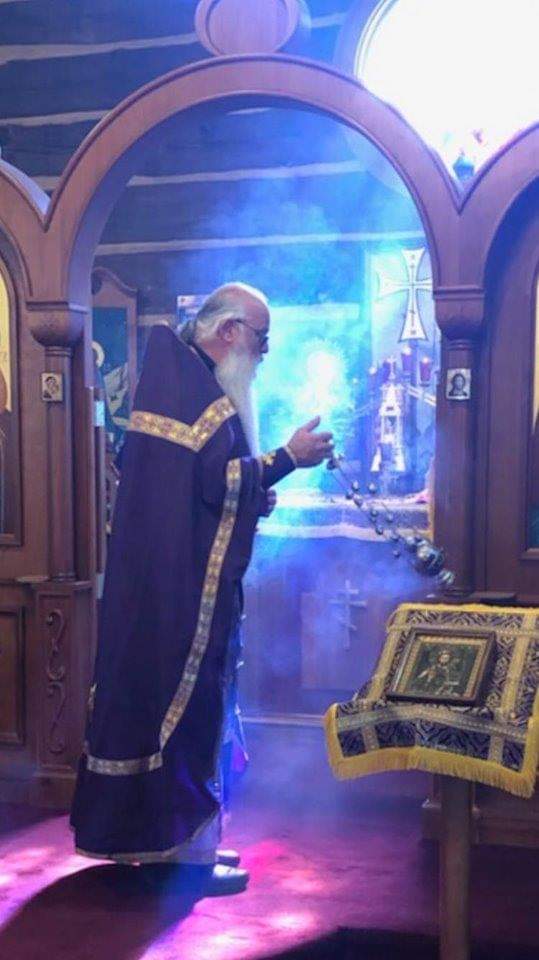
In the end, as Father Seraphim reminds us often in his homilies, we are not saved by our church attendance, we can read Scripture, sing, give tithes and it all be for naught. If there is no spiritual fruit this is all empty and utterly meaningless as far as salvation. However, as St Paul speaks of the law being a guardian, the established prescription and pattern for worship, once catalyzed with sincere Christian faith, is an invaluable asset. It may not be necessary for salvation, the repentant thief on the cross beside Jesus was never Baptized, and yet it does greatly enhance the life of the believer.
Lastly, Orthodox worship doesn’t take away from our ability to worship spontaneously, in the spur of the moment, like King David dancing as the Ark of the Covenant was being processed through the city of Jerusalem. This is not an either/or thing nor have I found the tradition to be onerous or confining in the way one may fear coming out of a legalistic tradition. There is a sort of casualness to our formality, an allowance for imperfection. So simple even children participate.
Structure We Need To Thrive
Us creative types loath structure. We like to color outside of the lines, right? And yet, despite this umbrage, we often live as beneficiaries of the structure that others provide. Many artists would starve, or be overrun, unable to do their work, outside the structure that others have diligently maintained for them. And many would do better, even in their passionate pursuits, if they would acknowledge their need.
The framework that Orthodoxy provides, likewise, for me has been that missing element that I didn’t even know that I needed. This idea that tradition is somehow bad is corrosive, it is creating a generation desperate to find their place, suicidal, distorted and unfulfilled. We are better when plugged in, when a part of something bigger than ourselves. Tradition brings us together and Orthodoxy enhances rather than take away from worship.
As we Orthodox like to say…
“Come and see!”
 Irregular Ideation
Great post! The earliest of Church Fathers (Ignatius of Antioch, Clement of Rome) saw the Church as being defined by its Liturgical Tradition and it’s structure of authority. It stands to reason that such structures are edifying to our being. I chose to become Orthodox the day I realized that I can’t let God in any further than in an Orthodox service since, as you say, it invades every sense with age-old tradition. Thanks for posting!
LikeLiked by 1 person
Hi Joel! I realize this post is two years old by now, but it seemed like a good place to reach out. I’m not Mennonite, but I do belong to a church within the Anabaptist tradition. Over the past year or so I’ve become deeply intrigued with Orthodoxy. I don’t know if I’ll ever be prepared to go “all in” but I’ve found my spiritual life enriched by adopting some practices such as a morning prayer rule, the sign of the cross, periodic fasting, the Jesus Prayer, etc. I also find the Orthodox theology of the saints beautiful and compelling. I do, however, have some hesitation regarding particular saints recognized by the Orthodox Church—two examples being Emperor Justinian and Prince Vladimir of Kiev. It’s not that I have any kind of disdain for them (there are things I admire about both). It’s just that it feels like a big leap for me to go from the Schleitheim Confession framework of “two kingdoms” and renunciation of the sword to actively embracing two “men of the sword” as fellow brothers in Christ. With your background, you can probably see where I’m coming from. Was this something you wrestled with in converting to Orthodoxy from the Mennonite Church?
LikeLiked by 1 person
Where Anabaptists tend to judge people based upon a cookie-cutter standard (either you follow the church rules or you may not be a Christian), the Orthodox take a different approach. For them, rather than it being about meeting a particular standard, it is about continual growth in faith. (I mean, think about this, even Abraham wouldn’t make the conservative Anabaptist cut, would he?) In other words, we don’t all start at the same place, some start in a Christian home, given much and much will be required of them. I never had a problem accepting that not all saints were like me. I’ve never been perfect enough to judge them as better or worse Christians for our differences. The Christian life is a life of repentance. None of us will earn our salvation and it is better to be the thief on the cross than Judas. Incidentally, the liturgy makes this contrast between Judas (who walked faithfully with Jesus by outward appearance) and the thief, telling us to be like the latter: “Like the thief, I will confess Thee, Remember me, O Lord, in Thy Kingdom.” We’ll be saved by God’s grace, not by our perfection. But, if there is perfection we should seek, it should be to be perfect in mercy and not in keeping some religious standard.
LikeLike
Thanks for your answer 🙂 It matches a lot of my own thoughts. As someone outside the Orthodox Church, I can look at these kinds of saints and simply plead “agnosis”—God alone knows the full truth about them and I only see a bare fraction. Were I ever to become Orthodox, the biggest leap of faith would be having enough confidence in their saintly status that I could venerate their icons and ask them to pray for me. It’s more a caution about the spiritual doors I open in my life than anything else.
LikeLiked by 1 person
The good news, so far as the saints, is that there is really no requirement to pray to any of them. As a theological matter, I do not need to judge a person’s salvation prior to asking for their prayers. So the same goes for the reposed. I don’t need to decide their eternal fate. The bigger concern is always our own salvation. That’s one other thing that the Orthodox emphasize: Staying in our own lane. I believe Protestants have this need to decide, everyone for their own selves, who belongs in the church and this is how you end up with early Anabaptists mutually excommunicating each other. It is better to let God decide. Furthermore, it is quite bold to believe that we know better than the same tradition that brought us the canon of Scripture.
That said, I may not be the one to ask. I was put off that my priest (from Baptist background) paused the liturgy to make sure our visitors knew that only those who were properly prepared could partake. To me this is not necessary. Didn’t Jesus let Judas partake? St Paul also said that there some Commune unworthily. So it just does not seem to be something that we should excessively concern ourselves with. None of us are worthy outside of Christ Jesus.
LikeLike
As far as Judas and Communion… https://orthochristian.com/130207.html
LikeLike
Hi Preston, like you I really appreciate Orthodoxy. I love the inclusiveness that I hear from many priests. But I was kind of shocked to realize that lots of Orthodox believe that the official teaching of their church is that no one outside of their church can be saved.
Here’s a debate where that is discussed at one point: https://youtu.be/hA9Rdo6jwxg
It sounds like Nicaea II, the same council that mandated the use of icons, declared anyone who doesn’t use icons to be accursed.
Joel, maybe as an Orthodox Christian yourself, you could give us your perspective. Is that something that the Orthodox Church teaches anymore?
LikeLike
I can’t speak for the Church, but have found some discussion of these topics:
https://www.earthaltar.org/post/what-does-nicea-ii-require-of-you
https://www.wenorthodox.com/forum/__faq/who-will-be-saved-what-about-non-orthodox-christians-or-others-by-father-michael-shanbour
LikeLike
Interesting take, thanks for sharing. That’s similar to what I’ve been hearing from those who can’t speak for the whole Church. Mainly, it’s the authoritative statements of the Orthodox Church that I’m wondering about, whether any more recent teachings have changed the historic anathemas.
I must admit that praying the Synodicon of Orthodoxy each year, and repeating its anathemas as part of the traditional liturgy, would be hard for me to take part in. https://www.johnsanidopoulos.com/2010/02/synodicon-of-orthodoxy.html
Although, if the Orthodox Church is the true Church, I guess it would make sense that this teaching wouldn’t conform to what the Western mind would prefer.
LikeLike
According to what I’ve read in those articles, not using icons isn’t anathema. However, I can’t see any reason why a person should be disrespectful towards images of Christ. Veneration simply means to respect and it really isn’t a tall order.
The big change for me, so far as icons, came by way of my Mennonite grandpa. My grandma had died and, as deep as his love for her was, he has missed her terribly since then. I learned that he was kissing her photograph seven times, every morning. Why? Well, it was a way to show his love and respect for her. And to confuse this with worship would be silly, it is simply veneration.
Would you dare to take this picture of my grandma, cherished by her husband, and treat it roughly or as if it had no value whatsoever?
I would hope not!
Anyhow, I am just like you, a Gnostic at heart, trying to spiritualize or rationalize away the value of physical things rather than incarnate and fully acknowledge the significance that Christ came in the flesh. Protestantism tends to emphasize that Jesus was God without comprehending that he was also man. We dismiss and intellectualize, starting with the Eucharist, thinking that only what exists in our brain has value. But St. Paul, in the book of Acts, sent objects to heal. Could it be we are the ones who are spiritually deficient for not recognizing the value of the Holy thing?
Ps. The above written by someone who just groaned about the Parish priest (from fundamentalist Baptist background) sending yet another reminder about church clothes and dress code. I rolled my eyes, internally, because I’m smart enough to realize that we’ll be clothed in the righteousness of Christ in heaven, right?
https://myocn.net/we-are-icons-images-of-god/
LikeLike
Actually I don’t have anything against icons myself. My question is whether the Orthodox Church in an authoritative decision has expressed the possibility of salvation outside the Church.
Icons themselves don’t bother me, but anathematizing my family and friends in the Divine Liturgy would be a difficult pill to swallow.
LikeLike
Again, I’m not sure what your referring to. What are you actually anathematizing? Can you provide a quote where it says the mere non-use of icons is condemned?
If you were asked to denounce Bible burnings, would that be an issue as well?
LikeLike
Gregory,
You can probably find some sectors within Orthodoxy who deny the salvation of anyone non-Orthodox just as you can find some sectors within Anabaptism who do the same. I know someone in my church from a former Hutterite family whose parents were told they would go to Hell if they left the colony. The Orthodox Church as a whole does regard itself as the “one true church” but I remember watching an interview where an Orthodox priest explained that “we can say where the Church IS but not where it ISN’T,” which basically matches what Joel shared about the views of Theophan and others regarding the “heterodox.”
Regarding icons, the other article Joel shared actually confirms some of my own thoughts about the Seventh Ecumenical Council. You have to keep in mind that pretty much anyone who “did not venerate” icons at that particular time was actively destroying them. It’s possible to “venerate” an image just by simple things like keeping it in good repair, handling it carefully, displaying it in a proper place, and not physically abusing it. I like how the article also pointed out the legitimacy of suspending certain forms of veneration as a pastoral measure in response to abuse—that actually addresses pretty much all of my personal concerns about the use of icons. They’re not appropriate for everyone and can be misused. But I will also gladly affirm that they can be a true means of drawing closer to Christ.
LikeLiked by 1 person
Thank you. You seem to have the correct understanding and it really is important to put these things in the context they were given. Orthodox writings need to be treated as we do any other text, with proper regard to the circumstances being addressed, and often are speaking to those who are clearly at odds with the Church. What is speaking to Arianism doesn’t necessarily apply to Protestantism today. And, what’s the alternative? Are we going to go full blown ecumenical where nothing matters except vague acknowledgement of Christ? Do we start to accept Muslims as brothers and not raise an eyebrow about rainbow flags flying in front of church buildings? The thing is, my Mennonite baptism was accepted.
LikeLike
To be clear, I don’t care whether individual Orthodox Christian believes one way or another. But if I were to join the Orthodox Church, I would conscientiously need to accept as infallible whatever the Orthodox Church teaches as infallible. The consistent belief of the Orthodox Church is that she cannot teach error, though individuals within her can. So it seems pretty important to agree with those infallible teachings.
So the question is whether the Orthodox Church teaches that those outside of her are damned. That’s why sources like ecumenical councils and the Synodicon of Orthodoxy are what I’m looking at. They are considered authoritative/infallible, while individual priests are not.
I don’t mind speaking out against what is wrong, but it seems problematic to say,
“To them who because of a mistaken adherence to the term uncircumscribed, wish not to depict in icons Christ, our True God, Who like us partook of flesh and blood, and thus show themselves to be Docetists, Anathema.”
I just don’t think that all those who don’t want icons are anathema, although I actually appreciate icons myself. Maybe I’m odd for being bothered by that? It doesn’t seem like you guys are, so maybe it’s not a big deal who is anathematized.
Here’s a link where you can read the rest of the Synodicon, which anathematizes those who use a different church calendar, those who use unleavened bread, etc. It seems a little different from “we know where it is but not where it isn’t,” which I have heard before as well.
https://www.johnsanidopoulos.com/2010/02/synodicon-of-orthodoxy.html
Joel, maybe your church doesn’t perform the Synodicon? I understand it is performed when a bishop is present on the Sunday of the Triumph of Orthodoxy.
LikeLike
Gregory,
The key phrases I see in that quotation are “because of a mistaken adherence to the term uncircumscribed” and “wish not to depict in icons.” It’s not even talking about whether or not to use icons but rather a theological objection to ANY images of Christ AT ALL for any purpose. The church I belong is “aniconic” in the sense that we do not make use of icons in our liturgy or private devotion. To the extent we even still think about the “why” behind this, it’s rooted in our forebears’ reaction against gross abuses within the Roman Catholic Church (which by that point had already been separated from the Orthodox for 500 years). But pretty much no one you talk to in my church objects to the idea of visually depicting Jesus Christ. Even the early Anabaptists still drew illustrations of Christ in texts like Martyr’s Mirror. You could maybe find some strands of Anabaptism whose views would fall under that anathema, but only a fringe of their present-day descendants would think that way. And the same is true of the Protestant world.
LikeLiked by 1 person
Sorry, the post above was from me. I logged in under the wrong profile.
LikeLiked by 1 person
Thanks for the reply, Preston. However, I recommend looking at the context, and not just the little item that I quoted. The iconoclast controversy was not just about people who refuse to have any images of Christ.
But even if it were only talking about people who refuse to have any images of Christ–it’s hard for me to see why those people should be consigned to damnation. Recall that this liturgy also anathematizes people who have a different church calendar and who use unleavened bread in communion. I recommend reading it.
What drew me to the Orthodox Church at first was, in part, that they didn’t seem to define who was saved and who wasn’t. But I’m finding that, while on the popular level, that’s what’s being taught, the actually authoritative statements of the Church don’t seem to reflect the popular language. There seems to be a disconnect between the Orthodox Church here in the West and what she has continually believed and practiced in the East.
You might also want to look into the pan-Orthodox Synod of Jerusalem (received by the whole Orthodox Church and therefore infallible) which also very clearly draws the lines of where the Church is and where the saved and damned are.
It seems important to me, before making any steps, to find out what the authoritative teachings of a church are. I don’t think that’s unreasonable to do.
Anyway, I’m going to need to sign off here. God bless you in your journey.
LikeLike
That… was powerful! Really enjoyed the article 👍 This ability to accept mystery and ambiguity is one of the things I’ve come to appreciate about Orthodoxy. Most Protestants have an irresistible compulsion to nail everything down.
LikeLiked by 1 person
Sorry, the “Empyreanvoyager” comment was from me. I somehow got switched over to my other profile.
LikeLiked by 1 person