Honor Killing Versus Western Values

Standard

The Old Testament is full of things those of us born in the liberal West would find to be abhorrent. It was a wildy different culture. But, the one thing most foreign—in an age when we coddle our children to death—is parents literally killing children when they stepped too far out of line:

Anyone who curses their father or mother is to be put to death.

(Exodus 21:17 NIV)

Simple. Concrete.

Or shall we say, written in stone?

If, however, the charge is true and no proof of the young woman’s virginity can be found, she shall be brought to the door of her father’s house and there the men of her town shall stone her to death. She has done an outrageous thing in Israel by being promiscuous while still in her father’s house. You must purge the evil from among you.

(Deuteronomy 22:20-21 NIV)

“Stoned,” in this context, doesn’t mean legalized marijuana.

But if you do like a little smoke:

If a priest’s daughter defiles herself by becoming a prostitute, she disgraces her father; she must be burned in the fire.

(Leviticus 21:9 NIV)

Honor killing, in the West, is associated with Islam. Yet, interestingly enough, not once is it mentioned in the Qu’ran. However, there are multiple references in the Bible starting with those that are quoted above. Children who disobeyed—or who otherwise brought shame to their parents—were to be put to death. This punishment was not a choice or an option. No, it was a “must be put to death” command to keep Israel pure. And no doubt this teaching in the Old Testament is part of what inspires the practice today and why honor killing continues to be part of traditional cultures in the world.

And this went goes beyond killing children for their rebellion or sexual sin.

There is also this account:

And Jephthah made a vow to the Lord: “If you give the Ammonites into my hands, whatever comes out of the door of my house to meet me when I return in triumph from the Ammonites will be the Lord’s, and I will sacrifice it as a burnt offering.

[The, oh no part, where he returns home and is greeted by his beloved daughter.]

After the two months, she returned to her father, and he did to her as he had vowed. And she was a virgin. From this comes the Israelite tradition that each year the young women of Israel go out for four days to commemorate the daughter of Jephthah the Gileadite.

(Judges 11:30-31, 39-40 NIV)

Umm, what?!?

Some commentaries try to explain away the most plain reading about what happened to the daughter of Jephthah. But if his vow is that important to him and a cause for her to mourn for two months, why would it be any less than what he said he would do? This is a religious tradition where the big patriarch, Abraham, was ready to kill his own son as a way to please God—so their ‘Biblical’ values seem very different from ours.

Even in the New Testament we start where Joseph is contemplating the out-of-wedlock pregnancy of Mary—his betrothed—does he spare her by having her sent away quietly or does he tell the world about her dishonoring him? What does an honorable man do? It is life or death. In the Gospel of Matthew, where this account was given, four other dreams are recorded and all of them for the purpose of saving lives.

Joseph’s dream saved Mary’s life.

There is this clear expectation: Honor or death. Or maybe honor and death?

It is important to note that Old Testament laws are longer applied even in the Jewish context. The Western world has liberalized all. Sure, you might still get caught on the Coldplay camera and cancelled for adultery—pelted with stones (figuratively) in form of memes and social media roasting—but not killed. We still judge sexual sin. That said, we don’t use Capital punishment for that or really much of anything anymore.

The Triumph of Liberalism in the West

In modern Western culture, promiscuous daughters or rebellious sons rarely provoke shame; some parents even take pride in their children’s nonconformity. How did this transformation occur?

Not very long ago that Europeans were a rather rowdy bunch—burning heretics and pillaging the world. They defended slavery as compassionate and Biblically endorsed. Cousin marriage was common and beating your wife not a big deal. This was ‘Christian’ civilization.

But, starting in the Enlightenment, human rights slowly expanded and eventually were extended to women and racial minorities. Individual liberty, religious rights, primacy of reason and scientific progress started with this movement in the West.

It took a few centuries for Enlightenment ideals to take hold—but the American colonies became a breeding ground for this new thinking and a liberal revolution. The French would follow suit and liberalism eventually swept through all of Western Europe.

This liberalism wasn’t always sunshine and roses. Napoleon had marched across the European continent at the same time as the Americans were manifesting their destiny all the way to the Philippines. Proclaiming “liberty and justice for all” while trampling the indigenous people underfoot. And yet, long-term, it has led to the assumptions we don’t even question in the West.

Even our most traditional religious types, who decry feminism, oppose the sexual revolution and vigorously defend their own entitled status as men, do an about-face when it comes to those getting ‘Biblical’ against sexual immorality according to the texts. I mean, I guess that is just the nature of sectarianism (Okay when we do it, but a dangerous extreme if they do the same or take it an extra step), but it also shows how deeply entrenched liberalism has become in the West—it shapes our perspectives.

Still, the hiccups (or hypocrisy) continues. The rights of the visible always trumping that of the fetus or foreigner.

Christianity has certainly played a role, but has tended to follow the cultural zeitgeist with adherents applying their faith on both sides of the popular argument. One could appeal to all being one in Christ or to some being excluded as the cotton pickin’ son’s of Ham. When the Bible has rules for slaves and masters, details genocidal campaigns at the command of God, and treats women as property of a man, a little confusion is to be expected. But Jesus definitely did stand up against graceless application of law and the religion that formed up in his name was a force for significant changes throughout the Roman empire. It was a shift from the might makes right of ancient civilizations—despite this still being how morality plays out in the real world.

The Church has always played a role in the abuses, from the bloodsoaked Crusades, to the brutal Inquisition and the current Zionist justification of slaughter in Gaza.

The West leads the body count in the modern world—the US following leading the West’s colonial mandate of killing a way to hegemony. This has become our biggest export. Our bombs and missionaries. Either they will convert to democratic values or die—as we replace the guy they elected with our dictator.

No, we don’t do honor killings anymore. But we will vaporize women and children if their government dared to attack a military base in response to economic sanctions. WW2 was a righteous war because it stopped the Holocaust, yet the US was allied with a guy named Joseph Stalin who was responsible for the Holodomor (3.5 to 5 million) and the purges of Christians and others who might oppose him. China, our other ally, is estimated to have killed 45-70 million, and yet Imperial Japan was an unprecedented evil for killing a hundred thousand in Nanjing?

An execution in Hiroshima

Only since 9/11 the US has directly killed nearly a million people and indirectly 4.5 to 4.7 million in addition to this. And then we wonder why refugees flood in from all around the world?

Evangeli-cons may claim an “age of grace” for themselves or their own family, but they also support the most brutal policies. If we are not directly involved in the violence, we’ll rabidly endorse those to whom all the “dirty work” is outsourced to. It’s amazing we will find the time to report an honor killing—by a person from a rival culture—and yet justify bombings and mass starvation of millions without second thought. Talk about strain on gnats and swallowing camels!

The Western world seriously needs to work on its own hypocrisy before lecturing the world (or adherents of other religions) on the immorality of their ways.  Kids in Gaza get the death penalty every day, via means we provide, and yet we say it is justified—let the civilization that is without sin cast the first stone!
‘Masculine’ Orthodox Growth

Standard

I awoke this morning to a message from Fr. Siewers. He shared a NY Post article, “Young men leaving traditional churches for ‘masculine’ Orthodox Christianity in droves,” which I read with my coffee. This is a trend within Orthodoxy, and arguably I’m part of it, where (relatively) young men are leaving the consumerist ‘Big Box’ and the compromised traditional churches for a weird alternative that feels foreign to most Americans.

I know, in past blogs, about Orthodox growth, I’ve done a sort of victory lap about Orthodoxy and in doing so left out valid counterpoints. Yes, indeed, many young men are finding Orthodoxy. But it may not be as big a trend as articles like this NY Post story or the Orthodox faithful make it out to be. The growth from fundamentalist reactionaries is limited—most especially if it is only drawing in males. It is difficult to sustain this if no accompanying young women are willing to procreate with these transplanted men.

The truth is that Orthodox, in the United States of America, only number around 6-7 million. Who knows how many show up on Sunday?  For sake of reference, that is less than the estimates for illegal immigrants who currently live in this country, around 11.7 million, and basically makes the Orthodox contingent a demographic drop in the bucket. Yes, growth is good, but is this sustainable? Or is it just a blip driven by those desperate to do something a little different from everyone else and destined to fade like Hipster fashion after a decade?

My own conversion to Orthodoxy was not the same as the template laid out in the NY Post article. I wasn’t running from a church with a ‘woke’ or social justice agenda that replaced the Gospel. Yes, maybe I was a bit disgruntled with a feminized church culture where marriage and family were sacrificed for impossible ideals and visible missions. But it wasn’t in reaction to liberalization. I had done it from a conservative Mennonite church and was attracted to Orthodoxy as it was different from fundamentalism.

Ironically, this new flow of reactionary men to Orthodoxy may come at the expense of the attitude of the church that had initially drawn me. While adopting the Orthodox worship ritual, some bring their Protestant or Catholic baggage with them, there are too many Ortho-bros or those simply trying to be edgelords and unique. It is part of the Alt-right vibe, those who have rejected the far-left’s absurdity on one hand and yet are still looking for a reaction more than they are serious about their faith.

There will always be that small percentage of people who will buy a Tesla Cybertruck to be strange. Those who do things to piss off everyone else with normal tastes. And the growth of Orthodoxy is as much a rejection of the political mainstream as it is about seeking God. It feels more like cosplay, in my experience, than it is something born of a repentant spirit and desire to truly submit to the authority of Christ vested in the church. It is a bunch of dressed-up Protestants.

Case and point? The parish I left has an old Baptist convert as a priest who offended a couple (very fragile extremely idealistic homeschoolers) and the mom of this union made it her personal mission to pull as many people away as possible through lies and attacks. That’s where much of the new growth in the ROCOR parish down the road has come from and why I’ve been inclined to stay home on Sunday to be away from all of it. Not all growth is good growth.

As a postscript, my wife and I do not share the same perspective as far as worship and what church is ideal. She got along with the folks at Holy Cross. But didn’t get much out of the preaching (which was fundamentalist in flavor more than Orthodox) and practice. We sometimes attend a generic Protestant consumerist church, with a rock band and a coffee shop, because it is what reminds her most of her own generic Evangelicalism in the Philippines. My son and new daughter remain unbaptized.

Playing Church

Standard

One of those fun things to do after church, as a child, when the adults had left the auditorium, was to go up and play preacher. We could mimic the motions of our elders in a convincing enough way to be funny and yet really had no idea what we were doing. And this reality would be quite obvious the moment we were asked a serious question.

Part of becoming an adult is the realization that many don’t really know what they are doing. Sure, some might enthusiastically perform their roles, and they have the necessary qualifications, but they either lack practical experience or simple aptitude. Not every doctor or engineer is equal, for example, some are more competent, and others—not so much. But none of these ‘professionals’ have an authority that should be unchallenged.

Reflecting on the priorities, and performative religion, I can’t help but come to the conclusion that some are really only concerned about looking the part and lack any real spiritual substance. It is disheartening when getting customs right is of greater importance than welcoming children. When leaders can answer on matters of trivia but are unable to offer any real wisdom or direction when it comes to the practical application of the clichés they preach, they’re phonies.

I’ve concluded that many participate in church as a sort of social club. And it goes all the way to the top. They have clout in the organization. They can wear the costumes and get the recognition that they so desperately need. But, in the end, they are empty vessels, a noisy gong or a clanging cymbal. It would be better to be a child going through the motions, in play, than to take yourself seriously and offend the little ones in the faith. Jesus wasn’t talking about pedophiles in Matthew 18:6.

The Big Box Church

Standard

Sitting in “The Well,” a coffee shop within the campus of Christ’s Wesleyan, a local mini mega-church.  Why a coffee shop? It is pretty much the same reason a Target store has a Starbucks. It is a trendy and cool place to chill out as the service plays out on the big screen.  The ‘church’ here is as American as a big box store.  It is quite the production, with many programs tailored to children and all needs in the congregation.  The wonderful thing is that you are free to participate to the level that you want.  I’m not alone as I sip my caramel frappe while the administrative pastor goes over bulletin announcements and the highlights of Miami versus Kansas City play on the small screen.

The thing is, I was once threatened by this, the professional musicians mimicking rock stars on the stage.  How could this really be called a church?  And, as they currently ruin “How Great Thou Art” with some ridiculous contemporary rendition, I would definitely be tempted to pile on.  There’s certainly a kind of consumerist hokeyness to the whole enterprise.  I mean who looks at Walmart and an Alanis Morissette wannabe, then says, “Wow, this is the perfect model for the church!”? It’s all as cheap and throw away as the American culture in general.  Nevertheless, this is the place most people are today and also as close to an actual community as many get in this age of suburban sprawl.

Yes, I’m a worship snob.  To me, nothing can rival true Orthodox worship.  Old hymns, like those in a traditional Protestant church, and the Psalms and Scripture of the liturgy feel much more meaningful.  But is this really a substantive difference?  Is the worship here more or less about our personal preference than it is there?  Even Orthodoxy, with its simple images and chanted theology, was trying to make the message accessible to the people at the time.  Would Jesus have filled a stadium had he had the opportunity to do so?  Maybe so.  Certainly, the church has always taken some of its form from the local culture. But then shouldn’t the church create the culture rather than the other way around?

The thing is the biggest problem that I have with all of this is that it exposes religion for what it is.  The reason some of us need to stay traditional is because if worship is allowed to change then we start to question.  Could it all be fake?  We find our security keeping it all the same.  If it has a timeless feel then we don’t need to struggle with the foundation of our faith.  My cynicism takes over because this chintzy architecture exposes the framework that some of us would rather keep hidden under the ornate historical facade. It works like satire to undermine my confidence.  Oh well, as the couple prepares in front of the lights and cameras in the lobby, like television reporters, I suppose it is time to wrap this blog up.

Postscript: I attended with my wife, out of convenience due to our busy afternoon, who prefers this style of service as it is similar to her church in the back in the Philippines. I was reflecting on the similarities of this to Orthodoxy, in that you have “coffee hour” after the Orthodox church. The biggest difference really is the size and organization. One models itself after the Byzantines and the other off a shopping mall or shopping plaza. And yet both require donations from viewers like you. What really is the big difference between dropping money in the offering plate and tapping your credit card to pay for the brew? The church calendar and the many programs to help make the Gospel accessible? Being in awe of the temple and being impressed by the light show? It all basically serves the same purpose.

What Is Biblical Israel?

Standard

There is a nation in the world that identifies as Israel.  And, as we all know, if a person or group of people identify as something then this is what they are.  If I say that I’m a ham sandwich you better believe it!  Israel is what calls itself Israel.

That out the way, is that Israel the same as the Biblical Israel established by God?

If you were raised under Zionist teachings this isn’t even a question.  Of course, it is!  What else could it be?  Biblical criteria or qualifications, what are those?  I mean, how exciting would those end times novels be without our favorite backdrop???  And next, you’ll be telling us reality television is fake and that Caitlyn Jenner is a man and not a stunning and brave woman!?! 

Isn’t everyone who identifies as something that thing?

However, for those slightly more literate, and not born yesterday, the question of what the Biblical Israel is and if the state by the same name is the same thing is important.  For a Christian, up until the time of the reformation and a little after, this answer was quite clear and that is that Israel today is the remnant of the Jews who remained faithful—as well as those Gentiles converted. 

From the perspective of New Testament writers Israel is the Church or the body of those who believe—a religious affiliation and not a particular race.

About Religion, Not Race…

While still a member of a Mennonite church, I was not happy to have my religious identity be classified as an ethnic group.  In my own opinion I wasn’t born a Mennonite, it was my religion and something that I had to choose to participate in.  And yet there was truth to the claim.  There is was an ethnic component to being part of the group.  We shared a culture, and have our own common surnames, and many converts don’t fit in well.  

However, the most damning evidence, other than having unique genetic disorders, is the broad range of beliefs and practices under the Mennonite banner.  Those calling their church Mennonite span from those who are progressive and ordaining lesbian pastors to those very traditional still using horses and buggies for transportation.  So, when the only true common bond between all of these Mennonite groups is a sprinkling of Yoders, Gingrichs, Millers, or Barkmans, can it really be a religious belief system?  

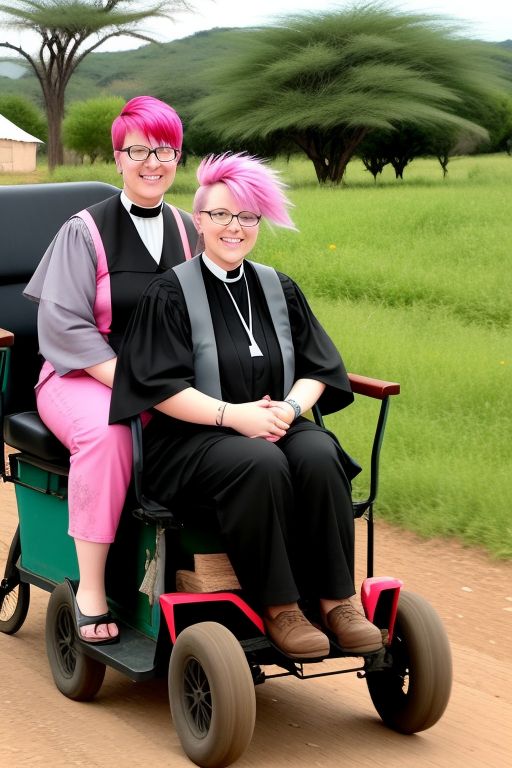
Rev Michelle Yoder, a charismatic lesbian pastor of the Mennonite faith, sitting comfortably with partner in her electric Mennonite buggy as she makes her way through Africa

Okay, like a Facebook relationship status, it’s complicated.  People can and do convert to become Mennonite.  And, surprisingly enough, since a few decades ago, an African version of the Mennonite denomination has been growing rapidly to the point there are now more Mennonites in Congo than in Canada.  I mean, who knows if their doctrines or religious practices are anything that a North American conservative would recognize, nevertheless they do carry the name of Menno Simons in a direction he probably never imagined.

That’s one thing that the Orthodox generally put up front.  If you are Orthodox in Greece or a Greek community, then you’re a Greek Orthodox.  The liturgy and general practice are the same, established by canons, but there is also room for ethnic expression and use of the language common to the people.  In the Arabic world, for example, they use “Allah” where we use the Roman pagan word ‘God’ and have been using it before Islam even existed as a religion.  Anyhow, in Orthodoxy, unlike Mennonites, the identity is built from the substance of something established and a faith that is ancient.

Absurdly, when it comes to Judaism, we no longer care if they’re practicing or apostate, we slap that big ethnic label on them all and claim all of them have a claim to the land by their DNA.  To us, they’re all the same.  But that’s certainly not the case when it comes to Biblical Israel, not every part of the assembly was blessed, some were literally swallowed up by the earth, while others were put to death for disobedience, and the whole would end up in exile: 

But if you or your descendants turn away from me and do not observe the commands and decrees I have given you and go off to serve other gods and worship them, then I will cut off Israel from the land I have given them and will reject this temple I have consecrated for my Name. Israel will then become a byword and an object of ridicule among all peoples. This temple will become a heap of rubble. All who pass by will be appalled and will scoff and say, ‘Why has the Lord done such a thing to this land and to this temple?’ People will answer, ‘Because they have forsaken the Lord their God, who brought their ancestors out of Egypt, and have embraced other gods, worshiping and serving them—that is why the Lord brought all this disaster on them.’ ‭‭‭‭

1 Kings‬ ‭9:6‭-‬9‬ ‭NIV

It is quite clear that the covenant was even conditional for those who were biological offspring of Abraham.  Not only this, but people could become part of Israel who were not blood descendants of Abraham, Ruth the Moabite, or Rehab the prostitute, a Gentile, for example.  So it was never about ethnicity, it was always about obedience and the covenant conditional based upon obedience rather than bloodlines.

Chosen For Abraham’s Faith

The children of Israel were not picked for their superior genetics.  That’s not to say there aren’t very intelligent and extremely talented people of Jewish religious heritage.  Abraham was picked for being a righteous man:

And the LORD said, Shall I hide from Abraham that thing which I do; seeing that Abraham shall surely become a great and mighty nation, and all the nations of the earth shall be blessed in him? For I know him, that he will command his children and his household after him, and they shall keep the way of the LORD, to do justice and judgment; that the LORD may bring upon Abraham that which he hath spoken of him.

Genesis 18:17‭-‬19 KJV

It was Abraham’s righteousness and how he would guide his children to “keep the way of the Lord,” that God picked him.  God went on to set Israel aside through religion, not race, and those who did not keep the law would soon find themselves entirely cut off from the assembly of Israel.  There was never a blessing for simply being a blood relative of Abraham.  It was always conditioned on a faith that produced the work of obedience and this remains the case.  

Those born to keep the law of Moses must recognize their Lord and Savior or they’re no more blessed than the Benjamites put to the sword for their evil:

The tribes of Israel sent messengers throughout the tribe of Benjamin, saying, “What about this awful crime that was committed among you? Now turn those wicked men of Gibeah over to us so that we may put them to death and purge the evil from Israel.” But the Benjamites would not listen to their fellow Israelites. […] The Lord defeated Benjamin before Israel, and on that day the Israelites struck down 25,100 Benjamites, all armed with swords. […] The men of Israel went back to Benjamin and put all the towns to the sword, including the animals and everything else they found. All the towns they came across they set on fire.

Judges 20:12‭-‬13‭, ‬35‭, ‬48 NIV

If this were a Covenant merely about blood or genetics, then the Benjaminites really got shafted.  I mean, I’m not sure how anyone could construe being slaughtered wholesale as being a blessing or some special thing to be chosen for, “Congratulations, you’ve been selected to be purged!”  So this idea that anyone will ever be saved simply for their chosen race is wrong and there is only one true religion which is founded in Abraham’s seed, through the law of Moses, and is fulfilled in Christ.  

My favorite Jewish writer explains:

Those who want to impress people by means of the flesh are trying to compel you to be circumcised. The only reason they do this is to avoid being persecuted for the cross of Christ. Not even those who are circumcised keep the law, yet they want you to be circumcised that they may boast about your circumcision in the flesh. May I never boast except in the cross of our Lord Jesus Christ, through which the world has been crucified to me, and I to the world. Neither circumcision nor uncircumcision means anything; what counts is the new creation. Peace and mercy to all who follow this rule—to the Israel of God. 

Galatians 6:12‭-‬16 NIV

After Christ, even the law of circumcision becomes secondary to what St Paul describes as being “the new creation.” 

So it was the righteousness of Abraham, which was followed up with their being set aside by careful obedience to the law—which was the test of the Old Covenant—and finally, reconciliation through Christ that is salvation for all. 

It was NEVER only about ethnicity or race.  Modern descendants of the Jews must do the same as anyone else, repent and accept their King or perish. Repentance is the first step to salvation and that is what distinguishes true Israel from the counterfeit.  The first followers of Jesus were Jewish.  Christianity is the part of the assembly that remained faithful to their Lord while the others who rejected their rightful king are called anti-Christ:

Dear children, this is the last hour; and as you have heard that the antichrist is coming, even now many antichrists have come. This is how we know it is the last hour.  They went out from us, but they did not really belong to us. For if they had belonged to us, they would have remained with us; but their going showed that none of them belonged to us. […]  Who is the liar? It is whoever denies that Jesus is the Christ. Such a person is the antichrist—denying the Father and the Son.  No one who denies the Son has the Father; whoever acknowledges the Son has the Father also.” ‭‭

1 John‬ ‭2:18‭-‬19‬ ‭NIV‬‬

There are a great many who call themselves Christian today who have Scripture and yet no discernment whatsoever.  You don’t even need to believe in Jesus to understand what is being said in the passage.  Who is identified as the liar and anti-Christ?  1 John 2 very plainly tells us who: “It is whomever denies that Jesus is the Christ.”  That is to say those unfaithful to the covenant made with Abraham through their rejection of the Son—God in the flesh.

To say that some can deny the Son and still have a Covenant with the Father?  It is to basically throw out the entire Gospel of Jesus Christ.  It is completely moronic and a sign that someone was never truly part of the assembly of God.  If they truly belonged they would see their Lord as the fulfillment and not be so easily led astray.  When Jesus says “Salvation is from the Jews” he is not talking about an ethnic group, he is talking about himself and how he is the Messiah that was promised through the faithful seed of Abraham.

Chosen by Christ

It is really a form of idolatry to hold a race or ethnicity up as chosen by God for no reason other than their genetics.  That is not what the “Israel of God” ever was.  The assembly (or ‘ekklesia’) was always about those who were faithful, a remnant of Abraham’s seed that included Gentile converts, and turning it into an ethno-nationalist state is a perversion of what the original covenant between God and Abraham actually entailed.  A covenant is a two-edged sword, while it comes with blessings for those who obey there is also a list of curses for those who do not hold up their own end.

‭‭Jesus spoke to them again in parables, saying: “The kingdom of heaven is like a king who prepared a wedding banquet for his son. He sent his servants to those who had been invited to the banquet to tell them to come, but they refused to come. […] “But they paid no attention and went off—one to his field, another to his business. The rest seized his servants, mistreated them and killed them. The king was enraged. He sent his army and destroyed those murderers and burned their city. “Then he said to his servants, ‘The wedding banquet is ready, but those I invited did not deserve to come. So go to the street corners and invite to the banquet anyone you find.’ […] “For many are invited, but few are chosen.”

Matthew‬ ‭22:1‭-‬3‬,5-9,14 ‭NIV‬‬

Any guess which of those on the guest list killed the servants sent by the King?

The Biblical Israel, for those who believe in the Gospel of Jesus Christ, is that remnant of Jews who obey and follow after the Word of God incarnate.  This is always how Israel worked.  Some were pruned off the tree and others grafted in.  There were never special exceptions made for anyone merely on the basis of ethnicity or race.  The Church is the nation of those faith to the work of God that started with a Covenant with Abraham and needs no worldly state or rebuilt temple of stones.  Christians are the chosen people.

This essay doesn’t mean that there should be no modern state of Israel or that the mistreatment of any group of people in the world who have rejected Jesus is ever acceptable. We just need to know there’s a big difference between “identifies as’ and what is actually being referred to in the Bible.

Biblical Reversionism

Standard

I’m dismayed by the number of people who profess Christ as their Lord and Savior yet fall for the most brazen of heresies.  The one which is the topic of this post turns the Bible on its head.  It diverts attention from what is important and undermines the Gospel Jesus preached first to the Jews, for their salvation, before it was spread throughout the world by way of his disciples.  Biblical reversionist heresy elevates the Old Covenant to be equal with the fulfillment of these promises in Christ. It is, in the end, a rejection and mockery of Christ.

The Resurrection of Old Defies the New…

The reversionist believes that, despite Jesus coming to save both Jews and Gentiles, according to Romans 1:16, the Old Covenant continues in parallel for those who have rejected Christ. It is ignorant of the fact that the New Testament talks about both those who are cut off from the vine (which is Christ) and those who are grafted in:

If some of the branches have been broken off, and you, though a wild olive shoot, have been grafted in among the others and now share in the nourishing sap from the olive root, do not consider yourself to be superior to those other branches. If you do, consider this: You do not support the root, but the root supports you.  You will say then, “Branches were broken off so that I could be grafted in.” Granted. But they were broken off because of unbelief, and you stand by faith. Do not be arrogant, but tremble.  For if God did not spare the natural branches, he will not spare you either.

(Romans 11:17-21 NIV)

The Old Covenant law does not save:

For what the law was powerless to do because it was weakened by the flesh, God did by sending his own Son in the likeness of sinful flesh to be a sin offering. And so he condemned sin in the flesh, in order that the righteous requirement of the law might be fully met in us, who do not live according to the flesh but according to the Spirit.

(Romans 8:3-4 NIV)

It was only ever a shadow:

The law is only a shadow of the good things that are coming—not the realities themselves. For this reason it can never, by the same sacrifices repeated endlessly year after year, make perfect those who draw near to worship. Otherwise, would they not have stopped being offered? For the worshipers would have been cleansed once for all, and would no longer have felt guilty for their sins. But those sacrifices are an annual reminder of sins. It is impossible for the blood of bulls and goats to take away sins.

(Hebrews 10:1-4 NIV)

Which is made obsolete, in Christ:

But in fact the ministry Jesus has received is as superior to theirs as the covenant of which he is mediator is superior to the old one, since the new covenant is established on better promises. For if there had been nothing wrong with that first covenant, no place would have been sought for another. But God found fault with the people and said:

“The days are coming, declares the Lord, when I will make a new covenant with the people of Israel and with the people of Judah. It will not be like the covenant I made with their ancestors when I took them by the hand to lead them out of Egypt, because they did not remain faithful to my covenant, and I turned away from them, declares the Lord. This is the covenant I will establish with the people of Israel after that time, declares the Lord. I will put my laws in their minds and write them on their hearts. I will be their God, and they will be my people. No longer will they teach their neighbor, or say to one another, ‘Know the Lord,’ because they will all know me, from the least of them to the greatest. For I will forgive their wickedness and will remember their sins no more.”

By calling this covenant “new,” he has made the first one obsolete; and what is obsolete and outdated will soon disappear.

(Hebrews 8:6‭-‬13 NIV)

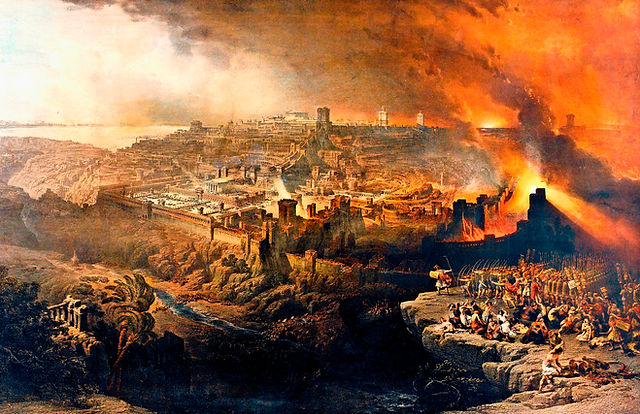
The outdated covenant *did* disappear with the destruction of the Temple.

From John the Baptist:

But when he saw many of the Pharisees and Sadducees coming to where he was baptizing, he said to them: “You brood of vipers! Who warned you to flee from the coming wrath? Produce fruit in keeping with repentance. And do not think you can say to yourselves, ‘We have Abraham as our father.’ I tell you that out of these stones God can raise up children for Abraham. The ax is already at the root of the trees, and every tree that does not produce good fruit will be cut down and thrown into the fire.

(John 8:7-10 NIV)

At no point does Jesus say that there will be multiple paths to salvation or that there will be a tree of salvation that stems only from being biologically linked to Abraham. There is one true vine, that is Jesus, some are cut off and destroyed, others are grafted in and saved. There is nowhere where it is said that the Old Covenant will be resurrected to provide another way for those who have rejected and continue to reject Christ. To preach that is heresy, it is reversionism, and replaces the true Israel (that is to say those who believed or the church) with a secular nation borrowing the name.

The New Covenant is not about an ethnostate or the Haaretz of Israel. No, it is about the heavenly kingdom, a kingdom where there is no Jew or Gentile, that is defined by faith rather than biological pedigrees. Our blessing, eternal life, comes through Christ Jesus alone.

Blessings of the Anti-Christ?

The reversionists base their entire interpretation on a misuse of this blessing given to Abram:

“I will make you into a great nation,
    and I will bless you;
I will make your name great,
    and you will be a blessing.
I will bless those who bless you,
    and whoever curses you I will curse;
and all peoples on earth
    will be blessed through you.”

(Genesis 12:2,3 NIV)

They ignore everything St Paul said to explain the seed of Abraham as being singular (Christ) in his rebuke of the foolish Galatians trying to revert back to the Old Covenant. Over and over again Scripture tells us of the failure of those who try to do things through means of the flesh and yet here we are again.

But even the passage itself is spoken specifically about Abram (later Abraham) and those who bless or curse him. It doesn’t say anything about those who bless or curse this “great nation” promised nor does it seem to be talking about nations period. It is a promise to Abraham specifically and then ends by saying that “all people on earth will be blessed through you” which is to say him or his seed, which again is Christ—who didn’t require blind allegiance to a worldly nation.

Furthermore, the modern state of Israel, with a powerful military and foreign backing, does fit the criteria of the nation God said must be fully dependent on Him. Israel is a progressive state, ranked 7th in the world for gay happiness, and one of the least religious countries in the world, and God’s Covenant with the nation of Israel was always conditional. Both Leviticus and Deuteronomy make this quite clear: If they obey God will bless them and if they do not they will be destroyed. Zionism, the Jewish version, makes the Jews themselves the saviors of the world and totally replaces Christ.

This being our own Christ and denying the true Christ is exactly what is being referred to when New Testament writers use the phrase anti-Christ:

Who is the liar? It is whoever denies that Jesus is the Christ. Such a person is the antichrist—denying the Father and the Son. No one who denies the Son has the Father; whoever acknowledges the Son has the Father also.

(1 John 22-23 NIV)

If there is a temple rebuilt, it will be the seat of the anti-Christ:

Don’t let anyone deceive you in any way, for that day will not come until the rebellion occurs and the man of lawlessness is revealed, the man doomed to destruction.  He will oppose and will exalt himself over everything that is called God or is worshiped, so that he sets himself up in God’s temple, proclaiming himself to be God. […] The coming of the lawless one will be in accordance with how Satan works. He will use all sorts of displays of power through signs and wonders that serve the lie, and all the ways that wickedness deceives those who are perishing. They perish because they refused to love the truth and so be saved.  For this reason God sends them a powerful delusion so that they will believe the lie and so that all will be condemned who have not believed the truth but have delighted in wickedness.

(2 Thessalonians 2:3,4,9-12 NIV)

And what a powerful delusion some believe, that puts the Church established by Christ behind the nation that rejected Him, this we’re told:

Dear children, this is the last hour; and as you have heard that the antichrist is coming, even now many antichrists have come. This is how we know it is the last hour.  They went out from us, but they did not really belong to us. For if they had belonged to us, they would have remained with us; but their going showed that none of them belonged to us.

(1 John 2:18-19 NIV)

Ultimately, choose whatever Israel you want. But you can’t have both. You can’t have your worldy Israel, that is rejected even by observant Jews who call it fraudlent, and then claim to be a part of the kingdom of Christ Jesus. Reversionism is in no way a Covenant with the God of Abraham. It is only a counterfiet of the original promise and one that draws many away from their only means of salvation. Don’t be one who is decieved by this new version of the same old heresy, don’t be like Judas looking for his worldly fulfilment. There is only one Israel where Christ is king and that’s His Church.

The saddest part about reversionism (or ‘Christian’ Zionism) is that it muddies the waters and sends mixed messages to those who need salvation. So many professing Christ and then supporting the brutal reality of what it takes to create a Jewish state on land that was inhabited is a slanderous and degrading witness of Christ who would have had no problem establishing a worldly kingdom through use of violence over two millenia ago. So many are like Gehazi, servant of Elisha, dishonoring the example of their master and inheriting the disease that was healed: “For what shall it profit a man, if he shall gain the whole world, and lose his own soul?”


Your Own Personal Jesus

Standard

The title of this blog is a repeated line from a popular song, “Personal Jesus,” covered by Johnny Cash.  According to the writer, this song is “about being a Jesus for someone else” and more specifically the mentoring role Elvis Presley had played in the life of his wife Priscilla.  The power of these words is how they change meaning depending on the artist who sings them.  When it was covered by Marilyn Manson they came off as being mocking and derisive.

My own thoughts, hearing the song, always brings me to the popular Evangelical phrase “accept Jesus as your personal Lord and Savior” and the theological implications.  Unintentionally, it is a commentary on how the Christian religion has been reinvented in this consumerist and individualistic age.  It is all about you.  Jesus is now personal, like a boyfriend, and pretty much whatever you want him to be.  There is no obligation to others, no real need for self-sacrificial love, or becoming part of the body of believers, only to hold a kind of positive sentiment in your heart.

And this is what I encountered in the church of my youth.  Except for those few symbolic expressions of community and caring, carry-overs from those radical Anabaptist roots, it was pretty much everyone for themselves—which is how most of us preferred it to be.  I mean, sure, we would tell the other guy we would be praying for him after ritual foot washing, some would still call you brother as if simply saying it made it true, but that was generally the extent of it.  We all had our own families if there was ever a real need, the church projects were generally for the elderly and those few favorites.

Saved Together 

Orthodoxy has a more robust view of Holy Communion and could, in theory, answer the overly independent view of salvation.  At the very least, with our partaking of the body and blood together central to worship, this puts to rest this idea that the internet preacher is enough.  Life in Christ is about His body and His physical presence, not only something we hold in our minds as true.  It is not only our knowledge of Christ and mental assent but is also about making His example the basis of our actions—being an incarnation.

Faith is not about what we claim to believe, it is about how we act:

Carry each other’s burdens, and in this way you will fulfill the law of Christ. […] Do not be deceived: God cannot be mocked. A man reaps what he sows. Whoever sows to please their flesh, from the flesh will reap destruction; whoever sows to please the Spirit, from the Spirit will reap eternal life. Let us not become weary in doing good, for at the proper time we will reap a harvest if we do not give up. Therefore, as we have opportunity, let us do good to all people, especially to those who belong to the family of believers.

(Galatians 6:2‭, ‬7‭-‬10 NIV)

Carrying of burdens is about more than mere “thoughts and prayers” or those mostly empty expressions.  No, it is all about providing real relief to others, being that ‘neighbor’ like the good Samaritan or the true advocate like St. Paul was for Onesimus.  It is not enough to only say “Go in peace; keep warm and well fed,” without ever helping others with their actual needs as we read in James 2:16.  It is our job to be our brother’s keeper, that is to look after their needs like we would our own or that of a family member.  This is what a community of faith is supposed to be about and also key to our salvation.

“If anyone falls, he falls alone. But nobody is saved alone.”

—Alexei Khomiakov

For some, their salvation comes from the hand we offer.  For others, their salvation comes from offering that hand.  The early church had this saying, “unus Christianus, nullus Christianus.”  That is to say that one Christian is no Christian.  This is what it means to follow Christ, this is what being in Communion is really about.  Sure the ritual and religious practice matters.  But the true substance in the blood and the flesh we are to consume is in how we become the hands and feet of Jesus.  To do otherwise, to only partake without acting in genuine love is to drink unworthily and bring damnation upon ourselves:

In the first place, I hear that when you come together as a church, there are divisions among you, and to some extent I believe it. No doubt there have to be differences among you to show which of you have God’s approval. So then, when you come together, it is not the Lord’s Supper you eat, for when you are eating, some of you go ahead with your own private suppers. As a result, one person remains hungry and another gets drunk. […] So then, whoever eats the bread or drinks the cup of the Lord in an unworthy manner will be guilty of sinning against the body and blood of the Lord.

(1 Corinthians 11:18‭-‬21‭, ‬27 NIV)

Stay In Your Lane

Sadly, within Orthodoxy, for some, it is about lighting a candle, making a sign of the cross, paying their membership dues (tithes), and regular church attendance.  In other words, all about going through the motions.  They don’t want to be bothered by real relationships or overcoming differences—let alone be concerned with the salvation of their fellow parishioners.  

Sheesh, let the priest do his job!  Mind your own business!  Don’t you have enough sins of your own to attend to?  

I’ve even heard clergy give advice like “stay in your lane” as if there’s no difference between confrontation of lingering issues and petty fault-finding…

I’ll back up a second and agree fully that we should be “work[ing] out [our] salvation with fear and trembling” (Phil 2:13), which does imply some introspection and that we start first with the beam in our own eye.  But, that said, even this admonition is addressed to “my dear friends” or the church body and not as a personal note.  So even this could be used to further the view of salvation that is about collective effort and not some sort of personal experience we have while sitting in the pew deliberately not noticing elephants in the room as our penance.

There are some who do not seem to realize that their mother’s scold, “If you don’t have anything nice to say don’t say anything at all,” isn’t written in Scripture, but this is:

“‘Do not do anything that endangers your neighbor’s life. I am the Lord.“ ‘Do not hate a fellow Israelite in your heart. Rebuke your neighbor frankly so you will not share in their guilt. “ ‘Do not seek revenge or bear a grudge against anyone among your people, but love your neighbor as yourself. I am the Lord.

(Leviticus 19:16b‭-‬18 NIV)

Speaking the truth is not always pleasant to the ears of those hearing it and yet it is part of what love does.  It is not that we should never confront, rather it is the SPIRIT of how we approach these sins or shortcomings of others.  So, sure, staying in our lane is good, but that doesn’t mean we should never alert someone driving with their headlights off at night since we have also done the same in the past.  It may feel like ‘keeping the peace’ to sweep everything under the rug or let the ‘problem’ go away by ignoring it—but it’s also an unloving attitude.

“Church is not a social club…”

I’ve now encountered it in two very different religious traditions.  When that cry is made for real brotherhood, deeper connections or genuine relationships are met with the strong suggestion that you’re not spiritual enough and a reminder that church is for worshipping God and superficial interactions.  If you expect a little more then you’re turning it into a social club.  This is an inversion.  It is a psychological projection and a garbage excuse.  It’s telling a person seeking medical care that hospitals are about the awe of the building and reverence for the institution, that they should go to the dance club if they so desperately want to be touched by someone.  

These phony physicians only add insult to injury, they are exactly the type of religious authorities that Jesus rebuked: 

“The teachers of the law and the Pharisees sit in Moses’ seat. So you must be careful to do everything they tell you. But do not do what they do, for they do not practice what they preach. They tie up heavy, cumbersome loads and put them on other people’s shoulders, but they themselves are not willing to lift a finger to move them. 

(Matthew 23:2‭-‬4 NIV)

For them, it is all about the right image, the dress standards, and keeping their perfect attendance record.  Basically, they check all of the right boxes.  Performative religion.  And who knows?  Maybe their Bible study and prayers, ten hours a day, really does it for them?  Who am I to say that their mission to Uganda was entirely a self-indulgent display of privilege and a waste of resources?  But I’ll also say that those who travel the world while doing the bare minimum for those whom God put right at their own doorstep are condemned as hypocrites by Jesus.

The church is established by the same God who told us that it is not good for man to be alone.  Good for you if you need nobody in your life.  Jesus is your homeboy?  But most of us need those meaningful and sometimes messy interactions with other humans.  That is what family is.  That’s what hospitals are built to facilitate.  And that is what a church is literally supposed to be.  If you don’t need a doctor maybe you are the doctor and your salvation requires you to show up to attend to those sick and suffering?  Why call would we call each other brothers and sisters in Christ if this weren’t the case?  If the church isn’t at all about social interactions—why do we waste the gas?

Those who say that church isn’t a social club are right.  It is also not an art museum where pretentious people go to engage politely and then share a light snack.  It should be much more than that.  It should be a refuge we can flee, the juniper tree where God sends angels to comfort and attend to the physical needs of Elijah, a garden of Gethsemane where the disciples are not sleeping in hours of need, it should be intimate and practical, a hospital or home.  A place to be ministered to and minister to each other.  It’s both where we share our moments of happiness and also mourn with those who mourn.

Church is a family or it is just fake.  

Post Script: Those who personalize Jesus tend to depersonalize their religion. Protestant or Orthodox, it doesn’t matter, they want to claim their great devotion with their embrace of abstraction and their own prescribed practices, but seem to forget that pure religion is about the human touch (James 1:27) and what they do materially for others is how to show their love for Jesus. Our salvation does not come apart from the body of Christ. Communion isn’t only what we partake of on a Sunday morning, it is what we participate in as far as loving others and, in particular, the community of believers. You cannot stay in your lane, avoiding people in a pretense of righteousness, and also love God.

The Token Converts

Standard

Years ago I had a nemesis. My counterpart positioned himself as a white knight type of character and was basically there to harass anyone too fond of the religious tribe I was born into. He knew the group, he had been a convert and was now an ex-member, who classified us as “an ethnic church” dismissing what we said about our conversion experience.

Now that I’ve left the group there is no reason to continue to guard the ideas left behind and that includes the notion that my own participation had been completely a choice. There are doctrinal reasons for this denial of the obvious. I mean, if you believe that conversion is a personal choice, a rational and unbiased conclusion, then it really gets under your skin when someone says that you’re more or less a product of a religious culture.

We were, in our own eyes, a sort of remnant church. And then also had to deal with the awkward reality that many, like us, were so inbred that they had distinct genetic disorders. And, unlike our radical forbearers, we had no cultural relevance besides being the quaint old fashioned people who dressed like it was the 1800s and called this non-conformity to the world. So, obviously, the fact that everyone who shared our views happened to be genetically related was the source of cognitive dissonance.

It is for this reason that converts, the more exotic the better, were clung to and even given special treatment. We would say it was out of Christian love and yet some of this had to do with our own insecurities. They were our validation. They were the proof that we were more than just an ethnic cloister, more than a bunch of cousins of a particular European heritage claiming that our own brand of religion represented something universal and relevant to the times.

Those who come into this group, visibly from the outside, are often treated both with mistrust and also with a special adoration as well. They can never be fully accepted, they’re always both more and less than equal, coddled or spared normal rebuke from some to keep them from leaving, and yet also can sense that they’re just the tokens being used to prove a point rather than being treated as people. Sure, they may form real friendships with some, but they themselves are often misfits from whence they came and still remain stuck in no man’s land.

Now that I’m in a church that both spans continents and is mostly converts locally, I don’t have as strong an urge to collect tokens or evidence that I’m not just a product of my ethnocultural roots. I mean, sure, I still want to be right. But the pressure to bring the Gospel to all people is off my shoulders. The Church didn’t take long to spread into Asia or Africa, early Christians didn’t dress like Europeans from a generation ago either, there may be some times to chase down Ethiopian eunuchs in their chariots, and yet there’s also a time to acknowledge that the fullness of the faith has never left Africa.

Evangelicals, of all stripes, have this desperation for relevance. They think that they will win more converts by being more cosmopolitan, and by painting a picture of superficial diversity and inclusion, but Jesus said that his message would make the world hate us and even divide families. If we have the truth, if we know the truth, we are no longer bound to ethnic quotas and, instead, simply love people, especially of the household of faith, as we are commanded. Jesus preached to his own tribe first, his converts were mostly other Jews, like him, and that was perfectly fine.

“Whether by word of mouth or by letter…”

Standard

The US Constitution is a prime example of how the same words can be interpreted in many different ways. Sometimes this is just a way to get around the clear meaning and other times it is simply a problem with language. There are many cases, with this founding document of a nation, that it would be nice if we could have some further explanation. Sure, you can read some of what the writers and signers said elsewhere in order to try to fill in the blanks. But, in the end, without them here, we don’t truly know how they would respond to the demands of our modern economy, technology, and needs.

This only gets murkier when dealing with Scriptures written two millennia ago. Yes, every Bible-thumper and their brother thinks they have a clear understanding while everyone else is just making things more difficult than they really should be. I mean, “The Bible Says It, I Believe It, That Settles It,” right? And yet, if I were to answer that with, “do you bury your poo outside of your property, in a hole you dug with a trowel, as instructed in Deuteronomy?” I’m guessing that suddenly what the Bible says would become a bit less settled as those using this phrase made some sort of theological exemption and that’s okay, there are things in Scripture that aren’t perfectly clear without some further explanation.

But what is more intriguing to me is what is completely left out that would be so obvious to early Christians that it wouldn’t even be worth mentioning in the letters. As the saying goes, more is caught than taught, and sometimes the most important things never do get written out. In other words, if we were writing instructions on how to drive a car, we would probably assume that the person knows how to get into the vehicle or sit facing forward. However, from the Bible, do we know how the early church structured their services or generally lived? Would they even recognize us as Christians? The reality is that there are gaps that many today just fill in with assumptions and it is usually these different extra-Biblical assumptions that lead to many divisions.

In the Protestant world “extra-Biblical” is practically a curse word. How dare you ever have a rule, custom, or tradition that goes beyond the written text! That’s false religion or something! This is why Orthodoxy is often dismissed by those seeking to strip down Christianity to the Biblical bare bones. It is a special kind of ignorance.

A good illustration? In World War II there was a study of returning aircraft and the damage that they had to determine how to better prevent future losses. The Center for Naval Analyses concluded from this that the aircraft needed more protection in these most heavily damaged areas. However, Abraham Wald, a Hungarian mathematician, begged to differ. He reasoned that the aircraft returning had survived and those that had been hit in more critical areas did not. In other words, what needed to be done was the very opposite of what the others had concluded. They needed to better armor those areas that weren’t damaged in the returning aircraft. This tendency to misinterpret evidence, based on what we have rather than what is missing, is called “survivorship bias” and can lead to woefully incorrect ideas.

This is what the Bible says about what is written versus what is not:

So then, brothers and sisters, stand firm and hold fast to the teachings we passed on to you, whether by word of mouth or by letter.

(2 Thessalonians 2 NIV)

The “letter” is what we have received in Scripture. These are the books of the Bible, canonized by the Church and believed to be truly inspired writing for this reason. But the “word of mouth” is where things are more interesting. What of the Apostle’s teaching (or tradition according to the KJV) is not written in their letters and how do we know what is missing?

The Orthodox, of course, say that this is the tradition of the Church and tie their legitimacy to the fact that there is a line of secession going all the way back to the Apostles, by the laying of hands and ordinations, and this only makes sense. The Church (note, not an individual or even the institutions) is what keeps the spoken teachings of the Apostles preserved like it did the Bible, and also serves to provide the correct understanding of Scripture. Because we should know, as Peter warned, that the Bible does not provide its own interpretation: “[Paul’s] letters contain some things that are hard to understand, which ignorant and unstable people distort, as they do the other Scriptures, to their own destruction.” (2 Peter 3:16 NIV)

However, it isn’t just the non-Orthodox that fall victim to their own bias. There are parts of the Church tradition, whether spoken or written, that slip through the cracks. We all have blind spots. We all have our distortions of concepts and errant assumptions. The difference is, that the Orthodox, if they are truly seeking to be Orthodox, are at least making some effort to incorporate the sayings of the Fathers and have a grasp of those “word of mouth” traditions not necessarily ever expressed in Scripture. In doing this, in understanding how Christianity was practiced by the faithful throughout the centuries, it becomes that much harder to distort the words of the Bible.

In the end, Christianity is about Communion, not easy textbook answers, not following an instruction manual, not standing alone, but real relationships. The more important being that between ourselves and God. However, a relationship with God implies love for our brothers and sisters. It means we are rubbing elbows with other Christians and the Saints. As Fr. Anthony put it, in his fatherly council to me, “there are no Lone Rangers” in Christianity, we can’t put the words of Jesus to practice in solitude or isolation. It’s not in removing ourselves that we are purified, it is in our getting messy and involved in the life of the Church of imperfect people (like us) that we are changed. That is taking up our cross. That is the hard part of Christianity we would rather run from.

Learning never stops in relationships. Christ Jesus did not come so we could house church with the few other perfect people who have the proper understanding of a book according to us. Instead, the very act of Incarnation was God choosing to be around those undeserving and impure, to identify with them and their suffering, which should be the impulse of those filled with the Holy Spirit. It is the Spirit, St Paul tells us, that will bring “unity” and a “bond of peace” which should span centuries or the current divisions because: “There is one body and one Spirit, just as you were called to one hope when you were called; one Lord, one faith, one baptism; one God and Father of all, who is over all and through all and in all.” (Ephesians 4:4-6 NIV)

The Church With A Leak In The Roof

Standard

There was this elegant old structure, in the countryside, a tall pointy steeple beckoning the passers-by to gaze upward at the blue skies.  It had been around at least a century, the doors still open to all.

One day a tradesman moved into this rural community and admired this building.  He loved the sturdy timbers holding beneath the slightly weathered clapboard siding, and then that ever-reliable stone foundation keeping it all square.

But one concern, as he did his inspection, was the missing roof shingles.  The wind and storms having taken their toll.  It would be a shame, he thought, to have the contents all get ruined and eventually see the church itself destroyed by this neglect.

So he thought to get involved.  He showed up one Sunday morning and met the pastor and congregation.  Good people.

The building inside was as beautiful as it was outwardly.  Fine craftsmanship at a level rare to non-existent anymore.  The stained glass in the sanctuary gave an ethereal feel and the beauty of the whole experience was breathtaking at times.  And yet, he could see the signs of a leaking roof, the water spots in the ceiling, and his concerns grew.

It was a few months later, after becoming a regular and joining the church, that there was a members’ meeting.  Taking the chance to raise the issue of the roof, he stood up, described the problem, and offered to help coordinate the repairs.  

There was a hush that came over the room.  An elder thanked him kindly for the suggestion and yet seemed slightly bothered.  

A week or two later the minister, a stately yet friendly man, took the tradesman aside, putting an arm on his shoulder, “Hey, brother, we’re glad you come here.  We love that you participate in all we do.”  He paused, trying to search for the right words.  “There has been some concern, umm or rather, I appreciate your perspective, as a man who works with his hands and I don’t want to discourage that.”  Stopping again. “However, the church is a spiritual place and, no offense, I know you meant well, but you need to have more faith.  If you see a problem, rather than be consumed by doubt or despair, looking for man-made solutions, pray about it, okay?”

Now a bit stunned, but still respectful, the tradesman did not argue.  He instead agreed to pray and did.

More time passed, things continued as usual, the roof continuing its deterioration, until one day the congregation was having a service and a chunk of the ceiling fell and squarely on the tradesman’s head.  Adding insult to the injury, as he began to brush the debris from his suit jacket, a stream of water from the rain shower outside completely drenched him.  

He was now upset.  Enough is enough!  We really need to do something about the roof, he decided, and approach the pastor again, after some small talk he announced, “You saw what happened today, right?”  And then continued, “I know a Christian must remain committed to prayer and that God is always in control, but we have the means to fix that roof and should!”

Disappointment swept over the pastor’s face as he considered this statement.  But, rather than lash out, he tried to be diplomatic, “I can hear your frustration.  And nobody likes to be humiliated.”  Smiling warmly to lighten the mood before getting serious, “Have you ever considered that the roof isn’t the real issue here?  I noticed you only wear a suit coat, it is okay and yet a bit underdressed for services.  Have you considered wearing a tie?”

The tradesman wore a tie from then on.  And, after a few more awkward encounters, where he was eventually forbidden from trying to throw a tarp over the growing holes and told to tithe more instead, he would do his best to keep his exasperation from showing.  It was none of his business, he was told, that we come to church to worship God together and prayer would provide all of our needs.

Eventually, the congregation of country folk would be left standing on top of the rubble.  They would spend the winters shivering in the cold and wind-driven snow, summers in the blazing heat, wondering why God had taken their wonderful building, yet serenely sure this was just a test of their faith and devotion to Providence.