Our power to influence reality…

Standard

My life would be incomplete without the influence of my brothers.  I was in conversation with my brother Kyle about the book I am working on, about life and faith. That dialogue eventually resulted in the thought that sparked this post.  Much of what we discussed seemed blog-worthy, but one particular thought came that I knew I would need to expand on and that is the idea of our influence.

We influence reality even if we squander the opportunity to exercise that ability in an intentional and directional way.  No matter if you have resigned yourself to ‘it is what it is’ fatalism, or if you live deliberately to change the world, you will have an influence in creating reality and not just reality for yourself either.  We are creating reality for ourselves, but we are also creating reality for those whom we come in physical contact with and possibly even in realms beyond that.

I believe it is easy to understand that if a person shoves another person physically they have altered something about the other person’s physical outcomes.  No, that action will not determine if the person has a good day or bad day, but you might change the way their day plays out if you push them hard enough that they fall and break their arm.  Again, they could be happily in the emergency room despite the pain, but you still have shaped some part of how their day progresses even if it did not break their spirit by your influence.

Good parents attempt to influence the decisions of their children.  I believe it is safe to presume that most parents do not want their children to become violent criminals and would attempt to in some way prevent that outcome.  Parents do have some influence over the direction of their children, perhaps mostly by genetics and not by things taught or at least that is where Steve Pinker suggests the evidence points.  However, parents do have an influence and that true whether or not they have given up on trying or if they stay entirely engaged.

The epidemic of fatherless homes bears out the reality of parental influence.  I would make the argument myself, but fortunately, another blogger has done the numbers for me and you can click that link if you need convincing.  The absence of a father correlates with many things we would consider bad and therefore the opposite is also true.  Statistics cannot tell us the whole story, but there is definitely some sort of connection and I am guessing the type of interaction also would have a part in the outcomes of children.

The influence of our physical proximity to other people is likely not something that is too much dispute.  Our intentional attempts to influence outcomes are a sign also of our belief in an ability to influence others.  But what if that is just the tip of the iceberg?  Could our very thoughts influence the outcomes for our neighbors beyond even our outward actions? Is our influence deeper than the surface level influence of our own physical reality?

Speaking of the ‘tip of the iceberg’ idiom, one could visualize the Titanic streaming the frigid Atlantic ocean and consider the implications of the block of ice it encountered.  The iceberg was visible on the surface and yet the destructive mass of the iceberg was actually below the surface.  The Titanic avoided a direct collision with the above water portion, but it was the underwater or invisible influence of the iceberg that ripped open the hull and actually doomed the ship.

Our influence likewise could be more than our spoken words or even our visible actions.  I speak now of the realm of our attitudes, spirituality, and faith.  We know if we push someone it could shape the outcome of their day, but what if we think well or ill of a person?  Do our very thoughts change reality for ourselves, but not only for ourselves and also for others as well?  I say, if we are more than just physical beings, if we do also dwell in an extra-dimensional spiritual reality, then we certainly do and should exercise that influence with responsibility as well.

My evidence, if you are Christian and accept the Bible is true, is that the ability of Jesus to heal was blunted where he was not believed (Mark 6:1-5 and Matthew 13:53-58) and the implications of this are huge.  If even Jesus, with a more complete faith, was hindered by the faithlessness of others, then how much more will we who struggle with faith be hindered and prevented by those in our midst who do not have faith in our abilities or God’s?  I believe we need to be aware of the influence we wield below the surface of physical reality, take ownership of it and use it for the glory of God.

What does it practically mean?  I believe it means we extend our love for others to our very thoughts about them.  I believe it means we recognize that we might be hindering other people by our very attitudes towards them, severely unfairly limiting the potential they have because of our negativity and perhaps creating them in the image that we have decided for them.  This is serious stuff if we consider the implications.  The words of Jesus equating hate to murder could be more literal than we realize.

At very least, we do have an influence over what other people think of another person.  Things like poisoning the well do actually to some degree shape the opinions of others and could do literal harm to a person by damaging their reputation.  We wouldn’t have laws against slander and libel if our words could not be literally destructive of something of value.  A person’s reputation is a priceless commodity.  Our reputation is what allows us to obtain a job, what another person says about us could be the difference between getting a chance or not.

Do you take seriously how you wield your influence both above and below the water line?  Perhaps you do not attempt openly to shape the opinions of others, but do you realize the potential influence of your non-verbal communication and thoughts about the other person?  Our influence is not only what we do for a person, but our influence is also what we deliberately choose not to do for a person and our very thoughts could be the spiritual power we withhold from them.

Belief is a powerful influence on reality.  Belief is a powerful influence over other people.  If we do not have faith in another person we may be effectively killing their ability to use their spiritual gifts effectively even if we do not realize it.  Belief also seems to hold some influence over God’s will.  The Bible is full of promises for those who have faith, but also gives many examples of where faithlessness influenced outcomes in a negative way and thus we who are spiritual should be aware.  Our doubt may cause harm to others.

We need to think of ourselves less as individuals and more as part of an interconnected whole.  Certainly, I am a big believer in our individual responsibility.  However, I do not see it as an either/or that we are either individual or we are not individual.  I believe reality is often better explained as a both/and, which means we are both individual and also a part of the collective whole.  We should not tend to one extreme or the other in this regard, we need to embrace both and take 100% responsibility for both.

We are, in fact, our brother’s keeper and he is our keeper as well.  In this regard, I am truly blessed to have brothers who care, share and pray for me.  I speak first of my thankfulness for biological brothers who are of shared faith and a similar mind, but also of my spiritual brothers as well.  I am glad for those who understand their influence over my outcomes and exercise their influence deliberately on my behalf knowing they could be the difference between my success or failure, these are the brothers who I seek.

But, lest this blog post be incomplete, the influence of sisters is as great or greater.  In my own religious setting this is an influence downplayed and gender separation outside of marriage encouraged, but to do that is to forget that the best example of love for Jesus was probably the pouring of expensive perfume on his feet by a woman (other than his wife) that drew the ire of his male disciples.  I for certain do not underestimate the influence of women.  My mother is probably the most influential person in my life and I believe the opinions of women go further with me than those of my male counterparts.

So, in conclusion, one should acknowledge their own full range of influence beyond just what they openly say or intentionally do.  One should perceive the potentiality that what is visible on the surface is not the beginning nor the ending of their influence and maybe the smaller part of their influence.  We need to take responsibility for how our influence shapes others for better or worse and exercise that influence in a positive way.  We should never limit the power of good by our faithlessness in our own influence and shown towards others.

If your influence of word, action or hidden attitude can harm or help other people, what has your influence been? Do you love others with more than just your words, but also with the influence of your thoughts (prayers) and actions?  Is your influence positive, do you build the good of others and your own character, or dwell on the negative and destruction?

The Most Dangerous Book in Existence

Standard

Books are powerful and there is little doubt of that. Their words carry ideas far beyond those who wrote them. The power of books is widely recognized and that is why they are written; that is why books are removed as a potential threat. Books have undoubtedly had a huge influence on the course of history.

Books carry both good and bad messages. Books have popularized ideas that have led to hate and harm of people. If one were to list the most dangerous books in history there are many titles that might come to mind. Books such as Mein Kampf, The Protocols of the Elders of Zion or The Communist Manifesto can be linked to political purges, religious persecutions and genocide. With each title one could discuss the human causalities related to each and try to rank them.

However, there is one book that perhaps is more dangerous (especially spiritually) than all of those titles combined and that is the book this blog is about. It is a book so powerful that it has been used to create sectarian division within the very group it was written to inform. Knowledge of this book has historically caused some religious experts to reject as a false teacher that others believe it was written about. It is a favorite source of ridicule of those skeptical of the truthfulness of the ideas it contains. This is a book that was used as a means to tempt Jesus. This one book is actually a combination of books that were compiled into the single book which is now called The Holy Bible.

The Bible is arguably one of the most influential books in all of human history. The Bible carries both great potential for good in the right hands and also a terrible power for evil used wrongly. It has inspired some to great acts of self-sacrificial love. It has been used by others as justification for violence. The power and potential of the Bible is in the hands of the interpreter.

Biblical reformation, the division in the church and the interpretation question

Biblical fundamentalism is branch of Christianity that has become popular since the Protestant Reformation. It is a belief system made possible with the invention of the printing press and widespread availability of Biblical texts to the general public. This wresting of control of the church from the institutional church and new emphasis on a written text was a significant development in church history; it seemed necessary at that time as a reaction to the abuses of the institution of church.

Unfortunately, as reactions often do, the resultant bibliocentrism has also created a great deal of other problems. The biggest of those problems is the all too obvious explosion of sectarian divisions within the church. The confusion is evidenced in the reality of the over 30,000 separate church denominations in existence today. The widespread availability of the Bible has clearly not created church unity. It has rather clearly created the opposite and a spirit of division.

Those of the Sola scriptura (by Scripture alone) view cannot agree on how Scripture should interpreted and let alone how it should be applied. Those who believe the Bible is sufficient alone put the interpretation of their own group and own personal interpretation above all others, each believing they are more correct than the others. Everyone doing what is right in their own eyes.

Bible based faith produces results that are wildly different from person to person. I know a guy who believes sincerely that the Bible teaches that Christians should basically be like ISIS and should either remove (kill) unbelievers entirely, subjugate them or enslave them and he has many proof texts to support his position. I know of many others who believe that the Bible teaches pacifism, endorses state socialism or forced wealth redistribution and they too can produce many supporting texts. I know some who based in their own understanding of the Bible believe Jesus was not God.

We could go through Scripture with a variety of people and get completely contradictory perspectives on what it actually says in many significant areas. On the basis of a few snippets of text, on a specific definition of a word or two and on the base assumptions they brought into their reading people have built whole doctrines. Different hermeneutic (or interpretive) approaches produce greatly different theologies that are contradictory in their extremes. The Bible is a great source of confusion.

People in the church cannot even agree on an appropriate translation of Scripture. Some will insist an earlier Old English translation of the Bible is more accurate than others and can give complex rationals in support of their position. Some even teach the one version they believe in is the only acceptable ‘inspired’ version. Varying degrees of literalism have led to many disputes within the church. Some believe the Bible teaches that the world is flat based in their dogmatic literalism. Others see more figurative speech, more allegories and metaphors.

Whole doctrines built off of words or phrases that aren’t clearly understood and yet are assumed to be understood in ignorance. The Bible, according to 2 Peter 3:15-16, describes concepts that are difficult to understand and words which can be misused in ignorance:

“And count the patience of our Lord as salvation, just as our beloved brother Paul also wrote to you according to the wisdom given him, as he does in all his letters when he speaks in them of these matters. There are some things in them that are hard to understand, which the ignorant and unstable twist to their own destruction, as they do the other Scriptures.”

In the hands of “ignorant and unstable people” the Bible is potentially destructive. I believe we do not need to look far into history to find many examples of where this has been the case. If you do not know examples, then I will present the Münster Rebellion and the Bible-based predictions of Harold Camping as examples of Biblical application gone badly.

So, to my friends of Christian faith: Be humble, be diligent and do not ever believe your own knowledge of Scripture is without potential error. Faith cannot be in reading the Bible alone, there must be source greater than the Scripture that guides us spiritually and that is where the Spirit of God comes in.

Biblical literalism, the rejection of Jesus and the Elijah Question

Error is not a new problem with those attempting to interpret the written text of Scripture for themselves. Jesus himself was rejected on the basis of the Scriptural interpretation of those who knew the bulk of the book (we call Bible) better than most of us probably ever will or can hope to so many years removed from the culture and people it was written to. The Pharisees knew their Bibles well and also knew what it said about the Messiah.

Based in Malachi 4:5-6 there was an expectation that Elijah would return before the Messiah. According to Jesus the prophet John the Baptist was Elijah and he is recorded having said that in Matthew 11:13-14:

“For all the Prophets and the Law prophesied until John. And if you are willing to accept it, he is the Elijah who was to come.”

However, the experts on Scripture, who rejected Jesus, were evidently looking for some more literal. Perhaps they were envisioning Elijah returning in a spectacular way and hoped for a kingdom of physical world importance, who knows? But the answer Jesus gave did not satisfy them.

It is interesting that even John the Baptist himself denied being Elijah when questioned in John 1:19-21:

“Now this was John’s testimony when the Jewish leaders in Jerusalem sent priests and Levites to ask him who he was. He did not fail to confess, but confessed freely, “I am not the Messiah.” They asked him, “Then who are you? Are you Elijah?” He said, “I am not.” “Are you the Prophet?” He answered, “No.”

So, should we take John’s own words recorded in Scripture at face value? Should we believe the words of Jesus in Matthew 11:13-14 that contradict them? This is a serious problem for a literalist. This irreconcilability of message can easily explain the angst of those looking for a literal fulfillment of Malachi. Considering that John the Baptist himself would not claim to be Elijah probably caused some of the critics of Jesus to be even more secure in their own understanding of Scripture.

Luke 1:13-17, however, offers us this view of John the Baptist:

“But the angel said to him, “Do not be afraid, Zechariah, for your prayer has been heard, and your wife Elizabeth will bear you a son, and you shall call his name John.  And you will have joy and gladness, and many will rejoice at his birth, for he will be great before the Lord.  And he must not drink wine or strong drink, and he will be filled with the Holy Spirit, even from his mother’s womb.  And he will turn many of the children of Israel to the Lord their God, and he will go before him in the spirit and power of Elijah, to turn the hearts of the fathers to the children, and the disobedient to the wisdom of the just, to make ready for the Lord a people prepared.”

What Luke suggests is a literal return of Elijah, but not a literal physical return of Elijah and a spiritual fulfillment instead. John the Baptist was a return of Elijah, in that he embodied the “spirit and power” of the prophet, and yet he was not literally Elijah in physical form. To reconcile John 1:19-21 with Matthew 11:13-14, we can probably assume that John the Baptist was being humble in his answers, not even claiming to be a prophet, and that Jesus was exalting him as he should have been.

But, those who rejected John the Baptist as Elijah also rejected Jesus as Messiah and their knowledge of Scripture did not save them as they apparently believed it would. In John 5:30-40 this type of misplaced faith in Scripture is confronted by Jesus:

“I can do nothing on my own. As I hear, I judge, and my judgment is just, because I seek not my own will but the will of him who sent me. If I alone bear witness about myself, my testimony is not true. There is another who bears witness about me, and I know that the testimony that he bears about me is true. You sent to John, and he has borne witness to the truth. Not that the testimony that I receive is from man, but I say these things so that you may be saved. He was a burning and shining lamp, and you were willing to rejoice for a while in his light. But the testimony that I have is greater than that of John. For the works that the Father has given me to accomplish, the very works that I am doing, bear witness about me that the Father has sent me. And the Father who sent me has himself borne witness about me. His voice you have never heard, his form you have never seen, and you do not have his word abiding in you, for you do not believe the one whom he has sent. You search the Scriptures because you think that in them you have eternal life; and it is they that bear witness about me, yet you refuse to come to me that you may have life. I do not receive glory from people. But I know that you do not have the love of God within you. I have come in my Father’s name, and you do not receive me. If another comes in his own name, you will receive him. How can you believe, when you receive glory from one another and do not seek the glory that comes from the only God? Do not think that I will accuse you to the Father. There is one who accuses you: Moses, on whom you have set your hope. For if you believed Moses, you would believe me; for he wrote of me. But if you do not believe his writings, how will you believe my words?”

For those who believe that the Scripture is God’s own voice, I think they need to take heed of what is written above and understand what Jesus is trying to explain. The people Jesus spoke to were experts on Scripture, they were extremely knowledgeable of the books of the Bible they had and put faith in their knowledge of the text like many religious people do today.

Unfortunately, what their knowledge of the book could not give them is true faith that can only come from the Spirit of God. The passage above in some translations tells us that they “searched diligently” the Scripture and yet before that tells us they have never heard from God or had “his word” in them. This passage flies directly in the face of those who think the written words of Scripture are themselves the word of God.

Biblical temptation of Jesus and the authority question

I’ve had Christian friends post on social media a message similar to this:

“When you carry the Bible, Satan gets a headache. When you open it, he collapses. When he sees you reading it, he faints. When he sees you living it, he flees. And just when you’re about to re-post this, he’ll try to discourage you. I JUST DEFEATED HIM! Copy and re-post if you can. Any takers?”

I do appreciate the enthusiasm. But it is perplexing to me that a person who has read the Bible themselves can believe that. The account of the temptation of Christ should put that idea to rest. The Gospels of Matthew, Mark and Luke all give an account of a conversation between Jesus and Satan that proves the exact opposite.

Satan is not afraid of Scripture. Satan cited Scripture and tried to use it to deceive Jesus. This is a version of that temptation in the Matthew 4:5-6:

“Then the devil took him to the holy city and set him on the pinnacle of the temple and said to him, “If you are the Son of God, throw yourself down, for it is written, “‘He will command his angels concerning you,’ and “‘On their hands they will bear you up, lest you strike your foot against a stone.’”

That is a quote of Psalm 91:11-12 used by the devil to tempt Jesus!

We don’t actually defeat our spiritual enemy through our enthusiasm for the Bible. Evil is not afraid of the Bible. Evil men have long used the Bible to accomplish their own selfish ends and have deceived many using the book. It is not a book that will save us from temptation. It is not a book that will give us the right answers or knowledge to defeat those who attempt to deceive us. What we need is the same authority dwelling in us that led Jesus into the desert to be tempted in the first place. What we need is the word of God in us or the Spirit of God and then (and only then) Scripture will become profitable in our hands. We need the authority that gave authority to those who were inspired to write the Scripture.

It is a bit paradoxical that I am trying to explain this using Scripture what I do not believe Scripture alone can explain. But, it is because I believe those who are Biblically religious and yet truly spiritually seeking will understand through the power of the Holy Spirit.

Many simply give credit to the wrong source unknowingly. They allow the true authority to speak to them and still do not understand they are actually receiving their understanding through that authority. So, to them, those who are listening to the voice of Jesus in their heart even unknowingly, Paul gives us a solution to understanding Scripture in 1 Corinthians 2:6-16:

“Yet among the mature we do impart wisdom, although it is not a wisdom of this age or of the rulers of this age, who are doomed to pass away. But we impart a secret and hidden wisdom of God, which God decreed before the ages for our glory. None of the rulers of this age understood this, for if they had, they would not have crucified the Lord of glory. But, as it is written, “What no eye has seen, nor ear heard, nor the heart of man imagined, what God has prepared for those who love him”—these things God has revealed to us through the Spirit. For the Spirit searches everything, even the depths of God. For who knows a person’s thoughts except the spirit of that person, which is in him? So also no one comprehends the thoughts of God except the Spirit of God. Now we have received not the spirit of the world, but the Spirit who is from God, that we might understand the things freely given us by God. And we impart this in words not taught by human wisdom but taught by the Spirit, interpreting spiritual truths to those who are spiritual. The natural person does not accept the things of the Spirit of God, for they are folly to him, and he is not able to understand them because they are spiritually discerned. The spiritual person judges all things, but is himself to be judged by no one. “For who has understood the mind of the Lord so as to instruct him?” But we have the mind of Christ.”

To understand God in Scripture you must have the ‘mind of God’ in you first. It is not enough just to have knowledge of Scripture. Even the best Biblical doctrines and theology all will fall short if they are practiced by a person not also under subjugation to the Spirit of God. The words of the Bible are not magical in themselves, the words themselves are dead and the interpreter is the one who gives them life. And, to give the words of the Bible the right life requires that one have the “mind of Christ” while reading them and not any other.

The Spirit of God is the ultimate authority, the ultimate teacher and is the one we should trust when we claim to be a follower of Jesus Christ.

Stay tuned, this will likely be a multiple part series…

“You can’t handle the truth!”

Standard

One thing I have not fully learned yet is that people are not emotionally able to handle the whole truth.  My penchant for full-disclosure of hopes, fears or intentions can be discomfiting to those who ask “be completely honest” and are themselves unaccustomed to the same level of transparency.  Few people are honest with other people about their own agenda and whether that is good discretion or dishonesty is debatable.

People may ask for the truth, but that doesn’t mean they are emotionally mature enough or able to handle the complete truth.  None of us can.  We may want to know, but we could not function if we knew the truth of everything.  It would overwhelmed if we knew completely what people thought of us, all of what we would face in the future or understood fully the consequences of our poor choices.  Lack of disclosure is not always a way to protect others or of conscious good discretion, some people withhold truth as a way to manipulate and get their way.

People are also not honest with themselves.  It could be a lack of logical maturity, mental development and ignorance.  It could also be a matter of emotional self-preservation and a deliberate semiconscious choice of mind or completely willful ignorance.  Our minds sometimes are more aware than we are consciously aware.  For example, most of us know we are going to die, our mind always is aware of this at some level and yet we are able to live in the present moment without consideration of our own mortality.  Even those who are thrill seekers or get an emotional high from taking risks because of the possibility of death are a conflicted mix of natural (subconscious) fear and conscious hope for survival.

The title of this blog comes from a movie classic.  The movie “A Few Good Men” is about a military murder trial.  The title quote, “you can’t handle the truth,” comes from a heated exchange, a climatic defining moment in the story and you will need to watch the linked clip to understand my commentary.  You will see the Colonel on the stand trying to simultaneously defend his own innocence, his honor and code.  But there is a conflict in his logic that the prosecutor seeks to reveal in his questions, the conflicted claims of Colonel become very apparent and the resulting emotional outburst exposes a lie.

This is a study on cognitive dissonance. The Colonel had two sets of ethics, one for his protecting of the greater mission of saving life and another that applied to discipline within the the platoon and the one that didn’t protect Santiago’s life. The Colonel becomes emotional when his own conflicted views are presented back to him, he’s being defensive of an irreconcilable position and thus his only defense is an attempt to attack the character of his questioner. He got caught in his own self-deception.

This is more than just good drama, it is a window into how our minds work and illustrates the need for an outsider’s perspective on our own consistency applying our ethics.  Most people are trying to be good, most people think they are good because they are trying to be good and do not see the exceptions they make to their ethical principles. The Colonel yells, “you can’t handle the truth,” when in reality he could not handle the truth of his own failure to consistently live up to the good ethics he claimed to be protecting.

We aren’t on trial, we do need to show discretion when we speak to others and not reveal truth.  We also have blind spots where we aren’t consistently living up to the ethics we claim to hold and need to be open to those who challenge our own assumptions about ourselves and that requires humility.  Our taking offense, our becoming defensive or burying our heads in the sand can prevent growth and is a form of faithlessness that kills us spiritually. If you’re religious, tradition and theological dogma can prevent knowing truth. If you’re scientific, materialistic logic and known evidence based reasoning can be likewise blinding.

Truth is something that exists beyond our own full ability to comprehend. Without truth, with tradition, theology, material evidence and facts we can only build a rational. Rationals are not truth. Rationals can be disproven with more evidence or changed with a different perspective of the evidence. We cannot handle the truth if we are unable to realize the fallibility of our own opinions or if we are afraid to have faith and trust. We must realize that we are shaped by our various influences and that those influences themselves could also give us a corrupted version of reality.

So be humble, be open to correction and be able to repent when wrong…

Too little [but never] too late…

Standard
I have always been a late bloomer, for my stature dubbed with nicknames that included ‘micro’ in them by classmates and stood only 5′-3″ on my first driver’s license.  In my class of over one hundred I was simultaneously second oldest and also, of the guys, the second smallest.  I was too light weight to even donate blood until my junior or senior years of high school.

Beyond that, I was also a little behind in motor skills and sorely lacking in coordination; it was as likely in my early teens that a football would hit me in the face rather than be caught by my hands.  It probably didn’t help anything that I didn’t grow up tossing a ball at home, my dad was equally undeveloped athletically, he did not follow professional sports and we just weren’t a sports oriented family.  It all added up to me often being close to last picked in gym class, which wasn’t much of boost of confidence to say the least and perhaps explains the antipathy I had towards athletic pursuits.  For the time I had concluded athletic competition was for big dumb brutes, not me.

Then, somewhat inexplicably, I became interested in the high school football team.  I do not recall what started it.  There may have been a combination of factors, I do not know for sure.  But, my junior year, I started to attend games (even hitched a ride with the team to an away game) and around the same time began to lift weights and imagine myself on the field.  Football, I discovered, was about more than one guy being able to run over another; football was also a chess match of strategy involving slight of hand trickery and all trying to gain an advantage or out smart an opponent with misdirection, formations and plays.  So, at 5′-8″ tall and 112lbs, I decided I would go out for the team despite my late start and my shortcomings of natural raw abilities understood.  I wanted to try.

Over the summer I practiced with the team, but the real commitment began with the ‘two-a-day’ practices and with the start of my senior year.  It was hard work physically.  I can remember a time in practice a collision that I had thought for a second had collapsed my entire spine like an accordion.  I also recall the sheer terror of having to occasionally face padded behemoths who were close enough to double my weight.  I have not forgot being ran over by a fellow senior in a tackle drill an act I imagine included a big grin on his face.  Had I known some of the bruises and pain beforehand I might have second thoughts about my decision to play, but once started I was determined to endure to the end whatever it took.  From the onset I knew I was not likely to play much due to inexperience and size, yet I was a competitor all the same and wanting to make the team better if only with a winning ‘no quit’ attitude.

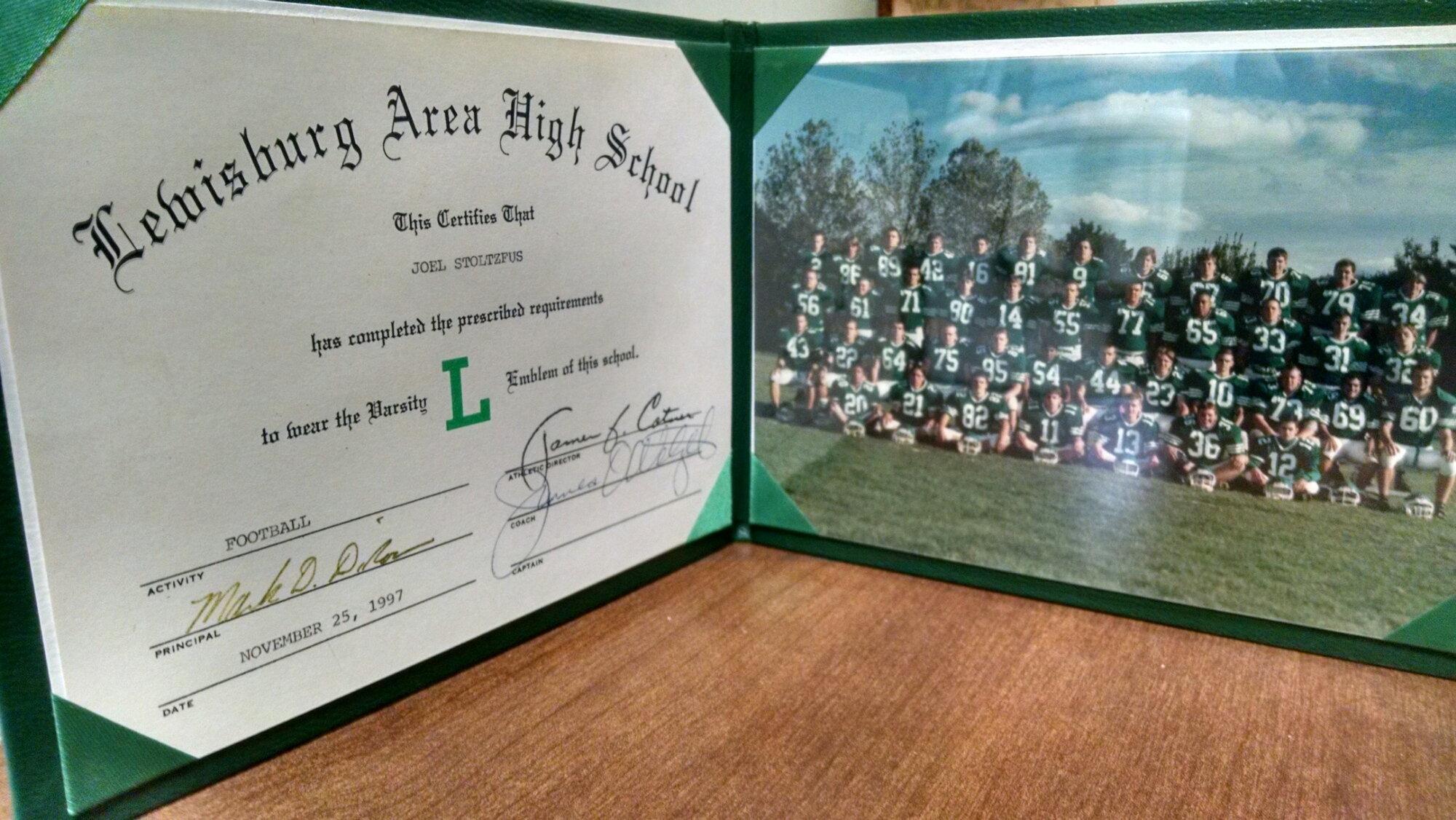
There was plenty of reward.  After weeks of practice there was the proud moment of wearing your game jersey on Fridays at school before game night.  Football made me part of something when I saw teammates in the halls or got ‘good luck’ wished upon me by random students.  I was a warrior, a representative of my school and had earned the team colors that I wore on my back.  I was #13 (I figured an unlucky number fit an unlikely player and couldn’t hurt) and now called ‘Stoltz’ or ‘Stoltzy.’  Those nicknames were the chant of teammates on the sidelines when I stepped onto the field for those few last plays that iced a blowout win.  I belonged.

But the biggest reward was the handshakes and hugs of coaches at the end of the season.  It was after a disappointing loss that ended our season in the first round of playoffs.  We lost to a team we had beaten prior in the regular season.  It was a very emotional moment to be at the end of my first and last season as a player.  Nevertheless it was satisfying to have finished, having survived from the blistering heat and throbbing shin splints of preseason camp to outlasting the bone chilling *shivering* cold of late season practices.  I received a varsity letter for my efforts and with it memories to last a life time.

If I would have any regrets it would be declining my chance to play in the waning minutes of that decisive last game.  An assistant coach had tapped my shoulder telling me to go in the game.  But, because I knew my entering the game was a tacit admission of defeat and keeping the starters in would increase the unlikely chances of victory, I refused saying, “I don’t want to play, I want [us] to win!”  I regret my choice, but only because the sophomore who went in my place caught my favorite route (a deep post) and seemingly could’ve scored with just a bit more heart; he came up a yard short.

I graduated from high school, but to me there is still nothing like a crisp fall night under the lights and watching those bright green jerseys take the field one more time.  And now I have another loyal fan who often accompanies me, who also (less inexplicably) began to love the sport he once thought was silly and that fan is my dad.  We sit there, it is our yearly ritual, we share memories of past games, talk about life and cheer on the team…

image

Writing is easy [hard] work…

Standard

I needed a break.

My first post in this blog contained something about blogging being easier than writing a book, more intimate, accessible, etc.

It is since then, partially a result of my own thoughts produced in this blog, that a book idea came to mind in full force. The past week I have been consumed trying to get started putting this simple, succinct, but simultaneously big idea on paper.

The first couple days were exciting. I had a book idea that would seem to write itself was in my head for the first time. I was busy jotting the ideas as they flowed in and too distracted by it to enjoy anything else.
In two days I had a first chapter nearly complete.

Then I discovered editing. I sent the nearly completed work to some friends who I knew could give some good (aka: honest) feedback. I definitely got what I was asking for. I realized suddenly that I wasn’t even close to finished with anything.

I revised the first section of my first chapter several times with each of the various edits coming in. I finally started to feel I had something. I put it down. I came back later and scrapped it all to start all over again.

I am quite satisfied with the two thousand, six hundred and ninety-five words after a mentally grinding week of effort. I am ready to move on from that first section for now to the greener pastures of what comes next after.

Along with discovering editing, I also discovered I don’t know anything about writing and last week was a start on the path of relearning everything. My hope is that by the end of writing I will know how to write.

I started out with the idea of paradox of faith, I moved on to the loftier ground of paradox of perfection and now I am back to faith again. Faith to perfection to faith again, all in one week!

*whew*

Any ideas for this fledgling author?

The Mind of the Designer

Standard

I spent my childhood in my own world of daydreams.  While some children have imaginary friends when I was a child I created whole planets far away and untouched by war, want and all the things I knew weren’t right in this world.  This perfect place was my refuge from the mundanity of school work and I would doodle pieces of this world inside my head creating stories and imagining rescue.  There were times in elementary school where I was actually disappointed when these grand designs didn’t come to life so that I could be swept away in front of my stunned classmates.

My dreamy ideals eventually began to fade into an interest in more practical designs.  I had spatial intelligence, in that I could easily imagine things in three-dimensional form and convert the thought with pencil to paper.  As I got older I became interested in computer-aided design, I learned quickly how to convert the ideas in my brain to keystrokes and with my fingers I would build things on the screen.  It was very satisfying to hold a finished work printed on paper to show friends or family.  I had assumed at that point that my future would be engineering, design was natural to me, but life and God had other plans.

For various reasons my vision to be a mechanical engineer never was realized and with that came a sense of something missing and potential unrealized in my life.  It troubled me not being who I was ‘supposed’ to be, it was a little humiliating too to watch friends and classmates sprint past me to their own goals.  And, it was this need to fill a thirst to build, design or create that eventually pricked my interest in writing as an outlet.  A writer is an engineer with words; an author is defined as an originator or the one who gave existence to something and I wanted to use words to create snap shots of the ideas flying around my head.

Since then I have had mixed success sculpting words into interpretable sequences.  Writing to be understandable to another mind is sort of like trying to write code for a smart phone except you don’t know if you are dealing with an iPhone, Android, Blackberry, Windows phone or even if it is a smart phone at all.  Writing depends on both the author and interpreter to ‘be on the same’ page.  If the writer misses a line of code in trying to explain or if the writer and reader interpret the code of symbols we call language differently then the picture in the mind of the receiver created in words will be distorted and sometimes lost on them completely.

Needless to say, the challenge of communication of ideas with words is both frustrating at times and fulfilling for me.  When I sense a connection with another person through my written creations it is a wonderful feeling of accomplishment and especially when it encourages or inspires them to create new things in their own life.  In writing my ideas can live inside of other people, when I write the designs of my own mind are transferred to one or multiple others, thus a piece of me now lives in them and now has potential to grow to something more than I myself could ever have imagined.  Writing makes both the world of the reader and the writer bigger; the reader taking a part of the writer with them and the writer living in the mind of the reader.

To me that ability to build ideas makes the frustration of potential failures to communicate and the time spent drawing my thoughts out in paragraphs well-worth the effort.  I love to turn abstractions in my mind into appreciable designs, using words like my paint and dictionaries like a palette full of shades of color.  Writing is an art form, words give an author the power to create universes never seen before and the ability to live in the minds of those who are able to translate their work.  I write because I still like to create.  I write because I enjoy engineering solutions to problems and using words as a means to draw the designs put in my head.

Ideas change your reality so think of good designs and then build them with the means you have been given to express them.  Engineering is a field with endless possibilities, so build the good designs in your own mind and create the world you know should be.  So, bring heaven to earth one pen stroke, one act of kindness, one carried burden, one painted picture and one small step at a time.  Together, brick by brick we can build the world God intends.  If you pray “on earth as it is in heaven” with sincerity, then believe in it and make that design live through you; bring glory to God with the creative designer’s mind you have been given.

My writing is ultimately an act of worship to the Master Designer and Author of the universe; it is a means to love my fellow creation, to fellowship with them and to mirror my own Creator to them.  I write to love Master by loving the creation by expressing designs with the work of my mind, words and hands.  I create a new world with the ideas of my own mind, I am a child of my Father.  I, like God, am an engineer at heart.

Broken noses, mangled plans and perseverance

Standard

“Everybody has a plan until they get punched in the face.” Mike Tyson.

I believe most reading can identify in at least a small way with the quote above. If you have ever been hit so hard that you don’t know if you will be on your feet again then you probably understand completely. Hits come in many forms in life and can interrupt even the best of our plans.

I have not taken a hit from a professional boxer, but I have had my nose bloodied a time or two.  My list including the vicious hit delivered by my brother during a pickup football game; that an episode that ended with me being hurried to the emergency room having suffered a deviated septum.  I had caught a lateral pass, turned, then *WHAM* a shoulder smashed into my head and suddenly I am on the ground (still clutching the ball) dizzy wondering where all the blood was coming from. That day my immediate plans were altered as severely as my visibly mangled nose.

Everyone has hopes, dreams or plans and success does often depend on hard work, discipline and execution of a plan.  However, planning is easy but real life isn’t always and the truer test of resolve is when an effort is met with a unexpected and disorienting blow.  It takes courage and strength to stand back up again, after looking at the lights above the ring, having been knocked flat on your back.  Our plans and the realities we will face can be vastly different things.  I believe most people who live long enough will experience times where perseverance requires overcoming obstacles of pain, loss and fear.

I have withstood many setbacks or small disappointments in life and have usually been able to keep a positive attitude about it.  I have built up a tolerance for physical pain. But there are other types of injury other than physical that do not heal in weeks or months and those are the real trials of my faith.  There have been a few moments in my life where it seemed as if all hope was sucked from my soul and faith was nearly impossible.  It is only, by the grace of God, with the help of good friends that I have made it this far.

My heart goes out to anyone who has lost a loved one.  The death of a close friend’s child was on of the hardest hits of my life.  I felt totally helpless, I could do nothing to ‘fix’ the situation for my friend and my heartache lasted for years after. My hopes and plans built around that child died on a Thursday afternoon with a piece of me.  I got out of bed each morning, some days better and other days worse, but down inside was a deep pain of heart that I could not solve.

I have found peace for the questions that raged inside after the death.  Still, there are scars for each battle I have faced and some circumstances remain that I have no clear answer for.  It can be easy to be discouraged when past experiences haunt you and is tempting to give up when overwhelmed by an opponent seemingly too big or powerful to defeat.  Each blow is different, every day of overcoming is a new battle and each one requires new courage and fresh resolve.  We can only pray for the wisdom and for sufficient provision of hope to get through each day.

We all have obstacles to face, blows to our confidence and our faith to overcome. Things like a cancer diagnosis, the agony of a rejection, or death can continue to trip us up spiritually or emotionally and sometimes for years.  It is in those moments where character is formed; one can become bitter, cynical or jaded and otherwise defeated by the odds against them, or one can also keep faith alive, believe tomorrow will be a better day and live to overcome.

Real strength is not quitting when a harsh reality smacks you in the face. Faith begins when it seems like giants stand in the way of promises for a future and when hope feels quite delusional.  Plans change, life hits us in the face, but with God all things are possible, so do not wallow in despair; regroup and get back in the fight.

Life and faith require perseverance. That, and some appropriate protective gear may also help as well, and especially if you are up against Mike Tyson or younger brothers.

Take care!

Why Blog?

Standard

Before I do anything new I tend to ask a multitude of questions and the decision to start blogging (again) is no exception.

Questions of why blog? > what will I blog about? > how frequently will I blog? > who will want to read my random thoughts? > swirled about asking for answers and I decided answering those questions would make a good introduction topic.

So here it goes…

Why blog?

It is easier than writing a book.  Blogging is an accessible medium; it is interactive, immediate and intimate.  I have been encouraged to write by various friends.  I enjoy writing because I enjoy ideas and sharing them.  I like challenging the status quo, encouraging deeper thought and gathering useful feedback.  I seek connection with people beyond just superficial interaction.  I want to be a better communicator of thoughts and my hope is that others may benefit in some way by my rambles.

What will I blog about?

Ask me a year from now.  I picked ‘ideation’ as part of the name because formation and discussion or communication of ideas is the goal.  I cannot come up with a specific focus for this endeavor so I guess anything could become fodder for thought here.  I hope the content can be both intellectually stimulating and practical value.  I do not have lofty credentials or a real specialty and particular expertise to draw from, so expect a smorgasbord of casual observations and non-expert insights.  In broad categories I do imagine my commentary will be on topics pertaining to life, love and faith.  Expect some talk of current events, personal experience, theological perspectives, spirituality, worldview, history, human nature and vision for the future.

How frequently will I blog?

It could be irregular in frequency.  Although I would prefer to blog frequently as possible without compromise of quality and hopefully at least weekly.  Expect my blogging to come in spurts as available time and available inspiration could constrain me.  I do not know what the future holds; I cannot know for certain what will demand my attention today let alone weeks or months from now.  I figure the more important step is that I get started while I have opportunity then leave tomorrow in God’s hands.

Who will want to read my random thoughts?

Who knows?  I hope someone other than me does find them useful.  I suppose it will be those who already have an investment in me: My friends and family and those interested in the topics I happen upon.  It would be nice to have some following.  However, in the end, this could be more of a personal journal of observations and my own experiences than anything else.

Anyhow, as one voice in the crowd to another and until next time…

God bless and good day!