Life is full of strange and unexpected twists.
Upon leaving the denomination of my birth, I had joked that my two choices were to a) start “The Perfect Church of Joel” or b) become Orthodox. But, since I lacked the ambition and other qualifications for being a cult leader, the latter was my only option, and became Orthodox.
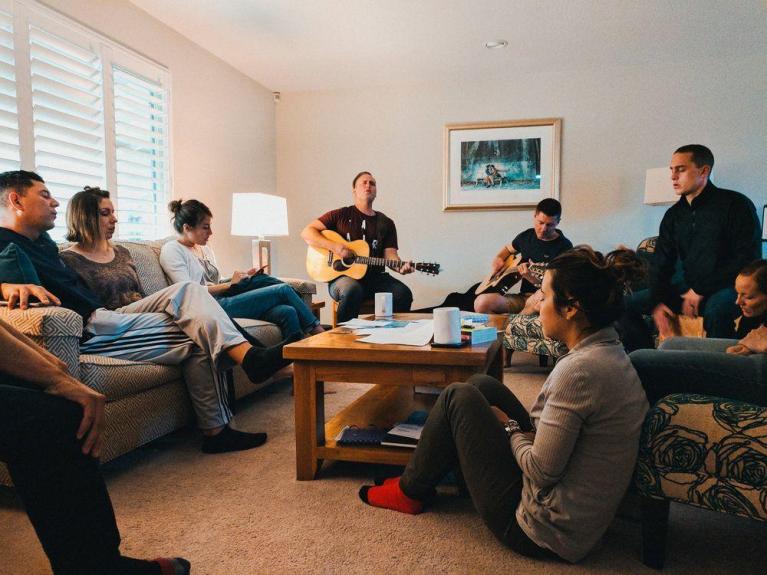
However, now, only a year and a half after my Chrismation, and due to circumstances that are beyond my control, I am currently in the planning stages of a house church.
Yes, I realize that this might come as a big surprise to many of you, it could appear like a complete one-eighty and reeks of instability, but it is a necessary step.
I know, I’ve always questioned this new house church trend where a few Protestant fundamentalist separatists, willful people who can’t agree with anyone about anything, people who claim to be copying the early church and decide they are better off doing church themselves.
Sheer arrogance, right?
I mean, the Amish do this too, I suppose, in that they do not have designated church buildings and meet in homes. Yet, they do it in a completely different spirit, they maintain a real community beyond their own immediate family and are truly accountable to an orthodox tradition that transcends them as individuals.
So how did I go completely from one end of the spectrum, from a church with two millennia of history, with ornate architecture and a strong emphasis on Communion, in a universal sense, to deciding that I need to start a church in my own home?
My Journey to the House Church…
Okay, before I give Fr. Seraphim a heart attack, I have no plans on leaving the Holy Cross family in Williamsport. None whatsoever. In fact, my decision to start a house church has everything to do with Orthodox tradition and my beginning to comprehend the reason behind a particular practice—that practice being an iconstasis.
Orthodox churches have an iconstasis, it is basically a wall with images of Jesus, Mary, various saints, and angels situated between the nave (where the congregation is gathered) and the altar where the bread and wine are consecrated. It is a reflection of how the Jerusalem temple was laid out, where the “Holy of Holies” was separated by a veil, and is symbolic of the connection between heaven and the “Holy Place” of the nave.

I had been contemplating how to incorporate an “icon corner” in my new home (a place on an East wall of an Orthodox home designated for prayer and worship) when I found out that this is also called an iconstasis.
Interesting…
As it turns out, this prayer corner in Orthodox homes harkens back to the real house churches of the early church. Every Christian home is supposed to be a microcosm of the Church, a wedding being basically equivalent to an ordination service, the parents acting as the clergy, and the children being the laity of this house church. The designated area for prayer and worship in the home mirrors that of the parish church building and early house churches.
As an aside, it is necessary to note, given currently popular notions pertaining to corporate worship in modern times, that the idea of a house church being a sort of informal affair is entirely wrong. In the early church, when meeting in houses, according to first-hand account, the priests and bishops were in a room east of the laymen (and women, who sat separately) with the deacon guarding the door and keeping the congregation in line. It was an orderly liturgical service and not a free-for-all. And, likewise, worship at home today should still be similarly structured.
The Very Protestant Problem of Division
Growing up, as a Mennonite, we would have “family devotions” and prayer before meals. This was always informal, where we were, and never really patterned as a church service. It was not called or considered a house church. Church for me then was the assembling together of the body of Christ on Sundays and on other days of the week—and that church service was a semi-formal affair, with a definite form and structure.
In decades since my childhood, at least in the conservative Mennonite circles that I ran in, it has become more and more commonplace to skip corporate worship services, on occasion, and to “have church” with just the youth, family members on a weekend retreat or what have you. There are some who have taken it a step further and ceased their mixing with non-biological brothers and sisters, and cousins (or the otherwise impure) altogether and replaced it with a casual around-the-campfire or lounging-in-the-living-room kind of house church affair that can last at least as long as their biological children lack access to transportation and a means to escape the inflated ego of their parents.
The trendline in Protestant denominations is abundantly and woefully clear. There has been a steady march away from any established order, any authority besides one’s own opinion, and Protestantism has played a key role in this development. What started as an attempt at reformation has ended as a fracturing of the Western church into thousands of competing and often very contradictory entities. From the dwindling Fred Phelps types on one side to the growing “woke” crowd on the other, it is very little wonder that this form of Christianity has led many to abandon the enterprise of faith altogether.
There is no need for a Jerusalem council in the current climate. No, in this denominational chaos, there is no longer a need to even practice a Christian love that is willing to work through differences, no reason to submit or show deference to anyone, you just stay home or start a new even smaller, more pure and perfect group and move on.
It is a classic purity spiral, it is a result of people heading their own opinions over the urging of St Paul:
Make every effort to keep the unity of the Spirit through the bond of peace. There is one body and one Spirit, just as you were called to one hope when you were called; one Lord, one faith, one baptism; one God and Father of all, who is over all and through all and in all. (Ephesians 4:3-6 NIV)
There isn’t much effort towards that end anymore, is there?
The Protestant house church, often billed as a return to the early church, is merely the next step in the direction of individualism and it is little wonder when children raised in such an environment continue down this path of division in search of a new purity on their own terms. Many will find congregations that require less of them, others will join the growing ranks of “nones” who simply stay at home Sundays, but some of the more ambitious will attempt to recreate a perfect church in their own image.
The Church That Spans Dichotomies
Fortunately, there are other options from the dichotomies of Protestantism. As it turns out, Christians do not need to choose between participation in the universal church (by attending services in a church building with other spiritual brothers and sisters in Christ) and having a “house church” primarily biological relatives, former denominational cohorts, and close friends.
There is a solution to this paradox where you can both have your cake and eat it too: You can (and should) have a house church with your families, but can (and should) also maintain the unity of the faith and be in Communion with the Church body that transcends denominationalism and has an unbroken chain of ordinations back to the time of the Apostles.
In Orthodox Christianity, every man is a priest and his wife co-ordained as the leaders of their own church/home, that is what their marriage implies. But there are also priests over priests, and everyone (man and woman alike) is still accountable to the “priesthood of all believers” (which is to say the Church) and must submit to each other, especially the elder, as St Paul instructs:
Have confidence in your leaders and submit to their authority, because they keep watch over you as those who must give an account. Do this so that their work will be a joy, not a burden, for that would be of no benefit to you. (Hebrews 13:17 NIV)
It is impossible to obey that teaching above while being your own boss.
I’m under no delusion about the Orthodox hierarchy, there are problems there like anything else people are involved. I do not submit to their perfection. I do, however, submit in Christian love, to honor my Lord, and in knowing my own unworthiness. I have no need to be the priest, at least not until God ordains it through his Church, but do see an urgent need for all Christians to submit one to another as we are told many times in Scripture.
You can have a house church and be Orthodox. In fact, you should have a house church if you are Orthodox and that is historically well-established.
But you simply cannot be Orthodox or truly Christian and refuse to acknowledge that the church is bigger than you and your own comprehension or ideas.
Orthodoxy, once again, simultaneously occupies both sides of an argument in both strongly encouraging home church while also—at the same time—rejecting the spirit of Diotrephes of those who acknowledge no authority besides their own and set about to create a new pure church in their own image.


 Irregular Ideation