

Excuse Me, Miss…

Standard

My wife and I were taking advantage of the spring weather, out on a walk together, baby in stroller, when a voice from behind us interrupted our stride:

“Excuse me, miss, why do you walk with your hands behind your back?”

Apparently, according to this inquirer, my wife was walking with her hands clasped together behind her and it made him curious.  And, after he said it, I immediately knew what he meant, I had seen her do this before and now considered that it wasn’t a common thing for American women to do.  

My wife—other than to answer the man with his New Jersey accent that it is something common with older people from her place—had no good answer.

She told me later it was something she recalls her grandma doing and was not something she ever gave much conscious thought to until he stopped us.  It was just what felt natural or right to her—a mannerism that the Igorot women of certain age and good reputation simply did.

The best explanation I have found is that this is social signalling in Asian culture.  It is an image of authority and composure.  And it could mean my wife feels confident, does not need to be in a rush or has earned the right to be contemplative, non-defensive and like a respected elder in her native culture. 

Whatever it is, it isn’t deliberate or something she tried to do, it had just naturally came to her.

Mennonite Matriarchs and Mirroring Behaviors

What piqued my further interest was a parallel conversation, led by Dorcas Smucker (a popular conservative Mennonite blogger), trying to figure out why her female religious peers cross their arms in front of them while standing.

The answers ranged from comfort to having no pockets in their traditional dress—or a resting position.  Others say it is a defensive posture or a symptom of women ashamed of their feminity or trying to hide themselves.   However, I have also noticed, in office meetings, my male coworkers—all of us from Amish or Mennonite background—sit around the table with their arms crossed.  The room is a bit cool.  Maybe that’s all it is?
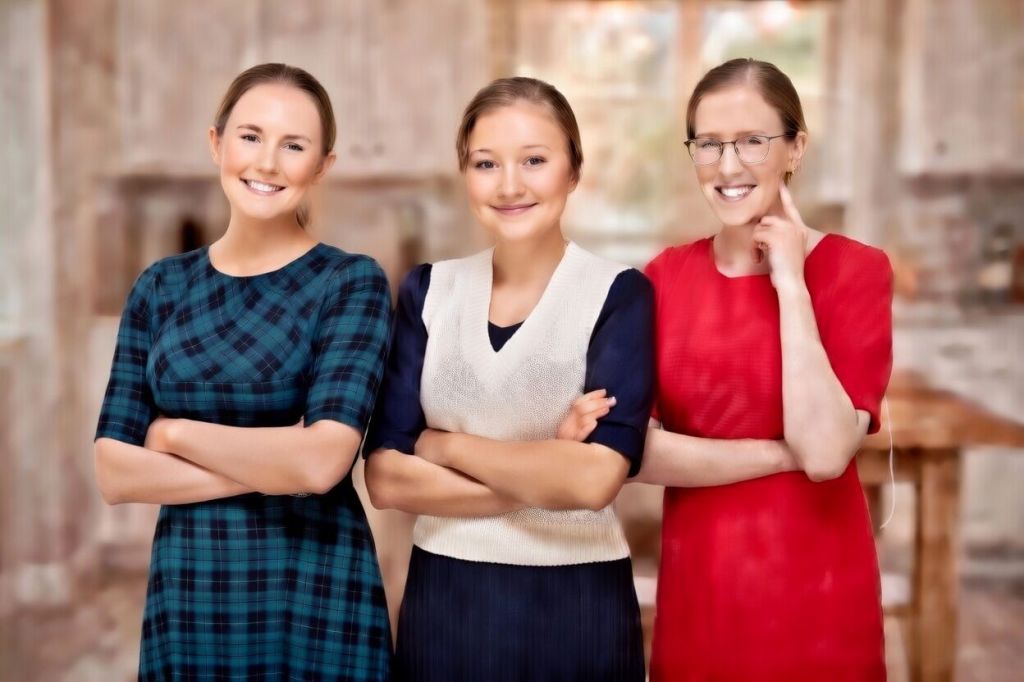
I’m guessing this has very little to do with what is projected onto it by those who often seem to see the broader American culture as some kind of benchmark for normal. 

Yes, it is the case that those of us born into this religious subculture tend to be self-conscious about what we wear and appearance.  I knew I was odd, at a public school, wearing long pants during the heat of August, and had classmates who would remind me of my being Mennonite.  But is it the cause every mannerism?

Chimpanzees also cross their arms.  But it is described as just being a neutral relaxed position or simply a way to rest and relieve muscle strain.  The crossed arms as being a defensive posture has fallen out of favor with experts.  Could there be some post hoc rationalizing in how we explain human body language? 

Mirroring behavior provides a more plausible explanation.  This is to say we will just imitate the postures or mannerisms of others in our group without a thought.  This is called “chameleon effect” and part of the way we build rapport or trust.  It is part of our sense of belonging within a community.  It’s wired in our brain—the “mirror neurons” which fire off both when we perform a particular action as well as when we see someone else doing the same thing.  Nobody has to tell us to do it.

This is deliberate.  Whereas mirroring is subconscious.
This hand gesture is very common all throughout the Philippines.  The “I’m good looking” pose.  Click here for more gestures.

So what is likely, whether those Mennonite arms crossed or Igorot elders walking with their hands clasped behind, is that these postures are about a cultural identity and unconscious process where we copy those whom we respect in the group or just what we have seen thus accept as normal.  It is social glue—in the same way my cousin picked up her Southern drawl after marrying a Virginia boy.  This is similar to how we yawn when other people do.  It’s just an instinct.

Social Glue in Religious Ritual Too

What’s interesting is that religions attempt to capitalize on this by forced mirroring that becomes unconscious.  The extended hand, the greeting a non-relative as “brother” and all ritual is about building an artificial bond that makes us feel like we belong.  It’s in the silly cliché phrases, they’re part of that “hedge of protection” around community identity, and just social connection that makes us feel comfortable.
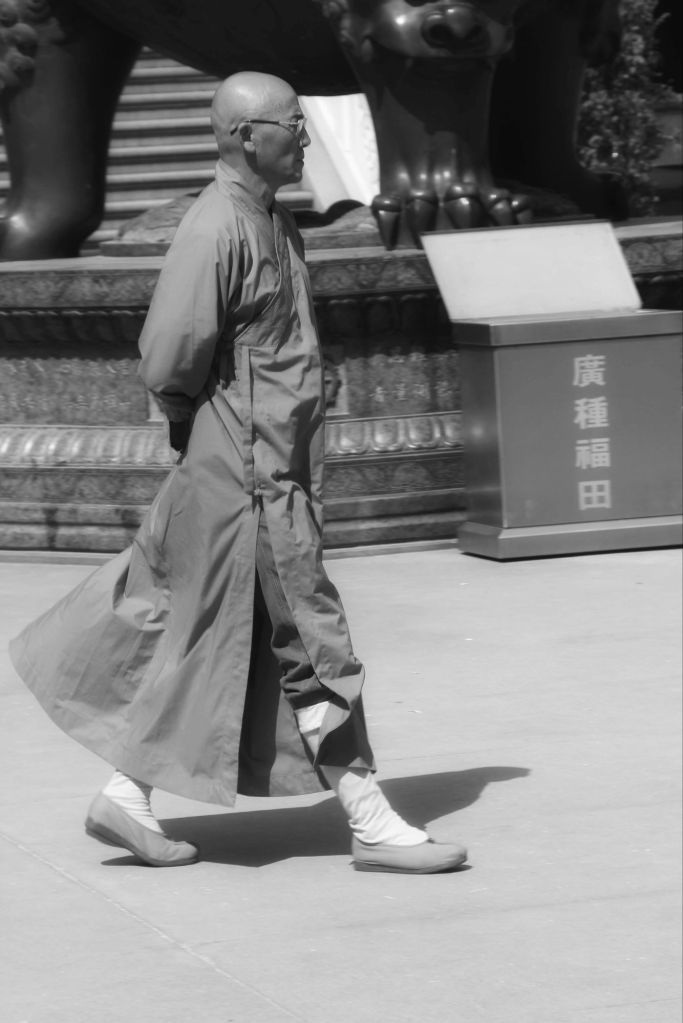
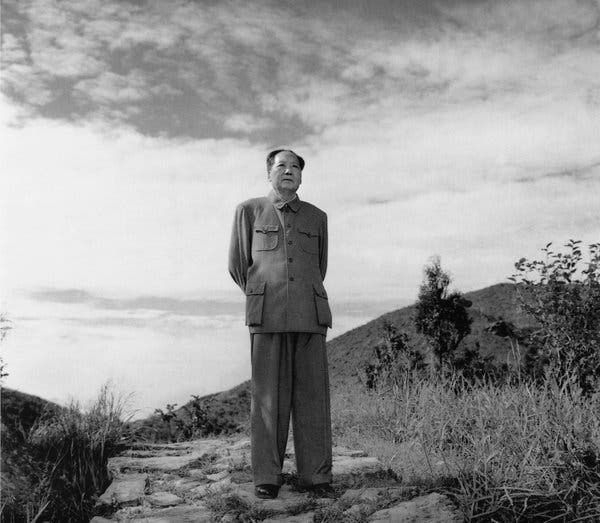
Common in the East.
The “Four Olds” (old ideas, old culture, old customs, and old habits) of the Cultural Revolution didn’t reach Chairman Mao.  His hands are still in the traditional Asian authority position.

However, this can also make life very difficult for those outside coming in.  An outsider that tries to go through the same motions will very likely look forced—like a mask or performance rather than genuine.  This “false signal” could be taken as mockery and give off an uncanny valley feel that makes people suspicious or uncomfortable. Not to mention it is hard for the person trying to keep up the appearance as well.  Like the time when I awkwardly did a full prostration rather than the requested bow from the priest for that part of an Orthodox service.

And yet, off the insecurities most contemptible, it is this need to explain or apologize for what was programmed into us by our culture.  Hands in contemplative clasp behind our back while we walk or an assuring restful self-hug, we need not ever feel awkward about our mannerisms and physical pose simply because it is unique to our own subset of humankind.  It is an unfortunate side-effect of modern pluralism and exposure is we’re left second guessing our status rather than just being a part of the social fabric.

We don’t need to defend or pathologize this. 

At the same time, like physical posture, culture is built on religion and our moral assumptions are basically inherited.  So there is a place for careful deliberation and more intentionality in what we do.  And we do this by understanding how new generations absorb many practices through a process of socialization osmosis rather than only verbally through instruction.  If more is caught than taught; if many things are learned through unconscious mirroring—then we need to practice much more than we ever preach.

The Church In the Age of Narcissism

Standard

The idea of individual rights and liberty has evolved into a defiant “nobody can tell me what to do” attitude. This toxic individualism can be in reaction to abuse, a response to the failures of authority figures or simply a person’s naturally narcissistic disposition.

As a product of American culture, I’ve always believed that people should be free and still believe this. It seems that totalitarian states, while certainly able to build great monuments and copy the innovation of their rivals, do often stifle creativity and limit the potential of individuals. A right to self-determination has enabled many to pursue their passions and helped in bringing about progress in terms of technology and medicine.

However, there does seem to be a point where unchecked individualism begins to be a threat to our collective advancement. And we are now to the point that it is not safe to so much as assume an individual’s gender based on the evidence without potentially triggering a violent, over-the-top and completely abusive backlash.

In this age of narcissism, it does not matter what has been established for centuries. It also doesn’t matter what the consensus is on a given topic or what the various authorities tell us. No, all that matters is how the individual imagines themselves.

Narcissism Enters the Church

In the church, this narcissism is often hidden under a mask of spirituality and sanctimonious blather. Sure, many will claim the Bible as their ultimate authority, yet they will reject anything it says about respect for the elder and submission when it is convenient for them and their own ends.

It is absurd, truly, that people are rejecting the very foundation of the rights that they assume. They tear down structures and institutions without realizing that they are unraveling the very things that have produced and protected the concepts they take for granted. They are dangerous in that they are too dumb to realize that everything they believe currently did not originate within them. Everything, even their ingratitude, and resentment of authority is a product of the times they are in,

They are not free, they are just ignorant of the collective consciousness that nourished and created their grand delusion of independence. Or, worse, they only recognize the negative contributions of the system without ever considering the benefits. They are not so pure or undefiled either, they have their own motivations and are woefully lacking in self-awareness. It is only a lack of humility, an idea that there is nothing to be gained in deferral to an elder or expert, that the individual knows all simply because they have basic reading comprehension and elementary knowledge.

Sadly, the erosion of confidence in the collective, mistrust of authority in general, does not make the individual any more competent than the system that created them. It doesn’t mean that they are themselves better qualified to be arbiters of truth than the hierarchies of flawed individuals that they aim to replace with their papacy of one. But it does destroy our chance for unity, it does make individuals extremely vulnerable to the deceptions of their own ego (“The heart is deceitful above all things and beyond cure.” Jeremiah 17:9 NIV) and boiled down is nothing more than self-worship.

How the West Was Lost

In the West, this ego trip may have started with the Pope asserting his own authority over the church, to unilaterally decide matters for himself without counsel and led to the Great Schism. But eventually, it trickled to ordained men doing the same in protest, relying on their own individual authority and understanding of church tradition to start their own denominations—before their attitude spread to the laity who rejected their authority as well.

The reformers, in their exuberance, eventually denied the very tradition that established the canon of Scripture and yet, through circular reasoning, still clung to the book as being authoritative simply because they believed it to be so. This led to others, more enlightened, who saw the irrationality, went a step further, rejected even the book as written by men and written by men whose authority they could not accept. The cold might be preferable to those lukewarm, at least they can’t use “well, the Spirit led me to [insert whatever]” and must attempt a rational argument instead.

At least the secular scientist is subject to peer review. They can’t simply declare something for themselves or rely on their cohort of like-minded advisors, like king Rehoboam who reject the advice of the elders, ran with that of his unwise cronies, and ended up creating division. A biologist, unlike the windbag pontificator in the men’s Sunday school class, has at least had to earn his credentials and must carefully make a case with evidence or will be treated as a joke by colleagues. Those feeding their own individual tastes from the Biblical smorgasbord, oblivious to their own biases being read into the text, can’t be made accountable.

Unfortunately, science and human rationality have also reached their limits. The intellectual enterprise could never answer questions of why we exist, an accumulation of facts could never fill the void left by religion, most people can’t keep up with the brightest minds in various fields and yet many (on both sides of any issue) speak more boldly than those who have spent years of rigorous study, confident because they read something on the internet. There is a growing mistrust of all authority and structure. Political ideologies push the research and echo chambers have replaced serious discussion.

For example, in climate science, there is plenty of grey area between Greta Thunberg’s emotional alarmism and the actual evidence. Sure, there may be some consensus on a current temperature trend and human contribution, but there is no such thing as settled science. At very least there is no reason to assume that warmer weather is automatically a catastrophe or the cause of all things bad. And there’s definitely some hysteria involved when you have a CNN anchor speculating, on-air, about a possible connection between an asteroid and climate change. Is it any wonder that more are dismissing the whole thing as nonsense?

On the opposite side of the coin are those who use the above, the misuse of science by media sensationalists and political activists, as a reason to dismiss all science. I’m talking, of course, of those (often religious fundamentalists) who deny what is well-known about the general shape of the planet and physics. They use a form of reasoning, they are not wholly irrational individuals and yet seem to be motivated more by their mistrust of all authority and undying trust in themselves. They are much like the far-leftist who refuse to see gender differences as real (while, in contradiction to themselves, claiming that a man with feminine traits is transgendered), they have made their own opinion an article of faith.

Eventually, if things do not change, we may soon not be able to hold civilization together and return to our roots of tribalism. Christendom was the force that once brought Jew and Greek, man and woman—people of vastly different social status—into fellowship with each other through their allegiance to Christ. From the beginning, the church had a definite structure and also ordained leaders to decide the weightier matters. But that order has dissolved, often in reaction to abuses and always to be replaced with increasingly arrogant smaller entities. The current narcissism is only the final step before the total collapse.

How To Break the Trend Towards Narcissistic Chaos

Groups of people, institutions, can certainly fall victim to their own collective confirmation bias. Again, authoritarian regimes that stifle independent thought destroy innovation and limit potential. But the individual, especially the individual who resists all authority, is even more vulnerable to being blinded their own biases.

Yes, certainly authorities do fail, alas even the President of the United States is human and makes mistakes, but that does not mean that individuals are all equally qualified for every role. It is always good to question the experts. Doctors, lawyers, and engineers can miss the obvious, laypeople are not all total idiots because they lack a degree. At the same time, this overreaction to abuses and failures is even more dangerous.

No, the Titanic disaster does not mean engineering is untrustworthy nor does the 737 MAX being certified by the FAA before a couple of deadly crashes make the whole institution a waste. The alternative of everyone being right in their own eyes, being their own expert, will do absolutely nothing to improve the quality of life. The reality is that we are better off with authorities, those who have made a career trying to understand specific issues and can be held accountable. Sure, even the professionals can be wrong, but there are greater consequences that go along with their license.

The church also needs elders and examples. The church should have those ordained and more respected. The idea that spirituality is a free-for-all is utter nonsense, not founded in Scripture nor the church tradition that canonized and established what is Scripture. The person who sees no need for any authority in their lives besides their own understanding or that of their cohort are the dumb beasts condemned by Peter:

This is especially true of those who follow the corrupt desire of the flesh and despise authority. Bold and arrogant, they are not afraid to heap abuse on celestial beings; yet even angels, although they are stronger and more powerful, do not heap abuse on such beings when bringing judgment on them from the Lord. But these people blaspheme in matters they do not understand. They are like unreasoning animals, creatures of instinct, born only to be caught and destroyed, and like animals they too will perish. (2 Peter 2:10‭-‬12 NIV)

True Christianity starts with repentance. Repentance comes with an attitude willing to voluntarily sacrifice some self-determination and take advice. It means humility and realizing that the universe does not revolve around your own individual understanding of things nor is truth a matter of your own personal opinion. It isn’t so hard to submit to an elder—even when you do not fully agree on everything—when one realizes their own fallibility and need of a savior.

Sure, hierarchies do fail and especially when they cease to be accountable to the bodies that they represent. A Christian leader always had authority, like Peter or Paul who spoke in a manner that commanded respect, but was never supposed to be a tyrant like Diotrephes. Leaders, like individuals, can be terrible failures and must be disciplined or removed as needed. But to overreact, to pretend everyone is on the same level, is no different than the pride that led to the fall of heaven’s highest-ranking angel. To reject authority besides one’s own is to repeat that same sin.

We need order, we thrive when we are able to specialize and let individuals reach their full potential, and that requires us to acknowledge our own limitations. We need an order that keeps authorities even more accountable than others, that does not give them a free pass as part of a good ol’ boys club, and actually requires that they are more submissive (as an example) than those who they hold charge over. Ultimately a church with no submission to others is a church without love, only self-love, and will offer nothing to those trying to escape the narcissism of our age.

Going Full Circle, I’ve Decided to Start a House Church…

Standard

Life is full of strange and unexpected twists.

Upon leaving the denomination of my birth, I had joked that my two choices were to a) start “The Perfect Church of Joel” or b) become Orthodox. But, since I lacked the ambition and other qualifications for being a cult leader, the latter was my only option, and became Orthodox.

However, now, only a year and a half after my Chrismation, and due to circumstances that are beyond my control, I am currently in the planning stages of a house church.

Yes, I realize that this might come as a big surprise to many of you, it could appear like a complete one-eighty and reeks of instability, but it is a necessary step.

I know, I’ve always questioned this new house church trend where a few Protestant fundamentalist separatists, willful people who can’t agree with anyone about anything, people who claim to be copying the early church and decide they are better off doing church themselves.

Sheer arrogance, right?

I mean, the Amish do this too, I suppose, in that they do not have designated church buildings and meet in homes. Yet, they do it in a completely different spirit, they maintain a real community beyond their own immediate family and are truly accountable to an orthodox tradition that transcends them as individuals.

So how did I go completely from one end of the spectrum, from a church with two millennia of history, with ornate architecture and a strong emphasis on Communion, in a universal sense, to deciding that I need to start a church in my own home?

My Journey to the House Church…

Okay, before I give Fr. Seraphim a heart attack, I have no plans on leaving the Holy Cross family in Williamsport. None whatsoever. In fact, my decision to start a house church has everything to do with Orthodox tradition and my beginning to comprehend the reason behind a particular practice—that practice being an iconstasis.

Orthodox churches have an iconstasis, it is basically a wall with images of Jesus, Mary, various saints, and angels situated between the nave (where the congregation is gathered) and the altar where the bread and wine are consecrated. It is a reflection of how the Jerusalem temple was laid out, where the “Holy of Holies” was separated by a veil, and is symbolic of the connection between heaven and the “Holy Place” of the nave.

I had been contemplating how to incorporate an “icon corner” in my new home (a place on an East wall of an Orthodox home designated for prayer and worship) when I found out that this is also called an iconstasis.

Interesting…

As it turns out, this prayer corner in Orthodox homes harkens back to the real house churches of the early church. Every Christian home is supposed to be a microcosm of the Church, a wedding being basically equivalent to an ordination service, the parents acting as the clergy, and the children being the laity of this house church. The designated area for prayer and worship in the home mirrors that of the parish church building and early house churches.

As an aside, it is necessary to note, given currently popular notions pertaining to corporate worship in modern times, that the idea of a house church being a sort of informal affair is entirely wrong. In the early church, when meeting in houses, according to first-hand account, the priests and bishops were in a room east of the laymen (and women, who sat separately) with the deacon guarding the door and keeping the congregation in line. It was an orderly liturgical service and not a free-for-all. And, likewise, worship at home today should still be similarly structured.

The Very Protestant Problem of Division

Growing up, as a Mennonite, we would have “family devotions” and prayer before meals. This was always informal, where we were, and never really patterned as a church service. It was not called or considered a house church. Church for me then was the assembling together of the body of Christ on Sundays and on other days of the week—and that church service was a semi-formal affair, with a definite form and structure.

In decades since my childhood, at least in the conservative Mennonite circles that I ran in, it has become more and more commonplace to skip corporate worship services, on occasion, and to “have church” with just the youth, family members on a weekend retreat or what have you. There are some who have taken it a step further and ceased their mixing with non-biological brothers and sisters, and cousins (or the otherwise impure) altogether and replaced it with a casual around-the-campfire or lounging-in-the-living-room kind of house church affair that can last at least as long as their biological children lack access to transportation and a means to escape the inflated ego of their parents.

The trendline in Protestant denominations is abundantly and woefully clear. There has been a steady march away from any established order, any authority besides one’s own opinion, and Protestantism has played a key role in this development. What started as an attempt at reformation has ended as a fracturing of the Western church into thousands of competing and often very contradictory entities. From the dwindling Fred Phelps types on one side to the growing “woke” crowd on the other, it is very little wonder that this form of Christianity has led many to abandon the enterprise of faith altogether.

There is no need for a Jerusalem council in the current climate. No, in this denominational chaos, there is no longer a need to even practice a Christian love that is willing to work through differences, no reason to submit or show deference to anyone, you just stay home or start a new even smaller, more pure and perfect group and move on.

It is a classic purity spiral, it is a result of people heading their own opinions over the urging of St Paul:

Make every effort to keep the unity of the Spirit through the bond of peace. There is one body and one Spirit, just as you were called to one hope when you were called; one Lord, one faith, one baptism; one God and Father of all, who is over all and through all and in all. (Ephesians 4:3‭-‬6 NIV)

There isn’t much effort towards that end anymore, is there?

The Protestant house church, often billed as a return to the early church, is merely the next step in the direction of individualism and it is little wonder when children raised in such an environment continue down this path of division in search of a new purity on their own terms. Many will find congregations that require less of them, others will join the growing ranks of “nones” who simply stay at home Sundays, but some of the more ambitious will attempt to recreate a perfect church in their own image.

The Church That Spans Dichotomies

Fortunately, there are other options from the dichotomies of Protestantism. As it turns out, Christians do not need to choose between participation in the universal church (by attending services in a church building with other spiritual brothers and sisters in Christ) and having a “house church” primarily biological relatives, former denominational cohorts, and close friends.

There is a solution to this paradox where you can both have your cake and eat it too: You can (and should) have a house church with your families, but can (and should) also maintain the unity of the faith and be in Communion with the Church body that transcends denominationalism and has an unbroken chain of ordinations back to the time of the Apostles.

In Orthodox Christianity, every man is a priest and his wife co-ordained as the leaders of their own church/home, that is what their marriage implies. But there are also priests over priests, and everyone (man and woman alike) is still accountable to the “priesthood of all believers” (which is to say the Church) and must submit to each other, especially the elder, as St Paul instructs:

Have confidence in your leaders and submit to their authority, because they keep watch over you as those who must give an account. Do this so that their work will be a joy, not a burden, for that would be of no benefit to you. (Hebrews 13:17 NIV)

It is impossible to obey that teaching above while being your own boss.

I’m under no delusion about the Orthodox hierarchy, there are problems there like anything else people are involved. I do not submit to their perfection. I do, however, submit in Christian love, to honor my Lord, and in knowing my own unworthiness. I have no need to be the priest, at least not until God ordains it through his Church, but do see an urgent need for all Christians to submit one to another as we are told many times in Scripture.

You can have a house church and be Orthodox. In fact, you should have a house church if you are Orthodox and that is historically well-established.

But you simply cannot be Orthodox or truly Christian and refuse to acknowledge that the church is bigger than you and your own comprehension or ideas.

Orthodoxy, once again, simultaneously occupies both sides of an argument in both strongly encouraging home church while also—at the same time—rejecting the spirit of Diotrephes of those who acknowledge no authority besides their own and set about to create a new pure church in their own image.