

“The propagandist’s purpose is to make one set of people forget that certain other sets of people are human.”
Aldous Huxley
Most on one side of this issue likely will not even get this far into reading this. For daring to question the narrative they’ve swallowed I’ll probably be quickly dismissed by some as a “terror apologist” or worse. Nevertheless, for those who know that I don’t take positions lightly or without due diligence, this post will help explain my position on the ongoing conflict between Israel and the Palestinians. But more important than that this blog is aimed at addressing the brazen dishonesty of the fundamentalist cheerleaders.
First of all, for anyone conservative who has come through the past few years and is still lacking skepticism about what the political establishment is saying really deserves to be exploited. Now that Hamas has attacked we can now trust the same media that saw riots as “mostly peaceful protests” and then calls MAGA supporters “insurrectionists” for their questioning the election results??? Are you really that dumb?!? Why don’t you at least consider that the same people who distort the truth here, who seize upon the parts of the evidence that support their own agenda on domestic issues, might also do the same thing there?
Second, okay, so you never heard ‘our side’ chanting “death to Gazans” and yet let’s not be cute about this. Both sides are dedicated to the destruction of the other. Israel slowly but surely takes all of Palestine. Hamas is fully committed to ending Israel. How genocidal that would end up being is anyone’s guess—but these stories from a couple Israeli Defense Force veterans can give us some idea, they burned people alive and shot school children—watch them talk about it and then moralize to me about how only one side is barbaric or evil.
No, this horrendous history of atrocities on both sides certainly does not justify anything that Hamas did in the past week. But what should we expect to happen when that boy crying when an air strike killed his entire family grows up? Is it a surprise when he’s angry and blames the nation that dropped the bomb? Are we just going to gloss over the fact that the Israeli prime minister, Benjamin “Bibi” Netanyahu, is in a leaked video saying to make it painful for the Palestinians and that basically anything is a military target? What does that mean? Are we going to play ignorant?
This is why I can’t take seriously people who only condemn one side and never the other, this selective moral outrage is not about true care for children. Those who quickly share unverified accounts of beheaded babies and then never even acknowledge those thousands of innocent Palestinians who have died in the indiscriminate and brutal bombing campaigns are being dishonest. No, not saying that there must be complete equivalency or proportionality in a war. but let’s not pretend that only one side is a victim of terrorism. It just looks really disingenuous to only care about the children of one side.
Getting this out of the way…
My point is not to convert you from one side to the other. My point is that the common presentation of this conflict is a false dichotomy and we have the option of choosing none of the above. We can stand with the true victims, those innocent people caught in the crossfire, and oppose all of the militant parties. That is where I stand. Furthermore, I will mostly address the propaganda and war crimes of one side. Why? It is because my typical audience is completely biased toward the West’s narrative and certainly not because I am unaware of what the other side has done. We don’t need to be partisans.

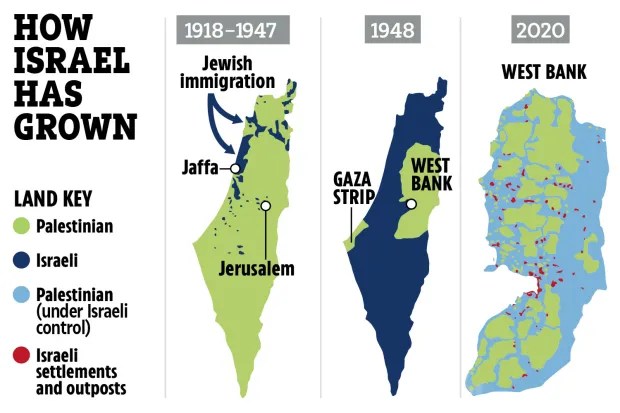
The big lie is that this conflict is not about ethnic cleansing on both sides. Israel has systematically, since May 14, 1948, pushed the native inhabitants out of their land and then played the role of victim when their militarily weaker opponents employed asymmetrical warfare tactics against the occupation. Israel has turned Gaza into an open-air prison, but we only care when Hamas strikes back. American Evangeli-cons believe every claim without skepticism when it is made by Israel (burned babies) as if a party in the conflict has reason to be truthful—why are we such fools?
It Is Okay To Bomb Nazi Children!
Maybe you do not know what Jewish neo-con Ben Shapiro (as well as Isreal’s Prime Minister) meant when he pronounced the people of Gaza to be Amalek?
But I do:
This is what the Lord Almighty says: ‘I will punish the Amalekites for what they did to Israel when they waylaid them as they came up from Egypt. Now go, attack the Amalekites and totally destroy all that belongs to them. Do not spare them; put to death men and women, children and infants, cattle and sheep, camels and donkeys.’
(1 Samuel 15:2-3 NIV)
We call that genocide.
Sure, maybe Shapiro is emotional, he has a right, but these chants of “kill the Arab” or about Gaza becoming “a cemetery” with no school children left alive didn’t start last week. And maybe that’s what US Senator Lindsay Graham wants when he says this is a religious war and he suggests the solution “level the place,” while also braying for a confrontation with Iran? Apparently, it is okay when Israel ‘defends itself’ by wiping out men, women, children, and infants of any who resist their claim to the land. I guess it is the privilege of being a chosen people, right?
Like an Israeli official said we shouldn’t care about Palestinian civilian deaths because they’re all Nazis. Much of this is based on unverified accounts of partisans repeated as fact, even embellished by Joe Biden who claimed, with great sincerity, that he had seen the pictures of beheaded babies himself only to have the claim retracted. So now we’re collectively punishing people, looking the other way at inhumane things done by the military, using the circular ‘punch a Nazi’s logic of the far-left and misuse of religious texts. Are we better than them?

So let’s just be honest about it! Let’s not say that this is about human rights or preventing ethnic cleansing when it is all about clearing the place for a Jewish ethnic state. Stop being a coward, and say that you’re okay with babies being killed (as long as it is their babies) and with millions of people who are being displaced from their land—all because you have stupidly embraced an errant eschatology that replaces the Church, which was established by Christ, with reemergent nation of those who have fully rejected Him.
Or you could just join me in agreement with St Paul:
Understand, then, that those who have faith are children of Abraham. Scripture foresaw that God would justify the Gentiles by faith, and announced the gospel in advance to Abraham: “All nations will be blessed through you.” So those who rely on faith are blessed along with Abraham, the man of faith. […] The promises were spoken to Abraham and to his seed. Scripture does not say “and to seeds,” meaning many people, but “and to your seed,” meaning one person, who is Christ.
(Galatians 3:7-9, 16 NIV)
Understand yet?
Support for a modern ethno-nationalist state has no connection to the promises given to Abraham. Sure, many have been made into useful idiots for this cause, by the twisting of Scripture, but Jesus didn’t promise a patch of land along the Mediterranean coast and the Jews do not share Christian values any more than Muslims do. Both sides of the Israeli-Palestinian conflict have chanted for the death of the other. One sees us as being Infidels and the other calls us Goyim. When has Israel, a country declared ‘our greatest ally’ according to many of our greasy-haired politicians, ever defended our borders? The blessing is they get a ton of US aid and send propaganda pictures of their most attractive women in uniform in return.
There’s no denying the tragedy of what has been unfolding over the past few days. We have seen the pictures and videos, very real, of terrified young people. One moment they were enjoying a music festival, the next they were being mercilessly gunned down. And yet I did not see the same level of concern from fundamentalists for the victims of the Pulse nightclub attack. These same people overwhelmed with concern about Israel do not think twice about collective punishment and forcing Gazans into the desert before there is provision for them—this isn’t about protecting innocents or looking out for the most vulnerable, it is about wiping Gazans off the map by wherever means available at this time.
Christian compassion is that none should perish and all will be saved. It isn’t about a political entity called Israel or any kingdom of this world. Our battle, if we were indeed servants of Christ as we claim, should not be against flesh and blood. Jesus commanded us to love our enemies and do good to those who mistreat us. That’s coming from a man who was tortured, unjustly nailed to a cross, and killed by an occupying power. So why again do we support the death of Palestinian children simply for living in the wrong place at the wrong time?

Shouldn’t we love these little ones as much as their other more fortunate Semitic cousins?

 Irregular Ideation