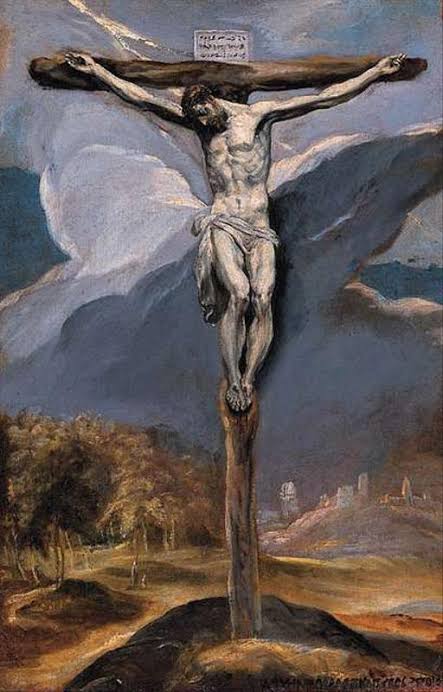
Most long for a world that conforms to their own idea of fairness and justice. Shouldn’t a person get what they deserve? And in the Bible there is a concept of reaping what we sow. Call it karma. Cause and effect. The urge to explain the misfortune of others as their fault or our own fortune as the proof of our righteousness. We feel punished when things don’t work out—and vindicated when they do. But what if there is more randomness to outcomes than we imagine?
While the law of sowing and reaping should be applied—where hard work and the fruits of harvest are related—this understanding should also be counterbalanced. Some get wealth by reaping what they did not sow as an inheritance or through theft. Those who assign positive moral value to wealth miss this entirely. This often becomes a excuse for lack of charity or even reason to further disenfranchise the disenfranchised. Look at the caste system in Hindu India and “health and wealth” preaching of the false Prosperity Gospel.

I’ve seen this in response to the flooding in Nepal, posts by suggesting that it is some kind of Divine punishment for the majority Hindu nation for persecution of Christians, which is strange given that victims are from multiple countries. Funny how we never got that kind of interpretation of the destruction in Asheville and Swannanoa Valleys due to the rains from hurricane Helene. We should probably work out some of these details of this before we assume anything, right?
Do good things happen to good people—bad things to bad?
Is our good or bad fortune a matter of our deserving and merit?
Sometimes there are consequences for our actions—like when an algae bloom caused by your merciless bombing of a neighbor is now threatening your own water supply. Yet the mistake is believing that every bad thing other people suffer is sowing and reaping—cause and effect. Some reap what they did not sow, they have meritless wealth and the prosperity built from exploitation.
First let’s take a look at what we can learn about the suffering of righteous people in Scripture—and then move on to the myth of meritocracy in American culture.
The Righteous Loser
There is something else meaningless that occurs on earth: the righteous who get what the wicked deserve, and the wicked who get what the righteous deserve. This too, I say, is meaningless.
(Ecclesiastes 8:14 NIV)
The above credited to Solomon, a wise king, who understood the good guys don’t always win. He reverses the expected order, denies karma, and he tells us that indeed many bad things happen to good people and from our perspective evil wins.
This same sentiment is captured elsewhere in Scripture, the apparent success of the wicked which nearly caused the faithful to stumble. In Psalms 73:2-12, the psalmist admits, “my feet had almost slipped; I had nearly lost my foothold. For I envied the arrogant when I saw the prosperity of the wicked.” He describes how “They have no struggles; their bodies are healthy and strong” and remain “free from common human burdens,” while saying “pride is their necklace; they clothe themselves with violence.” From callous hearts they scoff and speak with malice, even claiming, “How would God know? Does the Most High know anything?”—all while they stay “always free of care” and “go on amassing wealth.” Such observations highlight the tension between the alarming prosperity of wicked and our belief that all people should get what they deserve. The world doesn’t work according to our moral logic or narratives.
And it’s not only the wisdom of the Psalms or Solomon, but something Jesus had tried to explain to a prejudice crowd:
As he went along, he saw a man blind from birth. His disciples asked him, “Rabbi, who sinned, this man or his parents, that he was born blind?” “Neither this man nor his parents sinned,” said Jesus, “but this happened so that the works of God might be displayed in him.
(John 9:1-3 NIV)
The disciples anticipated a link between a man’s blindness and sin. However, Jesus answered with “none of the above” before healing the man. This is clearly refutation of the idea that sin causes misfortune. It has nothing to do with the righteousness or unrighteousness of the sufferer. Even the most devoted assumed people simply got what they deserved. Jesus corrected their errant belief and presented blindness from birth as an opportunity to show God’s glory. Physical defect is not a punishment for sin, nor is poverty or misfortune, evil men are sometimes rich and powerful—it is only our spiritual blindness that makes us see great wealth or good health as a direct reward for virtue. Jesus did not.
Here’s another case of Jesus addressing an unfortunate circumstance:
Now there were some present at that time who told Jesus about the Galileans whose blood Pilate had mixed with their sacrifices. Jesus answered, “Do you think that these Galileans were worse sinners than all the other Galileans because they suffered this way? I tell you, no! But unless you repent, you too will all perish. Or those eighteen who died when the tower in Siloam fell on them—do you think they were more guilty than all the others living in Jerusalem? I tell you, no! But unless you repent, you too will all perish.”
(Luke 13:1-5 NIV)
We all ask questions after tragedy. Why do some get swept away in the flood waters—while others escape without injury? These are questions we all must grapple with and one answer is to blame the victims. Jesus is citing two recent events for his audience. The euphemism about mixing of blood with sacrifices refers to the pilgrims from Galilee killed by Roman soldiers while at the temple atoning for sin. The tower in Siloam tragedy was, by contrast, was an engineering failure or natural disaster rather than deliberate. In both cases Jesus dismisses the idea that it is a form of retributive justice—and instead he gives a reminder that we all die.
The whole Gospel narrative depends on an idea that even the good people suffer (and oftentimes more for being good) because it is exactly what happened to Jesus. If only good things can ever happen to righteous people then explain the suffering and death of the Christian example. And this is not a new teaching of the Gospel, there’s a whole book named Job about a man who had one calamity after another because of—and not in spite of—his righteousness. Job’s friends were rebuked, by God, for trying to fault with him. They made the same mistake many in the time of Jesus made and assigned moral weight to misfortune. This idea contradicts the core of the Gospel showing the ultimate example of the righteous man is one who is willing to suffer for the sins of others.

The reason why we prefer to blame victims is because it removes our responsibility to care. We can simply say they got what they deserved and move on. But that’s the same attitude of Cain—who murdered his brother and then when confronted by God says “Am I my brother’s keeper?” The example Jesus gave is a polar opposite: Saving those who are completely undeserving—taking the loss on himself rather than demand that people suffer for their sins. A Christian should only see disaster as an opportunity to help those in need—to show gratitude for grace of God towards us—never as cause for speculation about their hidden sins.
Myth of American Meritocracy
The idea that great wealth is a reward for virtue is a pillar of American conservative politics. This naturally accompanies that notion that people get the suffering which they deserve and is a cornerstone a current economic system we call Capitalism. The myth of meritocracy is that those at the top gaining their riches through their hard work or wise investments rather than via shady business or exploitation. If you work hard you’ll do well—that’s a foundational premise of our economic system.
And it is true, having a good work ethic and investing well are keys to success. Making excuses rather than finding a way will keep you in poverty for life. However, many do the right things and fail. While others, born into the wrong circumstances, never have a real opportunity despite trying. And some people simply lack ability. Real life—beyond those ideological or theoretical constructs—defies pat answers. Some are successful only because of the investment of others in them—they were born with a silver spoon in their mouth—others did everything they can do and can’t escape their constraints.
I’ve gone at length taking on the Democrat’s divisive identity politics and their creation of dependency-for-votes strategy—keeping the poor coming back for more while only ever delivering crumbs. But the Republican myth of American meritocracy isn’t much better—it is an extension of a televangelists “health and wealth” message or: Donate to me and you’ll be blessed sevenfold!” They basically get rich by gaming the system, while we pay their bills and then get blamed for our own lack of ability to get ahead financially due to inflation their policies created.
The idea that all wealth is deserved or equal to virtue is wrong. Money can be gained by many different means, some of them good—some bad. A decent person creates value with their own work and trades this for what others have produced. The laborer, the one who is doing the actual work, deserves their wages. And yet there are many less analog ways exist to gain wealth that don’t involve the sweat of your brow. Yes, it might all be legal, but gain through a promotion of vice or through exploitation of human weakness is not the same as honest work.
There are many unethical and unscrupulous ways to get rich. And many who are on the ‘Capitalist’ or ‘conservative’ side seem to be fine with this brutal finders-keepers-losers-weapers death race. This social darwinism that rewards taking legal loopholes or every deceptive scheme possible, might be called free market but is a predatory system which favors the ruthless rather than those with a conscience. Money through vice can come quicker because it is a mere transfer and is not produced by an individual but obtained through trickery and exploitation. Vice and usery, political prostitution, are all examples of unmerited gain even if legal.
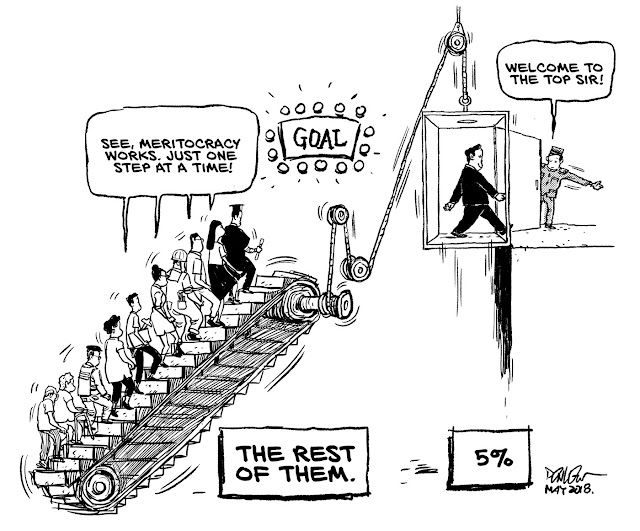
We’re not a meritocracy. Jeff Bezos did not get rich from his own work alone. And the Republicans do not represent hardworking Americans any more than Democrats—both work for the donor class. Money we did not gain by the work of our own hands, which is obtained without any moral consideration, it is meritless wealth. Merit is about qualities such as “good, valuable, or worthy of praise and reward” and, therefore, in a meritocracy we must be concerned with the means with which wealth is obtained. Economic rents and monopolies, transaction fees, political prostitution, usery, luck and inheritance, are all a means of financial gain which do not require productive efforts.
The myth of meritocracy is that all those at the top did something to deserve it. While most certainly did something to gain their wealth, the types who are ruthless and would “sell their own grandma” shouldn’t be praised. Money has no moral value, or at least other than that people tend to compromise for those who will write that fat check. And Capitalism is not meritocracy by default—not when there are so many paths to enormous wealth through means of deception or exploitation. Stepping on others in order to get ahead is depravity, not merit, and a sign of moral bankruptcy rather than being something to be celebrated.