
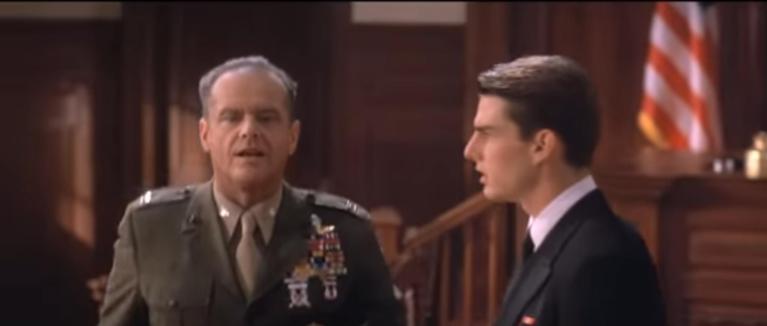
A Few Good Men has memorable lines. The courtroom drama is about a pair of Marines charged in the hazing death of an unpopular recruit. One of the accused refuses to take a plea deal, standing on principle, believing they did nothing wrong—claiming they were just following orders. It all culminates with a verbal battle between the defense lawyer, Lt. Daniel Kaffee (Tom Cruise) and sneering Col. Nathan R. Jessep (Jack Nicholson) the superior officer who was behind a deadly hazing incident. Col Jessup, when finally pressed for the truth, exclaims “You can’t handle the truth!” and then he goes on a diatribe:
Son, we live in a world that has walls, and those walls have to be guarded by men with guns. Who’s gonna do it? You? You, Lt. Weinberg? I have a greater responsibility than you could possibly fathom. You weep for Santiago and you curse the Marines. You have that luxury. You have the luxury of not knowing what I know; that Santiago’s death, while tragic, probably saved lives. And my existence, while grotesque and incomprehensible to you, saves lives. You don’t want the truth because deep down in places you don’t talk about at parties, you want me on that wall. You need me on that wall. We use words like honor, code, loyalty. We use these words as the backbone of a life spent defending something. You use them as a punchline. I have neither the time nor the inclination to explain myself to a man who rises and sleeps under the blanket of the very freedom that I provide, and then questions the manner in which I provide it! I would rather you just said “thank you” and went on your way, Otherwise, I suggest you pick up a weapon and stand a post. Either way, I don’t give a damn what you think you are entitled to!
What is brilliant about this rant is it comes off as what it is: A justification from an arrogant man who sincerely believes that he is stands for good even when he’s clearly in the wrong.
Jessup is not a mustache twirling caricature of a villain. He is someone with moral reasoning that many can relate to or even may side with. He’s arguing that those who put him on the stand are insulated from the truly life and death decisions he must make and should simply accept his role of protector—not question his judgment.
This fictional statement is a variation on the idea “…people sleep peaceably in their beds at night only because rough men stand ready to do violence on their behalf.”
The quote above, often misattributed to George Orwell who actually said this: “Men can only be highly civilized while other men, inevitably less civilized, are there to stand guard and feed them.”
Orwell himself paraphrasing Rudyard Kipling who wrote of the “thin red line” and rebuked the people making a mockery of “uniforms that guard you while you sleep” in his 1890 poem “Tommy” written from the perspective of a British infantryman.
This rejection of pacifism is common. It’s a part of the jingoistic fervor and cult thinking of those who demand we fall into line when our political establishment beats those war drums.
Don’t you know they are protecting you?
We should be grateful, they say, or we would be speaking German, be Communist, or forced to convert to Islam!
We’re now at a stage of preemptive war, which directly violates our U.S. Constitution, claiming it is necessary to “defend freedom and democracy” from the uncivilized.
There’s certainly no end to the violence that these self-assured ‘defenders’ will do on behalf of us—and would do to us to save us from ourselves.
Good Men Must Do Bad Things
This blog is a response to a request:
After reading that piece on dogma, I’m curious. Should you be willing to create a similar criticism of the “sometimes, good men must do bad things” mantra, I’d be very interested in your take.
That quote might be a paraphrase of Suits—a television legal drama—where a character uses this reasoning as their excuse to bend or break rules. The full quote from the series: “Sometimes good guys gotta do bad things to make the bad guys pay.” And the show popular Yellowstone also has a line similar, “Sometimes good men have to do real bad things.”
I don’t know enough about those shows to know if this is intended as ironic. But it has a strong resemblance to the evil is competence and thus good statement by Peter Thiel, the co-founder and board chairman of Palantir.
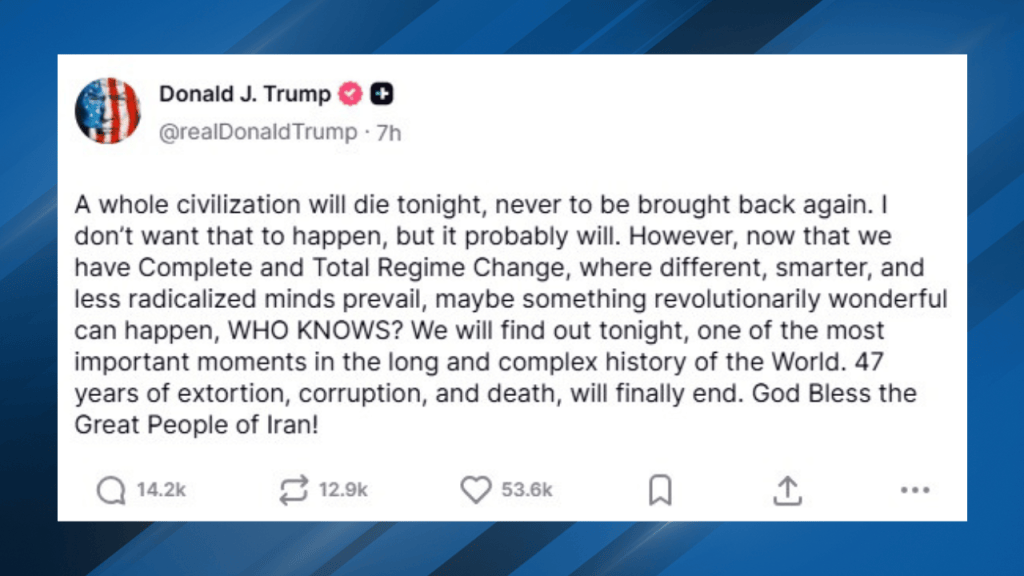
This idea of exemption to do evil for sake of good is something both the far right and left agree on—whether “punch a Nazi” memes by Antifa or it is Trumpanyau saying we may need to nuke Iran to prevent Iran from having nukes. Basically, it is an idea we can be good while we do bad things and yet the other side can never be forgiven.
What this looks like is fundamental attribution error crossbred with moral relativism. I declare someone evil and list off the evil things they’ve done. And then justify things often many times worse in response and it’s all good because I’ve designated them as being evil. Unfortunately, as convenient as this circular thinking is for the dogmatic partisan, it is about as reliable as our ability to accurately assess our own driving skills—where 73% to 93% of people believe that they are an above average driver. We classify our bad as being a result of circumstances and then assess the failure of others as being something inborn or a character flaw.
The moral relativism accompanying this is how we judge an action by who is doing the action rather than apply the same standard to all. From the perspective of the Imperial Japanese, being economically and militarily strangled by the U.S. oil embargo, the attack on Pearl Harbor was a necessary evil. They had a better reason to surprise attack when and where they did than the U.S. has had in wars since then and yet our infamy must be always forgotten. During the Vietnam War the CIA “neutralized” (kidnapped, tortured or killed) tens of thousands who were accused of collaborating with the North—no trials or proof needed. Did you know that?
In 1988, Iran Air Flight 655 was shot down over the Persian Gulf, killing all 290 souls, by a U.S. Navy destroyer. The crew and commanding officer of that ship got medals. In the 1991 Gulf War the U.S. killed 408 Iraqi civilians in a single strike against the Amiriyah shelter—which we knew was being used by civilians during the Iran-Iraq War. And even after the bombs stopped dropping the brutal economic sanctions killed hundreds of thousands of Iraqis. The Vietnamese people, even to this day, suffer unusually high rates of rare birth defects due to the widespread use of Agent Orange and other chemical defoliant decades ago—to just dismiss this all as ‘collateral damage’ is not very pro-life.

It is just so strange to see the same people who justify total obliteration of two cities in Japan being so upset when U.S. economic and military interests are targeted by those who have been subjected to far worse.
The point being, people always come up with justifications for their own evil. Even the total psychopath can often defend heinous acts with a moral reasoning: “He looked at me wrong so—acting 100% in self-defense—I bashed his face in with a hammer.” If we name a date, and ignore the context of all that happened prior, we can claim we’re fighting for justice—when, in reality, the other side has as much justification as we do or more.
It’s a world where all violent people believe they are the good guy forced to do bad things.
Tired Analogies and Immoral Math
On a religious forum, mostly pacifists, there was always a ‘sheepdog’ guy or that one person who self-designated themselves as a protector of the herd.
You see, he was not an unsuspecting sheep like everyone else.
No, not at all!
He was an exception, the ever protective guard of decency and goodness—who only every so often took an accidental bite out of a sheep.
What’s interesting is you’ll never find a sheepdog metaphor anywhere in Biblical texts, it is simply something invented, a cover story. What you do find is a division between sheep and goats. The goats are those unruly, stubborn or independent animals—used in Scripture as a metaphor for the cruel and exploitative leaders or those who bully the sheep. They will be sorted out of the faithful flock at the final judgment.
And the other animal mentioned?
The wolf in sheep’s skin.
These are actual predators who wrap themselves up in an innocent appearance—to divide and devour the sheep. It sounds a bit like those sheepdogs, right?
In my own experience this sheepdog schtick was often just an excuse for their aggression against voices defying their self-asserted authority in all things. Nobody had elected them to the role. It was all their own personal judgement.
Unfortunately, few seem able to see through the phony knights in shining armor—who turn rivals into a dragon to slay rather than an equal to treat with the respect they demand for themselves.
The real issue is when we make exceptions for ourselves that we don’t accept if turned on us. For example, collateral damage. We say that the death of innocents is simply a part of war and unavoidable. But if it were our own child burned alive would we be okay with it—as just a part of war?
True morality values all people and their rights like our own. It never justifies killing of innocents or the treatment of some lives as expendable.
Good people do good to all people and not only a chosen few.
All lives matter or none do.
If you make exceptions for yourself to violate the rule eventually it boomerangs back—those who live by the sword die by the sword.
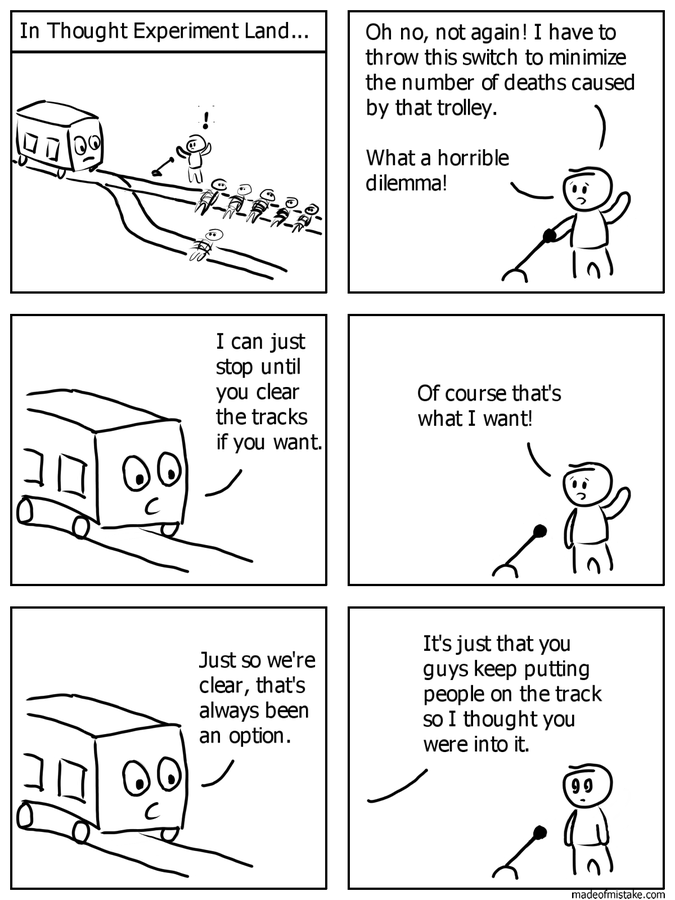
Using the ends to justify the means, playing God with Trolley problem math, choosing which lives matter—rather than treat all people with dignity and respect—is a moral logic 100% anti-Christ.
Jesus, in his response to the condemning attitude of the Pharisees against sinners, told the Parable of the Lost Sheep. In the story he reasoned that a good shepherd leaves their ninety-nine sheep to find the one lost. In his morality saving 99% was not good enough. And, like Abraham, he was not okay with close enough or even one person being harmed when it could be avoided.
If one sinner isn’t expendable in the eyes of God—then what is the worth of an innocent child’s life?
When you’re okay with killing one person for the sake of some imaginary “greater good” you’ll justify a million. That is the genocidal math, the cold calculation behind nearly all industrial scale mass murder campaigns—trying to kill their way to peace. They claim it is a binary choice, either us or them, save more lives by switching the track and killing one instead.
This is the kind of justification or rationalization that allowed men like Stalin, Hitler, Mao, Pol Pot, Truman and Netanyahu today. One might be completely fine with the slaughter of innocents when they’re ideologically aligned with those who are doing the killing, yet agreement doesn’t make it any less evil—and silence is to be complicit in the murder.
You’re Not Exceptional…
So maybe one suffers from main character syndrome, their own grandiosity delusions and narcissism—they understand good and evil only in terms of what serves them as an individual or a tribal identity group? Or they just think they have a special clarity of mind to make “hard decisions” on who should be sacrificed or saved? But this arrogance will only lead to hell. Those who claim to do evil for goodness sake are almost always just doing evil—dressing it up in the language of necessity so they never have to look in the mirror and be honest with themselves.

Col. Jessep, while violating military ethics and the law, positioned himself as being a protector of civilization. Likewise many in the world make excuses for their own lack of civility—the “they started it” or “ist” labeling exemptions. The whole “violence is the only language they understand” rationale by those whom themselves only seem to be restrained from by force.
Every accusation is a confession?
The difference is semantics—not substance. The worst offenders believe the sanitized descriptions of their own brutality and atrocities they commit makes them less a “terrorist” than those whom they hate—yet this righteous veneer is stripped away under cross-examination. It is only in their own mind they’re special.
Woe to those who call evil good and good evil, who put darkness for light and light for darkness, who put bitter for sweet and sweet for bitter. Woe to those who are wise in their own eyes and clever in their own sight.
Isaiah 5:20-21 NIV
You can’t be good while you are doing evil—good is what it continually does. Certainly we all fall short. We all have bad days and make mistakes. A good person is one who is able to admit wrong doing rather than try to whitewash evil. Giving exemptions for some and harsh penalties for others is just favoritism and a sin. There is one standard for all people and that is to love others (our neighbors) as ourselves. When you start to defend “your people” rather than humanity it leads to a breakdown of morality and ethics that only creates more conflict. The double standard is to make exceptions for evil and a good person does not.
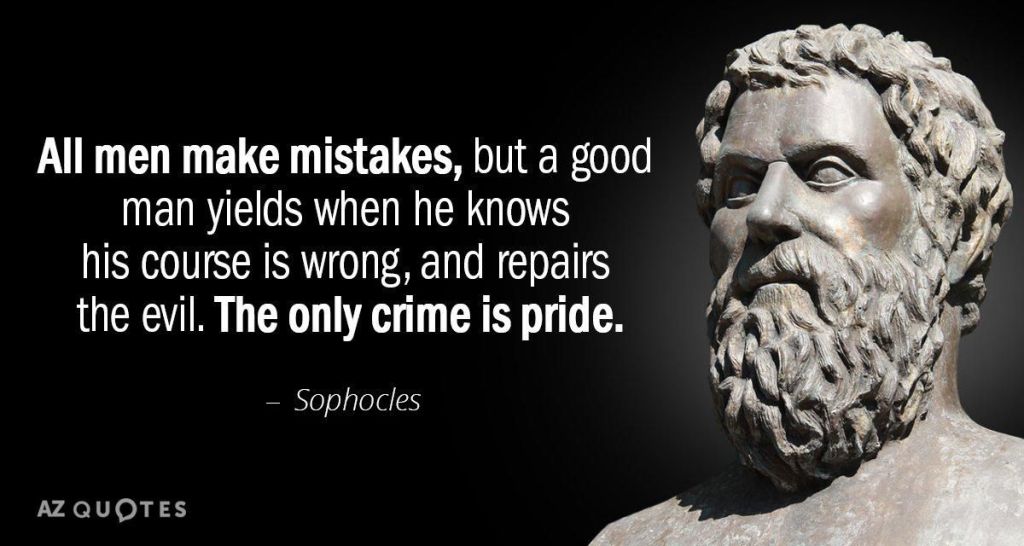
Good morality starts with an idea that we all stand in front of a neutral judge. It applies a consistent standard for all people.
Good morality doesn’t ask who is pulling the trigger—it asks whether a trigger should be pulled at all.
True integrity means abandoning self-serving or tribal math which values our rights more than theirs. It means accepting that we are not the exception to the rule—and abiding by universal moral principle. Until we drop the self-righteous rationalizations of our own violations and submit ourselves to a single, impartial standard of love and justice, we will remain trapped in an endless cycle of violence of our own making—and prove to the rest of the world that we are precisely what we have accused our enemies of being: Lawless, agents of chaos, and just plain evil no matter how we dressed it.
Nobody thinks they’re evil. No they’re just a good person forced to do bad things. They are victims of circumstances, compelled by the evil of others to neglect common moral decency and do bad things. They may even claim to be on the wall guarding civilization from itself, but the truth is they represent an erosion of morality more than the foreigner beyond they say we should fear: They’re the barbarians and savages! But those who do evil for goodness sake are worse than the uncivilized who do bad in ignorance.
A person who knows what is right and exempts themselves is evil. If you’re good, then you will do good for goodness sake—without exception.

