Unmerited Wealth, Righteous Losers

Standard

Most long for a world that conforms to their own idea of fairness and justice.  Shouldn’t a person get what they deserve?  And in the Bible there is a concept of reaping what we sow.  Call it karma.  Cause and effect.  The urge to explain the misfortune of others as their fault or our own fortune as the proof of our righteousness.  We feel punished when things don’t work out—and vindicated when they do.  But what if there is more randomness to outcomes than we imagine?

While the law of sowing and reaping should be applied—where hard work and the fruits of harvest are related—this understanding should also be counterbalanced.  Some get wealth by reaping what they did not sow as an inheritance or through theft.  Those who assign positive moral value to wealth miss this entirely.  This often becomes a excuse for lack of charity or even reason to further disenfranchise the disenfranchised.  Look at the caste system in Hindu India and “health and wealth” preaching of the false Prosperity Gospel.

Faces of those who got rich through exploitation

I’ve seen this in response to the flooding in Nepal, posts by suggesting that it is some kind of Divine punishment for the majority Hindu nation for persecution of Christians, which is strange given that victims are from multiple countries.  Funny how we never got that kind of interpretation of the destruction in Asheville and Swannanoa Valleys due to the rains from hurricane Helene.  We should probably work out some of these details of this before we assume anything, right?

Do good things happen to good people—bad things to bad?  

Is our good or bad fortune a matter of our deserving and merit?

Sometimes there are consequences for our actions—like when an algae bloom caused by your merciless bombing of a neighbor is now threatening your own water supply.  Yet the mistake is believing that every bad thing other people suffer is sowing and reaping—cause and effect.  Some reap what they did not sow, they have meritless wealth and the prosperity built from exploitation.  

First let’s take a look at what we can learn about the suffering of righteous people in Scripture—and then move on to the myth of meritocracy in American culture.

The Righteous Loser

There is something else meaningless that occurs on earth: the righteous who get what the wicked deserve, and the wicked who get what the righteous deserve. This too, I say, is meaningless.

(Ecclesiastes 8:14 NIV)

The above credited to Solomon, a wise king, who understood the good guys don’t always win.  He reverses the expected order, denies karma, and he tells us that indeed many bad things happen to good people and from our perspective evil wins.  

This same sentiment is captured elsewhere in Scripture, the apparent success of the wicked which nearly caused the faithful to stumble. In Psalms 73:2-12, the psalmist admits, “my feet had almost slipped; I had nearly lost my foothold. For I envied the arrogant when I saw the prosperity of the wicked.” He describes how “They have no struggles; their bodies are healthy and strong” and remain “free from common human burdens,” while saying “pride is their necklace; they clothe themselves with violence.” From callous hearts they scoff and speak with malice, even claiming, “How would God know? Does the Most High know anything?”—all while they stay “always free of care” and “go on amassing wealth.” Such observations highlight the tension between the alarming prosperity of wicked and our belief that all people should get what they deserve.  The world doesn’t work according to our moral logic or narratives.

And it’s not only the wisdom of the Psalms or Solomon, but something Jesus had tried to explain to a prejudice crowd:

As he went along, he saw a man blind from birth.  His disciples asked him, “Rabbi, who sinned, this man or his parents, that he was born blind?” “Neither this man nor his parents sinned,” said Jesus, “but this happened so that the works of God might be displayed in him.

(John 9:1-3 NIV)

The disciples anticipated a link between a man’s blindness and sin.  However, Jesus answered with “none of the above” before healing the man.  This is clearly refutation of the idea that sin causes misfortune.  It has nothing to do with the righteousness or unrighteousness of the sufferer.  Even the most devoted assumed people simply got what they deserved.  Jesus corrected their errant belief and presented blindness from birth as an opportunity to show God’s glory.  Physical defect is not a punishment for sin, nor is poverty or misfortune, evil men are sometimes rich and powerful—it is only our spiritual blindness that makes us see great wealth or good health as a direct reward for virtue.  Jesus did not.

Here’s another case of Jesus addressing an unfortunate circumstance:

Now there were some present at that time who told Jesus about the Galileans whose blood Pilate had mixed with their sacrifices. Jesus answered, “Do you think that these Galileans were worse sinners than all the other Galileans because they suffered this way? I tell you, no!  But unless you repent, you too will all perish. Or those eighteen who died when the tower in Siloam fell on them—do you think they were more guilty than all the others living in Jerusalem?  I tell you, no! But unless you repent, you too will all perish.”

(Luke 13:1-5 NIV)

We all ask questions after tragedy.  Why do some get swept away in the flood waters—while others escape without injury?  These are questions we all must grapple with and one answer is to blame the victims.  Jesus is citing two recent events for his audience.  The euphemism about mixing of blood with sacrifices refers to the pilgrims from Galilee killed by Roman soldiers while at the temple atoning for sin.  The tower in Siloam tragedy was, by contrast, was an engineering failure or natural disaster rather than deliberate.  In both cases Jesus dismisses the idea that it is a form of retributive justice—and instead he gives a reminder that we all die.

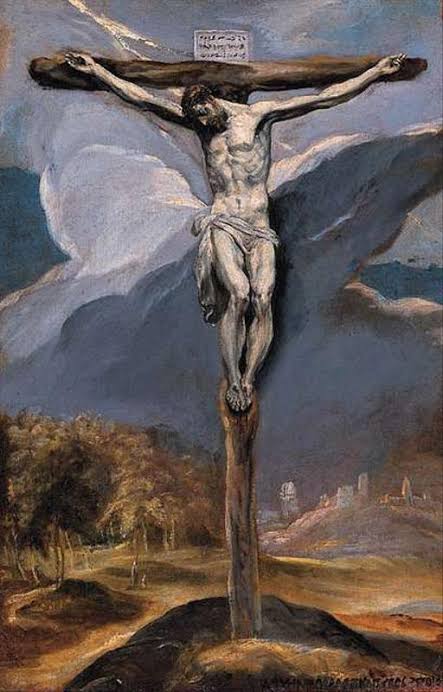
The whole Gospel narrative depends on an idea that even the good people suffer (and oftentimes more for being good) because it is exactly what happened to Jesus.  If only good things can ever happen to righteous people then explain the suffering and death of the Christian example.  And this is not a new teaching of the Gospel, there’s a whole book named Job about a man who had one calamity after another because of—and not in spite of—his righteousness.  Job’s friends were rebuked, by God, for trying to fault with him.  They made the same mistake many in the time of Jesus made and assigned moral weight to misfortune.  This idea contradicts the core of the Gospel showing the ultimate example of the righteous man is one who is willing to suffer for the sins of others.

The way of the cross is hated by those who crave worldly power.

The reason why we prefer to blame victims is because it removes our responsibility to care.  We can simply say they got what they deserved and move on.  But that’s the same attitude of Cain—who murdered his brother and then when confronted by God says “Am I my brother’s keeper?”  The example Jesus gave is a polar opposite: Saving those who are completely undeserving—taking the loss on himself rather than demand that people suffer for their sins.  A Christian should only see disaster as an opportunity to help those in need—to show gratitude for grace of God towards us—never as cause for speculation about their hidden sins.  

Myth of American Meritocracy 

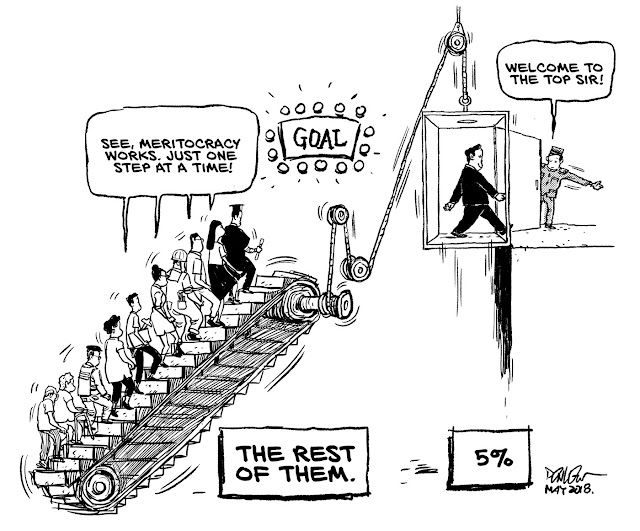
The idea that great wealth is a reward for virtue is a pillar of American conservative politics.  This naturally accompanies that notion that people get the suffering which they deserve and is a cornerstone a current economic system we call Capitalism.  The myth of meritocracy is that those at the top gaining their riches through their hard work or wise investments rather than via shady business or exploitation.  If you work hard you’ll do well—that’s a foundational premise of our economic system.

And it is true, having a good work ethic and investing well are keys to success.  Making excuses rather than finding a way will keep you in poverty for life.  However, many do the right things and fail.  While others, born into the wrong circumstances, never have a real opportunity despite trying.  And some people simply lack ability.  Real life—beyond those ideological or theoretical constructs—defies pat answers.  Some are successful only because of the investment of others in them—they were born with a silver spoon in their mouth—others did everything they can do and can’t escape their constraints.

I’ve gone at length taking on the Democrat’s divisive identity politics and their creation of dependency-for-votes strategy—keeping the poor coming back for more while only ever delivering crumbs.  But the Republican myth of American meritocracy isn’t much better—it is an extension of a televangelists “health and wealth” message or: Donate to me and you’ll be blessed sevenfold!”  They basically get rich by gaming the system, while we pay their bills and then get blamed for our own lack of ability to get ahead financially due to inflation their policies created.

The idea that all wealth is deserved or equal to virtue is wrong.  Money can be gained by many different means, some of them good—some bad.  A decent person creates value with their own work and trades this for what others have produced.  The laborer, the one who is doing the actual work, deserves their wages.  And yet there are many less analog ways exist to gain wealth that don’t involve the sweat of your brow.  Yes, it might all be legal, but gain through a promotion of vice or through exploitation of human weakness is not the same as honest work.

There are many unethical and unscrupulous ways to get rich.  And many who are on the ‘Capitalist’ or ‘conservative’ side seem to be fine with this brutal finders-keepers-losers-weapers death race.  This social darwinism that rewards taking legal loopholes or every deceptive scheme possible, might be called free market but is a predatory system which favors the ruthless rather than those with a conscience.  Money through vice can come quicker because it is a mere transfer and is not produced by an individual but obtained through trickery and exploitation.  Vice and usery, political prostitution, are all examples of unmerited gain even if legal.
Cleverness isn’t a virtue.

We’re not a meritocracy.  Jeff Bezos did not get rich from his own work alone.  And the Republicans do not represent hardworking Americans any more than Democrats—both work for the donor class.  Money we did not gain by the work of our own hands, which is obtained without any moral consideration, it is meritless wealth.  Merit is about qualities such as “good, valuable, or worthy of praise and reward” and, therefore, in a meritocracy we must be concerned with the means with which wealth is obtained.  Economic rents and monopolies, transaction fees, political prostitution, usery, luck and inheritance, are all a means of financial gain which do not require productive efforts.  

The myth of meritocracy is that all those at the top did something to deserve it.  While most certainly did something to gain their wealth, the types who are ruthless and would “sell their own grandma” shouldn’t be praised.  Money has no moral value, or at least other than that people tend to compromise for those who will write that fat check.  And Capitalism is not meritocracy by default—not when there are so many paths to enormous wealth through means of deception or exploitation.  Stepping on others in order to get ahead is depravity, not merit, and a sign of moral bankruptcy rather than being something to be celebrated. 

Gothard: Messenger or Manipulator?

Standard

I was walking across the mall with no time to waste.  Up ahead was one of those Dead Sea salt kiosks staffed by Israelis trained to intercept passing Gentiles. 

My intentions were to stride on by, keep my eyes focused ahead and totally avoid the high pressure sales tactics that make men of less mental fortitude into suckers.  I am not a sucker.

But as I passed I failed.  She spoke sweetly with an irresistible accent.  I was too nice to not answer a friendly greeting.  Sales people are human after all.  I let a reply slip.  “Thank you,” I said, “but, I’m in a hurry…” 

She was ready with an answer before I had even opened my mouth, my forward progress had somehow stopped, and she was rubbing lotion on my hand before I could think to protest.  My higher cognitive functions suddenly neutralized by the sensory input filling that primal need of physical touch.

I still was determined to resist.  I refused to make a purchase.  I am a consummate saver, a responsible spender, only buy things I need, and have no need of lotion, deep cleansers or any of that overpriced slime.  And, no, not for my mother, nor my sister, and what girlfriend, right?

“You’re really good at your job.”  I said, as I as I paid penance to the wiles of a soothing seductress, and contemplated male stupidity, and wondered what I would do with all the clutter she left in my hands, as if I had an obligation to spare her embarrassment of failure to sell. 

She never gave me the satisfaction of being right about her insincerity. 

What is manipulation?

To manipulate is to bend, form or move something and make it conform to your will.  We use a hammer as a persuasion device to manipulate steel or to pound a nail into a block of wood.  We try to manipulate our environment to make it more suitable to our own desired ends.

There are also people who manipulate other people, like my temporary friend at the mall kiosk, and try to control people through false means or fear.  This goes beyond simple persuasion.  Psychological manipulation, according to Wikipedia,“is a type of social influence that aims to change the perception or behavior of others through underhanded, deceptive, or abusive tactics.”

In the political sphere there is fear-mongering, demagoguery and pandering as manipulative tactics.  The manipulator plays on the emotions of the target audience.  He set himself up as an authority or in the know and trustworthy.  She poses as a concerned friend, a common person standing up against the bad people, or a heroic altruist.  But beneath the rhetoric is often a cynical calculated effort to buy votes and control people.

This is also an unfortunate aspect of religion.  Jesus warned of those who “tie up heavy, cumbersome loads and put them on other people’s shoulders,” and yet, “they themselves are not willing to lift a finger to move them.” (Matthew 23) These people, he goes on to say, are “hypocrites,” who “strain out a gnat but swallow a camel.”  He’s speaking of the religious experts, the “teachers of the law” and Pharisees.

The Pharisees were outwardly righteous, they followed many rules trying to please God, they would continually ask, “what must I do to inherit eternal life?”  But, despite their “diligent” study of the Scripture, we are told, “the Father who sent me has himself testified concerning me. You have never heard his voice nor seen his form, nor does his word dwell in you, for you do not believe the one he sent.” (John 5)  They missed the answer standing literally (literally) in front of them.

They were deceived, self-decieved, and destroyed the very people they ‘won’ over by their dedicated missional efforts, making them “twice as much a child of hell” as they are according to Matthew’s account.  They posed as gate keepers to the “kingdom of heaven” and, unfortunately, did not enter themselves.  They are “blind guides” who neglected more important matters of actual spiritual weight.  These were men full of themselves and not the Spirit of God. 

Who is Bill Gothard?

Bill Gothard, PhD is a teacher popular in some Biblical fundamentalist communities.  He is known for his seminars which give “principles” loosely based on the Bible.  He is an elderly man now, he was never married (although he does give marriage and child rearing advice) and founder of Institute in Basic Life Principles.  He recently resigned from his organization amid sexual harassment allegations.

image

(Read the “about me” on his website: http://billgothard.com/about )

I was asked for my thoughts about Gothard after my last blog post.  I had made a passing mention of him as one who rationalizes sexual abuse as a product of female immodesty or rebellion (kind of like earthquakes in Nepal) and I was also criticized for jumping on the bandwagon against him.  The link I provided was written from a “victim’s perspective” and apparently (in the critic’s opinion) the only right response for those who suffer abuse is forgiveness.

Well, I am not a victim of Mr. Gothard.  I have never met him in person.  I will leave it for God and others to judge Gothard’s personal life.  But, as one committed to “rightly dividing the word of truth,” (2 Timothy 2:15) I feel I must examine his teachings against Scripture.  I am familiar with his teachings. My church has hosted his seminars. I have had questions about his ideas and long before the Duggar family sexual molestation controversy put Gothard’s Advanced Training Institute in the spotlight.

My primary concern in this essay is with Gothard’s Scriptural hermeneutic and his theology, not his person.  There is some obvious overlap between the influence of his teachings, his behavior as a person and what he believes.  However, I prefer to stick as much to what is verifiable.  I do, as always, recommend looking for yourself rather than just take my word for it.  So I will give my perspective as an invitation to study for yourself and find the truth.

Gothard‘s teaching manipulates Scripture.

There are many different perspectives on Scripture and many opportunities to be wrong about what the Bible says.  I’ve made my share of mistakes when it comes to correctly understanding written texts.  I cannot fault a person for an occasional error in their interpretation and application of the Bible.  The Bible is a complex book and difficult to understand according to what is written in it:

“Bear in mind that our Lord’s patience means salvation, just as our dear brother Paul also wrote you with the wisdom that God gave him. He writes the same way in all his letters, speaking in them of these matters. His letters contain some things that are hard to understand, which ignorant and unstable people distort, as they do the other Scriptures, to their own destruction.“ (2 Peter 3:15-16 NIV)

Gothard’s teaching goes beyond just a simple misinterpretation of Scripture.  He makes fundamental and systematic errors in his Biblical exegesis.  He reads his own presuppositions into the text of the Bible and in ways that go directly against the actual explanations supplied within the text itself.  His understanding of Scripture seems to revolve around his own established ‘principles’ rather than go the other way around.  He neglects important concepts of faith while emphasizing his own prescriptions at the expense of whole truth.

This is not a perspective of Gothard’s work unique to me.  In a paper, “Issues of Concern—Bill Gothard and the Bible: A Report,” published May 30, 1984, Ronald B. Allen, ThD expressed the following evaluation:

“Gothard’s approach is not that of the careful exegete who wishes to determine the meaning of the text, but of the engineer who wishes to use the material in his own programmatic approach which is mechanical and not personal, mechanistic and not dynamic. Gothard does not really teach the Scripture; he really uses the Scripture to fit into his own categories.”

Gothard seemingly throws out the baby (what the Bible explains) to keep the bathwater of his own preconceived notions and prescriptive formulas.  His analysis of the book of Job is a glaring example of his editorial manipulation of a text.  Gothard actually comes out on the side of those who are rebuked by God for their false attribution of reasons for Job’s suffering, as Allen explains:

“The clear teaching of the Book of Job is that a mechanistic, cause-and-effect, approach to life may be way off base! Is it any wonder that Gothard tries to evade the clear teaching of the Bible that Job was a righteous man (the only reading on which the book works!), and finds many sins and character flaws in him (overwork in Christian causes, neglect of his family, embittered sons, estranged from family, wrong attitudes toward the workers). In this way the book is turned inside out and by this strange alchemy Job supports Gothard’s lists.“

There is nothing in the Biblical text to suggest Job brought his suffering upon himself for something wrong he did.  In fact it was the righteousness of Job that was the theme of the book. At the end of the book God vindicated Job and rebuked his persecuting comforters:

“After the Lord had said these things to Job, he said to Eliphaz the Temanite, “I am angry with you and your two friends, because you have not spoken the truth about me, as my servant Job has… My servant Job will pray for you, and I will accept his prayer and not deal with you according to your folly. You have not spoken the truth about me, as my servant Job has.”  (Job 42:7-8)

Gothard is repeating the folly of Job’s falsely accusing friends and does so despite having the end of the book where God sets them straight.  So, why would Gothard take the Job story and turn it upside down?  Well, perhaps it is because he over-applies an idea of sowing and reaping (or cause and effect) to every circumstance?  It becomes quite evident in Gothard’s teaching that every bad thing that happens to a person is a result of their own sin.

This erroneous idea is nothing new or unique to Job’s friends or Bill Gothard, the disciples of Jesus made the same mistake when they encountered a blind man in this Biblical account:

“As he went along, he saw a man blind from birth. His disciples asked him, “Rabbi, who sinned, this man or his parents, that he was born blind?”  “Neither this man nor his parents sinned,” said Jesus, “but this happened so that the works of God might be displayed in him.”  (John 9:1-3)

Sometimes bad things are the result of nobody’s sin.  Jesus made a similar point as why we should show grace to all people when he reminded that God“causes his sun to rise on the evil and the good, and sends rain on the righteous and the unrighteous.”  (Matthew 5:45)  In other words, sometimes (or even most times) a rainstorm is just a rainstorm and not judgment or a reward for behavior from God.  Not every good thing that happens to a person is a reward, not every bad thing that happens is a punishment.

Gothard’s teaching manipulates people.

One of the responses to my last blog came from a woman molested by her own father at age nine.  She did not invite that upon herself by something she did.  Sexual abuse victims often feel a sense of guilt or shame and need to be freed from that to be able to move on.  But, if she goes to Gothard, this may be the tenor of the advice she gets:

image

Note the fourth point, “Why did God let it happen?”  In that there is “Result of defrauding by” and that followed by a list of four subpoints: Immodest dress; Indecent exposure; Being out from the protection of our parents; Being with evil friends?

I spoke at greater length about what the Bible actually says about modesty in my last post and there is absolutely nothing in the Bible that says sexual molestation or rape is a result of female immodesty.  That woman molested at nine years old did not dress to draw her own father’s attention, she was in her own home, she was molested by a parent and, again, in her own home!  So that is quite the exception to the logic of “defrauding” laid out by Gothard’s counseling literature.  There should be a big exception clause at very least.

But Gothardism doesn’t allow for exceptions to his own rules.  In Gothard’s view, as with his mistreatment of Job’s suffering as somehow self-inflicted, if a young woman is raped then she must’ve done something to deserve it.  In his “character sketches” he twists the Biblical account of Dinah by attributing wrongful attitudes to her that cannot be found anywhere in the text.  Gothard makes Dinah out to be a rebellious daughter and thus responsible for what happened to her.  Then he turns the opposite direction and is critical of Tamar for actually obeying her father’s request.  Gothard’s logic is self-contradictory and contradicts the Bible.  Worse, it shames sexual assault victims by implicating them and it adds a weight of guilt undeserved.

The Bible doesn’t support the false dichotomies and overly simplistic principles of Gothard’s teachings.  But, rather than admit his thinking is flawed and repent, Gothard attempts to manipulate the Bible to fit his own preconceived ideas.  That is to elevate his own opinions above the very explanations given in Scripture.  Gothard manipulates Biblical evidence in the same way Satan twisted God’s words to deceive Eve and in the same way Satan later misused Scripture to tempt Jesus.

Gothardism attempts to manipulate God

It also appears Gothard thinks of God like a vending machine: You insert devotion to a list of basic principles, you turn a few levers, pull a few knobs and out pops a blessing.  This is a mechanical view of God.  Another blogger critiquing Gothard put it this way:

“Perhaps the most disturbing aspect of Gothard’s heterodoxy is what it does to God. Not only does God plays little or no part in a believer’s life through omission, but Gothard actually teaches that God’s grace is bound to the limitations of our own abilities. It is not simply that God helps those who help themselves, but that God will not and cannot help anyone who is not already practicing the right principles.”

It is an underestimate of God that essentially makes us our own savior and that is antithetical to the Gospel of Jesus Christ.  Sure, I see many good things in what Gothard teaches, his textbook contains many interesting anecdotes and observations about human nature, but it is missing something.  It reminds me of when Jesus said to the Pharisees, “go and learn what this means: ‘I desire mercy, not sacrifice.’” (Matthew 9:13)

The quote Jesus used was from the sixth chapter of the book of Hosea.  At the time there was a complex ritual of sacrificial devotion to God and in that chapter the people, treating God like a vending machine, give a superficial repentance.   But God is not impressed.  God answers with “I desire mercy, not sacrifice” and doesn’t accept their religious devotion.

Gothard seems intent on trying to please God by his devotion to a set of life principles.  Unfortunately, in that he seems to have gotten off track and is so concerned about tithing spices of his own system that he neglects the weightier matters of spiritual life (Matthew 23) and that being genuine relationship with God.  God is not a machine.  Faith is not mere religious devotion to a set of principles.

What is missing from Gothard’s teaching?

Grace is the wild card in a black and white world of determinism’s cause-and-effect dictates.  The Gospel without grace is like a car without wheels.  Over and over again in the critique of Gothard’s work is mention of a lack of his proper understanding of grace.  Yes, there is mention of grace in Gothard’s work, but there seems to be a difference between what he means by grace and what is spelled out in Scripture.  Grace is not a mechanical process of our careful application of correct principles, it is a mysterious paradox of God’s love:

“But because of his great love for us, God, who is rich in mercy, made us alive with Christ even when we were dead in transgressions—it is by grace you have been saved. And God raised us up with Christ and seated us with him in the heavenly realms in Christ Jesus, in order that in the coming ages he might show the incomparable riches of his grace, expressed in his kindness to us in Christ Jesus. For it is by grace you have been saved, through faith—and this is not from yourselves, it is the gift of God—not by works, so that no one can boast. For we are God’s handiwork, created in Christ Jesus to do good works, which God prepared in advance for us to do.”  (Ephesians 2:4-10)

This is the work of religion…

“Do not let anyone who delights in false humility and the worship of angels disqualify you.  Such a person also goes into great detail about what they have seen; they are puffed up with idle notions by their unspiritual mind.  They have lost connection with the head, from whom the whole body, supported and held together by its ligaments and sinews, grows as God causes it to grow.  Since you died with Christ to the elemental spiritual forces of this world, why, as though you still belonged to the world, do you submit to its rules: “Do not handle! Do not taste! Do not touch!”? These rules, which have to do with things that are all destined to perish with use, are based on merely human commands and teachings. Such regulations indeed have an appearance of wisdom, with their self-imposed worship, their false humility and their harsh treatment of the body, but they lack any value in restraining sensual indulgence.“  (Colosians 2:18-20)

This is the work of faith…

“What good is it, my brothers and sisters, if someone claims to have faith but has no deeds?  Can such faith save them? Suppose a brother or a sister is without clothes and daily food.  If one of you says to them, “Go in peace; keep warm and well fed,” but does nothing about their physical needs, what good is it?  In the same way, faith by itself, if it is not accompanied by action, is dead.  But someone will say, “You have faith; I have deeds.” Show me your faith without deeds, and I will show you my faith by my deeds. You believe that there is one God. Good!  Even the demons believe that—and shudder.  You foolish person, do you want evidence that faith without deeds is useless?”  (James 2:14-20)

Christianity, authentic Christian faith, is about love and not manipulation.  Jesus told his disciples:

“A new command I give you: Love one another. As I have loved you, so you must love one another.  By this everyone will know that you are my disciples, if you love one another.”  (John 13:34-35)

Is Gothard a false teacher?

I wish matters like this were as simple as the Dead Sea salt kiosk where it was quite obvious I was being manipulated.  My initial reaction is that Bill Gothard is a false teacher.  It is not because he does not have some good insights or points either.  I was reminded of the time when Jesus rebuked Peter, saying “get behind me, Satan!” (Matthew 16:23)  Peter went on to be a powerful example of God’s grace.

I worry about the tendency of fundamentalist’s to ‘circle the wagons’ when it comes to someone who claims to uphold ‘Biblical principles’ and conservative values.  The same people who repost scary internet memes about “Charlie Charlie” will welcome a man like Gothard into their church or home without stopping to consider that he could be a false teacher and potential traitor to the Gospel.

“For the traitor appears not a traitor; he speaks in accents familiar to his victims, and he wears their face and their arguments, he appeals to the baseness that lies deep in the hearts of all men.”

That above is part of the warning Marcus Tullius Cicero gave in Roman times.  He was speaking about threats to nations or governments from within them, but his words could also easily apply to the church today.  We need to be aware of the enemy within the gates.  Satan was described as subtle, are we looking for the subtle deception or only the obvious threat?

As far as Gothard, I have stepped back from my initial reaction.  I am content to let God judge him and his teachings.  However, for myself I will go to another source of authority rather than him, I believe there is a primary source greater than even the best of commentators and it is that wisdom I seek.  For you who teach, I leave this:

“Not many of you should become teachers, my fellow believers, because you know that we who teach will be judged more strictly.”  (James 3:1)

Be careful teachers what you teach!