“Whether by word of mouth or by letter…”

Standard

The US Constitution is a prime example of how the same words can be interpreted in many different ways. Sometimes this is just a way to get around the clear meaning and other times it is simply a problem with language. There are many cases, with this founding document of a nation, that it would be nice if we could have some further explanation. Sure, you can read some of what the writers and signers said elsewhere in order to try to fill in the blanks. But, in the end, without them here, we don’t truly know how they would respond to the demands of our modern economy, technology, and needs.

This only gets murkier when dealing with Scriptures written two millennia ago. Yes, every Bible-thumper and their brother thinks they have a clear understanding while everyone else is just making things more difficult than they really should be. I mean, “The Bible Says It, I Believe It, That Settles It,” right? And yet, if I were to answer that with, “do you bury your poo outside of your property, in a hole you dug with a trowel, as instructed in Deuteronomy?” I’m guessing that suddenly what the Bible says would become a bit less settled as those using this phrase made some sort of theological exemption and that’s okay, there are things in Scripture that aren’t perfectly clear without some further explanation.

But what is more intriguing to me is what is completely left out that would be so obvious to early Christians that it wouldn’t even be worth mentioning in the letters. As the saying goes, more is caught than taught, and sometimes the most important things never do get written out. In other words, if we were writing instructions on how to drive a car, we would probably assume that the person knows how to get into the vehicle or sit facing forward. However, from the Bible, do we know how the early church structured their services or generally lived? Would they even recognize us as Christians? The reality is that there are gaps that many today just fill in with assumptions and it is usually these different extra-Biblical assumptions that lead to many divisions.

In the Protestant world “extra-Biblical” is practically a curse word. How dare you ever have a rule, custom, or tradition that goes beyond the written text! That’s false religion or something! This is why Orthodoxy is often dismissed by those seeking to strip down Christianity to the Biblical bare bones. It is a special kind of ignorance.

A good illustration? In World War II there was a study of returning aircraft and the damage that they had to determine how to better prevent future losses. The Center for Naval Analyses concluded from this that the aircraft needed more protection in these most heavily damaged areas. However, Abraham Wald, a Hungarian mathematician, begged to differ. He reasoned that the aircraft returning had survived and those that had been hit in more critical areas did not. In other words, what needed to be done was the very opposite of what the others had concluded. They needed to better armor those areas that weren’t damaged in the returning aircraft. This tendency to misinterpret evidence, based on what we have rather than what is missing, is called “survivorship bias” and can lead to woefully incorrect ideas.

This is what the Bible says about what is written versus what is not:

So then, brothers and sisters, stand firm and hold fast to the teachings we passed on to you, whether by word of mouth or by letter.

(2 Thessalonians 2 NIV)

The “letter” is what we have received in Scripture. These are the books of the Bible, canonized by the Church and believed to be truly inspired writing for this reason. But the “word of mouth” is where things are more interesting. What of the Apostle’s teaching (or tradition according to the KJV) is not written in their letters and how do we know what is missing?

The Orthodox, of course, say that this is the tradition of the Church and tie their legitimacy to the fact that there is a line of secession going all the way back to the Apostles, by the laying of hands and ordinations, and this only makes sense. The Church (note, not an individual or even the institutions) is what keeps the spoken teachings of the Apostles preserved like it did the Bible, and also serves to provide the correct understanding of Scripture. Because we should know, as Peter warned, that the Bible does not provide its own interpretation: “[Paul’s] letters contain some things that are hard to understand, which ignorant and unstable people distort, as they do the other Scriptures, to their own destruction.” (2 Peter 3:16 NIV)

However, it isn’t just the non-Orthodox that fall victim to their own bias. There are parts of the Church tradition, whether spoken or written, that slip through the cracks. We all have blind spots. We all have our distortions of concepts and errant assumptions. The difference is, that the Orthodox, if they are truly seeking to be Orthodox, are at least making some effort to incorporate the sayings of the Fathers and have a grasp of those “word of mouth” traditions not necessarily ever expressed in Scripture. In doing this, in understanding how Christianity was practiced by the faithful throughout the centuries, it becomes that much harder to distort the words of the Bible.

In the end, Christianity is about Communion, not easy textbook answers, not following an instruction manual, not standing alone, but real relationships. The more important being that between ourselves and God. However, a relationship with God implies love for our brothers and sisters. It means we are rubbing elbows with other Christians and the Saints. As Fr. Anthony put it, in his fatherly council to me, “there are no Lone Rangers” in Christianity, we can’t put the words of Jesus to practice in solitude or isolation. It’s not in removing ourselves that we are purified, it is in our getting messy and involved in the life of the Church of imperfect people (like us) that we are changed. That is taking up our cross. That is the hard part of Christianity we would rather run from.

Learning never stops in relationships. Christ Jesus did not come so we could house church with the few other perfect people who have the proper understanding of a book according to us. Instead, the very act of Incarnation was God choosing to be around those undeserving and impure, to identify with them and their suffering, which should be the impulse of those filled with the Holy Spirit. It is the Spirit, St Paul tells us, that will bring “unity” and a “bond of peace” which should span centuries or the current divisions because: “There is one body and one Spirit, just as you were called to one hope when you were called; one Lord, one faith, one baptism; one God and Father of all, who is over all and through all and in all.” (Ephesians 4:4-6 NIV)

The Need For Faithful Fathers

Standard

My memory is, generally speaking, an amorphous soup—don’t expect me to remember your name, important historical dates, or even specific events from my childhood.

However, I can remember particular moments with my father and some of those memories remain quite vivid. One such memory was of a day where I joined him on a job site. I have no idea how old I was. I was a toddler. My dad must’ve had some work up top to do. He could not leave me down below to fend for myself alone. And, therefore, I had to up with him.

So he hoisted me to his back and proceeded to climb those rebar rungs with me hanging on for dear life. I was terrified of heights even as a child. And, even if I was able to someone overcome my fears, I was too young to climb that ladder on my own at that stage. Anyhow, as tightly as I held onto his neck, he’s lucky I didn’t chock him out.

My dad was a construction worker. He built concrete silos (later water tower pedestals and smoke stacks) and as early as I can remember he was always the man in charge. He worked faithfully, out on the road for the first fifteen years of my life, to provide for my mom and us children.

This lanky “hard hat,” a big hammer in the metal loop of his leather work belt, oil and ‘mud’ splattered on his pants and T-shirt, defined manhood for me.

What would my life would have been like without my father?

I’ve recently pondered that question.

My life is completely intertwined in my father’s, determining where his influence begins or ends is impossible.

Would I have had interest in engineering and design had he not brought home blueprints?

My preferences are tied to his.

For example, and another of those childhood memories, my ride in dad’s 1969 Mach 1 Mustang (a wonderful machine powered by a rare “428 CJ” engine with a “shaker” hood scoop) and the impact it had.

It wasn’t actually his car anymore, he had sold it to his brother so he could buy a family car, and I only ever had one ride. But how could I ever forget that lopey idle giving way to a roar as that big block took a deep breath of atmosphere and gasoline?

I was pinned, wide-eyed, to the bucket seat. We accelerated to what seemed like takeoff velocity down that country road and then, when we were turning around, after the most incredible experience of my life to that point, my dad says, “Hmm, it seems to be missing…”

What!?!

It wasn’t even running right and it had redefined my understanding of physics!

Perhaps I would have been a motor head regardless—still there is little doubt that my expectations were formed, in large part, by the loyalties and interests of my father. I’ve only owned Ford powered vehicles. Love for machines is one thing that we share in common, being allowed to drive at a young age was likely a factor in later career choices, and that just one of many things that I owe to my dad’s presence in my life.

As with all hypothetical “what if” senarios, we can really only know what we have experienced and thus I cannot know what I would be without my father’s example. But undoubtedly my dad, being a good and responsible man, one who cared for those who worked under him enough to be at odds with upper management, was a role model for me.

Having no father figure correlates with many problems…

I do not know what I would be had my father decided he was not ready for a family and left. But I have reason to suspect that I would not be better off without him.

There is a strong correlation between absent fathers and poor outcomes in children. Arguably fatherlessness is a more reliable predictor of outcomes than economic status or race. An article about links between fatherlessness and violence in the Baltimore Sun drives home the point:

According to the U.S. Census Bureau, for example, children living without fathers have a 400 percent increased chance of being poor. Only about one-tenth of children living with both parents are living in poverty. The U.S. Department of Health and Human Services also states that drug and alcohol abuse is far greater among children living without fathers.

Again, statistics cannot tell us anything about individuals. There are many very successful men raised in single parent homes and ultimately every individual must choose how to play the hand they’ve been dealt. One can use their own disadvantages (perceived or real) as an excuse not to try or they can overcome and use their experience as a strength.

That said, I was privileged to have two parents, both respectable people, and I have a great deal of gratitude for my father’s choice to remain faithful to my mother and us children.

“Do I have a reason to hate dad?”

I asked my brother that the other day because I was genuinely perplexed as to why there seemed to be anger in my heart towards my dad.

Our minds are complex and thus, even after years of trying to figure out my own mind, understanding how or why my feelings come and go as they do remains a mystery beyond my grasp.

However, no man is perfect and my dad was not without his flaws. And, unlike my younger siblings, I’ve seen him grow up from obnoxious, insecure and sarcastic young man (who would rudely correct my mom’s occasional mispronunciations) to the current gentler wiser version.

My dad is a high school dropout. He was, for the most part, missing the first fifteen years of my life, out on the road working, busy around the house or exhausted. He didn’t play sports. He has never owned his own business, he was never ordained in the church, and for that reason could not pass on the pedigree to his son.

I’ve tried to take responsibility and not blame him for my own failures in romance or otherwise. Still, it only stands to reason that parental influence goes two ways, both good and bad. And, after dropping out of college (due to lack of funds and fear of debt) being out on the road seemed like a curse passed down to me from my father—a fate that I could not escape

Besides that, I couldn’t even complete with my dad in his many areas of strength. It seems my genetic inheritance in some important areas (like physical stature and personality) came from mom. We would often be at odds, me constantly asking “why” as a child and him getting frustrated with my too many questions.

I’m very different from my father and differences often lead to conflict. I’ve spent many years simultaneously respecting and also resenting of my father. While my dad, a quiet man, has offered much in the way of encouragement and praise—all of that can be outweighed by just one of his sighs, eye rolls, or other signs of disgust.

I don’t hate my dad. But there are definitely some areas where I hope to improve upon the foundation he gave me. A man who wants to maintain his status quo, who avoids tedious discussion and theological debates, doesn’t have much to offer in terms of growth in perspective. There are simply limits to how far his guidance can take me.

My longing for acceptance and fatherly pursuits…

A remarkable number of the girls I’ve had serious interest in over the years were daughters of missionaries or pastors. This was not something conscious or intentional on my part, but it seems to be indication of a deeper level awareness of my own limitations and desire to overcome.

Interestingly enough, my dad’s family has many who have traveled the world and are ordained leaders in the church. But my dad was not, he is not noteworthy as a teacher (although he has much to offer) and really could not provide an example to follow in that regard. So, as a result, I had to look outside of my own father’s example and sought someone who would help me.

My pursuit of the impossibly was as much a pursuit of a father’s approval as it was anything else. The man, whose daughter I sought friendship with, had embodied the Mennonite ideal to me and I desired his mentorship as much as his recommendation of me. Unfortunately that was not a role he was willing to fulfill and, frankly, no conservative Mennonite man I’ve met is interested in taking up.

In the Mennonite world fatherhood is reserved for the biological realm. A man feels only responsible for the welfare (spiritual or otherwise) of his own biological children and all others should go to their own parents. What I was asking for, a real mentor and advocate like a parent, was beyond their realm of possibilities—my own deficiencies were tough luck and not their problem.

If there was a time when Mennonite leaders were more open to mentoring and discipling those not their own biological children, that passed with the encroachment of individualism and the abandoning of the Anabaptist community ethic (still alive in Old Order groups) for my-family-first homeschooling cultural and patriarchalism.

A father like Paul was to Onesimus…

Therefore, although in Christ I could be bold and order you to do what you ought to do, yet I prefer to appeal to you on the basis of love. It is as none other than Paul—an old man and now also a prisoner of Christ Jesus—that I appeal to you for my son Onesimus, who became my son while I was in chains. Formerly he was useless to you, but now he has become useful both to you and to me. (Philemon 1:8‭-‬11 NIV)

Paul’s intercession on behalf of Onesimus, in the passage above, is the kind of fatherhood missing in my Mennonite experience and is something desperately needed in the church.

Onesimus wasn’t Paul’s biological son. But it is obvious that there was a depth of commitment there that went beyond talking after church on Sunday, saying “I’ll pray for you” or a few token gestures. No, Paul was clearly fulfilling a fatherly role for Onesimus and willing to be an advocate for him.

The idea of fatherhood in the church, of spiritual fathers, is something foreign to many Protestants and is a concept often met with resistance. Some would take the words of Jesus “do not call anyone on earth ‘father'” (Matthew 23:9) as a strict prohibition against a use of the term to describe a church leader. But I believe, in their legalistic approach, they are missing the point Jesus is making and forgetting that Jesus himself used the term “fathers” to describe Jewish ancestors.

It doesn’t take long, reading the New Testament, to see that the most literal interpretation of what Jesus said in his sermon against religious hypocrisy was not meant to abolish use of a term. If it was, then early church leaders, the same that gave us the Scripture, would be in direct violation to the rule and condemned by the words of Jesus. The writers of the New Testament frequently referred to other Christians as their “children” and most certainly took a fatherly role:

I am writing this not to shame you but to warn you as my dear children. Even if you had ten thousand guardians in Christ, you do not have many fathers, for in Christ Jesus I became your father through the gospel. Therefore I urge you to imitate me. For this reason I have sent to you Timothy, my son whom I love, who is faithful in the Lord. He will remind you of my way of life in Christ Jesus, which agrees with what I teach everywhere in every church. (1 Corinthians 4:14‭-‬17 NIV )

Onesimus was a slave, perhaps born into slavery, and Paul became a father to him—who freed him from both spiritual and physical bondage. That is the kind of fatherhood we need in the church.

Meeting a father…

When I first met Fr. Anthony I was curious about many things and, noting their use of a church calendar, had asked the him if the Orthodox had a day to commemorate the prophet Joel. He wrote me the very next day to tell me that the prophet Joel was on the calendar that day, an interesting coincidence, and that was the beginning of a relationship that eventually led me to the Orthodox church. Fr. Anthony’s humility (despite his academic credentials and being an encyclopedia of knowledge) and willingness to carefully answer questions was something that spoke volumes to me.

There is little doubt in my mind that Fr. Anthony is the reason why Orthodoxy was the direction I went after my Mennonite ideal disintegrated. I know very humble Mennonite leaders, I also know many who are somewhat knowledgeable as well, I have great respect for men like Frank Reed, for example, but somehow Fr. Anthony had all the right answers for my needs. Many ex-Mennonites had tried to convince me to join them and only made me upset, but Fr. Anthony explained in a way that both validated my Mennonite ideal and also took me beyond it.

My biological father is a very good man. I am privileged to be his son and grateful of his example. I could not possibly be where I am today without his faithfulness.

However, my dad is not a philosopher nor interested in many of the questions I would ask and thus left a void to be filled. My prayers for a fatherly mentor went unanswered in the Mennonite church and it is only in a journey of faith that took me beyond Mennonite possibilities that I’ve found a father in the way Paul was to Onesimus.

There are many in the church lacking good fathers and many good fathers who hoard their abilities for only their biological children. Even those who have good fathers could benefit from a concept of fatherhood that revolved around Christian faith and not only what is natural default. The church needs leaders willing to take a true fatherly role. We need men who will love, disciple and be spiritual fathers to all in need.

Do you love God’s children as much as you love your own?

Too little [but never] too late…

Standard
I have always been a late bloomer, for my stature dubbed with nicknames that included ‘micro’ in them by classmates and stood only 5′-3″ on my first driver’s license.  In my class of over one hundred I was simultaneously second oldest and also, of the guys, the second smallest.  I was too light weight to even donate blood until my junior or senior years of high school.

Beyond that, I was also a little behind in motor skills and sorely lacking in coordination; it was as likely in my early teens that a football would hit me in the face rather than be caught by my hands.  It probably didn’t help anything that I didn’t grow up tossing a ball at home, my dad was equally undeveloped athletically, he did not follow professional sports and we just weren’t a sports oriented family.  It all added up to me often being close to last picked in gym class, which wasn’t much of boost of confidence to say the least and perhaps explains the antipathy I had towards athletic pursuits.  For the time I had concluded athletic competition was for big dumb brutes, not me.

Then, somewhat inexplicably, I became interested in the high school football team.  I do not recall what started it.  There may have been a combination of factors, I do not know for sure.  But, my junior year, I started to attend games (even hitched a ride with the team to an away game) and around the same time began to lift weights and imagine myself on the field.  Football, I discovered, was about more than one guy being able to run over another; football was also a chess match of strategy involving slight of hand trickery and all trying to gain an advantage or out smart an opponent with misdirection, formations and plays.  So, at 5′-8″ tall and 112lbs, I decided I would go out for the team despite my late start and my shortcomings of natural raw abilities understood.  I wanted to try.

Over the summer I practiced with the team, but the real commitment began with the ‘two-a-day’ practices and with the start of my senior year.  It was hard work physically.  I can remember a time in practice a collision that I had thought for a second had collapsed my entire spine like an accordion.  I also recall the sheer terror of having to occasionally face padded behemoths who were close enough to double my weight.  I have not forgot being ran over by a fellow senior in a tackle drill an act I imagine included a big grin on his face.  Had I known some of the bruises and pain beforehand I might have second thoughts about my decision to play, but once started I was determined to endure to the end whatever it took.  From the onset I knew I was not likely to play much due to inexperience and size, yet I was a competitor all the same and wanting to make the team better if only with a winning ‘no quit’ attitude.

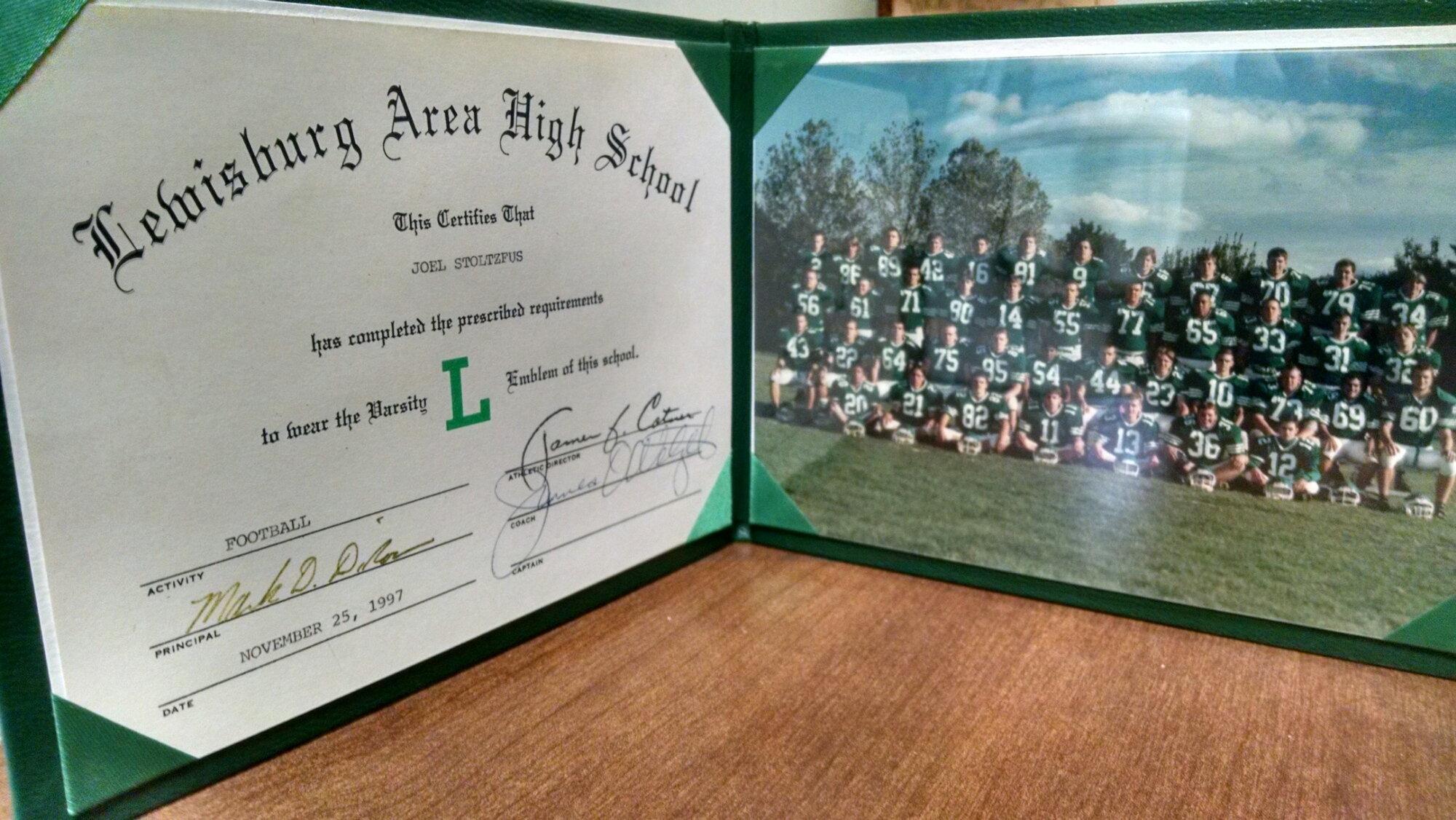
There was plenty of reward.  After weeks of practice there was the proud moment of wearing your game jersey on Fridays at school before game night.  Football made me part of something when I saw teammates in the halls or got ‘good luck’ wished upon me by random students.  I was a warrior, a representative of my school and had earned the team colors that I wore on my back.  I was #13 (I figured an unlucky number fit an unlikely player and couldn’t hurt) and now called ‘Stoltz’ or ‘Stoltzy.’  Those nicknames were the chant of teammates on the sidelines when I stepped onto the field for those few last plays that iced a blowout win.  I belonged.

But the biggest reward was the handshakes and hugs of coaches at the end of the season.  It was after a disappointing loss that ended our season in the first round of playoffs.  We lost to a team we had beaten prior in the regular season.  It was a very emotional moment to be at the end of my first and last season as a player.  Nevertheless it was satisfying to have finished, having survived from the blistering heat and throbbing shin splints of preseason camp to outlasting the bone chilling *shivering* cold of late season practices.  I received a varsity letter for my efforts and with it memories to last a life time.

If I would have any regrets it would be declining my chance to play in the waning minutes of that decisive last game.  An assistant coach had tapped my shoulder telling me to go in the game.  But, because I knew my entering the game was a tacit admission of defeat and keeping the starters in would increase the unlikely chances of victory, I refused saying, “I don’t want to play, I want [us] to win!”  I regret my choice, but only because the sophomore who went in my place caught my favorite route (a deep post) and seemingly could’ve scored with just a bit more heart; he came up a yard short.

I graduated from high school, but to me there is still nothing like a crisp fall night under the lights and watching those bright green jerseys take the field one more time.  And now I have another loyal fan who often accompanies me, who also (less inexplicably) began to love the sport he once thought was silly and that fan is my dad.  We sit there, it is our yearly ritual, we share memories of past games, talk about life and cheer on the team…

image