‘Masculine’ Orthodox Growth

Standard

I awoke this morning to a message from Fr. Siewers. He shared a NY Post article, “Young men leaving traditional churches for ‘masculine’ Orthodox Christianity in droves,” which I read with my coffee. This is a trend within Orthodoxy, and arguably I’m part of it, where (relatively) young men are leaving the consumerist ‘Big Box’ and the compromised traditional churches for a weird alternative that feels foreign to most Americans.

I know, in past blogs, about Orthodox growth, I’ve done a sort of victory lap about Orthodoxy and in doing so left out valid counterpoints. Yes, indeed, many young men are finding Orthodoxy. But it may not be as big a trend as articles like this NY Post story or the Orthodox faithful make it out to be. The growth from fundamentalist reactionaries is limited—most especially if it is only drawing in males. It is difficult to sustain this if no accompanying young women are willing to procreate with these transplanted men.

The truth is that Orthodox, in the United States of America, only number around 6-7 million. Who knows how many show up on Sunday?  For sake of reference, that is less than the estimates for illegal immigrants who currently live in this country, around 11.7 million, and basically makes the Orthodox contingent a demographic drop in the bucket. Yes, growth is good, but is this sustainable? Or is it just a blip driven by those desperate to do something a little different from everyone else and destined to fade like Hipster fashion after a decade?

My own conversion to Orthodoxy was not the same as the template laid out in the NY Post article. I wasn’t running from a church with a ‘woke’ or social justice agenda that replaced the Gospel. Yes, maybe I was a bit disgruntled with a feminized church culture where marriage and family were sacrificed for impossible ideals and visible missions. But it wasn’t in reaction to liberalization. I had done it from a conservative Mennonite church and was attracted to Orthodoxy as it was different from fundamentalism.

Ironically, this new flow of reactionary men to Orthodoxy may come at the expense of the attitude of the church that had initially drawn me. While adopting the Orthodox worship ritual, some bring their Protestant or Catholic baggage with them, there are too many Ortho-bros or those simply trying to be edgelords and unique. It is part of the Alt-right vibe, those who have rejected the far-left’s absurdity on one hand and yet are still looking for a reaction more than they are serious about their faith.

There will always be that small percentage of people who will buy a Tesla Cybertruck to be strange. Those who do things to piss off everyone else with normal tastes. And the growth of Orthodoxy is as much a rejection of the political mainstream as it is about seeking God. It feels more like cosplay, in my experience, than it is something born of a repentant spirit and desire to truly submit to the authority of Christ vested in the church. It is a bunch of dressed-up Protestants.

Case and point? The parish I left has an old Baptist convert as a priest who offended a couple (very fragile extremely idealistic homeschoolers) and the mom of this union made it her personal mission to pull as many people away as possible through lies and attacks. That’s where much of the new growth in the ROCOR parish down the road has come from and why I’ve been inclined to stay home on Sunday to be away from all of it. Not all growth is good growth.

As a postscript, my wife and I do not share the same perspective as far as worship and what church is ideal. She got along with the folks at Holy Cross. But didn’t get much out of the preaching (which was fundamentalist in flavor more than Orthodox) and practice. We sometimes attend a generic Protestant consumerist church, with a rock band and a coffee shop, because it is what reminds her most of her own generic Evangelicalism in the Philippines. My son and new daughter remain unbaptized.

A Beautiful Vision of God’s Spirit Pouring Down On His Church

Standard

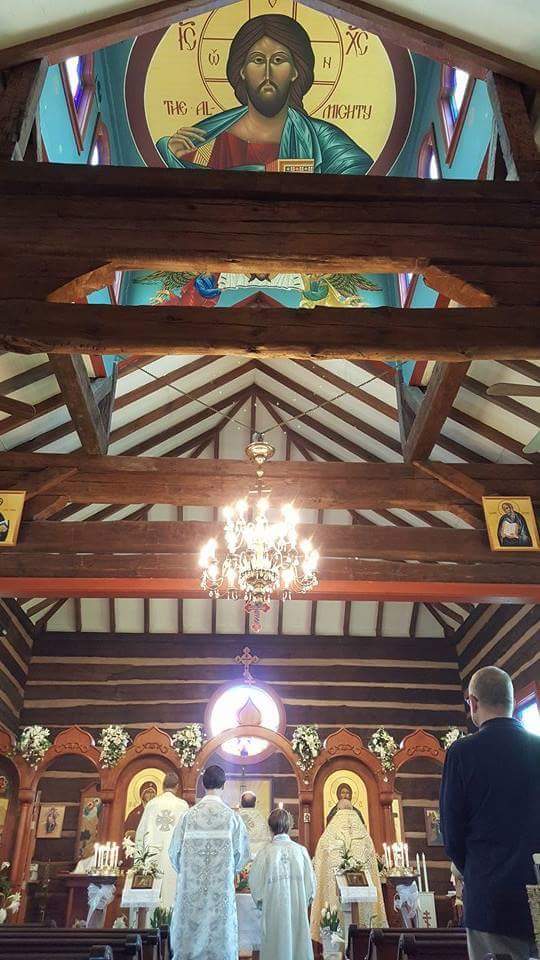
One of my favorite features of Orthodox architecture is that Jesus is always above all.

And by this I mean, literally, there is an image of Jesus painted on the ceiling, looking down from the highest point, and this is a constant reminder during worship of what it means to cast our eyes up towards heaven:

This past Sunday I had a beautiful vision while Fr Seraphim blessed the bread and wine. I saw this flow, like a vapor or a cloudburst, coming down through Jesus, pouring down on us and then fanning out in all directions into the world. It was a glimpse of what Holy Communion really is, it is God bringing life into those who are gathered so they can go out bring hope and healing to the world.

Microburst in Pittsburgh

During the liturgy (which literally means “the work of the people“) we bring our petitions to God. Our prayers, which are represented by incense, rise towards God’s heavenly throne. It is a picture of worship found throughout Scripture. It is found in the description of worship throughout the Old Testament and also in Malachi, at the end of that volume of books, in this a promise:

“Oh, that one of you would shut the temple doors, so that you would not light useless fires on my altar! I am not pleased with you,” says the Lord Almighty, “and I will accept no offering from your hands. My name will be great among the nations, from where the sun rises to where it sets. In every place incense and pure offerings will be brought to me, because my name will be great among the nations,” says the Lord Almighty. (Malachi 1:10‭-‬11 NIV)

Of course, we know that Jesus brought a permanent end to temple worship in Jerusalem. The old temple was destroyed in 70 AD, as Jesus had prophesied would happen in the generation to which he spoke (Luke 21:5-32), and now the promise of Malachi is fulfilled in the church which has been founded by Christ. We have become the new temple, the Spirit of God dwells in us, and worship in every place. It is the church that offers incense and pure offerings and makes God’s name great among the nations.

It is a picture of heaven found in the last book of the New Testament:

Another angel, who had a golden censer, came and stood at the altar. He was given much incense to offer, with the prayers of all God’s people, on the golden altar in front of the throne. The smoke of the incense, together with the prayers of God’s people, went up before God from the angel’s hand. (Revelation 8:3‭-‬4 NIV)

Our prayers go up, with a sweet savor of incense, for the country we live in, for the city we are in and every city and land, for favorable weather, an abundance of fruit and peaceful times, for those traveling by land, sea, and air (also through space), for deliverance from affliction, wrath, danger and necessity, and asking “Lord have mercy” after each petition led by the priest. These prayers go up, culminating with the Holy Oblation, the blessing of the Precious Gifts, and we sing:

Holy, holy, holy, Lord of Sabaoth; heaven and earth are full of your glory. Hosanna in the highest. Blessed is he who comes in the name of the Lord. Hosanna in the highest.

Those words a combination of the hymn of the Seraphim (Isaiah 6:3, Revelation 4:8) and the words of the crowd called out when Jesus made his triumphant entry to Jerusalem. It is in anticipation of what is to come. Our prayers go up and God pours out his mercies through the body and blood of Jesus, through the life of Spirit as it was foretold in the book of Joel:

And afterward, I will pour out my Spirit on all people. Your sons and daughters will prophesy, your old men will dream dreams, your young men will see visions. (Joel 2:28 NIV)

Peter quotes this on the day of Pentecost, in Acts 2, to explain the miraculous things happening then and that continues in us today as well. It is through Communion, our partaking of the body of Christ together, that we can be filled with the Spirit and flow out into the world. The life of the church comes through our Communion with each other and with God. This is the picture of what happens next:

A fountain will flow out of the Lord’s house and will water the valley of acacias. (Joel 3:18b NIV)

From what I’ve read, the “valley of acacias” was a dry and barren place.

Looks like it too:

That is the world, people are thirsty for spiritual life and to be watered by the fountain of truth. It is in our Communing with God (and being anointed with oil) that we have a cup that runs over (Psalm 23) that brings life and healing to those whom we touch. We, as those in Communion with Christ and his Church, are the Lord’s house, we are “God’s temple” (1 Cor. 3:16) and our “body is the temple of God” (1 Cor. 6:19) and, therefore, we are the fountain of life in the world.