As I ponder my responsibilities, bringing a daughter into this world, my patriarchal protection is a given.
The West has been so successful at privileging women that many women do not comprehend the risks of true equal treatment. Feminism is only possible as a part of the patriarchal duty that men feel to protect women. What it amounts to is using male power to enforce standards that are friendly to women, that allow them to walk freely in the street in all manner of dress (or undress), and ignore the reality of what has existed outside the walls of patriarchalism.
Even the idea that sexual assault is a bad thing is an extension of patriarchalism where natural desire must be restrained by structures created by men. A buck in the rut doesn’t ask permission. Hormones direct it’s behavior and only the bigger male can ward off the advances it will make on a doe. It is a hierarchy that is built only on strength. Moral conscience is built off the idea that there’s a big man up there who cares about property rights; who says that a body belongs to someone and is therefore not ours for the taking simply because we desire it.
Yes, eventually this evolved into an idea of everyone owning themselves that we now assume is simply the universal truth. However, nothing in the animal kingdom suggests this is the case. The real world is often a brutal and unforgiving place. When a new group of male lions takes over a pride they will kill the cubs of the previous males. And human morality developed in a very similar manner. This was the default, whether the Psalmist’s fantasy about bashing the heads of an enemy’s infants against rocks or the book of Deuteronomy giving some rules for the treatment of war brides:
When you go to war against your enemies and the Lord your God hands them over to you and you take some of them prisoner, and if you see a beautiful woman among the captives, desire her, and want to take her as your wife, you are to bring her into your house. She is to shave her head, trim her nails, remove the clothes she was wearing when she was taken prisoner, live in your house, and mourn for her father and mother a full month. After that, you may have sexual relations with her and be her husband, and she will be your wife. Then if you are not satisfied with her, you are to let her go where she wants, but you must not sell her or treat her as merchandise, because you have humiliated her.
Deuteronomy 21:10-14
To our modern ears, this is horrendous. There is no asking for permission. And, other than saying to wait a month, the men were free to rape their captive females. But the reality is that this was a radical step in the direction of protecting women from physical violation. One hopes that this delay would’ve ensured a more compassionate and gentle approach rather than some blood-soaked orgy during the heat of battle and immediately after her male relatives were slaughtered. As grotesque as this seems, it was better for her to belong to one man (with some rights after he rejects her) than to be passed around as a mere sex object in the manner of a Japanese comfort woman:
CLAVERIA: (Through interpreter) A Japanese soldier got his bayonet and started peeling my father’s skin while saying, tell us the truth – your child is part of the guerrillas with the owners of that empty house.
MCCARTHY: As Claveria pleaded to let her father go, a soldier wrenched her arm. Birdlike, petite, Claveria strokes a badly set bone as she picks up the story of how she followed her mother’s screams up the stairs.
CLAVERIA: (Through interpreter) I saw my mother lying down with her skirt up, and there was a Japanese soldier on top of her. I ran. My two youngest siblings took little sticks and started hitting the soldiers. The Japanese soldiers then snatched away the sticks and bayoneted both of them.
MCCARTHY: They died. Claveria believes her parents were killed when the village was torched. Japanese soldiers hauled away two older sisters to a garrison and took Claveria to an infirmary for her injured arm. She does not recall how long she was there recovering, but she remembers a soldier named Terasaki. One day, he told Claveria she smelled, but she refused to take a bath, saying she had no change of clothes. Ordering her to wash, she says he gave her a uniform to put on.
CLAVERIA: (Through interpreter) I was to be taken to the garrison where my two sisters were. Before we reached the garrison, he raped me. I thought that I was going to die because I was in so much pain.
MCCARTHY: Terasaki would be the first of many Japanese soldiers to sexually assault Claveria, who was not even a teenager at the time. She was 12. She said her sister Meteria had been driven half mad by the trauma she’d experienced at the garrison. Claveria was shocked when she caught sight of her there.
CLAVERIA: (Through interpreter) She was burned with cigarette butts and boiled sweet potatoes. When one soldier after the next raped her, she put up a fight, but my sister was not brave. She refused because she was in so much agony from all the abuse.
MCCARTHY: Claveria believes her other kidnapped sister was moved to a different garrison. She was never seen again. Historians have estimated that at least 200,000 women were forced into sexual servitude during World War II, mostly in areas occupied by Japan, prominently Korea. The women were euphemistically called comfort women, and the organized system of comfort stations to supply soldiers sexual gratification ran from Seoul to Singapore. Writer Evelina Galang has documented women captured in the Philippines.
EVELINA GALANG: And these are women as young as 16 years old – really, some of them 8, 10 years old. In the Philippines, historians estimate that there were probably about a thousand women and girls taken and put into military sex slave camps.
Men can be monsters. Worse than animals. And, in many parts of the world, immodest dress is taken to be a sign she wants it. Morality does not hold back the aggression of the rapist. No, rather it is the role of other men to restrain evil. Women are protected by their fathers, by their husbands, and by institutions that represent these men. Political structures were created by men and are defended by men. Yes, even if women were granted the right to participate. E.g. even if Kamala Harris takes the patriarchal role—she is still acting in a patriarchal manner and will need the strength of men to impose her will.
There will not be a feminist left in Europe if Islamists take over. That is not to bash Islam or say they would kill off all women who did not submit. No, it is to say that feminism cannot exist outside of the Christian West. The notion of individual rights, that people can independently make their own decisions, cannot exist only on paper or it is impotent. It requires men willing to sacrifice themselves to preserve this egalitarian ideal for their wives and children. Self-sacrificial love is not natural nor a priority in every religious patriarchal structure. Feminists cannot exist in Islam because only the respect of patriarchal institutions gives them power.
The alternative to the current patriarchy is not the absence of patriarchy, men (or those who act like men) will always rule, but the real choice is what manner of rule we wish to live under. It really is survival of the fittest outside of the walls of civilization. Chants of “down with the patriarchy” are about as meaningless as shaking your fist at the wind. It misunderstands the world. It assumes that nature will simply obey our voice because we’re angry and believe rights can exist outside of the structures that guaranteed them for us. It is only in the absence of rule by men who care about more than their own sexual gratification that the value of this benevolent form of patriarchy is known.
It is astonishing, really, but motherhood isn’t actually a one-way relationship. It is symbiotic. The child provides their own blood for the benefit of their mothers. And once the child is born there’s the release of a hormone (Oxytocin) which leads to that special bonding and attachment that mothers have with their children.
Blood relatives can be our closest friends. We share some of the same genetic material and often intimate experiences as well. My siblings and cousins understand my humor, we think alike in many regards, and sometimes I wonder if I have any true friends that aren’t family. I certainly do not trust anyone, besides Charlotte, the same as I do my own relatives.
Don’t get me wrong either. I know many good people, some who might literally give me the shirt off of their back, and yet I’ve had so many friends like that who have faded out of my life.
The Quote…
The fraternity of Christ, is closer than the fraternity of blood.
St. Ambrose of Milan
Is a statement actual truth or wishful thinking?
This is what the body of Christ is supposed to be. A brotherhood, a group of people who carry burdens and cry together, who cheer each other on and encourage, who have real intimacy rather the superficial, make small talk, kind of relationship. The kind of familial investment that goes to bat for others in the Church, as St. Paul did speaking on behalf of Onesimus:
Therefore, although in Christ I could be bold and order you to do what you ought to do, yet I prefer to appeal to you on the basis of love. It is as none other than Paul—an old man and now also a prisoner of Christ Jesus— that I appeal to you for my son Onesimus, who became my son while I was in chains.
(Philemon 1:8-10 NIV)
When I read that quote of St Ambrose, a couple of days ago, it provoked me to reach out to someone that I love in that way and still did after a sort of falling out. It remains to be seen if that effort, to be a brother, will bear fruit or only widen the divide. But one thing is for certain, no matter how this goes, and that is that relationships that are “closer than blood” have not been my own experience yet.
Sure, the good church people will use weighty words like “brother” and “sister” to describe their relationships, but is it truly reality or is it a faux closeness like those social media scammers trying to exploit religious strangers for personal gain?
Maybe, in this time of social fragmentation and community disintegration, where many children are raised without both of their biological parents, we have lost some of the meaning of these words?
Community, for example, should mean living in close proximity and sharing in common. People used to work and worship with the people who lived in close proximity to them. Now I barely know my next-door neighbors and then drive thirty minutes to ‘fellowship’ for a couple of hours. And then there’s those who watch a sermon at home and make-believe that’s being part of the church. I mean, might as well take it all the way and spend the afternoon gardening, right?
Is It All Fake?
One of my memories, in the church I grew up in, was pastor Sam slapping down a transparency onto the overhead projector, and starting with his wonderful baritone, “You may notice we say brother and sister ’round here…” He was certainly sincere. A fatherly leader in a denomination that neglects such things. Once he caught a hint that I was a fan of high school football he would always ask me about the game. I have fond memories of the times spent in the Corderman’s living room even after leaving my Mennonite roots.
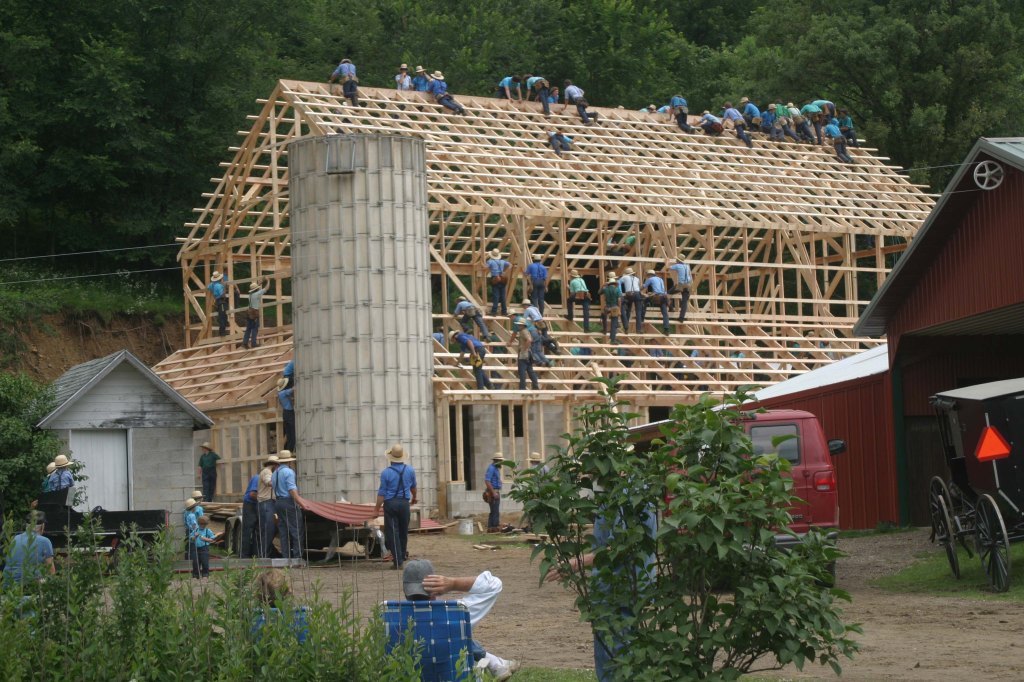
And yet not all there got the memo. We were more glorified acquaintances. Sure, we would smile, shake hands, and make small talk together. There was also that cultural and ethnic component that did give a kind of closeness. There were also those last vestiges of the Anabaptist barn-raising spirit. However, like those veils on the female heads or the foot-washing rituals, it all seemed to be mostly symbolic. A father might set his own son up in business, but no man in the church would ever think of doing the same for a non-family member in the congregation. It was superficial closeness.
Amish community spirit…
I’ve heard it explained before that religious groups hijack the language of family to create a false sense of closeness. At first, I had bristled at this suggestion. It felt like they were trying to discredit this special spiritual bond that people of like faith share. However, if we were close as family, let alone closer than blood, would we even need to use this familiar language? Wouldn’t it just be self-evident, like when Charlotte told me she would rather die with me than go on living without?
It is in that weird territory of language, like when some feel compelled to pray in old English as if this somehow reverences their prayers or those hypocrites that Jesus condemned for their love of important titles. One starts to be able to see through the pretense. There’s a vast difference between the man who treats you as a brother, offers protection, like big Tony Fisher did for me in school, and the people who use the right terms as a way to acquire resources or maintain status.
But, for me, those intuitions only came after being played a fool many times.
And perhaps I learned that lesson a little too well?
It’s Not You, It’s Me
I have trust issues.
And I’m not completely sure why.
It could have something to do with my premature birth and spending my first weeks in a plastic box rather than bonding with my mom. It could simply be a natural disposition. But I do know that I was the one child in my family who had separation anxiety and would go into panic mode if my mom would leave me for a moment to take out the trash. I was clingy and fearful.
Still, I was an extremely trusting person at one time, and long before I knew names like Jerry Sandusky or Jeriah Mast, when I lived in this sort of “Leave It To Beaver” world where people were true as their smiles and everything worked out in the end.
And that’s how childhood should be. Children may pretend, but they don’t put on masks in the same way as an adult and tend to be open about their intentions and accepting of even strangers. It is often easier to talk to eighteen-year-old girls than it is to have a conversation with those that are in their mid-twenties and that’s likely because the latter group understands that male attention usually means romantic interest. We become cagey as we become older, it is a way to protect ourselves from those who might do us harm or simply defile with their hopes of more than we’re willing to offer them.
For me, everything went downhill after puberty and with that gradual (often excruciatingly painful) loss of innocence. One of my earliest memories is walking hand in hand with my cousin when we were five years old. I don’t even talk to her anymore. She’s married to a privileged wackadoodle and didn’t appreciate my opinions of where his far-left politics will lead. Even if that weren’t the case, we probably wouldn’t be holding hands anymore even if we were on better terms. I mean, I would, because I still have fond memories, and yet I’m weird.
Anyhow, my own fear of rejection, a product of my purest hopes being smashed over and over again, has metastasized into disillusionment. I have a hard time trusting. I start to pull away when I sense the slightest bit of phoniness in another person. Call it despair, call it depression, I prefer to think of it as preserving what little sanity I have left, but I don’t want to have fake friendships anymore. I’m tired. Exhausted by it all, truthfully, and simply want to withdraw to the safety of not caring or concerning myself with those who are only going through the motions.
My expectations are impossible. But, then again, they should be. We are told, in Scripture, that with faith all things are possible. And, therefore, if someone declares otherwise, says that they can’t love or live as a Christian ought to live, it is because they lack faith.
Either that or it is all made up.
The thing that has most fed my own fear and doubt, is how people in the church don’t really act any different from people outside of it. In other words, if we don’t act like family then are we even Christians?
My Orthodox parish has a good number of converts and some older singles like me. There is a sort of closeness that came initially, as we traded stories about our experience, and it was very exciting for someone who had looked for depth elsewhere and had come out disappointed. However, there is this class, a sort of misfit club, of converts that is very similar to the Protestant fundamentalists of my past. They are really caught up in getting the Orthodox rituals right and somewhat neglecting as far as the meat of faith which is this self-sacrificial familial love.
My moon shot…
The thing is, I came into this damaged. I had shot for the moon, in faith, and somehow ended up in Williamsport, at Holy Cross, wondering what happened. My expectations were low and it wasn’t about the “smells and bells” to me. There was a combination of things that brought me, excellent theology, Fr. Anthony’s fatherly care, and a connection to the ancient Church. Since I knew no one local who was Orthodox, I went in simply seeking a place to worship and not expecting much. But I did meet many good people there, some who did embrace me as family, I’ll never forget that old woman (I can’t even recall who it was) who warmly told me “welcome home” after my Chrismation.
As with everything in faith, familial love is a work in progress and there are bound to be many failures along the way. At best, we’re a dysfunctional family, like many American families, caught up in our own lives, acting like Protestants when things don’t go our way, and not as truly full of love and grace as we are for our own blood. My want of perfection, and pursuit of the impossibility, must first and foremost mean that I love those who are difficult to love, love who let me down and abandon me, and let God judge those who do not meet my own expectations.
Therefore, as God’s chosen people, holy and dearly loved, clothe yourselves with compassion, kindness, humility, gentleness and patience. Bear with each other and forgive one another if any of you has a grievance against someone. Forgive as the Lord forgave you. And over all these virtues put on love, which binds them all together in perfect unity.
Colossians 3:12-14 NIV
What Is Love, Friendship, Humanity?
Still, the thought that plagues me most and probably always will is this question of if real love even exists at all. I’m not talking about those passing feelings of fondness we have for another person, but that spiritual bond and willingness to sacrifice ourselves for the good of others. As I’ve posited before, there is a selfish component to love. Not only those who say they “love” someone and then kill them in a jealous rage either. But it seems that it is impossible to love without getting something in return.
It is always nice when a server pays attention to me. I would certainly like to believe that they like me. And I’m guessing a few would actually enjoy spending time with me outside of work too. I’m a polite and considerate guy, I also tend to lay a heavier tip when there’s some conversation that comes along with the meal. I do, indeed, go out because staying home would be lonely and alone since it is simply too hard to coordinate plans with friends or I don’t know whom to ask. So I’ll pay for that time with another human. But it can also be unfulfilling. The relationship could have an element of truth and yet really it is centered on the economic transaction or they would be inviting me to hang out when they’re not on the clock.
There is a scene, in Blade Runner 2049, a science fiction thriller about what it means to be human, that illustrates the point. The story follows, K, a “replicant” (or bioengineered ‘human’), and his relationship with his girlfriend named Joi. Except she is not flesh and blood, not even human, but artificial intelligence, software on a computer, with a holographic projection. Still, despite this, the relationship is real. And, when the device containing her (their memories together that made the interaction meaningful) is crushed, he mourns. As the audience, you feel some pain. Yet, later, an interactive sign, with her likeness, uses the same pet name, and it is obvious that the original Joi was programmed to “fall in love” with anyone who wanted companionship.
What is real? What is artificial?
The part that gets to me is how hormones and the positive feedback loop of emotions is, practically speaking, the same as programming. So how are the emotional responses we receive from others any more authentic than that of Joi?
What about our own friendships?
Why do we favor some people over others?
Do we love people or do we merely enjoy what benefits we get from them and that’s why we show such strong preference. Sure, there are some who are kinder and more willing to give attention to the unattractive or social outcasts. However, as far as real commitment, ongoing investment, we generally spare that for those most likely to produce a return. In other words, we love those who do what we want them to do, have something we want in terms of their physical form, intellect, or other abilities, or simply feel drawn to as a result of our coding and subconscious desires.
And then we expect people to stay at the level of friendship assigned to them. One sure way to make things awkward is to make an expression of love that is more intimate or deep than the level the other person wants. Asking a girl on a date is a good way to get put on her blocked list, to get an industrial strength cold shoulder, and even if she was seeming to enjoy the relationship up until then. Why? Well, maybe the ‘friendship’ was a social obligation more than anything authentic? You just know, when push comes to shove, most on your social media friends list aren’t going to be there for you, or at least not like blood relatives.
The Impossible Love
Still, I’m not comfortable with this mechanistic, bound by programming and mere product of circumstances, perspective. If love is not a choice, if we can only love those who are attractive, have resources we want, or are this sort of enjoyable reflection of ourselves, then we would not have agency or the ability to follow the commands to love God and our neighbors. Can we really do that? Do people ever go beyond and actually transcend themselves by loving those whom they would not naturally love?
I’m not sure, when I look at the Christian experiment, that I see much evidence of these relationships that are closer than blood. I mean, maybe, if we were willing to “fake it until we make it” then we would be able to overcome. Isn’t that what faith is really about, doing things that are uncomfortable, going against our own natural condition, or an exercise? I’m pretty sure my grandparents didn’t always feel like loving each other and yet going through the motions of a relationship, in those tough times, is how their love became such pure gold. Sixty years of marriage is impossible for many today because they’ve decided to be ruled by what is comfortable at the moment.
So when church people say they can’t love, and I’m talking about any kind of love, what they’re actually saying is that they don’t believe. It is agnosticism, denial of the humanity of another, and have refused to see the command of Christ as being actually true. When we decide we can’t love as we ought to love or pretend that we are loving while we truly are not, we are essentially making Scripture into a lie. At that point we are nothing but animals following after our programmed instincts and selfish desires. Do you truly love the body of Christ as much as you do your own blood?






 Irregular Ideation