

Philosophical Candidates

Standard

Remember, as a child, those day-dreams of a life unrestricted by parental control, where it would be video games all night, ice cream, pizza, and soda all day?  What is amazing is upon reaching adulthood the thought of this lifestyle is disgusting.  First off, it would be horribly unhealthy—in the sense that those who indulge bulge.  Second, a party every day is totally unsustainable, someone has to do the work to keep the lights on and put food on the table.

Many people become more conservative as they mature and start to realize the value of the limitations they once spurned.  Yes, an adult will modify what was taught to them by their parents and community.  And some grew up in social environments where there was not much worthy to be preserved.  But to totally throw away everything inherited from prior generations is a terrible mistake.  Only an ideological extremist believes stripping it all bare is necessary and good.  It is wiser to build on what works.

That is not to say that the tradition passed down can’t become stifling and overbearing or limiting our potential either.  There must be a bit of flexibility, some Oikonomia, or means to adapt the rules as the need arises.  However, the opposite ditch, of discarding everything and starting from scratch very quickly becomes chaotic, everyone does what is right in their own eyes, and it soon requires authoritarian measures to enforce the vision.  This is the thing Nietzsche warned about—our morality is not self-evident and we should think long and hard about those monsters that we will release with our neglect.
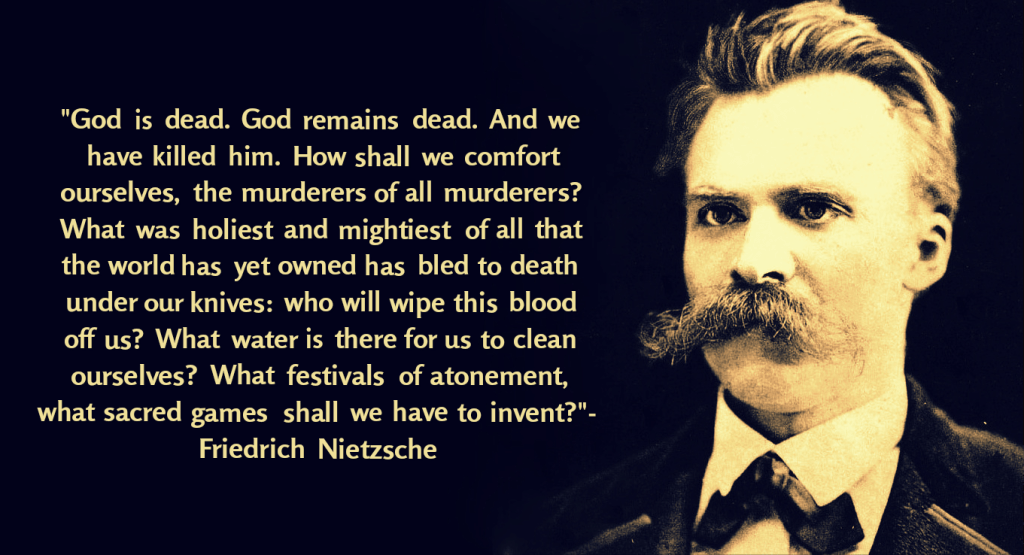
This wasn’t a sacrilege, it was a lament of what happens when you yank the foundational rug out from under a moral system.

Cultural revolution, while always promising to upend systems of oppression and usher in a new utopian age, ends up being worse than what it is replaced.  Yes, “All animals are equal” may be the founding cry, but is very soon after modified by opportunists who sadly are now unrestrained by those institutions despised and yet there for a reason.  The only good thing is that this out-of-balance off-kilter, ‘we know better than all who came before’ attitude, tends to implode on itself if given time.  The Soviet Union only lasted as long as it did because of Christian ethics within the population.

Two Visions For Our Future 

Recently, with the decline of Joe Biden and a failed assassination attempt against his rival, the Democrats decided it was time to make a change up top.  It is her time now—that is to say Vice President Kamala Harris—and there is plenty that could be said about her career thus far, but there is one peculiar repeat statement she has made that really deserves our attention:

“What can be, unburdened by what has been.”

This strange little mantra has been widely panned by the right.  This is more Kamala word salad, they chortle, and yet—while she does sometimes explain things like a school teacher talking to a kindergartener—it is not gibberish.  This is something Harris has apparently put some thought into and is something with a meaning that we should try to unpack.

What does it really mean to be unburdened by what has been?

I’m not going to sinisterize.

Most on the left I know have a glowing hope for the future and could never imagine that their philosophy could lead to Gulags.  I do not believe Harris intends it this way, but it does hint heavily of Marxist thought where we are to be liberated or emancipated from all that came before.  On the surface, this is an inviting thought.  Imagine a world with no abuse, no poor, everyone has their needs provided and has complete freedom.  This would be wonderful—and this is what every cookie-cutter college leftist has in mind as the end product of their efforts.

So how does the unburdening begin?  Well, it already has.  If you have been paying a bit of attention, everything normal is now being called fascist.  Believe that women exist as a category and isn’t something a man can ‘transition’ to?  Fascist!  Maybe you like the nuclear family and see it as a praiseworthy social convention?  Fascist!  How about a border where there is reasonable control over who is allowed in and who is kept out?  That makes you literally Hitler!  And Harris has embraced this side of the debate, she announced her pronouns and the nature of her politics.

None of this is to say that Harris is a terrible person.  I simply don’t want a leader unbound to existing ethics or any standard of decency, or who can write off Constitutional law as being a “what has been”  product of wealthy white men with some of them slave owners and thus should be discarded.  Sure, it may be a document with flaws, and could possibly use more amendments too, but it is better than nothing and represents the will of the people who signed onto this national project to this very day—white, black, Native, or immigrant alike.

What was established is for our benefit.  It is no more a burden than a wool coat in the blistering cold.  To think that we know more than every other generation that came before us, that science and technology have made us into gods, is delusional. 

Furthermore, the left’s unboundness means they do not care about precedents (except as a tool to restrict their rule-obeying opponents and the ends justify the means.  And they mean well.  They plan to fight injustice.  But this script has played out many times before and is the very thing that tradition is a bulwark against.  At the very least those who believe what “has been” has value will hesitate and consider before they destroy the foundations of civilization.

Make America Great Again

Donald Trump rolled out his red hats and MAGA slogan in his 2016 campaign.  The message was simple, a repeat of Ronald Reagan’s “Let’s make America great again” encouraging answer to the total economic disaster of the Carter years.  As he said, in the 1980 Republican convention:

For those without job opportunities, we’ll stimulate new opportunities, particularly in the inner cities where they live. For those who’ve abandoned hope, we’ll restore hope and we’ll welcome them into a great national crusade to make America great again.

Trump knows a good brand and borrowed it from the best Republican leader since a guy named Abraham Lincoln.  The progressives lost their minds.  They dug up the one time it was used by the KKK.  And couldn’t decide to condemn with “America was never great” or be offended because “America is already great and how dare Trump suggest anything otherwise!”  If you were playing a game of “wrong answers only” this harsh criticism of MAGA as white supremacy would make a bit of sense.  

MAGA is not hateful.

When the left says, “Do you know who else said make America great again?” and then goes on to associate this benign statement with all manner of evil, they’re poisoning the well.  There is zero reason to interpret this slogan as Trump’s desire to bring back Jim Crow or the racial policies that were once championed by Democrats.  But this does whip the left into a frenzy and it keeps them from deviating and making an independent decision whom to vote for based on the actual positions of candidates.

What does Trump mean by “make America great again”?

Trump is a businessman, his interests are mostly economic, rebuilding our industrial base, bringing back gainful employment for blue-collar workers lower taxes, and less red tape standing in the way of entrepreneurial spirit.  My wife, who opened a store in her home country, complains that the US is not a free country and is appalled by the many layers of taxes and requirements.  This is what dooms many to working for “the man” or corporations that can afford compliance costs while drowning their competitors with cheap imported foreign goods.

The legalism of US law would make a Pharisee uncomfortable.

From a 2016 Trump campaign speech on jobs and the economy:

Jobs can stop leaving our country, and start pouring in. Failing schools can become flourishing schools. Crumbling roads and bridges can become gleaming new infrastructure. Inner cities can experience a flood of new jobs and investment. And rising crime can give way to safe and prosperous communities.

Had Trump’s first term not been sabotaged by COVID and blue state shutdowns, there is no doubt this would have been fulfilled.  In fact, by the third year of his presidency the minority unemployment rate reached record lows.  Even NPR, while downplaying it, could not deny these numbers Trump touted were real.  Biden’s only success comes from not rolling back those tariffs the fear-mongering media had so roundly criticized.  It is strange how the success and failure of policies is determined only by who is employing them, isn’t it?

No, Trump’s not woke.  He believes in hiring based on qualifications.  He doesn’t want to continue world policing and the massive expansion of government programs.  This is why he is the enemy of those who derive all of their power from the administrative state and sap our resources.  He is keenly aware that a free flow of cheap labor, while it helps elites who want nannies and landscaping at a discount, pulls down wages for those who do not come from wealth.  Even a Senator named Barack Obama understood this:

If this huge influx of mostly low-skill workers provides some benefits to the economy as a whole—especially by keeping our workforce young, in contrast to an increasingly geriatric Europe and Japan—it also threatens to depress further the wages of blue-collar Americans and put strains on an already overburdened safety net.

Make America Great Again is not about a swerve in the direction of Nazism or some new form of ethno-nationalism.  It is about restoring the economic conditions that had allowed our grandparents to buy their home and a car on a single income.  Back in 2015, Bernie Sanders had blamed open borders on a right-wing conspiracy, that will make everyone poorer, but now the left is saying that normal border security is racist.  What changed?  Why are these Democrat policies, like the immigrant cages during the Obama administration, demonized under Trump?

Compassion means disincentivizing illegal crossings where human trafficking is a concern requiring sorting facilities.

It is really disorienting for those who soak propaganda like a sponge.  They never see that Democrats did this full 180 on multiple issues where they had been right.  Trump is right about the border.  It should be the top priority.  Just the Fentanyl overdoses alone are a reason.  I’ve lost a former high school classmate and football teammate this way— 83,000 Americans died in 2022 alone—and it had ironically played as much role in the death of George Floyd as a knee on his shoulder.  Why do we even talk about that dozen killed in a school shooting or Ukraine in light of this?

Reform, Not Revolution 

Progressives tear at the fabric of civilization without understanding the consequences of their actions.  They believe that the erasure of history, destruction of monuments, or the degrading of religion (see Paris Olympics) is a path to a better future.  But this amounts to cultural vandalism and is ignorance of the positive contribution of these religiously created values we’ve internalized.  There is truly nothing that is written on the substrate of the universe that says slavery is wrong or that genocide is evil—the stopping point to “unburdened by what has been” is a return to animalistic impulse.

By design, not accident.

The frontal lobe of the brain is developed by the myths and moralities that progressives do everything in their power to destroy with ridicule and sacrilege.  And it will inevitably go much further than anticipated.  We rarely have enough appreciation for what we have been given.  Everything is taken for granted until it is gone.  And when there is a vacuum that is left to fill, and the ‘demons’ waiting in the wings will come rushing in:

When an impure spirit comes out of a person, it goes through arid places seeking rest and does not find it.  Then it says, ‘I will return to the house I left.’ When it arrives, it finds the house unoccupied, swept clean and put in order.  Then it goes and takes with it seven other spirits more wicked than itself, and they go in and live there. And the final condition of that person is worse than the first. That is how it will be with this wicked generation. (Matthew 12:43-45 NIV)

Christianity led to equal rights in the West, the abolition movement, is a product of St Paul advocating for Onesimus or telling the Galatian church, “There is neither Jew nor Greek, there is neither slave nor free, there is neither male nor female; for you are all one in Christ Jesus.”  The left assumes the values it has are universal.  They see only the faults without giving credit.  

“You will not surely die!”

The progressive left, by contrast, denies all limits and conventions.  Their “can be” may seem good at first glance.  But is opening Pandora’s box, it is releasing what previous generations have built social structures to contain and could end up being more like a trip on Event Horizon.  America has been good and bad, had moments of greatness and failure.  We should tune the ideal it was founded on, not tear it down to start all over again.  There is much to conserve in “what is” with an eye to improvement.  Veer not too far to the right or left.

At least with Trump, morally corrupt as he may be, he comprehends that our inheritance is not a burden. For him, there is something that can be recovered “again” from the past generations even if those lessons were not perfectly applied to him.  He’s a grandpa, he has seen trends come and go, old enough not to care about what is currently popular.  Trump may have some narcissistic traits, at least that is the character he plays on television to the roar of the WWE crowd—but he isn’t trying to be God.

Legalism: Knowing the Letter of the Law but Missing the Spirit

Standard

This is part two of a four part series on law, legalism, church authority and economia.

Ever get angry after being cut off in traffic?

I know I do.

Instantly I’m making judgments about that person’s lack of driving skills. How dare they interrupt my text messaging and topple the donut that was perched precariously on my lap!

However, later that same day, I’m cruising along in bumper to bumper traffic, my exit is coming up, I see an opportunity and take it. The guy behind me blows the horn, he obviously cannot appreciate my superior skills and that I had no other choice.

That, of course, is a composite of many true events out on the road. When I do something wrong, there’s always a good reason for it and if there isn’t a good reason—Well, nobody is perfect, everyone makes mistakes, right?

People believe they see things as they are.

We feel we are a fairly good judge of ourselves and others.

This trust in our own abilities is what enables us to navigate life. If we couldn’t judge up from down or left from right we would have no means to make a decision or progress in a direction. We are aiming creatures. We have two eyes pointed frontward, stereoscopic or “binocular” vision, so we can judge distance and aim correctly at a target down range. That is what our mind does, it prioritizes one thing over another, it is a sorting machine, we are built to judge and—unless sleeping or in a vegetative state—we are always making judgments.

Unfortunately, this forward facing vision gives us big blind spots. We can only see in one direction at a time. When we are locked in on a particular subject we can lose grasp of the bigger picture and possibilities outside of our range of vision. We are creatures with a finite mind and ability to comprehend. We need our judgment to navigate through life and yet our judgment is not perfect, we are short-sighted, biased and often inconsistent. We project into our environment. We judge people based on our presumptions about them and their motives.

We tend to justify or rationalize our own bad behavior, see our mistakes or the mistakes of those whom we love as being the result of circumstances, then turn around and mercilessly judge the faults of others as being serious character defects. This tendency—called fundamental attribution error—leads us to judge ourselves only by our own intentions and others only by their actions. It is extremely common, if not completely universal, and shows up constantly in political and religious debates. The other side is evil, corrupt and inexcusable—our own side is righteous, well-intended and misunderstood.

We don’t see things as they are, we see them as we are.

Truth be told, many people are not good at judging others as they imagine themselves to be and are wrong more they realize. Our memory is selective. On one hand, we sort out examples that go against our fundamental assumptions about reality and, on the other, we can easily recall those things that confirm our existing ideas. This confirmation bias, combined with fundamental attribution error and our many other cognitive limitations, unless humbly considered, will make us a very poor judge.

Legalism is a misuse of the law by those who do not understand the intent of the law.

The basic intent of the law is to create order out of chaos and yet law itself can become a source of confusion and conflict. The problem with any law is that it requires interpretation and understanding of the intent. This is why we have lawyers, judges, juries, and courts—to safeguard the intent of the civil law from abuse.

Legalism abuses the intent of the law.

Legalists incorrectly use the technicalities of language to find loopholes and carve out special exemptions for themselves. Legalists also apply their own interpretation of the law to others in a way that is harsh and often hypocritical. For them, the law is a tool to help them achieve their own personal or political ends.

That is not to say legalists are lacking in sincerity either, they are often diligent students of law, they have zealously committed the letter to memory and know the words inside and out. But what legalists lack is the spirit of the law and their knowledge is a hindrance to them.

#1) The rich man who relies on his own abilities rather than live in faith. (Matt. 19:16-30, Mark 10:17-31 and Luke 18:18-30) In this story, we are told of a young man who is wealthy and also very religiously devoted. He comes to Jesus, whom he addresses as “good teacher” and asks “what must I do to inherit eternal life?” Jesus, upon hearing this man’s diligence, tells him to sell all he has, to give the proceeds to the poor and then to follow him.

Sadly, and ironically, this account is often used by modern legalists to make a new religious formula rather than understand. This man was a legalist who succeeded in following the law and still lacked one thing and that thing being faith. There are a few who are able to keep the letter of the law and miss the intent of the law because of this. The intent of the law is so we depend on God for our salvation rather than our own works:

For all who rely on the works of the law are under a curse, as it is written: “Cursed is everyone who does not continue to do everything written in the Book of the Law.” Clearly no one who relies on the law is justified before God, because “the righteous will live by faith.” The law is not based on faith; on the contrary, it says, “The person who does these things will live by them.” Christ redeemed us from the curse of the law by becoming a curse for us, for it is written: “Cursed is everyone who is hung on a pole.” He redeemed us in order that the blessing given to Abraham might come to the Gentiles through Christ Jesus, so that by faith we might receive the promise of the Spirit. (Galatians 3:10‭-‬14 NIV)

The law is not there so we can believe we will impress God with our careful obedience. No, the intention of the law was to do the opposite—it was to remind us that we do not measure up to the righteousness of God and that we are therefore condemned to death. This rich young man had achieved the letter of the law, he had done everything that could be done through his own abilities, yet lacked the most important thing and that being faith in God. Jesus gave the answer to how we are saved: “What is impossible for man is possible for God.”

#2) The religious hypocrites who use the law to accuse others and are guilty themselves. (John 8:1-11) In our day we don’t take some sins as seriously as we do others. Many, for example, are condemning of homosexuality and yet do not seem to realize that there are many things that we take rather lightly that are sin and that all sin comes with the penalty of death. Such was the case in the following extraordinary account:

The teachers of the law and the Pharisees brought in a woman caught in adultery. They made her stand before the group and said to Jesus, “Teacher, this woman was caught in the act of adultery. In the Law Moses commanded us to stone such women. Now what do you say?” (John 8:3‭-‬5 NIV )

We are told they did this was intended as a trap for Jesus. Evidently they knew the compassion Jesus had for sinners and wanted to present an impossible dilemma: a) He follows the law, condemns her to death as is required and proves to be no better than them or b) he contradicts Moses, can be accused of rebellion against the law and be himself condemned under their law.

He avoids their trap:

But Jesus bent down and started to write on the ground with his finger. When they kept on questioning him, he straightened up and said to them, “Let any one of you who is without sin be the first to throw a stone at her.” Again he stooped down and wrote on the ground. At this, those who heard began to go away one at a time, the older ones first, until only Jesus was left, with the woman still standing there. Jesus straightened up and asked her, “Woman, where are they? Has no one condemned you?” “No one, sir,” she said. “Then neither do I condemn you,” Jesus declared. “Go now and leave your life of sin.” (John 8:6‭-‬11 NIV)

We have no indication of what Jesus wrote in the dirt. However, it is fairly obvious, it takes two to tango and yet we only have a woman standing accused—What happened to the man involved in the adultery? Why was no man brought with this adulterous woman?

It is also interesting that the only tool these men seemed to have was condemnation. Perhaps this is psychological projection? Maybe deep down they felt guilty and the reason they needed to find fault with Jesus and this woman is so they could feel better about themselves?

Whatever the case, we know that Jesus did not condemn this woman. This could be interpreted as Jesus saying that what she did doesn’t matter. But, he doesn’t say her sin doesn’t matter—he tells her to go and sin no more.

#3) Judas betrays Jesus with his legalistic use of compassion. (John 12:1-8, Matt. 26:6-13) If you want to see the ultimate expression of legalism, it is Judas (and other disciples) interrupting a beautiful act of worship to criticize and, in the process, throwing the words of Jesus back in his face:

Then Mary took about a pint of pure nard, an expensive perfume; she poured it on Jesus’ feet and wiped his feet with her hair. And the house was filled with the fragrance of the perfume. But one of his disciples, Judas Iscariot, who was later to betray him, objected, “Why wasn’t this perfume sold and the money given to the poor? It was worth a year’s wages.” He did not say this because he cared about the poor but because he was a thief; as keeper of the money bag, he used to help himself to what was put into it. “Leave her alone,” Jesus replied. “It was intended that she should save this perfume for the day of my burial. You will always have the poor among you, but you will not always have me.” (John 12:3‭-‬8 NIV)

It is interesting there are many who use the words of Jesus the same way as Judas. They use them to support a socialist political agenda or as a means to condemn any extravagant form of worship. They rationalize their condemnation of others using the words of Jesus and, despite completely missing the spirit of the law, are correct according to the letter of the law—but they completely lack the joy and life of the Spirit. They might hide their legalism in compassion for the poor or in concern for the kingdom of God and yet themselves are no better in their attitudes than the legal experts who put Jesus to death.

What is the true intent of the Biblical law?

To save us from ourselves.

Those who use the law to parse away their own guilt or as a bludgeon to use against those who do not add up to their own standards, even standards that are based in the law itself, have missed the point—we don’t add up and by our own efforts we never will.

Any person, when held up to a perfect standard, will fail by comparison. How can we, as finite and limited creatures, ever compare favorably to an infinite and limitless good? This is a reality that should humble us and fundamentally change how we treat other people.

It is fitting that the first step in Christianity is repentance. If one considers the severity of the law and that everyone stands condemned before God—and that just might change our perspective about that guy who just cut us off in traffic.

The Christian answer to legalism: “Judge not lest ye be judged.”

Legalism is applying the law to others in a way we, as individuals, were never ordained to do. Yes, we must make judgments for ourselves and should always promote what is good even if it offends. Yes, there are some things that are under the jurisdiction of civil authorities (Romans 13:1-7) and sin is to be addressed by the church. However, we are not given license to go out on our own as individuals passing judgment on others, quite the opposite:

Brothers and sisters, do not slander one another. Anyone who speaks against a brother or sister or judges them speaks against the law and judges it. When you judge the law, you are not keeping it, but sitting in judgment on it. There is only one Lawgiver and Judge, the one who is able to save and destroy. But you—who are you to judge your neighbor? (James 4:11‭-‬12 NIV)

Some religious experts, who argue the false dichotomy of faith versus works, might see James (above) as contradicting Paul’s emphasis on grace, but they can’t on this point:

You, then, why do you judge your brother or sister? Or why do you treat them with contempt? For we will all stand before God’s judgment seat. It is written: “‘As surely as I live,’ says the Lord, ‘every knee will bow before me; every tongue will acknowledge God.’” So then, each of us will give an account of ourselves to God. Therefore let us stop passing judgment on one another. Instead, make up your mind not to put any stumbling block or obstacle in the way of a brother or sister. (Romans 14:10‭-‬13 NIV)

Our true obligation to others is not to bring them condemnation—it is to be like Jesus and show them the love and grace we want God to show us.

The truer law is not that of the letter. It is the law of reciprocation. What we do to others or demand be done to them will be the same standard that is applied to us. In other words, if you live by the sword you will likewise die by it (Matt. 26:52) and if you judge others by the law you are putting yourself back under the curse of the law and will be required to do the impossible without God’s help—as Paul warned the Galatian church.

Jesus, when asked by a lawyer, says the entire law hangs on two commandments: He says to love God with all your heart and love your neighbor as yourself (Matt. 22:35-40, Mark 12:28-32) and this is some practical application:

For if you forgive other people when they sin against you, your heavenly Father will also forgive you. But if you do not forgive others their sins, your Father will not forgive your sins. (Matthew 6:14‭-‬15 NIV)

That is black and white. So is this:

“Do not judge, or you too will be judged. For in the same way you judge others, you will be judged, and with the measure you use, it will be measured to you. (Matthew 7:1‭-‬2 NIV)

The law is a means to end, to point us to our need for Jesus, and not an end in itself as many religious folks attempt to make it. The law itself can only bring condemnation and death because nobody is able to match the righteousness of God. The law is given, ultimately, not to condemn anyone—but rather so we can all know our own need of a savior and be saved.

Be perfect, not in legalism, but in mercy…

One of the starkest warnings Jesus gave (Matt. 18:21-35) was a parable about a man forgiven a debt impossible to pay and is shown great mercy by the king whom he owed. This same forgiven man turns around and demands a small sum owed him—throwing the offending party in jail. The end result is the king revoking the mercy he had shown and doing what the unmerciful man had done to the one who owned him a little. That is the response Jesus gave to how much we should forgive.

James further expounds:

If you really keep the royal law found in Scripture, “Love your neighbor as yourself,” you are doing right. But if you show favoritism, you sin and are convicted by the law as lawbreakers. For whoever keeps the whole law and yet stumbles at just one point is guilty of breaking all of it. For he who said, “You shall not commit adultery,” also said, “You shall not murder.” If you do not commit adultery but do commit murder, you have become a lawbreaker. Speak and act as those who are going to be judged by the law that gives freedom, because judgment without mercy will be shown to anyone who has not been merciful. Mercy triumphs over judgment. (James 2:8‭-‬13 NIV)

Merely showing favoritism is mentioned in the same breath as murder and adultery!

Presumably, given we should be one in Christ according to Galatians 3:28, that would include any kind of favoritism. In other words, sexism, racism, ageism, xenophobia, social elitism, or anything else used to justify the favorable treatment of some and unfavorable treatment of others, makes you condemned as much as the evilest men of history under the law. James says that a person is guilty of breaking the entire law if they show favoritism…

Who then can be saved?

It is interesting, especially in a discussion of legalism, to consider some of the discrepancies of language in Scripture. For example, one Gospel calls out only Judas for his judgmental attitude towards the woman pouring perfume while another says it was disciples (plural) and not just Judas. One Gospel account of the rich man has him calling Jesus “good teacher” while another omits this entirely and says he started by asking “what good thing must I do” instead. Perhaps the writers were a bit less concerned than we are with the legalistic details and more with the message?

There is also an inconsistency between what the Gospels tell us Jesus said at the end of the Sermon on the Mount. I quoted Matthew’s version in my last blog: “Be perfect, therefore, as your Father in heaven is perfect.” Which seems sort of vague and open to some interpretation. I mean, how does one compete with the perfection of God? However, in Luke 6:36, in the same context of love for enemies, we read: “Be merciful, just as your Father is merciful.” Combining the two different tellings, it seems what is being asked of us is to be perfect in mercy towards others and not perfect in some onerous legalistic manner.

We should turn our natural tendency to fundamental attribution error around. In other words, rather than judge those outside our own social group and show mercy to our own, we should judge ourselves (our own people) more harshly and leave the others to God. Or, in more practical terms, if someone cuts us off in traffic, rather than attribute his or her annoying act to an irredeemable character flaw, we should assume the best. And, if we cut someone else off, we should not excuse our own poor driving habits and take full responsibility instead.

If we want to be judged by God’s perfect law (and condemned) we should be legalistic.

If we want God’s mercy we should be merciful.