

The book of Ruth is a nice little oasis in the midst of dry and tedious reading. Up to this point the Bible isn’t all that relatable. It has some highlights, interesting characters, but is stories of ethnic cleansing, description of weird sacrificial rites, polygamous patriarchs and stonings for picking up sticks, violence and laws, it is cumbersome.
And then you get this:
But Ruth replied, “Don’t urge me to leave you or to turn back from you. Where you go I will go, and where you stay I will stay. Your people will be my people and your God my God. Where you die I will die, and there I will be buried. May the Lord deal with me, be it ever so severely, if even death separates you and me.” When Naomi realized that Ruth was determined to go with her, she stopped urging her. So the two women went on until they came to Bethlehem. When they arrived in Bethlehem, the whole town was stirred because of them, and the women exclaimed, “Can this be Naomi?”
Ruth 1:16-19 NIV
What a contrast to the storytelling prior, all of the resistance to racial mixing as well, here a Moabite woman would rather remain with her Israelite mother-in-law than stay with her own people. It’s personal. And the romance that follows, while very foreign and featuring many practices which are weird to our own ears, shows a more compassionate side of the legal system instituted by Moses. Boaz acted both out of love and duty as guardian-redeemer. Starting with his genuine concern for her safety:
So Boaz said to Ruth, “My daughter, listen to me. Don’t go and glean in another field and don’t go away from here. Stay here with the women who work for me. Watch the field where the men are harvesting, and follow along after the women. I have told the men not to lay a hand on you. And whenever you are thirsty, go and get a drink from the water jars the men have filled.”
Ruth 2:8-9 NIV
This paternalistic care a sharp contrast to an episode in the book of Judges when a Levite and his host offered their innocent women to please the perverse desires of the men in the local community:
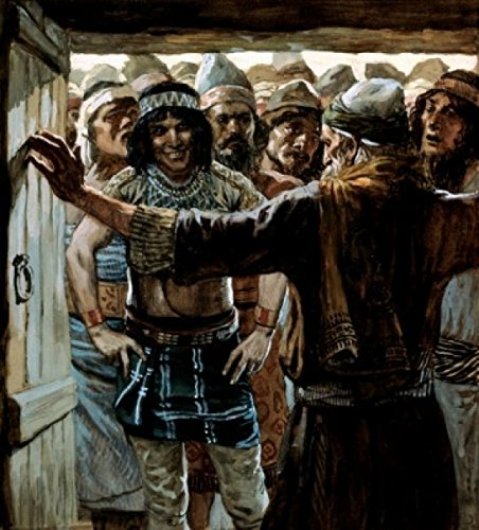
While they were enjoying themselves, some of the wicked men of the city surrounded the house. Pounding on the door, they shouted to the old man who owned the house, “Bring out the man who came to your house so we can have sex with him.” The owner of the house went outside and said to them, “No, my friends, don’t be so vile. Since this man is my guest, don’t do this outrageous thing. Look, here is my virgin daughter, and his concubine. I will bring them out to you now, and you can use them and do to them whatever you wish. But as for this man, don’t do such an outrageous thing.” But the men would not listen to him. So the man took his concubine and sent her outside to them, and they raped her and abused her throughout the night, and at dawn they let her go. At daybreak the woman went back to the house where her master was staying, fell down at the door and lay there until daylight. When her master got up in the morning and opened the door of the house and stepped out to continue on his way, there lay his concubine, fallen in the doorway of the house, with her hands on the threshold. He said to her, “Get up; let’s go.” But there was no answer. Then the man put her on his donkey and set out for home.
Judges 19:22-28 NIV
While the brutal rape and murder of this poor concubine was later avenged, it is quite clear that the two men were more concerned with saving their own skin than protecting those whom were entrusted to them. Not saying it would be easy to know what to do in those circumstances. It isn’t like there was 911 to call or semiautomatic weapons to hold back the lascivious mob. Still, Boaz stood ready to protect Ruth, a foreign woman, from the other men who would very likely have taken advantage. How easily we can take our own law and order for granted.
Where the men made the woman vulnerable for exploitation in the book of Judges and in other parts of the Bible, like Abraham claiming his wife was his sister or Jacob putting his family in the front, in Ruth it is the women putting themselves in a vulnerable place to capture the attention of the good man:
One day Ruth’s mother-in-law Naomi said to her, “My daughter, I must find a home for you, where you will be well provided for. Now Boaz, with whose women you have worked, is a relative of ours. Tonight he will be winnowing barley on the threshing floor. Wash, put on perfume, and get dressed in your best clothes. Then go down to the threshing floor, but don’t let him know you are there until he has finished eating and drinking. When he lies down, note the place where he is lying. Then go and uncover his feet and lie down. He will tell you what to do.”
Ruth 3:1-4 NIV
I’m not sure if the description of Ruth acting out on her mother-in-law’s bold plan to lay at the feet of Boaz is euphemistic language. Seems risky to be that intimate with a man who was drinking and “in good spirits” as the text tells us. But, that said, whatever transpired that night, we know that he took responsibility for Ruth and also the welfare of Naomi. And, in this regard, the guardian-redeemer system worked as designed. But mostly because of Boaz having genuine care in his heart. Ruth, for her part, was his equal in that she was loyal to her mother-in-law to the point of leaving her own homeland.
This is a story exceptional in a good way and likely part of the Biblical canon so far as has to do with the lineage of King David. It also brings us to Bethlehem, where Jesus (of the line of David via his mother) was born. That both Ruth and Boaz stand out as characters for their abiding love is significant. In a time when woman were treated as if property or merely objects for male pleasure, we have honorable and caring men. Boaz took Ruth under his wing in the same way his grandson longed to love his people:
“Jerusalem, Jerusalem, you who kill the prophets and stone those sent to you, how often I have longed to gather your children together, as a hen gathers her chicks under her wings, and you were not willing.
Matthew 23:37 NIV
In this account there is a clear precedent for a family relationship that goes beyond only our biological relatives. The law of the kinsman or guardian-redeemer, through Naomi, was also applied to Ruth. And, likewise, through adoption we become sons and daughters of Abraham by our faith (Galatians 3:6-14) and true children unlike those blood relatives of the Patriarch who rejected their Salvation. Our real kin are those who fulfill the role they have and love in the manner of Boaz or Ruth.
 Irregular Ideation