
Dismantling of the Penn State Colossus

Standard

Growing up, college sports, or even sports in general, were not part of my world. My father didn’t toss a football with me in the backyard or gather us around the TV for games—work was his recreation, and that was our normal. I had no reason to care. But something shifted later in high school, culminating in my going out for football my senior year, and I found myself very drawn to Penn State, captivated by the legacy of Joe Paterno and the blue-and-white pride that defined it.

In the years just prior to my tuned in, Penn State had soared to new heights, claiming two national championships and cementing its place as a powerhouse. For that fleeting moment, the Nittany Lions were the best in the gane. State College, just to the west of me, was the heart of this empire—a house that Paterno, a son of Italian immigrants from Brooklyn, had built. He was not just a coach; he was a living legend, embodying the loyalty, community, and tradition that made Penn State more than a football team—it was a shining symbol of our American values at their finest.

I didn’t love Paterno because he won every game. In fact, other than a Rose Bowl win, the program had definitely taken a half step back from the prominence of the 1980s. It was their “success with honor” mantra and Paterno’s commitment to the “kids” as part of his “Grand Experiment” philosophy that had attracted me. Paterno’s stated mission was not only to win on Saturday, but to build men through the game. At least according the brand, the win at all costs attitude was anathema. We are Penn State meant being at a higher standard on and off the field.

The Scandalous End of an Era

There are many good things that Paterno is rightfully remembered for. But history is not kind to those not true to their values and the legacy of “success with honor” is not what any of us wanted as fans from a distance. The man who lived in a very modest house adjacent to the campus—and had donated $4.2 million to the university library—was embroiled in a situation completely at odds with the character of his program. This, of course, being the horrific revelations about Jerry Sandusky—a former Paterno assistant—who was found guilty of sexual abuse of children and was for years according to the allegations.

Shock and denial are a natural response as a defense mechanism. Penn State fandom was more part of our identity where the “We are” was supposed to be a call to a certain moral code and standard. It was supposed to be about more W’s on Saturday and thus it was unthinkable that there was a sexual predator potentially being protected by the program. Those of us who accepted that it happened still wanted to minimize and keep it separate from the man who had preached excellence on and off the field. To this day this is something to be wrestled with—what did he really know and when?

My current stance is that Paterno prioritized the program over everything else. Similar to how religious institutions (like CAM or the Catholic church) too often try to deal with embarrassing issues internally—as a way to minimize fallout—there’s always the desire to save the ‘mission’ by undermining pursuit of the full truth or actual justice. In the end this little leaven of a moral compromise for sake will leaven the whole lump. However, expediency often trumps principles and the putting of reputation first started with Todd Hodne, in the 1970s, when the rapes of the prized Long Island football recruit began to be known. Paterno wanted to deal quietly with these kinds of ‘problems’ and it would blow up in his face at the end.

Hodne was a violent and vile predator.  Initially the rape allegations were hushed.

In my conversations with a cousin, who is a generation younger than me and far less of an idealist, my being completely appalled at fan behavior in the wake of coach Franklin’s collapse is silliness. He says the toxicity is everywhere and, basically, that I should not expect the Penn State football community to be exceptional. Even in response to my own posts on social media some of my friends believe that it is okay to make their vicious attacks against players and future prospects—because apparently sportsmanship is not a goal in the era of NIL money?  To me there has been something we have lost in our dignity and self-respect when we pile on young athletes and those who have invested far more than most in the bleachers ever did.

It feels like the culture has been hollowed out. An ethos has been lost. And my own disappointment with the sudden realization of the total absence of anything that actually distinguishes Penn State today, other than a few symbols and slogans, the final dismantling of the Paterno legacy that I’ve protected so long is complete. Why pretend? Integrity was neglected. And the thin veneer of The Grand Experiment philosophy has long ago worn away, we are not what we’ve claimed to be, we’re just another sports ball brand—class and character a mere facade.

Penn State peaked in the 1980s and has been in a ‘wilderness’ of ten win seasons since. 

Demystifying is the first step in dismantling the Colossus. With the transfer portal and NIL the era of loyalty and commitment to a higher ideal is over. But this shifting is one that goes beyond the football field or Penn State fan base. This is just a microcosm of the failure of the United States of being this “city on a hill” that was imagined by Puritan preacher John Winthrop. The “We are” is a localized flavor of American exceptionalism or the declaration of our unique quality and superiority over others. It is delusion.

It is also decay…

Reclaiming Lost American Values

The erosion of American values, particularly those intangible qualities that once defined community, loyalty, and collective spirit, is vividly reflected in the current state of college football, the influence of Name, Image, and Likeness (NIL) deals, and the broader societal shift toward prioritizing money over meaning. These three threads—Penn State’s football struggles, the commodification of college athletics, and the personal lesson of a child fixated on monetary rewards—converge to reveal a deeper cultural loss that is harder to pinpoint but profoundly felt.

At Penn State, the football program’s collapse mirrors a broader unraveling of shared purpose. The team’s 3-3 record in 2025, with losses to Northwestern, UCLA, and Oregon, has extinguished playoff hopes, compounded by the season-ending injury to quarterback Drew Allar. The program, once ranked #2, has been plagued by self-inflicted wounds—stupid penalties, turnovers, and a lack of team chemistry despite returning key players. The toxic “fire Franklin” narrative, fueled by fans and possibly amplified by wealthy alumni, has created a vicious cycle of negativity. This environment, where success is taken for granted and loyalty to coach James Franklin is eroded, reflects a loss of the communal spirit that once defined college football.

The fans’ inability to appreciate last year’s achievements, coupled with the pressure of high expectations, has turned a storied program into a cautionary tale of how a community’s values—patience, unity, and resilience—can erode under the weight of entitlement and short-term thinking. The prospect of rebuilding under new leadership may spark a recruiting bounce or an influx of NIL funds, but it also risks perpetuating a cycle where only wins and money matter, leaving little room for the intangible pride that once fueled rivalries like the one against Ohio State.

The field at Beaver Stadium is now “West Shore Home Field” after a large donation.  How long before Penn State’s no-name jerseys are replaced with corporate sponsors?

This shift is starkly evident in the rise of NIL, which has transformed college football from a bastion of amateurism into a billionaire’s playground. The purity of the sport, where loyalty to a program and the concept of the student-athlete once held sway, has been supplanted by a system where, as Mark Cuban’s “big number” donation to Indiana University athletics illustrates, wealth dictates outcomes. Fans no longer celebrate players who stay an extra year out of commitment; instead, they view them as paid mercenaries, unworthy of respect or admiration unless they deliver victories.

This also mirrors a broader societal decline in volunteerism and good sportsmanship—values that once rivaled capitalism in shaping America’s identity. The community spirit that made school sports a unifying force has been replaced by a transactional mindset, where loyalty is bought, not earned. This shift reflects a deeper cultural loss: the unquantifiable sense of duty to others or something greater than oneself, whether a team, a school, or a nation.

As the current system prioritizes individual profit over program or principle, it signals a collapse of the traditions that made college football a symbol of American unity, leaving behind a hollow pursuit of wins at any cost.

Now billionaires and corporations rule college athletics in the age of NIL.

This same erosion of values plays out on a personal level for me, where my tying my son’s chores to cash rewards has instilled a mindset in him that everything must have an immediate reward or monetary payoff. This mirrors the broader societal trend where wealth is the sole measure of success, undermining the concept of family as a unit bound by mutual care rather than financial transactions.

In cultures like the Philippines, where my wife is from, multigenerational support is just a given, but in America, the collapse of family unit and community has fueled reliance on pay based systems like elderly care, which often exploit the most vulnerable and leave little for future generations.

This shift away from communal responsibility toward an extreme individualism and personal profit reflects a loss of the intangible values—selflessness, duty, and shared burden—that once made America redeemable, if not great. And the rise of socialism, decried by conservatives, is less a cause than it is a symptom of this deficiency, as needy people seek external systems to replace the community support that has faded.

These threads—Penn State’s demoralized and debased fanbase, commodification of college sports through NIL in general, and my own struggle as a father of a teenager to instill non-monetary values—point to a broader cultural decay. The current loss of American values like loyalty, community, and tradition is not easily quantified, as they were woven into the fabric of what it meant to be American, and never before required definition or separate designation.

NIL, like the toxic fan culture or a child’s fixation on cash, is a symptom of a deeper disease: a society that prioritizes money and winning over the unmeasurable qualities that once held it together. This shift, felt more than seen, leaves us grappling with a question: if we cannot identify what we’ve lost, how can we hope to reclaim it?

Records Come and Go—Family Is Forever

After the Northwestern game, a third loss this year, Franklin waited until everyone else—including his daughter—had gone through the tunnel before he strode through. This is likely because he knew what awaited him—taunts and trash being hurled.

Father and daughter.  Franklin was determined to be a better father than his own.

In comparison to the stupid entitled clowns, Franklin is a class act. He is the father protecting his family. A standard bearer for Paterno (an Italian surname that means father) or at least the commendable part of the late coach’s legacy. I have seen some of the comments online, one claiming Franklin was arrogant because he had only answered one of their emails or something of similar entitled quality—as if he could just sit responding to every moron harassing him. But the players who played for him are unanimous in their support.

In fact, one of the saddest things I’ve seen is the current Penn State roster expressing their guilt over his firing for “not playing well enough” to please the raving lunatics. They didn’t fail Franklin, the fans failed them and the Penn State tradition.

The players taking responsibility is a sign of a relationship with a man who told them his demands of them as players start with love and end with love. In other words, this was a high pressure environment, expectations were high, and yet it was for their good that he challenged them to be better. And, truth be told, Franklin’s teams punch above their weight. He was a player’s coach and that is why Penn State is bleeding top recruits who were coming to State College for something different under his leadership.

The “fire Franklin” types love to talk about how he “couldn’t win the big game” and yet neglect to mention his teams were almost always coming in as the underdog and with less talent and depth than their top ranked rivals. Or, in basic English, he was coaching them up to the level of the elites. And this a testament to his philosophy that had built on the positive part of Paterno’s legacy—he valued the players for more than the wins or losses and they responded with loyalty and inspired football.

Nobody will ever say Franklin was the best game manager or play caller. But then the online critics keep going back to a couple plays a decade ago. A run on 4th and five against Ohio State or kicking a field goal in a 28-0 Michigan game ending the shutout. But ultimately they were one play from the national championship game last year and Franklin was third behind two other coaches from 2022–2024 with a 34-8 overall record during that span—trailing only Kirby Smart (Georgia, 39-5) and Ryan Day (Ohio State, 36-7) for wins. Good luck finding the guy who will top that after we cut the soul out of the program that drew the talent that we did have. Who will come to State College to be nitpicked and unappreciated?

I loved a family man arriving at Penn State and to see it end as it has just makes me think we don’t deserve what we have.

The toxic part of the Penn State fan base is transactional. They believe their watching a game entitles them to perfection execution and results. I mean, imagine that, a howling mass of ingratitude made of mostly grown men who are apparently that unhappy with how their own life went that everything now is a matter of wins on Saturday. Most did not go to The Pennsylvania State University nor do they have any real investment in any tradition of excellence—like that which was upheld by Franklin’s family approach.

Franklin deserved better. He was not a DEI hire. He is certainly not a terrible coach. It is his players—who carry on his legacy—that actually matter. Penn State football should never be about pleasing drunk Uncle Ricos who failed at life, it should continue to be oriented towards success in life. Truly the few Saturdays under the lights are not a measure of a man. Franklin’s tenure should be remembered as a battle against wider societal decay—where the development of moral character and the building of community are too often sacrificed for the fleeting victories or short-term financial gains.

Pattern recognition isn’t for everyone.
Twelve teams with the most National Championships

Both Nick Saban and Urban Meyer, who are legendary coaches, expressed their support for Franklin. And to think delusional Penn State fans believed that they could replace Franklin with one of these two (already past retirement age) by waving a little money in their faces. No, nobody is coming to State College to be unappreciated for producing one winning season after another. We will be lucky to find any successful coach who is tempted by the job—let alone replace all of those who decommitted or will transfer now that James Franklin is gone.

Values Beyond the Scoreboard

In this blog—Irregular Ideation—my struggle with the disconnect between stated values and the values they truly live out. People claim to believe one thing and yet live something else. I’ve dealt with this in the religious and romantic sphere, the disappointment, this false notion that virtue would always win over mere physical or economic superiority. Mennonites teach that the meek shall inherit the Earth or that the first shall be last—these being Christian concepts about the kingdom of Jesus. But the reality lived is always different from that ideal preached.

The reality is that everyone is in it to win it. Yes, even that sweet and submissive young woman doesn’t date no scrubs. Sure, maybe a pious individual will adjust some language or settle on one rather than playing the field, but ultimately they’re going for the status or strength and attractiveness everyone else in the world pursues. Some overestimate the market value they have, but even in love we are being self-sacrificial or altruistic. We’re motivated by hormones and sexual desires—often things we’re not even totally aware of behind our wall of moral rationalizations and narratives.

With denial of this is the delusion that good things will happen to good people. We tend to confuse physical beauty with virtue as it serves our own carnal desires to see them as one and the same. I mean, who wants to say the quiet part out loud by admitting they picked Joe over Bob because he was taller or had charisma? We may say things about nurturing or character traits but this is code for nice breasts and big biceps. So what I am getting at is that we dress all this stuff up as something it is not and revelation of what is underneath is not debasement—it simply exposes what always existed.

From Paterno trying to bury the truth about Todd Hodne to the firing of Franklin, the true ruthless nature of college football culture is revealed.

Beaver Stadium rises out of the valley floor, an edifice, a temple where sacrifices were made in the name of success.

Beaver Stadium rises up from the farm fields of Happy Valley, a monument to Pennsylvania pride, like the “city on a hill” of American exceptionalism. But success was not built on anything different here as it was anywhere else. What is buried is the reality it is always about aggression, financial gain, and wins. The Grand Experiment failed and Penn State had to be like everyone else if it wanted to reach the top. Furthermore, there is a sense in which every program becomes a sort of family or builds men—Paterno was only unique for highlighting this.

Are there values beyond the scoreboard?

Is it a zero-sum game?

Yes and no. Friedrich Neitzsche describes “slave morality” or a system of ethics that reverses what we naturally value and then says this denial of reality is virtue. Woke is a manifestation of this, where they attempt to turn the world on its head and celebrate obesity, ugliness, criminal behavior or lack of ambition—and create an artificial reality—rather than deal squarely with the world as it is. Body positive isn’t going to spare you health consequences if you’re obese. Fair or not we must at some point deal with the cards we’ve been dealt and rise above our station or accept what we are. Mutilation of yourself to be something you’re not ends as badly as well. There really are no shortcuts to success or Uno Reverse cards to play—it is what it is on the scoreboard that matters to the world in the end.

Ultimately we also have our limits. We need expectations to match our abilities or we’ll end up in a spiral—always chasing what is beyond our reach rather than just building on what we have. I’ve seen it many times, those who leave a consistent and reliable partner, thinking they’ll do better out in the market, only to find out that (yet never will admit) that their discontentment played a trick on them and they had it better before than after. Not everyone can be a National Champion every year—it just isn’t possible—but we can have a family or community that respects all members and seeks only their best rather than tear them down.

Symbolic?

So maybe Penn State football does need to be dismantled and rebuilt to be great again?

It could be that, like the children of Israel in the wilderness, we’ll need this generation to pass so our children can enter the promised land?

If the foundation laid has led to this ugly spirit of entitlement then it was flawed. We might need to decide if football is so important we will lose our humanity or the immeasurable qualities not displayed on a scoreboard—for a “big game” win that won’t matter in a year or two. What does it truly matter if we gain the and lost our soul?

A race to the lowest common denominator is the end of civilization. Despite my lament above, I don’t believe life is all about money, sex and power—which ever order they come in. I still believe my elderly grandma had a beauty that was unsurpassed and morality is not just a smokescreen for our failure to be the best. Maybe the impossibility for me is possibility for my children. I cannot stay disillusioned. But, like I did in finally leaving my religious roots, I may need to also bury that delusion of Penn State excellence both on and off the field.
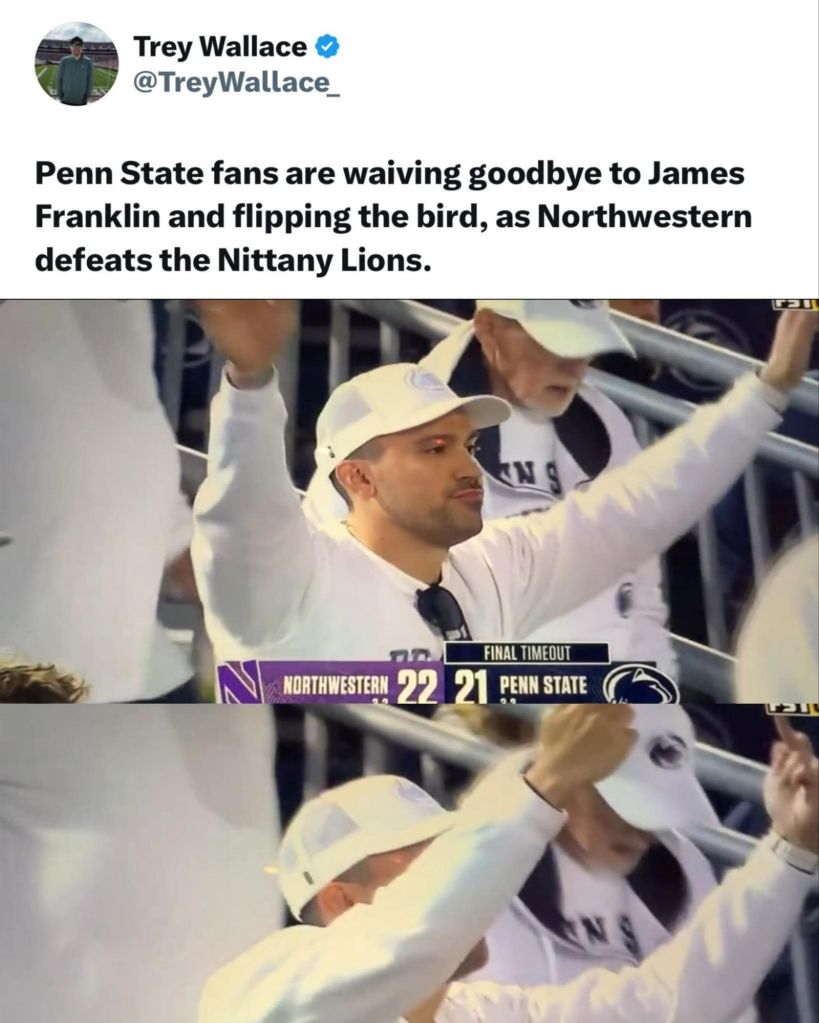
Not the tradition that made Penn State great.

Maybe the failure of The Grand Experiment was all Paterno’s own personal failure? Or maybe the message never went beyond the young men who loved him like players love Franklin today. But the Colossus now lies in ruins making me wonder if it was ever great to begin with. They didn’t just fire Franklin—they pushed over what remained of an ideal for sportsmanship, they’ve fully demolished the mythology that so inspired me. A giant ‘moral’ idol is gone—will something real rise up in its place?


The Rise of the Christian Influencer

Standard

The man had charisma.  He wore a swanky grey sport coat and a shiny pair of quality brown dress shoes, that all went along with his well-manicured hair.  He stood out in this crowd of mostly Amish gathered for the seminar. 

I tend not to pay for such things.  I have a knack for learning through non-conventional means, namely running into walls until I get to the correct answer, and have also learned quite a bit from observation.  My own ticket had been provided by my company and I was there with the rest of the office staff to hear what this life-coaching speaker had to say about customer service and listening. 

The content was good.  It seemed worthwhile advice for those seeking to improve their customer experience and grow their business.  However, I kept thinking about the Christian themes mixed into his message.  This son of a missionary did not preach a sermon nor did he mention the Gospel of Jesus Christ.  Still, there was definitely an attempt to relate to the audience at a level of their religious values.

This sort of thing, good or bad, seems like the latest development in Christian missions.  In times past, the church was the church, those ordained and sent were more open about their underlying goals, urging repent and be baptized, and those personally profiting off the message were condemned:

“Unlike so many, we do not peddle the word of God for profit. On the contrary, in Christ we speak before God with sincerity, as those sent from God.”

(2 Corinthians 2:17 NIV)

Now, the man before us, he represented a non-profit entity and was giving advice that pertained to sales and serving customers.  Still, he did reference Scripture amongst his quotes of self-improvement gurus and even used the phrase “word of God” at one point in his presentation.  He would use our familiarity with the “good book” to bolster his claims and even shared some theological perspective. 

Again, I have no problem with this man nor the particular presentation.  In the business world this kind of consulting and advice is likely key to reaching the next level of sales and I’m sure we will do many of the things that he recommended.

However, what did stand out, and is the reason for writing this blog, is this trend towards a mission of influence rather than open proclaiming of the Gospel and, in many ways, I was at the forefront of this evolution.  My blogs, often a mix of theology, philosophy, and personal observation, is not openly declared as a Christian mission.  Still, I have used this media, and my understanding of Scripture, to do pretty much the same thing (minus the monetization) of this life coach of Anabaptist background.

So here’s some thoughts…

Where Did It All Begin?

The church has always had influential men and inspiring women.  Some rose in prominence, even have their writings and stories recorded in the canon of Scripture for our benefit.  The Orthodox have many noteworthy figures, Early Church Fathers, including St John Chrysostom, the archbishop of Constantinople, a man who took on the abuses of ecclesiastical and political authorities of his own time, and whose Divine Liturgy we celebrate to this very day, his name means “golden-mouthed” in Greek and he definitely had a way with words to match the description.

However, those in Scripture, as well as St John Chrysostom, were themselves all under the authority and guidance of the other Christians.  They were also very open about their mission.  They were unabashed preachers of the Gospel of Jesus Christ.  They weren’t your life coach using Christian themes to decorate a business oriented daylong consulting session for $150 a head.  St Paul may have made tents to support himself and his ministry, yet I’m not sure that he sold them using Christian themes.  Just saying.  His ministry was ministry and business was business.

But there is a sort of murkiness to many modern-day efforts, where they aren’t part of the church per se nor even announcing themselves as a ministry, and it is by design.  So how did we get here?

The starting point of the current Western paradigm is obviously the Protestant schism with the leadership in Rome.  The intention of Martin Luther, ordained by the Roman Catholic Church, was not to start a denomination.  He wanted reforms and had good reason for his critiques.  And yet his written protests quickly became a catalyst, many took things much further than he had ever intended and we have the multitude of denominations as his most significant accomplishment.

Still, despite this, the church, even or especially with those of the radical reformation, remained a collection of individuals with accountability to each other.  Sure, the Anabaptists were more localized, led by shared statements of faith, and collectively agreed upon congregational rules rather than by a hierarchical structure, but it was never every-man-for-himself or a free-for-all.  Those who spoke were ordained by various means, not simply a man full of his own ideas and finding a following.

The turning point? 

I think around the turn of the last century represents a shift.  The whole tent revival circuit, where a dynamic speaker, an Evangelist, would get up in front of the crowd and wow the audience with his polished salvation message.  Many were sold the Gospel in this manner, walked the sawdust trail, the circus would eventually leave town and life would go back to normal or the new normal, I suppose?

The next stage in development was the parachurch missionary organization.  By parachurch, these organizations are run seperately from the denomination, are often subject only to their own board members, and seek funding for themselves.  Basically, any ambitious person, with some natural musical or speaking talent, interested in travel, can start a prison ministry, missionary training institute or what have you, and only with as much ties to the existing church structure as they want.  All one must do is set up their nonprofit, find investors, buy the bus, and be on their way to preach the word as their adoring wife glows beside them.

Yet, as all things, the traveling Evangelist and other obvious Christian missionary efforts, including openly Christian contemporary artists, have become tired old tropes.  The in-your-face presentation, the lack of follow-up or one-dimensionality of the presentation, the realization that the novelty had worn off of the original form, the scams, and scandals, has led to a third wave of influencer and that’s the one that doesn’t even announce the Christian intentions at all.

Sometimes this lack of openly expressed intention is to avoid legal prohibition.  For example, teaching English in Asian countries that would not otherwise invite Christian missionaries.  Other times it is to add a practical element, after preaching and charities failed to help solve many underlying conditions, which gave rise to micro-lending groups.  Sometimes this repackaging is to sell the mission itself as something exciting, an adventure rather than some kind of dull service opportunity, and part of an effort to make Christianity relevant to the next generation.

After watching the presentation the other day, I suggested to a left-leaning Mennonite friend that we go on tour together for sake of racial reconciliation and healing.  Why not?  I think I could probably work the crowd, with a little practice, and definitely believe in the cause, could leading faith-related seminars be my calling too?

In theory, this cause-oriented Christian influencer thing seems great.  We can have sportsman’s banquets, business seminars, and TED Talk the unsuspecting heathens (or even the more traditional religious types) with a flashy Powerpoint presentation, funny stories and down to earthiness.  And yet, this does seem to get things out of order, it puts values first and repentance second. 

More troubling, from the Evangelist of the past century, to parachurch missionary organization of the past decades, to the influencers of the present, the distance between the activity and actual purpose has grown.  The Evangelist preached without providing adequately in discipleship.  The missionary went without being sent or accountable to the church.  And the motivational speaker, while referencing the Bible, never announced a Christian intention.  And it makes me wonder, how far can we detach values or ministries from the Church, and cause of Christ, before it becomes entirely self-interested and divorced from Christ?

At what point is it all just a moneymaking scheme, devoid of actual spiritual substance?

I mean, we’ve all seen it, the shyster, the con man, the ministry with a board of directors full of families and “yes man” friends, the Televangelist, the guy selling a product, an ideology, a Ponzi scheme.  There is sometimes a very fine line between the less scrupulous, eyebrow-raising efforts, and the more accepted manifestations.  Are we someday going to have Christian pornography, subtle Christian themes, maybe an actor pick up a Bible and read a passage before the main event, to hopefully plant that seed of influence? 

Where does it end?

The Rise and Fall of the Christian Influencer

David Ramsey, James Dobson, Ravi Zacharias, Ken Ham, and Bill Gothard are familiar names in conservative Mennonite circles.  Ramsey with his financial advice, Dobson with his focus on the culture war, Zacharias with his appeals to reason, Ham for his fundamentalist theme park, and Gothard an earlier version of life coaching seminars.  The point of all of these men, at least as expressed, was to advise, consult, and influence.  They are all men who took aspects of their religious values and turned it into an enterprise.

None of the men above represent a church denomination.  They rely on selling merch, the loyal support of people like you, and donations to expand their reach.  They have built ministry campuses, a literal ark in the state of Kentucky, a few massage parlors here and there, and are only accountable to their own ministry boards.  Usually the focus, at least initially, is around one illustrious character, a strong personality, who is too often surrounded by the cult he has created rather than those who will challenge.

There now seems like a parachurch organization for every niche.  The list of bloggers, authors, evangelists, producers of all sorts, continues to grow and especially now in the age of social media.  It costs me nothing but time to set up my account on WordPress and start spewing out my perspectives.  Perhaps, if I were a bit more ambitious, I would write a book, do a book tour, and eventually be at your Lady’s Tea event sharing what I learned about life and love from the book of Ecclesiastes.   Book your reservations now as available slots are filling fast!

But the parachurch is the downfall of the church.  Too often these ‘ministries’ have come at the expense of the local body of believers, submitting and serving each other in love.  Too often it is something guided more by the spirit of Diotrephes, wanting things our own way and seeking those who agree, rather than by Christ.  That is why we have seen a growing number of scandals come to light, of leaders forced to resign by outside pressure or disgraced after death for their hidden sinful deeds.  I know, speaking for myself, it is too easy for me to shun deeper involvement in the actual church because it is difficult, not determined by my feelings of inspiration, and this is something that must be repented.

Jesus was willing to serve, but he didn’t determine the cross he was required to carry and, instead, submitted to the will of the Father.  The disciples, and St Paul, likewise, were not Lone Rangers, doing it their own way, without accountability or oversight.  Those with gifts aren’t to use those gifts to serve themselves or build their own empires.  They were sent and commissioned by the church, under the umbrella of those ordained to lead, and not independent contractors pursuing their own pet causes.

The Christian life is not about values, certainly not about self-promotion or having the right program either, but is about our Communion together with other believers, both past and present, and with Christ.  From that, the Holy Spirit, from our accountability to each other, our true obedience, transformation will come from inside out and love will flow out to change the world.  The values and culture come from that rather than being taught at seminars, religious institutions, or Bible schools.

We don’t need more influencers.  We don’t need more parachurch organizations or a return to tent revival meetings either.  Many of these things are mere human efforts that will ultimately fail.  What we really need is the body of Christ, to partake and participate together in the life of the one true Church. 

Mind Your Own Business — The Christian Response to Gossips and Busybodies

Standard

A few weeks ago a story swept across my Facebook feed about a young Mennonite man from Indiana who went missing after a visit with his girlfriend in Arkansas.  I quickly determined, after a brief look on Google maps at the points mentioned, that there was very little that I could do to help.  There are plenty of situations where my own inputs and interventions are truly needed and this was not one of them.

The need for my personal involvement didn’t change after he was found.  Yes, as a normal human being, I was curious about the circumstances surrounding his disappearance and hoped to eventually hear more about what happened.  However, there was no reason for me to pry or persist in an effort to find information, I was content to wait until his family was ready to share and truthfully didn’t need to know anymore than I already did.

However, some were not satisfied to simply rejoice with those who rejoice.  Some felt entitled to information, they felt that they deserved an explanation and more or less demanded immediate answers.  Making matters worse, the online discussion (including a page created to help locate the young man) quickly became and a cesspool of gossip and den of busybodies who seemed to take great pleasure in sharing their scandalous revelations.

Anyhow, because this does effect my newsfeed, and having had malicious nonsense spread about me in the past, and knowing what Scripture says on the topic of gossip, I want to make three points:

1) The young man didn’t ask to be turned into a public figure.

Family and friends decided to take their search public and the network of Mennonites on social media responded in force.  But that doesn’t mean that we should not respect the privacy of the young man.  The public handling of this was not his choice.  If their best interests (both his own and those of the people more intimately involved) are better served by not sharing more than has already been shared, then so be it.

2) You are not entitled to anything more than has already been revealed.

I’ve seen the spreading of rumors explained as need for closure and blame being put on those closest to the young man for their not revealing more information at this time.  That, of course, is complete nonsense.  Being asked to pray and assist in a search does not give anyone a right to know the juicy details and nor does morbid fascination.  There is no need to know anything more than what needs to be known.  He has been found, he is with those who love him, and that should be everything a reasonable person needs for closure.

3) Gossip is a sin and busybodies are severely condemned.

Curiosity is excusable.  I understand the want to know more about a story than is already known.  I can even see good reason to share, in the right time and place, about unflattering things discovered.  However, what I cannot excuse is sharing dirt on another person and publicly trashing them for no good reason.  True or not does not matter, what does matter is that we show the grace we wish to be shown and handle such matters in the way appropriate for a Christian.

There seems to be some confusion about what is appropriate and inappropriate sharing of information…

Fortunately there are Biblical passages that offer us strong clues.  In fact, being a “meddler” (1 Peter 4:15) or “gossip” (Romans 1:29) is mentioned in the same context as theft and murder and slander.  We are even told to disassociate ourselves from those who are “busybodies” (2 Thessalonians 3:11, 1 Timothy 5) as a result of their idleness.  And, if that condemnation is not enough, there is also this clear instruction:

Brothers and sisters, do not slander one another. Anyone who speaks against a brother or sister or judges them speaks against the law and judges it. When you judge the law, you are not keeping it, but sitting in judgment on it.  There is only one Lawgiver and Judge, the one who is able to save and destroy. But you—who are you to judge your neighbor? (James 4:11-12 NIV)

The word “slander” in the passage above is also translated as “speak evil” or “speak against” and doesn’t simply refer to false tales.  It comes from the Greek word “katalaleó” (καταλαλέω) and is defined by International Standard Bible Encyclopedia as follows:

Slander (etymologically a doublet of “scandal,” from OFr. esclandre, Latin scandalum, “stumblingblock”) is an accusation maliciously uttered, with the purpose or effect of damaging the reputation of another. As a rule it is a false charge (compare Matthew 5:11); but it may be a truth circulated insidiously and with a hostile purpose

It is important to note that this goes beyond the modern definition of slander.  It is saying something, true or untrue, in a way that is unnecessarily harmful to another person.  In other words, this means *not* revealing things in public about an individual that detract from their reputation.  That in contrast with sharing only what is helpful to another individual and of benefit:

Do not let any unwholesome talk come out of your mouths, but only what is helpful for building others up according to their needs, that it may benefit those who listen. (Ephesians 4:29 NIV)

There is a time and place for confronting sinful behavior.  However, unless the sin is already public knowledge and obvious (as in 1 Corinthians 5) or something that must be reported immediately to civil authorities like sexual abuse, the process of confrontation should always start one-on-one with the offending individual in private:

If your brother or sister sins, go and point out their fault, just between the two of you.  If they listen to you, you have won them over.  But if they will not listen, take one or two others along, so that ‘every matter may be established by the testimony of two or three witnesses.’  If they still refuse to listen, tell it to the church; and if they refuse to listen even to the church, treat them as you would a pagan or a tax collector. (Matthew 18:15‭-‬17 NIV)

In light of this, spreading scandalous information about another person just because you can is never appropriate for a Christian.  It goes completely against Biblical instruction to “make it your ambition to lead a quiet life” and to “mind your own business” (1 Thessalonians 4:11) and amounts to a sin as bad as any other.

As for closure…

There are certainly those who should be working with this young man to help and restore him.  But there are many more (in the online crowd) who have no role in that and should be mindful of what Jesus told those who brought an adulterous woman out to be condemned: “Let anyone of you who is without sin cast the first stone…”

Christians should have no time for gossip and no place for busybodies in their ranks.  There is no duty to tell the world about things than can (and should) remain private and absolutely no need for salacious appetites to be fed.  So, if you desperately need closure, use the opportunity to reflect on your own attitudes and actions.