Built for Scarcity: Why I Won’t Give My Son Everything He Wants

Standard

I’ve tried to give my son everything he needs to succeed. But that doesn’t mean I will give him everything he wants. There’s a reality in any pursuit: to be excellent, you’ll need to put in the work or delay gratification to reach your full potential. If a parent gives a child everything they want, there’s no incentive for them to learn and improve.

To a child, everything provided for them is a given, and every task required is an injustice. Why should they have to wash the dishes? The grumbling or attempts to negotiate last longer than the time it would take to finish the chore. And, honestly, the easy route is just to do it ourselves. But that deprives a child of the opportunity to learn all those transferable life skills—at the very least, to get a little practice being helpful rather than entitled.

In the West we already have abundance and the result is atrophied muscles and dull minds.

If we shower children with abundance, they will never appreciate what is given nor ever be satisfied. It seems that no matter what we have, we always want more. If given the moon, we’ll want the other planets and the stars as well—and then we still won’t be happy with that. The greatest satisfaction comes through work and accomplishment. Playing video games all day or scrolling social-media feeds may trip reward centers, but it amounts to empty calories and can’t replace substance.

I’ve watched spontaneous interviews with very wealthy men, and nearly every one of them says that their abundance did not bring happiness. At least one admitted he was suicidal despite millions in assets. Our peak enjoyment in life comes when we invest time, effort, and resources and eventually reap the fruit of our labor. Sure, going to the gym may be difficult, but the endorphins are addicting and the muscles are a reward.

Built for Scarcity—Not Utopia

I watched a video about the problems with utopia, and the framing of capitalism as a system built for scarcity was correct. We would need a radically different way of ordering ourselves if the things we wanted just grew on trees. If you could have whatever you wanted without effort, why would you pay for anything or even care who owns it? My property rights only matter because it costs something to acquire or replace the things I own. If everything we wanted was free and completely abundant, we wouldn’t need to value it at all.

The presenter, who seemed intelligent enough, made a critical flaw while talking about providers of generative AI. He claimed that those charging for the service were creating artificial scarcity “because the code is open-source or whatever.” But this totally ignores the immense computing power that’s required—the powerful microchips, massive amounts of energy, and the staff needed to keep it all running. So no, that isn’t an example of abundance.

I’m used to naïve takes coming from the religious side, but it’s fascinating to see secular thinkers stumble over the very same things. Yet it touches directly on the human condition. We are not wired for abundance. Ultimately, even if we could reduce human labor to zero, our brains were created for scarcity, and when faced with unnatural abundance we don’t actually do very well.

Wall-E is probably the best depiction of a world of abundance that goes well.  It could go in many directions, unhealthy ease the better of the many scenarios.

Material wealth, to start with, is never a cure for boredom or lust. If anything, those who have all their physical needs met are often left with a void of purpose. Their abundance never creates fulfillment or a reason to be in the world. And some appetites are basically insatiable: a man can have all the sex he wants and still desire the one he cannot have. It is often the ultra-wealthy—those who have everything we imagine would make us happy—who are also the most perverse and dissatisfied.

It reminds me how young-earth creationist (YEC) types often portray entropy as purely negative when it is as necessary for life as order. Fertile soil, for example, contains organic compounds that come from dead plants and animals. This is part of a cycle—neither good nor bad—like the weather. The same forces that bring a spring shower can also leave behind a swath of destruction. Creativity itself often lives at the edge of order and disorder. You may not enjoy a messy room that needs cleaning, but without it your life would probably feel pointless.

Furthermore, social hierarchy would be the only game left if we completely removed the need for productivity and occupation. If AI replaced all jobs, the result might be material abundance, but not utopia. As the saying goes, “Idle hands are the devil’s workshop,” and some people with nothing to do will create drama. Boredom is good when it provokes us to create something new, but bad when the “new thing” is us causing trouble for others for lack of something else to do. It is better when we need to do something productive to survive, because we’re primed for it.

Consider how an overly sterile environment can trigger autoimmune disorders; similar problems would arise in a world where struggle was fully removed. It wouldn’t solve our environmental or energy problems—there would still have to be limits and rationing to keep from stripping the planet bare. Some people will never be content with the base level of property and possessions. There will still be scarcity even if human labor is no longer a cost. Advantages will still exist. At that point a new hierarchy will form—perhaps one based solely on beauty or charisma—where many have no path to “level up.”

In capitalism, while there’s an advantage to those who go first, there are multiple paths to success. Sure, there is cost-cutting at the expense of quality (see the Campbell’s Soup controversy), but there is also genuine efficiency and a system where nothing need go to waste. Bad actors create opportunities for others. If Enzo Ferrari hadn’t been a pompous jerk, we wouldn’t have Ford’s GT40 legacy or Lamborghini. Ferrari’s rude remarks were the provocation that pushed others to build cars capable of beating his. In a free market there is a profit motive to share rather than hoard. In a post-labor AI world where elites no longer need human workers or customers, would they have any incentive to distribute limited resources?

Abundance, Unearned, Robs Good Character

The video is correct that abundance won’t lead to utopia—yet it misses the deeper reason why. It isn’t just that we’d get bored or turn to status games (true as that is). The real problem is that abundance without cost quietly deletes the only proven mechanism we have for turning a human being into a person worth becoming. 

When everything is given for free, nothing is cherished.  When nothing is earned, nobody is grateful.  When no one is grateful, no one is generous.  When no one is generous, society stops being a community and it becomes a zoo with really nice cages: no material need unmet, the trough always full, and yet we are no different from a lion removed from its natural habitat.

That’s why I won’t hand my son the life he thinks he wants. I’ll give him everything he truly needs: enough security to take risks, enough scarcity to make victories sweet, enough resistance to grow muscle around his soul. I’ll let him wash the dishes, wait for the game he saved up to buy, lose the race he didn’t train hard enough for, feel the sting of “not yet” and the glory of “I finally did it”.

That feeling of a hard fought win cannot be artificially produced.  In a world where AI leads the way can there be human thriving?

Because the cruelest thing a parent can do isn’t to let a child struggle.  The cruelest thing is to raise him in a world so padded, so instantly gratifying, so artificially abundant that he never discovers the one truth every happy adult eventually learns: The joy was never in finally getting the thing.  The joy was in finally becoming the kind of person who could get it—and still know it wasn’t the point.

Scarcity isn’t the enemy of human flourishing.  It’s the narrow gate we have to squeeze through to find out who we actually are.  And I want my son on the other side of that gate—tired, scarred, proud, alive, and deeply, durably grateful—not because he was given the universe, but because he earned his small, yet irreplaceable and fully human corner of it.

Struggle with God

Standard

I completely missed the opportunity in a recent post about what Israel is in Biblical terms to mention the meaning and origin of the name itself, which we find in the book of Genesis:

That night Jacob got up and took his two wives, his two female servants and his eleven sons and crossed the ford of the Jabbok.  After he had sent them across the stream, he sent over all his possessions. So Jacob was left alone, and a man wrestled with him till daybreak. When the man saw that he could not overpower him, he touched the socket of Jacob’s hip so that his hip was wrenched as he wrestled with the man. Then the man said, “Let me go, for it is daybreak.”

But Jacob replied, “I will not let you go unless you bless me.”

The man asked him, “What is your name?”

“Jacob,” he answered.

Then the man said, “Your name will no longer be Jacob, but Israel, because you have struggled with God and with humans and have overcome.”

Genesis 32:22-28 NIV

With that definition, once again, Israel is less who you are and more what you do. Jacob’s life up until that point was a struggle. He wrestled even in the womb with his twin brother Esau and we’re told was grabbing the heel of his elder sibling who emerged first. He came up on the short end of the stick then, but managed to fool his father and get the blessing that was supposed to go to the eldest son. And even that plot ended up leading him to more struggle. He went from trickster to being tricked (karma?) when Laban, his employer and then father-in-law, did the ol’ bride switcharoo on his wedding day and he got the other sister rather than the one he had worked for. He ended up working seven more years to have the woman of his choice. The episode above comes as he returns to face Esau after many years and is still looking for a blessing from God.

Struggling is part of a sincere walk of faith. As Fr. Seraphim, my parish priest likes to say, “If you ain’t struggling, you ain’t Orthodox.” And like Jacob, the Christian certainly has to wrestle and contend for their blessing from God. Yes, salvation is a gift, but it is one that we work out with fear and trembling, that comes with the fruit of repentance:

John said to the crowds coming out to be baptized by him, “You brood of vipers! Who warned you to flee from the coming wrath? Produce fruit in keeping with repentance. And do not begin to say to yourselves, ‘We have Abraham as our father.’ For I tell you that out of these stones God can raise up children for Abraham. The ax is already at the root of the trees, and every tree that does not produce good fruit will be cut down and thrown into the fire.”

Luke 3:7-9 NIV

Note that John the Baptist didn’t put much weight on the genetic ties the crowds had to the patriarch Abraham, dismissing it by saying that God could replace them with stones, but he puts weight on the fruit of repentance instead. Likewise, Jesus, in praising the Centurion, a Roman soldier, for having greater faith than all of Isreal (Matt 8:10) is very significant—especially when the Lord follows up by saying many of the current subjects of the kingdom will be thrown out. So this heresy of saying some get a blessing from God without having to struggle, without needing to have faith in Jesus, is dangerous. Those comfortable aren’t Israel, those building a worldly kingdom aren’t Israel, only those who are spiritually like Jacob and striving for their place against the odds.

Path of [Least] Resistance…

Standard

One of my favorite players, while coaching ‘semi-pro’ was a guy named Jerry. The league knew him as this out-of-control and sort of dirty player. He would get wound up with his asthma attacks and get into verbal altercations on the field. But to me, despite his reputation as a loose cannon, he was actually more coachable than many on the team. The guy could’ve easily ripped my head off, he was a fairly large guy (playing defensive end) and a physical force on the field. However, in the few times when I did need to directly to intervene, he was surprisingly respectful. I mean, he would address me as “coach” and, every time, after a few mumbles, he would back down. He would even often apologize later.

Only once, with a little alcohol involved, did I catch a small glimpse of what was driving him. At the time, in his late forties or early fifties, he recalled how his own dad had pushed him. He was abusive and never satisfied. And football was the direction his dad was pushing him in. Jerry had D-1 offers as a younger man. Yet, ultimately, he walked away from the sport at that level and much to do with the pressure he had felt. Obviously, he was still very conflicted over all of this. He played as if a demon were biting at his ankles, a man on fire, and probably pushing a little too hard for a man his age. I’ve lost contact with him, not even sure if he lives in the area anymore, but his story is a cautionary tale for me as I try to navigate my son’s current involvement in athletic endeavors.

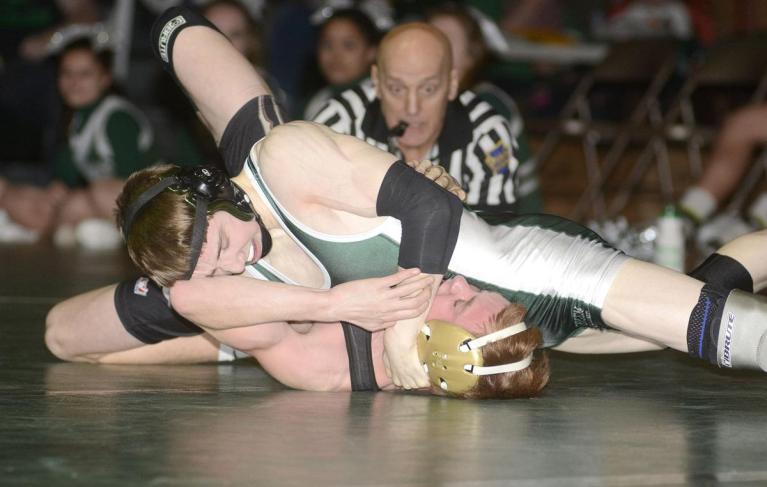
I love sports as a training ground for life. It is an opportunity for character development, to learn lessons about work and reward, teamwork, etc. I had my own regrets for having started competing only very late in high school and, therefore, have been very pleased that my own son wrestled over the winter and has been practicing for football season. He’s an amazing athlete for his age. He won his bracket in wrestling, his first year out, with a combination of will, natural strengths, and things learned from his coaches. It has not taken much encouragement to keep him going. He is an enthusiastic participant and seems to really enjoy himself with other kids his age. There have been a couple of times when he was upset and seemed ready to quit, but the next day he has always come back for more.

Desirous Distractions

Of the things I hate most, his tablet is probably in the top ten. We had successfully hidden it away (he didn’t miss it after a week or two) and yet brought it back out due to some current circumstances that make it better to keep him occupied. The result has been like an addict, or binge, where he would use the device non-stop if we allowed it. It turns him from an active and engaged kid, who loves to swim in the local pool and requires a ton of attention, to a slug barely moving for hours. It’s not healthy and that’s the reason why I’ve fought back against this and haven’t minced my words on this topic with him either. I’ve been glad that we had football practices to give that indisputable non-negotiable reason to separate him from the screen. However, the other day, after practice, he confessed that he wished that he didn’t play football so he could be on his tablet more!

One of my successes, so far, as a parent was to keep sports as his idea. Sure, I want him to play, I have done my part to facilitate his involvement as well, but I’ve mostly let him lead in what direction he wanted to go and was glad that his own desires lined up with my own. I’m sure my own hopes and expectations have found their way to influence, children likely know their parents better than their parents know them and generally want to please them. He knows that I’m a Penn State football fan and that, Charlie, the elementary wrestling coach was an old teammate. So it isn’t really surprising that he went down this path similar to my own. Still, I didn’t want to be one of those dads, the kind living vicariously through their son and putting undue stress on him. It does seem we’re too sports-obsessed, where youth leagues are year-round, there is this camp and that camp, which is driven by parents with glowing ambitions more than it is by the children themselves. I wouldn’t be all that surprised if many of these overworked and pushed too hard will quit. At the very least, it won’t be enjoyable.

The big question for me is what would I do if my son said “I don’t want to play anymore.” I’ve already assured him that not playing doesn’t mean he would get more time with his tablet and that he would probably be bored. And he seems to understand that he needs to finish what he started as far as the current season. Nevertheless, the chill I felt, all of my own dreams of watching him now threatened, could easily lead to my being more controlling. It is scary to me that a tablet, this path of least resistance, has so much appeal that he would sacrifice all for it. I’ve also had to question my own motives. Am I doing what is best for him? When I restrict access, when I push him to do things that make him uncomfortable, that’s the reason why I do. But as a parent, we really need to be careful not to project our own desires onto our children so much that they are stifled and not free to be themselves.

The Elusive Balance

My son would likely be completely happy if I just let him play on his tablet nonstop. Maybe he would eventually get over it on his own if we didn’t interfere? I mean, I doubt it. There are always new games to download and more distractions to occupy for hours and hours. And that’s my concern, that the hours he spends vegging out could be put to much better use. It would be negligence, on my part, to simply give him what he wants and never resist his short-sighted perspective. It is my job to develop him, to make him ready for life and sports are one of those tools used towards that end. I don’t want him to develop character, not to be a character in a video game. I want him to get exercise, experience the tactile and real world, and not just live in the fantasies that others created for him. I must resist him.

That said, football is also just a game. I don’t want to be that dad who ended up putting so much pressure on his son to be successful that it ruined our relationship and he quits in frustration. There is much more to life than statistics or the accomplishments that the world will notice. Yes, I would beam with pride if my son were to score a touchdown, be on a state championship team, and be good enough to compete at the next level. A college scholarship, of course, would be great. He doesn’t seem to be the type that will get that in the classroom, so why not encourage the path that he does have? Still, that is exactly the problem. I quickly get way out ahead of reality and with that could quickly destroy even my own enjoyment of the moment. He should, as a child, be involved because it is fun. Certainly, I must coach a little, put some restrictions here and incentives there, but ultimately he needs to choose.

I don’t want my son to go down the path of least resistance. I want him to be resilient, a leader, involved, pushing back, and growing his abilities rather than comfortable. I truly want him to be better than me in all regards. Or, at the very least, to be better for having had me be a part of his life. Sometimes this will require me to bump against his will, dig in my heels a bit, and not let him rest on his laurels or waste the opportunities he has. Other times I will need to step back, let him go his own way, learn at his own pace, and accept that his goals for life may not align with my own. The real struggle is the wisdom to know when to intervene and how. Hopefully, he knows my heart is oriented towards his good even if my execution is flawed. And, actually, I’m okay if we’re not always friends so long as what I’m offering him is a way to go beyond my own limits and reach his full potential as a man, that’s my reward.

Do you *really* want a life without conflict?

Standard

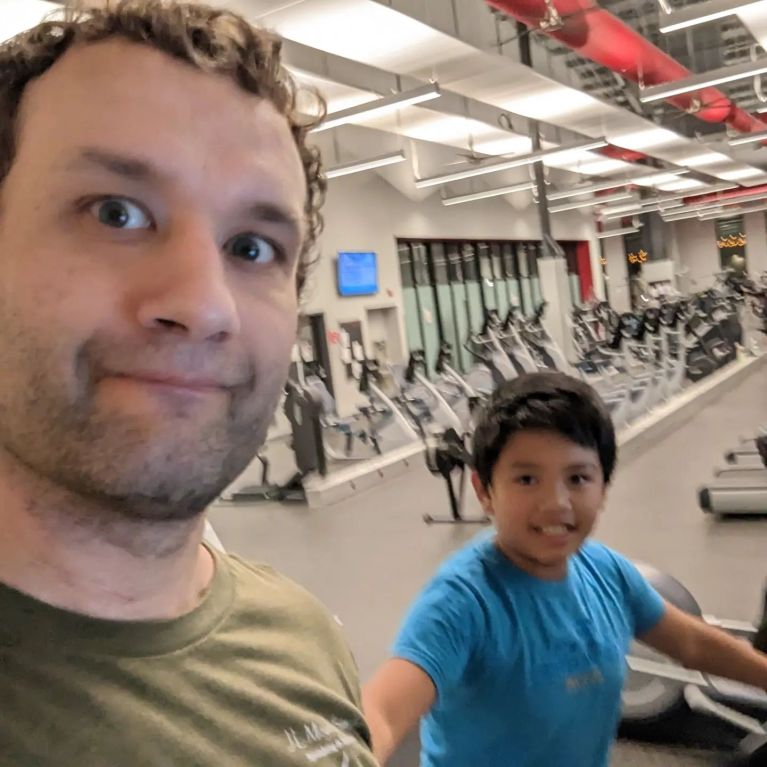
Thinking, as I’m sipping my coffee at Dunkin, a Saturday habit, we build civilization as part of the urge to reduce variables and the effort of living.  The thought started during my pre-waking slumber: We work, build shelters and store resources, create complex networks, to try to decrease unpredictability and the end result is that I don’t need to worry about my source of caffeine.

This orderly environment we create is ideal for raising children.  It is a nest.  Or at least at some levels.  Where we, like birds, weave a structure out of chaos in order to keep our offspring safe from predators and ourselves protected a world that can be unkind to the unprepared.  Squirrels scurry around, in the fall, gathering up things to keep for food over the hard winter months.  Our own species, likewise, is as instinctively forward thinking and creates systems to ease the strain.

The human endeavor, towards these ends of producing stability and abundance, has been so successful that many can go their entire lives not appreciating it. 

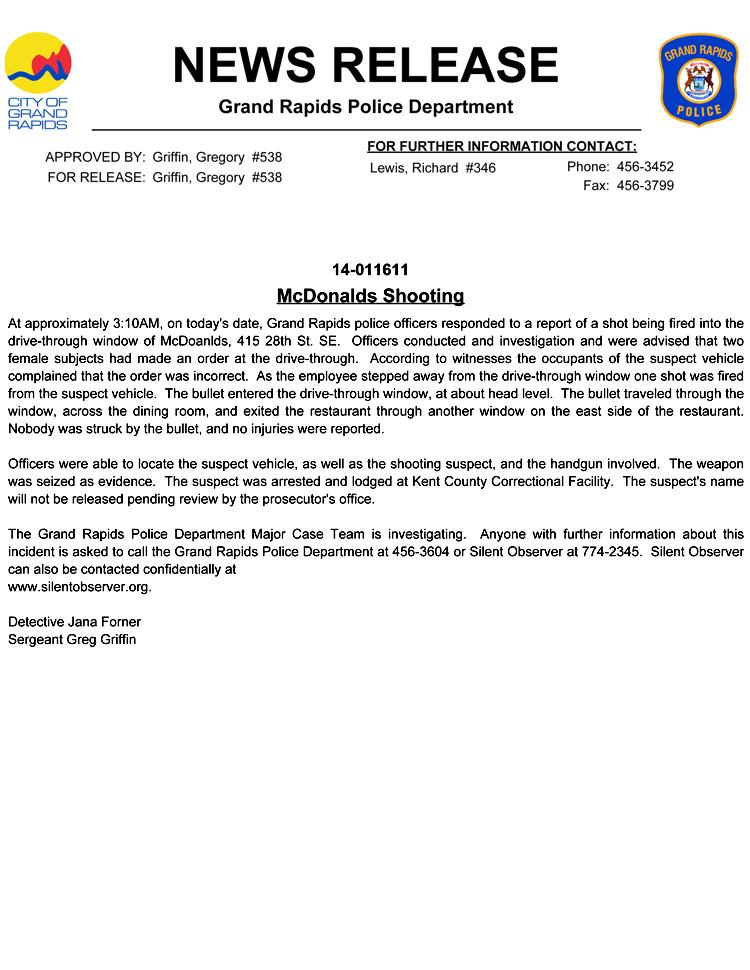
We’re so well-off, in the developed world, that our impoverished are obese rather than hungry and many now think that healthcare (a service provided by others) is a right.  we live in such unprecedented luxury and ease, even the poor can afford a lifestyle that many ancient kings would envy and yet feel so entitled to everything that we will shoot up the McDonald’s drive thru if we can’t get our bacon:

Evidently, being in civilization doesn’t make someone civilized.

Anyhow, other than entitlement and lack of appreciation, another product of civilization is boredom and fat.  In the absence of wars we created sport and without hard work, to keep from physical deterioration, we go to the gym.  It is truly bizarre, when you think about it, that we go out and seek the very anxieties that our ancestors built civilization to escape.  We are adrenaline junkies, doing intentionally dangerous things for the fix, we want to have unpredictable outcomes.

All of this really does make everything about our existence a weird paradox.  As soon we achieve a little bit of stability and peace we become restless.  That’s what convinces me that we are as much nature, made for the world we are in, as we are not.  That feeling that we somehow do not belong in this place with death and sorrow is what has motivated our progress.  It is less about our own being otherworldly and more what has enabled us to survive this universe that would kill us the moment we grew complacent.

This, incidentally, is the one thing that many people do not grasp about entropy, we tend to see decay and deterioration as being only a bad thing.  I mean, we fight it.  If someone walks into the house with muddy boots it is upsetting and spurs action.  But, without this tendency to disorder, without this repeated need to clean up on aisle five, would we even have a reason to live?  As much as we hate disorder, it is this continual struggle against it that gives us meaning and purpose.

Diary Of A Tortured Soul

Standard

What makes me a forever tortured soul is that I’m standing on the knife’s edge.  On one side my ideal, my hopes, dreams and faith.  On the other side my rationality, my anxiety, my knowledge and fears.  

The current cultural paradigm tells me the prior things are built upon social construct, the latter upon science.  They have first deconstructed meaning and purpose, now moved on to trying to even erase categories built upon biology, constantly destroying the rule by highlighting the exception.

The problem with me is that I’m not able to dismiss one or the other.  In many regards I am a postmodern thinker, having rejected modernism, and yet not in the way of those out to destroy every religious tradition or cultural institution.

My own understanding is that social structures, like family, gender distinction or nation, do exist for a reason.  Sure, they should not be an excuse for injustice or unfair exclusion.  However, those who only see these things in negative terms or as unnecessary are severely mistaken.

There are things that can’t be viewed under a microscope that are as needed for human thriving as oxygen or water.  Sure, it is easy to dismiss religion as superstition or redefine terms to suit the current demands of outliers.  

But being unable to appreciate the balance of forces that keep a bridge from falling doesn’t mean that someone can keep removing structural members without consequences.

While being a critic of abuses by these institutions of culture and religion, my point has never been to destroy them.  Sure, it is not acceptable, for example, that the word “modesty” in the Bible is misused to blame women for male lusts, nevertheless tearing down all expectations is an abuse as bad or worse.

Perhaps there are benefits to promoting healthy masculinity or a distinct feminine role?

Those trying to erase all difference in the name of equality are the most controlling and unpleasant people.  In the name of tolerance, they are literally at war with everyone present and past trying to preserve an identity they cherish.  They worship the exception while making life miserable for everyone else.

That’s where I differ from the ‘woke’ and the virtue signaling masses that empower their tyrannical edicts.  Sure, I believe in recognizing disadvantages of some and making wrongs right.  But that’s not what social justice is truly about.  It advertises itself as being a solution, yet is only the same evil of intolerance in a new more ‘colorful’ form.

Still, I am not capable of being fully engulfed by the teachings of Christianity either.  I tend to be philosophically in alignment rather than spiritually and that’s because I’m continually dismissing my own experience as invalid.  I mean, so what if I got the warm fuzzies at a church service, right?  I’ve also experienced euphoria on Adderall.  Been manipulated by music, a rousing speech or what have you.

I can identify fully with H.P. Lovecraft:

“We all know that any emotional bias — irrespective of truth or falsity — can be implanted by suggestion in the emotions of the young, hence the inherited traditions of an orthodox community are absolutely without evidential value…. If religion were true, its followers would not try to bludgeon their young into an artificial conformity; but would merely insist on their unbending quest for truth, irrespective of artificial backgrounds or practical consequences. With such an honest and inflexible openness to evidence, they could not fail to receive any real truth which might be manifesting itself around them. The fact that religionists do not follow this honourable course, but cheat at their game by invoking juvenile quasi-hypnosis, is enough to destroy their pretensions in my eyes even if their absurdity were not manifest in every other direction.”

But this writer of horror, who lived in his own existential crisis hell, does not seem like an example to follow.  What is the point of being ‘rational’ if it keeps one in a state of constant dread about how insignificant and out of control they are?  Is this holding to an agnostic and meaningless interpretation actually intelligence or simply another form of ignorance?

I vote the latter.

Command of language, the ability to pull together a vast amount of information and sift science from superstition, these are things seen as signs of intelligence.  And certainly they are measures of a particular kind of capability of mind.  But, as a person can be knowledgeable and unwise, saying things that bring us pleasure or purpose are not real is simply ignorant.

Serotonin is as real as the stars in the sky, the feelings this hormone produces are no different from light.  It would be stupid to argue that light waves are less important because they lack mass.  Likewise, to say that the spiritual is non-existent, because it cannot be weighed or otherwise measured, is not brilliance either.  Lack of appreciation or ability to comprehend things of emotional value is not intellectual strength.

Nevertheless, there is a sense in which seeing behind the veil changes things, there are things that can’t be unseen.  And those Lovecraftian monsters do exist even if only in the mind of the author.  

My own experience, unfortunately, has left me untethered from the comfortable and floating in space.  My sincerest hopes rejected as being delusion by the very people who I had thought would appreciate such things.  It is difficult to cling to the belief that “with faith all things are possible” when your former pastor’s daughter, encouraged by him, supposedly missionary minded, tells you she can’t love.

It is that disconnect between profession and action that keeps me still precariously balanced on bloodied feet.  

Orthodoxy has brought me a firmer foundation than the ever shifting sands of Protestant theology and practice.  It is certainly more ancient and authentic than the alternatives.  Still, that loss of identity and innocence, that process of degradation of my child-like faith over time, makes restoration of my soul seem as possible as a return to my mother’s womb.  How to become less cynical again?

I do envy the simpletons who can ignore such things.  They suffer without swaying in the belief that God is in control.  Wouldn’t we all live that way if we could?

At some point doesn’t logic dictate we take the advice of Job’s wife, curse God and die, rather than continue to push through the pain against all odds?

This blog site, Irregular Ideation, was a product of my dilemma.  That is what to do when the happily ever after and meant to be fairy tales are insufficient to get us beyond our fears.  What does happen when those teeth of quiet desperation and endless angst finally gnaw through what remains of the moral foundation.  The eternal abyss opens beneath our feet, the inscription over our heads: “Abandon all hope, ye who enter here.”

Fr. Anthony, the spiritual mentor that met me in my time of need, boiled it down to a choice, either we choose to live a life of meaning or we do not.  Charlotte, my bhest, has also urged me to be strong and that likewise suggests that we decide what is worth the effort.  But none of that makes the choice easy or pain free.  Adam and Eve never lost that awareness that biting from the forbidden fruit of knowledge gave them, the thistles of doubt and despair still remain.

It is both assuring and terrifying that the most notable characters in Scripture were tormented.  Elijah, having witnessed literal fire from heaven, fled terrified into the wilderness because a wicked queen threatened him.  John the Baptist, suffering in prison, sent his disciples to ask Jesus, “Are you the one who is to come, or should we expect someone else?” (Matthew 11:3 NIV)  And Jesus himself, in angish, speaking of his coming trials, prayed “take this cup away, and on the cross felt forsaken or abandoned by God.

St. Paul, with his undisclosed “thorn in his side,” suggested a division within, the ‘spirit’ being willing while the ‘flesh’ is weak.  The book of Psalms and other Biblical poetry, a great comfort to many today, suggests the writers were experiencing travails and torment.  In no way were these ignorant people living a life of bliss.  They were fully aware, they had their moments of failure, and choose to keep going on in faith despite this all.

As my parish priest reminds us, “If you ain’t struggling you ain’t Orthodox.”

So while my life would be so much easier if I could be agnostic and accept that we’re all products of random chance, biological robots plotting a predetermined course, that everything is about sex and power.  But I don’t give in to that existential dread and will stand against those who, with seeming sadistic pleasure, tear at the foundation of meaning and purpose.

I’m tortured soul because I am able to both see the fullness of beauty and also stare into the void of emptiness.  I live with keen awareness that many have died, clinging to breath and hope, thinking their salvation was right around the corner.  It could all be for naught.  Still, I fight.  I’m not in control, I never will be, and long for that final peace when my journey is complete.  For now, though, I’ll dance on this blade, my persistent uncertainty on one side and strong desire for God on the other.

I can pretty much rationalize around any moral boundaries, maybe eventually embrace a life of self-indulgence and not giving a crap about those whom I’ve stepped on to gain a small advantage.  I could, more easily, give in to self-pity or be overwhelmed by cruelty and give up.  Lord have mercy!  Still, something within, not even sure how to define it, pushes me to endure through hardships.

At some level it makes no sense, why must we go through hell to get to heaven?

It doesn’t make sense.

But then neither does my existence.  How did I come to be?  If my life is finite and time stretches infinity in both directions, there is essentially zero chance of being on this moment right now.  So our existence is not rational nor that we extrapolate, from our pleasure and our pain, that there is something greater.  Maybe belief in the divine realm, where all is made right, is merely a survival mechanism—so why then do we question it?

And so it goes on.  There is no growth without pain, not triumph without suffering, our moments of glory would not be such a pleasure if there was nothing required to attain.  So why not extend this pattern and conclude that our torment, if righteous, will be rewarded…

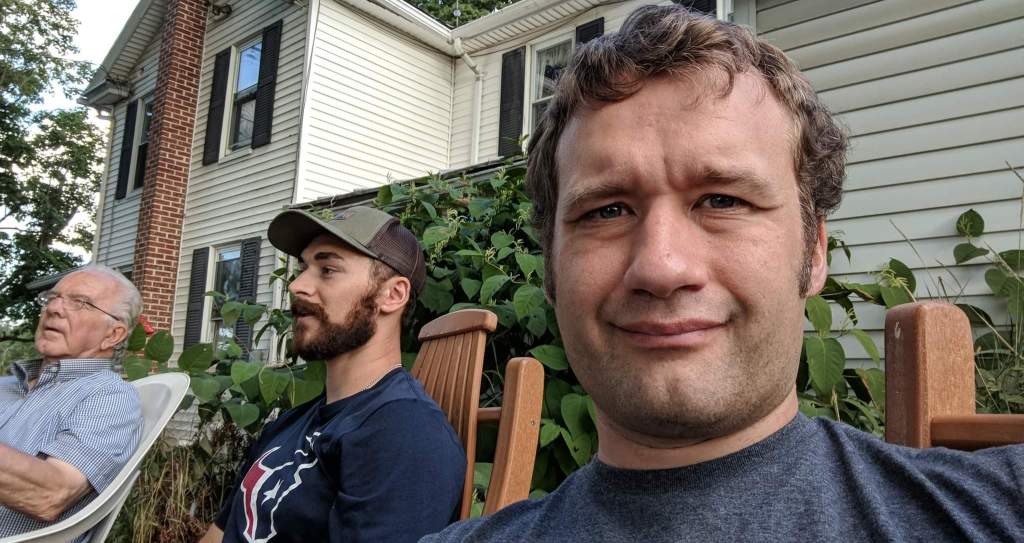
A picture I snuck of my grandpa, Uriah and myself…while contemplating life…

Simone Biles, Joey Julius, Jim Thorpe and Mental Strength

Standard

Simone Biles, arguably the best female US gymnast ever, decided to quit the competition at the Tokyo Olympics.  This decision was as celebrated as if she had won gold and that caused some conservative friends to protest.  The bulk of the criticism having to do with the glowing coverage of this choice.  But then there was a lot that was aimed at her personally, calling her a deserter, “an entitled, weak, brat,” and part of the “participation trophy” behavior. 

While I won’t call what she did stunning or brave, I will also withhold any sort of hard judgment concerning her.  Maybe it was the right decision?  If she isn’t feeling up to the task then it might be good to allow the next one up to fill the spot on the team?

Given that it was leaked, back in 2016, that Biles uses Adderall, a common stimulant used to treat ADHD, and banned by the Olympics, it is little wonder she is out of sorts.  That’s a strong drug, in the methylamphetamine class, and going off of it could severely hamper a person mentally.  Many people (conservatives, in particular) do not understand how much their mood and level of ambition are predetermined.  During my brief stint using Adderall, I learned a lot about how easy it is to get things done when you have complete focus  The withdrawal is something fierce too.  For me it left a dead inside, can’t get out of my own way, feeling when in withdrawal. 

So, rather than an indictment of Biles, this may be a concern about how we deal with life in the United States.  Whereas previous generations and most people in the world cope without drugs, the US is very drug dependent.   The US, in fact, is the world leader in prescription drug usage.  The US produces and uses about 85% of the world’s methylphenidate.  Rather than overcome by internal means, learning coping skills, or building mental strength by simply getting up and after it, we are relying on the take a little pill solution to problems.

Then again, we can’t know if Biles would ever be competing at this level without Adderall.  But we do know that she has had many things to overcome.  She has worked very hard to get to where she is.  She has endured a childhood of hunger and sexual abuse too.  This is why I’m not going to join anyone in calling her weak or anything else.  Unless someone has competed at the highest levels of gymnastics and knows a little of the commitment and strength it takes, then it may be best to leave judgment to those who have been there and done that.

That said, the question of whether we are getting mentally weaker is worth looking into, but first another athlete’s story…

A hard-hitting and short career

Joey Julius stormed onto the college football scene with his big boot and his hit stick tackles. 

Kickers are not generally known for their toughness.  It is typical that they hang back and play safety on the kick coverage.  It is expected that they might try to run the play out of bounds or go for a feeble attempt at the runner’s ankles.

Moment before impact

But that wasn’t Julius.  He was a big boy, 260lbs, and very quickly became a Penn State fan favorite with his ferocious coverage team collusions.  He was a walk-on and seemed to be ready to entertain for years to come.  Yet, right as his fame rose, he disappeared.

It certainly was disappointing for me, as a fan, to see this exciting and unique player off of the roster. And, of course, I had to ask why. For me being able to start for a college football team would be an amazing privilege and never something I would pass up. However, as one who saw my own cousin, a 6′-8″ 320lb lineman, confident as he was going in, get bogged down with injuries and the pressure of college life, end up off the team after one season, I understood that it isn’t an easy thing to be an athlete at that level.

As it turns out, Julius, despite his new celebrity, still struggled with body image issues and binge eating disorder. For all his success on the field, and the acceptance it brought, he felt he was not as he was supposed to be, was overcome by anxiety, depression, and suicidal ideation.

As for toughness?

I know for certain, at least at my own size and strength, I wouldn’t run full speed into a division one athlete. So it would be hard to call Julius a weakling. As with Biles dropping out, their fame and athletic pursuits, our want of entertainment, all come secondary to their well-being and only they know what is right for them.

I wish him well.

My own story of quitting early…

I was picked to be on the church council late last year.  My congregation is small, yet a serious responsibility and, in my mind, an honor.  I had planned to serve out my full-term and was even a little excited.  It was the first time I would serve in a leadership position.  I had not been so much as a youth officer in my old denomination and it did bother me a little.  That said, I’ve never sought out mundane administrative duties, so being overlooked for the role wasn’t that big of a deal either.  Nevertheless, I took the reminders of Father Seraphim to heart, that we were to be an example to the rest of the church, and that would eventually lead to me resigning my post.

I would love to see myself as being mentally strong and might be in some regards.  However, the death of Uriah had taken an emotional toll and I really was not feeling up to the task of being a council member.  I was simply not putting in the kind of energy that I thought would be right for the position and started to have second thoughts after the first couple of meetings.  So I shared these thoughts privately with sub-deacon Anthony, who graciously responded, but then decided to continue the course.  However, that resolve did not last long.  The next meeting, for whatever reason, I was just feeling very discombobulated and even angry, it didn’t make any sense.  It was at that point that I decided to send Father a message to ask if it was okay to resign and he accepted.

It was embarrassing to me. 

As Jesus said, concerning discipleship:

Suppose one of you wants to build a tower. Won’t you first sit down and estimate the cost to see if you have enough money to complete it? For if you lay the foundation and are not able to finish it, everyone who sees it will ridicule you, saying, ‘This person began to build and wasn’t able to finish.’  “Or suppose a king is about to go to war against another king. Won’t he first sit down and consider whether he is able with ten thousand men to oppose the one coming against him with twenty thousand? If he is not able, he will send a delegation while the other is still a long way off and will ask for terms of peace. In the same way, those of you who do not give up everything you have cannot be my disciples.

(Luke 14:28-33 NIV)

Yes, perhaps the death, after a year hoping for a miracle, presented an extenuating circumstance.  But then everyone on the council has their own crap to deal with and some of them possibly more than me.  With a combination of perfectionism with some laziness, I had taken the easy way out.  Sure, it was good that I took my job seriously enough that underperformance was an issue.  And I knew when I agreed to the position that I wasn’t going to be a flawless participant.  Furthermore, I don’t quit my day job because of a bad day or even months of struggle.  So maybe it was all simply an excuse as soon as things got tough? 

I do know this, my replacement on council is an elderly fellow who probably should be enjoying his retirement rather than pick up the pieces for this me-first generation.

Is weakness a choice?

There is a character issue to be considered.  I’m the guy who can show up to work, in absolute agony, head ready to explode from an infected tooth, because someone has to do the job. 

Diminished capabilities or not, I understand that my participation in the group effort makes a difference and also that my paycheck depends on showing up.  In other words, maybe my quitting council was a sort of self-indulgence, or willing fragility, rather than an absolute reflection of my true ability to complete the task?

Sounds harsh. 

But then it is part and parcel of my generation’s ‘authenticity’ at all costs mindset.  We cast this as being strength, the “you do you” mantra is repeated often.  Still, it is also likely costing our greater potential when we choose to quit because of feelings of inadequacy or our lack of mental fortitude.  The idea of “fake it until you make it” does not exist because other generations had it easier than we do.  This learned helplessness, while comfortable, is essentially a self-fulfilling prophecy and keeps many people from ever reaching their full potential.

The name Jim Thorpe comes to mind. This Olympic athlete, the first of Native American heritage to win gold, was an incredible story of mental toughness. While in competition, having had his shoes stolen, he found a mismatched pair of shoes in the garbage—used an extra sock on one foot to make it work—and went on to win a couple of gold metals in this hasty arrangement. This is a man who had every excuse to give up. Have you ever try to run, let alone compete at the highest level, in shoes that don’t fit?

The true GOAT

It would be worthwhile to read up on Thorpe, compare what he endured to the stories of Biles, Julius, and my own, then draw some conclusions. Perhaps the reality is that we could and we simply didn’t? In other words, we made a choice, picked an easier path, and missed an opportunity for growth?

My grittier moments…

I’ve had many setbacks in my life. I started struggling for breath, as a preemie, was a slow developer physically and late bloomer otherwise. Opportunities were often behind me before I even realized I should be seeking them.

I don’t recall, it was relayed to me, but apparently an elementary school teacher had told my mom about an incident, during a math test, where I jumped up beside my desk and screamed. Why that shy child would make such an outburst? Well, probably because I was so frustrated, trying so hard to focus, full of anxiety, and was barely able to do the work.

Obviously, like my eldest sister who blazed her path, I was driven. But, unlike my sibling, who could put her mind to something and do it, I would be overcome with my perfectionism and eventually defeated in various pursuits by my fear and doubt. The most crushing of those being my inability to pull myself together when things became uncertain in romantic hopes.

That’s not to say that my sheer will and determination gained me nothing. As a 112lb senior, I started and finished a season of football. I’ve comeback, on a couple of occasions, from injuries that might have caused some to put an end to their fitness regime. I had even walked in faith, against the odds, to pursue the impossibly, to the point that I became mentally ill and had nothing left to give. I’m still here.

At times I hated whatever made me want to keep going despite these setbacks. My mind, like Job’s wife, telling me “curse God and die.”

Fortunately, unlike many in this age that loves victimhood, I had a mom who would not let me slack off or quit. Sure, she could never do the work for me. But she could have easily nurtured me to death by catering to her poor Joel. I was a trouble child, especially as a teen, a tortured soul, someone always stuck in the mud, spinning his wheels as dreams sped away and vanished over the horizon. I didn’t actually know how to grow up or be independent. I would still be living at home had my mom allowed it. She didn’t.

Nobody is born ready to soar, not even a bird!

The idea of a home mortgage had terrified me. Could I make the payments? What if I could not pay it back? It was too much for me to do voluntarily, without that push, because I didn’t have the mental strength. And yet, when the time came, when I finally did sign the papers, not only did I pay off the loan, I actually paid it off in half of the time!

Incidentally, it was this that made me more confident when facing the impossibly, that Mennonite female interest to end all, and also totally upended me when she said, “you’re thirty years old living in Milton.” In one sentence she had destroyed the meaning of the entire struggle up to that point.

Nevertheless, even then, when I stopped eating and holed up in that cracker box house, wishing to die. It was my parents, especially my mom, who continued to push. Yes, there was comfort and consolation, time given for me to grieve, rest and collect myself again, yet never coddling or agreement with my despair.

It is absolutely terrifying for me to imagine what I may have become had I quit the first time things required digging deeper. I mean, I would have likely died in that plexiglass box—the isolette—had I not been a fighter, had my physician uncle given up, etc.

Not to mention had my mom decided pregnancy was too much for her or my grandparents lacked the commitment of marriage.

Life is tough.

We would not get very far if we make quitting when things don’t go our way into a habit. That is why we should be concerned about the new turn towards making heroes out of those who do not finish. Sure, there are reasons to quit, to avoid injury or whatever, but when it is simply an excuse for not putting forth effort? That’s a problem.

Build strength—Do not coddle weakness

Our culture, sadly, is coddling many to their own detriment. Many young adults live as overgrown children, unfulfilled, because they’re encouraged to be mentally weak and their needs are being provided. By contrast, I’ve seen an Amish toddler herd cows, Chinese toddlers can cook meals, and humans have an amazing ability to rise to the challenge.

It is a sad day when we go from honoring strength, that hard work it requires to achieve greatness, to celebration of weakness. It is basically a suicide pact, a death spiral, and makes thriving impossible. By telling people that they’re unable, that quitting is okay, we are doing them a lifetime of harm. We are currently at a crisis point it is not sustainable to go the direction we are going.

We need more heroes like Jim Thorpe now more than ever. The future of our species depends on it. However, this mental toughness, it doesn’t start (or end) with elite athletes on the world stage. It means having the courage to get up and go again, despite our feelings, and repeat as many times as necessary until we’re able to overcome. There is no pill, no magic solution, only learning not to make excuses and push on.

Loose Ends, Long Waits, and Second Acts

Standard

The only thing I hate more than loose ends is multiple loose ends. Loose ends represent instability and uncertainty, they are the fringes of the chaos and confusion that perpetually threaten to overwhelm the necessary stability and order of our lives.

There are several big projects in my life right now, well under way, some years in the making, and all of them various stages of incomplete. My ability to handle pressure has always been a big question mark and the past few months have tested the strength of my resolve.

I’ve sometimes felt as if I’m a person at the edge of functional, who kept things together mentally or otherwise by careful management of his resources and emotions. But in the past few years I’ve determined to sail beyond my safe waters, beyond the established boundaries of my known limits and at the risk of failure.

Am I built for this?

My new career is the first part of this stress test. I definitely have the basic aptitude for truss design and have become reasonably proficient at using the engineering software. However, with my proficiency, and changes in the truss market towards residential, the expectations are high and the workload has ballooned.

More recently it has become a make or break it moment as the construction season wraps up and a new prospective customer has piled on, who refuses to give the information that I request and seems to have very little respect for my time. He wants a “conference call” after every small revision and email, every conversation with him is circular and I’ve reached peak frustration in dealing with him.

However his project does promise to be one of those signature projects, if it ever gets underway, and the truth is that I really want him to be pleased with the work we do. It’s just that right now it is impossible to know if he’s just going to be an endless hassle, who tries to micromanage every part of the process or if he’ll become more cooperative and less doting as things progress. I’m not holding my breath.

There are days where I could be tempted to turn back, return to the proverbial Egypt of truck driving, and not need to deal with the pressure of always having to get things perfect. In trucking, a few spilled beans is just a few spilled beans. But, in this job, if I enter my numbers wrong here I could have the truss equivalent of “Galloping Girtie,” a very costly disaster and would need to bear the shame of my failure.

Of course, then again, an accident, for a commercial driver, can be a felony offense and especially if they can prove that you were distracted at the time. So maybe I’ll stick to the possibility of big financial losses for my company and potential of losing my job over sharing a cell with Bubba because the dispatcher needed answers and a silly “four wheeler” decided to use the same exact moment to check my reaction time?

I’ll stick with tapping the keyboard where there is less chance of me dying trapped in the burning wreck of a big rig, where I can be home at night despite a long commute, and my coworkers are Amish and awesome people. My hope is that eventually that will grow to the point where they can justify a second designer, so I can breathe a little and at least have the possibility of a day off or even working from home. It is a work in progress.

When will it be finished?

In the midst of everything else, I am (with the help of a more construction qualified friend) preparing a place. For many years I’ve lived comfortably in a small house, my bachelor pad, but for various reasons have decided that it is the right time to make a move.

First, the opportunity presented itself in the form of a “for sale by owner” sign along the path of my Saturday Dunkin coffee and donut routine. It was an upgrade from my current residence in terms of square footage and yard space. But it was also in severe need of a remodel, with cracked plaster, evidence of past leaks showing on the ceiling tiles, and other blemishes.

So, with the bank on board and price being right, after consulting some contractors, I went forward with the purchase.

Obviously, being that this is not only my own money involved and every month I wait to move in is a loss of a rent check plus the cost of utilities, there is a strong desire on my part to get the job done. That said, it will also be my own personal residence, the future “bhest nest” for my loved ones, there is also an equal desire to get it right the first time and thus speed was not the only concern.

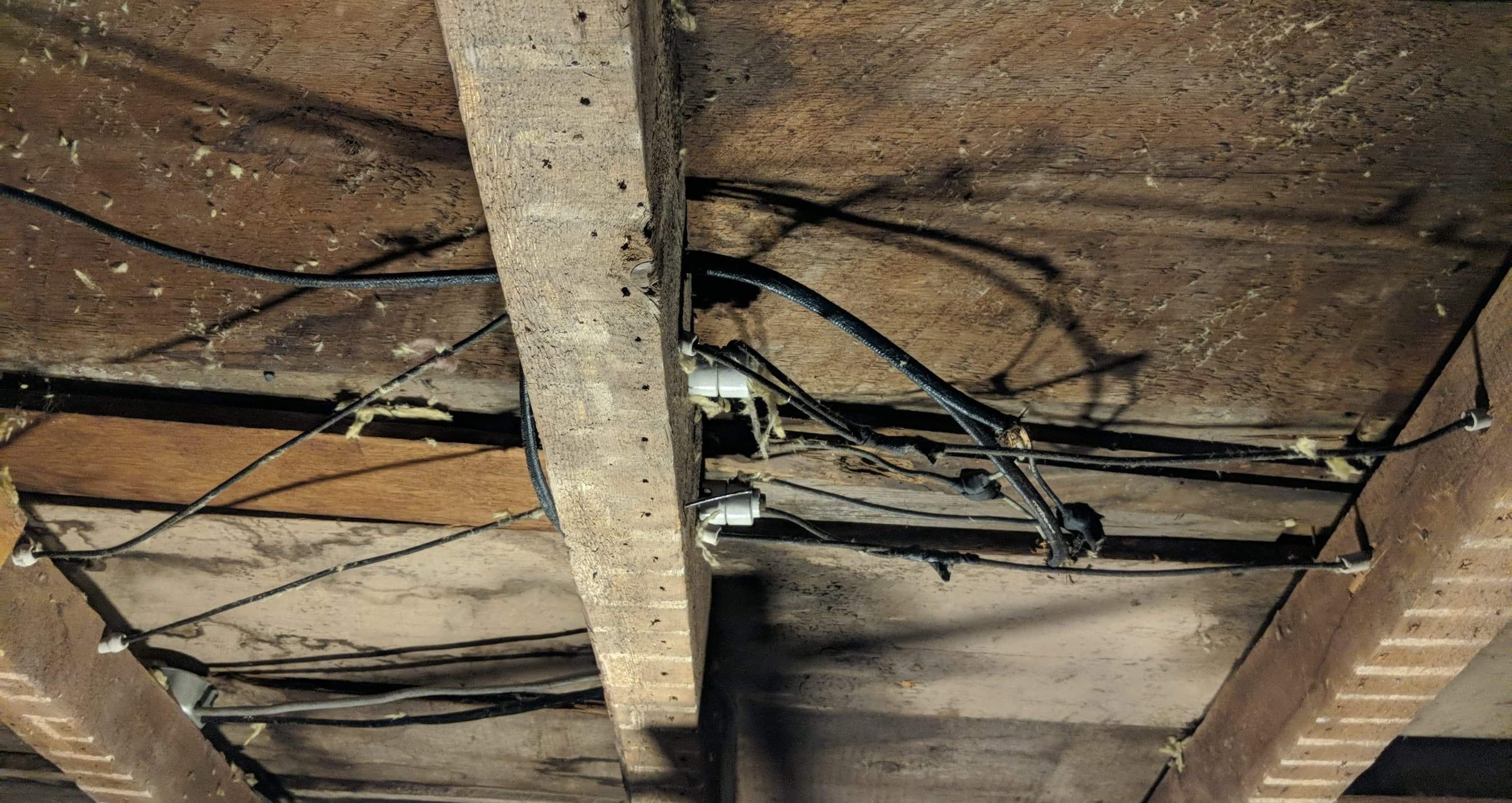
As such projects go, we are behind schedule and threatening to go over-budget. But, at the same time, I have confidence we are doing it right and not cutting corners. For example, the old “knob and tube” wiring could have simply been covered up, spared us that extra week or so of work and the added cost, yet this is the place where I plan to sleep, keep my accumulation of things, etc.

I’ve also decided that working with a contractor is preparation for a having a wife. They don’t spend money like I do. They seem to see my wallet as being a spigot from a bottomless well, spending a thousand here and two thousand there is no big deal, whereas I’m keenly aware of every dollar spent and who will be slaving away to accommodate their excess. I’ve never told them no and they still call me tight—perhaps a warning against hiring (or marrying) friends?

Oh well, I’ve been every bit annoying as the customers I would complain about, I’ve made frequent visits, had things reworked midcourse to suit my preferences, and fussed about the lack of progress. I’m sure we’ll both be relieved once the travails of a major remodeling project are behind us, at very least the pressure will be off of me once I’m moved in and temporarily not hemorrhaging cash like a politician trying to buy votes. Ultimately, the best kind of project is a finished project!

Building towards that simple and happy life…

The bhest is yet to come. Everything up to this point I do and will be made worth it all when the big moment finally arrives. At this point I’m just getting all the pieces into position for something far greater on the horizon.

It has been a sort of an intermission period, with one act over with the next act yet to begin, and he waiting for the curtain to open has been my grueling, seemingly impossible, task as of late. There is much anticipation of things to come, but also as much anxiety about how things could go wrong (as so many did in act one) and I’m simply ready to get started with this next significant and very long awaited stage of life.

I had once wondered how Jacob could have labored so many years for the woman he loved. But now that I’ve surpassed his fourteen years, I’m not so much impressed, that’s puppy love. Besides that, he had a companion for half that time and also knew what was waiting for him at the end. I never had a Laban in my life. I’ve never had a father who let me prove myself or work for the love of his daughter nor any reason for hope other than my own stubborn refusal to quit.

In fact, I longed for something definite, some kind of clear path towards the Promised Land, and always ended up staring into an uncertain future. It is easy to fight dragons when you know that the princess is waiting for you in the castle. But it takes real courage and character to continue to fight despite the fears that a more profound loneliness and more terrible depression could be the only reward waiting at the end of your struggles.

Just an undefined waiting time is bad enough. It is the thing I hated the most about driving truck. I would much rather be told a specific time, even if it is a long period of time, than a “we’ll tell you when we’re ready” or some other non-committal response. I mean, how do you plan for an indeterminate period of time? Do I crawl back into the sleeper only to be woke from my sleep five minutes later? Not knowing confined me, it limited what I could do, and did not allow me to prepare.

It remains to be seen how the lingering conflicts of act one will be resolved. Questions still remain that I hope can soon be put to rest. But right now I must focus on tying up the loose ends, working through the stress of the interim, being patient and trusting that the right answers will come in due course.

Will the impossible be made possible?

Stay tuned!

Pure Nonsense: The Courtship Idealism That Failed

Standard

I’m sure you are familiar with them, you know, that family who has a life that resembles a Thomas Kinkade painting, always so idyllic and cute. In fact, they are so adorable they are annoying. This sort of charmed life comes a sort of “holier than thou” smugness. Sure, they are too perfect to say it outright, they always religiously maintain that facade of sweetness, but they often have the easy answers that often betray their true cluelessness.

I can recall, for example, a lovely twenty-something, themselves engaged, who with complete sincerity suggested that my romantic struggles may be God’s will for me to remain single. They themselves successful because of their endearing charm and connections (which to them meant divine favor) whereas my own inability to navigate was to be taken equally as a sign. Apparently they worship the God of circumstances, one that absolved them of any responsibility to help those less fortunate—other than to offer some words of encouragement and advice.

Anyhow, thank God that doctors do not subscribe to a similar thought process: “We know you are lots of pain, broken legs are not easy for sure, but have you ever considered that it might not be God’s will for you to walk? Here’s an ice cube, I suck on one of these when I’m feeling down and out…” That sort of response would probably fall under the category of medical malpractice. Likewise, the advice of those who heap a burden on the shoulders of others and yet are unwilling to lift a finger to help (Matt. 23:4) are guilty of spiritual malpractice:

“Suppose a brother or a sister is without clothes and daily food. If one of you says to them, “Go in peace; keep warm and well fed,” but does nothing about their physical needs, what good is it? In the same way, faith by itself, if it is not accompanied by action, is dead.” (James 2:15‭-‬17 NIV)

The passage above, from James, contrasts the mere words of the pretentious and the gritty hands-on sacrificial love that true faith requires. Talk is cheap, my darlings. And what my advice giver really meant to say is that they were unwilling to pull out all the stops on my behalf, they themselves were comfortable with my circumstances as they had persisted for years and thus they were unwilling to confront the prejudices or cultural assumptions that had made an impossible hurdle for me. But, rather than take personal responsibility for their own indifference towards my plight, they turned it into God’s will.

The Courtship Idealism That Failed…

When the news of the separation of Joshua Harris from his wife of over twenty years reached me this week it was hard not to connect it back to the courtship ideal he expressed many years ago. Harris, a “purity culture” advocate, rose to prominence in fundamentalist churches for his book “I Kissed Dating Goodbye” published in 1997. In this book unmarried Harris promoted a model of courtship that was supposed to lead to happily ever after and instead left many of us outside looking in—unable to overcome this stumbling block put in our path.

The Harris model of courtship required a level of commitment that, for the less beautiful and bold, made it virtually impossible for many of us to get started. This absurdly increased threshold of commitment meant that unmarried women, even in their mid or late twenties, refuse to go so much as a coffee date with an eligible bachelor for fear that it could lead to ‘defilement’ or marriage. The horrors of being sucked into a commitment after finding out that slightly awkward guy is a lovable child of God! I mean, isn’t that what King Solomon had in mind by “guard your heart”?

(I have about 1000 reasons to doubt that interpretation.)

Pushers of purity culture didn’t necessarily intend their model as a panacea. I’m guessing Harris and others would deny that there were guarantees of success that accompanied following their prescribed methods. I’m also pretty sure they did not anticipate the unintended consequences and damage caused by their teachings either. Nevertheless, they did “tie up the heavy, cumbersome loads” of fear and many have failed to find meaningful relationship with their religious counterparts as a result. It undoubtedly contributed to my own woes.

Sure, some, including Mr Harris, were able to get through this courtship minefield. However, that doesn’t mean it produced that perfect marriage as was promised by their courtship prescription. However, formulas aren’t going to produce happiness through the years and struggle of a marriage. If anything they built up impossible expectations for married life in the same way that they did for dating relationships and leads to future disappointment. At very least, while unwarranted confidence is attractive, nobody wants to be married to someone with all the answers.

True Faith Comes Through Struggle…

For all of us who weren’t born into a Precious Moments world, who had to beg and plead, compete against the odds, claw for inches at a time, to earn our small measure of success, we can’t simply rely on circumstances. Our Pollyannaish notions of destiny and love have always went up against the headwinds of fear and brick-wall after brick-wall of rejection. We weren’t born tall, extraordinarily handsome or especially wise. If we were wait for our dreams to arrive on a silver platter we would never get anywhere.

If we were fatalists and shared the mechanical view of God’s will of those who depend on circumstances rather than faith, the faith of those who “ask, knock and seek” (Matt. 7:7-12) that Jesus described, then we could also blame circumstances for our not getting out of bed anymore. I can assure you of this, there were days where I had fight to continue, where it was only the love of another person that kept me going, and that’s what real faith is. Real faith is having the guts to face down the impossible.

The cutesy patootsy life doesn’t actually require any faith, sacrifice or grace. Everything depends on their good feelings and God’s will mysteriously never goes against their own expectations. And it works until they face that first real test. When those delusions of “meant to be” are replaced with the reality of failure. I pity those who get the rug yanked out from under their idealism at a later age. That is why I pray that Mr Harris and his family find God’s grace is sufficient even when things do not go as planned.

We need fewer books giving advice. We definitely need less advice from single men, with their graceless formulas (*ahem* Bill Gothard, are you listening?), and more faith of real action. Being a best-selling author at twenty-one might be a thrill and even good for your chances of getting married. My question is what did these idealistic men do to help others across that impossibly high threshold they created? In the end what matters is what we do to help others carry their burden.

It’s time to kiss the book “I Kissed Dating Goodbye” goodbye. A courtship ideal cannot prevent divorce and it seems to more often prevent marriage. It is faith of action, not a courtship ideal, that makes a successful loving relationship possible. A faith that is willing to sacrifice, truly sacrifice, for the good of another person. A faith that makes the impossible possible rather than blame God’s plan for our own unwillingness to intervene on behalf of others.

Easter, Endgame and Resurrections

Standard

Spoiler alert.

The fight is hard, there are great sacrifices that need to be made, but in the end the good guys win and the armies of chaos and confusion are defeated.

Or at least that is how one would expect of a superhero movie that packs movie theaters around the world, right?

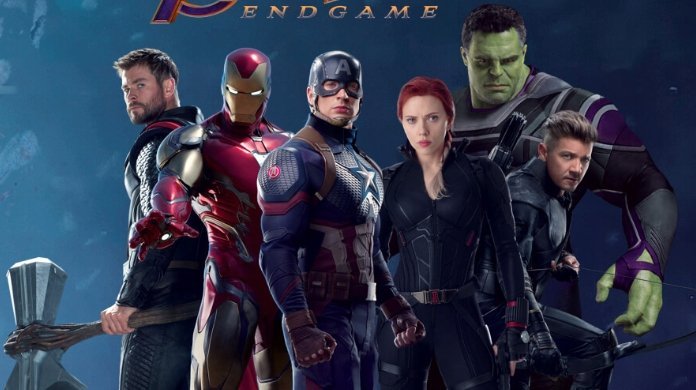
Some, from my religious roots, would decry the fact that “Avengers: Endgame,” the wrap-up to a 21 movie saga where an unlikely group of misfits take on villains of increased size and power, is better attended than their Easter services.

I mean how can it be a good thing that so many seek to be entertained by watching such nonsense?

However, in my own perspective, it doesn’t seem like such a bad thing that story of triumph through self-sacrificial love still dominates the box office. In fact, if imitation is the highest form of flattery then this creation of Stan Lee’s imagination is possibly the ultimate expression of Christian worship.

God, who lives outside of time itself, taking on the form of a man to save the world from death and destruction, sacrificing his all for sake of his friends only to triumph in a way unimaginable, is basically the end game of the Gospel.

As someone who enjoys “cinema magic” I’ve had to reflect many times, and often with tears, as I related to the struggles of the characters on the screen. Sure, the stories may be fictional, yet there is truth that transcends our reality captured in these fantastic accounts and that is exactly what draws the crowd now as it did when Jesus worked his miracles.

I am Tony Stark insomuch as I’ve needed to adapt to survive and overcome even myself, my pride, to protect those who I love.

I am Steve Rogers insomuch that I’ve often felt like a throwback to a more innocent time and, like him, I belong in a world that has passed me by while frozen in ice.

I am Bruce Banner insomuch as I’m the nice guy, who doesn’t always know how to express himself, but when pushed far can go full on Hulk mode and leave a path of destruction.

I am Thor insomuch that I’ve been handed great responsibility, given a divine inheritance that I feel unworthy to wield (despite many assurances) and have failed those whom I love.

I am Natasha Romanoff insomuch as my loneliness, being a tragic character, haunted by my past and my crushed romantic hopes in particular.

I am Clint Barton insomuch as I’m just a man wanting to live a happy simple life, yet always faced with complexities, sucked into a fight bigger than my abilities, etc.

As I enter this endgame of my life, I’m in a fight to save my future from my past. I carry a weight of painful baggage, the resurrection of my hopes still incomplete, and some days I feel stretched well past my abilities to continue on. There are times I wish I could go back in time and fix the terrible things that have taken so much out of me. However, there are those whom I love too much now to abandon in an effort to retrieve that which was lost.

It is only fitting that the Endgame movie come out so close to Easter and you’ll need to watch it if you want to understand why that is. The story is compelling because it is a story very much like that of the one who overcame death through death and has given humanity a path to salvation. As I look forward to being a husband and father, a true friend to those in need of love, it is the heroic example of Jesus that will guide me.

Wrestling for the Meaning Behind the Chaos…

Standard

A few years back, while in the throes of a struggle that would inevitably change my religious identity forever, I pondered the story of Jacob wrestling with a mysterious visitor through the night. In the book of Genesis we read the account of Jacob grabbing hold of the strange angelic man, refusing to let go even after serious injury that would leave him crippled for life, and finally declaring: “I will not let you go unless you bless me!”

The man, identified in the passage as God, does bless Jacob. He also gives him a new name, “Israel,” that means “man who struggles with God” because of his life of contending with everyone and Jacob, now Israel, limps into the new day forever changed.

That story resonated with me.

The tenacity of Jacob mirrored my own a few years ago.

My mom had always told me that my name meant “strong-willed” and she paid the price for her declaration with an intensely determined son—a son who would who, after traumatic birth, needed that will to fight and would go on to contend with his parents and everyone else in the stuggle to survive.

Unlike many religious folks who seem to think that “contend for the faith” means something akin to wishful thinking, always waiting for God to do something and general agreeableness, somehow I got in my head an idea that it means grabbing hold and never letting go until we are blessed by God. It is Jesus who likens sincere faith to a persistent widow who relentlessly pursues justice for herself against an adversary until her plea is heard.

My struggle to find the meaning in my struggle, documented in prior blogs, did not end within the Mennonite denomination as I had hoped. My hope against hope, all of the seemingly meaningful coincidences in my pursuit of the impossibility (like when she literally walks by me and reads “with faith all things are possible” at the same moment of my doubts), ended cataclysmically—my priorities instantly changed from a struggle to find meaning to a fight for spiritual survival.

Since then I’ve kept very busy, have been awestruck by the beauty of Orthodoxy and have found a good reason to venture out of Milton—which I’ll tell you more about that at the right time. But, despite all of that activity, it has been very difficult to regain that sense of meaningfulness that propelled me to pursue, with reckless abandonment, that special purpose. It is harder now to believe there is anything that is truly knowable or that the narrative we create for our life is reliable or ever more than a delusion.

People believe many things, some of those beliefs inspire them to incredible accomplishments, and the power of belief cannot be understated. But the connections we make between events or the significance we assign or attribute to things, that is something that takes place in our minds, it is not objective reality, and is open to debate. In other words, we must decide for ourselves whether something is simply causality and just a coincidence or Divine Providence.

Things like confirmation bias and conspiracy theories are pretty easy to discern for those not blinded under their spell. However, the problem is that everyone seems to think that everyone else is under a delusion (except for themselves) and believes that they somehow see reality for what it is. Whether Mormon, Mennonite, Muslim or atheist, we all have our reasons for what we believe and can all find the issues with what the others believe. And, yet, amazingly enough, many somehow remain confident that their own conclusions are correct.

I can’t really claim to know much of anything anymore. Everything I believe could be a product of my need to create a meaning for my existence. Trust of my own ability to discern meaning took a huge hit a couple years ago with the rejection of those who I had entrusted with my spiritual well-being. They dismissed my judgement, my experiences and my visions (never even gave them serious consideration) which has left me no choice but to reconsider. My hopes and their ‘realities’ could no longer be reconciled.

The good news about my predicament is that I’ve finally done something I could never do before and that is live completely for the good of another person. In the absence of an overarching narrative and without any greater meaning behind events, I’ve been free to simply live. I can go to work, go to church, love the people whom I love, and can survive just fine that way without need of anything more.

Still, I would love to give confident answers about hope and meaning to those suffering through terrible tragedy or illness. And do want to more fully embrace Orthodox Christian faith and grow spiritually through the examples of the many who have walked the path of suffering and salvation before me.

However, sometimes, after wrestling through the night, we need a break. The meaning behind the chaos of life can come later date and we just need to survive. Whether my faithful pursuit of impossibility (or my grabbing hold of God refusing to let go until being blessed) will ever bear meaningful fruit I do not know—maybe, maybe not?

But what I do know is that there was one precious soul on the opposite side of the world who refused to let me go, an Orthodox priest was there at just the right moment to provide some direction when I needed it most, and whatever meaning there is behind all that I’ll leave for y’all to decide…