Coddled to Death—How the West Made Weakness a Virtue

Standard

My son complains that he doesn’t get paid enough for household chores.  He feels he is somehow entitled to everything that we’re giving him and more.  It is a struggle trying to explain why we won’t simply hand him all that he wants.  We have plenty, in his eyes, and can just share our wealth with him.  But the reason we hold back isn’t our greed or that we don’t want him to have the best life has to offer.  No, quite the contrary, in fact, it is because we want him to do well life that we resist the urge to coddle him.

What is coddling?

On the surface it is being overprotective and indulgent.  It stems from distrust of another other person’s ability to deal with normal life situations and emotions on their own.  And, while it may appear to be motivated by love or compassion, it only ever empowers those who keep the other confined to the bubble wrapped world.  It is the devouring mother, the one who uses their nurture as a tool of control.  They only care about the target of their efforts so far as it feeds their ego or feelings of self-importance.  It is a virtue signal and degrades those coddled.

Bigotry of Low-expectations

Along with thoughts about parenting and the goal, some of the inspiration for writing this came from the governor of the state of New York, Kathleen Hochul, who declared:

Young black kids growing up in the Bronx, who don’t even know what the word a computer is, they don’t know. They don’t know these things. And I want the world open up to all of them, because when you have their diverse voices, innovating solutions through technology, then you’re really addressing societies broader challenges.

Other than to call this statement what it is: Bigotry (or racism) of low expectations and patronization.  I’ll not pile on.

Many, like Hochul, are isolated.  They have not spent much time in urban communities nor met the people who live there.  From my own first hand experience her claim (which she now claims was misspoken) is absurd, none of the black I met were unfamiliar with or incapable of using computers.  Many of my acquaintances there could afford to go to college and more credentialed than I am, so where does this notion come from that they’re hapless ignorant people in desperate need of government assistance?

The answer, in this case at least, is that it is hard to maintain a bloated state budget (let alone greedily expand it) without somehow justifying it and what better way to do that convince people that they need you to get somewhere in life?

Condescending political elites are not moral paradigms and minority voters are not stupid.  I believe those pandered to know it is insincere and coming from someone who sees them as dumb.  But they also understand it works to their advantage and don’t say no to it.  We naturally take the path of least resistance and rationalize why we are deserving of the help.  By playing up the consequences of slavery and impacts of racial prejudice, a little wealth redistribution (looting or theft) can be redeemed as social justice.

Unfortunately, low expectations produces what it is supposed to remedy, it gives an excuse to wait around for a handout and kills initiative.  This contributes to racism in that it creates the impression that the only way some can compete is by lowering the bar or a double standard.  It diminishes the accomplishments of those who knew what a computer is without the help of those in the the benevolent class.  Now, because of politicians meddling, there is the question, did they earn it by being the best candidate or are they a diversity hire?

Woke is Weak

My conservative friends wouldn’t likely see the link between Christianity and wokism, but it is definitely there.  The woke glorify the victim and reframe accomplishment as unearned privilege.  For those who started a business, “You didn’t build that” they reason, and nullify the hard work and the sacrifice of those who followed the entrepreneurial spirit to success.  Likewise, in church we’re encouraged to tithe generously and be charitable since it is giving back a portion of all that is given to us by God.  The difference being that the woke want us to give to the government, the religious their own organizations.

And there’s nothing wrong with our helping those in need.  I provide for my son and my wife as well.  However, when I give I give to empower rather make them dependent and weaker.  My hope is for my son to grow his strength and ability so that in time he does not need me to survive.  And the same thing is true of my wife, she is my partner not my patron, we both contribute different things to the whole and neither of us is entitled to what the other gives to the relationship.  It is how a real community works, we give and take as necessary, and we do it for the good of the common project.

Wokism, by contrast, is motivated by envy and pity, it encourages fragility by marking off space spaces and enforcement of strict language codes.  Again, this strict regulation has a parallel in religious fundamentalism.  Home schooling parents are terrified of the influence of the ‘world’ on their children.  They, like the woke, overemphasize the role of the environment in the formation of the individual.  The one exempts swaths of the population from the normal civil expectation (while increasing the burden on others) and the other thinks salvation of poor little Johnny depends on them.  Bad behavior always blamed on an external influence rather than a lack of will to do better on the part of their designated eternal victims.

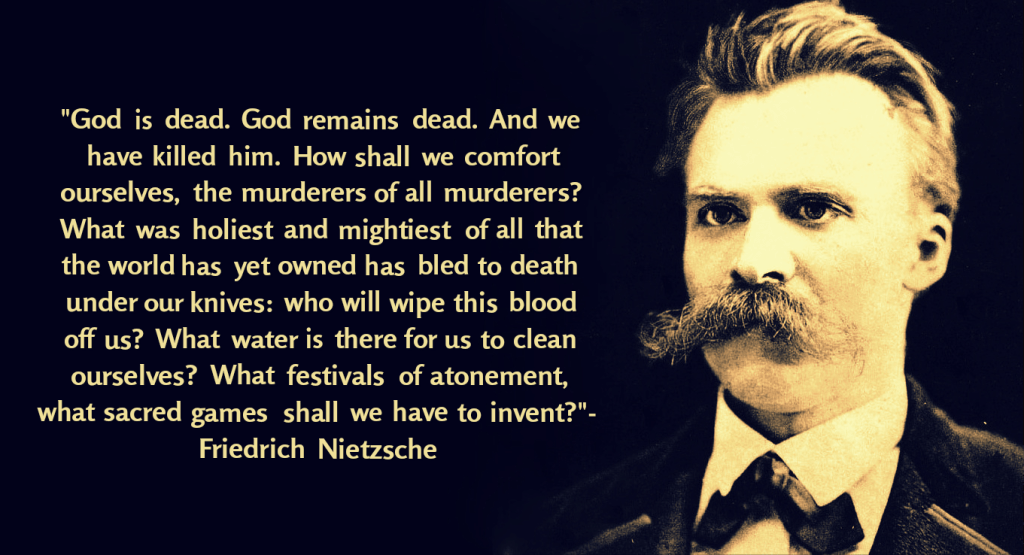
This is what Friedrich Nietzsche critiqued as being a hatred for life.  When we remove temptation rather than ever teach children to resist it—when we are constantly vilifying strength rather than encourage it—when we follow after reasoning or rationality instead of developing our instincts, we are promoting the weakness of our society and degeneration. 

Woke is weak.  It attempts to foster spirits of ressentiment and forms an identity around a person’s fear of being disenfranchised for things completely out of their control.  And in the end it destroys the incentive to find a way to overcome by our own means.

The Meek Shall Inherit 

Neitzsche could be accused of painting with too broad a brush for the dismissal of the Christian ethic as slave morality and an opposition to the powerful.

The message of Jesus and his Apostles was, in part, freedom from those human laws of “Do not handle! Do not taste! Do not touch!” (Colossians 2:21) and very nearly could be the “will to power” that the German philosopher championed once unpacked.  Hedonism wasn’t the goal of the departure from “slave-morality,” the aim was instead for people to exercise will-power and resolve.  In the same manner Jesus and St Paul preached freedom from the law that brought only bondage and death:

But now, by dying to what once bound us, we have been released from the law so that we serve in the new way of the Spirit, and not in the old way of the written code.

(Romans 7:6 NIV)

This is not to suggest that there is any kind of compatibility between the Spirit-led and the Übermensch.  Nevertheless, both would have us abandon a lower morality based on restrictions for a pursuit of our own ultimate form.  To St. Paul the Gospel means we are free from “the flesh” or the unbridled urges, while Nietzsche thinks we’re instinctively at our best, and both men are not opposed to impulse control.  The big difference is that the Apostle’s answer is spiritual whereas the philosopher says that additional layer is not needed and morality a hindrance.  Both would disagree devaluing the attitudes and culture that lead to success.  Being master of ourselves requires strength and never allows for excuses.  

Furthermore, the Jesus of the Bible wasn’t weak, he spoke with authority and we are told that he had power over all things, but he chose a meek posture rather than wield this power destructively.  Now it is a matter of faith if you accept this or not.  I could say that I could strangle Mike Tyson yet choose not to.  Talk is cheap.  But meekness is the ability to restrain ourselves.  Having the power to impose our will is always desirable, nobody wants to be at the mercy of the elements or other people.  However, sacrifice for sake of the next generation is better, to parent is to live beyond ourselves, that is why this is an instinct for those who have children, and it is the role of the Father.

When I wrestle with my son I don’t use all of my strength.  I would hurt him if I employed full power.  My goal is not to destroy him, he is not my enemy or threat to obliterate, but it is to train and strengthen him.  I restrain to protect him currently and also challenge to protect him in the future.  That is the real Biblical kind of meekness, it submission to the greater role we can serve as protectors and builders of civilization.  It is the having all things in balance, which Nietzsche might agree, and using our strength to take on the burden of creating the future.  We do not retreat from life.  Faith requires the we go headlong into the fight rather than hide or be ruled by resentment.

Late-stage Protestantism

I can understand the campaign Nietzsche waged against morality in light of wokeism and virtue signaling nonsense.  Apparently he was very well-versed in theology and did not find answers there.  Which is correct, it is not intellect that brings us life, study for sake of study is vanity, and truth is more in the practical telos than in some theoretical construct.  Nietzsche attacks rationality and reason as an end and those things do implode upon themselves when no longer grounded in a higher life-serving purpose.

The current ideological push for wokeism, and the mindless promotion of diversity, equity and inclusion at the expense of standards, merit or competency, is simply another step down the path of trying to eliminate all suffering and in the process destroying excellence.  I want my son to face some hardship, even if it is only artificial, because his striving will build strength.  It is the thought behind Proverbs 13:24: 

Whoever spares the rod hates their children, but the one who loves their children is careful to discipline them.

Or, as Nietzsche postulates in Beyond Good and Evil:

The discipline of suffering, of great suffering – do you not know that only this discipline has created all enhancements of man so far? 

In the same vein, in The Will to Power, he wrote:

To those human beings who are of any concern to me I wish suffering, desolation, sickness, ill-treatment, indignities – I wish that they should not remain unfamiliar with profound self-contempt, the torture of self-mistrust, the wretchedness of the vanquished: I have no pity for them, because I wish them the only thing that can prove today whether one is worth anything or not – that one endures.

No, I don’t want my son to be last picked for his dark skin.  And yet I also don’t want him to live in a world so sanitized that he’ll need to invent offenses (in the same way that an autoimmune disorder is the body attacking itself) then expects me to always step in on his behalf rather than face it.  Success in life requires some voluntary submission or suffering for sake of our goals.  Coddling and bigotry of low expectations does not serve the long-term benefit of children or civilization.

We need to discard this ugly paradigm of late-stage Protestantism.  There are great men, powerful and worthy of our respect, then there are those in desperate need of improvement.  We don’t help the latter by going soft and changing the requirements to make everything easier.  There is nothing radical or reforming about the direction the church in the West has gone.  This “have it our way” drive has led to a fracturing of the church, a consumerist mentality in worship and a new religion without obligation to the fathers or their commands.

Woke is simply the latest development in the direction.  It is the child with imperfect parents now thinking they know better and don’t need the silly disciplines of their parents to thrive.  Whether Anglican or Anabaptist, it is always about rejection of authority and the hierarchies established by the early church and originating with Christ.  We think we can do better, that the home is better if there is equal with no patenting or need for development of conscience.  In the end we get the complete agnosticism which goes further and to destroy everything the generations of faithful built for our good. 

Attainment and success doesn’t need to be made more accessible.  My son may think he deserves everything without effort, that we’re hoarding a kind of wealth just given to us and undeserved.  But that’s his ignorance.  There are no shortcuts to heaven and you can only keep the benefits of civilization if you continue to maintain the very foundation it is built upon.  We think that we will be saved by technology and the vague notions of progress of those who think power comes from the stroke of a pen—but that’s not how we got here nor is it a path to a better future.

Playing Church

Standard

One of those fun things to do after church, as a child, when the adults had left the auditorium, was to go up and play preacher. We could mimic the motions of our elders in a convincing enough way to be funny and yet really had no idea what we were doing. And this reality would be quite obvious the moment we were asked a serious question.

Part of becoming an adult is the realization that many don’t really know what they are doing. Sure, some might enthusiastically perform their roles, and they have the necessary qualifications, but they either lack practical experience or simple aptitude. Not every doctor or engineer is equal, for example, some are more competent, and others—not so much. But none of these ‘professionals’ have an authority that should be unchallenged.

Reflecting on the priorities, and performative religion, I can’t help but come to the conclusion that some are really only concerned about looking the part and lack any real spiritual substance. It is disheartening when getting customs right is of greater importance than welcoming children. When leaders can answer on matters of trivia but are unable to offer any real wisdom or direction when it comes to the practical application of the clichés they preach, they’re phonies.

I’ve concluded that many participate in church as a sort of social club. And it goes all the way to the top. They have clout in the organization. They can wear the costumes and get the recognition that they so desperately need. But, in the end, they are empty vessels, a noisy gong or a clanging cymbal. It would be better to be a child going through the motions, in play, than to take yourself seriously and offend the little ones in the faith. Jesus wasn’t talking about pedophiles in Matthew 18:6.

What Do We Do with the Freaks?

Standard

I ran across two stories the other day, one of them about a mixed race man who looks like a female and another about a child with ‘werewolf syndrome’ who looks like the missing link—in both cases I thought about the negative attention this brings.  In the later case, given the current awareness push, a young man who looks very feminine faces presumptuous comments about his ‘transitioning’ and I wondered at what age this happy kid would realize that he was a genetic freak?  School children don’t need to be taught cruelty.

While I’m certainly not on board with the current “I identify as” phase, I also am not for alienating or adding to pain others have from being odd.  What I’m talking about is the exceptions who are the exceptions by no fault of their own.  Starting with those who are visibly different, dwarfs, albinos, Down Syndrome, conjoined twins, chimeras, Klinefelter syndrome (boys and men with extra X chromosomes), intersex people (born with ambiguous genitalia) or Turner syndrome.  There are many chromosomal abnormalities and many issues that do put some in a “none of the above” category that is apart from what is most common.

We accept that physical abnormalities exist, it is pretty much impossible to deny, but the controversy begins when someone who has all of the physical characteristics of a man demands that other people use a female pronoun to describe them or competes as a woman.  Genitals don’t tell me what goes on in someone’s head.  My wife says that I’m “like a woman” in how I am expressive and emotional.  My little sister was a “tomboy” growing up.  I suppose today that would be proof that we deserve special protection or rights?  How far can we tolerate people who do not meet expectations for their gender?

You don’t need a biologist to tell you that men tend to have a very distinct advantage over women in strength and size.  It is not fair or safe for women to be in competition with those born with an XY chromosome no matter how they identify.  I mean, isn’t that why women’s sports were created in the first place?

And, contrary to what the “Muh rights!  You can’t make me wear a stupid mask in your private establishment.” people think, it is perfectly okay for groups to exclude those who have willfully refused to conform to the established standards.  Try to walk into any church naked.  They probably won’t even let you get to your explanation about material making you itchy or how Biblical prophets ran around butt naked.  We set rules.  We define categories.  We decide if those with Swyer Syndrome are men or women.  Click the link and give me your own answer in the comments.

Include or exclude?

It is our cultural bent to be more inclusive of the exceptions.  We are taught that we must show empathy and understanding for those who are “born eunuchs” as part of Christian love.  Then again, the Gospels are a sort of square peg being fit in the round hole of Scripture and it is easy to comprehend why the ‘chosen people’ rejected Jesus given how he mingled with the impure.

Biblical Exclusion 

One reason why to be sympathetic towards those Jews who rejected the message of a teacher who ate with sinners is the Biblical tradition itself and the system it established to exclude those deemed defective:

The Lord said to Moses, “Say to Aaron: ‘For the generations to come none of your descendants who has a defect may come near to offer the food of his God.  No man who has any defect may come near: no man who is blind or lame, disfigured or deformed; no man with a crippled foot or hand, or who is a hunchback or a dwarf, or who has any eye defect, or who has festering or running sores or damaged testicles. No descendant of Aaron the priest who has any defect is to come near to present the food offerings to the Lord. He has a defect; he must not come near to offer the food of his God. He may eat the most holy food of his God, as well as the holy food; yet because of his defect, he must not go near the curtain or approach the altar, and so desecrate my sanctuary. I am the Lord, who makes them holy.’ ”

 (‭Leviticus 21:16-23 NIV‬)

And repeated:

No one who has been emasculated by crushing or cutting may enter the assembly of the Lord. No one born of a forbidden marriage nor any of their descendants may enter the assembly of the Lord, not even in the tenth generation. No Ammonite or Moabite or any of their descendants may enter the assembly of the Lord, not even in the tenth generation. 

(Deuteronomy ‭ 23:1-3 NIV)

Discrimination against the abnormal wasn’t only suggested or caught in a round about way be misinterpretation, but a command from God.  Talk about a kick in the nuts (or lack thereof) for those already suffering an undesirable condition.  Be born the ‘wrong’ ethnicity or suffer an unfortunate accident and you’re out.  Not much of this is actually explained, giving opportunity for apologists to explain around it, but Christian religion (along with modern science) has certainly taken things in a very different direction.

If a woman is ‘barren’ nowadays we try to treat the condition rather than assume it is a curse from God.  I mean, yes, the woman in the Philippines who had the hair covered son with ‘werewolf syndrome’ may believe that it had something to do with eating a cat during pregnancy, the popular notion of “you are what you eat” manifesting, but we’re not as likely to see it as punishment from God—we do not tend to attribute things blindness or misfortune to sin.  It is harder to exclude those who are imperfect when you realize it could’ve been you.

Any more than I need to know why Islam is different from Christianity, where someone was clearly copying some else’s notes, I’m not going to attempt to theologically explain the transition from Old to New Covenant.  It is clear enough that those who had lawfully been excluded, the leprose, lame and blind, Jesus healed.  The result of his ministry two millennia ago was a wave of tolerance that started with his Jewish converts.  Peter had his pigs in a blanket vision (while hungry out on the road) and now we eat bacon despite Biblical command:

About noon the following day as they were on their journey and approaching the city, Peter went up on the roof to pray. He became hungry and wanted something to eat, and while the meal was being prepared, he fell into a trance. He saw heaven opened and something like a large sheet being let down to earth by its four corners.  It contained all kinds of four-footed animals, as well as reptiles and birds. Then a voice told him, “Get up, Peter. Kill and eat.”  “Surely not, Lord!” Peter replied. “I have never eaten anything impure or unclean.” The voice spoke to him a second time, “Do not call anything impure that God has made clean.” This happened three times, and immediately the sheet was taken back to heaven. 

(‭Acts 10:9-16 NIV)

This, along with the Jerusalem Council, is a huge departure from Jewish Biblical religion and, again, it is no big surprise this new cult was rejected by the faithful.  Even today some observant Jews continue the tradition, like that Orthodox chaplain who declared loudly as he took a seat (next to me) on a crowded airliner with mixed races, “I’m a racist and don’t care what you think!”  My own cringe at this statement is born of an indoctrinated sensitivity, years of Christian influence, and not values arising naturally from thin air.  Or, rather at least not without a sheet to carry it down from heaven.

Bacon To Bisexuals

The other day I saw a post, from a Muslim friend, and it listed the problems with eating pork meat, their unique parasites, what pigs eat, etc.  Of course the winning comment was “but fried bacon is so delicious” and it basically for this reason why no Baptist will ever depart from pork consumption.  If it is pleasurable to us, we do it.  However, don’t dare use that reasoning with these same Biblical fundamentalists when it comes to things they’ve not be acculturated to.  And not at all to say that bisexuality is now in that big blanket of tolerance coming down.

No, it is just interesting to me how Biblical law is largely ignored except where it makes sense to us.  Don’t like tattoos?  Well then it is okay to misapply those laws that pertain to specific ancient pagan practices.  But if you like shellfish, then “freedom in Christ” exempts you from having to obey these outdated and irrelevant laws.  The energy in the room is completely different when it comes to the violations of Scripture we’re unaccustomed to or don’t apply to our own circumstances.  Sexual deviation is a whole can of worms that I’ll avoid until or at least until a good explanation of Swyer Syndrome is given to me.

One eyebrow raising moment, during a Bible study, while being brought into Orthodoxy, was when the topic of veiling (1 Corinthians 11) came up for discussion and how the old ethnic Russian priest dismissed it as being custom or cultural.  I never had the chance to ask him about the explicit quotes of Saint John Chrysostom on the topic.  But, like all things, what is important is a matter of our perspective.  The cradle Orthodox follow after the mainstream of Protestantism as much as anyone else, whereas the converts from Protestantism are more strict about preserving Orthodox tradition.  It’s amazing how culture influences our applications of Scripture.

All this to say that I don’t know where the precise dividing line is between pure and impure, acceptable or unacceptable.  But believe there is much more value in being merciful as our Father is merciful.  That is to apply the Golden Rule to those who struggle in ways that we can’t fathom or begin to understand.  Where it was once okay to stigmatize and treat left-handed people as second-class or evil we now accept them and think it is strange it was a problem for past generations.  There are many things that aren’t an identity we choose or a matter of “feel this way” (like a man who claims to be transracial) that require that us to show some grace.

“Ew, Brother Ew”

You’ve probably seen the meme.  A Muslim preacher lamenting those who abandon the Islamic practices of eating on the floor and growing a beard.  His comical expression of their disgust gets to the heart of what most of these religious do and don’t rules come from.  There is a continuum when it comes to gender and normalcy, taboos change, as do ideas of what real men do.  It’s funny to see how these standards have evolved over time.  From the time pulpits had spittoons to the current time of rainbow flags, we are not the same as our ancestors.

There are natural aversions.  We’re naturally disgusted by bodily fluids and it is for good reason.  Disease travels in blood, saliva and waste.  We are also attracted to beauty, the healthy form or good hygiene, this is about instinct and survival.  Sexual promiscuity is also risk as well.  So being grossed out can be beneficial if it protects us from negative outcomes.  However, this can malfunction, sort of like an autoimmune disorder, where we can overreact and exclude on the basis of things that aren’t a danger to us.  Bigotry and prejudice, like middle school fears of cooties, are often as sign of immaturity or lack of self-awareness.  Attributing every unfortunate condition to a moral failure is not sound judgment.

Just because something is strange or ugly to us is not a reason to recoil.  If a person is not trying to draw attention to themselves it is important to acknowledge their humanity rather than their odd appearance.  We didn’t choose to be ‘normal’ anymore than it was a decision they made to be different.  We do not need to pretend everyone is beautiful or affirm every exception as glorious.  There is healthy, there is deformity and disorder, we can love the person who overcomes or does not give up for their character.  It is possible for inner beauty to shine when we truly get to know the person rather than only see the outward appearance.

Reliable Sources

Standard

My initial reaction to the collapse of the Francis Scott Key Bridge was disbelief, I had just swiped open my phone, eyes adjusting after I rolled out of bed Tuesday morning, and saw the Daily Mail headline blazing on my Facebook news feed.  So immediately I Google “bridge collapse” and, sure enough, the highlighted results were full of similar headlines.  It must be true.

Since that moment there has been a flurry of speculation.  My first thought, of course, is was this deliberate?  Did the Russians do it?   But as I started to gather evidence, like the video showing the lights going out and puff of black smoke, mechanical failure was a plausible explanation.  That didn’t rule out some kind of sophisticated hacking attack, but then this isn’t a Tesla car or Hollywood fantasy where anything electronic can just be operated remotely through undisclosed magical means.

Theories are easy to create.  The hard part is to sift through the information pouring in and come up with something actually likely given probabilities and reliable sources.  A random guy online or old Larry at the parts counter isn’t trustworthy.  The corporate media is only slightly better, in that they at least get the general story right, yet are also politically motivated and basically parroting official sources or their ‘experts’ at a lower resolution.

What of these officials and experts?

I generally rate someone who has their own reputation on the line over someone who is spit balling and couldn’t change their own spark plugs.  Someone with credentials is a better choice for information given that they did put in the work to get their degree and prove their competence.  However, a PhD or government position doesn’t make a person honest or free of bias.  Those who get paid by the government are part of the political establishment and their partisan agenda should be assumed.

1) Professional Experience 

The sources that I trust are those who built a reputation outside of politics and within the industry—this is why I’ve subscribed to “What is Going on With Shipping?”  Later in the day of the collision and collapse of the bridge I found an established channel about maritime matters for explanation.  How do I know he’s credible?  His fluency is a start, he has the technical jargon and credibility with others who know shipping from first hand experience.  It is notable that nobody here is surprised that this incident could happen.  The details of his analysis give me confidence that the information is good.

Authority comes from having professional experience and a proven record.  When I picked my neck surgeon, for example, we had a conversation about his prior record and the procedure.  I sized him up.  He was articulate, empathetic, and had all the expected confidence of someone who could work a miracle of modern medicine.  He also was able to explain everything in terms that I could understand.  The trust I put in him paid off, my recovery was great and I’ve come back stronger than ever.  Licensing with charisma doesn’t mean someone is competent, but it definitely helps.

2) My Own Aptitude 

But my main tool for determining who to trust is based on my own aptitude.  I have a decent understanding of physics and spent my younger days curious about mechanical systems—and always needed to understand how they work.  I could turn a wrench.  I did my own diagnostics and repairs.  So when I do bring my car to the mechanic I’ve already done my homework. 

For example, when my car lost power right away I suspected the Ti-VCT system was to blame.  The engine then gave a code that supported this hypothesis and I took it to a local tire shop and inspection garage.  I told them exactly what to look for giving them a page of the diagnostics manual.  And yet, after having the car for a day or two (after changing the air filter and cleaning the MAF sensor) they concluded it could just be the car is old and losing compression.  Finally, after taking the time to look under the hood, I found the problem.  It was what I had been suspecting.  This time I took the vehicle to a real technician, a guy who with a reputation for good diagnosis, and he gave a beautiful technical explanation of what happens with a short in that system.  After an inexpensive repair I’ve had no issues since.

I’ve never worked in the engine room of a big cargo ship.  I know that they are huge and, despite involving the same principles, are on an entirely different scale.  For one, it takes a team to keep them running, this isn’t like your Toyota where you can simply turn the key, put it in drive and go.  No, they have a startup sequence and when I heard a play-by-play of the disaster unfolding, where the puff of black smoke was explained as being a fuel-air mixture imbalance when they were using a burst of compressed air to start the massive engine, I recalled hearing this being explained in a documentary and it all lined up with what I know about engines.  It is clear he was credible and therefore I felt the rest of his commentary had merit.  I’ll never trust the people who completely miss on the basics and then expect me to believe their conspiracy theories.

3) Most Plausible Explanation 

It could be the MV Dali crew were attacked by mind control aliens using the 5G cell phone network.  There’s no way to disprove this is not what happened.  However, it is not the most plausible explanation and certainly not the first stop (or last) of a reasonable analysis.  What is probable is the answer with the least amount of moving parts or crazy assumptions, which points currently in the direction that this was an accident waiting to happen or a matter of reasonable probabilities that needs no fanciful dreamt up explanation.

There are those times when fact is stranger than fiction.  But we should only go there if there is plain evidence of motives and the means.  Like when the Nord Stream pipeline exploded and prior to this the US President made a threat “We will bring an end to it.” It isn’t a big stretch to believe he had a hand in the sabotage.  The US Navy is one of the few in the world that have the capability of making this kind of attack, so that is a very plausible explanation.  It also wouldn’t just happen on its own or accidentally, so we do look for the potential connections.

Nothing is ever absolute.  We can’t know for certain.  But I’m going with the assessment of the professionals who don’t seem at all surprised that this could happen and can give an informative analysis.  I’ll weigh one of their opinions over ten thousand who claim that there’s something fishy or they feel it in their gut and who have never set foot in the bowels of a cargo ship.  The reliable sources are those with professional experience and are not tainted by ideologies or narratives that color their perspective of all events.

Navigation Of The Virtual Space

Standard

As we rolled into Washington DC, national symbols emerging into view, I alerted my twelve-year-old son to the sites ahead.  He looked up, grunted an acknowledgement, and then immediately buried his head back into the device in his hands.  At which point, now frustrated, I let him have it with one of those classic back in my day dad speeches imploring that he join us in the real world.  

This episode segues well with a thoughts developed further this past weekend.

I had an informative conversation with a man who worked in the US Capital with prominent politicians and also knew a little about astronomy.  He showed me a picture of this formation of stars that he took while at his home in the Philippines.  I didn’t recognize it and he then proceeded to tell me that this is the Crux (or Southern Cross) and how early explorers had used this for navigation after the North Star slipped under the horizon.

I’ve been trying to define a problem that is more prevalent in to our time.  And it has to do with the difference between social constructs, suspended in language, and actual substance.  Before GPS, to navigate the globe required direct observation and accurate intuition.  A successful voyage depended on being grounded in the realities revealed by the tapestry of the stars above and celestial bodies.  Even without images from satellites they could properly deduce the shape of the Earth.

Today we are not looking up anymore, we look down to our smart phones and get lost in the mire of information space and tangle of interpretation.  It is sort of like the night sky is blotted out by artificial light, many do not know the difference between overlay of language or theory and the real bedrock of science.  They live in a world of distracting fantasies and imaginary monsters.  They float off into a sea of nothingness at very best and could potentially imperil the ship of civilization if their delusions took the helm.

Abstraction is great.  Thinking beyond what can be immediately seen is an important tool of human intellect.  Language, likewise, is a superpower.  And yet these things must be properly calibrated.  The sextant is only useful with the correct inputs.  Likewise, if the waypoints of our thoughts are incorrect and the final conclusions that we reach will be flawed as well.  Many sail boldly, despite having deviate far off course of sound logic and reason, with disaster ahead.

Collapsing the Narrative

The Francis Scott Key bridge was struck by a careening cargo ship after the first part of this of this blog was written and the many interpretations of that event provide even more fodder for thought.  Many have a hard time believing that this kind of accident can just happen without some kind of nefarious behind the scenes orchestration. 

These conspiracy minded folks are like the ‘woke’ who always see everything through the lens of race.  From my friends who tell me to not believe my eyes (or engineering intuition) and follow their gut feelings about “something fishy” or those on the opposite side trying to make a connection between this and “MAGA extremists” voting against a pork-filled ‘infrastructure’ bill—they mistake their ideological lens and partisan bias with special discernment.

The problem is, unlike the Key bridge that needs actual physical pillars to remain as a viable structure, there is no amount tonnage of reality that can knock down these towers of ignorance.  Those who confuse their own interpretive matrix with the actual substrate of reality can free-float in their fantasy lands and delusions pretty much indefinitely.  It is what Jonathan Swift explained: “You cannot reason a person out of a position he did not reason himself into in the first place.”

The other day I stumbled across a video, “Why Smart People Believe Stupid Things,” that discussed the motivated reasoning that is detached from reality and delusion.  The description “fashionably irrational beliefs” (or FIBs) gets to the heart of the matter and that is that our intelligence is oriented in the direction of social status or acceptance and group belonging rather than some notion of objective truth.  This identity protective cognition leads us to believe a pile of nonsense:

“A great deal of intelligence can be invested in ignorance when the need for illusion is deep.”

Saul Bellow

This disposition explains the eagerness of academics to join with their other colleagues in pushing agendas like transgenderism and concepts of white privilege. 

It also relates religious dogmas and doctrines, where you post a blog post questioning the idea that Anabaptists are the true church resulting in hate-mail from a self-described radical who couldn’t find polite words when their most cherished identity was challenged.  Whether the defense mechanism is middle-school insults or doctoral dissertations, it can all be lacking substance underneath.

As I’ve thought how to make this blog more concrete, I believe it all does come down to the disconnect between language (and the ideas contained) and the material world.  I can tell you that gravity is fake—something invented by the Pope in Rome to control and subjugate, but jumping off of a tall building will not likely go well for me.  In that case the ground rising up to meet me would be the final authority and my special “wisdom of the ages” splattered.

Unfortunately, while we can escape the virtual reality of our cell phones by looking up and just observing the world around us, we can’t ever be free of our own minds.  We’ll always be limited by our own perceptions and concepts—seeing the world as we are rather than as it is—but we can always at least be aware that we need constant calibration.  Abstraction needs to be grounded or it is useless for navigation and only good for entertainment.

The First Anabaptist Identity Conference

Standard

Over the past couple of decades the liberal end of the conservative Mennonites and a few others get together to navel gaze about what it means to be them.  This “Anabaptist Identity Conference” (an annual event which some of us have dubbed the identity crisis) is truly a product of this time where nobody is sure of who they are as they once were.  There is a strong urge to seek out others, like us, as to bolster our shaking foundations. 

In this year’s event there is a line up of many meme worthy topics, like “The Anabaptists: Continuation of the Ancient Faith,” where ol’ David Bercot, a man who truly knows where his meal ticket comes from, will try to make the case that Anabaptism (as they define it) is somehow a direct lineage to the Apostle’s church.  This connecting the dots to make it fit narrative, of course, will play right into the confirmation bias of his audience who fawn over an educated outsider.  Maybe this year he’ll have pictures of whoopie pies painted in the catacombs?

Anyhow, some may believe that the first Anabaptist Identity Conference was held in 2007, in the Amish vacation Mecca called Sarasota, but there was one before this way back in 1536.  It occurred in the aftermath of an event that left Anabaptists then trying to find a path forward.  This is the Bocholt meeting that brought together survivors of the Münster rebellion and other factions in the Anabaptist movement:

In August 1536, the leaders of Anabaptist groups influenced by Melchior Hoffman met in Bocholt in an attempt to maintain unity. The meeting included followers of Batenburg, survivors of Münster, David Joris and his sympathisers, and the nonresistant Anabaptists.[4] At this meeting, the major areas of dispute between the sects were polygamous marriage and the use of force against non-believers. Joris proposed compromise by declaring the time had not yet come to fight against the authorities, and that it would be unwise to kill any non-Anabaptists. The gathered Anabaptists agreed to the compromise of no more force,[5] but the meeting did not prevent the fragmentation of Anabaptism.

No discussion of Anabaptism is complete without a little discussion about this crazy polygamous uprising.  Sure, the revisionist historians of the denomination may tell you otherwise, but the association is definitely there and the Wikipedia summary is accurate.  Menno Simons, in his 1539 Foundation Book, called the Münsterites “dear brethren” rather than claim they weren’t truly Anabaptists.  So are we really in a better position today to decide who is truly representative of the Anabaptist identity?  No, we’re not.

What is the Anabaptist identity?

In America it is mostly an ethnic group with a similar religious lineage.  Some within this category have openly lesbian pastors while others cling to traditional dress and buggies for transportation.  Unlike in the first 1536 identity conference, when their big debate was over use of violence, now the surviving Anabaptist groups agree on that and really not a whole lot other than that.  Even those who organize and attend the conference in the current year only represent a subset of the conservative Anabaptist groups.  The ‘spiritual’ lineage, while all claim it as their own, is too vague to put a finger on.

Men like Bercot and their ilk may want to declare the boundary lines even stricter than the early Anabaptists did, but that is just adding delusion upon a delusion.  No, I am not saying they aren’t Christians, that’s not my purveiw, but for one to claim they’re some kind of special remnant of the remnant is just plain grandiose.  And what comes to mind, at this juncture, is the “Stop It, Get Some Help” meme. 

Newsflash: You’re not even representative of the early Anabaptist —let alone the ancient church. 

This conference can’t speak for the plurality of the groups today who trace their roots the so-called “radical reformation” and do not have a voice in this identity rumination project.  What is hard to miss, for those outside looking in, is that this is an effort to preserve their distinction and not to seek the the unity in Christ that St Paul commanded (1 Corinthians 3) when some in the early church were busy commending themselves for their special identities.

I don’t have a problem with having an ethnic identity that is cherished.  I’m German, still Mennonite in many regards, and absolutely adore Old Order people.  I have no problem with having our own culture or celebrating our heritage.  It is why I encourage my son to keep his Igorot language and ways rather than have it all be erased in the American monoculture.  But there’s a vast difference between that and those basically arguing that they’re saved through heritage. 

Saying that Anabaptists are a “continuation of ancient faith” is only a half step away from being as crazy as the Schizophrenic who thinks they’re the second coming of Jesus.  The denominational ground you’re standing on is not sacred simply because you currently stand on it.  It is spiritually equivalent those Anabaptists in Münster declaring their own project to be the New Jerusalem.  We should know better than to live in that kind of self-delusion.  We should not condone or encourage it.

How Can You Love a Stepchild?

Standard

There are questions that frame an issue the wrong way and are only answered by asking another question.  One of them is: How can you raise another man’s son?  The only real question for me is how could I claim to love my wife and then not love HER children?  

Maybe I simply look at the world differently from other men.  But the initial question to me comes off as sounding like “how can you love another man’s daughter?” Answer: “Well, we are the same species and it just happens naturally, I suppose?”

I believe the real issue is when someone is looking at step-parenting from a detached or deconstructionist view.  In this framing it is all about biology and evolution.  In other words, we should be like lions who kill the offspring of male rivals, not raising them as our own.  It is a sort of Social Darwinistic construct where a man should only ever be concerned about raising the product of his own immediate genetic insemination.

But I think this is truly a very naive view of human relationships.  We get along with our relatives as far as we relate to them and not after we DNA test them for our paternity.  It is the same for my son and I.  Probably a bit over six years ago I met this goofy kid with a bit of a crooked grin.  He was endearing to me for his energy and his incredible ability to make friends anywhere.  And, a few years later, when he asked me if he could call me “Daddy,” the die was cast.

The thing is, when I learned my bhest had a son I knew any romance with her would be a two for one deal.  It was never a question for me.  I did put considerable thought to it, worried more that this young person would accept me for this important role.  

There was assurance, along the way, that helped me settle my worries and came from a stepdaughter who absolutely adored her stepfather.  She told me that the fact he had choose to love her like a daughter made it a special love.  Good step-parents don’t make a mistake when they bring a child into their lives.  By contrast, there are many biological parents who become parents because they were unable to control sexual impulses.

In conclusion, my question is to those who ask the question: How could you not love a beautiful child, a wonderful miracle of life, who makes no judgement of you for your own multitude of faults?   A child can form attachment to any adult who loves them as a parent loves and the same works for men who are committed to love.

Despite our variety of gifts and superficial differences of appearance, we’re all genetic cousins.  My wife comes from the opposite side of the world, like our son, yet we are a couple very much compatible.  Sure, there are differences in cultural expectations, or personality conflicts that come along, but it is really what you’re willing to put in as far as building the bond that matters.

If you could not love or even raise a child simply because they aren’t genetically your own then my only advice is to step up your game.  Any man, who still has a functional reproductive system, can impregnate fertile women.  That doesn’t make him a father or worthy of raising a child.  No, it is always a choice to take responsibility for the needs and future of another unique individual.

It was our joint love for Ydran that helped us to push through years of waiting.  If it were only the future of two adults going separate ways would have been easier.  But when he called me “Daddy” on the phone, something changed in me and after that there was no way I would simply abandon him to fate.

The Big Box Church

Standard

Sitting in “The Well,” a coffee shop within the campus of Christ’s Wesleyan, a local mini mega-church.  Why a coffee shop? It is pretty much the same reason a Target store has a Starbucks. It is a trendy and cool place to chill out as the service plays out on the big screen.  The ‘church’ here is as American as a big box store.  It is quite the production, with many programs tailored to children and all needs in the congregation.  The wonderful thing is that you are free to participate to the level that you want.  I’m not alone as I sip my caramel frappe while the administrative pastor goes over bulletin announcements and the highlights of Miami versus Kansas City play on the small screen.

The thing is, I was once threatened by this, the professional musicians mimicking rock stars on the stage.  How could this really be called a church?  And, as they currently ruin “How Great Thou Art” with some ridiculous contemporary rendition, I would definitely be tempted to pile on.  There’s certainly a kind of consumerist hokeyness to the whole enterprise.  I mean who looks at Walmart and an Alanis Morissette wannabe, then says, “Wow, this is the perfect model for the church!”? It’s all as cheap and throw away as the American culture in general.  Nevertheless, this is the place most people are today and also as close to an actual community as many get in this age of suburban sprawl.

Yes, I’m a worship snob.  To me, nothing can rival true Orthodox worship.  Old hymns, like those in a traditional Protestant church, and the Psalms and Scripture of the liturgy feel much more meaningful.  But is this really a substantive difference?  Is the worship here more or less about our personal preference than it is there?  Even Orthodoxy, with its simple images and chanted theology, was trying to make the message accessible to the people at the time.  Would Jesus have filled a stadium had he had the opportunity to do so?  Maybe so.  Certainly, the church has always taken some of its form from the local culture. But then shouldn’t the church create the culture rather than the other way around?

The thing is the biggest problem that I have with all of this is that it exposes religion for what it is.  The reason some of us need to stay traditional is because if worship is allowed to change then we start to question.  Could it all be fake?  We find our security keeping it all the same.  If it has a timeless feel then we don’t need to struggle with the foundation of our faith.  My cynicism takes over because this chintzy architecture exposes the framework that some of us would rather keep hidden under the ornate historical facade. It works like satire to undermine my confidence.  Oh well, as the couple prepares in front of the lights and cameras in the lobby, like television reporters, I suppose it is time to wrap this blog up.

Postscript: I attended with my wife, out of convenience due to our busy afternoon, who prefers this style of service as it is similar to her church in the back in the Philippines. I was reflecting on the similarities of this to Orthodoxy, in that you have “coffee hour” after the Orthodox church. The biggest difference really is the size and organization. One models itself after the Byzantines and the other off a shopping mall or shopping plaza. And yet both require donations from viewers like you. What really is the big difference between dropping money in the offering plate and tapping your credit card to pay for the brew? The church calendar and the many programs to help make the Gospel accessible? Being in awe of the temple and being impressed by the light show? It all basically serves the same purpose.

#CringeLivesMatter

Standard

Over the holidays my wife was out bargain hunting with me and we stopped at a strip mall where there was a pop-up store in one of the unleased spaces.  We had parked at the wrong end of this clearly past its prime shopping plaza and near what appeared to be a Christmas party of some sort which I glanced at before heading to the discount shop a few doors down.

On the way back, after purchasing a box of used baseball gear, there was an older gentleman who beckoned me and my son to come inside.  My wife wasn’t interested and returned to the car, but I wanted to be friendly and thought my eleven-year-old may enjoy meeting Santa. 

Upon entering, there was nothing wrong with anything I saw as my eyes swept the room.  They had various stations set up, there was a Mr. and Mrs. Claus, as one may expect, but the place wasn’t brimming with children and the average age most likely exceeded me by a decade or two.  So we sauntered in past the ladies positioned to receive the guests towards the promising display of cookies and treats. 

“Hmm…maybe we’ll come back to this?”

I didn’t bother to politely pluck a pastry as we turned towards the other folding tables, stopping first at the one with the coffee urn, warming CJ to the idea, by suggesting, “Hey, maybe they have hot chocolate mix!”  Nope, I guess not.  I quickly observed that cocoa was not available, segued to coffee, and—no cups.  I didn’t feel like bothering anyone and my son had found a craft station where they had little ornament tree cookies for him to paint.  He used an embarrassing amount of orange and blue paint to make a little brown for the trunk, but we achieved success and I worked on my exit strategy.

We humored the sweet old ladies on the way out (including one actually the size of an elf and appropriately dressed to play the part) then passed their brochures on the way out were they such and such county patriots or something?  Not sure.  But definitely fits a stereotype I have in my mind of the “save the children” picketers and people who rant online about chemtrails.  They could be the January 6th grandma, showing up to throw their support behind Trump and ending up a felon for their undocumented tour.

Whatever the case, these probably were not the popular kids in school, not the members of the homecoming court, valedictorian or star athlete of the football team, but those of very average abilities.  Some likely served in the military, most probably worked those mundane blue-collar jobs our politicians tell us Americans don’t want to do.  They’re the forgotten people.  Those who never had a way out of flyover country struggled to make the payment on the picking truck in from of their trailer park home, and even this party was awkward as there were.

This was real grassroots politics.  Not those well-funded astroturf campaigns that get only glowing sympathetic reports from the corporate media.  Nah, unlikely darling BLM or Antifa, these people are the true outcasts of our society, and when I look at them with a judgmental tone.  I mean, there’s nothing wrong with their little outreach effort, I know they put work and planning into it, but still, I cringe as if the coastal elites will somehow think of me as different if I mock and throw these rubes under the bus.

I know how the internet treats these people, in one breath denouncing these lower class folks as being “privileged” and then, in the next, making fun of them for their crooked teeth or poor spelling.  How many of those who smirk and sneer have a “Be Kind” sign in their front yard?  I thought of this today as some older folks, some of them likely to wear a MAGA hat, tried to arrange a singles meet on the local community board only for an attractive 30-something female to call this effort “creepy” as if lonely people should be seen and not heard.

The thing is, there is no social benefit to our showing compassion to truly downtrodden people.  While I would certainly get praise from the ‘cool’ people for showing up at a Black Lives Matter event, I get nothing for speaking up for the kind of people eliciting a cringe-response.  This is another thing that feeds my skepticism about Christianity, the most ‘mission-minded’ uncles, those who appear to show love for the people of the world, will uncritically parrot the most negative characterizations of these people as if they’re lessor than.

And I get it.  How can we respect someone who is unsophisticated and doesn’t know the difference between they’re, there or their, like we do?  These people are likely high school dropouts, and certainly not professionals or professors, and (as awfully dumb as they are) are obviously brainwashed by the most dangerous and anti-democratic man in the history of America!  No, we can’t take their grievance seriously. Instead, we’ll label them as “racist” “xenophobic” and “white nationalist” so we feel free to dismiss all they say as rubbish.

Meanwhile, the current party favorites can do no wrong, even if their violence is good.  Torch a city and they’ll tell us straight-faced, while the fires burn, that this was “mostly peaceful protest,” but question their election result and enter the Capital building (like many on the left have done in the past when things don’t go their own way) and suddenly it is an “insurrection.”  While they hunt down and gleefully prosecute those grandmas for their unauthorized tour—nobody on Jeffery Epstein’s client list gets investigated.  Tell me again how you care about justice?

Far-left protestors take over capital in Madison to subvert the democratic process


Maybe I should just join the disdainful and look down my nose at my neighbors?  They have nothing really to offer me.  They had jobs that could be outsourced and can be replaced with migrants from South of the border who work for less pay, right?  Besides that, most of these folks will be dead in a decade or two, why not look to the future?  And yet if we do then we should admit what we are and quit acting as if we’re these wonderful Christ-following people for being completely in sync with the Hollywood activist in-crowd. Maybe Jesus wouldn’t pile on the world’s favorite whipping boy?

Struggle with God

Standard

I completely missed the opportunity in a recent post about what Israel is in Biblical terms to mention the meaning and origin of the name itself, which we find in the book of Genesis:

That night Jacob got up and took his two wives, his two female servants and his eleven sons and crossed the ford of the Jabbok.  After he had sent them across the stream, he sent over all his possessions. So Jacob was left alone, and a man wrestled with him till daybreak. When the man saw that he could not overpower him, he touched the socket of Jacob’s hip so that his hip was wrenched as he wrestled with the man. Then the man said, “Let me go, for it is daybreak.”

But Jacob replied, “I will not let you go unless you bless me.”

The man asked him, “What is your name?”

“Jacob,” he answered.

Then the man said, “Your name will no longer be Jacob, but Israel, because you have struggled with God and with humans and have overcome.”

Genesis 32:22-28 NIV

With that definition, once again, Israel is less who you are and more what you do. Jacob’s life up until that point was a struggle. He wrestled even in the womb with his twin brother Esau and we’re told was grabbing the heel of his elder sibling who emerged first. He came up on the short end of the stick then, but managed to fool his father and get the blessing that was supposed to go to the eldest son. And even that plot ended up leading him to more struggle. He went from trickster to being tricked (karma?) when Laban, his employer and then father-in-law, did the ol’ bride switcharoo on his wedding day and he got the other sister rather than the one he had worked for. He ended up working seven more years to have the woman of his choice. The episode above comes as he returns to face Esau after many years and is still looking for a blessing from God.

Struggling is part of a sincere walk of faith. As Fr. Seraphim, my parish priest likes to say, “If you ain’t struggling, you ain’t Orthodox.” And like Jacob, the Christian certainly has to wrestle and contend for their blessing from God. Yes, salvation is a gift, but it is one that we work out with fear and trembling, that comes with the fruit of repentance:

John said to the crowds coming out to be baptized by him, “You brood of vipers! Who warned you to flee from the coming wrath? Produce fruit in keeping with repentance. And do not begin to say to yourselves, ‘We have Abraham as our father.’ For I tell you that out of these stones God can raise up children for Abraham. The ax is already at the root of the trees, and every tree that does not produce good fruit will be cut down and thrown into the fire.”

Luke 3:7-9 NIV

Note that John the Baptist didn’t put much weight on the genetic ties the crowds had to the patriarch Abraham, dismissing it by saying that God could replace them with stones, but he puts weight on the fruit of repentance instead. Likewise, Jesus, in praising the Centurion, a Roman soldier, for having greater faith than all of Isreal (Matt 8:10) is very significant—especially when the Lord follows up by saying many of the current subjects of the kingdom will be thrown out. So this heresy of saying some get a blessing from God without having to struggle, without needing to have faith in Jesus, is dangerous. Those comfortable aren’t Israel, those building a worldly kingdom aren’t Israel, only those who are spiritually like Jacob and striving for their place against the odds.