

The default position for most people is some form of tribal ethic. If it is done to them or their own family by another tribe it is a horrendous and terrible crime. But, when only those in another tribe are hurt or if they are afraid that confronting the abuse will hurt their own tribal agenda—then suddenly the unforgivable becomes a “Who cares, everyone does it, why are you bringing that up again?”
Tribal ethics amount to doing only what is good for the tribe—usually sacrificing the rights of an individuals in the tribe and always denying the basic humanity of those outside of the tribe. Individual rights of those in the tribe are generally honored, but only so far as protecting them is useful to the collective and not as something that is absolute or immutable. If a few die for sake of the tribal order—are stoned to death for daring to pick up sticks on the Sabbath—that’s just how it is.
The Old Testament is full of this. Your own are completely free to enslave, rape or take from those outside the tribe and yet would be enraged if one of their own were treated in the same way—like when vengeance was taken by Dinah’s brothers who wiped out a whole city for sake of the family’s honor. If it were within the tribe the attitude would be quite a bit different. Under Moses law this was simply a matter of paying the price of the bride and not a death sentence. And it is clear that things morally abhorrent by a modern standard, like genocide, were done by the command of God.
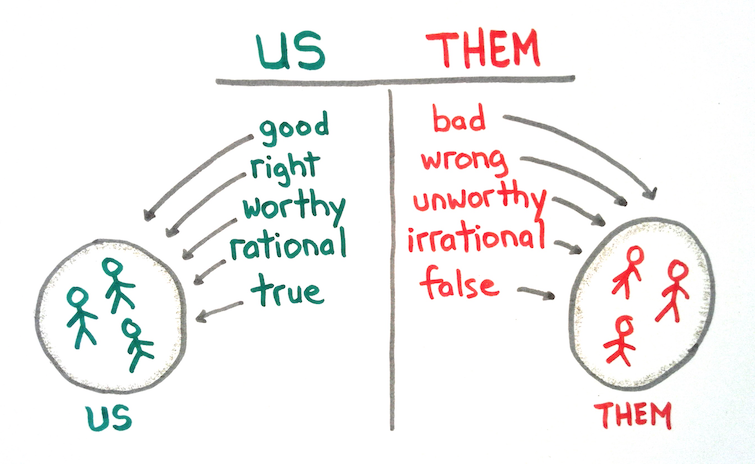
Tribalism is a feature of politics, a natural or default condition, where we defend our own and demonize the other. To the left Charlie Kirk deserved to die for his sins of hate they claim were harmful to their woke collection of identities. The Evangeli-cons soak up the propaganda from Israel that paints children in Gaza as future terrorists. We protect the people most like us because and adjust our moral rules according to the situational and immediate needs of our tribe.
A Case For One Higher Universal Standard
But a Christian ethic is completely different from this. It says sin is sin. Evil is evil no matter who is committing it or who it is against.
And, if anything, those who are in the church, who profess their faith in Jesus, should be held to a much higher standard. There is no room for favoritism (James 2:1, Romans 2:11) or carving out exemption for elites or even our friends and family. Jesus said to love our enemies (Matt 5:44, Luke 6:27) and even ‘hate’ our own family (Luke 14:26) if necessary to truly be his follower. Even our thoughts subjected to a standard of love and forbearance.
Jesus didn’t get hung on a cross for saying cutesy stuff that is easy to do. And I really do not expect anyone to live by that code. It requires actual faith and a true belief Jesus is what he said he was to make sacrificing ourselves for his ethic reasonable:
Do not repay anyone evil for evil. Be careful to do what is right in the eyes of everyone. If it is possible, as far as it depends on you, live at peace with everyone. Do not take revenge, my dear friends, but leave room for God’s wrath, for it is written: “It is mine to avenge; I will repay,” says the Lord. On the contrary: “If your enemy is hungry, feed him; if he is thirsty, give him something to drink. In doing this, you will heap burning coals on his head.” Do not be overcome by evil, but overcome evil with good.
(Romans 12:17-21 NIV)
But even if you don’t truly believe in a future eternal reward or God, there is a reason why universal morality is better than our default tribalism. And that is an idea of what goes around comes around. Sure, you might not care about someone else’s daughter being sexually exploited by wealthy and powerful men—most especially if they are furthering your partisan political agenda—and yet we want to have a society where there’s justice or the injustice will eventually spread to us.
This is the big difference between my own understanding and the one that is far more popular: Good and evil never change on the basis of who is doing it or if I benefit. If it is wrong for the neighbor to kill my dog under most circumstances it is wrong for me to kill theirs. And if I (or one my own) start to act with impunity—are continually forgiven for things others are always condemned for—eventually this will piss off enough of the ‘others’ that they’ll dish out their version of justice against their abusers.
The Fallacy of Judeo-Christian Values
Evangeli-cons want the world to forgive for all their infractions and yet never forget if a victim fights back against their aggression. It is the very opposite of what Christ taught and anti-Christ. Jesus would likely warn us that how we judge we will be judged and the measure we use will be measured back to us. Which should make us tremble when we consider the slaughter and razing to the ground of Gaza using bombs we provided—there will be no call for mercy on the behalf of those who claim that young children are terrorists so they can kill them:
We are imposing a complete siege on Gaza. There will be no electricity, no food, no water, no fuel. Everything is closed. We are fighting human animals and we are acting accordingly.
October 13, 2023, Isaac Herzog, President
Just as it is clear that the right wing was right, today everyone says it is clear all Gazans must be annihilated… There is no logic in differentiating between uniformed [Hamas] and the rest of the inhabitants there.
September 2025, Moshe Saada, Likud MK
Every child born in Gaza is already a terrorist, from the moment of his birth.
January 15, 2024, Nissim Vaturi, Likud Deputy Speaker
And they were stating their genocidal intent long before October 7th:
Huwara needs to be wiped out. I think the State of Israel should do it… Water, electricity, and food must be cut off from the Gaza Strip. Those who do not die by bullets will die of hunger.
February 2023, Bezalel Smotrich, Finance Minister
This shows the absurdity of what is called Judeo-Christian values. Tribal logic says it is okay to kill man, woman and child of the rival so we can take the land for ourselves. Whereas Christian morality calls for all to be saved (1 Tim 2:4, 1 Pet 3:9) and erases the boundaries of tribal identities based on gender, race or social status. It is the polar opposite of having a chosen people with a license to take and kill. Jesus offended his ‘righteous’ ethnic audience by saying that a pagan had greater faith than all of Israel. To embrace this radical ethic is to reject the tribalism that fuels division and violence, choosing instead a universal justice that holds all accountable and protects all, not just the chosen few. Only by abandoning the hypocrisy of tribal loyalty can we hope to build a world where the measure of our judgment does not return to condemn us, but instead fosters a shared humanity that is grounded in love of Jesus.
A Fundamentally New Way of Thinking
The Christian ethic really is a total reversal of fundamental attribution error. It is easy to attribute what others do to us to a matter of their immutable character, they’re just evil and irredeemable, therefore do not need to be heard or understood. But for our own or ourselves we tend to blame only the circumstances and call it a mistake—one of those forgivable offenses. The reverse is to never make excuses for our own while also showing grace to those who offend us.

When someone cuts us off in traffic is it because they are a terrible driver? Or did they just have a bad moment? Or if we do the same, is it truly just an isolated incident or is our confirmation bias simply forgetting all of those times we transgressed with an “oops, sorry!” Reversing our fundamental attribution error is simply to apply grace we give to ourselves to others. It is, at the very least, to apply the same standard we do for ourselves as we do to others.
When a person of our own tribe does some kind of horrific deed, do we dismiss this as not representing us as a whole? Maybe we justify it? When the US Navy shot down Iran Air Flight 655 flying a routine route over the Strait of Hormuz, back in 1988, and killed all 290 on board—the US didn’t even apologize and, adding insult to injury, gave medals to the crew that did it! That is tribalism and is how fundamental attribution error works. If Iran did the same the US population would be calling for our military to turn the whole country into a smoldering ruin.
But the Gospel of Jesus Christ starts with a call for repentance. Repentance being an inward turn where we identify and confess our own faults rather than hide them behind rationalization or claims that our hand was forced by the other side. And, finally, after this deep introspection, we show the fruits of a changed spirit by showing the grace we have been shown to even those who we feel are most underserving. A true Christian will strive to love their worst enemies while also holding their own to a high standard.

Evangeli-cons want all grace for themselves and yet give none to the enemies of their ‘Christian’ empire. They don’t want sins of some in their midst to count against them, they will deny the inconvenient violence of those on their side politically, but then make the whole left or all of Islam responsible for everything ever done by one of their own. It is a tribal ethic that has nothing to do with a Jesus of repentance. Or a spirit of grace to others that exists in those who understand their place before God.


 Irregular Ideation