The Cost of Treachery: Israel’s Surprise Attacks and the Erosion of Global Credibility

Standard

Suddenly the surprise attack has become cool again. When Hamas launched their incursion, on October 7th of 2023, to take hostages to exchange for Palestinians who were taken by Israel, this was portrayed as proof of their derangement. This was used as an excuse for a brutal air campaign that has turned Gaza into rubble. To this today dozens are being slaughtered, while the rest of the population of over a million souls is subjected to a starvation death. But we’re told even the babies burned head to toe are acceptable collateral damage—Israel has a right to defend itself, right?

The sucker punching lion, Israel, decided to end Trump’s nuclear talks early with what is called a preemptive strike. Netanyahu has been warning, for decades now, that Iran is just two years from a nuclear bomb. Much to his dismay, however, the US population—having been fooled once by his talk of Iraq being an imminent threat—is war weary and was not ready to make a move. So like old Thanos finally saying, “Fine, I’ll do it myself,” and executing his plan to destroy half of the life in the universe, Netanyahu gambled and surprise attacked, Pearl Harbor style, while peace attacks were ongoing and Iran was making major concessions.

Much like the Six-day War, when Israel went on an offensive before a war even started, it is the modus operandi of the IDF to hit first, to simply declare neighboring people to be an imminent threat and then attack. There is no other country in the world permitted to do this. Only Israel can and then, when they draw reprisals, portray themselves as being a victim. This notion that Iran should just surrender it’s sovereignty to Netanyahu or the US is incomprehensibly absurd. I hope this is just part of the “big ask” strategy of Trump before a deal, but all bets are off at this point where this goes.

However, Iran is not an open air prison with only small arms and home-made rockets—if the IDF hoped to send them into complete disarray with this blitzkrieg, then they failed miserably. Yes, Iran is back on its heels, yet even while being struck while having guard lowered by treachery, effectively blinded by a vicious rabbit punch, they will managed to land an effective counterpunch. The bully, accustomed to ‘winning’ against opponents that were virtually fish in a barrel, made a huge miscalculation. Israel can bleed, with parts of Tel Aviv looking like they belong in Gaza, and it ends the illusion of invincibility that has cowed other nations in the region into compliance.

Half of the power Israel has in the Middle-East and the US in the world is a notion of legitimacy, that they can’t be beat, and this is now compromised. How did Israel know where to find the leading nuclear scientists of Iran? Well, the Iranians, had been fully cooperating with the IAEA and thus by this had given the location of these men. It is treachery that won’t soon be forgotten. The US and Israel are losing their credibility on multiple fronts. Decades of reputation are being erased with each broken promise and every thunderous hypersonic impact. Even if Iran is hit with a nuke or the US hangs on to global control for another decade, there is writing of our end on the wall.

Writing on the Wall 

Unlike past elective wars where Russia and China remained on the sidelines, both of these countries are signalling that they will not put up with it.  In recent days two Chinese surveillance ships have arrived in the region, massive cargo planes also landing in Tehran, and Putin (while chiding the leadership in Iran) for not taking his offer of a more advanced air defense, won’t hesitate to get some payback against the imperial West.  It only gets worse if the US, were to employ some tactical nukes in trying to destroy bunkers.  It would only open that Pandora’s box in Ukraine.  The best option would be stepping back from the brink to save face and move on.  Unfortunately this better end is unlikely to happen.

Netanyahu has been arrogant and he is now overextended, Trump betrayed negotiations entered in good faith and he will never be a trusted deal maker anymore. The fallout from Israel’s audacious preemptive strike on Iran, much like the Hamas attack on October 7, 2023, has reshaped the geopolitical landscape in ways that may prove irreversible. Netanyahu’s gamble, driven by a decades-long obsession with Iran’s nuclear program, has not only failed to deliver the decisive blow he envisioned but has also exposed the fragility of Israel’s perceived invincibility. The counterpunch from Iran, though delivered under duress, has left Tel Aviv scarred and the myth of an untouchable Israel in tatters. This was no mere military miscalculation—it was a strategic blunder that has eroded the legitimacy Israel and its ally, the United States, have long relied upon.

The treachery of exploiting Iran’s cooperation with the IAEA to target its nuclear scientists has shattered trust in international negotiations. Iran, far from the disarmed prisoner Gaza has become, proved resilient, landing blows that revealed Israel’s vulnerability. This betrayal, coupled with the U.S.’s complicity in undermining Trump’s own peace talks, has tarnished America’s reputation as a global mediator. Trump’s “big ask” strategy, if that was the intent, has backfired spectacularly, leaving him sidelined as a dealmaker and the U.S. further isolated on the world stage.

“This is the inscription that was written: mene, mene, tekel, parsin “Here is what these words mean: Mene : God has numbered the days of your reign and brought it to an end.  Tekel : You have been weighed on the scales and found wanting. Peres : Your kingdom is divided and given to the Medes and Persians.”

(Daniel 5:25-28 NIV)

The broader consequences are dire. Israel’s modus operandi—preemptive strikes justified by vague claims of imminent threats—has long been tolerated by the West, but the world is growing weary of this exceptionalism. The rubble of Gaza, the starvation of its people, and now the reckless escalation with Iran have stripped away the moral veneer Israel once claimed. Each hypersonic missile and broken promise chips away at the credibility of both Israel and the U.S., hastening the decline of their influence. Even if tactical victories are won, the writing is on the wall: arrogance and betrayal have set the stage for a new era where their dominance is no longer assured. The question now is not whether this decline can be stopped, but how swiftly it will unfold and what new powers will rise in its wake.
Trump: Business, Not Bombs

Standard

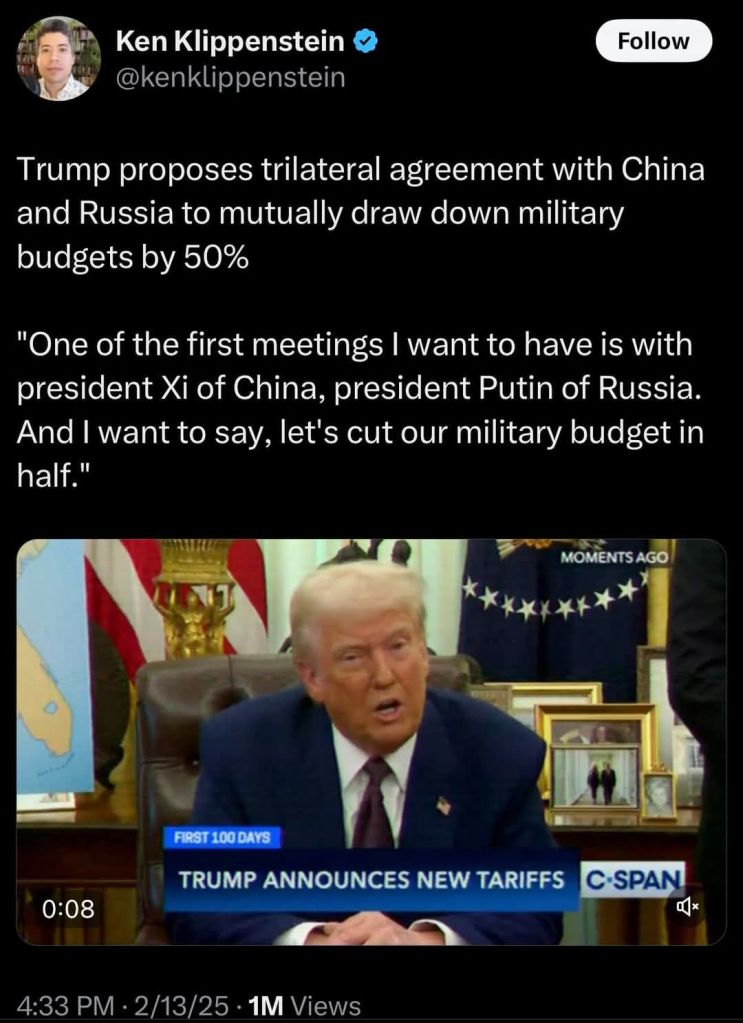
Trump has been full of surprises in the first few weeks of his delayed second term, but this latest proposal was the least expected and one even the professional fault-finders won’t be able to oppose.  He has just made a proposal that could change the world for a generation to come: A trilateral agreement between Russia, China and the US to reduce military spending by 50% and decrease our nuclear stockpiles.

But this isn’t out of character for Trump.  He got started then before he officially entered the office.  According to the Israelis, Trump, who told Netanyahu that the war must end, deserves full credit for the Gaza ceasefire deal.  And this is just a pattern.  Trump has no interest in wars.  He is about business, not bombs, and it goes all the way back to his youth when he, rather the be beholden to phony patriotism, stayed out of Vietnam.

Avoiding War By Any Means

Back in 2016, when Trump was running for President against Hillary Clinton, there was a hearsay report that the MAGA candidate had avoided military service in Vietnam by using a diagnosis of a foot injury.  There is yet to be documentation to prove this.  But it has led to some ridiculing him as “Captain Bone Spurs” and alleging his cowardice.  

To me, knowing what I do about Vietnam, I can’t see how avoiding that meat grinder is a reflection of poor character.  

No, the war was an absolutely horrendous waste of life and resources, a quagmire, in defense of a dying colonial order.  What the US government did to that country and it’s people is beyond the pale.  

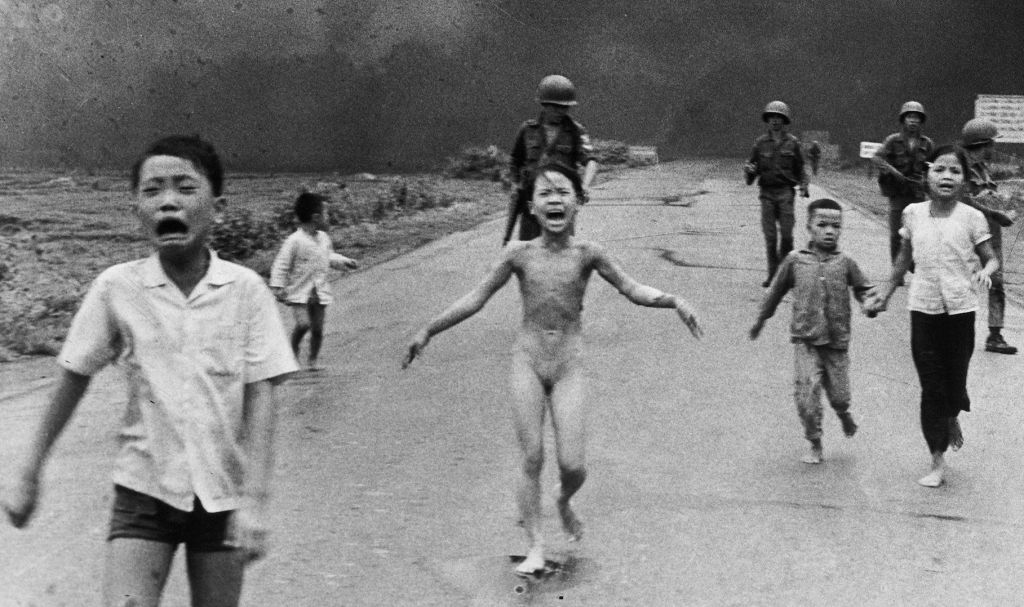
Over one million people died, bombed with napalm in their villages—scores of young American boys killed in the process—and nothing was gained besides an ecological disaster.  Our veterans were left scarred and many of them (like the father of a friend of mine) suffering from debilitating illness—which is likely due to the widespread use of chemical defoliant agents.  

It is easy to see the vanity now.  In the end Vietnam did become a Communist nation.  And yet this did not lead those dominoes falling across Southeast Asia, as ‘experts’ predicted (like they do now claiming Putin has ambition to take all of Europe) and we should be celebrating that anyone avoided this pointless conflict.

Trump may have avoided the Vietnam War for selfish reasons, nevertheless the moral reasoning was correct: Why kill thousands of Asians, at risk of your own life, when you can just do business instead and everyone wins?

Trump Angers Neo-cons

In his first term Trump did something even Obama didn’t do and despite being given a Nobel Peace Prize.  Both Obama and Trump would continue the war in Afghanistan, but it was Obama who bombed Libya in pursuit of “regime change” and turned that country into the hellhole it is today.  Trump, on the other hand, avoided war and even started negotiations for peace with a country we’ve been at odds with since 1953.

I recall being told by a die-hard Democrat friend that Trump, the terrible loose cannon and narcissist he was, would start WW3.  It is quite interesting, to see how that this dire prediction compares to actual reality where the last administration had pushed us to the brink of a nuclear Armageddon.  But in four years of Trump’s presidency, despite all the insane fear-mongering rhetoric from his opponents—nothing close to this happened.  

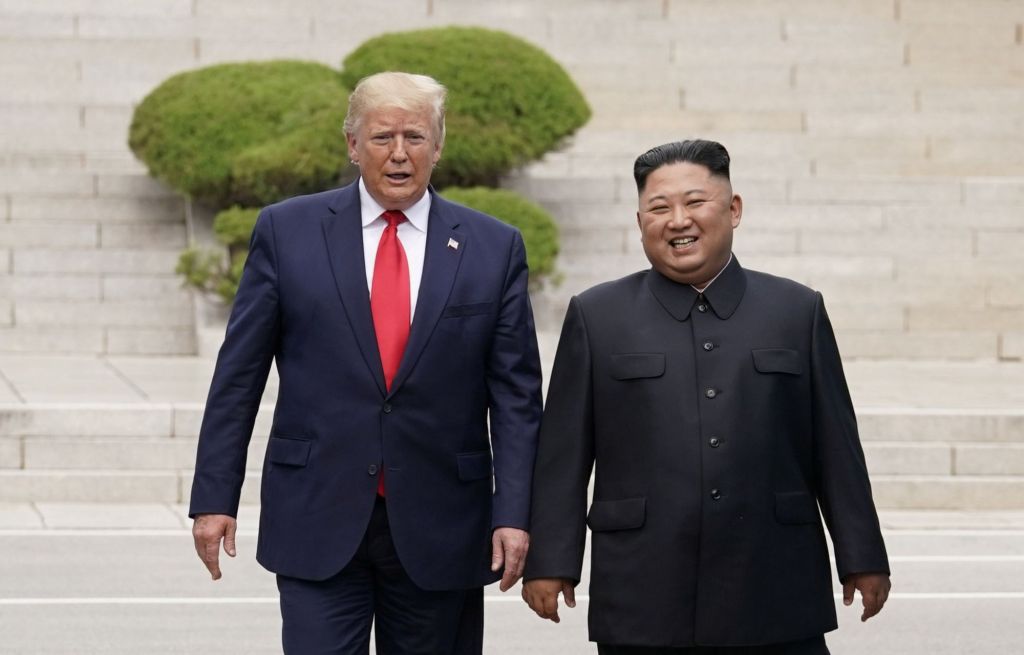
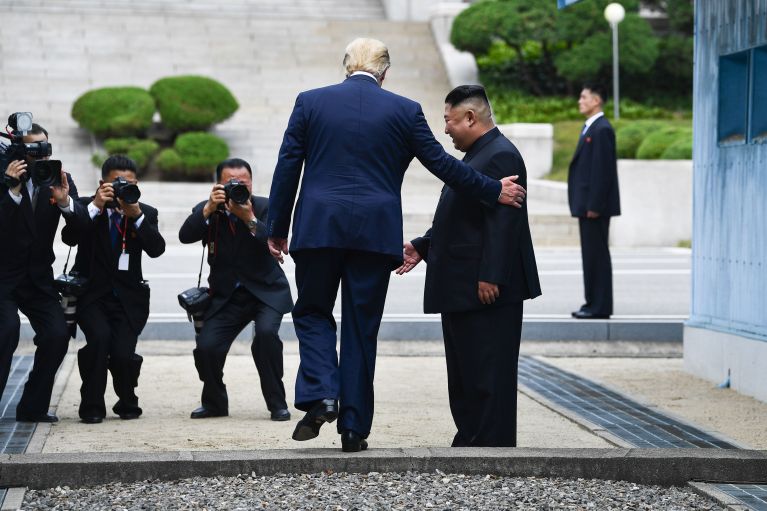
Instead, what happened under Trump, but not Biden, was a slight thaw of relationship with North Korea.  Yes, Trump engaged in a little rocket size comparison, but eventually would walk across the DMZ to shake hands and get some pictures with Kim Jong Un his counterpart.  That is unprecedented.  And is a legitimate reason to award a peace prize, but nobody recognized that moment and it has faded as Biden returned us to a status quo of use of threats and the proliferation of arms deals, rather than diplomacy, in an attempt to dictate terms.

No, Trump is not a peacenik or even a nice guy (depending on who you ask), but he did avoid a dangerous escalation with Iran over a down surveillance drone.  With neo-cons salivating and only ten minutes from strikes, Trump—learning that 150 Iranians may die—called it off.  This is likely why John Bolton turned on him.  The warmongers wanted a violent confrontation, dead bodies, whereas Trump valued human life.

And maybe it was all just a cynical ploy and part of deal making strategy?

Nevertheless, those Iranian men got to go home to their families rather than die so a President could look like a tough guy.  And, when all lives matter peace is possible.  A President that is even doing a little bit of lip-service in concern for enemies will be even less likely to put US service members into harms way.  Yes, he would retaliate against Qassem Soleimani, the Iranian General who was responsible for the deaths of American people, which shows Trump prefers to hold decision-makers accountable rather than subordinates.

Business, Not Bombs

What makes Trump unique, as a President, is his willingness to entertain different ideas in the open.  Our tireless defenders of the status quo claim it is unpresidential, that he suggests alternatives, but this is how a true innovator works.  Why not float a thought or start a conversation?

A prime example is his proposal for Gaza.  I mean, certainly, the Palestinians have truly got the short end of the stick.  They, being Semitic people themselves, get labeled as being anti-Semites, for fighting for their own deeded land, by the most powerful lobby in the world.  Theirs is a legitimate grievance, if there is any, they were chased off of their land by a campaign of violence and terror—are now portrayed as the villains.

So when Trump proposed they walk away it seemed grotesque. Israel is the one country in the world that didn’t see their foreign aid disrupted by Trump’s America-first doctrine and clearly Netanyahu is in agreement with the plan or they would not be doing a joint press conference.  Palestinians had nobody to represent them in this.  How do you make a deal with only one party present?

However, upon some further thought, this could be the best deal Palestinian people can ever can expect to get.  What really is the alternative?

They are in a war they can’t win.  October 7th caught the IDF off guard and yet it was never a serious threat to the Isreali state nor a reason for the Israeli government to come to the negotiating table.  Hamas may have hoped for a hostage exchange in order to get their own captives back.  But hardliners, like Netanyahu, saw it as an opportunity and used it.  Sure, many in the world do protest indiscriminate bombing that kills far more non-combatants and children than it does members of Hamas, but holding a sign or occupying buildings won’t stop this ethnic cleansing campaign.  

Enter, “Riviera of the Middle East”

Trump reframed the conversation from one of fighting for soil, that has led to decades of suffering and death, to what is truly best for me and my children.  Sure, Hamas may disagree, but many Palestinians will likely take a buy-out deal.  Why stay in Gaza if you have a choice to relocate?  There is no new real estate, the Saudis have a lot of money to invest, so why not redevelop Gaza into a modern vibrant city, like Dubai?

The reality is Palestinians aren’t only being kept walled in by the Israelis.  They are truly caught between the two stubborn sides of a regional conflict, like Ukraine, and they (with their children) are paying the full price.  The nations of this region have not forget about colonialism and obviously consider a nation of expansion-minded European settlers to be a thorn in their side.  Add to this that the official policy of Israel is to destabilize their neighbors and you have a breeding ground of resentment.  Palestinians are their way to return the favor—used as a tool to provoke and prove the evil of the Jewish state.

So, for my liberal friends, is this land really so important that we should, for perpetuity, continue to sacrifice more children.  Or do we find a new and creative way to break the deadlock?  And, for my conservative friends, is it better that we send Israel bombs, at the expense of taxpayers, when we could help to broker some kind of buy-out instead?  It is time for a business deal, to give those in Gaza—who just want to live normal lives—a chance.  

So, Trump, I realize this is at your “ridiculous first offer” stage, but I’m listening.  

Tell me more.

The Status Quo Alternative 

The political establishment has only known old divisions and escalation.  It is one big area of bipartisan agreement.  Republicans and Democrats in Congress may disagree on details, but nearly all support an endless war with Russia and China, through proxies or even direct threats.  The goal is always to box their rivals in militarily or back then into a corner economically—as if this is the only way forward.  

Diplomacy took a back seat.  Instead of the slightest acknowledgement of Russian and Chinese security concerns, our government has made regime change the goal with even near-peers with a nuclear deterrence.  And it is this attitude that led to the bloody conflict in Ukraine that has cost countless lives and billions upon billions of US taxpayer money, all after the US had orchestrated a coup on Russia’s doorstep, leading to a civil war in that country and—after eight years of Kiev’s regime lobbing shells at civilians—a direct intervention by Russia.

The problem is a combination of Cold War ideology and institutions.  Endless war is where the big money is.  Many, in the West, profit off conflict and chaos.  That and they are old.  They’ve become functionally fixed, see only one solution (to further humiliate or defeat those who stand in their way) and lack imagination or even the will to come up with win-win resolutions.

Truly, the only way to win any war is not to fight it.  Wars cost both sides.

Trump, for better or worse, is disruptive of the status quo.

As for his proposal, I would consider 50% to be the “ridiculous first offer” stage of negotiations and do not expect China or Russia will go along with it.  For them that would leave the US on top of the balance of power—given our tremendous head start in comparison—and this maintaining our advantage over them leaves their interests vulnerable.  They will probably come back with an alternative proposal and the horse-trading will begin.

Nevertheless, it sure beats a strategy of endless escalation—that eventually ends in a nuclear war or our bankruptcy.  Even a 10% reduction in defense spending would go a long way to slowing down inflation and give hardworking Americans more bang for their buck.  Our sons not dying in Europe or in the East China Sea the biggest benefit of avoiding confrontation.

Lead, Follow, or Get Out of the Way

Like him, love him, or loath him, Trump is the President of the United States and has resolve to make his second term historic in ways nobody imagined.

Even if we disagree on some policies or we have a different understanding of his drive for government efficiency, we should agree with this aim to convince the great powers to beat their swords into plowshares. 

There is just too much to lose (and also too much to gain) by this to not jump on this unique opportunity to challenge existing order and build a better one. 

Business (and buy-outs) rather than bombs—that’s the Trump way of doing geopolitics.

Even his idea of buying Greenland, as part of a containment strategy for Russia and China, is far better than the alternative we see playing out in the steppes of Ukraine.  There is no way to bomb and kill our way to world peace or at least not a kind of peace where humanity survives and thrives.  We need to find a different approach, we need to dissolve the Cold War organizations and agencies that encourage military solutions or regime change.  We need to double down on diplomacy and fair-trade agreements.

It is time to give peace a chance.  We need to be disruptive, to change the conversation, and work with those who are willing to work towards a better future together.  If Trump is a partner in this, then we should embrace this as his role and not hinder this with old partisan battle lines.  Maybe he’s not pure or perfect, but at least he’s oriented right as far as war and avoiding the costs.

Lust, Modesty and False Dichotomies

Standard

Of the many issues that are defined by false dichotomies one of them is most glaring and that is who bears responsibility for lust.  It is very clear that Jesus makes us responsible for our own wandering eyes:

“You have heard that it was said, ‘You shall not commit adultery.’ But I tell you that anyone who looks at a woman lustfully has already committed adultery with her in his heart. If your right eye causes you to stumble, gouge it out and throw it away. It is better for you to lose one part of your body than for your whole body to be thrown into hell. And if your right hand causes you to stumble, cut it off and throw it away. It is better for you to lose one part of your body than for your whole body to go into hell.

(Matthew 5:27‭-‬30 NIV)

This is the ultimate case for taking personal responsibility and why I don’t buy it when men try to blame women for their lust or claim immodesty caused sexual assault.  If poverty is not an excuse for looting or theft from those with something desirable, why would a victim of rape be considered even partly responsible for what was done to them?

If people can blame-shift for one behavior they can for all. 

There’s always an excuse for aggression and yet Jesus says that we are responsible for even managing our temptations.

Is she responsible for male lust?

It makes sense.  In a world full of advertising telling us to consume, moderation depends on our learning self-control.  McDonald’s did not make you fat.  No, your choice to bend to the urge to grab yet another Big Mac, on the way home, did that.  Ultimately, A truly moral person learns how to avoid stumbling blocks and would sooner remove their own eyes than make excuses.

So where is the false dichotomy?

Well, while we can’t blame fast food restaurants for obesity, we have recognized that advertising does influence decisions. Marketing would not be an industry worth hundreds of billions of dollars if this were not the case. For this reason it is worth being aware and acknowledging reality, it is our responsibility not to lust and it is also just smart to recognize the power our physical bodies have over others.

The Two-way Street…

People love to display their bodies for the attention and recognition it brings.  We have body building competitions and beauty pageants for this reason.  Our bodies are beautiful, like great art, and especially attractive to our sexual opposites.

But then it seems only young women complain loudly when that “creeper” takes notice of them in a cleavage baring skin tight outfit, as if they aren’t posting pictures of themselves in the same outfit for the world to see on social media, and that’s just plain meanspirited.  So maybe they are just seeking more attention by bashing older and physically unattractive men? I mean, come on, do they really not know that their exposed bodies are not a magnet for the male gaze?

Some want to have it both ways: They want the positive attention that their bodies bring them and then become angry about being objectified by men.  It is as dumb as a sugar daddy being upset about the “gold diggers” when he was the one flaunting his wealth as a way of gaining access to women.  If you truly want other people to value you for your personality then make that the centerpiece by being modest about your other ‘assets’ and also seeking others on the same basis rather than being superficial.

The response to overbearing purity culture, where women are wrongly blamed for male struggle, is to deny biological reality and that being sexual attraction.  That is to say this ridiculous notion that a person can wear the most revealing and provocative clothing then be upset when they’re objectified.  It would be like me claiming that I can walk into a gay bar, wearing hot pants and a tank top, then claim I wasn’t inviting attention.

Modesty is not about preventing others from lusting so much as it is about not advertising what we’re not willing to give to all.  If I don’t want anyone to stare or appreciate my Shelby GT-350, I’ll keep it under a cover in the garage and never take it out on the street. Our bodies are an object, they are the most wonderful of physical things, and to appreciate this is not a matter of lust or sin. We should not be offended when people take notice of what we have very publicly displayed.

Finding the Balance…

Jesus said what he did about responsibility for lust as an instruction to those who are trying to be moral. 

What he did not do is contradict what others in Scripture told us about being modest nor did he recommend making a big display of our various valuable assets for all to see. 

While it is not my fault if my car gets stolen and, indeed, it could happen anywhere—I still understand that the streets of some Baltimore slums are not the place to park my new car with the keys in the ignition.

Don’t park your C8 Corvette in Detroit

What this does not mean is that immodesty is an excuse for sexual assault. 

Without exception, all cases of lustfulness and sexual abuse are wholly the responsibility of those who are commiting the immoral act.  But we should understand that 1) our bodies (albeit sacred) are a desirable object and 2) there are many evil and immoral people willing to take advantage of the unwise.  Being an adult means understanding that the world does not always live up to our own ideal we must therefore take reasonable precautions.

Sure, we can curse gravity when we get stumble-down-the-stairs-drunk yet it makes more sense to acknowledge the reality and avoid known risks.  For example, wearing a skirt that only leaves the last little bit to the imagination, then going to a frat house party and getting totally wasted, is obviously risky behavior.  By denying contributing factors we are, at some point, the enablers of negative outcomes.  We should teach our children to protect themselves by being aware of enter-at-your-own-risk situations.

It is why my wife has warned me against talking too openly about my many fanciful dreams in her home country: Although my ambitions are far bigger than my wallet. Some people hearing may misunderstand—think that I’m incredibly wealthy—and this would potentially make me or my family a target for crime.  I could complain about this, claim that I should be free to express myself as I please, but that won’t save me from a kidnapping or being murdered.

To be clear, many (if not most) cases of rape and sexual assault have absolutely nothing to do with what the victim wore or where they were.  It was a relative or someone they knew who took advantage of their trust and they really could not have done anything better.  And, again, even if the victim was ‘immodesty’ dressed, they did not cause the aggression inflicted upon them.  If we don’t tell people who were carjacked that they should have left their car in the garage, why would we ever tell a girl that her exposed legs caused an assault?

My point is simply that bad people do exist and aren’t deterred by a lecture about respecting other people or their property and bodies. We know not to put our valuables on display in a seedy neighborhood—it’s just unwise.

Appreciate the Good…

Many who rejected patriarchalism are more the embodiment of the very toxic attitudes that they claim to oppose than those whom they accuse.

As the saying goes, “When you point a finger, there are three fingers pointing back at you,” we should be careful in our zealousness for a cause not to fall into our own delusion.

 Or as Jesus taught:

“Why do you look at the speck of sawdust in your brother’s eye and pay no attention to the plank in your own eye? How can you say to your brother, ‘Let me take the speck out of your eye,’ when all the time there is a plank in your own eye? You hypocrite, first take the plank out of your own eye, and then you will see clearly to remove the speck from your brother’s eye.”

(Matthew 7:3‭-‬5 NIV)

Browbeating moral men about “rape culture” is no better than religious fundamentalists who constantly guilt-trip conscientious and modest women about male lusts.

Good men don’t…is this a controversy?

The vast majority of men are not rapists nor is someone a “rape apologist” for stating the truth about sexual attraction and additional risks for women.  The fact is that there are bad people in the world, willing to exploit the vulnerable if allowed, and that is why we put locks on our doors.  Clothing is just one of many layers of defense and also a way to keep the focus on something other than our bodies.

We take for granted the religious laws against rape, theft or murder, as if such things are written into the substrate of the universe, but the reality is that this is order built upon moral men who use their strength to protect rather than exploit.  It is truly only under the protective umbrella of civilization that a person can expect to walk around (without the direct protection of their clan) and not be immediately set upon by predators. 

We should, therefore, appreciate the good self-controlled men and distinguish between them and the bad.

Are You Better Than A Pharisee? (Matthew 23:29-32)

Standard

Denial is our first line of defense.  Even the guiltiest person will plea “not guilty” in an effort to avoid judgment.  And when we read Matthew 23, it is easy to assume that the stinging words of Jesus apply to them but not us.

Denial is a natural response and therefore it was no surprise if we read Jesus’s words to the Pharisees and fail to make a connection between “us” and “them.”  Most of us prefer to think of ourselves as the good guys, you know, the ones with better understanding and more complete knowledge.  How could we be as wrong as those whom Jesus condemned?

And when we do have to admit our failures we tend to deflect and downplay them: Sure, we are imperfect, we make mistakes; but who doesn’t, right?

I should know.  I was once an ardent apologist for everything Mennonite.  I believed that by God’s grace, I was born into the church denomination that best applied the teachings of Jesus—which is a sentiment not uncommon among my Anabaptist peers who have not been sexually abused, the witness of a vicious church split, or excommunicated.

Unfortunately, this assumption of our having a corner on the truth is a position built on confirmation bias and arrogance.  Every religious zealot believes that the ground they stand on is sacred simply because they are standing on it.  But, unless you believe that all paths lead to God, they can’t all be right.  Likewise, our own assumption that we are right, and our ability to defend it, doesn’t make us any better than them.

Those who do not learn from history are bound to repeat it.

The Pharisees and religious experts believed that they were on the right path; they proudly considered themselves to be God’s chosen people and resisted his message.  It would be easy to try to distance ourselves from them, to think of them as extraordinarily bad people and deny our commonality with them.

However, if we do that, if we are too proud to consider that we could be on the wrong side of history, then we have the same exact mentality of those condemned by Jesus:

Woe to you, teachers of the law and Pharisees, you hypocrites! You build tombs for the prophets and decorate the graves of the righteous. And you say, “If we had lived in the days of our ancestors, we would not have taken part with them in shedding the blood of the prophets.” So you testify against yourselves that you are the descendants of those who murdered the prophets. Go ahead, then, and complete what your ancestors started! (Matthew 23:29‭-‬32)

The teachers of the law and Pharisees, like us, identified with the good characters in history and distanced themselves from the bad.  They thought they were different from their ancestors who killed the prophets.  But Jesus turns their attempt to disassociate themselves around and uses it to create a link.  He taunts them, telling them to finish what their ancestors started.

The sad reality is that the proud religious fundamentalists of Jesus’s time did not see themselves as repeating history.  They imagined themselves to be the preservers of a pure religion passed down from the prophets before them and heroes of their own story.  To them, Jesus was a dangerous and false teacher, so they wanted him silenced and conspired to have him killed.

What was so wrong with the Pharisees?

“Pharisee” has become a pejorative word in our time, and yet in the time of Jesus it was a proud distinction.  They were the devoutly religious people; they held themselves to a high standard and kept the law better than their neighbors.

Jesus once told his audience:

For I tell you that unless your righteousness surpasses that of the Pharisees and the teachers of the law, you will certainly not enter the kingdom of heaven. (Matthew 5:20)

It might seem odd that Jesus uses the Pharisees as a benchmark and then lambastes them later as hypocritical.  Was Jesus inconsistent and changeable?  Moody or bipolar?  I doubt it.

Actually, I believe the Pharisees were the “good people” of their time and trying their best to live righteously.  And, as people respected by their religious peers, they were not accustomed to being called out and condemned.  But, despite their diligent efforts, they were missing something and it was because of that that Jesus poked and prodded them.

The problem with the Pharisees was not that they were extraordinarily bad people.  The problem was that their success in surpassing others had made them into entitled brats who thought themselves superior to others.  Sure, they were pristine on the outside, did the right things to be regarded well, even thanked God for all their advantages, but were they living in faith?

Or were they content to simply do better than others?

The servant who knows the master’s will and does not get ready or does not do what the master wants will be beaten with many blows.  But the one who does not know and does things deserving punishment will be beaten with few blows. From everyone who has been given much, much will be demanded; and from the one who has been entrusted with much, much more will be asked. (Luke 12:47‭-‬48)

A faithful person is not content to simply do better than others; they realize that their advantages are a gift from God and not deserved.  There is no room for arrogance when this is understood.  The Pharisees may have feigned reverence for God, but a genuinely humble person does not try to create distance between themselves and people of a social lower order.

The Pharisees rejected faith.  They were so outwardly successful that they were able to delude themselves into thinking that they could actually impress God and save themselves.  In their zealous pursuit of knowledge and religious fundamentalism they forgot one thing, and that was faith.

Are we better than the Pharisees?

Probably not.

The Pharisees knew their Scripture extremely well and lived the law more carefully than most of us could even imagine.

That said, good Mennonites have much in common with the religiously educated and traditionally-focused Pharisees.  They were middle-class businessmen—not as political and compromising as the Sadducees, nor violent agitators like the Zealots… and not too different from us.

The disciples Jesus called to follow him were a motley crew by comparison: a mix of poor fishermen, a tax collector, and other losers of their time.  They would probably not even be second-tier Mennonites and certainly not the ones we would select to be missionaries and future leaders.

However, unlike the rich young ruler, who kept the law perfectly and placed his security in his wealth, the disciples put everything down to follow Jesus.

Perhaps it is because they had less to lose?

Whatever the case, nobody is beyond hope and that is why I write.  Many Pharisees did eventually come to faith in Jesus and many Mennonites do too, despite our religious and cultural baggage.  As long as we have breath in our lungs, I believe we can be saved.

But a journey of faith must start with repentance, and I’m not talking about the ritual repentance that wins the approval of parents and religious peers, either.  We need the true repentance of those who know that outside of God’s grace, we are no better than a Pharisee.