I write this post with trepidation. I have been accused before of being too open with my thoughts by some. But I have been told by others that I am very guarded about my personal life and have been urged to express more of that. The truth is that my sharing is often intentionally not vulnerable. Talk may be cheap, but sharing my innermost feelings always comes with an emotional price tag and the risk feels too great. I can discuss abstract ideas for hours without wearying, but when I lay my deeper feelings out it leaves me exhausted, often also feeling degraded and disappointed.
I believe all people desire affirmation or acceptance. We also want to maintain our own separate identity, to be different from others and still be accepted. I had that conflict growing up as a religious minority. I wanted to be identified with my unique heritage. However, I also wanted to be treated as a unique individual and resisted being cornered with the many stereotypes of classmates. Questions, frequently asked without ill-intent, would often be framed as statements categorizing me, “you are X therefore you do Y and Z…”
Uniquely Mennonite; also a Unique Mennonite
I was born into a Mennonite home. Mennonites are a small Christian sect, a product of the Anabaptist movement that swept through Europe in the 1500’s and are known today for their traditional way of life and non-violent stance. Mennonite is both a religious denomination in that ‘members’ conform to certain established standards and, because historically many members come from within existing Mennonite families, it can also classify as a distinct ethnic group.
Most Mennonite children attend private schools and some, more frequently over the past couple decades, are home schooled. However, my parents chose differently, my siblings and I all attended the local public school. It was a consequential decision and a source of some inner turmoil for me as well. I am a proud alumnus of Lewisburg Area High School, yet there was a time where I begged my mom to home school me and throughout my schooling I always identified more strongly with my Mennonite sub-culture.
At school I conscientiously did not join my classmates in various activities. I would stand respectfully and silent during the reciting of the pledge of allegiance. As a devout Christian, I believed my allegiance was owed to something greater than country and I felt I could not pledge to anything besides God. I was separated in other ways as well. I did not grow up with a television at home, so I was out of the loop as far as popular culture and could not identify with much of the chatter about this or that celebrity. I didn’t wear shorts in the summer. I was odd.
But, in church, I did not always identify well with my Mennonite peers either, they had their own school experience and cliques. Prayers by church leaders would give specific mention of the students and staff of the Maranatha Christian School, but would leave out those few of us who attended elsewhere and I noticed it. The neglect of mention was completely unintentional, but it did contribute to a feeling of not mattering, that feeling was a source of insecurity then and lingers in my mind today. I never felt I fit into my school or church culture.
I savored my independent mindedness. I could feel privileged over both my public school and Mennonite peers at times. I had a spot amongst the misfits in both categories too. But, my finding a place among the misfits was to still feel excluded from the mainstream of both settings and was to be a double misfit. It was exclusivity with some exclusion or at least I felt excluded. I had one foot in with mainstream American thinking, with another in a culture that celebrates a persecuted past, and with that a mixed identity all my own.
My Place Amongst the Persecuted
Mennonites have a long memory. We are dutifully reminded of acts of gruesome torture committed against our people from hundreds of years ago. There’s a book, Martyr’s Mirror, nearly as sacred as the Bible in many Mennonite (and Amish) homes, which is basically a chronicle of the violence done to Christian believers. The book includes haunting etchings of the terrifying ends of some who would not recant their faith under trial and these stories help shape Mennonite identity as a persecuted minority.
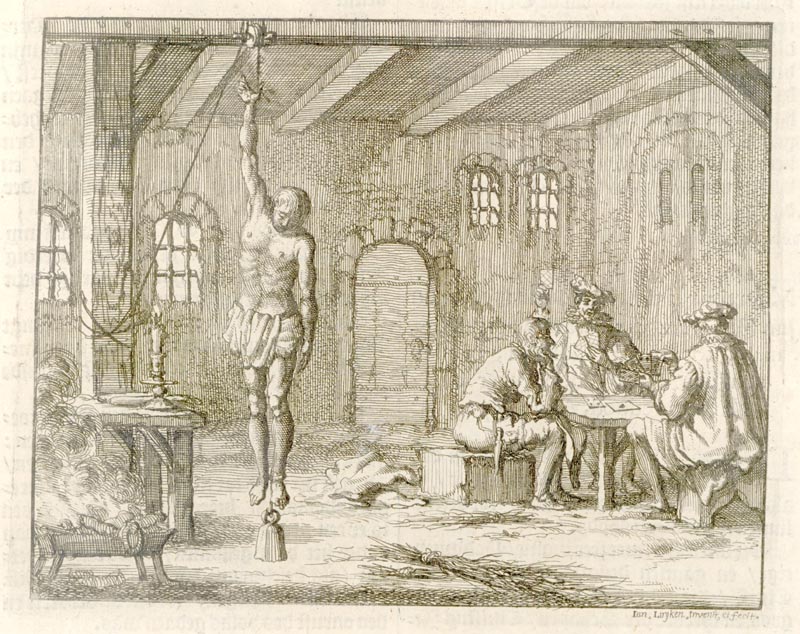
Torture of Geleijn Cornelus, Breda, 1572
Mennonites have a mistrust of mainstream society. Part of it is in a product of a religious emphasis to intentionally maintain a ‘non-conformed’ outward appearance and lifestyle. But the other big part is a real fear that persecution is just around the corner and that we could all soon suffer the same fate as our spiritual/ethnic fathers. Mennonites (and Amish) have been so insular and so separated from mainstream society that they actually have their own unique genetic disorders. Many still maintain their own German dialect, commonly referred to as “Pennsylvania Dutch” or “PA Dutch” for short, and church outsiders are referred to as “English” by Amish people.
The irony of it all is that Mennonites are more frequently adored than they are despised. Our biggest critics tend to be those who are disgruntled ex-members or those who had a bad experience in one church and judge all Mennonites based in it. We are treated both with respect and also patronizingly at times. My sister, a medical doctor, was once asked by a non-Mennonite if she would be interested in cleaning houses or babysitting, which could be taken as an insult to a person who was qualified for much more. Many have assumed my ignorance as well and apparently because of my rural and religious upbringing.
People do judge by outward appearances. People do make prejudiced assumptions based on ethnic heritage or religious connection and I have experienced this first hand. I believe that is likely why I have instinctively classified myself with the victims of prejudice rather than with the perpetrators. My unique upbringing may have been the reason why I was fascinated with history of racism in America. I read books; some of them required reading, but many others by curiosity and choice. The titles escape me, but I remember experiencing the civil rights era from the perspective of a woman in the NAACP, then living life as a young woman in Japanese internment camps and later spending time with a fictional lawyer named Atticus Finch.
My Struggle to Find Acceptance
I also have another identity and that one created in my slow development that earned me nicknames which included “micro” in them. I was short and small for my age. I was a late-bloomer beyond even my then diminutive size. I was older in my class, a polite and respectful student, I would often find more in common with adult teachers than my age-group peers, I had keen interest in history, was knowledgeable, but was also very innocent. I had little more than platonic interest in girls until my late school years and had mostly kept a safe distance from them. I did not seem to draw a whole lot of female attention either. I was an introvert in a crowd and shy around women.
With my struggle with stature, with a lack of strong social skills, athletic abilities, or other especially developed talents (besides being a non-stop daydreamer with some artistic gifts) and having not received an abundance of popular attention, I developed a bit of an inferiority complex. It only intensified as I became interested in dating and noticed many girls were more interested in a muscular, square shouldered or smooth talking male figures and I realized that just wasn’t me. I was this sensitive bundle of analytical thoughts without an adequate ability to express them. It was also furthered by the fact that I felt I was a misfit. I was way too religious for the more secular public school girls, but I was way too nuanced and philosophical for the cut-and-dried products of my own conservative religious culture.
For whatever reason, fate or fortune, I struck out with the first Mennonite girl I asked and that experience was where my confidence really began to wane. I had a an acute awareness of nuance differences of how people treat each other and knew too well how girls treated the ‘cool’ guys compared to those less popular. I was not disliked or mistreated. But I was also not that quintessential Mennonite guy either. It seemed the average Mennonite girl wanted this simple, macho, disinterested, reserved fellow and I did not fit that conventional mold. I was complicated; I alternately talked too much while not saying enough of the ‘right’ things, was fully Mennonite in some ways and not enough in others. I also lucked out with a church full of first cousins.
I was a deep-thinker, a conscientious person, fiercely loyal, told multiple times (by marriageable women) that I would make a wonderful husband, earnestly faithful, protective and gentle. I wanted to be the hero of the woman I admired, unfortunately I always seemed to play the cards of the villain or that’s how it felt my sincere efforts were received. It is against my nature (or maybe my Mennonite training) to harbor ill-will towards anyone. But feelings of rejection (both real and perceived) are as a poison to the soul. I have had my flashes of misogyny or jealousy, with those feelings immediately followed by longer moments of self-loathing and contempt for everything I was or was not. I was a victim of bad-timing, I was disadvantaged by my genetics, I was unfairly categorized and felt it all to be an injustice.

Drowning of Mattheus Mair, Wier, 1592
It may be irony, but it was black women who later affirmed my strengths and restored some of my confidence lost along the way. Like in the books I read, where I could identify with the female minority lead character, I felt minority women could somehow understand me and with them is where I felt most accepted. I was treated like I mattered. It did not hurt that some were educated beyond my Mennonite peers and could appreciate discussions of philosophy, psychology, sociology, identity and race. Not wanting to produce a stereotype about Mennonites, but I would probably be more popular with my ethnic kinfolk if I would shoot more deer, get a big diesel truck, be an outstanding volleyball player and learn to love card games.
The Schizophrenic Demands of Insecure People
We live in a culture that both tells us to “be you” and yet also encourages conformity of thought or action and shames divergent thinking. We live in a society that preaches against stereotypes, that celebrates individuality and yet continually it categorizes people by race, religion or gender. I am simultaneously castigated as the perpetrator of racism and sexism, as a white male, but then instructed not to build identity around race or to make any judgments about sexuality. It is a feeling of being whipsawed, assailed for doing something that I have not done by those who are doing exactly what they say I shouldn’t do and that I didn’t do.
That is the dilemma of a colorful thinker: Do I go with those who say I should be identified with the perpetrators of historical violence? Or should I go with my instincts, my experience as a minority, and make my identity with the victims?
For me the choice is clear: I am neither victim nor villain. I have felt a victim of circumstance in the past. I have been treated unfairly, excluded unjustly, felt like a perpetual underdog. I have been condescended to and even discriminated against based in my race or religion. I have withstood bullies who picked on me because of my differences (my genetics did not lend to physical intimidation) and I have endured educated elitists who hurled insults, alleged my ignorance for challenging their perspectives and then would burned their straw-man effigies of me with an unwarranted glee. But I refuse to make my identity center on my claim to victimhood.
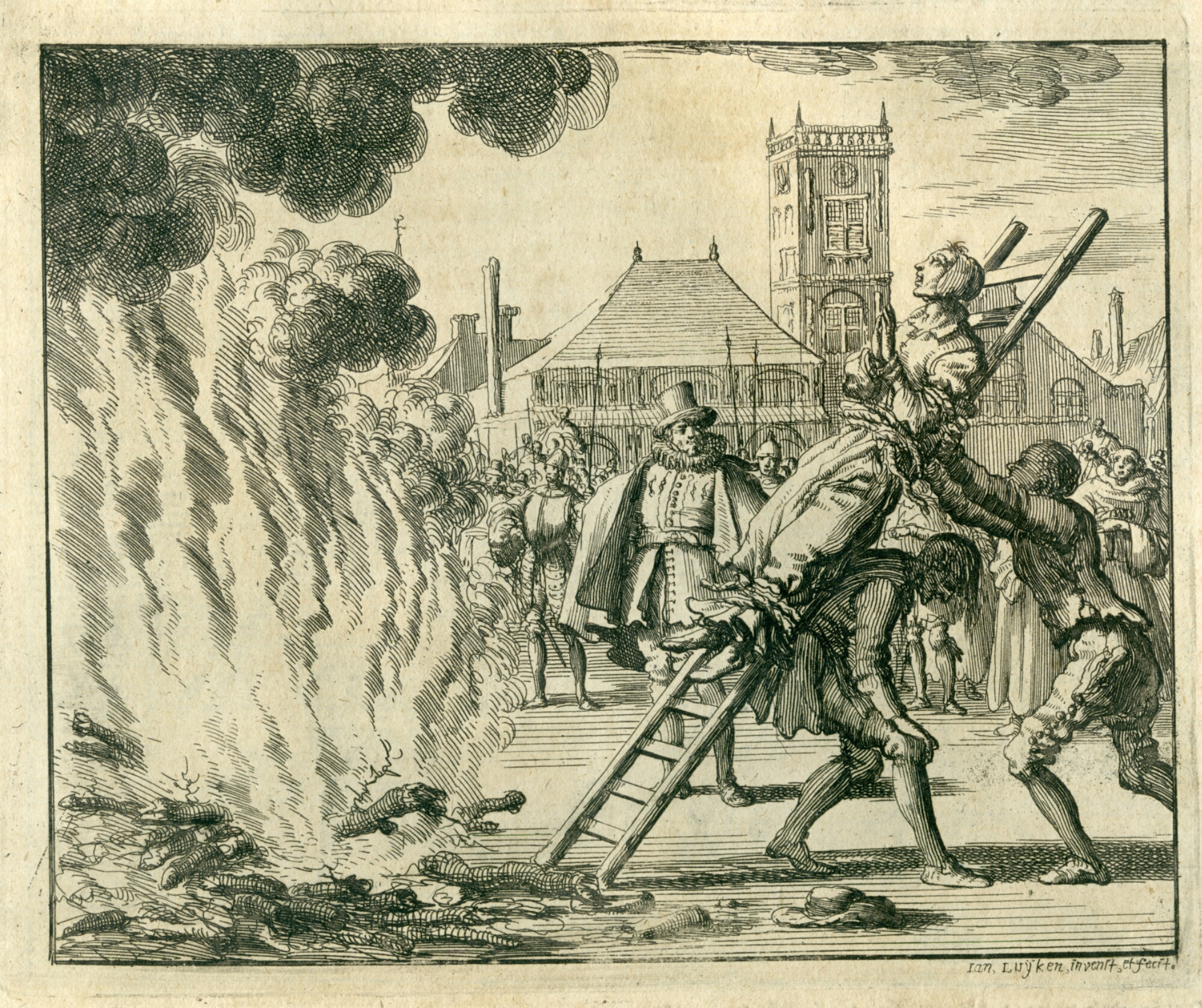
Burning of Anneken Hendriks, Amsterdam, 1571
I will not be like the bitter white co-worker who blamed his lack of success in college on not having the special privilege of affirmative action and would spout one racist opinion after another. I rebuked him without hesitation. I share no identity with his racism and hatred. I will likewise not patronize, show favoritism or cater to others simply on the basis of skin color and historical injustices. We all have challenges to overcome in life and it is easy to assume that our own are bigger or more real than someone else’s. I am not going to coddle and perpetuate the insecurities of any person, white, black or otherwise. I do not believe we help people overcome by treating people as helpless and hapless victims.
In discussions over race, with constructions like ‘white privilege’ and such, I have more frequently been lumped in with the perpetrators of racism rather than treated as a unique individual. It is frustrating, because Mennonites were some of the first to protest slavery and that is the identity that is more real to me than my skin color. Amish and Mennonites were even singled out in America for their ethnicity and conscience, some locked in prison during the First World War because they refused to fight. I feel, at times, that I have more in common with a persecuted minority than with anyone else. Yet, because I am a white male, some assume I could not possibly understand them and seemingly dismiss my perceptive without ever hearing it.

Burning of David and Levina, Ghent, 1554
I may not understand exactly what it feels like to be black in America. But I do know how it feels to be treated as inferior and less of a man on the basis of superficial things. I know too well what it is like to be categorized and stereotyped. I understand the conflict of one who loves their own heritage, has a defensive urge against those who attack their ethnic community and yet is still aware of the problems of their own people. I have a love-hate relationship with my own Mennonite religious/ethic heritage. I was taught to be afraid, not just of the police, but of mainstream society in general and some of my religious peers think they are persecuted because of perceived slights.
I have felt insulted and belittled at times. The slights were real and sometimes intentional too, but not always. I have found my reactions are a product of personal insecurities and sometimes little more than that. People all have their sources of insecurity. Conservatives fear a tyrannical government will soon take away their rights, thus fearfully stockpile guns and ammunition. Liberals think that the economic system is stacked against them and want government to impose on their neighbors allegedly as an act of justice. We can build identities around these insecurities. We may find people who share our fears and can look for evidence to ‘prove’ our own disadvantaged status or victim role. Unfortunately, while we do this, while we are demanding respect of our own person or people like us, we are also often leaving a wake of destruction behind us.
Insecure people produce more problems for themselves and others. We all know them, that super-sensitive person who is so insecure that they see an insult in even the most innocent requests or gestures. Take, for instance, a guy who told a story (apparently thinking his audience would be sympathetic) of a time he was driving down the road and a woman driving in the opposite direction scratched her nose as they passed. He knew an insult when he saw one. So he spun his vehicle around, aggressively pursued the offending party and gave a lecture on her disrespectful behavior. Of course, who knows why she touched her nose at that moment. Much more disturbing is a man who assumes an insult or injustice at every turn—and does not see his own offending belligerence.
Seeing Beyond Divisions of Black and White
I am a person with multiple identities and with none in particular. I am not alone either, I believe many Americans have many different identities and do not fit neatly into statistical categories. That said, Americans do also have bigger common identities of race or gender and these identities can sometimes be used to divide us. Our differences can be a cause for celebration, but they are also the basis of falsely dichotomous ‘us’ versus ‘them’ narratives and are used feed existing insecurities. But, treating every person like a unique person to be individually loved as a unique person, rather than in category of victim or villains, would solve a multitude of problems.
Pigeonholing, finger-pointing, scapegoating or shaming those who have offended me probably will not solve my own insecurities and I’m doubtful this type of action would ever create desirable results those whom I deem as guilty. Demonization usually only creates another class of victim. When we treat people like problems rather than people, when we throw them into categories of perpetrator on the basis of their appearance or history, then we have become contributors to the disease of prejudice rather than healers and helpers. If we want more heroic people in the world, then we must treat more people like heroes and as we wish to be treated. If we want dignity and respect for ourselves, then we need to stay committed to treating others with dignity and respect.
Healing of existing wounds will not come from two sides beating each other with superior arguments or competitive claims to offense. Tensions certainly will not be solved by making any person feel inferior or labeled as a villain. The urge to point out statistics about black men in response to those who cite statistics about police will not bring us closer to peace. The truth is if there is to be healing it will come from us learning to identify with all men, and not with only those who look like us or share our own opinions.
We need to recognize even our own intuitions, even those that are informed with history or statistical evidence, might be skewed, prejudicial and wrong. What we perceive to be true is not always whole or complete truth. We need to be more introspective, practice more constructive self-criticism, and address our own faults squarely. The assumptions we make about ourselves and about other people can hurt our chances for success. Yes, I could build a pretty solid rationalization to defend my own insecurities, but it would get me nowhere towards overcoming the obstacles to my success and, if reinforced long enough, could become a reason to not try at all.
Creating Shared Identities
It is impossible to say categorically that every white man has it better or every black woman has it worse and it is foolishness to assume it. A single black mother probably has more in common with a single white mother than she does with a black woman who is happily married. Then again, a black woman, who endures assumptions about her appearance, might actually be able to identify with a young Mennonite woman who dresses differently because of her own religious/ethnic heritage.

Dirk Willems rescuing his pursuer, Asperen, 1569
We need to endeavor to create shared identities bigger than race or gender or religion or even economic status and rid ourselves of crippling victim identities entirely. There are more of us misfits than there are those of us defined by statistics or stereotypes. We all have unique advantages or disadvantages and also our own special challenges to face. So, rather than dwell on ourselves only, or focus solely our own specific problems, we could realize struggle in various forms is common to all people and part of our shared humanity. I have my own struggles, you have your struggles and in sharing our burdens together we become brothers and sisters in the same fight rather than rivals or enemies.
I am not saying we should lose our unique identity either. What I am saying is that categories of white and black, privileged or persecuted, hero and villain are too small. We are colored, but not in black and white or shades of gray, we are truly many shades of many colors and uniquely our own person. We have many shared identities that could bridge our gaps and create common understanding, but to find them we need not to be bound to our past or prejudices.
My advice: Build an identity with those who overcome with love and despite the odds against them. Tune out those who only feed insecurity and fear.
(Click here for more Martyr’s Mirror images)





 Irregular Ideation