Facing the Truth

Standard

I decided to take on one of the lies being spread on social media today and found myself bumping up against the Facebook censorship regime once again.  And what they allow or disallow is purely about the partisan narrative they’re pushing.  Leftists can post memes all day long showing Elon Musk with his hand raised, claiming that he is a Nazi, but you can’t even post a plain old picture of Democrats with their hands in an apparent salute without that “misleading” blackout being slapped on it.

InDePeNdEnT fAcT-cHeCkInG

This is the kind of protection those left of center can expect.  They’re never held to the same standard as those on the right.  If you are conservative any soundbite can ripped out of context and disseminated without a fact-check.  Republicans are guilty until they prove themselves innocent.  By contrast, the corporate media mouthpieces do not confront the left for their hypocrisy and require Democrats to denounce the left-wing violence.   And Billionaire’s like Mark Zuckerberg play interference for them by not even letting us make a comparison to show how ridiculous their claims are.

This is what I posted on Facebook with the image above:

What happens when you put a conservative guy with Asberger’s syndrome in front of an audience of leftists?

Bullying.  

The left is about conformity.  

You march to the beat of their drum or they will ostracize and belittle.  Name-calling is a leftist invention.  They love their categories, white and black, haves versus have nots, and it is always about pigeonholing people into tribal groups and robbing all people of their own unique identities. 

But turning Musk’s awkward movements, as a guy clearly on the Autism spectrum, into a Nazi salute—even the ADL said that’s taking it too far.  Unfortunately this misinterpreting of his hand motion has become that moral justification the far-left wanted to unleash a terror campaign of vandalism and violence—a Krystalnacht redux.  

Why did Nazis hate the Jews?  Well, there was the same envy of wealth and influence then that the left is now directed at public figures like Musk.  To the left a billionaire’s money should belong to them, the ‘fasces’ or their elite managerial class, whereas an American vision is that people should keep their lawfully acquired gains.

Patriotic Americans believe in free markets and rule of law.  In stark contrast, the Antifa left (deceptively named) believe in central control (in their hands) and rule by mob if anyone dares to resist their ‘progressive’ regime.  They are everything un-American bundled into one ugly package, unforgiving, anti-freedom, big government, collectivist (you do what ‘we’ demand or else) and do not believe in civil rights—starting with that of respecting property and persons.

As I travel in Asia there are Swastikas all the place.  If we judged their usage by our own narrow interpretation and understanding we would issue travel warnings to Jews.  But it is not the symbols or gestures that matter—it is the attitudes and actions behind them.  Musk wants taxpayers to keep more of the money they’ve earned.  While the left, along with their Democrat enablers, want to scare you away from choosing the best EV brand there is because they’re control freaks.

The left totally lacks empathy.  Sure, they claim it, like they claim everything else on the planet they didn’t earn with their own work.  It’s all about them, their Narcissistic small-minded worldview, that is why they can only ever project, accuse, self-deceive and destroy the success of others.  They’re an organism that thanklessly destroys their host and condones hate, theft, arson, and murder of anyone who does not lockstep with their cult agenda.

Musk’s “my heart goes out to you” gesture…

The problem isn’t only that the left has a clear double standard, it is that they think they’re the worthy judge when they’re clearly as biased as they come.  A little humility would go a long way for this lot.  At the very least they could let us be free from their grip to spend our own money and live our own lives—but then that would be too democratic for their tastes.

Oxygen Masks and Civilizational Math: Empathy’s Breaking Point

Standard

Anyone who has flown commercial knows the safety rundown before take-off.  You’re instructed on where to find lifejackets and how to put on the oxygen masks.  And one thing they emphasize is before taking care of anyone else, including children, they need to secure their own oxygen first.  This does not mean that a passenger shouldn’t care at all about anyone else.  What it means is that caring for ourselves first can make us more able to help others.

I came across a post of Facebook about the vandalism and terror campaign against Elon Musk’s Tesla brand.  In the comments I saw a left-wing activist justifying their violence by using a paraphrase of Musk, “empathy is a weakness.”  So I looked into the claim and found a quote of Musk during a Joe Rogan Experience podcast:

There’s a guy who posts on X who’s great, Gad Saad? … Yeah, he’s awesome, and he talks about, you know, basically suicidal empathy. Like, there’s so much empathy that you actually suicide yourself. So, we’ve got civilizational suicidal empathy going on. And it’s like, I believe in empathy, like, I think you should care about other people, but you need to have empathy for, for civilization as a whole, and not commit to a civilizational suicide. … The fundamental weakness of Western civilization is empathy, the empathy exploit. They’re exploiting a bug in Western civilization, which is the empathy response.

I’m not sure where “empathy is a weakness” can be found there.  What it seems Musk is saying is to keep everything in balance and not go to self-destructive extremes.  I would call it rational pragmatism rather than use a weird sounding “suicidal empathy” and yet it is a poignant point.  We can understand and share the feelings of others (empathy) while not destroying civilization in the process.  It is sort of how I always listen to my son, but don’t always give him stuff that he wants—because the soda and sweets could lead to tooth decay and diabetes.

This is the Gad Saad quote referenced by Musk in the interview:

Imagine an entire civilization that is taken over by an emotional parasite called suicidal empathy that trumps every other instinct that is within your adaptive repertoire. You are willing to sacrifice everything at the Altar of Suicidal Empathy. Nothing is more important than that.

What he’s taking on is the ideologies that demand we recognize, accept and finance every kind of bizarre behavior.  Money being sent for transgender operas when we have crumbling infrastructure, for example, this is what suicidal empathy looks like.  Or letting a confused men destroy women’s sports—there is an opportunity cost to these special accomodations and, with limited resources, it means many will suffer for the whims of a few demanding empathy in the form of their own exemptions and privileges.

My son may want me to taking him fishing every day.  To him I have limitless time and resources.  He says it would only take me a few minutes to drive him across town to his favorite spot.  But what he doesn’t really get is how doing this is difficult given I can’t just leave baby at home and it also cuts into my time to do the chores he neglects.  To him it seems simple and he reacts with disgust as if he is entitled to transportation and a life of leisure at the expense of everyone else in the house—yet the adults know better.

Performative Empathy vs. True Compassion

Nobody at DOGE is saying we should beat or bully transgender people or forbid people from donating to foreign causes.  What they have advocated is for efficient and effective use of public funds.  Yes, it could be called “tough love” and yet it is really essentially to the thriving—even surviving—of the country that we don’t bleed resources for minimal or no real return.  Government is not a charity, it relies on coercion to attain funds, for that reason it should only be used for things the majority of people support.

Those burning Tesla supercharger stations, smashing out dealership windows, or even attacking vehicles owned by individuals not named Elon may claim to represent the side of empathy, but their’s is only performative empathy and part of their partisan political agenda that is all about maintaining their own power and control over others.  Those same people forcing mandates, in the name of climate change, have now spun a 180 to creating unnecessary pollution.  They never cared about the planet—it is always about their belief they have the right to rule us.

That is what toxic empathy is about.  It is a manipulation game, a virtue signal, and like the jealous boyfriend’s love.  Sure, they say they love, and yet would murder before they would ever let their significant other go their own way or be apart from them.  This is, of course, symptomatic of leftism.  They want complete control over your life and yet call a billionaire greedy for being allowed to keep the wealth they’ve amassed.  And that’s the real culprit here: Envy.  It’s not that those on the left care so much about people, it is that they are looking for a moral justification for their rage against successful people.

Leftist ’empathy’ strikes again.

Elon Musk is many things.  He’s extremely motivated.  A problem solver.  A billionaire.  A bit of an online troll.  A father of fourteen children.  Efficiency expert.  And also has Asberger’s syndrome.  It is that last item on the list that puts him at odds with normies who prefer lawyerspeak to bluntness.  Musk doesn’t coat anything in syrup, he analyzes, identifies the problem, and states it plainly rather than beat around the bush.  Contrast to the left, he puts logic and reasoning first—feelings second.

As an aside, CEOs and political leaders have a higher likelihood of being psychopaths.  It is what makes them good at their jobs.  You can’t make good decisions for a corporation or a country when you’re too zeroed in and obsessing over impacts to individuals.  That is going to lead to analysis paralysis and no necessary corrections being made.  Instead they think on the macro scale.  This is not to say they don’t care about the parts, but the good of the whole is what matters to them and they distribute concern according to the overall picture.  Sure it may seem cold and calculated—but serves the common good much better than empathy run amok.

As much as those on the left like to crow—as if their great empathy stretches across the globe—the reality is their typically very focused on their own feelings.

Their ’empathy’ is unsustainable.

Myopic.

Blind.

Christian compassion, in contrast, balances judgment and mercy. You do unto others as you want them to do to you, but also speak the truth in love—even when it gets you killed by an angry mob that doesn’t want to hear it. The tension or fusion of love and accountability keeps it grounded; it’s not a free-for-all where every whim gets a blank check. Unlike leftist empathy, which often bends toward appeasement or control, Christian compassion holds a line—help the widow and orphan, yes, but don’t burn down the house to warm them. It’s personal, not performative, and it doesn’t bankrupt the future for the sake of today’s applause.

Breathing Room for Civilization

In the end, the clash isn’t about empathy versus apathy—it’s about who gets to breathe first when the masks drop. Musk and Saad aren’t wrong to call out the self-inflicted wounds of suicidal empathy; they’re just pointing to the scoreboard: civilizations that forget their own oxygen don’t survive to help anyone. Leftist empathy, with its envy-fueled ‘virtue’ and reckless spending, dresses up as love but flirts with collapse—torching Teslas while preaching care, funding operas while bridges crumble. Christian compassion, for all its flaws, at least remembers the whole plane matters, not just the loudest sob story. We don’t need more performative tears or smashed windows—we need a hard reset on what keeps us aloft. Secure your mask, folks; the turbulence is just beginning.

The Displaced Aggression Of Ruby Hamad  

Standard

As someone who prefers getting news from non-Western sources, I occasionally read Al Jazeera for some perspective, and that is how I came across an article, “Imane Khelif and Western delusions of white innocence” and had to hit back.  For the remainder of this blog, I will identify as a minority woman to obtain maximum victim points, and so I don’t need to pull my punches.

Editorials are often wild swings, some are so off-balance and contrived that they invite a counterpunch.  I had no idea who Ruby Hamad was.  But her profile reveals a Syrian-Lebanese woman obsessed with ‘white’ European women and how they are loved more than her.  She has made her name through her racist and misogynistic attacks on ‘white’ feminists.  It’s a little bit weird given how white she is.  But hatred is not always rational—she only has a platform because she helps ‘woke’ white leftists with their self-loathing.

In response to the recent outcry, about the two Olympic boxers who had previously failed their gender eligibility test, Hamad politicizes.  She rides on her favorite hobby horse—that being ‘white’ women—and she tries to reframe the discussion as being about the protection of ‘white’ women rather than a matter of maintaining integrity and fairness in the competition.

Now typically I’m sympathetic to those trying to break free of US hegemony and who are tired of their national stability and desire to self-govern being constantly undermined by US-led Western powers.  European colonizers are responsible for the current disorder in many parts of the world.  And, I also believe the Palestinian voice should be heard and that their innocent population should be protected by international law like any other occupied nation, and the killing of children and non-combatants in Gaza is horrendous.

Victims aren’t just Israeli — nor are ‘people of color’ the only ones who suffer injustice.

However, Hamad does exactly what those on the Zionist side do to Palestinians—with a broad swipe she tries to make all people in a place share guilt for what governments have done.  In essence, she has exactly the same attitude as Israeli spokespeople who claim that all in Gaza share in the blame for the Hamas incursion and—outraged that we care that Palestinian babies die—then turn the attention back to the suffering of their own people on October 7th. 

It is a whataboutism.  A deflection.  And doesn’t deal with the actual issue.

This does highlight one aspect of the controversy, that being the solidarity with the two athletes centers on racial or religious identity rather than their gender.  Those who most vehemently deny the complexity of the gender question are Arabs (or Taiwanese, in the case of Lin Yu-ting), which suggests their political partisanship and that the racial motivation is a projection that is entirely their own  Hamad believes that it must be about white women because this is how she thinks.  But it is really about how gender is defined to keep competition fair.

I guess Istanbul is now white?

Hamad flails in her attack.  She makes the row about the Italian boxer crying—which totally reinvents the chronology and ignores the reality of where it all started.  People had already been talking about the disqualifications of Khelif and Yu-ting, by the International Boxing Association because of failed gender tests.  It had nothing to do with how they looked, where they came from, or the race of the women pounded by them.  It is, rather, everything to do with alleged XY chromosomes and higher testosterone levels, and fairness to female athletes.

Guess which one is a woman of color?

But the truth does not need to line up with her narrative.  An Italian woman, who has a darker complexion than Haman, is now made into the token example of “white woman tears” for being upset after a disappointing loss to a physically superior opponent.  Imagine that, someone who put an enormous amount of time into their sport, then forced to quit the fight after 46 seconds due to the strength of the blows that were landing, having very strong emotions…

Scandalous whiteness! 

Had silly Hamad spent 46 seconds thinking instead of trying to force the evidence to fit her own toxic ideology, you would have missed this rhetorical beat-down.

The biggest irony of this all is that Hamad is in complete alignment with the old imperial left—who, by far, are the most meddlesome of the political elements of the West both in the world and domestically with a constant barrage of moralizing emotive nonsense.  Like concern over ‘misgendering’ a trans ‘man’ who is competing as a woman and is born a woman at the same time they tell us we can’t question the gender on birth certificates or passports. 

The self-loathing face of white privilege.

It is truly only the privileged people who have the time to virtue signal and stir up division between people, the rest of us need to work and provide for our families—hoping these lunatics don’t start another war.

What makes this personal is I have a good friend who is Algerian and is one of the most beautifully feminine women I’ve ever met.  Had she not been a devout Muslim (who, unlike Khelif, wore the traditional dress which always included a Hajab) there may have been been good chance of a romantic relationship between us.  So this notion that European femininity is somehow different or more vulnerable is plain ridiculous.  Khelif is no more representative of Algerian or Arab femininity than I am Britney Spears.

Stunning and brave!

Ultimately this is all political.  Hamad does not care about boxing, certainly not things like safety or fairness.  She is just another myopic and mean-spirited partisan who only cares about injustice when it comes to her people.  She’ll never write an article about the Arab abuse of their foreign help (many of them vulnerable women of color) nor is she intellectually curious enough to know about the slave trade of Europeans (yes, many women) by Muslim Arabs who raided shipping and became enshrined in the anthem of the US Marine Corps: “To the shores of Tripoli.” 

Incidentally, the ‘Barbary’ pirates capturing US sailors for ransom led to the re-establishment of the Marines.  At the time, the US was not oriented towards global dominance and only started along that path of being a sea power because of this provocation.

Muslim Arabs, before they were conquered themselves, pillaged the Christian Middle East and subjugated all in their path.  No, this is to villainize them or say that ‘white’ is better.  What it is to say is that conquest is human and we’re all guilty of the best and the worst parts.  The only real difference between myself and the Hamad types is that I want to escape the tribalism of the past while she thrives on it.  I envision a world where everyone wins whereas she can only be happy when those who she declares “not white” rule.  She’s not truly anti-colonial, she is simply enraged that her own tribe lost the civilizational struggle to those she believes are inferiors.

In addition to this, she is like the angry PhD candidate, also from a Syrian background as I recall, and as vile as Hamad, who—despite a progressive feminist lean—was very racially prejudiced and to the point that she scorned me for my once having a black fiance—told me she would never go with a man who had been with a black woman.  This is what makes me amused when Hamad gestures towards the African American grievance.  Blacks may have been second class in the US, but they would be far worse off in the Arab world she represents.

The truth is that men beating women is as acceptable in Algeria as it is across Arab and Muslim regions.  I believe this is why intelligent women from these places have such cognitive dissonance.  They believe, on the one hand, this religious cultural identity makes them better.  But then, on the other hand, they’re also battered and afraid of the men in their own places.  They’re resentful.  They would love to be treated as a Western woman and protected.  This is why they want to see the women they envy to be hurt.  It is displaced aggression:

Displaced aggression is a statistically robust psychological phenomenon. It involves a specific form of attack prompted by rumination on anger-inducing experiences and/or revenge-related thoughts, which might lead to the expression of anger on innocent people. Often, victims of aggression will not seek to confront the actual source of aggression (the original provocateur), and instead bully subordinates in an effort to relieve themselves of the stress that they carry.

Incidentally, in a conversation with a black female neighbor, she described the toxic reality of the community she left and how much she loves to live amongst us ‘white’ rural people who encouraged her rather than trying to tear her down and ruthlessly compete.  Her mother, an alcoholic, used to deride her with the slur that she was ‘white’ for showing a little bit of ambition and self-respect.  This black woman wisely chose to bring her children to the safety of a community still governed by a culture of self-restraint and looking out for the vulnerable.

White women are targets of jealous rage.  Hamad would be better to acknowledge the true origin of her self-loathing and challenge the framing that makes her only care about the tears of those who look like her.

Hamad’s book “White Tears Brown Scars” is an attack on feminism and the West’s culture of protecting women.  She popularized the phrase “white women’s tears” as a way to downplay and dismiss the suffering and display of emotions by white women.  It is dehumanization.  Making her sexual rivals into manipulative animals that do not deserve our empathy or concern.  A license for calloused and cruel disregard in response to actual injustice.  What it really amounts to is an attempt to normalize the abuse of women who step out of line—which is allowed in the Islamic culture that produced Hamad. 

Ruby Hamad should clean up her own side of the street first before commenting on ours.

But I reject her, with her displaced aggression, because it is not okay for men to beat women—despite what her Syrian–Lebanese culture or the Quran says:

Men are in charge of women by [right of] what Allah has given one over the other and what they spend [for maintenance] from their wealth. So righteous women are devoutly obedient, guarding in [the husband’s] absence what Allah would have them guard. But those [wives] from whom you fear arrogance – [first] advise them; [then if they persist], forsake them in bed; and [finally], strike them. But if they obey you [once more], seek no means against them. Indeed, Allah is ever Exalted and Grand.

This is key to understanding the big difference in attitudes between Christian and Islamic traditions, I know the Old Testament treats women more as property of men—like the Quran—but the Gospel radically changed the conversation.  St Paul tells husbands to sacrifice themselves for their wives like Christ died for the Church. 

My wife tells me you couldn’t walk around in her home country like American women do, go out in revealing clothes, alone.  She claims men where she lives would take it as being an invitation for assault and they would likely find your body in the ditch.  If it is ‘white privilege’ or some form of imperialism for women to be able to stroll safely through their own community, then so be it.  I’m not going to apologize for valuing the tears of my wife, the woman I love, over Hamad’s bitterness about not being able to find a man like me.  I’m quite alright with a daughter who cries.

Coddled to Death—How the West Made Weakness a Virtue

Standard

My son complains that he doesn’t get paid enough for household chores.  He feels he is somehow entitled to everything that we’re giving him and more.  It is a struggle trying to explain why we won’t simply hand him all that he wants.  We have plenty, in his eyes, and can just share our wealth with him.  But the reason we hold back isn’t our greed or that we don’t want him to have the best life has to offer.  No, quite the contrary, in fact, it is because we want him to do well life that we resist the urge to coddle him.

What is coddling?

On the surface it is being overprotective and indulgent.  It stems from distrust of another other person’s ability to deal with normal life situations and emotions on their own.  And, while it may appear to be motivated by love or compassion, it only ever empowers those who keep the other confined to the bubble wrapped world.  It is the devouring mother, the one who uses their nurture as a tool of control.  They only care about the target of their efforts so far as it feeds their ego or feelings of self-importance.  It is a virtue signal and degrades those coddled.

Bigotry of Low-expectations

Along with thoughts about parenting and the goal, some of the inspiration for writing this came from the governor of the state of New York, Kathleen Hochul, who declared:

Young black kids growing up in the Bronx, who don’t even know what the word a computer is, they don’t know. They don’t know these things. And I want the world open up to all of them, because when you have their diverse voices, innovating solutions through technology, then you’re really addressing societies broader challenges.

Other than to call this statement what it is: Bigotry (or racism) of low expectations and patronization.  I’ll not pile on.

Many, like Hochul, are isolated.  They have not spent much time in urban communities nor met the people who live there.  From my own first hand experience her claim (which she now claims was misspoken) is absurd, none of the black I met were unfamiliar with or incapable of using computers.  Many of my acquaintances there could afford to go to college and more credentialed than I am, so where does this notion come from that they’re hapless ignorant people in desperate need of government assistance?

The answer, in this case at least, is that it is hard to maintain a bloated state budget (let alone greedily expand it) without somehow justifying it and what better way to do that convince people that they need you to get somewhere in life?

Condescending political elites are not moral paradigms and minority voters are not stupid.  I believe those pandered to know it is insincere and coming from someone who sees them as dumb.  But they also understand it works to their advantage and don’t say no to it.  We naturally take the path of least resistance and rationalize why we are deserving of the help.  By playing up the consequences of slavery and impacts of racial prejudice, a little wealth redistribution (looting or theft) can be redeemed as social justice.

Unfortunately, low expectations produces what it is supposed to remedy, it gives an excuse to wait around for a handout and kills initiative.  This contributes to racism in that it creates the impression that the only way some can compete is by lowering the bar or a double standard.  It diminishes the accomplishments of those who knew what a computer is without the help of those in the the benevolent class.  Now, because of politicians meddling, there is the question, did they earn it by being the best candidate or are they a diversity hire?

Woke is Weak

My conservative friends wouldn’t likely see the link between Christianity and wokism, but it is definitely there.  The woke glorify the victim and reframe accomplishment as unearned privilege.  For those who started a business, “You didn’t build that” they reason, and nullify the hard work and the sacrifice of those who followed the entrepreneurial spirit to success.  Likewise, in church we’re encouraged to tithe generously and be charitable since it is giving back a portion of all that is given to us by God.  The difference being that the woke want us to give to the government, the religious their own organizations.

And there’s nothing wrong with our helping those in need.  I provide for my son and my wife as well.  However, when I give I give to empower rather make them dependent and weaker.  My hope is for my son to grow his strength and ability so that in time he does not need me to survive.  And the same thing is true of my wife, she is my partner not my patron, we both contribute different things to the whole and neither of us is entitled to what the other gives to the relationship.  It is how a real community works, we give and take as necessary, and we do it for the good of the common project.

Wokism, by contrast, is motivated by envy and pity, it encourages fragility by marking off space spaces and enforcement of strict language codes.  Again, this strict regulation has a parallel in religious fundamentalism.  Home schooling parents are terrified of the influence of the ‘world’ on their children.  They, like the woke, overemphasize the role of the environment in the formation of the individual.  The one exempts swaths of the population from the normal civil expectation (while increasing the burden on others) and the other thinks salvation of poor little Johnny depends on them.  Bad behavior always blamed on an external influence rather than a lack of will to do better on the part of their designated eternal victims.

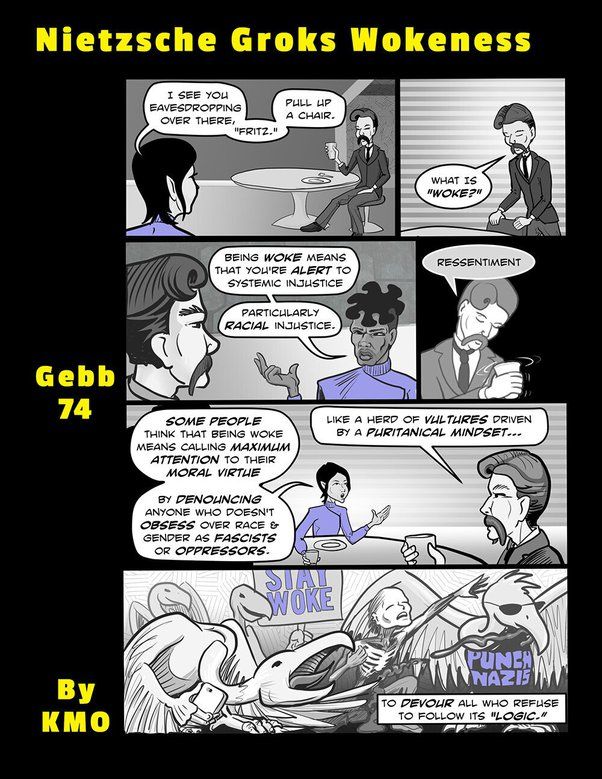
This is what Friedrich Nietzsche critiqued as being a hatred for life.  When we remove temptation rather than ever teach children to resist it—when we are constantly vilifying strength rather than encourage it—when we follow after reasoning or rationality instead of developing our instincts, we are promoting the weakness of our society and degeneration. 

Woke is weak.  It attempts to foster spirits of ressentiment and forms an identity around a person’s fear of being disenfranchised for things completely out of their control.  And in the end it destroys the incentive to find a way to overcome by our own means.

The Meek Shall Inherit 

Neitzsche could be accused of painting with too broad a brush for the dismissal of the Christian ethic as slave morality and an opposition to the powerful.

The message of Jesus and his Apostles was, in part, freedom from those human laws of “Do not handle! Do not taste! Do not touch!” (Colossians 2:21) and very nearly could be the “will to power” that the German philosopher championed once unpacked.  Hedonism wasn’t the goal of the departure from “slave-morality,” the aim was instead for people to exercise will-power and resolve.  In the same manner Jesus and St Paul preached freedom from the law that brought only bondage and death:

But now, by dying to what once bound us, we have been released from the law so that we serve in the new way of the Spirit, and not in the old way of the written code.

(Romans 7:6 NIV)

This is not to suggest that there is any kind of compatibility between the Spirit-led and the Übermensch.  Nevertheless, both would have us abandon a lower morality based on restrictions for a pursuit of our own ultimate form.  To St. Paul the Gospel means we are free from “the flesh” or the unbridled urges, while Nietzsche thinks we’re instinctively at our best, and both men are not opposed to impulse control.  The big difference is that the Apostle’s answer is spiritual whereas the philosopher says that additional layer is not needed and morality a hindrance.  Both would disagree devaluing the attitudes and culture that lead to success.  Being master of ourselves requires strength and never allows for excuses.  

Furthermore, the Jesus of the Bible wasn’t weak, he spoke with authority and we are told that he had power over all things, but he chose a meek posture rather than wield this power destructively.  Now it is a matter of faith if you accept this or not.  I could say that I could strangle Mike Tyson yet choose not to.  Talk is cheap.  But meekness is the ability to restrain ourselves.  Having the power to impose our will is always desirable, nobody wants to be at the mercy of the elements or other people.  However, sacrifice for sake of the next generation is better, to parent is to live beyond ourselves, that is why this is an instinct for those who have children, and it is the role of the Father.

When I wrestle with my son I don’t use all of my strength.  I would hurt him if I employed full power.  My goal is not to destroy him, he is not my enemy or threat to obliterate, but it is to train and strengthen him.  I restrain to protect him currently and also challenge to protect him in the future.  That is the real Biblical kind of meekness, it submission to the greater role we can serve as protectors and builders of civilization.  It is the having all things in balance, which Nietzsche might agree, and using our strength to take on the burden of creating the future.  We do not retreat from life.  Faith requires the we go headlong into the fight rather than hide or be ruled by resentment.

Late-stage Protestantism

I can understand the campaign Nietzsche waged against morality in light of wokeism and virtue signaling nonsense.  Apparently he was very well-versed in theology and did not find answers there.  Which is correct, it is not intellect that brings us life, study for sake of study is vanity, and truth is more in the practical telos than in some theoretical construct.  Nietzsche attacks rationality and reason as an end and those things do implode upon themselves when no longer grounded in a higher life-serving purpose.

The current ideological push for wokeism, and the mindless promotion of diversity, equity and inclusion at the expense of standards, merit or competency, is simply another step down the path of trying to eliminate all suffering and in the process destroying excellence.  I want my son to face some hardship, even if it is only artificial, because his striving will build strength.  It is the thought behind Proverbs 13:24: 

Whoever spares the rod hates their children, but the one who loves their children is careful to discipline them.

Or, as Nietzsche postulates in Beyond Good and Evil:

The discipline of suffering, of great suffering – do you not know that only this discipline has created all enhancements of man so far? 

In the same vein, in The Will to Power, he wrote:

To those human beings who are of any concern to me I wish suffering, desolation, sickness, ill-treatment, indignities – I wish that they should not remain unfamiliar with profound self-contempt, the torture of self-mistrust, the wretchedness of the vanquished: I have no pity for them, because I wish them the only thing that can prove today whether one is worth anything or not – that one endures.

No, I don’t want my son to be last picked for his dark skin.  And yet I also don’t want him to live in a world so sanitized that he’ll need to invent offenses (in the same way that an autoimmune disorder is the body attacking itself) then expects me to always step in on his behalf rather than face it.  Success in life requires some voluntary submission or suffering for sake of our goals.  Coddling and bigotry of low expectations does not serve the long-term benefit of children or civilization.

We need to discard this ugly paradigm of late-stage Protestantism.  There are great men, powerful and worthy of our respect, then there are those in desperate need of improvement.  We don’t help the latter by going soft and changing the requirements to make everything easier.  There is nothing radical or reforming about the direction the church in the West has gone.  This “have it our way” drive has led to a fracturing of the church, a consumerist mentality in worship and a new religion without obligation to the fathers or their commands.

Woke is simply the latest development in the direction.  It is the child with imperfect parents now thinking they know better and don’t need the silly disciplines of their parents to thrive.  Whether Anglican or Anabaptist, it is always about rejection of authority and the hierarchies established by the early church and originating with Christ.  We think we can do better, that the home is better if there is equal with no patenting or need for development of conscience.  In the end we get the complete agnosticism which goes further and to destroy everything the generations of faithful built for our good. 

Attainment and success doesn’t need to be made more accessible.  My son may think he deserves everything without effort, that we’re hoarding a kind of wealth just given to us and undeserved.  But that’s his ignorance.  There are no shortcuts to heaven and you can only keep the benefits of civilization if you continue to maintain the very foundation it is built upon.  We think that we will be saved by technology and the vague notions of progress of those who think power comes from the stroke of a pen—but that’s not how we got here nor is it a path to a better future.

Confessions of the Prodigal’s Older Brother—the Rough Road To Be Free Of Resentment

Standard

I do not call for the judgment of anyone, but it seems only right that good behavior is rewarded. And yet it is often unruly people who get the loving attention when they do bad and then the accolades when they begin to do what the well-behaved have been doing quietly for years.

The conscientious person feels bound to their duty to righteousness. They are driven by loyalties to people, motivated by moral obligation and take responsibility for the welfare of others. It was not out of a desire to be recognized, it is a burden they’ve been carrying since birth, it is never a choice for them, but rather is something inescapable, a prison and hell.

I’ve been that tortured soul. I’ve always wanted to do everything right and for the right reasons. While definitely wanting to be my own person and entitled to my own thoughts, I had no desire to be a troublemaker or disruption. I tried to be cooperative and compliant, to make the lives of my teachers and authorities easier, because I knew the greater social good was dependent upon this and would not be served by my selfish outbursts.

I could never live this ideal out perfectly. I had a standard for myself, a part of the religious inheritance I received as a Mennonite, that was impossible to live out. My frustration with this reality of my own failure would sometimes come bubbling up. Something would set me off and, in the privacy of my parent’s home, I would rage against this awful predicament and the unfairness of it all.

The carefree (and careless) younger brother…

A week or two ago some resentment returned. This change in mood was likely triggered by two things (or rather two conversations) and one of them being an encounter with David Bercot on the topic of divorce and remarriage. The other thing? I had a run-in with my own Prodigal side.

We claim there are consequences for sin. This is how we convince ourselves that our righteous inclinations are correct and there is really no other way to justify depriving oneself of hedonistic pleasure. If it doesn’t matter what we do, no real score kept for right or wrong in the end, then we might as well just have some fun, right?

I’m friends with one of those “bad boys” who (despite his heart of gold) doesn’t care what other people think and has done things at his age that were unimaginable for me. He is a ladies’ man, he’s that guy the young women (yes, even the ‘good’ ones) feel comfortable playing around with, and is basically my antithesis.

I can’t help but love him. He was my true friend a few years ago, heard me spout venom at those who had hurt me with their self-righteous indifference, and never said a word of condemnation. That said, his recklessness and lack of my seriousness, while I was fighting for all I was worth to stay glued together after a devastating announcement, had also sparked my most violent and evil imaginations.

I can’t hold him accountable, though. I look at his freedom with a bit of envy in that at any moment he could decide to settle down, marry the perfect girl (drawn by his charm) and carry no stigma. Me, however, I was always outside looking in, I wasn’t allowed (by character or circumstance) to partake of that “wild” youth nor given the legitimacy that is his for the taking once he decides to settle down.

I’m not jealous of or bitter toward him. Why should I be? But what I do struggle with is anger towards the religious culture that made me, that fed me a steady stream of false promises and left me feeling completely betrayed in the end. Specifically, I’m still upset with the fathers who dismissed me with their cynical calculations and their daughters who continually rejected my sincerest efforts—while meanwhile crawling all over the reckless and indifferent guys.

It is bad enough to go unrecognized. But we seem to live in a world where no good deed goes unpunished, where caring (when others do not) is mischaracterized as creepiness and doing right for the right reasons is often stigmatized. It seems my obeying conscience doesn’t allow me the freedom of rebellion nor does it gain me the approval of those who told me that my conscientious is a good thing when I do what is right in spite of their opinions.

The daddy issues of the Prodigal’s older brother…

The problem with the older brother, in the parable Jesus told about the Prodigal son who returns home, was deeper than his resentment over the celebration for his wayward brother. His indignation was towards his father:

“The older brother became angry and refused to go in. So his father went out and pleaded with him. But he answered his father, ‘Look! All these years I’ve been slaving for you and never disobeyed your orders. Yet you never gave me even a young goat so I could celebrate with my friends. But when this son of yours who has squandered your property with prostitutes comes home, you kill the fattened calf for him!’ (Luke 15:28‭-‬30 NIV)

This anger is likely due to a misconception the older brother had about his father. He obeyed. However, he obeyed for fear of consequences rather than purely as a matter of conscience. His motivation, while in some respects a devotion to his father, was also a desperate effort to secure his place in the family and a mistrust of father’s love. He, like the servant who buried his talent for fear of punishment, couldn’t comprehend being loved for anything other than his performance and had lived in fear rather than faith.

Can you imagine having spent years trying to hold up your own end of the bargain, working hard to produce because that’s how your father’s love is earned, only to have the bubble burst?

In my own case, it was not entirely my own fault that I saw God, my heavenly Father, as this sort of vengeful tyrant. As one raised in a fundamentalist setting there is plenty of reason why I would assume that God’s love is based on my own performance rather than something freely shared to all who accept it and that’s because my earthly fathers often did keep me in limbo. Revivalistic preaching undermined any assurance of salvation, my life could never measure up to their purity standards, and their love for me was limited by what I was able to provide for them.

For years my hopes for love outpaced my resentments. I would tell myself that next time will be different, that my fears of always being on the margins of their paradise were unfounded, and eventually Christian love would triumph over my inadequacies. However that paradigm came crashing down in spectacular fashion when a young woman, someone to whom my hope against hopes (in respect for her professed devotion) were fully invested, said “I can’t love you like that,” which was to say that she really could not love me at all, and destroyed that last hope of a way to her or rather her father’s world.

Trying to please the lawyer’s God…

Over the past weeks, I’ve felt whipsawed. That is to say, I’ve felt pulled between two seemingly opposed views that together undermine my peace with God and the ability to live a victorious life. The first being how the Prodigal gets the embrace while I’ve often been ignored or, worse, had those whose love I had desired recoil as if I was some sort of monster. The second being the inescapable legalistic mindset that is at complete odds with true Christian love.

I have nothing against men like David Bercot personally. In fact, I see them as men very much like myself a few years ago, they diligently search Scripture trying to find their salvation, and yet they are far more capable than I’ll ever be. Their dedication and discipline would seem to be commendable and even something enviable. However, their standard is something I’ve found to be out of my own reach and their religious prescriptions often come at the expense of love.

Bercot, like so many others including myself, is law rather than love oriented. By this I mean we prioritize precise legal interpretation and application of law above the loving purpose behind it. In other words, we are like those religious experts Jesus encountered, who do things like tithe spices, are more concerned with the day someone is healed than the fact that they have been healed, remained as dogmatic even when entering the church and had to be put in their place:

It is for freedom that Christ has set us free. Stand firm, then, and do not let yourselves be burdened again by a yoke of slavery. Mark my words! I, Paul, tell you that if you let yourselves be circumcised, Christ will be of no value to you at all. Again I declare to every man who lets himself be circumcised that he is obligated to obey the whole law. You who are trying to be justified by the law have been alienated from Christ; you have fallen away from grace. For through the Spirit we eagerly await by faith the righteousness for which we hope. For in Christ Jesus neither circumcision nor uncircumcision has any value. The only thing that counts is faith expressing itself through love. You were running a good race. Who cut in on you to keep you from obeying the truth? That kind of persuasion does not come from the one who calls you. “A little yeast works through the whole batch of dough.” I am confident in the Lord that you will take no other view. The one who is throwing you into confusion, whoever that may be, will have to pay the penalty. Brothers and sisters, if I am still preaching circumcision, why am I still being persecuted? In that case the offense of the cross has been abolished. As for those agitators, I wish they would go the whole way and emasculate themselves! (Galatians 5:1‭-‬12 NIV)

Paul’s pun at the end does not take away from the serious warning in his words. Those trying to please God through their careful obedience to the law “have fallen away from grace” and are thus obligating themselves to an impossible standard. They will either end up deluded (like the Pharisee praying loudly about his own superiority to others) or desperately trying to cross all the T’s and dot all of the I’s and ending up in despair when his/her effort falls woefully short of God’s perfection.

Where I’ve found God’s love…

My goal is not to be the rebellious Prodigal son or the one whose careful dedication ended in bitter disappointment. Both of them have fallen short in love for their father or in understanding their father’s love for them and have suffered consequences as a result. The story isn’t intended so that we go out to sow our wild oats, enjoying the pleasures we are afforded us as a result of our inheritance, and then come back to our father’s house again. It isn’t just a warning against a superficial closeness either.

The true meaning of the story is for us to be more like our heavenly Father, who is perfect in mercy and loves even when His love is not reciprocated. Yes, there is a law, not the kind of law that pleases a sanctimonious religious lawyer, but a law summed up by Jesus:

“‘Love the Lord your God with all your heart and with all your soul and with all your mind.’ This is the first and greatest commandment. And the second is like it: ‘Love your neighbor as yourself.’ All the Law and the Prophets hang on these two commandments.” (Matthew 22:37‭-‬40 NIV)

When we love God we do not worry about being stigmatized like Jesus and his disciples were for breaking with the harsh and unloving application of the law. We stop trying to please those impossible to please, stop believing God is some tyrant finger over the “smite” key waiting for us to slip up, and start doing what is possible to do out of love for our neighbors. It is in remembering that Jesus came to save and not to condemn the world—that through his love even the vilest of sinners can find eternal life.

I still struggle with my hurts despite God’s grace towards me. I still find myself trying to please people who have made pretty much zero real investment in my well-being spiritual or otherwise—who absolutely refused to reciprocate my love for them. I could easily become unsettled again, reject the greater blessing I’ve received by pursuing the promises of those who attempt to live by a standard impossible to please.

But I choose to love those whom God has entrusted to me instead and even if it costs me what little remains of my Mennonite reputation. I would rather lose it all for sake of the kingdom than to return to the bondage of fundamentalist expectations. Jesus loved despite the disapproval of his religious peers and that’s the love that will overcome my feelings of resentment as one who followed the rules and got burnt. It is a rough road some days, but we are called to suffer rejection and carry our cross.