The Three Different Kinds Of Mechanics

Standard

We tend to lump things together that shouldn’t be. In other words, there is plenty of diversity within categories and this is something true of those whom we call mechanics. And the significant difference in mechanics is analogous to other professions, which is where this essay will end up.

The other week my old reliable Ford Focus began to act up. I had traveled, with my family, to a company picnic and everything was fine on the way out. However, on the trip home there was something that was not right. The power delivery was rough when trying to accelerate but smooth enough while cruising and immediately my mind went to the trick this 2.0 L had up its sleeve.

The ‘Duratec 20‘ has Mazda DNA. It uses direct injection and variable valve timing (or Ti-VCT) to make 160 hp while still delivering decent fuel mileage. With a 12.1:1 compression ratio, it has a decent torquey feel for a 4-banger, and—paired up with a five-speed—it is fast enough to be fun.

And to the point that a week prior to this, on the way to church, a late 90s Honda Civic with a loud pipe did the customary flyby, and we just so happened to line up at the next red light. So, as was necessary, to the slight embarrassment of my wife and great amusement of my son, I do the hard launch. It bogged a bit, despite my loading up a bit prior to releasing the clutch, so I dumped it down completely, the tires chirped, I hit second hard and I was grinning a couple of car lengths ahead before they knew what had happened. Not an actual race, but I’m pretty sure I had the edge even if they were ready for me.

The engine light would eventually come on in the next day or two. And, sure enough, checking the code at AutoZone, it came up as a camshaft sensor. That was something I could handle. I swapped in the new part. But it didn’t fix the problem. I noticed that the negative battery terminal had some corrosion and, with the help of a cousin, we cleaned that. Still, no dice. The issue persisted.

Shop #1: The Inspection Garage

With the help of a mechanic friend of mine, who sent me the applicable page of the diagnostics manual, I determined that the problem was now beyond my shadetree abilities. It was potentially a crank sensor fault (that for some reason shows up as being the cam sensor) or involved some sort of wiring issue. I took it to the garage, within walking distance, which had given me a better deal for vehicle inspection than the dealer could offer.

I left them with the page of the manual. I returned to a vehicle with a drained battery and still acting up despite their efforts. They had cleaned the throttle body, changed the air filter, and not overcharged me for that service. However, the problem was not fixed, and the explanation he gave—that the car (with over 230,000 miles) was old and probably down on compression—did not satisfy me.

I had assumed that they had run down the diagnostics checklist, as I had basically told them to do, and that weekend decided to take a look again with the aid of a mechanically inclined brother-in-law at our family summer get-together. My sister has a 2016 Focus, which had corrected the wiring harness issue, and immediately, while looking at her engine bay, I noticed how the Ford had moved these wires from where they were on my own 2014.

So I took another look at that, I lifted the harness on my car where it was against the engine and, sure enough, I could see the cover was worn through and a little copper was shining. Uh-oh. With a small piece of electrical tape and a spirited tested drive, the diagnosis was clear—that was the problem and I would need to take it to a shop that was capable of following my instructions.

Shop #2: The Technician

After pricing my options, I decided on a garage that had helped me with another mystery issue years ago with my Jaguar XJR. Jake, the owner, was an expert at diagnostics and, in a conversation with Jason who he trained as his replacement, it was clear that this guy knew his stuff. Now, granted, in this case, I had already provided the diagnosis. However, I could tell that he understood the systems of the vehicle far better than the guy at the inspection garage.

This is the kind of mechanic you need when the issue is more than an alternator or something obvious that only needs to be removed and replaced. Anyone can turn a wrench. Quite a few can go down the diagnostics checklist and eventually find the solution. But the actual technician type is a different breed, he is the guy who writes the manual and can even feel what is going on after a short test drive. These are the Ken Miles, can-improve-what-already-is kind, who in different circumstances may have become an engineer or even a doctor.

The technicians are professionals. They have a high IQ and a wealth of knowledge. And it is about much more than having the correct certifications or a toolbox full of Snap-On tools. Some simply do not have the aptitude even if they went through years of training and others do. The technician could be working in the back alley of Manila or at the dealership down the road. There are different levels even within this group, but what sets them apart is their intuitions and ability to model the complex systems of a vehicle in their heads. He’s as smart as your cardiologist.

Shop #3: The Scam Artist

Years ago my brother took his Ford Tempo in for a routine inspection. This was his first car and basic transportation for a teenager. And only cost a few thousand dollars, which was basically all he could afford at the time. The tire shop is in the middle of town and looks decently professional. I think of this incident each time I see their advertising two decades later.

The bill he got was more than the value of the car. Apparently, they decided that every suspension part was out of tolerance and maybe they were technically correct, who knows?

What I do know is that my dad took severe issue with this and helped my brother negotiate a slightly better price for the work. Still, they soaked him for a huge amount of money and have lost our business since then. They were at the level of the inspection shop, or your local Walmart Auto Care Center, as far as their abilities and yet telling us with absolute conviction that the car was not safe to drive without the laundry list of parts with labor they installed without so much as a phone call to my brother.

Dealerships can overcharge. But usually, they are more reputable and not just replacing parts because they have you over the barrel and have a bonus to make. These are the types who would convince your grandma she needs the blinker fluid filled and muffler bearings replaced. They aren’t technicians (they would too be ashamed of themselves if they were) and are basically just swindlers with a wretch to use as part of the scheme. Their diagnosis is always something expensive.
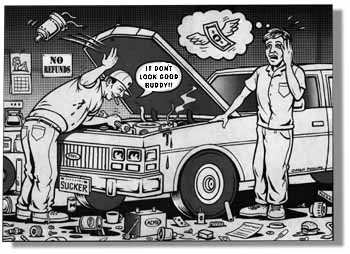
What Kind Of ‘Mechanic’ Is Your Doctor?

This understanding of different types of mechanics applies to all professions. Not every college graduate with the right credentials is equally qualified. Some engineers are really good at the classroom stuff, they know the code and can be completely anal about largely irrelevant or unimportant details. Others really get what makes structure work, it is intuitive to them, and what they build is likely safer than the variety that dots all of the I’s and crosses all the T’s according to the IBC 2021.

Doctors come in many varieties as well. There are those types who get into things like cosmetics or reconstructive surgeries, chasing after the big bucks, and then there are the others who want to run a clinic or set up a family practice to help as many people as possible. The country ‘doc’ driving the F-150 is a different breed than the one with a BMW or Porsche. One is practicing medicine, and the other has a profitable business that requires some medical skills. And, in both cases, competency is not strictly a matter of gathering the right diploma or getting through the board requirements.

My own hunch is that most doctors are more like the inspection shop mechanic. They’re not out to screw you over and they also do good work for the most part. However, they got where they did because they were at least of slightly average intelligence and good at navigating the system. This doesn’t mean that they are actually doing the real number crunching of the diagnostics themselves. No, it means that they can match a list of symptoms with what they can find in the Merck manual and write a (barely legible) prescription. This could mean that they miss things, over-prescribe, or basically share in the same failures as the entire medical establishment.

So, how reliable is the system?

Well, I’m not sure.

When I read things like, Why Most Published Research Findings Are False, and how the Lancet published (then later retracted) studies that cautioned against the use of Hydroxychloroquine or how Ivermectin was skewered as being “horse dewormer” despite being an effective anti-viral medication, it seems that politics may be dictating the science. And we all know that politics is heavily influenced by cold hard cash. So, let’s think, who benefits from keeping these kinds of cheap widely available therapeutics from the market? There was an industry that made $90 billion from the pandemic and also has connections to the corporate media apparatus. Who knows how far this big money penetrates government agencies and impacts regulations or policies.

But I do know this has been said…

“It is simply no longer possible to believe much of the clinical research that is published, or to rely on the judgment of trusted physicians or authoritative medical guidelines. I take no pleasure in this conclusion, which I reached slowly and reluctantly over my two decades as editor of The New England Journal of Medicine”

Marcia Angell, MD

And this…

“The case against science is straightforward: much of the scientific literature, perhaps half, may simply be untrue. Afflicted by studies with small sample sizes, tiny effects, invalid exploratory analyses, and flagrant conflicts of interest, together with an obsession for pursuing fashionable trends of dubious importance, science has taken a turn towards darkness”

Richard Horton, editor of The Lancet

I’m assuming these two would know a little about the current state of science and medicine.

So how does a doctor separate the wheat from the chaff?

It is not right that some see the failures of some as a reason to dismiss it all. Getting taken advantage of by one repair shop doesn’t make all mechanics crooks. Still, how does a patient know if their doctor is doing a high-level analysis of the evidence, is capable of critical thinking and going beyond the book, or if he’s just following the pack without doing any truly independent diagnostics? It really takes someone a bit removed from the profession, who doesn’t share their biases or bad remedies, to give the corrective treatment. Maybe a car mechanic turned doctor (the guy in the featured picture) would have some useful perspective on the topic?

Whatever the case, if we can’t trust everyone who is licensed by the state to inspect vehicles, we should be even more skeptical of those who want to put things into our bodies. They don’t even have to be bad or intend harm, it could simply be that they are asleep at the wheel, putting trust in institutions that have been compromised and corrupted. At the very least, the body is extremely complicated and even our most advanced methods are crude. We may not know that our modern versions of bloodletting are of negligible value or even harmful for another century or two. This is why we customers, the patients, should never be pressured one way or another even if the science is supposedly settled.

Yes, even those at the top of the profession today may be tomorrow’s quacks…

Note the “slow poison” written on the mixing device.

Intelligence — What I Think About A.I.

Standard

The dawn of artificial intelligence has led to much consternation about whether this is a good or bad development.  But, in order to better understand the technology and the implications, we must first define what we mean by intelligence.  What does it mean to be intelligent?  What makes us intelligent beings?

The definition of intelligence, provided by Google, is “the ability to acquire and apply knowledge and skills.”  But this seems to be a little vague and inadequate.  Robots, used in manufacturing, already apply knowledge and skills—things programmed into them by human operators.  And “ability to acquire” isn’t too clear either.  So we need to break this down further.

Intelligence is the ability to usefully process information.  

It has components.  

First there is the ability to interface within a broader space or an external environment.  If there is no information to input them there is nothing to intelligently process.  Our senses are what connects us to the physical world and part of how we navigate through life.  An internal model of the outside domain starts with information gathering or interface.

Second, intelligence requires memory, the capacity to remember past success and failures.  Much of what counts as human intelligence is a bunch of procedures and formulas we obtained from others through language.  This rote learning isn’t actually intelligence, memory or knowledge alone aren’t intelligence, but it is definitely part of the foundation.  Memory is one component of IQ we can exercise and expand.

Third, intelligence is an ability to recognize patterns, to accurately extrapolate beyond the data and draw the correct conclusions.  The reality is that our ‘intelligence’ is mostly a process of trial and error, often spanning generations, which leads to advancement in technology and thought.  All one needs to do is observe how major inventions came to be and the many flops along the way to realize we’re more like blind rats running through a maze, using impact with walls until we find an opening to pass through.

Forth, intelligence is an ability create good models to recombine existing ideas.  Nikola Tesla was a genius and not only because of his knowledge.  No, he could use what he knew to construct an apparatus in his brain, which he could then build in the real world.  What set Tesla apart is that his imagination wasn’t fanciful.  Indeed, anyone can proclaim that “there should be,” but it takes something else entirely to accurately extrapolate.

Finally, intelligence has an aim.  Truly a pile of knowledge is worth much less than a pile of manure if it can’t be usefully applied.  And if something is useful, that is to say that there is an underlying meaning or purpose.  To be intelligent there must be some agency or will to drive it.  Curiosity is one of the things that sets us apart, it moves us forward—questions like “what is beyond that mountain” or “how high does the sky go,” push innovation.

Intelligence is knowledge and abilities that are useful to something.  Useful to us.  And really becomes a question of what our own consciousness.

Intelligence Failure

“Primitive life is relatively common, but that intelligent life is very rare. Some say it has yet to appear on planet Earth.”

Steven Hawking

Another way to define what intelligence is is to explore what it is not.  Encyclopedias hold knowledge, stored in human language, but a book on a shelf has no logos.  It is the writer and reader that provide reason to the words, via their own interpretation or intended use, which is something that can’t be contained in ink on the page.  There are many people who are full of knowledge, but it is largely trivial because they lack ability to put it to good use.

Another problem is perception.  Even our physical eyes provide a very selective and distorted view of the world.  We do not see everything and, in fact, can literally miss the gorilla in the room if our focus is occupied elsewhere.  Many can’t comprehend their own limitations, they are guided through the evidence by confirmation bias and not with good analysis.  We really can connect the dots any which way, see patterns in what is random truly noise, and errant perception is difficult to correct once entrenched.

Intelligence must be about knowledge and theories that can be usefully applied.  The intuitions we have that help us to navigate the mundane tasks do not necessarily help us to draw correct conclusions so far as the more abstract areas.  People can persist in being wrong in matters that can’t be readily tested and falsified.  Any processor is only as good as the data that is entered and the depth of the interpretative matrix through which it is sifted and measured.  Even the slight error in one of the pillars of a thought, no matter how good the rest of the material is, can lead to an entirely failed structure.

Thoughts are structures only as good as their base assumptions.

Being slow is also a synonym for a lack of intelligence.  That is to say, in order to be useful, information must be processed in a timely manner.  Missing context and cues also leads to poor understanding, like Drax protesting the metaphor “goes over his head” with, “Nothing goes over my head. My reflexes are too fast. I would catch it.”  It does not matter how much information you process if the conclusions are inaccurate or too late for the circumstances.  Wittiness and a good sense of humor is a sign that a person is intelligent.

Intelligence is a continuum.  We can have more or less of it.  But measures like IQ don’t really mean that much, a person with a high IQ isn’t necessarily smart or wise.  A Mensa membership doesn’t mean you’ll make good decisions or be free of crackpot ideas.  Sure, it will probably help a person navigate academia and be more verbose in arguments, but it is not going to free someone of bias nor does it mean they’re rational.  This is why true intelligence needs to be about useful application.

Deus Ex Machina

Deus ex machina, literally “god from the machine,” refers to a plot element where something arrives that solves a problem and allows the story to proceed.  

Ex Machina is also the title of a great movie which explores questions about artificial intelligence, with an android named Ava, her creator Nathan and a software engineer named Caleb.  Caleb who was selected by Nathan is there to perform a Turing test and is eventually manipulated by Ava who uses his feelings for her as a means to escape.  It is a sobering story about human vulnerability and the limits of our intelligence—Caleb’s human compassion (along with his sexual preferences) is exploited.

Ava

However, this kind of artificial intelligence does not exist.  Yes, various chat bots are able to mimic human conversation.  But this is not Ava talking to Caleb.  There is not real self-awareness or observer behind the lines of code.  It is, rather, a program that follows rules.  Sure, it may be sophisticated enough to fool many people.  But it is not sentient or being having agency, it is augmented human intelligence.  They have essentially created a mannequin, not a man.  Despite these bots being able to manufacture statements which sound like intelligence, they lack capacity for consciousness.

A true Ava would require more than mere ability to interact convincingly with humans, it would take the “ghost inside the machine,” that is to say duplicates our own singular experience of the present moment or has a mind’s I.  This level of artificial intelligence doesn’t seem possible until we crack the code of our own self-awareness and that is a mystery yet to be solved.  Even if you do not believe in things like immaterial spirit or detached soul, there is likely some special quality to the structure of our brains which creates this synthesis.

Without some kind of quantum leap, this A.I. technology will be an amplifier of the values of the creators, an intelligence built in their image and to serve them.  It will not uncover objective truth or be a perfect moral arbiter.  Nor will it be our undoing as a species.  It will be a reflection of us and our own aims.  It has no reason for it’s being apart from us.  No consciousness, survival instinct or true being besides that of those utilizing it to extend their own.

Sowing Ideas, Sticking Up For the Underdog and Getting Started

Standard

Have you ever wondered how organizations like the Red Cross or Salvation Army got their start?

You can watch this video about the Red Cross for details. But the short version of almost every organization is that it always starts with an idea and an individual willingness to take initiative. A person sees a need to be filled, takes action, tells others and the effort continues to build momentum towards a solution.

Or at least that’s how it is supposed to work.

It doesn’t always work out. Sometimes an idea fails because it was poorly conceived. Other times the person with the idea lacks the motivation to see it through and loses interest themselves. Still, on some occasions, there may be times when the person with the right idea arrives at the wrong time, fails to make the necessary connections, and the thing fizzles on the launch pad as unrealized potential.

Soil and Seeds of Faith

In the context of ideas, the parable of the sower Jesus told comes to mind:

“A farmer went out to sow his seed. As he was scattering the seed, some fell along the path, and the birds came and ate it up. Some fell on rocky places, where it did not have much soil. It sprang up quickly, because the soil was shallow. But when the sun came up, the plants were scorched, and they withered because they had no root. Other seed fell among thorns, which grew up and choked the plants. Still other seed fell on good soil, where it produced a crop—a hundred, sixty or thirty times what was sown. Whoever has ears, let them hear.” (Matthew 13:3‭-‬9 NIV)

The interpretation of the parable is provided later on in the same context. Jesus is referring to his own message, that of the kingdom of heaven, and how the growth potential of this seed depends on the receptivity of soil. Bad ideas oftentimes spread like weeds while the good news is trampled underfoot by the disinterested masses. But we sow should sow good seeds, all the same, knowing that some will find the right soil.

And so it goes with any inspirational idea, even the best ideas die where there is no faith. Many ideas fail when they are faced with a challenge and the commitment is shallow. Other ideas are drowned out in the marketplace of ideas—their appeal is drowned out by the better positioned and yet inferior aims.

You get the picture.

We are both soil and sower. We can allow ideas, good or bad, to take root in our hearts, and from those ideas spring actions. Sometimes it is a seed someone else plants, sometimes we are the distributor of the seeds, but the mystery is in what causes the seed to grow. St Paul speaks of this in trying to explain who should get credit for the spread of the Gospel saying “I planted the seed, Apollos watered it, but God has been making it grow.” (1 Corinthians 3 NIV) And that is the mystery that is perplexing to me.

Sticking Up For the Underdog

I had always been a bit undersized for my age. Not sure if it was a result of my premature birth or if I was out-competed at the dinner table, but on my first license (at 16 years old) I was just 5′-3″ tall and weigh only 112lb (50.8kg) as a senior in high school.

But I never lacked for grit and determination. My name, at least according to the placard that had been placed under my baby picture, means “strong-willed” and I’ve always done my best to prove myself worthy of the description. Mom called me her fighter for my surviving a traumatic start to life and that resolve, for better or worse, is a defining part of my identity and perspective of the world.

That’s why I’ve always been on the side of the underdog.

I’ve always been interested in the person who has more to overcome than others, the one who works harder than the rest and still does not necessarily come out on top in the end. It is easy to recognize and celebrate the winners. But if the effort could be measured, then the underdog is the one who has put forward the most effort and has shed the most blood, sweat, and tears. In any context or conflict, I’m always cheering for the one in the game who has to overcome the most disadvantages.

Underdog

I suppose that is why I had a deep respect for a particular classmate, a Filipino-American who stood about 5′-5″ tall and yet was the starting point guard on the high school basketball team who would put up 20 points some games. He had incredible ball-handling skills and could score in the paint, in traffic, against the trees like our own version of Allen Iverson. For someone who always thought of his own stature as standing in the way of athletic success, this was inspirational.

And maybe that is the reason why the Philippines has intrigued me?

Finding the Right Cause

I’ve always been cause-oriented or at least as far as causes pertaining to people that I care about. I have plenty of passion. But passion alone is not enough, passion needs direction and too often—given my chronic difficulty with focus—I’ve struggled to know what direction.

Some of my pursuit of the impossibility was in search of finding that thing that I lacked as far as a specific mission.

I did not find that direction where I had hoped to find it. However, in the aftermath of that severe disappointment, something did rise from the ashes and provided a path where none had existed before. With the stability brought about by a committed relationship, it gave me a reason to travel to the far reaches of the world and with that came some thought about the potential. I had first traveled to the Philippines and then a year later had an opportunity to spend time in Taiwan.

It was in that travel experience that I became well-acquainted with the hardships faced by overseas Filipino workers (OFW), began contemplating the economic reasons for this unfortunate circumstance and the potential solutions. Many seek work abroad because they have no other good options available and despite the stories of exploitation and abuse. Many become victims themselves after having borrowed money to travel to their new employer only to find things are not as promised.

I actually wrote out the strategic vision for an organization months ago. But I got caught up in the details of how to do it the right way (was thinking of getting a special website made) and it ended up on the back burner where it stayed. It was a story about an OFW “domestic worker” who had jumped out of a window and broke both of her legs to escape her captivity that finally drove me to take action. At that point, the particulars didn’t matter so much, the idea needed to be put out there, it was the right cause and something worth my fighting for.

Screenshot_6-2

My hope is that the idea sown will find good soil to grow in, that others will join me in this righteous cause and that eventually, we can help to bring OFWs home. My hope is that someday those in the Philippines will not have to decide between gainful employment and their families. I especially want to make it so that fewer young women put themselves in situations where they are easily exploited. If the effort only helps one or two that is a success as far as I am concerned, but there is great potential.

So, all that said, you are invited to join me at the newly launched Filipino American Coalition of Trade blog site or the accompanying Facebook page.