Why I Stopped Asking Why

Standard

With God, all things are possible.  That was a phrase that got me in trouble.  If pursued to the full literal extent this is an assurance which leads to disappointment.  All things may be possible, but in the sense that you only want what is about to happen.  What we have is more like the quote attributed to Henry Ford: “Any color the customer wants, as long as it’s black.”

Anything is possible if you want the possible.

It is what it is.  That has more or less been my life of the past few years.  Marriage has been good for me.  There is less need for a fight for a faith in the impossible when the actual has been decent enough.  This could simply be a matter of age.  You’ll become a little agnostic after being on the other side and seeing some of those foolish hopes of a child.  Not saying it is impossible, but it is just improbable that my Filipino son will be over six feet tall as he hopes.

The biggest chance in my life is not asking the question why anymore.  Now I am that father figure supposed to give answers and needing to play a stabilizing role.  There is just not enough time, the dishes need to be done, the baby needs to be fed, and nobody could ever answer my questions.  It seems my own answers were as good as any.  Why is a cry for answers, an underlying belief in an authority that can answer.  Why ask why if there is no authority to ask?

Sunday evening went a bit sideways soon after my wife and I crawled into bed.  I had seen a story, soon before going to the stairs for the night, that made me briefly consider that it could fit the profile of a family friend: A ten-year-old girl being swept away by the swift river current, friends trying to help, an adult woman going in after them.  But then, now in bed, I saw the post on social media confirming that indeed it was a tragedy that was hitting very close to home.

It was Claue

Kevin and Michelle are a couple very similar to my wife and I.  We met a few years back at a Filipino-American event.  He was also employed in an engineering related field, a guy with German background similar to my own, and also had chronic back issues that gave us a common bond considering what a pain my neck had been.  But what I liked most about him is that he was a family man who put his wife and children first.  Michelle likewise is a dedicated mother, one of those hardworking and unassuming types—who offered her quiet support to my wife as we dealt with the immigration gauntlet.

Claue had come with her mother from the Philippines.  Like my son, she had no real choice in the matter and suddenly found herself in South Williamsport with a school of American kids.  Unlike my son, she was shy and spoke very little English.  And, from what I recall, it was difficult for her initially to leave her mother’s side.  That’s why I was so happy to see her in a basketball jersey—it meant that she was finding her niche.

I knew the river was a special place for the mother and daughter.  Many pictures were posted of Claue wading in the shallow parts and enjoying a break.  

On May 4th, with baby in the stroller, Claue was splashing around again as her mother watched from shore.  The river was up just a little after some rains—the water slightly murky at this point—and she slipped.  The current pulled her away into deeper water where she was clearly in distress.  Her two friends tried going out to save her and also were being swept downstream.  Michelle, seeing it all unfold, did not hesitate to enter the water despite—like her daughter—being unable to swim.

The whole group would soon end up over the dam in the turbulence that is known to keep even experienced swimmers trap in its watery grasp.  Miraculously Michelle was pulled out.  But she did not escape without injury, she was taken to the hospital where she was treated for broken heart syndrome and remained for days.  The words “help me Mom” the last thing she heard her precious Claue say before she disappeared.  The two other children were saved—only Claue lost.

A design to keep dams from washing out keeps the victim in the froth where even a great swimmer will be helpless and in danger of drowning.  That our friend, the mother, escaped is a harrowing account requiring presence of mind, will to survive, and a hand from above.

The rescue operation has changed into recovery, but no signs of Claue have emerged a week after she disappeared.  I’ve set up a GoFundMe for the family as we wait and hope for our dear Claue to be brought home.

Waist deep in tragedy…

My life has been rather average, I suppose, in that I can’t claim it has been very tragic in comparison to some.  Nevertheless, there is a ‘tortured soul’ aspect to my existence that has once been called out by my little sister and is to some extent true.  I do tend to feel things very deeply and cannot ignore all the suffering in the world as some seem a little more able to do.  And always with this care came a big question: Why?

Why do such awful things happen to such undeserving people?

It is a question that will stay swirling in your mind if you let it.  Religious people will say it is for some greater reason we don’t know—the judgmental will try to assign blame with their Monday morning quarterbacking skills—and both never satisfied me.  If death is a path to salvation for a child, why would we ever oppose abortion?  We would celebrate the millions of babies sent straight to God to eternal worship.  And if you’re one of the people who think life can be risk free—that all suffering is preventable—you’re either a very lucky person or as dumb as a box of rocks.  

Every year there are around twenty cases of commotio cordis.  That is when a hit within a certain window of time stops the heart.  A young baseball player takes a line drive to the chest—collapses and dies.  

Does this make me a monster for allowing my son to play this dangerous game?

No!

Someone could spend their life hiding under their bed sheets, afraid to do anything, and get hit by a re-entering Soviet-era spacecraft.  The only tragedy, in that case, being that a person so risk adverse has not lived life and is already dead.  My cousin Uriah, who was diagnosed with terminal lung cancer near the start of the Covid shutdowns, had every reason to remain home and ‘safe’ from the disease—yet, with only a year to live, he decided he would live.  My most cherished memories with him would not have been possible if he picked a path of total risk avoidance.  Life is always risky and we cannot prevent tragedy by avoiding it.  Why huddled in fear?

They want easy answers.  Those who look for someone to blame or explain it by some hidden heavenly cause.  But the true reality is murkier.  Job was doing everything right and yet his friends found fault.  That’s not to say that we should not make an attempt to manage probabilities.  But something much bigger than us ultimately holds the dice and there may be no reason why other than that it happened.  Some can cope with a simple explanation—bad parenting or cosmic plan—great if that works for you.

Go with the flow…

Unlike my siblings, who were basically fish, I could not float and could barely swim.  My mom had tried to help and she sent me to swimming lessons, but when the instructor lowered me in the water I would stiffen up like a board and sink.  Some of the problem was that my BMI was probably five, skinny, and my lips would turn blue after a minute or two in the water.  All I could think about is getting back out and being cozy wrapped in a towel.  Add to that, one of my earliest memories was laying face down in a pool thinking it was game over.

That’s the funny part of advice given to “just relax” or “be confident,” we would without all the fear, anxiety, experience or regret in our lives, right?  

But then those who fight for control, who do not deal with life as it truly is, they are most miserable.  Acceptance is key.  It is what it is and what will be will be—because there is no other answer I can find.  That is also to truly choose compassion rather than judgment—it is people with the answers who are harsh in times of tragedy, who truly know nothing and yet believe they are morally superior or act as if they never fail.  Those who don’t lead with mercy either lack self-awareness or have never been chewed up and spit out by those beasts that lurk on the edges of their placid waters—which could draw them in at any moment despite their assumed sure-footing or preparation.

Faith too can also become a banal attempt to right equations that can’t be righted.  This is where I can appreciate Orthodoxy when it doesn’t offer answers, but does offer that a priest (with the right permission) may lead a service for a non-Orthodox person as an act compassion.  I would be more impressed if someone could command Claue to rise and she walked out of the river.  However—with no better answers—I learned to be content with compassion as an answer.  

Asking why does not ease a mother’s pain, nor does criticism, nor do those “God has a plan” pat answers.  Sometimes the best we can do is sit together, talk and laugh a little, humanity has continually won against those devouring forces of nature by sacrifice for the tribe or looking out for each other. Hugs never tell us why, but they do silence those nagging questions even for a moment.  A tear with a friend is medicine for a broken heart.  It is better to rest, not knowing, and be okay with it, because we’ll never know why…

Small, initially shy and yet energetic, Claue came from the Philippines with her mother knowing very little English.  This year she went out for basketball and seemed to be adjusting.  Her classmates miss their friend.

The People Want a King, Part II: The Idolatry of the State and the Call to Self-Rule

Standard

A decade ago, in “The People Want a King, Part I,” I wrestled with the ancient cry of Israel—“Give us a king!”—from 1 Samuel 8, seeing in it a mirror to our own craving for centralized power. I cast Trump, then a looming figure on the horizon, as a Saul-like pretender—brash, self-absorbed, a king unfit for the throne. The heart of man, I argued, is frail and fearful, ever eager to trade liberty for the illusion of security. Now, ten years on, we revisit that cry, turning the lens inward and upward: what happens when the king we demand becomes a god we worship? And what might it mean to cast down that idol and govern ourselves under a higher law—one that admits no rival?

Let us begin with a heresy: government is not sacred. It is not a divine institution bestowed from on high, nor are its stewards a priestly caste anointed with heavenly oil. Scripture offers no such mandate. The state is a human construct—a tool, a mechanism, a servant of necessity. It is not the ekklesia, the called-out assembly of God’s people, nor the Kingdom of Heaven breaking through the veil. It is, at its core, a business: a transactional entity exchanging services for tribute. When it ceases to serve—when it grows fat and lazy, a Blockbuster Video in a Netflix world—it deserves no reverence, only replacement. To treat it otherwise is to fashion a golden calf from the scraps of bureaucracy.

Yet the cry persists: “The nation is too complex for such simplicity!” I encountered this objection recently, a rebuttal to my call for radical restructuring. The argument, draped in the garb of sophistication, insists that governance transcends mere commerce—that its intricacies demand a permanence beyond critique. This is a shade thrown at those, like the DOGE reformers, who dare to wield the axe of efficiency against the overgrowth of empire. It is a plea for the status quo, cloaked as concern for “public trust.” But trust in whom? The regime that has ruled longer than memory, entwined with corporate titans and special interests, bleeding the commons dry? The trust was shattered long before any billionaire CEO took the helm; it crumbled under tax rates that plunder and wars that pulverize the defiant.

Here lies the theological crux: complexity is not a virtue—it is a veil. In 1 Samuel 8, Samuel warned Israel that their king would take and take—sons, daughters, fields, flocks—until they were slaves in all but name. The modern state has fulfilled this prophecy with chilling fidelity, its mission creep a slow idolatry. What begins as a servant becomes a lord; what promises order delivers oppression. The labyrinthine bills, the thousand-page tomes of legislation—these are not signs of wisdom but of deceit, a Sanhedrin of scribes hiding corruption behind the law’s letter. To call this sacred is to confuse the Temple with the moneychangers’ tables.

Government as business is no mere metaphor—it is a functional truth. It trades protection and infrastructure for our coin and consent, a covenant not unlike the marketplace. Yet unlike the agora, where competition hones the blade of excellence, the state resists renewal. Private enterprise, for all its flaws, bends to the will of the consumer: Sears falls, Amazon rises. Governance, enthroned as monopoly, calcifies. Its priests—elected or appointed—crown themselves with divine right, decrying reform as sacrilege, a “threat to democracy.” But democracy is not their god; power is. And power, unchecked, builds altars to itself.

This is the sin of the political establishment: they have conflated the nation with their institution, the people with their rule. The nation is not the state, nor the state the nation—just as Israel was not its kings, nor its kings Israel. Government should reflect the imago Dei in its people, a stewardship of justice and flourishing. Instead, it mirrors Baal, demanding sacrifice from the many for the feast of the few. How is this sustained? Through a catechism of control—children reciting pledges, citizens taught to venerate the machine as eternal. To question it is to court excommunication.

Yet Scripture beckons us elsewhere. The restoration of governance requires a return to first principles: simplicity as clarity, transparency as righteousness, accessibility as the leveling of pride. The state’s convolution is no accident—it is a shroud for sin, a “you wouldn’t understand” that echoes the serpent’s whisper. To dismantle it is not anarchy but exorcism, a stripping back to the studs to expose what festers. The old guard, like Saul clinging to his throne, shriek at the loss of their sacred monopoly. But their divinity is a lie, and their temple must fall.

The Stagnation of the External, the Promise of the Internal

Consider the contrast: a business that squanders its capital dies; a government that squanders ours endures. This is the curse of external governance—its inertia defies the natural law of adaptation. Were it subject to the crucible of choice, only the fittest form would stand. Instead, it grows sclerotic, a Leviathan too holy to slay. And the people, seduced by its permanence, make it their idol. They crave a king to think for them, a mediator to absolve their agency. Politicians—prostitutes of the soul—oblige, peddling promises they half-believe, deluded into messiahs of their own making. Zelensky’s advisors call him mad with grandeur; Washington’s geriatrics are no different, mistaking their tenure for providence.

This is not governance but bondage, a learned helplessness masquerading as piety. The privately employed know their limits—life persists beyond their shift. But the state’s acolytes preach indispensability, as if only they can wield the scepter. Contrast this with self-governance: a people ruled not by fleshly lords but by principle, by the law written on their hearts. Jeremiah 31:33 whispers of such a day; Hebrews 8 seals it in Christ’s blood. At the civic level, this need not mean chaos but discernment—shuffling roles, pruning branches, trusting that micromanagement by fools yields only thorns.

Why, then, the sanctity of the status quo? It is the coward’s theology: easier to bow to mystery than to wrestle truth. As Israel preferred a king to the uncertainty of judges, so we prefer bureaucracy to responsibility. Samuel’s warning rings anew: the king takes, and we cry too late. External governance is not our salvation—it is our stagnation, a false god promising safety while forging fetters.

The Myth and Monuments of the Federal Cult

To cement this idolatry, the Federal government has woven a mythology and erected monuments rivaling the temples of old. Consider the Capitol, that domed sanctum of marble and myth, its steps ascending like an altar to a civic deity. The Lincoln Memorial, a brooding Parthenon, gazes over a reflecting pool as if to baptize the nation in its own reverence. These are not mere buildings—they are shrines, designed to awe, to whisper: “This is eternal, this is beyond you.” Like the ziggurats of Babylon or the temples of Rome, they fuse power with divinity, demanding obeisance from the pilgrim and the peasant alike. The Founding Fathers, recast as demigods, stare down from friezes and statues, their words carved into stone as if they were Moses descending Sinai. Big Brother is not God—yet here he looms, a surveillance state cloaked as savior, its all-seeing eye promising protection while its fist tightens the leash.

This cultic architecture is no accident—it sells the lie that the state is sacrosanct, its form immutable. The pledge of allegiance, recited by schoolchildren, is a liturgy; the flag, a totem; the Constitution, a holy writ too sacred to amend save by the high priests of amendment. Yet this is a sleight of hand. The Constitution, for all its brilliance, is a human document, not a divine oracle—its framers knew it, urging vigilance against its abuse. The Federal cult inverts this, turning a tool into a god, a means into an end. As the temples of Baal housed idols to blind the masses, so these monuments obscure the state’s frailty, its susceptibility to rot.

Enter January 6th, 2021—a day branded as a desecration, a violation of the “sacred ground” of democracy. The narrative drips with priestly indignation: rioters stormed the Capitol, profaned its halls, threatened the holy order. Politicians clutched their vestments, decrying the “insurrection” as an assault on the nation’s soul. But let us parse this claim with a smirk—how many have died at the hands of this government, overseas and at home, in the name of “protecting democracy”? Millions, if you tally the wars and drones, yet the single death of that day gets the sackcloth and ashes. If the Capitol is sacred, what makes it so? Not its service to the people—its corridors have long echoed with the clink of corporate coin and the murmur of self-interest. Not its fidelity to justice—its laws have sanctioned plunder at home and terror abroad, not least against Argentina, whose people still bear the scars of U.S.-backed meddling and economic strangulation. The sanctity, then, is a projection, a mythos guarding the idol. January 6th was chaos, yes—ugly, reckless, and lawless—but to call it a sacrilege assumes the temple was holy to begin with. It wasn’t. It was a house of power, not of God.

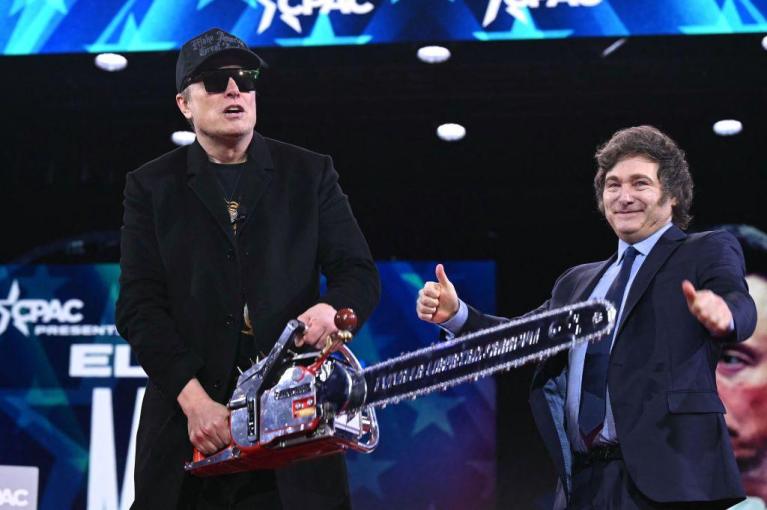
The true violation predates that day: the slow consecration of a bureaucracy into a deity, the elevation of marble over morality. Ancient temples hid their emptiness behind splendor; the Federal cult does the same, crying “blasphemy” when the curtain is pulled. January 6th didn’t defile a sacred space—it exposed a hollow one, a monument to a king the people demanded but never needed. And here’s where Argentina’s President Javier Milei enters, grinning like a Cheshire cat as he handed Elon Musk a chainsaw in 2025, etched with “Viva la libertad, carajo” (“Long live liberty, damn it”). Milei, who’s taken his own chainsaw to Argentina’s bloated state, wasn’t just gifting Musk a tool for bureaucracy—he was practically dancing with glee to see Musk turn it on the U.S. regime that’s bullied his nation for decades, from IMF debt traps to covert coups. It’s less a symbol of shared efficiency and more a middle finger to the empire, wrapped in a libertarian bow.

Trump’s Mandate and the Singular King

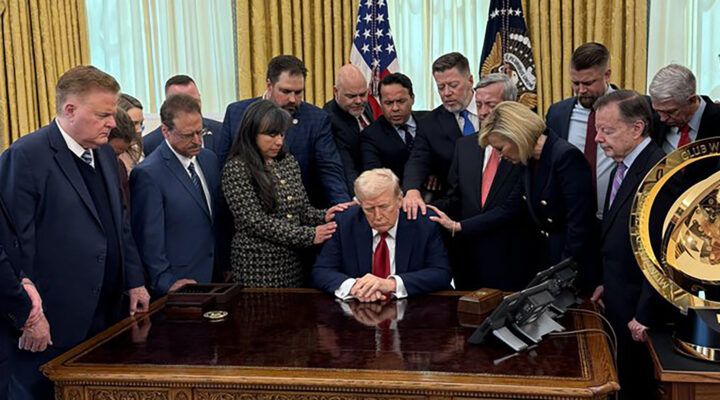
So where does Donald Trump fit in this unholy pantheon? In Part I, I cast him as a flawed Saul—brash, impulsive, a king more enamored with his own mirror than his people’s good. I stand corrected, or at least refined. Trump is no savior, nor should he be—Christians have but one King, enthroned above all earthly powers (Colossians 1:16-17). Yet he wields a mandate, both legal and theological, to tear down these idols, and therein lies his purpose—not as messiah, but as iconoclast.

Legally, Trump’s authority stems from the Constitution itself—a document that vests executive power in a president elected by the people (Article II, Section 1). His 2024 victory, a roar against the entrenched cult, grants him the democratic right to wield that power against inefficiency and corruption. The Federal government, swollen beyond its constitutional bounds, has no divine charter to resist pruning. The framers envisioned a lean state, not a Leviathan; Trump’s DOGE-inspired axe—however blunt—aligns with that original intent. He can shutter departments, slash budgets, and fire the high priests of waste, all within the law’s letter. The shrieks of “threat to democracy” from the old guard are the death rattles of a dethroned idol, not a defense of principle.

Theologically, his warrant runs deeper. Scripture abhors idolatry—Exodus 20:4-5 commands no graven images, no bowing to crafted gods. The Federal cult, with its temples and myths, is precisely that: a false deity usurping allegiance owed to Christ alone. When Jesus declared, “Render to Caesar what is Caesar’s, and to God what is God’s” (Matthew 22:21), He drew a line—Caesar gets coins, not worship. Trump, for all his bombast, serves as a wrecking ball to this blasphemy. He need not be pious to smash Baal’s altars; Gideon was a coward before he toppled the poles (Judges 6:27). If Trump’s tenure exposes the state’s hollow sanctimony—January 6th as symptom, not sin—then he fulfills a divine irony: a flawed vessel breaking a greater folly.

Yet here’s the correction to my 2015 take: Trump is not the point. I overstated his flaws as disqualifying, missing the forest for the trees. He’s no king to crown—Christians must reject all earthly thrones save one. “My kingdom is not of this world,” Christ said (John 18:36), and Paul echoed, “Our citizenship is in heaven” (Philippians 3:20). Trump’s role is transient—permitted, not ordained—to dismantle a false god, not to replace it. The Christian’s allegiance lies with the King of Kings, whose rule brooks no rival, be it Trump, Biden, or the marble gods of DC. Self-governance, then, is not just civic—it’s spiritual, a refusal to outsource our souls to any throne but His.

The Eschatological Hope

The people want a king, but the King we need refuses a throne of stone. To cling to the state as sacred is to repeat Israel’s folly, to trade the Spirit’s freedom for Saul’s spear. Self-governance is not utopia—it is obedience to a higher call, a shedding of idols for the stewardship God demands. Complexity is a liar’s refuge; trust is a martyr of our making. Let Trump tear down the temples—legally, he can; theologically, he should—but let us not crown him in their place. Overturn the tables, tear the veil, and build anew—not a kingdom of men, but a commonwealth of the free, under no crown but His.

Struggle with God

Standard

I completely missed the opportunity in a recent post about what Israel is in Biblical terms to mention the meaning and origin of the name itself, which we find in the book of Genesis:

That night Jacob got up and took his two wives, his two female servants and his eleven sons and crossed the ford of the Jabbok.  After he had sent them across the stream, he sent over all his possessions. So Jacob was left alone, and a man wrestled with him till daybreak. When the man saw that he could not overpower him, he touched the socket of Jacob’s hip so that his hip was wrenched as he wrestled with the man. Then the man said, “Let me go, for it is daybreak.”

But Jacob replied, “I will not let you go unless you bless me.”

The man asked him, “What is your name?”

“Jacob,” he answered.

Then the man said, “Your name will no longer be Jacob, but Israel, because you have struggled with God and with humans and have overcome.”

Genesis 32:22-28 NIV

With that definition, once again, Israel is less who you are and more what you do. Jacob’s life up until that point was a struggle. He wrestled even in the womb with his twin brother Esau and we’re told was grabbing the heel of his elder sibling who emerged first. He came up on the short end of the stick then, but managed to fool his father and get the blessing that was supposed to go to the eldest son. And even that plot ended up leading him to more struggle. He went from trickster to being tricked (karma?) when Laban, his employer and then father-in-law, did the ol’ bride switcharoo on his wedding day and he got the other sister rather than the one he had worked for. He ended up working seven more years to have the woman of his choice. The episode above comes as he returns to face Esau after many years and is still looking for a blessing from God.

Struggling is part of a sincere walk of faith. As Fr. Seraphim, my parish priest likes to say, “If you ain’t struggling, you ain’t Orthodox.” And like Jacob, the Christian certainly has to wrestle and contend for their blessing from God. Yes, salvation is a gift, but it is one that we work out with fear and trembling, that comes with the fruit of repentance:

John said to the crowds coming out to be baptized by him, “You brood of vipers! Who warned you to flee from the coming wrath? Produce fruit in keeping with repentance. And do not begin to say to yourselves, ‘We have Abraham as our father.’ For I tell you that out of these stones God can raise up children for Abraham. The ax is already at the root of the trees, and every tree that does not produce good fruit will be cut down and thrown into the fire.”

Luke 3:7-9 NIV

Note that John the Baptist didn’t put much weight on the genetic ties the crowds had to the patriarch Abraham, dismissing it by saying that God could replace them with stones, but he puts weight on the fruit of repentance instead. Likewise, Jesus, in praising the Centurion, a Roman soldier, for having greater faith than all of Isreal (Matt 8:10) is very significant—especially when the Lord follows up by saying many of the current subjects of the kingdom will be thrown out. So this heresy of saying some get a blessing from God without having to struggle, without needing to have faith in Jesus, is dangerous. Those comfortable aren’t Israel, those building a worldly kingdom aren’t Israel, only those who are spiritually like Jacob and striving for their place against the odds.

Christmas Without A Doubt

Standard

One remarkable thing about being a father is the perspective it gives on my own doubts of God.  While out shopping Y-dran would come across the perfect Christmas gift, he had to have, and then persistently remind us not to forget.  His need for control over what he got really could take away from the whole joy of giving and was a matter of his trust.  He is not sure of my ability or will to give him what is good.

Good Gifts 

Jesus used the analogy of a parent giving to their children to describe God’s disposition towards His creation:

Which of you, if your son asks for bread, will give him a stone? Or if he asks for a fish, will give him a snake? If you, then, though you are evil, know how to give good gifts to your children, how much more will your Father in heaven give good gifts to those who ask him!

(Matthew 7:9‭-‬11 NIV)

It is fun to see a child’s face light up when they receive a gift and it is likely because of this kind of feedback that we are so happy to give.  A good father wants to satisfy all of the needs of their children. They want to give them the best and would never torment them by giving them bad things.  It is especially easy for me to give to Y-dran as a reward for his helpful spirit.  I would give to him regardless, but it is much easier to give when he is being helpful or well-behaved.  I’m reluctant to give anything when he has an entitled attitude or makes demands.  I mean, I really don’t want to raise a son who can’t wait or ever hear the word “no” the first time.  Teaching him what is right is the best gift I can give.

My Father’s Son?

Just months into being a father I can see my own dad coming out and I don’t like it.  It is far too easy to greet inquiries with annoyance and not give the attention a child needs.  He really does know when I’m not making him a priority in my life.  Sure, we will remind him that we put the food on the table and shelter over his head.  However, to be honest, a very small portion of my income goes to him and I would need shelter for myself even if I did not have a family to care for.  And the truth is that I can be thrifty with money to the point of miserliness.

I have been at war with myself since bringing Y-dran into my life.  I’m really trying to be rid of the old man that lives in me, the one who makes others feel inadequate, that sees the financial bottom line as more important than family time, and to be the father who is truly self-sacrificial and involved in a meaningful way rather than merely playing the role.  But the reality is that the apple does not fall far from the tree and I am my father’s son.  I will need to battle it out with my own selfishness and self-righteous defense mechanisms.

Stepfather of Jesus

To some, the idea of raising another man’s son might be a deal breaker.  There was a story from earlier this year about a 5-year-old boy, in China, left behind at his kindergarten after the man raising him as a son found out that he was not the biological father.  

Joseph deliberated the same thing when he found out that Mary, the mother of Jesus, was pregnant:

This is how the birth of Jesus the Messiah came about: His mother Mary was pledged to be married to Joseph, but before they came together, she was found to be pregnant through the Holy Spirit. Because Joseph her husband was faithful to the law, and yet did not want to expose her to public disgrace, he had in mind to divorce her quietly. 

(Matthew 1:18-19 NIV)

Jesus, according to the Jewish writings of the Talmud, was an illegitimate child, the bastard son of a Roman soldier, and Mary a whore.  And Joseph, prior to a special visit from angels, would have every reason in the world to assume the same.  Even after being assured that the child was of the Holy Spirit, the stepfather of Jesus would no doubt have had to face the whispers of the scandal.  The angel didn’t visit his entire village to tell them and this was not like our times either when it is out of wedlock pregnancy is common.

Fortunately, for me, I’ve not had a struggle with the prospect of being a stepfather and, if anything, it was the prospect of being Y-drans father that kept me from giving up on the relationship after over three years of being apart and waiting.  It is one thing for two adults to break off their own romantic engagement, quite another to leave a boy who already calls you “daddy” behind.  I was willing to fight for the opportunity to earn the trust and love of Y-dran.  If anything, he was the best reason to marry his mother.

Our Father in Heaven 

Many social conservatives tend towards the harshness of a Chinese man who abandoned a toddler for not being his own. But this is not an attitude that is reflective of God:

He is a father to the fatherless and an advocate for widows.  God rules from his holy dwelling place.  God settles in their own homes those who have been deserted; he frees prisoners and grants them prosperity. 

(Psalms 68:5-6a)

Joseph, in taking Jesus called “the son of Mary” by skeptics in Mark 6:3 (an interesting word choice to say the least) as his son was reflective of the fatherly love of God.  Joseph shouldered this wrongful disgrace the same way that God, despite being Holy, is willing to bear the weight of our sin and even call us his own children.

If a man knows the significance of this, of St Paul’s declaration that believers become the sons of God by adoption (Romans 8:15; 9:26; Galatians 3:26) would he ever deny any child an opportunity to have a father?  

There is a sense in which we get back what we give, that there is reciprocity or a kind of karma.  If we are like the servant who buried his talents in fear or the one that refused to forgive another a debt after being pardoned, we will get the unpleasant or judgmental side of God.  We will get what we expect or demonstrate in our own actions.  Therefore, if we want grace for our own sins, to call God our Father, then we must put that old man to death, and be a father figure like the father we never had.  No one had a perfect earthly father, some have been abandoned by the man who should have been that man, but we can all be that source of structure, stability, and abiding love if we choose to be like our heavenly Father.

Why Believe In Sky Daddy?

One of the most intriguing things about the world that we are in is its symmetry and scalability.  There are repeating patterns, from the Nautilus shell to the spiral arms of the galaxy, that are amazingly paralleled in the language of mathematics and yet we really know nothing.  Science is not about knowing, it is only ever about probabilities, we can expect certain things based on prior observation.  And, in that light, the phrase “on earth as it is in heaven” can take another meaning.

The idea of God is ridiculed today and for good reason.  Many who claim to believe in God are completely petty and selfish people, quarreling over buttons on blouses, divided by political ideology and denomination, and full of self-righteousness or pride.  If God exists, then why do Christians live on their own strength and without faith?

It could be that our Father, God, is some kind of invention or an imaginary stand-in used to represent an ideal.  In other words, an Uncle Sam or Rosie the Riveter type of character there as a special example to bring out our best effort.  We know well today that people can believe almost anything, we have those who pretend to be animals and others who take on identities that do not match with the physical reality of their bodies.  So with all of this absurdity on display around us is it not possible that our traditional beliefs could be delusional as well?

Could God be the perfect dad to make up for the deficiencies of our own dad or provide us with a measure of security when our own father dies?  Or a Santa character, watching if we’re naughty or nice, and a manipulation tool used to keep children in line?

Speaking of Santa…

The Real St. Nick 

The Orthodox celebrate St Nicholas.  He is not a fat and jolly man dressed in a red suit who lives in the North Pole with elves and a sleigh pulled by reindeer.  He was a bishop, in Asia Minor, who drop bags of coins into the window of a home at night to help a poor father pay the dowry for his daughters and rescued three girls from prostitution.  So, he gave gifts, and yet he wasn’t giving trinkets to satisfy the demands of spoiled children.  No, he was a man led by Christian compassion and making a difference in his time.

How a holy man becomes the guy crying out “ho ho ho” is truly beyond me. 

A centuries-old game of telephone, I suppose? 

But it does show us that there is something that is real behind even this most distorted and commercialized image.  In other words, the atheist using the myth of Santa Claus as a reason to dismiss God is ignorant.  The myth is based on truth.  Many have rejected only a false image or caricature of God.  They run with “the man upstairs” kind of trope, but the God of Scripture is beyond comprehension and not a mere man.

For my thoughts are not your thoughts, neither are your ways my ways,” declares the Lord. “As the heavens are higher than the earth, so are my ways higher than your ways and my thoughts than your thoughts.

(Isaiah 55:8‭-‬9 NIV)

Many simply have the wrong concept of God.  They ​​have rejected the deity of their hypocritical parents or that of judgmental religious fundamentalists and the guy on television always asking for donations.  They see God as the petty tyrant, always out to get in the way of their enjoyment of life or trying to destroy them, and not the Creator who is good and loves mankind.

Daddy Doesn’t Love Me

It doesn’t take long, as a parent, to realize that children need some guidance for their own good.  If Y-dran were left completely to his own devices he would spend his entire day watching mindless content.  The tablet wars have been raging in our home as we try to reign in the entertainment monster.  And that is the worst part, while sucked into the vortex he changes from attentive and helpful to a different child.  This morning he became extremely upset after the WiFi doesn’t keep up with his media demands.

Y-dran may believe that we limit his time and that we refuse to get a better home internet plan because we don’t care.  But what he doesn’t realize is that the tablet is a parent’s easy way out.  If we actually didn’t care we would just let him play or watch endlessly and without any restrictions.  Sure, the end result would be a young person not prepared for success in life, and yet we would at least temporarily spare ourselves of the need to deal with his temper tantrums, right?  Of course, we are thinking of his long-term good which is why we deny his access despite his current wishes.

We can see unanswered prayers as neglect or we can believe that our not always getting what we want is truly the benevolence of our Creator who sees beyond our very limited perspective.  I mean, maybe there is no God, or maybe God is malicious and mean like some contend, but how will either one of those beliefs help us to do better in our life?  I believe in the Father who gives good gifts to His children because that’s the father that I want to be—even when they don’t understand my rules or appreciate my love.

God, Suffering and Salvation

Standard

I have complete sympathy for atheists and agnostics.  I’ve wrestled with questions my entire life and whether or not there is a God is always one of them.  But the one thing that I can’t understand is being angry about human suffering, from a rational basis, if God does not exist.  If there is no ultimate good, no greater purpose or meaning to life, on what basis do we make a moral judgment about suffering?

Okay, let’s back up a second.  I’m here at my local establishment drinking another Long Island, one of many since the death of Uriah, and it hasn’t given me an answer as to why he would die of cancer at twenty-four.  The medical diagnosis is simple enough.  He had cancer.  The aggressive kind.  It started with the lump on his ankle during boot camp.  I still have the picture on my phone taken out of morbid curiosity and never dreaming it was a death sentence.

Uriah and I, despite our difference in age, got along in a way that only cousins do.  He was like me.  We didn’t simply accept those easy cliché answers.  He was someone who was both determined and also full of doubts.  He was also the six-foot tall and better version of everything I ever was.  The best part was that I could claim some of his success for myself given that I had encouraged him to continue his college education, telling him that it was better to keep going than to live a life of regrets.

Watching Uriah sacrifice a leg only to have the cancer be found in his lungs a year later. It was a gut punch.  I think I stopped praying, at some point, because I just knew what the prognosis was.  

The hardest part, however, is that Uriah was not the first of his family that I had to carry out of the church on a cold winter day.  His parents had already lost one of their children to a seizure disorder.  His two other siblings are severely disabled and will need constant care.  Judy, his mom, is an incredible woman and has extraordinary faith.  Ed too has great strength of character.  And neither of them wastes any time feeling sorry for themselves despite losing the one healthy child they had to this terrible disease.

Where was God?

When my little Saniyah died, unexpectedly, it was a really big struggle for me.  It took me years to get my feet back under me again, spiritually and emotionally speaking, and I had both doubted my own faith along with the existence of a loving God.  The death of Uriah, along with my disappointments with those whom I put my trust in, and my long wait for Charlotte, have really tested me the past few years.  But, I have those who need me to be strong this time around and, for this reason, have had to push back against falling into despair again.

Nevertheless, I totally get why someone who has encountered suffering in a personal way is angry and denies the existence of God on this basis.  I mean why would this kind of pain and loss be allowed if there is an all-powerful good in the universe, right?  Why would God not intervene and stop this all rather than let us go through such terrible experiences?  It doesn’t make much sense, does it, that we should be left so lonely and struggling if God is good.

However, if we eliminate totally God from the equation, then we dismiss religious morality and must acknowledge that there is nothing written in the fabric of the universe that says our existence entitles us to good feelings.  I mean, as far as evolution goes, pain is more or less a survival tool, a feedback system to tell us what to avoid.  Feeling sad about the death of a friend or family member is, by this logic, a malfunction. 

In this harsh environment, where everything is out to kill us, why would we ever expect anything more than suffering?

The moral reasoning that makes this bad, if you are truly an atheist, is nothing other than a construct.  In terms of pure biology, it is good that fire hurts or we might burn our arms off.  That is pain for a very practical and utilitarian purpose.  Undeniably good if there is such a thing.  But what reasonable good is there in mourning those already dead?  No point in crying over spilled milk, right?  A totally rational being would simply move on to the next social resource and not be so attached or sentimental.

Being upset over suffering and death, if there is no God, is irrational.  And, if there is a God, like that of Christianity, then suffering and death are exactly what we’re promised in this life.  Sheesh.  Did you read the story of Jesus and how he was betrayed, beaten, and then unjustly killed in the most brutal fashion all as part of a redemptive plan?  If you actually believe in eternity then why be angry about a few years living out this rich narrative we call life? 

At the very least, how can we judge anything, especially a fictional character, on the basis of a moral standard that doesn’t exist? 

If there is no God, then there is no basis for morality either.  That too, including the idea that suffering is bad or pleasure is good, is entirely a construct.  Pain is good in some circumstances, it protects us from injury and causes us to change behavior in ways that are beneficial.  In other words, without the discomfort of hunger or thirst, we would not correctly prioritize our life.  Pleasure can be bad when it makes us eat too many donuts and become diabetic.  So how does one truly know that their own interpretation of these signals is the correct one?

From what I’ve observed in myself and in others, unbelief stems from disappointment when things do not go as expected.  It is about who is in control.  We can cling, in our own arrogance, to this notion that the universe should bend to our will.  Or realize that our own perceptions, based on senses which are not very reliable and a brain prone to making mistakes in judgment, are not infallible or ever actual truth.

The thing is we only ever know if suffering is good or bad if it is properly contextualized if we understand the end.  For example, feeling the burn of exercise is good pain because it is what accompanies muscle development and so we embrace this.  So what is the real context of our life?  To what end, or for what reason, did we become conscious?  What is behind this ‘accident’ if it is one? 

How do we contextualize our existence enough to judge what is good or bad?

If there is such a thing as an eternal reward, that would change the calculus, right?  It would mean that all pain can be gain, and all suffering can draw us closer as much as it drives us away because defining the moral character of any experience depends on the end.  I am willing to subject myself to many hardships if the reward is big enough.  No, this doesn’t take away the question of why we must go through here to get there.  But seeing past our immediate feelings is pretty much the only way to make progress.

Angry is a feeling, not a guide for life…

I was at this time living, like so many Atheists or Antitheists, in a whirl of contradictions. I maintained that God did not exist. I was also very angry with God for not existing. I was equally angry with Him for creating a world.

C.S. Lewis

People don’t walk away from Christianity for rational or scientific reasons.  Sure, they may guard their emotion-based unbelief behind a wall of post hoc justification.  But the reality is that they’re upset about something.  They had expectations and are now disappointed and acting as wounded people do.  It’s just strange that anyone at all Biblically literate would suddenly lose faith over our suffering when that’s literally the only we’re promised in this life.

What really doesn’t make any sense is why anyone would rather suffer with no hope at all of eternity.  If God is dead, then nihilism is the logical next stop and that life has no real meaning or purpose.  But the suffering does not go away simply because we’re angry at the giver of life.  No, it will only intensify and become a spiral of despair.  Our salvation is in our understanding that, smart as we may think we are, we’re truly quite ignorant and even our most ‘concrete’ reality is not real:

The first gulp from the glass of natural sciences will turn you into an atheist, but at the bottom of the glass God is waiting for you. 

Werner Heisenberg

For those who don’t know who that is, Mr. Heisenberg was awarded the Nobel Prize in Physics, in 1932, for the creation of quantum mechanics.  Materialism, despite the zombie corpse of this thing staggering on, died with the discovery of things in defiance of this entirely too simplistic conception.  Sure, this kind of physics is well-beyond most, but it does support a notion of reality that requires a Universal Perceiver (as described in this article) and we could call that God.

So, if you’re actually serious about science, then the hard science of physics is the place to start and, with its mathematical origin and proofs, is much less likely to be clouded by emotion one way or another.  We can’t run from God.  But we may need to leave behind the baggage of our own misconceptions and learn the value of true repentance.  Maybe Uriah died, and went to his reward, so some of us would have our flawed thinking broken and seek our salvation in Him?

Maybe some of us are just too stubborn, or too needing of control being in our own hands, to admit we can’t save ourselves?

I’ll tell you this.  The universe, without God, is an infinitely dark and lonely place.  It is that starring abyss of which Friedrich Nietzsche warned, the existential horror H.P. Lovecraft describes.  Highly intelligent men, both of them, and understood the implications that come with true unbelief in God.  You will not escape your suffering simply by denying that the Divine all-powerful good exists.  No, rather you will just remain in that hell of your own creation.

Postscript: Questions Remain

I still grieve Uriah, as I do Saniyah, uncle Roland, and others that seem to have been taken before their time. I’ve long struggled against sources of trauma much more basic, the lack of unconditional love in the church that could make up for my shortcomings, and much of that is unresolved. At the time of my writing, the impossibility is something yet to be fulfilled. I do not have answers for any of this nor do I expect to. I’m not the arrogant kid who argued with his high school biology teacher, not a Bible-thumping fundamentalist at all, and yet must believe.

Bring Back Providence

Standard

If there’s one pet peeve of mine, greater than all of the many others, it is the misuse of language that destroys meaning.  Sure, words evolve, their usage changing from one generation to the next, but it is religious terms that get watered down that are most offensive to me.  The word “miracle” is the chief amongst them.

A miracle, at least according to proper use, is supposed to be something that is completely inexplicable and deviates against natural law or is supernatural.  No, you getting all green lights on the way to your nephew’s piano recital is not a miracle!  That is easily explained as simply good timing and does not require any angels holding back traffic or special Divine intervention to explain.

So, a few years back I made a wonderful friend, a beautiful Algerian woman named Hajar.  Other than being full of life and laughter, even telling my car that she missed it on our second meeting, she was a devout Muslim.  She prayed five times a day, ate Halal food, and frequently used the Arabic term “inshallah” as part of discussing future plans.  The meaning?  If God wills.

Now, before I get jumped by someone.  No, the word “Allah” itself is not bad.  It is, in fact, used by Orthodox Christians in the Levant (or from there) and the word existed long before Islam and is no more a pagan in origin than “God” is.  So, yeah, unless you’re also in the mood to throw out “hell” for the pagan roots of that word and concept, you can forget what that ignorant fundamentalist preacher told you. 

Anyhow, back on words and pet peeves, it really should be part of our vocabulary to say “if God wills” rather than simply declare.  I know, we’re bold Westerners, things usually do go our way, we’re lazy efficient, and do not think we need to acknowledge our lack of control on a regular basis.  But this is, indeed, a wholly appropriate and strongly recommended Christian practice:

Now listen, you who say, “Today or tomorrow we will go to this or that city, spend a year there, carry on business and make money.” Why, you do not even know what will happen tomorrow. What is your life? You are a mist that appears for a little while and then vanishes. Instead, you ought to say, “If it is the Lord’s will, we will live and do this or that.”

(James 4:13‭-‬15 NIV)

The reason James mentions this, and that we should employ the advice liberally, is because we can so easily slip into a mode of self-sufficiency and arrogance.  This is also an attitude that Jesus spoke very strongly against, read the parable of the Rich Fool (Luke 12:16-21), and, therefore, frequent use of the phrase “Lord willing” is something worth considering for the faithful.

Even if someone doesn’t believe in God, or at least not the Biblical version, this ability to comprehend one’s own place in the universe can help to guard against deadly hubris.  We are simply not able to dictate outcomes, no matter how advanced our science has become, and are better to remain humble and understand our own place as those created from the dust of the cosmos.  We are at the mercy of forces far beyond our own control.

Going full circle, what is a word that could be used, better than using miracle, to describe good fortune or our getting things right?  I like Providence.  It both acknowledges God and also is not an overstatement.  It was a word once more frequently used and bringing it back into circulation is the perfect antidote to the dumbing down of culture.

The NEED For Loving Touch

Standard

A few years ago mom and sister, sensing my need for physical touch, made giving me a hug on Sunday evenings as I left for home and another week out on the road. It was a small gesture, a single suture on a gaping wound of loneliness and years of an unmet need for more intimate human relationship, but—nevertheless—it was something that kept me at least partially sane.

Not everyone is the same in regard to how they handle isolation. However, it is known that solitary confinement is extremely detrimental psychologically and is equivalent to torture for some. It is even worse for children deprived of healthy touch and, according to research, babies in orphanages with inadequate human interaction die at a rate of 30 to 40% and even survivors of the negligence often suffer terrible life-long consequences as a result.

We live in a culture that celebrates connectivity and social media. Unfortunately, those things, seeing words on a screen or having a “friends” list of thousands, do not fill the void or need for real physical interactions and touch. When my hopes of meaningful human connection faded away with another crushing rejection my mind slid back into solipsism—the ultimate aloneness, a disconnect from belief in anything outside of my own mind or imagination—the nightmarish hell put into words by Trent Reznor:

Yes I am alone
But then again I always was
As far back as I can tell
I think maybe it’s because
Because you were never really real
To begin with

I just made you up
To hurt myself
I just made you up
To hurt myself
I just made you up
To hurt myself
And it worked
Yes it did

The reality is that healthy people live for connection and survive periods of aloneness on their hopes of future intimacy and interactions. We were created for relationship, both with each other and with the one who walked with Adam in the garden. It is through relationships that we gain our personhood and purpose. The lack of real community, of physical touch and healthy interaction, has come at a great cost and, sadly, few seem ready to take the necessary action to change this for those most in need.

Some of the reason for this neglect is a misconception about the true meaning of the Gospel message…

“All you need is Jesus”

This is one of those religious clichés that is true in one sense, yet is completely untrue the way some people use it and is often nothing more than an excuse for their real indifference.

People need more than words to thrive.

Yes, we do not live by bread alone and we always depend wholly on God’s grace at all times. However, that doesn’t mean we do not have need of food, clothing, shelter or many other things that make our life complete.

Those who spiritualize and who dismiss the human needs of others should be locked for a week in a box naked, without food or sunlight, and then they can discuss what “all you need is Jesus” means to them as someone who was without anything else.

For those who think their offering mere words about an abstraction of Jesus are an indication of their faith and is doing enough, I will offer the words of James:

What good is it, my brothers and sisters, if someone claims to have faith but has no deeds? Can such faith save them? Suppose a brother or a sister is without clothes and daily food. If one of you says to them, “Go in peace; keep warm and well fed,” but does nothing about their physical needs, what good is it? In the same way, faith by itself, if it is not accompanied by action, is dead. (James 2:14-17)

If I could have a dollar for all the times that people expressed sympathy for my circumstances, and then assured me that things would magically work out for me without doing anything to help, I would probably be a millionaire. The whole book of James tells me that such people who do not offer anything in the form of concrete help, despite what they might profess, do not really know Jesus and are still in need of salvation themselves. Christian faith that does not express itself in meeting needs both spiritual AND PHYSICAL is not real Christian faith.

“The word became flesh…”

One of the deficiencies of the theological indoctrination that I received in the denomination of my birth was a lack of explanation for the full significance of incarnation. Incarnation tends to be explained as a historic event, that Jesus provided an example to follow, and yet very little is said about the what this says about the human condition and need for touch.

The incarnation, the word becoming flesh and dwelling among us, is the centerpiece of what John says at the start of his Gospel account and is something that has great significance as far as how it relates to church life. Jesus came so that the Spirit, something not physically defined and the same Spirit “hovering” over the waters in the Genesis creation narrative, could be made one with human flesh and so that through that we also (the church together as the “body of Christ”) could become the incarnation of Christ.

This idea that the Gospel is about an abstraction, some kind of spiritual experience or journey and theological/theoretical construct that has little to offer in physical substance, is wrong. It is part of the issue that early Anabaptists would’ve had with Luther and Protestantism. It is also something Orthodox Christians cannot accept. There is no salvation without incarnation. We cannot live the Chrisitan life alone or without real and tangible love for other Christians.

Christianity is something that must be communal, it must involve actual physical interaction with other members of the body and our partaking of the real flesh and blood of Christ together with other believers, or it is not real. Faith is, as James clearly says, something that changes how we interact with each other in the material world, it should remove barriers (like favoritism or separations within the body between higher and lower social/religious/economic tiers) and make us do something about the physical needs of other Christians.

Feeding people with platitudes does not make you Christ-like or spiritually-minded. No, it is only living in denial of the needs of others, profoundly unloving and disobedience. Yes, certainly, the point of Christianity goes well-beyond mere humanism or making the world a better place to live for others. The kingdom is something that cannot be defined in the material world. That said, Christianity without any fleshing out or being an incarnation of the Spirit ourselves, like Christ, in our Communion together and providing for the physical needs of others is truly not Christianity anymore.

Those who spiritualize physical needs really should consider the question of why Jesus came in the first place. Why didn’t God just send his good news message on tablets of gold from heaven?

The answer is that our body is not something bad or that God has given up on. We are not a mind with a body as many seem to perceive themselves. No, the body and mind are as interwoven as soul and spirit. Sure, you may be able to intellectually conceptualize things like love and theorize about salvation. But the reality is that we do have physical needs, what happens to our bodies does have an impact on our minds, and thus we should take care of our own bodies and also be concerned with the physical well-being of our fellow Christians. The incarnation is important because we are creatures of flesh and with real physical needs. We need other Christians to flesh out Christ today for the same reason Thomas needed to touch the wounds of Jesus to know that he had truly conquered death.

Not just talk, touch…

There is no shortage of advice in the world and much of it unsolicited. Tell a person about your needs and you are bound to get an earful of their opinions. They, like those who claimed faith without works, think that they can talk away your problems and/or need a way to dismiss your needs when you do not take their bad advice. They can say, “Well, he should just listen to me and then things might go better.”

Jesus condemns this sort of aloofness:

They tie up heavy, cumbersome loads and put them on other people’s shoulders, but they themselves are not willing to lift a finger to move them. (Matthew 23:4)

That is not to say that we should never give any weighty advice. However, when our advice is not accompanied by helpful action, then it will simply be adding another burden to someone already struggling under the weight of life. Having real faith, embodying Christ, means offering real substantive help to those who ask. Again, there might be a place for speaking against sin, there is also a good case to be made for teaching people how to help themselves, yet we also need to get our own hands dirty sometimes and help to dig people out of the mire they are in or at least lift their load until they can get their feet under them again.

Jesus said, “Give to those who ask” (Matthew 5:42) And, given that he does offer himself to anyone who asks, it is very likely meant those words take be taken literally. He didn’t say only to give what rationally makes sense to you at the time, he doesn’t say to give only money or time, he tells us to give and our willingness to give is the true measure of our faith. It is our job, as Christians, to give of ourselves for the salvation of others, that is what marriage is about and why we should attend church—and be all the more involved when those in the church need Jesus more than we do.

The point of Christianity is to be part of the body of Christ, to do what he did for others and the “greater things” he promised would come as a result of his leaving. We are to touch and heal the wounded like he did.

The need for non-sexual physical touch…

In many parts of the world, it is not unusual for men to hold hands with other men nor a scandal for men and women to exchange a familial kiss. But somehow here, in the United States, we have managed to sexualize everything and this is especially true fundamentalist Mennonite/Protestant sects. In fact, I have had a young woman from such a setting, in her early twenties as I recall, worried about somehow defiling herself just to be in my physical presence and unsupervised. And that, needless to say, made the conversation extremely awkward.

This aversion to touch does not seem to be found in Scripture. Jesus healed using physical touch, he allowed a woman to wash his feet with her hair and there is (at least according to less sanitized translations) a description of a disciple “leaning on Jesus’ bosom” (John 13:23) while they ate in a reclined posture. There is no indication in Paul’s letters that the “holy kiss” was a gendered practice, he mentions both men and women in his list of those to greet, nor that it was only for their time. It certainly doesn’t seem like physical touch was such a big deal for Jesus and early Christians.

Consider the following:

As Jesus went on from there, two blind men followed him, calling out, “Have mercy on us, Son of David!” When he had gone indoors, the blind men came to him, and he asked them, “Do you believe that I am able to do this?” “Yes, Lord,” they replied. Then he touched their eyes and said, “According to your faith let it be done to you”; and their sight was restored. (Matthew 9:27‭-‬30b NIV)

While Jesus was in one of the towns, a man came along who was covered with leprosy. When he saw Jesus, he fell with his face to the ground and begged him, “Lord, if you are willing, you can make me clean.” Jesus reached out his hand and touched the man. “I am willing,” he said. “Be clean!” And immediately the leprosy left him. (Luke 5:12‭-‬13 NIV)

People were also bringing babies to Jesus for him to place his hands on them. When the disciples saw this, they rebuked them. But Jesus called the children to him and said, “Let the little children come to me, and do not hinder them, for the kingdom of God belongs to such as these. (Luke 18:15‭-‬16 NIV)

While he was still speaking, a bright cloud covered them, and a voice from the cloud said, “This is my Son, whom I love; with him I am well pleased. Listen to him!” When the disciples heard this, they fell facedown to the ground, terrified. But Jesus came and touched them. “Get up,” he said. “Don’t be afraid.” When they looked up, they saw no one except Jesus. (Matthew 17:5‭-‬8 NIV)

And did I mention that Jesus touched?

That last passage, in particular, may give us some of the reason why the incarnation matters. We need more than an abstraction, more than a book or voice from heaven, we need touch. The church, as the hands and feet of Jesus, needs to be physically intimate in the same way that Jesus was to those he loved. There is healing in touch, it is healthy to touch, and Jesus touched.

Touch is good and right.

The need for good old-fashioned sex…

The person, responding to my prior blog about a failure in faith and relationship, had mentioned Maslow’s hierarchy of needs (something that I alluded to in an early blog) and how people, to reach their full potential, need food, water, shelter, clothes, and sex. They put special emphasis on sex because it is something that the spiritualizers (aka modern-day gnostics) would say sex doesn’t matter much and/or is something almost bad even in the context of marriage.

I recall being upset with a psychiatrist for describing my interest in a young woman as being sexual attraction. It was jarring to me at the time. How dare they describe my pure and lofty intentions in such a base manner? I’m not an animal! As obvious as sexual motives are now, looking back in retrospect, I truly was in complete denial then and still have difficulty now being honest about my strong desire for sex.

In fact, I had to be reminded recently that sex, within the marriage context, is something scared and thus my desire for that is not something to be ashamed of or hide.

So why did I hate and conceal this desire to the point that I didn’t even consciously recognize my motivations anymore?

Talk to anyone outside of a religious purity culture and they will be dead honest about their sexual desires. I too would never say that sex is a bad thing even while in denial of my own motivations. But, because sexuality is often discussed in negative terms, and because there was no healthy outlet for my sexual urges for all these years and also knowing that many conservative Mennonite girls share this same shameful view of sex, burying these desires seemed the only option. I mean what kind of God-fearing woman would marry a guy who openly admitted his mixed sexual and spiritual motives?

Unfortunately, this view of sex as being bad (or a shameful compromise) is completely unhealthy and needs to be addressed.

Scripture tells us “He who finds a wife finds what is good and receives favor from the LORD” (Proverbs 18:22) and, it is important to realize, marriage is a sexual union. The idea of “two will become one flesh” includes sex and part of that “good” a man finds in a wife. The apostle Paul, while encouraging celibacy for some, says (in 1 Corinthians 7) that those who “burn with passion” should marry rather than fall into sin. He also said that married couples should not deprive each other of sexual relations for an indefinite period of time. So maybe it is time for a more affirming and positive presentation of sexual desire?

Dividing sexual touch from the sacred is unhealthy and wrong. The marital bed is sacred. Sex, in the right context, is not shameful. Most people need this kind of physical intimacy to reach their full potential and thrive. It is not lustful or a sin to want sex. Sex is something we are made for, it is part of God’s original design and something good—we might as well be open and honest about it!

True connection is a human need…

Not everyone has the same need for intimacy and touch. However, a person doesn’t really know their need of something until it is taken away along with any hope of it. Those who minimize the importance or need for real physical connection with other people probably aren’t those who have been without it for long periods of time.

I believe, as a nearly forty-year-old virgin and one who has experienced years of physical isolation, that this is a big problem that is not being addressed. I believe it is especially a problem for men who have no healthy outlet for physical touch. It is not as culturally taboo for women to touch or at least it is not unusual to see teenage girls hanging all over each other. However unmarried men, who need touch to be healthy just like a woman does, are often left to their own devices—alone, unneeded and unappreciated.

But I digress, both men and women need physical touch and to feel loved.

For those with their own physical needs met, even just keeping singles/widows/widowers involved and regularly invited to dinner with your family is a good start. I know that this, even as a token gesture, helped me have a more positive outlook on life as much as it happened. In fact, my being welcomed into homes in this way by a Charity-ish church every time I visited was nearly enough for me to overlook my differences with their perspectives of theology and application. Something real and tangible is better than nothing at all. And love—genuine, self-sacrificial and materially real love—truly does cover a multitude of sins:

Above all, love each other deeply, because love covers over a multitude of sins. Offer hospitality to one another without grumbling. Each of you should use whatever gift you have received to serve others, as faithful stewards of God’s grace in its various forms. (1 Peter 4:8-10)

It is not enough to wish a brother or sister well who is starving or naked. Likewise, it is not enough to tell those who desire to be needed and appreciated that all they need is an abstraction of Jesus. Jesus came in the flesh so that he could physically interact with and touch people. We too need to incarnate the intimacy that we desire with God through our willingness to be physically connected and intimate with those whom God loves. We need to love others and not with empty words or in religious forms. We need to love them in a way that meets their real physical human needs and in the same way as we want our own spiritual needs to be met by God.

The real need is for meaningful connection. We need adequate relationships to keep our minds from falling into dark and dangerous places. Studies show a correlation between addiction and lack of adequate social connection. We are not self-sufficient, we are not mere minds in a body, we need each other, to be loved and to feel the love of others.

This is why the word became flesh and why we must flesh out the Gospel with healing and healthy touch. It is on us to be the hands and feet of Jesus—faithful love requires that we do more than talk about abstractions of love.

What Are the Practical Implications of Consciousness?

Standard

Have you ever pondered the complete impossibility of your existence as a finite conscious being?

Think about it.

What are the chances of your arriving at this precise moment of time given the infinite possibilities before and after?

Our existence seems finite.  We have vague memory of our beginnings as a sentient creature.  We were given a month, date and year of our birth; our first conscious moments arrived at some point in time before that (during the 24th and 28th week of gestation) in our mother’s womb.  All indications point to a beginning to our conscious existence and all things with a beginning will eventually end—or at least that is the pattern we can observe in everything in the universe.  (Well, everything besides death and taxes, both of those things apparently permanent fixtures…)

But, if we are finite, and time stretches infinitely in both directions from the point of our existence in this present moment, how did we end up here?  Why is it not a million, billion or quadrillion quadrillion years before or after this moment of now?  There is infinite possibility of it being any moment but now and yet inexplicably here we are contemplating our existence together.  How?

I believe the answer could be a matter of perception.  While it is true that what we perceive is our reality—there is a vast difference between our individual perception and reality as a whole.  For starters, as finite beings, we can only perceive an infinitesimally small portion of the universe we live in and can’t truly imagine anything beyond it.  And, beyond that, our perception is often skewed and distorted in ways we are unable to see ourselves.

One thing we do not perceive correctly is the reality that we are inexorably linked to the universe.  From our own perspective of consciousness we are something separatean individualand apart from everything else in the universe.  However, we did not just materialize out of thin air, every part of us was part of the universe long before it became part of us and will probably continue to exist long after our physical bodies die and become worm food.  Despite our perception of being something outside of the universe looking in, somehow a unique entity in our mind, we are still one with the universe and can’t be separated from it.

An immaterial soul, a part of us separate from the material universe and undetectable, is not required to explain our consciousness.  There is sufficient evidence to suggest that human consciousness is an emergent property of electrical activity in our brain.  And still, no matter how much science can explain, there’s a great mystery to our existence, as finite beings, at this time and place.

Timelessness and the divinity of Christ

At risk of being labeled heretic (not that anyone has the right to do that, especially not a Protestant armed with only their own opinion of the Bible and a denominational bias) I will postulate an idea about our consciousness and what it means.

Remember how Jesus turned the “you are gods” of Psalm 82:6 into a defense for his own claim of divinity?

Here’s the reference:

“We are not stoning you for any good work,” they replied, “but for blasphemy, because you, a mere man, claim to be God.”

Jesus answered them, “Is it not written in your Law, ‘I have said you are “gods”’?  If he called them ‘gods,’ to whom the word of God came—and Scripture cannot be set aside—what about the one whom the Father set apart as his very own and sent into the world? Why then do you accuse me of blasphemy because I said, ‘I am God’s Son’? (John 10:33‭-‬36 NIV)

The interesting thing about the passage Jesus quotes is how it applies to us.  If Jesus is using this verse as a defense of his own divinity, then what does that make us?  Does receiving the word of God (via the Spirit) give us the right to claim divinity as well?

There seems to be no other logical conclusion besides our being in some way divine.  We are told elsewhere that “those led by the Spirit of God are the children of God” (Romans 8:14-17) and “heirs of God and co-heirs with Christ,” which is an astonishing claim.  It means that, through adoption, we are and will be fully divine, like Christ.

And this gets even more bizarre when you consider the further implications.  We exist in time.  However, God exists at the beginning and ending of time simultaneously and thus is outside of time as we perceive it.  Therefore, when we complete this process of divinization (or theosis) described throughout Scripture and become one with God, in timeless eternity will we save ourselves before we even existed?

Maybe predestination is our choice?

Only God knows…

So, what does divinization have to do with consciousness?

To exist in eternity future, a timeless infinite future, then one also pre-exist time.  In fact, words like “past” or “present” or “future” do not exist in a timeless reality.  Something that exists as both infinite and eternal can be (without contradiction) at all points (of space and time) while, at the same time, also at none.

Our linear perception of time comes from a limited perspective of reality and is a perspective that falls apart at the edges of our universe.  At the quantum level things become irrational from a time-based perspective; quantum particles borrow energy from the future, they are somehow entangled together across vast swaths of space, and this all strongly suggests there is something “off” about our intuitions.

Consciousness, on one hand, is an emergent property of our physical brain.  But it also seems to be more than that or how could we be experiencing the present moment given the infinite possibilities?  Time defines our conscious experience and yet our consciousness of time allows us to contemplate timelessness.

To follow after Jesus, take on the divine nature and be “children of God” requires that some part of our being must exist beyond time.  The question is, if this is true, do we even exist as a separate consciousness or are we already part of something bigger and divine?

Could our conscious mind, like the individual neurons in a brain that have no awareness of the whole mind, also be individually unaware of our own part in a larger consciousness?

Are we in some mysterious way already timeless and divine?

Are we gods?

Revelation: Can God Speak To Us Directly?

Standard

I was struck the other day by a quote in an article I read about Michel Foucault, a French philosopher, and a conversation about that quote is some of the reason for this blog post.

The quote:

“Was not the death of God, in fact, revealed in a doubly murderous act that, at the same time that it put an end to the absolute, assassinated man himself?  Because man, in his finitude, is inseparable from the infinite, which he both negates and heralds. The death of God is accomplished through the death of man.” (Michel Foucault)

It was a response to the statement “God is dead” used by Nietzsche to describe the crisis those have who reject the established religious morality as he did.  The quote is an acknowledgement of the cost of western rationality, a philosophical perspective that depends solely on revelation through the physical sensory and dismisses spiritual experience.

Western thinking focuses on what can be known through natural or rational means.  The result of this pursuit of knowledge has been greater understanding of the world and technological advancement.  But this has led many to abandon all belief in the supernatural as superstition, it has undeniably come at the cost of moral purpose, and I know because I’ve been there.

The unbelieving believer phenomenon and lack of faith in the church.

Many in Western religious communities, while thinking themselves to be at odds with this western rejection of God, have a very worldly perspective of reality and are simply unaware of the implications of following their own theological ideas to completion.

Many Biblical fundamentalists, with their complete dependency on book-based circular reasoning and human interpretive ability, seem to actually be agnostics who simply have yet to come to the realization of their own real lack of faith.

Yes, the language of these ‘Christian’ religious unbelievers is often the same or similar to those of true faith.  Yes, they will emphatically declare up and down that they believe that the Bible is true, call the book the “word of God” even, and yet these unbelieving believers reject the very means of revelation described in the Bible.  They, like their more reasonable and logically consistent secular neighbors, have made human knowledge gained by natural means their god.

This pathology of unbelieving belief comes in many degrees and in various forms.  But underlying is always a reliance on human perception of physical evidence (inspired books or reliable science) and a partial or complete rejection of direct spiritual means of revelation.

It is actually humanism, disguised or hidden in a cloak of religious devotion and spiritual sounding language, because it depends primarily on human decision rather than something divine.  It is faith based in ones own ability to experience God through means of human effort.

It is what Paul addressed in the early church as foolishness:

“You foolish Galatians! Who has bewitched you? Before your very eyes Jesus Christ was clearly portrayed as crucified. I would like to learn just one thing from you: Did you receive the Spirit by the works of the law, or by believing what you heard? Are you so foolish? After beginning by means of the Spirit, are you now trying to finish by means of the flesh?” (Galatians 3:1-3)

The idea that God is primarily revealed through physical media or other intermediary mediums (institutions) is logically incoherent and ultimately a rejection of the teachings in Scripture.  Paul describes the Galatians as foolish because they were reverting to completely human means to know God and rejecting the primacy of the Spirit as the only true agent of spiritual revelation.

When little gods replace a big God there is division rather than unity.

The problem is that many people think God is governed by human rationality and therefore can only communicate through means they can understand.

Protestants too often prefer a little book god and call this “sola scriptura” which is Latin for through Scripture alone.  Catholics, the religious parents of Protestants, make a little god of the institutional church or the man who leads it through an idea of papal supremacy.

Yes, certainly the official story is more complicated than the simple explanation I give.  Both Catholics and Protestants acknowledge special revelation and the power of the Spirit.  And both western traditions are right in their own perspectives to some extent: Acountability to the collective church body, the catholic “universal doctrine” (katholikismos) is a true expression of faith through submission.  Likewise the written tradition of Scripture is obviously important for a believer and should not be abandoned.

However, the problem with both Catholic and Protestant traditions is when the overall emphasis is put somewhere other than the truth revealing Spirit of God.  Both have too often replaced the core of Christian faith, the living spiritual reality of Jesus Christ, with their own religious efforts of traditions, doctrines and dogmas.

In Galatians there was a reverting back to “the works of the law” and “means of the flesh” rather than “means of the Spirit” which caused a schism to form.  We can actually know with certainty when dependency on the Spirit of God is being neglected when there is disunity in the church:

“As a prisoner for the Lord, then, I urge you to live a life worthy of the calling you have received.  Be completely humble and gentle; be patient, bearing with one another in love.  Make every effort to keep the unity of the Spirit through the bond of peace.  There is one body and one Spirit, just as you were called to one hope when you were called; one Lord, one faith, one baptism; one God and Father of all, who is over all and through all and in all.” (Ephesians 4:1-6)

Clearly today, especially in the Western church, there is not unity in the Spirit.  No, instead there is unity only, and quite literally, on our own human terms.  There is a widespread refusal to hear anything that goes contrary to our own personal opinion and perspective.  Few are willing (or able?) to reconsider their own base assumptions about the nature of their reality or the truth of their religious indoctrination.

The fruit of Western thinking is the rule of men rather than God, it eventually leads to everyone being their own Pope and a tragic kind of individualism that wrecks meaningful community.  Now even our marriages do not last because of this growing lack of faith.  It is only through means of the Spirit that we are able to transcend our differences and submit to each other in Christian love.

We need fewer little gods with the spirit of Diotrephes (the early church leader in the third epistle of John who put himself first and judged unilaterally based on his own ideas) and seek after a truth greater than ourselves.  We need to realize our idolatry and flee from our small god perspective.

Dead religion relies on human judgment rather divine nature and their own fleshly instincts rather than intuition of faith.

Dead religion must rely on the work of man.  It must create mood through music and other emotional manipulation.  The focal point is often denominational labels or charismatic leaders, religious commentators, and not Jesus.  Growth comes primarily through by biological means, children are indoctrinated, brainwashed and pushed to commit before they can “count the cost” rather than encouraged to make an adult decision as an adult.  A negative fear-based cold calculus, a cancer, has replaced a true walk of faith, has displaced a positive spiritual vision and agape love.

Those who rely on themselves do not know grace, they cannot trust God to work in the lives of others and must therefore take judgment into their own hands.  They cannot reconcile the radical teachings of Jesus to love their enemies (Matthew 5:43-48Luke 6:27-36) into their reality.  They must reason around these clear instructions because they do not have faith in God to judge.  They usurp God’s authority because they are not themselves able to live under it:

“Brothers and sisters, do not slander one another. Anyone who speaks against a brother or sister or judges them speaks against the law and judges it. When you judge the law, you are not keeping it, but sitting in judgment on it. There is only one Lawgiver and Judge, the one who is able to save and destroy. But you—who are you to judge your neighbor?” (James 4:11-12)

One must have the Spirit of God in them to show true grace.  It is work of the Spirit, not our own righteousness, that we can have “fruit of Spirit” (Galatians 5:22-23) that include “love, joy, peace, forbearance, kindness, goodness, faithfulness, gentleness and self-control.”  It is because people do not have the Spirit of God that they revert back to their own human judgment and graceless application of law.  Without the Spirit we are left with a mind governed by fleshly desires and are spiritually dead:

“Those who live according to the flesh have their minds set on what the flesh desires; but those who live in accordance with the Spirit have their minds set on what the Spirit desires.  The mind governed by the flesh is death, but the mind governed by the Spirit is life and peace.  The mind governed by the flesh is hostile to God; it does not submit to God’s law, nor can it do so.  Those who are in the realm of the flesh cannot please God.”  (Romans 8:5-8)

Elsewhere in Scripture we are told “without faith it is impossible to please God” (Hebrews 11:6) and therefore we must have faith.  However, we are also told faith is gift from God rather than our own works and something given to us while we were yet dead in sin (Ephesians 2:1-10) which is the paradox of faith.  How do we get faith if we do not have it?  Both religious and secular minds do not have an answer for this and for that reason both turn to their own small gods.

Both secular and religious people attempt to kill a big God, but now even science defies them.

Many people in the Western world are trapped in a delusion of a materialistic view of reality, they cannot accept explanation that does not fit their own religious or scientific dogmas and attempt to kill off any possibility of a bigger extra dimensional reality.  Understanding, to them, is only gained through physical eyes and literal ears.  They want a little god that can be understood by a human mind and reject a God bigger than their own abilities to comprehend.

They are like the religious authorities who demanded a rational explanation of how a man’s physical blindness was healed by Jesus (read the account in John 9) and rejected, based in their own understanding of Biblical law, that this was a miracle from God.  These religious hypocrites concluded that the man was a fraud who faked his blindness and they cast him out as a sinner because it went against their own confirmation biases and understanding of reality.  But, truthfully, many reasonable people today (religious or otherwise) would conclude as they did and assume it was trickery.

There is no rational explanation of how a man born blind could be healed through having mud rubbed into his eyes.  Modern medicine does not tell us of any form of blindness that can be healed externally in this way and going by a reasonable standard this is literally a physical impossibility.  There are many scientific laws violated by miracles and this is why many reasonable people reject them as possibility.  The natural world is governed by a time based causality.  In other words, A leads to B which always without exception leads to C and there is no rational way that this causality chain can be broken without disrupting everything known about this universe.

So how could it happen?

It couldn’t happen, not in terms of rational thought or science, at least not without massive energy from a source outside of the closed loop system of our universe.  Any miracle, even the smallest epiphany of revelation inserted from a spiritual dimension into our physical brain to healing the blind or raising the dead, would need to disrupt the entire reality of this universe from the beginning and end of time to happen.  Any true miracle would require a force with power literally beyond the comprehending of a finite mind.

Therefore, everything Jesus did, from turning water into wine to walking on water, defied the idea that this universe is a closed loop system.  The life and witness of Jesus supported the idea that there is a source of power that is available beyond our universe and energy (for good or evil) that can be brought in through acceptance of these spiritual means.

This is the power of the Spirit.

And, believe it or not, that is also part of the huge implications of quantum mechanics.  Physicists, using the double slit experiment, have discovered a phenomenon called wave particle duality.  This, and other scientific evidence, points to a reality that defies rational explanation.  What it shows is that at the smallest level of the universe there is a break down of time based causality and with it possibility of spontaneous events.  What this means is there could be energy leaking into the universe from dimensions beyond it and more that there is only a thin veil between us and this higher dimensional reality.

Quantum computing, still in it’s infancy, promises to reach beyond the bounds of our natural universe and allow calculations impossible otherwise.  Some theorize that our brain is a quantum computer and may have backdoor of consciousness access to the spiritual realm.  This, to me, is the point of access to the realm of good and evil.  Those who have the Spirit can have close communion with God the Father through spiritual rather than physical means.

Living faith that reveals God only comes through spiritual means, not through our own works or understanding.

There is a story of a man described as a “rich young ruler” who asked Jesus what he must do for eternal life.  He was a religious man who faithfully followed all of the commandments from his youth.  But Jesus, instead of telling him “good job and keep up the good work,” yanks the rug out and tells him to sell everything, give all to the poor and follow him.

The disciples, with their little religious minds, are stunned by this and ask: “Who then can be saved?”

Jesus replies: “With man this is impossible, but with God all things are possible.”

The point of the story is that faith is not a product of careful religious practice.  It is not something we earn by our diligent study of Scripture and our good works.  Faith is rather something that is a gift from God and a result of the Spirit working out from within us.

Jesus describes an idea of being “born again” and completely befuddles a religious expert, Nicodemus, who takes him quite literally and asks:

“How can someone be born when they are old?  Surely they cannot enter a second time into their mother’s womb to be born!” (John 3:4)

Jesus replies with more metaphor from the physical world to explain this spiritual reality:

“Very truly I tell you, no one can enter the kingdom of God unless they are born of water and the Spirit.  Flesh gives birth to flesh, but the Spirit gives birth to spirit.  You should not be surprised at my saying, ‘You must be born again.’  The wind blows wherever it pleases.  You hear its sound, but you cannot tell where it comes from or where it is going.  So it is with everyone born of the Spirit.” (John 3:5-8)

The Spirit is not literally wind.  This is not something that originates in the physical world at all.  It is instead the breath of God that enters us through mysterious means and brings us to life spiritually.  It is something that transforms our mind and changes us literally from the inside out.  It is something divine, not originating in this sin cursed world, and the only true evidence of another kingdom.  It is a knowledge born of heavenly rather than physical worldly origins:

“Very truly I tell you, we speak of what we know, and we testify to what we have seen, but still you people do not accept our testimony.  I have spoken to you of earthly things and you do not believe; how then will you believe if I speak of heavenly things?  No one has ever gone into heaven except the one who came from heaven—the Son of Man.” (John 3:11-13)

Jesus was, as the son of God, conceived by supernatural means of the Spirit, and we must also be.  No one has given physical birth to themselves and likewise nobody is spiritually born of their own efforts.  Understanding of “heavenly things” does not come through physical means.  You cannot find a God bigger than the universe by studying things in universe, that is circular reasoning and will turn a rational person into an agnostic.

Only a blind person who gains their sight can know for certain they were blind and now they see.  Only a person born physically knows they exist in a physical reality and only through spiritual birth can someone know God exists.  Even if they can’t explain it, even if nobody believes them, they know simply because they know.  Our existing in any reality is a self-evident truth.

The West, in trying to kill God, has only killed their own spiritual connection and this is suicidal.

Western thinking has put emphasis on human will, knowledge or reasoning rather than the power of the Spirit and God’s grace to humanity.  People want a God governed by their own human reasoning and logic.  They try to make God subject to their own time based causality and turn spiritual life into some kind of physical process.  They reason things can only be know through natural means, by their physical eyes, ears or touch, and reject direct revelation through supernatural means.

Western thought, using human reasoning and worldly knowledge, attempting to kill the idea of a supernatural God.  But the tragedy in this is that we are blaspheming the true source of life (Mark 3:28-30) and effectively only killing the divine nature in ourselves.  The end result is hedonistic and meaningless life not worth living.  Those who cannot distract themselves in materialistic pursuits are soon left staring into a dark hopeless void of time and empty space.  This is leading many to premature death through drug abuse and suicide.

The Western church still holds on to a delusion of knowing God through their own works of faith and the symptoms of their humanistic pathology are still able to be masked through group hypnosis.  Many are able to maintain appearances through artificial conformity to tradition and are satisfied in their experiencing the ripples of Christian love passed down through the Spirit-led tradition left to them.  But eventually this spiritual momentum will run out and with it the life of the church.

It started with the elevation of one man (the Pope) and now has resulted in an unhealthy every man for himself mentality that first undermined the church, then the local community, then the family unit and is leading to a cultural suicide unless we repent and return to true faith.  We have embraced a rationality that leads us to death rather than life.

We need a return to a reality of faith based in a bigger God than the little god of human rationality, understanding that only comes from the physical world and dogmas both secular or religious.  It is time to see God through the supernatural means Jesus promised to those who truly have faith and follow him.  It is time to remove the veil of falsehood that western thought has put between us and God.

And it is time to take a quantum leap both forward in grace and backward to a faith that truly makes all things possible again.  There is a more abundant life that is only possible through spiritual means, we can know the truth and be set free, so seek direct revelation from God and reject western delusion.