False And True Knowledge

Standard

I am dismayed when fellow Christians (especially those claiming to speak for the church) make definitive statements that are unsupported in the evidence.  There are many who take a dogmatic black and white stand on ideas not supported logically, scientifically or in appropriate understanding of Scripture.

I am dismayed because we stand to hurt our credibility when we make our stand on things we do not actually know and with reasoning that falls apart under closer scrutiny.  It is too often the case that those who think they are defending the Gospel truth are actually destroying it in their stubborn obstinacy and inability to see past their own presuppositions about the evidence.

This is a problem in the fundamentalist circles I am most familiar with.  Instead of simply taking a stand on faith or sticking to the text of the Bible as they claim, many add their own assumptions.  They go another step off the firm ground of what is truly known and onto the quicksand of over-interpretation, unsupported inference and baseless speculation.  It is sad because it is unnecessary, it too often is the bathwater that conceals the true baby of Christianity, and drives critical thinking people away.

Two examples (often given in opposition to Evolution theory) is the idea that there is a clean break between living and non-living things.  The other is a misuse of the Second Law of Thermodynamics and the word “entropy” to mean something that it does not.  Both of these ideas originate in extrapolation from Biblical language, but neither one of them is actually as definitive in the Scriptural record as some might assume.

Postulate #1) Life cannot originate from non-life.

It seems obvious enough at first glance, doesn’t it?  I mean, have you ever seen mud materialize into human form, then suddenly become animated, walk and talk as a human would?  I have not.  We do not typically see dead organisms come back to life without a miracle.

And yet, under the microscope, it is interesting that the line between life and non-life is actually blurrier than one might imagine.  Viruses are considered dead because they do not have the ability to reproduce without a host cell and do not replicate themselves in the typical way of cell-division.  However, a virus can reanimate a dead cell, take control of it and use it to replicate.

Cells themselves are not ‘living’ in their individual components any more than a car is alive when you start it.  Yes, in one sense there is life, but it is the ‘life’ of chemical reaction (albeit in a complex system) and in physical processes not considered as living taken independent of each other. 

Think about it: The sun (due to gravity and other forces) is orderly, it takes hydrogen and, through a process of fusion, creates light energy and heavier elements.  Cells likewise, take one form of matter and through chemical process convert it to something else.  The difference between the sun and a cell, when we cut past the descriptive language to the actual material substance, is one of complexity and size rather than living or dead.

Our physical body is basically a complex machine comprised of individual self-replicating cells that work in concert with other different cells to produce organs, tissues and a body.  At the smallest level it is all chemical reaction and a sort of mechanical process that usually considered non-living.  But, at some point, taken together, these dead parts become something considered a living organism.  It is bit of a both/and paradox rather than an either/or dichotomy.

The difference between life and non-life seems to be a continuum more than a black and white line.  We do not consider a bacteria as equal to a plant or an animal equal to ourselves and the difference is probably the amount of ‘life’ each organism represents.  Likewise, I do not know if we can consider an animated universe something ‘dead’ with all the creative processes at work.  All, to me, are expressions of a creative and living God.

Postulate #2) Entropy is corruptive and not a good thing.

Lay people often misunderstand the Second Law of Thermodynamics (the state of entropy of the entire universe, as an isolated system, will always increase over time) as some kind of moral statement.  This misunderstanding is understandable.  Entropy is associated with decay and the universe is (by appearances, because of entropy) like a wind up clock that will finally someday be exhausted.

However, the increase of disorder or entropy in the universe is not an entirely bad thing.  In fact, entropy is how we get the energy and substance we need to survive.  When a man enters an ‘orderly’ forest, cuts a swath out to build a cabin and cultivates the space created, he has increased entropy.  Our favorite star (aka: the sun) taking ‘orderly’ hydrogen and turning it into a mix of heavier elements and light is increasing entropy.  Entropy is what makes the universe work and allows something as complicated as biological life exist.

Another way to understand entropy is to see it as an increase in complexity.  A stack of lumber is an orderly arrangement and has a relatively low state of entropy.  Hire a carpenter and turn the orderly stack into a house and, with addition of work to cut the lumber to different lengths, along with the contamination of nails, drywall, windows, doors, plumbing, and other building materials, you have increased entropy.

A pile of rocks is at a relatively low state of entropy.  People, one the other hand, represent a very high level of entropy.  We are arguably the pinnacle of disorder in the universe with our complexity and creative abilities.  Our turning orderly raw materials into complex creations, the process we use involving the dispersal of energy, is creating a higher level of entropy.  A 747 is a product of entropy as much as human engineering.

Entropy is like the sun or rain.  The same sun that produces the energy we need to survive can also cause skin cancer and kill us.  The rain cycle that we depend on for fresh water is also capable of producing floods and destruction.  Entropy is not exclusively creative or destructive, it is not something moral or immoral, it just is, and it is necessary for life to exist as we know it.

If life is an emergent property of physical complexity or entropy, then what?

The idea of life being an emergent quality of complex physical processes is unsettling to some.  There are serious philosophical questions and potentially big theological implications.  Nevertheless, if honest use of terms is our concern, we must be fearless and follow the evidence where it leads.

One idea at stake is our human exceptionalism.  In the book of Genesis we read an exceptional account describing the creation of man.  In it we both see humanity as being “in the image of God” and also that God ‘breathed’ the “breath of life” directly into man.  This is directness in the creation of humankind is unique in the Genesis narrative, but what does it really mean? 

We are not exceptional to animals in our physical body.  A human heart can be patched with a valve from a pig.  Human insulin can be created with bacteria and our genetic code is not too significantly different from other animals of our level of complexity.  It would appear that other animals also have consciousness at some level.

So clearly, for the Genesis account to be true, we are somehow special, touched uniquely by God, yet not in a physical sense.  When defining the terms used in Scripture, it is good to compare different accounts and see how similar language is used elsewhere.  In the case of breathing we are not without another reference for sake of comparison.

Genesis is not the only time in the Biblical canon that the divine breathed on men and gave them life:

“Again Jesus said, ‘Peace be with you! As the Father has sent me, I am sending you.’  And with that he breathed on them and said, ‘Receive the Holy Spirit.'”  (John 20:21-22)

The disciples of Jesus were clearly already physically alive.  But they were not yet ‘born of the Spirit’ and therefore could not understand the things of God.  Read John 6, Jesus talks about the “living bread” he represents and understand that he is not speaking about physical bread nor about physical life. There are many cases in Scripture like this one where a completely ‘literal’ (physical reality) interpretation is incorrect.

So, perhaps what many have been taught and think they know about the book of Genesis is wrong?  Perhaps the book is less about physical reality and more about a greater spiritual truth?  I believe that is possible, even probable, and leads to less conflict with what is known through scientific inquiry.

Knowing what we need to know…

I believe many Biblical fundamentalists confuse the bathwater of their own established interpretation, traditions and dogmas with the baby.  The baby or fundamental truth of Christianity is not found in historical documents nor proved with scientific evidence.  The truth of Christianity is found in knowing what Paul knew:

“For I resolved to know nothing while I was with you except Jesus Christ and him crucified. I came to you in weakness with great fear and trembling. My message and my preaching were not with wise and persuasive words, but with a demonstration of the Spirit’s power, so that your faith might not rest on human wisdom, but on God’s power.” (1 Corinthians 2:2-5)

The truth of Christianity is Jesus.  And, by Jesus, I do not mean the historical figure who’s words we read in a book and the religious traditions that borrowed his name.  I mean the Jesus that we live out daily and our having the mind of Christ today. The church must represent Jesus to the world presently, the power of the Spirit must be our reality now or our religious words only perpetuate a fraud.  Jesus must be experienced in our lives today and his will expressed through us or the truth is not in us.

When we find our answers in Jesus (rather than Genesis) and should have spiritual experience in our lives.  What makes us unique is the emergent quality of faith and the breath of God’s own Spirit in us.  We are in the image of the divine because we have the mind of Christ.  These are things revealed by faith and not products of mere human knowledge.

We need not know more than the way of Jesus.  If we live that out our lives will reveal the truth of Christianity without our need of superfluous or false knowledge to bolster our case.  Let the proof of faith be in the truth of our actions and the image of God found in our divine love.


Truth and Hypocrisy

Standard

In the midst of this age of information overload is it any surprise that deep thinking people give up on the idea of discernable truth?

Competive and contradictory claims assail us from all angles. Advocates on all sides are seemingly equally convinced that they see more clearly than those who of a different perspective. 

We would be persuaded, they say, if we just opened our minds, examined the facts fairly and were honest with ourselves.  But, despite their confidence, to me often all sides seem to lack a clear perspective and bring a bias that is only obvious to those on the other side.

Hypocrisy in Action

How is it the same people who want to string up leaders as war criminals are the same who demand only compassion and understanding for a woman who aborts a life because pregnancy is inconvenient?

How is it that gun owners and passionate pro-lifers are some of the same saying that we should judge all Syrian refugees as a potential terrorist and protest to keep them out rather than value them as individuals as they demand for themselves?

Everyone is convinced in their own minds.  Everyone believes that they think rationally and most can give reasons for what they believe.  But somehow everyone, including some very smart people on both sides, cannot agree on everything and oftentimes we vehemently disagree.

Even those who claim the same religious texts as their guidebook to life arrive at vastly different conclusions about what it says—often with perspective each claiming they are authentic and the others are the imposters.  Both come with carefully crafted theologies and neither side shaken from the moorings of base assumptions that lurk somewhere outside the realm of their conscious thought.

Muslims see terrorism as the result of western intervention.  They can point to the fact that terrorist organizations like Islamic State and al-Qaeda were nurtured to life or a direct consequence of foreign policy decisions of the United States of America.  Many Americans, by contrast, see radicalization as a genetic flaw of Islamic faith and downplay their own responsibility.

We tend to see only the noble intentions of those who share our own particular ideological alignment.  The same people who demand absolute accountability for others are often the most creative at manipulating the evidence in order to absolve themselves of even shared guilt.

Meanwhile, with a smug satisfaction (that I cannot know is genuine or facetious) I sit here thinking I know something and maybe I do?

Could it be that none of us can claim to have a complete picture of the truth and that all of us share some in creating this flawed reality?

I know it is more comfortable to assume our perspective is infallible and the we ourselves have no major fault.  It is easy to outsource blame for the problems of the world, wash our own hands of responsibility, and pretend it is moral to distance ourselves sanctimoniously.  However, isn’t that exactly what is wrong with the other side?

I say we all resolve all the more to clean our own side of the street.  Lead the world by making no excuses and being an example.  If you wish for people to be open to your own perspective try to see theirs.  If you do not wish to be judged wholesale by the actions of a few bad actors then do not judge others that way.

Truth in Action

I believe there is truth to be found, but it is not something we profess so much as what we practice.  The truth is the love that we live and not a proposition that is only possible when others do our bidding.  Truth is our walk in consistent love not our words in hypocritical judgment.

“Do not judge, or you too will be judged.  For in the same way you judge others, you will be judged, and with the measure you use, it will be measured to you.  Why do you look at the speck of sawdust in your brother’s eye and pay no attention to the plank in your own eye?  How can you say to your brother, ‘Let me take the speck out of your eye,’ when all the time there is a plank in your own eye?  You hypocrite, first take the plank out of your own eye, and then you will see clearly to remove the speck from your brother’s eye.”  (Matthew 7:1-5)

Do we give up on describing truth?  No.  I believe that there is some value in trying to put truth into words and arguing for what we believe is right and good.  However, we must always speak in humility and be as brutal to ourselves as we are to those who see things differently.

“Threescore Years and Ten”

Standard

Last Saturday I stood reflecting in the autumn foliage at the place where my uncle Fred drew his last breath.

I looked at the nondescript patch of dirt where he had been found the day before. I looked up towards the forest canopy and felt the warmth of the sun on my face.  I breathed in the crisp fall air.  I pondered the beauty for a moment.

Like dried leaves blowing, my mind swirled with thoughts about what happened and what it meant—Fred was dead and with that a jarring reminder of the incessant march of time.  The season was changing whether I was ready for it or not.

The words of Psalm 90:10 were not forgotten:

“The days of our years are threescore years and ten; and if by reason of strength they be fourscore years, yet is their strength labour and sorrow; for it is soon cut off, and we fly away.”

I was not alone contemplating.  I was surrounded by a crowd that had gathered.  We were together in our somber reflection about the events a day before.  Fred was struck down in the very spot where we—his friends, family, wife, and children—stood.

I thought about my dad who I had accompanied on the journey back the trail through the woods.  His hair seemed grayer today than my memories of that wiry hammer swinging construction worker who was once as invincible to me as the mountain under our feet.

I thought about my aunt Rhoda who would grieve this long after most of us by necessity moved forward.  I thought of Fred’s children, his sons in particular, who now carried the legacy of their father and spiritual mentor.  I felt their tears.

We surveyed the scene together—connected by our faith and love for each other.  We remembered a man with an angular face, a rugged frame, and gentle spirit.  He was a man who loved his family, was loyal to his wife and enjoyed his work.

He died with his boots on as I would imagine would suit him—he was seventy years old.

Fred F. Stoltzfus

May 21, 1945 — Oct. 31, 2015.

A Shameless Arrival — Mission Accomplished!

Standard

I arrived at Lock Haven’s Piper William T. Piper Memorial Airport at precisely 9:59 a.m.  The plan was to meet at 10:00 and fly to the Ponderosa cabin north of the airport.

I parked my little Ford next to a handsome Porsche.  I stepped out of the car, a twelve year old again, and full of anticipation as I took in my surroundings.  I scanned the tarmac through the security fence for the Cessna 150 or my brother.  I could not identify machine or man, so I headed to the office adjacent to the parking lot.

Inside I struck up a conversation with the natives.  They had not seen my brother, but they did share my enthusiasm for flying and soon I found out the man I was speaking to was an instructor.  I got the full sales pitch for flight lessons from an instructor.  I probably could’ve been signed up on the spot.

“Lock Haven traffic, Cessna 11479 is 4 to the north, inbound for landing 27 right. Full stop landing. Lock Haven.”

The words over the radio sounded.  “That’s your brother?”  I quickly opened the email that told me what Cessna I was to expect and indeed, it was!  I quickly stepped outside looking and listening for that distinct buzz of a boxer-type engine. 

It took a minute or two until I spotted the small aircraft on approach.  He came in over the trees and levee as I cringed as if trying to help him fly, but he nailed the landing with a chirp of the tires and was soon taxing towards me. 

image

I suppose I am allowed some brotherly pride, right?   

The Cessna 150L was remarkably small inside, only two seats, and was a bit hot without air movement, but was comfortable enough.  I put my headset on as Kyle switched on the intercom and yelled “clear prop” as a precaution before turning the engine over…

image

Life!  The four cylinders sputtered to a relatively smooth idle…  

image

We continued through the pre-flight rituals designed to identify those things that could end a sunny day with a violent death and before long we were looking down the length of the runway with the intent to defy gravity. 

The engine revved, the brakes released and we were rolling.  The little Cessna still had what it took!

Soon the ground slipped away and the town of Lock Haven turned into the world’s most wonderfully detailed model train set.  We gained altitude, then turned north towards the sea of trees and swells of mountains north of the town below.  We flew over a baseball game between people who looked like flees.  We passed a gas drilling rig in the wilderness…

image

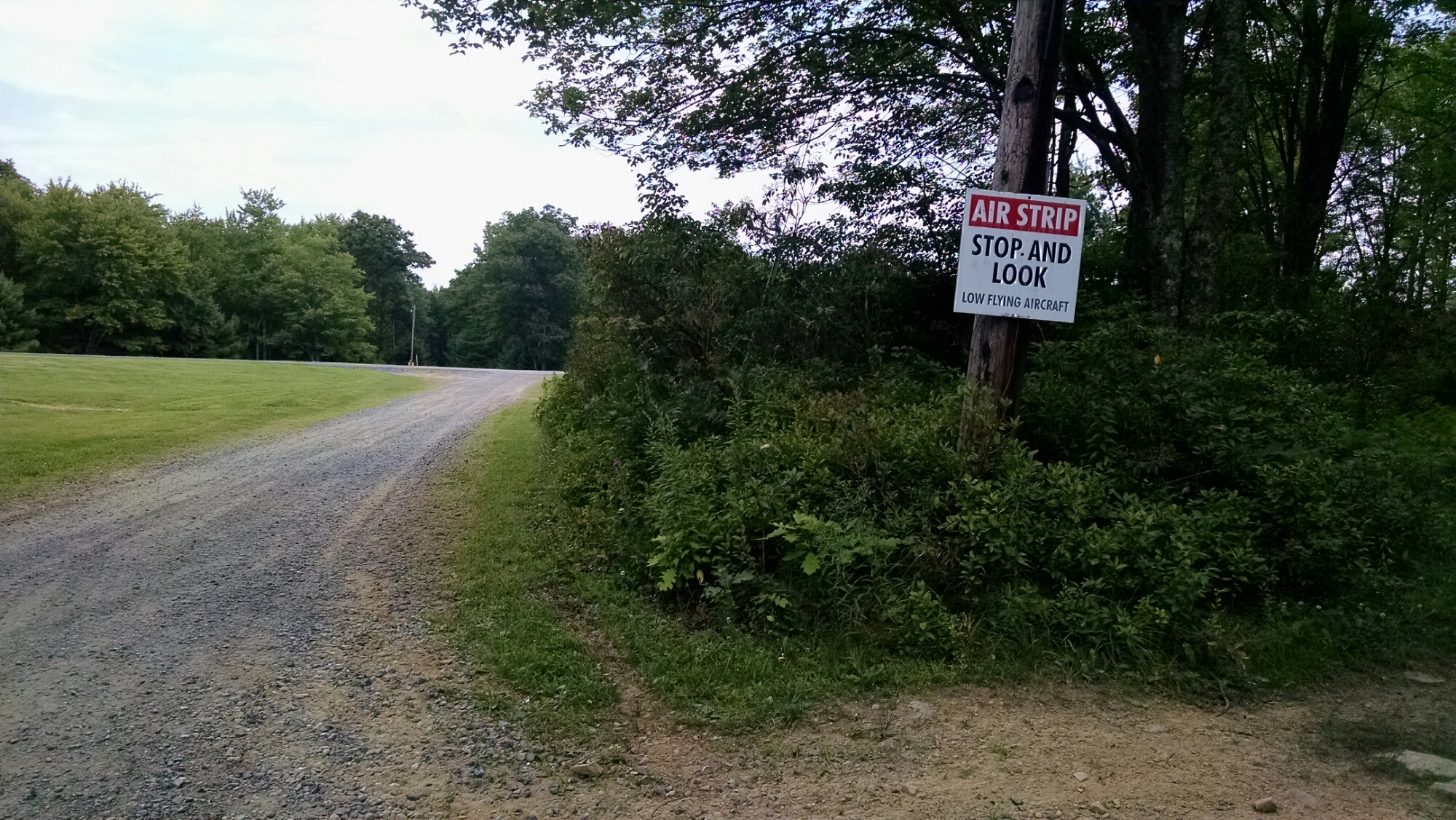
It didn’t take long before we spotted the small airstrip cut out of the trees.

We were later than the initial plan.  But as we swooped in for a high speed pass we could see the crowd of spectators gathered.  Our siblings, cousins, aunts, uncles, parents and grandparents wanted to witness this historical event and also to prevent anyone from crossing the driveway that bisected the small strip while we were on approach. 

image

We circled around for a practice run and were too high.  Kyle corrected for the final approach.  The runway sloped upward at a slightly awkward angle and I made sure my brother was aware of that tall tree nearly blocking the trajectory we were on. 

Kyle wagged the wings ever so slightly to avoid the obstruction as we dropped through the trees and set down on terra firma again.  We survived!  No violent death or unexpected drama either…

image

(Click here for a video of our departure and other pictures.)

What We Believe, Does It Matter?

Standard

What we believe matters.  What we believe changes our reality.  Belief matters because it changes the way we act.  If a person believes something they will live in a way that reflects the reality of their mind and work to create that reality.

If I believe I am disadvantaged, discriminated against or am cut off from a path to success, then I have also excused myself from making a full effort to overcome.  However, if I believe success is achieved by meeting challenges and adversity without making any excuses, then my trying may overcome the obstacles.  If I believe success comes from hard work and perseverance I will actively pursue it rather than wait around for my fate to be determined by my circumstances.

In practical or pragmatic terms it is better to believe there is hope.  Hopeless people go through the motions of life, they hold back because of their cynical attitudes and when their lack of effort results in failure they take it as proof of determinism.  When we believe things cannot be changed we are actually promoting that end.  There is truth to the idea of a self-fulfilling prophecy.  We can build positive or negative feedback loops depending on what we believe and how what we believe changes the way we act or react.

Some saw only giants…

What we believe changes how we view the evidence.  In the Bible there are multiple accounts where perspective had practical consequences.  There is the story of twelve Israelite men sent to spy on Canaan (Numbers 13) who saw the same evidence differently.  Ten of the twelve saw only impossible odds, plead their reasonable case against the promise, convinced the multitude to fear and doomed themselves to wandering.  However, two of the twelve saw victory over the obstacles and they did eventually see the promise fulfilled for them.  Unfortunately, because of the unbelief of others, even their fulfillment was delayed.

With a negative perspective could very well be robbing ourselves of a chance for success.  But, not only that, we may be robbing others as well because we aren’t giving our full potential.  When we take a fatalistic ‘it is what it is’ attitude towards something what we are actually doing is saying that we are unwilling to take steps to change what ‘is’ and make it better.  It is not an acceptance of reality, no, it is an excuse to be mediocre.  It is justification of our being indifferent rather than taking steps in faith to change circumstances for ourselves or others.

Cynicism and skepticism seem to be the ‘gods’ of our time.  And, while I am an advocate for critical thinking, I desire to use it as a means to strengthen humanity and not to destroy faith in the better.  I am not arguing in favor of foolhardiness.  I do not believe faith in the future is an excuse to be ignorant or unaware.  But, what I am saying is that we need to shoot for the impossible or we won’t even live the best of the possible.  It is the faithful who should be leading the way towards the ideal and without compromise or fear.

Unbelieving Christians…

There are many who claim to believe that the fantastic claims of the Bible are true and yet few who seem to accept the full implications of what doth dwell therein.  It is subtle, it often hides under cloak of theology or spiritual language, but underlying this ‘appearance of godliness’ (2 Timothy 3:5) is a heart of unbelief and doubt.  I can tolerate defeatism outside the church, but within the community of faith defeatism is inexcusable, it is spiritually dangerous ground and robs of us of our full potential as people of faith.  There are three areas where I see Christians accepting defeat and in the process defrauding themselves and the world.

“Be perfect, therefore, as your heavenly Father is perfect.” (Matthew 5:48)

The Bible tells us all have sinned and fallen short of the glory of God (Romans 3:23) and that to set the stage for our understanding a need for saving grace.  Yet that is NOT an excuse to continue in sin. (Romans 6:1) The mentality that will lead to spiritual victory is that which seeks to overcome sin rather than wallow in excuses for sin.  I can hear the chorus of “yeah, buts” in protest.  I know all the excuses because I have made them.  To those making excuses by citing religious tradition and theological exemption, read Mark 7:13.

Ironically, it is sometimes the same who attempt to apply the letter of their own law or tradition, who justify their own personal and group shortcomings.  They strain on gnats and swallow camels (Matthew 23) sowing the seeds of their own failure.  All have sinned.  Sin is falling short of perfect love.  We need grace for our own failings and need to show grace as those shown grace.  However we aim for perfection because to aim for less we are actually sabotaging our full potential and will likely feel need to justify ourselves by pointing out the failures of our neighbors.

To those I have judged for their sins while not dealing completely with my own, I apologize and offer my repentance.

“This, then, is how you should pray: “‘Our Father in heaven, hallowed be your name,     your kingdom come, your will be done, on earth as it is in heaven…” (Matthew 6:9)

This is the prototypical prayer Jesus offered his followers.  It is commonly referred to as the “Lord’s prayer” and recited religiously.  But, if one were to consider the implications, it should change our expectations and how we live.  There are two things we can assume, a) we could assume we are to pray this as mere wishful thinking, or b) we can take it literally and do our part to bring heaven to earth in faith.  It is an unfortunate feature of popular eschatology that seems to dampen the enthusiasm of some to make a positive contribution by a presumption that it will not make a difference what we do.

When we see the world with a rental car mentality we cease to take care of it as a gift from God.  Worse, too often this attitude is not just negligence towards the environment, but it also seeps into our attitude towards people and we become as Jonah sitting waiting (even hoping) for the judgment of the polluted and imperfect world.  To have that perspective is to extinguish our potential as a salt and light in the world (Matthew 5:13-16) and deprive our neighbors along with future generations of a better world.  We are essentially tying the hands of God (goodness) when we accept a corrupt world.  It is our job as people of faith to swim against the current and bring heaven to earth.

“Have faith in God,” Jesus answered. “Truly  I tell you, if anyone says to this mountain, ‘Go, throw yourself into the sea,’ and does not doubt in their heart but believes that what they say will happen, it will be done for them.  Therefore I tell you, whatever you ask for in prayer, believe that you have received it, and it will be yours.”  (Mark 11:22-24)

The passage above, a refrain repeated in the Gospels. It identifies the real root of our low expectations and the root of our low expectations is a heart of faithlessness.  We do not see the full potential of God’s love for us because we do not believe, pray in belief and act in full faith.  This cynical faithless attitude is the same that prevented Jesus from doing works he was doing among others who had faith (Matthew 13:53-58, Luke 4:14-30, Mark 6:1:6) and it is a spirit still alive today in religious circles today.  It is a spiritual ignorance, it is an idea that boxes in God by our own understanding, and limits our full potential.

Beware of what you think you know lest you repeat the same mistakes of those who limited not only themselves but also those who were with them.  Faith is not fatalistic.  Faith is a mind set on success in all areas of life, having a heart that believes all things are possible and acting with a will to overcome impossibility.  It is an attitude without fear of giants, not deterred by walls or oceans and has hope in all people.  It is with this kind of faith that the promises of God are made real as experiences today rather than a mythology in the past or a delusion about the future.

The radical faith…

I say, instead of spreading unbelief or doubt, and instead of living in doom or despair, become open to the better possibility and act to make it a reality.  I’m not saying to be ignorant of suffering, nor that life is all sunshine and rainbows for those with radical faith.  No, if anything, with higher expectations comes a greater burden; a person who believes does not sit idle waiting for the future to come to them.  A person with faith is more active and vulnerable.  Still, those who try and stumble occasionally are better than those who spiritualize their defeatism and never act practically to bring what is better into reality.

“In the same way, faith by itself, if it is not accompanied by action, is dead.   But someone will say, “You have faith; I have deeds.” Show me your faith without deeds, and I will show you my faith by my deeds.” (James 2:17-18)

Believe and live life an abundance rather than be resigned to fear or failure.  Be wise, be aware and live in faith.

Go bring heaven to earth.

Make no excuses.