Cultural Erasure in the Age of Corporatism: Preserving Local Identity and Sovereignty

Standard

Cultural erasure is often discussed in the context of dramatic examples. Communist efforts to eradicate religious practice or the forced assimilation of Native Americans are two clear instances. Another is the British schoolgirl punished for wearing a Union Jack on a day meant to celebrate cultural diversity. Yet, a more insidious form of cultural erasure is sweeping through the United States, infiltrating every small town under the guise of free markets and capitalism.

What I’m referring to is corporatism, partnered with consumerism. This country was once defined by businesses owned by average people—those “mom and pop” shops. That is no longer the case. Capital and control are increasingly concentrated in the hands of a few (see this video on BlackRock), and choice is largely an illusion in this age of mega-corporations. We have become a nation of employees. Yes, small businesses and boutiques still exist, but they are the exception. Our regulatory regime favors economies of scale, benefiting established players who can absorb compliance costs.

Illusion of choice

On the road—hauling commodities—this economic transformation is alarming to anyone who cares to notice. Local mills and grain elevators have been bought up or are in the process of being acquired by major players. Businesses where locals once knew the owner have been transferred, one after another, to corporate boards far removed from the operations.This trend spans every industry. Thriving downtowns and corner stores have been replaced by Walmarts. Ironically, when communities regain a “local” option, it’s often a Dollar General. The impact extends beyond retail. Doctors can no longer afford to practice independently, and hospitals are absorbed by larger systems to manage ballooning compliance costs. Local communities have lost true choice as corporate brands dominate.

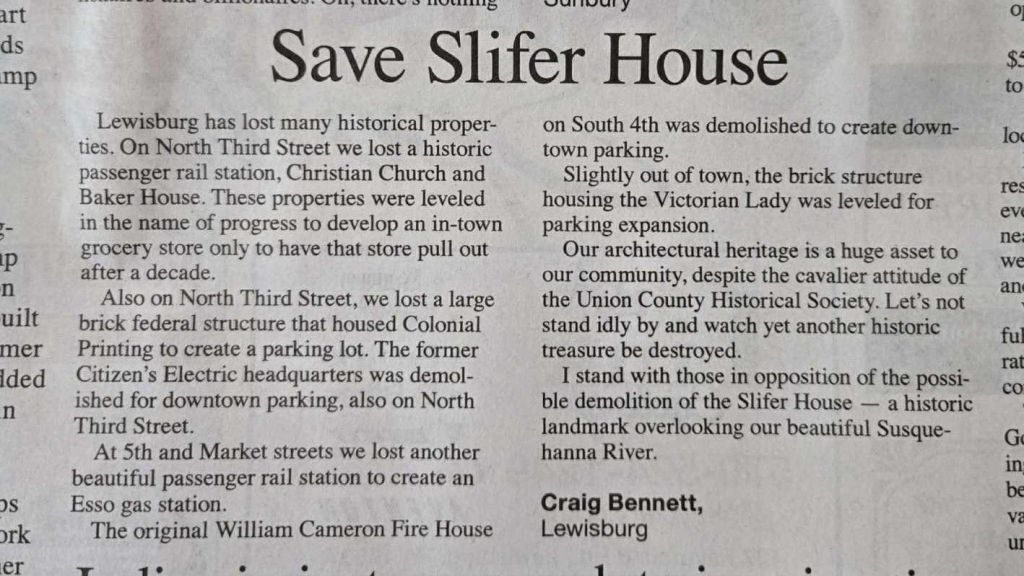
Even decisions within our towns are outsourced. Consider the plan to bulldoze Slifer House, a local landmark designed by a notable architect, listed on the National Register of Historic Places, and honoring a man who played a significant role in the town’s history. This building, originally a private residence, later an orphanage, and then a hospital, faces demolition. The board deciding its fate is disconnected from the community, concerned only with maximizing revenue at the expense of our shared heritage.

https://www.change.org/p/save-the-historic-slifer-house-from-demolition

I spoke with a township supervisor, a relative, and received the typical canned response about property rights. But this boilerplate conservatism fails in an era where BlackRock owns vast swaths of the economy, and we all now owe our souls to the company store. It’s not a free market when Larry Fink can mandate DEI policies across every place we shop or work.  Consumer choice doesn’t exist when all options on the shelf (see this video on BlackRock) are owned by the same entities.  Property rights may have built the middle-class, but appeals to them cannot address this systemic erosion of agency and destruction of ownership society by the current corporatism.

A town known for its Victorian charm and yet can’t protect this heritage from corporate interests.

This corporatist-consumerist machine erodes local identity and sovereignty by homogenizing communities. Regional dialects, traditions, and histories are drowned out by standardized corporate aesthetics and practices. The local diner with its quirky charm is replaced by a chain restaurant with identical menus and decor nationwide. The family-owned hardware store, where the owner knew your name, gives way to a big-box retailer staffed by transient workers. These shifts strip away the unique character of our towns, leaving behind this sanitized, generic, board approved and predictable landscape that could be anywhere—or nowhere.

Retaining local identity and sovereignty requires deliberate resistance to this tide. Communities must protect what matters to them, prioritize policies that support small businesses, such as giving tax incentives for independent retailers (rather than Jeff Bezos) or simply streamlined regulations that don’t disproportionately burden the little guy. Local governments should not side with entities outside of town, but rather should empower residents of the community to have a say in decisions affecting historic landmarks like Slifer House, ensuring that distant corporate interests don’t override community values. Grassroots movements can foster local pride by celebrating regional festivals, preserving historic sites, and promoting artisans who embody the town’s heritage.

Better options closer to home?

Sovereignty also means reclaiming economic agency. Communities could explore cooperative business models, where locals collectively own and operate enterprises, keeping profits and decision-making power in the hands of residents. Supporting farmers’ markets, local craftspeople, and regional supply chains can reduce dependence on corporate giants. Education plays a role too—teaching younger generations the value of their town’s history and traditions fosters a sense of ownership that no corporate boardroom can replicate.

Ultimately, the fight against cultural erasure through corporatism and consumerism is a fight for self-determination. It’s about choosing to preserve what makes our communities distinct, even when the deck is stacked in favor of scale and sucking out profits. By valuing local identity over corporate convenience, we can reclaim the soul of our towns and ensure they remain places worth calling home. Property rights were meant to protect local control—not to consolidate then outsource all decisions to out-of-towners.

Path of [Least] Resistance…

Standard

One of my favorite players, while coaching ‘semi-pro’ was a guy named Jerry. The league knew him as this out-of-control and sort of dirty player. He would get wound up with his asthma attacks and get into verbal altercations on the field. But to me, despite his reputation as a loose cannon, he was actually more coachable than many on the team. The guy could’ve easily ripped my head off, he was a fairly large guy (playing defensive end) and a physical force on the field. However, in the few times when I did need to directly to intervene, he was surprisingly respectful. I mean, he would address me as “coach” and, every time, after a few mumbles, he would back down. He would even often apologize later.

Only once, with a little alcohol involved, did I catch a small glimpse of what was driving him. At the time, in his late forties or early fifties, he recalled how his own dad had pushed him. He was abusive and never satisfied. And football was the direction his dad was pushing him in. Jerry had D-1 offers as a younger man. Yet, ultimately, he walked away from the sport at that level and much to do with the pressure he had felt. Obviously, he was still very conflicted over all of this. He played as if a demon were biting at his ankles, a man on fire, and probably pushing a little too hard for a man his age. I’ve lost contact with him, not even sure if he lives in the area anymore, but his story is a cautionary tale for me as I try to navigate my son’s current involvement in athletic endeavors.

I love sports as a training ground for life. It is an opportunity for character development, to learn lessons about work and reward, teamwork, etc. I had my own regrets for having started competing only very late in high school and, therefore, have been very pleased that my own son wrestled over the winter and has been practicing for football season. He’s an amazing athlete for his age. He won his bracket in wrestling, his first year out, with a combination of will, natural strengths, and things learned from his coaches. It has not taken much encouragement to keep him going. He is an enthusiastic participant and seems to really enjoy himself with other kids his age. There have been a couple of times when he was upset and seemed ready to quit, but the next day he has always come back for more.

Desirous Distractions

Of the things I hate most, his tablet is probably in the top ten. We had successfully hidden it away (he didn’t miss it after a week or two) and yet brought it back out due to some current circumstances that make it better to keep him occupied. The result has been like an addict, or binge, where he would use the device non-stop if we allowed it. It turns him from an active and engaged kid, who loves to swim in the local pool and requires a ton of attention, to a slug barely moving for hours. It’s not healthy and that’s the reason why I’ve fought back against this and haven’t minced my words on this topic with him either. I’ve been glad that we had football practices to give that indisputable non-negotiable reason to separate him from the screen. However, the other day, after practice, he confessed that he wished that he didn’t play football so he could be on his tablet more!

One of my successes, so far, as a parent was to keep sports as his idea. Sure, I want him to play, I have done my part to facilitate his involvement as well, but I’ve mostly let him lead in what direction he wanted to go and was glad that his own desires lined up with my own. I’m sure my own hopes and expectations have found their way to influence, children likely know their parents better than their parents know them and generally want to please them. He knows that I’m a Penn State football fan and that, Charlie, the elementary wrestling coach was an old teammate. So it isn’t really surprising that he went down this path similar to my own. Still, I didn’t want to be one of those dads, the kind living vicariously through their son and putting undue stress on him. It does seem we’re too sports-obsessed, where youth leagues are year-round, there is this camp and that camp, which is driven by parents with glowing ambitions more than it is by the children themselves. I wouldn’t be all that surprised if many of these overworked and pushed too hard will quit. At the very least, it won’t be enjoyable.

The big question for me is what would I do if my son said “I don’t want to play anymore.” I’ve already assured him that not playing doesn’t mean he would get more time with his tablet and that he would probably be bored. And he seems to understand that he needs to finish what he started as far as the current season. Nevertheless, the chill I felt, all of my own dreams of watching him now threatened, could easily lead to my being more controlling. It is scary to me that a tablet, this path of least resistance, has so much appeal that he would sacrifice all for it. I’ve also had to question my own motives. Am I doing what is best for him? When I restrict access, when I push him to do things that make him uncomfortable, that’s the reason why I do. But as a parent, we really need to be careful not to project our own desires onto our children so much that they are stifled and not free to be themselves.

The Elusive Balance

My son would likely be completely happy if I just let him play on his tablet nonstop. Maybe he would eventually get over it on his own if we didn’t interfere? I mean, I doubt it. There are always new games to download and more distractions to occupy for hours and hours. And that’s my concern, that the hours he spends vegging out could be put to much better use. It would be negligence, on my part, to simply give him what he wants and never resist his short-sighted perspective. It is my job to develop him, to make him ready for life and sports are one of those tools used towards that end. I don’t want him to develop character, not to be a character in a video game. I want him to get exercise, experience the tactile and real world, and not just live in the fantasies that others created for him. I must resist him.

That said, football is also just a game. I don’t want to be that dad who ended up putting so much pressure on his son to be successful that it ruined our relationship and he quits in frustration. There is much more to life than statistics or the accomplishments that the world will notice. Yes, I would beam with pride if my son were to score a touchdown, be on a state championship team, and be good enough to compete at the next level. A college scholarship, of course, would be great. He doesn’t seem to be the type that will get that in the classroom, so why not encourage the path that he does have? Still, that is exactly the problem. I quickly get way out ahead of reality and with that could quickly destroy even my own enjoyment of the moment. He should, as a child, be involved because it is fun. Certainly, I must coach a little, put some restrictions here and incentives there, but ultimately he needs to choose.

I don’t want my son to go down the path of least resistance. I want him to be resilient, a leader, involved, pushing back, and growing his abilities rather than comfortable. I truly want him to be better than me in all regards. Or, at the very least, to be better for having had me be a part of his life. Sometimes this will require me to bump against his will, dig in my heels a bit, and not let him rest on his laurels or waste the opportunities he has. Other times I will need to step back, let him go his own way, learn at his own pace, and accept that his goals for life may not align with my own. The real struggle is the wisdom to know when to intervene and how. Hopefully, he knows my heart is oriented towards his good even if my execution is flawed. And, actually, I’m okay if we’re not always friends so long as what I’m offering him is a way to go beyond my own limits and reach his full potential as a man, that’s my reward.

Denominationalism: “My Church Is Better Than Yours!”

Standard

People divide up.  Segregation occurs naturally in groups as individuals seek out others who have something in common with them.  It students find those of common interests, social status, gender or race.  It happens in communities—people choose to live with people more similar to them.

But where division should not happen is in the church.  Not according to the Apostle Paul, at least:

Be completely humble and gentle; be patient, bearing with one another in love. Make every effort to keep the unity of the Spirit through the bond of peace. There is one body and one Spirit, just as you were called to one hope when you were called; one Lord, one faith, one baptism; one God and Father of all, who is over all and through all and in all. (Ephesians 4:2‭-‬6)

I believe the first sentence, “Be completely humble and gentle,” is key to the second part being true of us.  With pride comes contention (Prov 13:10) and without humility there is divisivion.

Paul further elaborates:

I appeal to you, brothers and sisters, in the name of our Lord Jesus Christ, that all of you agree with one another in what you say and that there be no divisions among you, but that you be perfectly united in mind and thought. My brothers and sisters, some from Chloeʼs household have informed me that there are quarrels among you. What I mean is this: One of you says, “I follow Paul”; another, “I follow Apollos”; another, “I follow Cephas”; still another, “I follow Christ.”  Is Christ divided? Was Paul crucified for you? Were you baptized in the name of Paul? I thank God that I did not baptize any of you except Crispus and Gaius, so no one can say that you were baptized in my name. (1 Corinthians 1:10‭-‬15)

The message is clear in the words of Paul—the church should not be divided into competing denominations and, if Scripture is to be believed, we should be grieved by division in the church and preach against it.

We should stand united against this:

I wrote to the church, but Diotrephes, who loves to be first, will not welcome us. So when I come, I will call attention to what he is doing, spreading malicious nonsense about us. Not satisfied with that, he even refuses to welcome other believers. He also stops those who want to do so and puts them out of the church. (3 John 1:9‭-‬10)

Diotrephes evidently thought he was pretty special.  He desired preeminence, made slanderous accusations and was excluding other Christians from fellowship.  We aren’t told why he was banning people, but his attitude clearly is condemned as wrong in the passage.

A church divided against itself…

The church today is divided up into many denominations.  There was the big schism between East and West that was caused by disagreement over Papal primacy, the Filioque added to the church creed, canonization of Scripture and multiple other issues.  After various attempts to reconcile differences over many years the result was eventually mutual excommunications in 1054 that are regarded as the terminal event.

Then came the series of splits in the Western church, the so-called Protestant Reformation, set in motion by Martin Luther’s protests over the sale of indulgences in the 1500s, leading to the formation of a “Lutheran” church and culminating in the 33,000 denominations that we have today.  My own Mennonite denomination was the eventual product of a radical and rebellious (sometimes violent) Anabaptist movement.

My church is part of many Mennonite “conferences” that recognize each other to a greater or lesser degree.  Some groups considered “old order” (who reject modern technology) with a spectrum from “liberal” to “conservative” as broad as the overall church and spawning more variations (some who resist being called Mennonite) recognize each other to a greater or lesser degree… yet typically only allow their own members to take communion.

Mennonites today, unlike the schism in 1054 or other splits caused by larger more meaningful matters of theology and doctrine, tend to divide over the minutia of application.  Things like the style of coat, size of a floral print on a dress, color of socks, facial hair, and any number of nitpicking details which nobody in the world outside Mennodom would care about, can precipitate a church split.

For example, in my church the two big controversies that led people to leave were over hair style.  First, several families left for a more conservative conference because a little girl had bangs.  Later, a liberal contingent left because of a feud over a bit of peach fuzz.

Complete absurdity.

This is a reality in clear opposition to the teachings of Paul and the “unity of the Spirit” he describes.

What is the problem?

We have names from A to Z in front of our church buildings to proudly tell people what church tradition we follow.  We announce “I am of Menno Simons” or of this “Lutheran” theological perspective or that “Methodist” doctrinal division and promote a form of tribalism.  The result is a confusing mess that only a religious historian could untangle.

But, I can hear the protest: “Shouldn’t people know what denomination we are?  I mean, they’ll find out eventually, better to let them know before they enter and disturb us, right?”

And thus we prove we value our denomination more than we do welcoming others of Christian faith.  It is the spirit of Diotrephes, a prideful desire for preeminence and control; it is love of our own dogmatic ideas over other people.  It is the kind of attitude Jesus condemns:

Woe to you, teachers of the law and Pharisees, you hypocrites! You shut the door of the kingdom of heaven in people’s faces. You yourselves do not enter, nor will you let those enter who are trying to. (Matthew 23:13)

The “teachers of the law and Pharisees” thought they had every right to shut people out based on their biblical standards.  But Jesus warns them that they will be shut out the way they shut out others.  It seems the same message Jesus preached of forgive as you wish to be forgiven (Matt. 6:14) and judge as you wish to be judged (Matt. 7:2) and that should give pause to anyone humble enough to know their own imperfections.

The Mennonite church I grew up in will refuse to baptize a believer who doesn’t go through a class and agree to follow their own list of standards.  They would go so far as deny communion to a person from another denomination.  And this inhospitable attitude is not a problem to most of them.

Maybe God will be inhospitable to those who have denominational pride and shut out other believers different from themselves?

Some things to consider…

1) Reconsider having a denominational name in front of your church.  Do you understand the admonition of the Apostle Paul against division?  If so, why do you see it as allowable to emphasize a man’s name, a particular doctrinal slant or denominational tradition in front of your church?  What if our true worship was supposed to be less about theological correctness and more about our truthfulness in love and forbearance?

Therefore, as God’s chosen people, holy and dearly loved, clothe yourselves with compassion, kindness, humility, gentleness and patience. Bear with each other and forgive one another if any of you has a grievance against someone. Forgive as the Lord forgave you. And over all these virtues put on love, which binds them all together in perfect unity. (Colossians 3:12‭-‬14)

2) Stop attacking, belittling, and making slanderous accusations against other denominations.  I know I know, Catholics are idol worshippers, Joel Osteen isn’t negative enough (more about hell, please) and Calvinists are too fatalistic, predetermined or something like that.  But Scripture tells us, “everyone who calls on the name of the Lord will be saved,” and warns: 

If you bite and devour each other, watch out or you will be destroyed by each other. (Galatians 5:15)

Perhaps, before we get too sanctimonious, we should consider this:

Brothers and sisters, do not slander one another. Anyone who speaks against a brother or sister or judges them speaks against the law and judges it. When you judge the law, you are not keeping it, but sitting in judgment on it. There is only one Lawgiver and Judge, the one who is able to save and destroy. But you—who are you to judge your neighbor? (James 4:11‭-‬12)

3) Be less resistant to criticism and more receptive to correction regarding your own denomination.  It is easy to circle the wagons when our own church tradition is scrutinized, and to react defensively rather then be open to rebuke.  For example, nearly any time I blog about the defects of my own religious culture, there’s usually a chorus of those crying, “My Mennonite church isn’t like that!”  Many are in denial—but that is their pride.

We should practice introspection and be open to the possibility that outsiders might see our flaws better than we do, because:

If we claim to be without sin, we deceive ourselves and the truth is not in us. If we confess our sins, he is faithful and just and will forgive us our sins and purify us from all unrighteousness. If we claim we have not sinned, we make him out to be a liar and his word is not in us. (1 John 1:8‭-‬10)

There is no weakness in acknowledgement and confession of fault.  There is no need for huffy recriminations (“Well, they do it too!”) if we are truly humble.  Christianity is about forgiving and being forgiven, not about defending the image of our denomination.

4) Baptism should be uncoupled from denominational indoctrination and membership.  There is nowhere in Scripture where baptism is seperated from profession of faith.  Yes, we should disciple young believers, teach correct doctrine and encourage good application.  However, that can come after baptism.  There is no reason why a baptism should wait weeks or months.  And, if you belong to a church that ties baptism to extrabiblical church standards, speak out against it.  We should welcome the young in the faith rather than add our own prideful denominational requirements:

At that time the disciples came to Jesus and asked, “Who, then, is the greatest in the kingdom of heaven?”  He called a little child to him, and placed the child among them. And he said: “Truly I tell you, unless you change and become like little children, you will never enter the kingdom of heaven. Therefore, whoever takes the lowly position of this child is the greatest in the kingdom of heaven. And whoever welcomes one such child in my name welcomes me.” (Matthew 18:1‭-‬5)

5) Do not refuse to allow other Christians to participate in your Communion service.  Paul warns against eating and drinking unworthily (1 Cor. 11:27) and this is reason for introspection.  However, what is neither said nor implied is the idea that a church leader should determine who is worthy or not worthy.  Yes, we are told that an openly wicked and unrepentant person should be excluded (1 Cor. 5:13) and yet that doesn’t mean we should deny those of other denominational stripes from the table.

We must rebuke Diotrephes and welcome other believers even if they do not meet our own denominational standards.  There is one church and one Spirit—we must take a stand against the spirit of division.  We need to stand against sins of pride and denominationalism.

Nuclear Fusion and a Positive Vision of Love

Standard

Many people, whether they realize it or not, love for what they get in return and essentially are in love with their own image reflected in another person.  This can be dressed up in many ways, it can be hidden under religious motives or romanticized, but it is (once all the layers of rationalizations are removed) a selfish love.

For three years now I’ve sought after a different kind of love.  For three years I’ve sought after the kind of love that sacrificed personal ambitions and loved another purely out of love for God.  It was a love of faith, a love that transcends differences rather than be divided by them, and a love made possible only through God.

The impossible love meets human reality…

I set out to do the impossible in belief that the words “with God all things are possible” were true and pursued the love of someone who was completely different from me in everything but faith.

Unfortunately, this person—being that they are fundamentally different from me (despite our both being Mennonites)—did not see faith as a good enough basis and could not see the potential for love and refused even a friendly relationship.

I don’t blame her.  It was what she inherited from her parents and religious culture.  Mennonites, despite their bluster, are really no different from their secular neighbors and promote the same perspective of love.  That is to say Mennonites give advice like “find someone running the same direction you are” and centers on the wants of the two individuals.  You don’t need God to explain that kind of love.

But I sought something entirely different.  I sought a love that was not self-seeking and shallow.  I was seeking a deeper bond of a love that was truly self-sacrificial and put God at the center rather than the wants of individuals.  Instead of two people choosing each other because they are similar, a narcissistic love, I hoped to find the love of two people who formed their ambitions together in a spiritual union with God.

I met a wall of resistance.  Mennonites may claim to love their enemies and practice non-resistance, but don’t try to be their friend unless you fit their list of requirements.  I was not up to her standards.  She told me she couldn’t love me the way that I wished to be loved, except I didn’t ask for love—all I wanted was a little faith and a chance.

Imagine the exasperation of being told “hearts don’t change” by someone who plans to commit their life to missionary service.  It makes me wonder why they would even bother going over land and sea?  Evidently they aren’t going with actual faith in a God that makes the impossible possible.  Perhaps they are going for the excitement or for the praise of religious peers?

Anyhow, it is impossible to love someone who refuses to receive it.  In her mind, as one who was “thirty years old living in Milton” I had absolutely nothing to offer her.  She, taking cues from her father and religious peers, treated me more like a rabid dog than a brother in faith.  They actually denied me a means to love or be needed by them.

Meet Sarah, my sister from Congo-Brazzaville…

Severe disappointment leads to depression and many days I wished that I could disappear into my bed forever.  I was hurting and not in the mood to be sociable when the notification “Sarah Zinia has sent you a friend request” popped up on Facebook.

My initial thought was to ignore it.

However, I decided not to use my own pain as an excuse.  I remembered, “Do unto others as you would have them do to you,” and decided to apply that reasoning to this circumstance.

I clicked “accept” not knowing what to expect.

I was not kept in suspense.

Immediately thereafter a message “hey” came from this mysterious new friend.  So, still fighting the urge to ignore and deciding to apply the Golden Rule again, I said “hey” in reply.  We exchanged our “how are you’s” and that marked the beginning of a very special friendship between two very different people.

Sarah, I would soon learn, was in dead end of a town, living in a group home, a mother to a one month old baby Anthony, and had no car or public transportation.  It was obvious she was very bored, and I knew that if I were in her shoes I would want to get out a little.  So, in a moment of impulse, I offered to take her somewhere and she enthusiastically accepted.

After a first meeting (and being a good Mennonite by too carefully explaining my platonic intent) we were regularly going out to eat, hiking trails, visiting parks and even shopping!  She didn’t seem to care that I was a mildly miserable guy in his mid-thirties, she was simply glad to have a friend.

Our conversations were light at first, usually about the food we ate or the weather, but soon I was learning about the struggles of a teenage single mother and life from the perspective of a refugee from Africa.  Her story touched my heart and made my life seem like a walk in the park by comparison.

Sarah was pulled away from her home country, taken from her mother (who she has lost all contact with) in a new strange country, raised by the state system, treated as a slave and bullied.  I can’t go into details out of respect for her privacy and yet can assure you that she has gone through many awful experiences in her life.

Mennonites, like many others who are so privileged, take for granted the security that a family provides for them.  Sarah, by contrast, has been separated from her family and has been a half step from homelessness.  Yeah, sure, there are many government programs and private organizations to help, but none of that can replace family.  She needed real family and that is why she decided to accept me as her brother from another mother.

I treated her with respect.  She did not need to ask, it was easy to recognize the void in her life and that she needed someone she could trust to be there for her no matter what.  I tried to help her with her insecurities by assuring her that she would have a place to live even if I needed to give her my home and move back to my parent’s house.  

The friendship we have is impossible by a conservative Mennonite standard.  I’ve had various people in the church express their ‘concern’ to me.  Apparently, in their minds, a guy and girl can’t spend time together without bad things happening?  And then there were those who advised me to practice some ‘tough love’ and cut her off when she went against my advice and moved back to Arizona.

But I stopped caring what other people thought.  I trusted my heart and knew my intentions were right.  Sarah might be a net loss for my bank account, I’ve had to answer those late night calls, tune out a screaming baby (who had been perfectly delightful until alone with us in the car) and yet it was well worth it.  The moments of laughter, the happy and sad tears, seeing her progress—priceless.

She made my life meaningful again.  I probably needed her as much or more than she needed me.  She gave me a reason to care enough to get out of bed and her success has become my own.  Witnessing her accomplishments over the past couple years has encouraged me not to lose hope because the odds are against me.

Sarah has a positive outlook despite all the evil she’s endured—she still smiles with a big goofy grin and that brightens my day…

Helping my little lost sheep find God’s love again…

Last year I met another dear soul through social media.  I will never forget the first message where she apologized because she felt unworthy to be my friend.  She was a poor little lost sheep, shivering in the cold dark world, a nameless number to the machinery of capitalism, and had lost all hope.

Her family and her young son were far away in the Philippines.  She was working to support her son, and (because the wage was a little better than in her home country) she was pressured to take a three year contract in an electronics factory in Tiawan.  She lived in a dormitory with strangers.  Her life had fallen apart.

After her first message my heart ached with compassion.  I tried to convince her that she was indeed worthy to be my friend and assured that I would be there for her as long as she needed me.  But her descent from dreams of a simple happy life to the pit of despair was not overnight and restoration of hope would also take time.

Despite being on complete opposite ends of the planet (exactly twelve hours apart) we had the same schedule because she was on night shift.  So it worked out that every day she could be the first person I would greet and the last one I would talk to before going to bed.

There were many times early on where she would come away from work forlorn.  I would see the sad puppy sticker come across on Messenger and that was my signal to put everything down to get to the bottom of what was troubling her.  My mission was not accomplished until she smiled.

One day she asked me if it was okay if she called me “bhest” and, not seeing a reason why not, I granted permission.  Since then I’ve been her bhest and tried to live up to that special distinction.  My bhest has looked to me for assurance, for forgiveness when she made mistakes, and has privileged me with her faithful companionship.

The sad puppy sticker has not made an appearance for quite some time now.  Our daily reminders to each other to smile and be happy seem to create a sort of synergy or positive feedback loop.  It seems that we get more out than we put in.  We might be on complete opposite ends of the globe, but somehow we are twins and share one heart.

She has transformed from a sad puppy to a bouncy dancing and happy puppy—that is a great source of happiness for me.  It is my goal to continue to provide her with hope of that simple and happy life as long as I am able.

And, for the first time in my life, following her lead, I’ve started to call someone “bhest” and that makes me smile…

Anyhow, what does nuclear fusion have in common with a sister, a sheep, and the love I seek?

Nuclear fusion is a process in which two (or more) different atoms are pushed together with enough force that they overcome the forces that would normally keep them apart and they become one.  The result is a release of energy and particles.  Nuclear fusion is the process occuring in stars (like our sun) that continuously converts hydrogen atoms into helium and creates light.

There is research underway to replicate the conditions necessary for nuclear fusion to occur.  The reason for the effort is the tremendous potential for nuclear fusion to be a renewable and clean energy source.  Once the reaction was started (using a tremendous amount of energy) it would create far more energy than was used to start it and solve many problems of how to power our future.

My vision is for a love like nuclear fusion.  A love that takes two very different people who are not naturally attracted and bonds them together through a faith greater than the differences.  The idea would be a composite of two people of like faith with normally incompatible strengths and ambitions who are held together through a supernatural love.

That is why I set out a few years ago praying for the impossible to be made possible.  It was my hope to see this fusion of very different people who transcended their own independent dreams, sacrifice themselves completely (rather than find someone like themselves) and became bonded in a faith greater than themselves.  I had a vision of a tremendous potential yield.

And, I suppose, I may have gotten part way there.  I’ve seen people as different as black and white become family.  I’ve also found a love that can literally reach around the globe, and bridge east to west.  I’ve seen relationships that produce a synergy and seemingly more output than the energy put in.

But what remains to be seen and impossible?

I have yet to see a good Mennonite from the in-group make a commitment of love to someone outside their exclusive club.  Yes, I’ve seen them love a good project, I’ve seen them budge when hammered and make small concessions.

But, for these good religious people to truly reach for faith in something beyond their own comprehension and current abilities?

That, like nuclear fusion, remains out of reach (at least for this man) and impossible.

So what is my positive vision for love?

I asked God to make the impossible possible, and when I asked, I was seeking after that greater love—the fusion love of faith.  And, I’m not sure I’ve arrived at an answer yet.  I have many questions.

However, what I do know is that I have been changed over the past few years and now things that were impossible are closer to reality for me.  I have lived to be an answer to prayer even while my prayers seem to have gone unanswered.  I’m determined to help others see their own visions of a greater life become their reality.

 
The picture above is my family.  Not a family caused by biology or religious culture either, but one formed of obedience to conscience and love.  Do you share my vision for a transcendent love?