Zionism: Dismantling the Cross, the Judeo-Christian Deception

Standard

There was an act of vandalism in Wales.  A Christian cross made of stones, which had been on a hill in the countryside for half a century, was torn apart by Jewish tourists who used the stones to create the ‘Star of David’ or hexagram shape.  This act goes beyond total disrespect and destruction of a Christian display, but it is also symbolic of what Zionism is and what it has been doing to Christianity in the West.  

Zionism isn’t Jewish.  Many Jews, even who live in the Holy Lands, are as fully opposed to the ethno-supremacist state called Israel as their Christian and Muslim neighbors.  It is not something allowed by their religion, they insist, and I’ll let Jewish people debate their theology for themselves.  But the vast majority of Zionists aren’t Jews nor do they live in Israel.  Most Zionists were American Protestants who have become ensnared in this political ideology that rearranges parts of the Bible to justify taking property from a population who have lived in the birthplace of Christ since his birth.

Christian Zionism is an oxymoron.  It takes two opposites, the kingdoms of the world offered to Jesus during his temptation that he rejected and acts like Gehazi, the servant of Elisha, who goes back deceptively to get the gifts Naaman tried to give to his master and was then struck down with leprosy by the curse of his master.  There are many in church pews today who have betrayed their master and have rearranged the timeline of Scripture to embrace an evil replacement of the way of Christ.  They dismantle the cross and support Zionism instead.

Schofield’s Coup: Dismantling the Cross

In 1909 a new Bible was published.  It used the same English translation of the popular King James version and yet added notes of commentary written by a man named Cyrus Ingerson Scofield.  Dispensationalism is a relatively new interpretation of Biblical texts that started in the early to mid 19th century, initially invented by John Nelson Darby and the Plymouth Brethren in Britain, but it took Scofield’s in text commentaries distributed widely to finally sell it.

We could get into questions of exactly who Scofield was, his character, that he was a Confederate soldier (deserter?); who was an alcoholic who abandoned his family; a man who had defrauded several prominent Republicans with a railroad scam; who was arrested and jailed in St Louis for forgery and embezzlement, then had a dramatic conversion to Christianity and yet this essay will stick to the work he was known for: His popularization of a novel theological stance dividing Israel and the church in Scripture.

In the Christian Bible there’s a fairly obvious shift in tone between the Old Testament (or Jewish Torah, prophets, etc) and teachings of Jesus in the Gospels.  The conventional Christian perspective is that Jesus came as fulfillment of the law and supercedes the covenant that was given to Abram who became Abraham.  But Scofield turns the clock back, he ignores what the Epistles tell us about correct understanding, and he adds an idea that there are essentially two paths to God—one going through Jesus and the cross, the other by the Old Covenant.

Christianity, according to the Apostles, is the faithful remnant.  Israel is now the Church and the Church is the true Israel.

Where this was just an amateur mistake or an intentional deception doesn’t matter.  It has resulted in a battle between those who basically claim that “one way, Jesus” is anti-Semitic statement and smear it as being “Replacement Theology” (ironic, given this was, is, and will remain the only orthodox Christian perspective) for saying that the New Covenant continuation of God’s plan and necessary for salvation.  It ignores the New Testament books where St Paul and others give a correct Christian perspective of the covenant given to Abraham.

Always Through Faith, Never Bloodlines…

Jesus answered, “I am the way and the truth and the life. No one comes to the Father except through me.

(John 14:6 NIV)

I’m not nearly as dogmatic as some when it comes to passages like John 14:6 (above) and yet do see it as foundational to correct application of Scripture from the Christian perspective.  Jesus was making a definitive statement about who he is and the absolute requirements for salvation.  

The promises were spoken to Abraham and to his seed. Scripture does not say “and to seeds,” meaning many people, but “and to your seed,” meaning one person, who is Christ.

 (Galatians 3:16 NIV)

1) The passage above makes it very clear that the seed of Abraham is singular: Christ Jesus.  St Paul is saying that Jesus is that promise given to Abraham, that the promise is what bestows grace and continues:

So in Christ Jesus you are all children of God through faith, for all of you who were baptized into Christ have clothed yourselves with Christ. There is neither Jew nor Gentile, neither slave nor free, nor is there male and female, for you are all one in Christ Jesus. If you belong to Christ, then you are Abraham’s seed, and heirs according to the promise.

(Galatians 3:26-29 NIV)

2) We all become Abraham’s seed though faith in Christ and there is no distinction by religion (keeping the law) or race.  In other words, Jews and Gentiles are both saved in the exact same way and the old distinctions become moot in fulfillment of the promise:

It was not through the law that Abraham and his offspring received the promise that he would be heir of the world, but through the righteousness that comes by faith.  For if those who depend on the law are heirs, faith means nothing and the promise is worthless, because the law brings wrath. And where there is no law there is no transgression.  Therefore, the promise comes by faith, so that it may be by grace and may be guaranteed to all Abraham’s offspring—not only to those who are of the law but also to those who have the faith of Abraham. He is the father of us all.  As it is written: “I have made you a father of many nations.” He is our father in the sight of God, in whom he believed—the God who gives life to the dead and calls into being things that were not. 

(Romans 4:13-17 NIV)

3) Faith in Christ, nothing else, saves.

The Church and true Israel are the same, it is a group that is defined by faith both when those the Jews looked forward towards the promise and also in the Gospel fulfillment of the promise in the seed of Abraham that is Jesus.

Scofield, however, to justify Zionism, tries to drive a wedge between Christ and being the full fulfillment of promise or the seed of Abraham.  His footnotes take a passage like Genesis 12:3, addressed specifically to Abraham, about blessing those who bless him and cursing those who curse and then just hallucinate that it is speaking about all who ever have descended (but only through Isaac) from Abraham—no matter if they are faithful or not.  But this is in direct and total contradiction to the passages quoted above and simply meaning inserted into the text by a man fooled himself or just a fraud.

The Judeo-Christian Deception 

Do not be yoked together with unbelievers. For what do righteousness and wickedness have in common? Or what fellowship can light have with darkness? What harmony is there between Christ and Belial? Or what does a believer have in common with an unbeliever? 

(2 Corinthians 6:14-15 NIV)

Judeo-Christian is a term originally coined to describe a Jewish convert to Christianity, a Jewish Christian, but the usage has since evolved to become an oxymoronic coupling of religious traditions that formed up in full opposition to each other.  There is overlap, certainly, both started as religions rooted in the Hebrew Bible.  But one of the sides has rejected Christ, and is anti-Christ, while the other believes that the Torah can truly only be understood through the lens of Christ.  If your values start with something other than Christ then they’re not the same values as a Christian.

Starting with Jesus instructing his followers to let their ‘yes’ be ‘yes’ and ‘no’ be ‘no’ (Matt 5:37) or to use simple honest language.  So much dishonesty comes in from of a subtle twist of words.  For example, calling majorly invasive surgeries and hormone treatments “gender-affirming care” is just not the plain reality of what is being done.  Semantics is all about describing reality, but can also be about distorting the perspective and an art of deception.  There is no similar rule about using honest speech in Talmudic or Zionist Judiasm.  Mossad, the intelligence agency of Israel, used “By way of deception, thou shall do war.

Stratagem is part of war theory and tactics.  But it is not part of Christianity.  St Paul tells us:

For our struggle is not against flesh and blood, but against the rulers, against the authorities, against the powers of this dark world and against the spiritual forces of evil in the heavenly realms. 

(Ephesians 6:12 NIV)

The Christian doesn’t overcome the ‘enemy’ with deception.  They overcome them with good, with honesty and love, this is to reject the methods and means of those who see those outside their religio-political group as being terrorists to be destroyed or resource to exploited.  We are not required to reason with animals, we herd them, slaughter them, shoot them for sport, and impose our will—and is exactly what the Zionists do to those who get in their way.  There is no command to love enemies or good to those who those who hate you as there is in Christianity:

But to you who are listening I say: Love your enemies, do good to those who hate you, bless those who curse you, pray for those who mistreat you. If someone slaps you on one cheek, turn to them the other also. If someone takes your coat, do not withhold your shirt from them. Give to everyone who asks you, and if anyone takes what belongs to you, do not demand it back. Do to others as you would have them do to you. 

(Luke 6:27-31 NIV)

Interestingly enough, Islam has a similar teaching, but we would never call this area of confluence Islamo-Christian values.  So why do we attempt to add the leaven of the Pharisees through this linguistic maneuver that marries us to a religion that has values completely different despite a similar origin point?  The “Synagogue of Satan” (Rev 2:9, 3:9) has never stopped hating Christ or His followers, they have simply committed to a long-game strategy of subversion or using the naive to do their bidding.  This isn’t even a value judgment, I’m not saying you should not be Jewish if that is what you believe is, but you can’t be a Judeo-Christian because it is a contradiction of terms.

If a suggestion of “Islamo-Christian values” causes you to erupt in riotous laughter, then the combo of the way of Jesus with that of Zionism is doubly as ridiculous.  

Philosophically there is zero compatibility in these perspectives.  It is impossible to love and bomb your enemies.  You cannot claim to follow Jesus, who rejected worldly power, and then support the violence being done in the name of Israeli statehood.  Zionism is a “blood and soil” nationalist movement, and is all about land, all about ethnicity, whereas the kingdom of heaven is about repentance, self-sacrifice and meekness.  The only thing that is sacrificed in ‘Christian’ Zionism is the Gospel of Jesus Christ and the credibility of our collective witness—so our partners can slather themselves in misguided pride for being the chosen race.

Not good, especially when one is pulling the other backwards…

The real purpose of a term “Judeo-Christian values” is political and propaganda.  It is to throw a yoke on the neck of Christians and force them to work together.  It is simply a way to control one side and normalize the other.  There is no backward compatibility, a believer in Christ does not share values with those who reject him, with those who cling to national pride rather than the cross, and subjugate rather than serve.  Jesus opened his arms to children—Zionists justify killing children by starvation, by denying them care or even by burning them alive and gunning them down.

Origen, who is considered to be a church Father, may have toyed with universalism—an idea that all would be saved in the end.  But there is no parallel path that is given for anyone according to Jesus or the Apostles, most especially not for those who are far removed from Jesus as the Nazis—despite their claims to the contrary.  We cannot let the cross of Christ be rearranged into the symbol of a worldly kingdom.  Having some things in common with those who rejected Christ doesn’t make us the same.

Coddled to Death—How the West Made Weakness a Virtue

Standard

My son complains that he doesn’t get paid enough for household chores.  He feels he is somehow entitled to everything that we’re giving him and more.  It is a struggle trying to explain why we won’t simply hand him all that he wants.  We have plenty, in his eyes, and can just share our wealth with him.  But the reason we hold back isn’t our greed or that we don’t want him to have the best life has to offer.  No, quite the contrary, in fact, it is because we want him to do well life that we resist the urge to coddle him.

What is coddling?

On the surface it is being overprotective and indulgent.  It stems from distrust of another other person’s ability to deal with normal life situations and emotions on their own.  And, while it may appear to be motivated by love or compassion, it only ever empowers those who keep the other confined to the bubble wrapped world.  It is the devouring mother, the one who uses their nurture as a tool of control.  They only care about the target of their efforts so far as it feeds their ego or feelings of self-importance.  It is a virtue signal and degrades those coddled.

Bigotry of Low-expectations

Along with thoughts about parenting and the goal, some of the inspiration for writing this came from the governor of the state of New York, Kathleen Hochul, who declared:

Young black kids growing up in the Bronx, who don’t even know what the word a computer is, they don’t know. They don’t know these things. And I want the world open up to all of them, because when you have their diverse voices, innovating solutions through technology, then you’re really addressing societies broader challenges.

Other than to call this statement what it is: Bigotry (or racism) of low expectations and patronization.  I’ll not pile on.

Many, like Hochul, are isolated.  They have not spent much time in urban communities nor met the people who live there.  From my own first hand experience her claim (which she now claims was misspoken) is absurd, none of the black I met were unfamiliar with or incapable of using computers.  Many of my acquaintances there could afford to go to college and more credentialed than I am, so where does this notion come from that they’re hapless ignorant people in desperate need of government assistance?

The answer, in this case at least, is that it is hard to maintain a bloated state budget (let alone greedily expand it) without somehow justifying it and what better way to do that convince people that they need you to get somewhere in life?

Condescending political elites are not moral paradigms and minority voters are not stupid.  I believe those pandered to know it is insincere and coming from someone who sees them as dumb.  But they also understand it works to their advantage and don’t say no to it.  We naturally take the path of least resistance and rationalize why we are deserving of the help.  By playing up the consequences of slavery and impacts of racial prejudice, a little wealth redistribution (looting or theft) can be redeemed as social justice.

Unfortunately, low expectations produces what it is supposed to remedy, it gives an excuse to wait around for a handout and kills initiative.  This contributes to racism in that it creates the impression that the only way some can compete is by lowering the bar or a double standard.  It diminishes the accomplishments of those who knew what a computer is without the help of those in the the benevolent class.  Now, because of politicians meddling, there is the question, did they earn it by being the best candidate or are they a diversity hire?

Woke is Weak

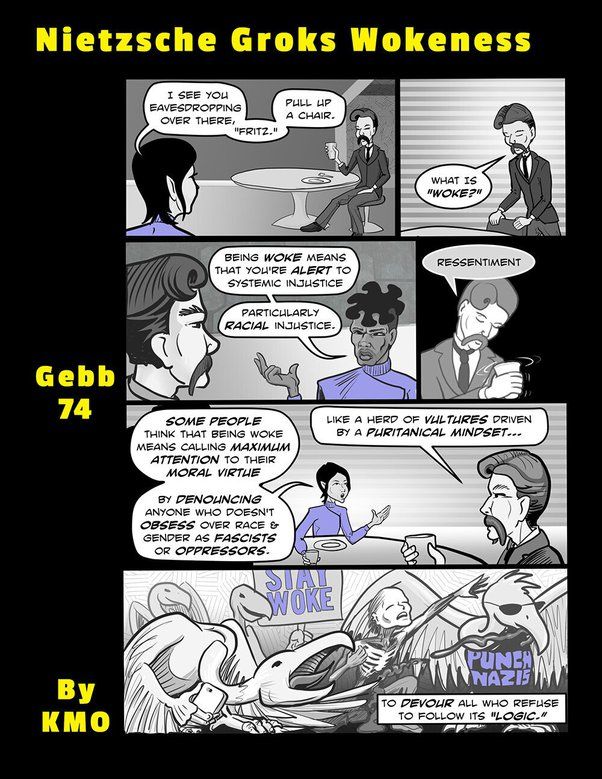
My conservative friends wouldn’t likely see the link between Christianity and wokism, but it is definitely there.  The woke glorify the victim and reframe accomplishment as unearned privilege.  For those who started a business, “You didn’t build that” they reason, and nullify the hard work and the sacrifice of those who followed the entrepreneurial spirit to success.  Likewise, in church we’re encouraged to tithe generously and be charitable since it is giving back a portion of all that is given to us by God.  The difference being that the woke want us to give to the government, the religious their own organizations.

And there’s nothing wrong with our helping those in need.  I provide for my son and my wife as well.  However, when I give I give to empower rather make them dependent and weaker.  My hope is for my son to grow his strength and ability so that in time he does not need me to survive.  And the same thing is true of my wife, she is my partner not my patron, we both contribute different things to the whole and neither of us is entitled to what the other gives to the relationship.  It is how a real community works, we give and take as necessary, and we do it for the good of the common project.

Wokism, by contrast, is motivated by envy and pity, it encourages fragility by marking off space spaces and enforcement of strict language codes.  Again, this strict regulation has a parallel in religious fundamentalism.  Home schooling parents are terrified of the influence of the ‘world’ on their children.  They, like the woke, overemphasize the role of the environment in the formation of the individual.  The one exempts swaths of the population from the normal civil expectation (while increasing the burden on others) and the other thinks salvation of poor little Johnny depends on them.  Bad behavior always blamed on an external influence rather than a lack of will to do better on the part of their designated eternal victims.

This is what Friedrich Nietzsche critiqued as being a hatred for life.  When we remove temptation rather than ever teach children to resist it—when we are constantly vilifying strength rather than encourage it—when we follow after reasoning or rationality instead of developing our instincts, we are promoting the weakness of our society and degeneration. 

Woke is weak.  It attempts to foster spirits of ressentiment and forms an identity around a person’s fear of being disenfranchised for things completely out of their control.  And in the end it destroys the incentive to find a way to overcome by our own means.

The Meek Shall Inherit 

Neitzsche could be accused of painting with too broad a brush for the dismissal of the Christian ethic as slave morality and an opposition to the powerful.

The message of Jesus and his Apostles was, in part, freedom from those human laws of “Do not handle! Do not taste! Do not touch!” (Colossians 2:21) and very nearly could be the “will to power” that the German philosopher championed once unpacked.  Hedonism wasn’t the goal of the departure from “slave-morality,” the aim was instead for people to exercise will-power and resolve.  In the same manner Jesus and St Paul preached freedom from the law that brought only bondage and death:

But now, by dying to what once bound us, we have been released from the law so that we serve in the new way of the Spirit, and not in the old way of the written code.

(Romans 7:6 NIV)

This is not to suggest that there is any kind of compatibility between the Spirit-led and the Übermensch.  Nevertheless, both would have us abandon a lower morality based on restrictions for a pursuit of our own ultimate form.  To St. Paul the Gospel means we are free from “the flesh” or the unbridled urges, while Nietzsche thinks we’re instinctively at our best, and both men are not opposed to impulse control.  The big difference is that the Apostle’s answer is spiritual whereas the philosopher says that additional layer is not needed and morality a hindrance.  Both would disagree devaluing the attitudes and culture that lead to success.  Being master of ourselves requires strength and never allows for excuses.  

Furthermore, the Jesus of the Bible wasn’t weak, he spoke with authority and we are told that he had power over all things, but he chose a meek posture rather than wield this power destructively.  Now it is a matter of faith if you accept this or not.  I could say that I could strangle Mike Tyson yet choose not to.  Talk is cheap.  But meekness is the ability to restrain ourselves.  Having the power to impose our will is always desirable, nobody wants to be at the mercy of the elements or other people.  However, sacrifice for sake of the next generation is better, to parent is to live beyond ourselves, that is why this is an instinct for those who have children, and it is the role of the Father.

When I wrestle with my son I don’t use all of my strength.  I would hurt him if I employed full power.  My goal is not to destroy him, he is not my enemy or threat to obliterate, but it is to train and strengthen him.  I restrain to protect him currently and also challenge to protect him in the future.  That is the real Biblical kind of meekness, it submission to the greater role we can serve as protectors and builders of civilization.  It is the having all things in balance, which Nietzsche might agree, and using our strength to take on the burden of creating the future.  We do not retreat from life.  Faith requires the we go headlong into the fight rather than hide or be ruled by resentment.

Late-stage Protestantism

I can understand the campaign Nietzsche waged against morality in light of wokeism and virtue signaling nonsense.  Apparently he was very well-versed in theology and did not find answers there.  Which is correct, it is not intellect that brings us life, study for sake of study is vanity, and truth is more in the practical telos than in some theoretical construct.  Nietzsche attacks rationality and reason as an end and those things do implode upon themselves when no longer grounded in a higher life-serving purpose.

The current ideological push for wokeism, and the mindless promotion of diversity, equity and inclusion at the expense of standards, merit or competency, is simply another step down the path of trying to eliminate all suffering and in the process destroying excellence.  I want my son to face some hardship, even if it is only artificial, because his striving will build strength.  It is the thought behind Proverbs 13:24: 

Whoever spares the rod hates their children, but the one who loves their children is careful to discipline them.

Or, as Nietzsche postulates in Beyond Good and Evil:

The discipline of suffering, of great suffering – do you not know that only this discipline has created all enhancements of man so far? 

In the same vein, in The Will to Power, he wrote:

To those human beings who are of any concern to me I wish suffering, desolation, sickness, ill-treatment, indignities – I wish that they should not remain unfamiliar with profound self-contempt, the torture of self-mistrust, the wretchedness of the vanquished: I have no pity for them, because I wish them the only thing that can prove today whether one is worth anything or not – that one endures.

No, I don’t want my son to be last picked for his dark skin.  And yet I also don’t want him to live in a world so sanitized that he’ll need to invent offenses (in the same way that an autoimmune disorder is the body attacking itself) then expects me to always step in on his behalf rather than face it.  Success in life requires some voluntary submission or suffering for sake of our goals.  Coddling and bigotry of low expectations does not serve the long-term benefit of children or civilization.

We need to discard this ugly paradigm of late-stage Protestantism.  There are great men, powerful and worthy of our respect, then there are those in desperate need of improvement.  We don’t help the latter by going soft and changing the requirements to make everything easier.  There is nothing radical or reforming about the direction the church in the West has gone.  This “have it our way” drive has led to a fracturing of the church, a consumerist mentality in worship and a new religion without obligation to the fathers or their commands.

Woke is simply the latest development in the direction.  It is the child with imperfect parents now thinking they know better and don’t need the silly disciplines of their parents to thrive.  Whether Anglican or Anabaptist, it is always about rejection of authority and the hierarchies established by the early church and originating with Christ.  We think we can do better, that the home is better if there is equal with no patenting or need for development of conscience.  In the end we get the complete agnosticism which goes further and to destroy everything the generations of faithful built for our good. 

Attainment and success doesn’t need to be made more accessible.  My son may think he deserves everything without effort, that we’re hoarding a kind of wealth just given to us and undeserved.  But that’s his ignorance.  There are no shortcuts to heaven and you can only keep the benefits of civilization if you continue to maintain the very foundation it is built upon.  We think that we will be saved by technology and the vague notions of progress of those who think power comes from the stroke of a pen—but that’s not how we got here nor is it a path to a better future.

Struggle with God

Standard

I completely missed the opportunity in a recent post about what Israel is in Biblical terms to mention the meaning and origin of the name itself, which we find in the book of Genesis:

That night Jacob got up and took his two wives, his two female servants and his eleven sons and crossed the ford of the Jabbok.  After he had sent them across the stream, he sent over all his possessions. So Jacob was left alone, and a man wrestled with him till daybreak. When the man saw that he could not overpower him, he touched the socket of Jacob’s hip so that his hip was wrenched as he wrestled with the man. Then the man said, “Let me go, for it is daybreak.”

But Jacob replied, “I will not let you go unless you bless me.”

The man asked him, “What is your name?”

“Jacob,” he answered.

Then the man said, “Your name will no longer be Jacob, but Israel, because you have struggled with God and with humans and have overcome.”

Genesis 32:22-28 NIV

With that definition, once again, Israel is less who you are and more what you do. Jacob’s life up until that point was a struggle. He wrestled even in the womb with his twin brother Esau and we’re told was grabbing the heel of his elder sibling who emerged first. He came up on the short end of the stick then, but managed to fool his father and get the blessing that was supposed to go to the eldest son. And even that plot ended up leading him to more struggle. He went from trickster to being tricked (karma?) when Laban, his employer and then father-in-law, did the ol’ bride switcharoo on his wedding day and he got the other sister rather than the one he had worked for. He ended up working seven more years to have the woman of his choice. The episode above comes as he returns to face Esau after many years and is still looking for a blessing from God.

Struggling is part of a sincere walk of faith. As Fr. Seraphim, my parish priest likes to say, “If you ain’t struggling, you ain’t Orthodox.” And like Jacob, the Christian certainly has to wrestle and contend for their blessing from God. Yes, salvation is a gift, but it is one that we work out with fear and trembling, that comes with the fruit of repentance:

John said to the crowds coming out to be baptized by him, “You brood of vipers! Who warned you to flee from the coming wrath? Produce fruit in keeping with repentance. And do not begin to say to yourselves, ‘We have Abraham as our father.’ For I tell you that out of these stones God can raise up children for Abraham. The ax is already at the root of the trees, and every tree that does not produce good fruit will be cut down and thrown into the fire.”

Luke 3:7-9 NIV

Note that John the Baptist didn’t put much weight on the genetic ties the crowds had to the patriarch Abraham, dismissing it by saying that God could replace them with stones, but he puts weight on the fruit of repentance instead. Likewise, Jesus, in praising the Centurion, a Roman soldier, for having greater faith than all of Isreal (Matt 8:10) is very significant—especially when the Lord follows up by saying many of the current subjects of the kingdom will be thrown out. So this heresy of saying some get a blessing from God without having to struggle, without needing to have faith in Jesus, is dangerous. Those comfortable aren’t Israel, those building a worldly kingdom aren’t Israel, only those who are spiritually like Jacob and striving for their place against the odds.

God, Suffering and Salvation

Standard

I have complete sympathy for atheists and agnostics.  I’ve wrestled with questions my entire life and whether or not there is a God is always one of them.  But the one thing that I can’t understand is being angry about human suffering, from a rational basis, if God does not exist.  If there is no ultimate good, no greater purpose or meaning to life, on what basis do we make a moral judgment about suffering?

Okay, let’s back up a second.  I’m here at my local establishment drinking another Long Island, one of many since the death of Uriah, and it hasn’t given me an answer as to why he would die of cancer at twenty-four.  The medical diagnosis is simple enough.  He had cancer.  The aggressive kind.  It started with the lump on his ankle during boot camp.  I still have the picture on my phone taken out of morbid curiosity and never dreaming it was a death sentence.

Uriah and I, despite our difference in age, got along in a way that only cousins do.  He was like me.  We didn’t simply accept those easy cliché answers.  He was someone who was both determined and also full of doubts.  He was also the six-foot tall and better version of everything I ever was.  The best part was that I could claim some of his success for myself given that I had encouraged him to continue his college education, telling him that it was better to keep going than to live a life of regrets.

Watching Uriah sacrifice a leg only to have the cancer be found in his lungs a year later. It was a gut punch.  I think I stopped praying, at some point, because I just knew what the prognosis was.  

The hardest part, however, is that Uriah was not the first of his family that I had to carry out of the church on a cold winter day.  His parents had already lost one of their children to a seizure disorder.  His two other siblings are severely disabled and will need constant care.  Judy, his mom, is an incredible woman and has extraordinary faith.  Ed too has great strength of character.  And neither of them wastes any time feeling sorry for themselves despite losing the one healthy child they had to this terrible disease.

Where was God?

When my little Saniyah died, unexpectedly, it was a really big struggle for me.  It took me years to get my feet back under me again, spiritually and emotionally speaking, and I had both doubted my own faith along with the existence of a loving God.  The death of Uriah, along with my disappointments with those whom I put my trust in, and my long wait for Charlotte, have really tested me the past few years.  But, I have those who need me to be strong this time around and, for this reason, have had to push back against falling into despair again.

Nevertheless, I totally get why someone who has encountered suffering in a personal way is angry and denies the existence of God on this basis.  I mean why would this kind of pain and loss be allowed if there is an all-powerful good in the universe, right?  Why would God not intervene and stop this all rather than let us go through such terrible experiences?  It doesn’t make much sense, does it, that we should be left so lonely and struggling if God is good.

However, if we eliminate totally God from the equation, then we dismiss religious morality and must acknowledge that there is nothing written in the fabric of the universe that says our existence entitles us to good feelings.  I mean, as far as evolution goes, pain is more or less a survival tool, a feedback system to tell us what to avoid.  Feeling sad about the death of a friend or family member is, by this logic, a malfunction. 

In this harsh environment, where everything is out to kill us, why would we ever expect anything more than suffering?

The moral reasoning that makes this bad, if you are truly an atheist, is nothing other than a construct.  In terms of pure biology, it is good that fire hurts or we might burn our arms off.  That is pain for a very practical and utilitarian purpose.  Undeniably good if there is such a thing.  But what reasonable good is there in mourning those already dead?  No point in crying over spilled milk, right?  A totally rational being would simply move on to the next social resource and not be so attached or sentimental.

Being upset over suffering and death, if there is no God, is irrational.  And, if there is a God, like that of Christianity, then suffering and death are exactly what we’re promised in this life.  Sheesh.  Did you read the story of Jesus and how he was betrayed, beaten, and then unjustly killed in the most brutal fashion all as part of a redemptive plan?  If you actually believe in eternity then why be angry about a few years living out this rich narrative we call life? 

At the very least, how can we judge anything, especially a fictional character, on the basis of a moral standard that doesn’t exist? 

If there is no God, then there is no basis for morality either.  That too, including the idea that suffering is bad or pleasure is good, is entirely a construct.  Pain is good in some circumstances, it protects us from injury and causes us to change behavior in ways that are beneficial.  In other words, without the discomfort of hunger or thirst, we would not correctly prioritize our life.  Pleasure can be bad when it makes us eat too many donuts and become diabetic.  So how does one truly know that their own interpretation of these signals is the correct one?

From what I’ve observed in myself and in others, unbelief stems from disappointment when things do not go as expected.  It is about who is in control.  We can cling, in our own arrogance, to this notion that the universe should bend to our will.  Or realize that our own perceptions, based on senses which are not very reliable and a brain prone to making mistakes in judgment, are not infallible or ever actual truth.

The thing is we only ever know if suffering is good or bad if it is properly contextualized if we understand the end.  For example, feeling the burn of exercise is good pain because it is what accompanies muscle development and so we embrace this.  So what is the real context of our life?  To what end, or for what reason, did we become conscious?  What is behind this ‘accident’ if it is one? 

How do we contextualize our existence enough to judge what is good or bad?

If there is such a thing as an eternal reward, that would change the calculus, right?  It would mean that all pain can be gain, and all suffering can draw us closer as much as it drives us away because defining the moral character of any experience depends on the end.  I am willing to subject myself to many hardships if the reward is big enough.  No, this doesn’t take away the question of why we must go through here to get there.  But seeing past our immediate feelings is pretty much the only way to make progress.

Angry is a feeling, not a guide for life…

I was at this time living, like so many Atheists or Antitheists, in a whirl of contradictions. I maintained that God did not exist. I was also very angry with God for not existing. I was equally angry with Him for creating a world.

C.S. Lewis

People don’t walk away from Christianity for rational or scientific reasons.  Sure, they may guard their emotion-based unbelief behind a wall of post hoc justification.  But the reality is that they’re upset about something.  They had expectations and are now disappointed and acting as wounded people do.  It’s just strange that anyone at all Biblically literate would suddenly lose faith over our suffering when that’s literally the only we’re promised in this life.

What really doesn’t make any sense is why anyone would rather suffer with no hope at all of eternity.  If God is dead, then nihilism is the logical next stop and that life has no real meaning or purpose.  But the suffering does not go away simply because we’re angry at the giver of life.  No, it will only intensify and become a spiral of despair.  Our salvation is in our understanding that, smart as we may think we are, we’re truly quite ignorant and even our most ‘concrete’ reality is not real:

The first gulp from the glass of natural sciences will turn you into an atheist, but at the bottom of the glass God is waiting for you. 

Werner Heisenberg

For those who don’t know who that is, Mr. Heisenberg was awarded the Nobel Prize in Physics, in 1932, for the creation of quantum mechanics.  Materialism, despite the zombie corpse of this thing staggering on, died with the discovery of things in defiance of this entirely too simplistic conception.  Sure, this kind of physics is well-beyond most, but it does support a notion of reality that requires a Universal Perceiver (as described in this article) and we could call that God.

So, if you’re actually serious about science, then the hard science of physics is the place to start and, with its mathematical origin and proofs, is much less likely to be clouded by emotion one way or another.  We can’t run from God.  But we may need to leave behind the baggage of our own misconceptions and learn the value of true repentance.  Maybe Uriah died, and went to his reward, so some of us would have our flawed thinking broken and seek our salvation in Him?

Maybe some of us are just too stubborn, or too needing of control being in our own hands, to admit we can’t save ourselves?

I’ll tell you this.  The universe, without God, is an infinitely dark and lonely place.  It is that starring abyss of which Friedrich Nietzsche warned, the existential horror H.P. Lovecraft describes.  Highly intelligent men, both of them, and understood the implications that come with true unbelief in God.  You will not escape your suffering simply by denying that the Divine all-powerful good exists.  No, rather you will just remain in that hell of your own creation.

Postscript: Questions Remain

I still grieve Uriah, as I do Saniyah, uncle Roland, and others that seem to have been taken before their time. I’ve long struggled against sources of trauma much more basic, the lack of unconditional love in the church that could make up for my shortcomings, and much of that is unresolved. At the time of my writing, the impossibility is something yet to be fulfilled. I do not have answers for any of this nor do I expect to. I’m not the arrogant kid who argued with his high school biology teacher, not a Bible-thumping fundamentalist at all, and yet must believe.

Let the Seed Fall!

Standard

Some might wonder why I have such a visceral reaction to wokeism.  I have written a few no holds barred blogs trying to warn people of what this is and where it invariably leads.  But each time I write it feels as if my concern is not well-explained.  I mean, I know some probably read and ask, “why is Joel attacking these well-intentioned people?”

However, I’m having a moment of clarity and therefore will try to expound on why it is absolutely necessary to shock people out of their stupor.  The reality is that wokeism (or grievance culture) and religious purity culture are two branches off of the same tree.  Both patriarchal conservative men and those angry pink-haired feminists are trying to create a world without suffering.  Both, tragically, create more problems than they solve.

First, what is purity culture?  

As I experienced it, in the conservative Mennonite context, it was a branch of Biblical fundamentalism (Protestantism) that had been grafted in to the Anabaptist tree.  It was a legalistic perspective.  The pure life was to avoid vice (no drinking, dancing, going to movies, etc) and remain completely a virgin until marriage.  It is not that the aim is entirely bad, but there was also a lack of grace accompanying this perspective.

In other words, there was no room for failure.  It a hellscape of unchecked perfectionist tendencies.  People who should be diagnosed as having obsessive compulsive disorder (OCD), along with other mental illness, viewed as being virtuous.  And the rest of us struggling to meet an unreasonable standard without the actual spiritual help we needed.  

For example, girls who thought they were ‘defiled’ for simply talking to a guy that they didn’t intend to marry.  And heaven forbid you did date and break-up.  Then you were damaged goods.  Cursed to walk the earth, like Cain, a stigma tattooed to your chest, a scarlet letter.  

To those steeped in this religious purity culture it was about saving the next generation.  It was a reaction to a world of promiscuity and failed commitments have produced far-reaching consequences.  And yet, while it does work for some, those who check all the right boxes, it permanently marginalize others and gives them no real road to redemption.  Divorced and remarried?  Tough luck, you’ll need to break up that successful loving family to become a Mennonite.

That’s the purity culture I know all too well and, for reasons I’ll get to later, have fully rejected as being unChrist-like and spiritually void.

Wokeism, despite the vast difference in appearance to what I’ve described above, is another subset of purity culture.  It is a reaction to the ‘privilege’ of those who better represent the cultural ideal.  It is another form of utopian idealism.  

Whereas the latter religious variety of purity culture believes that if their children only kiss one person, never experience the pain or disappointment of a break-up, then heaven will come to earth—the ‘woke, by contrast, believe that if everyone was forced to tolerate their ugliness and embrace their toxic grievance; if they could live free of further offense, then they would be fulfilled.  

Both forms of purity culture are offshoots of Western values.  They both see suffering as a flaw in the system and try to eradicate it through their own means.  And they do have their valid points.  No, the girl, the victim of sexual abuse, who (because of her loss of self-worth) goes from one guy to the next, should not be called a slut.  But, that said, nor should her unhealthy coping behavior be normalized.  Instead, we should stop seeing people as damaged goods because they failed to reach some sort of phony cultural ideal.

The truth is, the woke, as much as they attack whiteness.  Or the feminist who acts aggressively and looks to a career as being freedom.  The patriarchal father, as much as he claims to be protecting.  Are all the thing that they despise most.  Religious purity culture, sadly, is hypersexual in focus and produces conflicted men like Bill Gothard, Doug Philips and Josh Duggar.  Feminism amounts to a form of female self-loathing that unwittingly idealizes the male role.  And so-called social justice is simply a means to manipulate and enslave another group of people.

All of them assume that if a person could simply avoid pain and bad experience they would find their completeness.  All seek a kind of perfection outside of Christ and very quickly, despite their wonderful intentions, turn into a dystopian hell.  

What is wrong is this idea that pain us is less for our good than pleasure.  The religious, ignoring the lesson of Job, neglecting what Jesus said about the tower tower of Siloam or the man blind from birth, see suffering as a sign of God’s displeasure and a punishment.  Likewise, the woke want to be embraced without repentance, if they would simply be called clean then they could finally escape their terrible anguish, right?

The truth is, bad experience is part of life and as beneficial as the good.  Growing up in a single parent home can be an excuse or a motivation to do better.

This is what makes the story of Jesus so compelling.  Unlike us, he was completely innocent, his intentions were pure and should have been loved by all.  But, instead of embrace him, his own people saw him as a threat, he would undermine their system and perspective, show them for what they were, thus had to be eliminated.  That he was executed with criminals would seem like a humiliating defeat.  He suffered and died for what?

The tree of life.

However, it was in this suffering that salvation came.  Sure, the burden of the cross comes with anguish.  We would rather seek pleasure and avoid pain.  However, in Jesus, the cross is transformed from being a brutal instrument of death into a well of eternal life.  How?  It is in the same way that a seed falls to the ground, is buried and leads to new life.  

Why would we cling to the seed or refuse to let it be buried and prevent the tree?

The overprotectiveness of religious purity culture, the refusal to acknowledge our brokenness and need of transformation of wokeism, both try to find salvation by human means.  One seeks to impress God, like the rich young ruler or proud Pharisee, whereas the other (like Cain) demands that God accept their unworthy sacrifice and then murders their righteous brothers.  Both need Jesus.

The wonderful cross

In conclusion. We’re all damaged goods and can be made more beautiful than ever through repentance. Jesus can make our pain as much a joy as our pleasure.

The Beauty Of Orthodox Faith

Standard

A thought occurred to me, while lamenting my persistent unorthodoxness, that eventually the point of any religious practice (with emphasis on practice) is to color outside of the lines a bit.  From art, to athletic endeavors, being spontaneous, unpredictable, and original, there is advantage in harnessing some of that creative chaos.  So ritual and rigorousness has taken a back seat to emotional expression.  Many call themselves ‘spiritual’ for their abandonment of church tradition.

However, an art teacher will tell you and a good writer knows, that there is no natural talent so good that it can’t benefit from studying the masters.  Before one can reinvent the wheel, it might be good to at least know what the wheel is and understand the basic function of the thing before improving upon it.  No basketball player does well to ignore all of the established fundamentals of their sport nor is it recommended that a weightlifter abandon good technique.  Doing things your own way can lead to injury, can limit potential and be a tremendous disadvantage.

Yes, some do “shoot from the hip” and still manage to score some points.  My own writing has improved from simply writing and not from having read every style manual written in the past few centuries.  And yet I would be remiss, as well as incredibly arrogant, to not give complete credit to the teachers, the many writers, the coiners of terms and all those who have contributed to the descriptive wealth of the English language.  And if my desire is to improve, then reading the greats, absorbing their knowledge of the craft, is only going to enhance my own creative efforts.

Only a fool would enter the ring relying only upon their natural and unimproved fighting abilities.  Absolutely, Mike Tyson would knock me out without having spent a day training, God gifted him with a heavy weight’s frame and musculature.  But, no boxer, no high level competitor, would last a minute against a person who studied form, who learned all they could from the best, practiced hours and came prepared.  It is religious devotion that pushes even the elite to the next level.

Jesus is the foundation of the church, that is true, yet this doesn’t mean we should strip it bare to the bedrock each generation.  Do we forget that Jesus himself, God in the flesh, was a practicing Jew for three decades before, while reading Isaiah 61, the prescribed text at the synagogue, announced “today this Scripture is fulfilled in your hearing.”  We know that Jesus would go on to push the boundaries, to correct and build upon the established religion, yet never claiming it was worthless.

What Is Orthodoxy?

This word “orthodox” refers to correctness.  

It is the same root used for terms like “orthopedic” or “orthodontist” and basically implies straightening out, correctness.

Orthodox, as the Orthodox Christian uses it, is an adjective and not a noun.  Orthodoxy is not a denomination.  No, it is an unbending pursuit, a desire to live out the fullness of the faith, it means uncompromised worship and devotion to Christ and the Church.

Unlike Protestantism, that has whittled away at tradition, the Orthodox continue to practice as Christians have for over a millennia.  We celebrate the liturgy of St John Chrysostom or St Basil and not because it is required to be a Christian, I’ve never heard those Orthodox proclaim those who profess Christ outside the tradition to be lost, yet we do see established tradition as a useful aid to the Christian.

Orthodoxy is built upon the foundation of Christ.  And yet it is not in denial of the history of the Church nor dismissive of the written and unwritten tradition that the Apostle Paul admonished the church of Thessaloniki to keep:

But we ought always to thank God for you, brothers and sisters loved by the Lord, because God chose you as firstfruits to be saved through the sanctifying work of the Spirit and through belief in the truth. He called you to this through our gospel, that you might share in the glory of our Lord Jesus Christ.  So then, brothers and sisters, stand firm and hold fast to the teachings (or traditions) we passed on to you, whether by word of mouth or by letter.

(2 Thessalonians 2:13‭-‬15 NIV)

The first thing noteworthy is that the church had a tradition and the second is that this tradition was passed down by the Apostles both in letter and spoken word.  But, more significantly, in the same context of keeping tradition, St Paul also speaks of things of the Spirit.  The idea that spiritual is odds with traditional is the great delusion of our time and trying to sustain one without the other is proving to be an overall failed experiment.  Tradition, passed down by the Church both in written and by “word of mouth” is for our spiritual benefit.

Orthodox tradition is about carrying forward the practices sustained, and that sustained, generations of the Church.  It pertains most particularly to the traditions of corporate worship.  And, like the tradition of Scripture itself, gives a voice (or vote) to the many faithful who have gone on before us:

“Tradition means giving votes to the most obscure of all classes, our ancestors. It is the democracy of the dead. Tradition refuses to submit to that arrogant oligarchy who merely happen to be walking around.”

(G. K. Chesterton “The Ethics of Elfland,” Orthodoxy)

To be Orthodox one must appreciate that the Church is bigger than their own individual perspective.  The Church is bigger than this generation.  Yes, we, the Church militant, are still in the the fight and yet undoing the contribution of the Church triumphant is foolishness.  It is a special kind of ignorance in an age where ‘progress’ too often means replacing an old church building with a Dollar General.

Christ is the foundation of the Church, but much has been built, from the Apostle’s time forward, that is beneficial to our spiritual growth and also very beautiful.

The Beauty of Orthodox Worship

There is something incredible about participating in a tradition of worship that has passed the test of time.  The basic form of Divine Liturgy has endured, despite the severe persecution of the Orthodox, and in to join in this is to join in the choir of all who have worshipped in this manner.  

To those who have never been to an Orthodox service, the first experience may feel foreign, especially if there is some ethnic flavor mixed in, and yet why would we expect the Church (which is universal throughout time) to be a reflection of our modern American culture?  Are we truly that arrogant to believe that our own practices, built from the clay of Modernism, is superior to the gold refined over the centuries?  We’re better than the entire Church spanning the millennia?

Before going further, consider for a moment that every Church has a liturgy, an order to the service, their own unique traditions, and there’s a reason for this.  Protestants, from revival meetings to special mother’s day services, have formed their own traditions to replace those more timeless.  I’ve heard about conservative Mennonite churches where at least one elder would insist that the ordained men enter in order of their respective ranks.  

And, lest my ‘contemporary’ friends see themselves as superior.  Not everyone is up front leading the service.

Order is good.  St. Paul spoke to this need for order in worship as an alternative to the chaos and confusion of everyone talking over each other.  We are creatures of habit, when brushing our teeth or taking a shower, rather than go through the wasted mental effort of finding a new way each time, we repeat a liturgy of a sort.  We can get more done when we finally cease these useless arguments over worship style and move on to things of more substance.

Before I had ever entered an Orthodox liturgical service, I (like most or many Protestant borns) would’ve believed it to be stuffy and boring.  I mean, how can something prewritten, predetermined, be as authentic or real as my own concept of worship?

However, upon reflection, considering the many times of Mennonite deacons begging for testimonies and prayer requests to a deafening silence or the same requests over and over again from the same people, the liturgical form that covers everything in prayer makes much more sense.  Every service the priest leads us in prayer, through a list that covers pretty much everything, and I’ll often think (and pray) for a specific reason while crossing myself to physically confirm my inner thoughts.

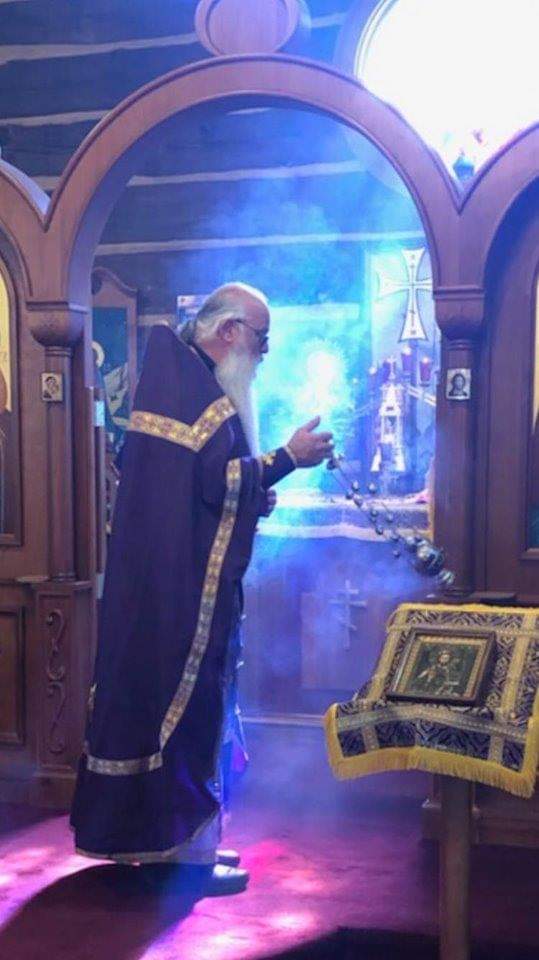
Which is the one beauty of Orthodox worship: It is immersive, involves all senses, we love the beauty of the house we share, our temple, that is divided in a similar way to the Biblical places of worship.  There is rich symbolism, incense rising as prayer (as is described in Scripture) and an altar, behind the Iconostasis, where the Communion is prepared.  Better yet, the entire service is participatory, a sort of call and response style, with the entire Divine Liturgy service centered around our partaking of the body and blood of Christ.

The second thing I have found, as beautiful, is that this repetition of Scripture in song is spiritually like the muscle memory formed from any other practice.  I can’t count the times when the music and words of a liturgical service will pop up during the week, either as a comfort or a challenge, and how these phrases have started to shape my perspective.  For example, “put not your trust in princess or sons of man in who there is no salvation.”  What a great reminder in this time when the institution of government seems to be failing, right?

Well worn pathways are not confining, they are freeing.  Why hack our way through the jungle of life, being ‘authentic’ in the way of every other person in this age who has lost both religion and depth, undisciplined, when there is a rich banquet of tradition to draw upon?  Does reciting the Lord’s Prayer over and over again ever take away from the meaning of the words or cause you to want to rewrite it for our own time?  I should pray not!  

No, we need good ritual in our life because it helps us to focus.  Everything in Orthodox worship is founded upon Scripture and a beautiful expression of obedience.  It has richness and depth, from the Lenten journey of fasting and reflection, to the icons, incense, vestments, altars, oil, candles, hymns, recitations and processions.  It connects is to centuries of the faithful, in our participation in the Church that they built together on the foundation of Christ and is wonderful.

Dismiss “smells and bells” all you want, but it is worshipful and beautiful.

In the end, as Father Seraphim reminds us often in his homilies, we are not saved by our church attendance, we can read Scripture, sing, give tithes and it all be for naught.  If there is no spiritual fruit this is all empty and utterly meaningless as far as salvation.  However, as St Paul speaks of the law being a guardian, the established prescription and pattern for worship, once catalyzed with sincere Christian faith, is an invaluable asset.  It may not be necessary for salvation, the repentant thief on the cross beside Jesus was never Baptized, and yet it does greatly enhance the life of the believer.

Lastly, Orthodox worship doesn’t take away from our ability to worship spontaneously, in the spur of the moment, like King David dancing as the Ark of the Covenant was being processed through the city of Jerusalem.  This is not an either/or thing nor have I found the tradition to be onerous or confining in the way one may fear coming out of a legalistic tradition.  There is a sort of casualness to our formality, an allowance for imperfection.  So simple even children participate.

Structure We Need To Thrive

Us creative types loath structure.  We like to color outside of the lines, right?  And yet, despite this umbrage, we often live as beneficiaries of the structure that others provide.  Many artists would starve, or be overrun, unable to do their work, outside the structure that others have diligently maintained for them.  And many would do better, even in their passionate pursuits, if they would acknowledge their need.  

The framework that Orthodoxy provides, likewise, for me has been that missing element that I didn’t even know that I needed.  This idea that tradition is somehow bad is corrosive, it is creating a generation desperate to find their place, suicidal, distorted and unfulfilled.  We are better when plugged in, when a part of something bigger than ourselves.  Tradition brings us together and Orthodoxy enhances rather than take away from worship.

As we Orthodox like to say…

“Come and see!”

Babel and the Upper Limits of Human Reasoning

Standard

Being raised in a fundamentalist sect meant taking the Genesis accounts as being a historical narrative.  I had been taught, and had for many years accepted without question, the idea that the veracity of the Gospel message hinged on the most ‘literal’ interpretation of the first book of the Biblical canon.

This understanding of this book had worked fine to get me through my school years.  I gave my high school biology teacher, Mr. Toohey, an atheist who had once considered the priesthood, a headache debating the textbook claims about mutations, millions of years, and Macro Evolution.  At this age, I thought this style of apologetics, debating science using the words of Scripture, was a key to securing the faithful against doubts and winning unbelievers.

Unfortunately, while this understanding may serve well those who do not venture too far from the Young-Earth Creationism intellectual ghetto, against what amounts to strawman versions of secularist arguments, it doesn’t hold up as nicely against a serious challenge and has left many religiously indoctrinated high and dry in their years in a university-level science program.  There is a reason why many in my former religious tradition are terrified of higher education. 

Even seminary was a synonym for cemetery to one of my childhood Bible-thumping pastors.  It should make one wonder.  If the foundation of faith is so flimsy that it can’t be tested, that it can only be sustained by ignorance, then what’s the point?

Sadly, it was a false choice, this dichotomy between science and religion, education and faith.

Getting the Cart Ahead of the Horse

The Biblical fundamentalists got everything exactly backward.  The truth of Christ does not depend on proving the Scripture, word for word, is completely 100% historically accurate and scientifically verifiable.  It is nice when those things do align, sure.  And yet, no matter how many mundane parts of the Biblical narrative are established this way, the fantastic claims are never proven.

If a politician lists off ten facts and nine of them turn up true according to the fact-checkers, does that make the final most grandiose claim true?

No, no it does not.

One of the most persuasive tricks of liars is to hide their one falsehood amongst a long list of facts and true statements.  And likewise, someone could prove 99.9% of Biblical claims and still not have touched anything of the miracles.  The Bible is true because it says it is true might work for idiots and the indoctrinated, but it is always circular reasoning and there being a town of Bethlehem doesn’t mean Jesus walked on water nor establish His divinity and conquering of death.

No rational person believes that a prophet flew from Jerusalem to Mecca, on a half woman half horse with a tail of a peacock, because they read it in a book.  I’m certainly not going to wear magical underwear because some dude, a few hundred years ago, claims he received golden tablets from the angel Gabriel.  So why would any reasonable person expect someone to believe a book written thousands of years ago?  Sorry, Ken Ham, I don’t care how many replica Arks you build, you’re not winning skeptical minds or hearts with this effort.

Human efforts fail. 

When Sarai reasoned with Abram to produce an heir through her maidservant, how did that go for them?

We know it didn’t go too well and have the commentary of St. Paul:

Tell me, you who want to be under the law, are you not aware of what the law says? For it is written that Abraham had two sons, one by the slave woman and the other by the free woman. His son by the slave woman was born according to the flesh, but his son by the free woman was born as the result of a divine promise.  These things are being taken figuratively: The women represent two covenants. One covenant is from Mount Sinai and bears children who are to be slaves: This is Hagar. Now Hagar stands for Mount Sinai in Arabia and corresponds to the present city of Jerusalem, because she is in slavery with her children. But the Jerusalem that is above is free, and she is our mother. For it is written: “Be glad, barren woman, you who never bore a child; shout for joy and cry aloud, you who were never in labor; because more are the children of the desolate woman than of her who has a husband.”  Now you, brothers and sisters, like Isaac, are children of promise. At that time the son born according to the flesh persecuted the son born by the power of the Spirit. It is the same now. But what does Scripture say? “Get rid of the slave woman and her son, for the slave woman’s son will never share in the inheritance with the free woman’s son.”  Therefore, brothers and sisters, we are not children of the slave woman, but of the free woman.

(Galatians 4:21‭-‬31 NIV)

Here we see the contrast of human efforts “according to the flesh” and those of a spiritual and Divine origin.  St. Paul emphasizes the “son” which is “born by the power of the Spirit” as an alternative to the “son” human reasoning that produced conflict and heartache.

It is amazing how many times St. Paul, and Jesus before him, encountered those who believed Scripture word for word and rejected Jesus as Lord.  They, in many ways, had a stricter interpretation of the text than many of us do and did not face the strong headwind of modern science and philosophy either.  And yet, even meeting Jesus in the flesh, seeing him with their own eyes, taking Scripture as literally as anyone, they saw Jesus as the imposter and rejected Him.  So, how then can we be saved?

Fortunately, that question is answered many times over and over again, by St. Paul, and has next to nothing to do with the book of Genesis.  The truth of Scripture is established on Christ, and His church, which established the canon of Scripture and does those “greater things” that Jesus promised would come through the power of the Spirit.  Yes, we preach and teach, but only God can bring the increase.  So, the apologetics industry starts us out on the wrong foot and doesn’t produce true faith in Christ. 

Our salvation does not depend on our own understanding of a book.  St. Paul, in Romans 9:16, states clearly, that our sonship depends on God’s mercy, not human desire or effort.  Scripture is the cart, not the horse.  We accept that the Bible is true because we believe in Christ, and His Church, not because we can establish it through our human reasoning or effort.  Faith is a work of the Spirit, a gift from God, not a product of our knowledge or works.  Those trying to ‘prove’ the Bible are on a fool’s errand. trying to save themselves, slaves to human reasoning, lost and confused.

What Does That Have to Do with Babel?

Hopefully, the Noah rode on a T-Rex crowd is too triggered with that intro, because now we shift to something they may find more agreeable and that being the even greater monument to human reasoning and effort. 

But, first, the tower of Babel narrative:

Now the whole world had one language and a common speech.  As people moved eastward, they found a plain in Shinar and settled there.  They said to each other, “Come, let’s make bricks and bake them thoroughly.” They used brick instead of stone, and tar for mortar.  Then they said, “Come, let us build ourselves a city, with a tower that reaches to the heavens, so that we may make a name for ourselves; otherwise we will be scattered over the face of the whole earth.”  But the Lord came down to see the city and the tower the people were building. The Lord said, “If as one people speaking the same language they have begun to do this, then nothing they plan to do will be impossible for them. Come, let us go down and confuse their language so they will not understand each other.”  So the Lord scattered them from there over all the earth, and they stopped building the city. That is why it was called Babel—because there the Lord confused the language of the whole world. From there the Lord scattered them over the face of the whole earth.

(Genesis 11:1-9 NIV)

This story is likely the origin of the phrase, “men plan, God laughs.”  Actual historical event, ancient myth or both, does not matter, the tower of Babel narrative is so much more.  The account speaks to human limits and hubris, a true story told over and over again in history and a lesson repeated in different ways with each passing generation.  The moment humans forget their place, begin to rely on their own cleverness and start to see themselves equal to their own Creator, the clock to destruction begins to tick.

These people, in the Biblical account, had somehow overcome the odds, they evidently were a resource-rich civilization, more powerful than external threats, and ready to cement their name in history.  But just when heaven seemed within their grasp, the very thing that they had sought to avoid, being scattered, brought the entire endeavor grinding to a halt.  Now Babel, the name a play on words that meant “to confuse,” is a synonym for colossal human failure.  Sure, maybe it is an origin story for the diversity of language.  But, undeniably, it is also a cautionary tale.

Other accounts tell us that this confusion of languages, by God, was to save humanity from the total destruction of another flood.  In other words, it was an act of mercy to prevent an even greater calamity to end this project and scatter the people.  But, more than that, it is a lesson about not leaving God out of the equation.  What does that mean?  Well, that means that we can’t see everything and, without humility to reign in our ambitions, we are an existential threat to ourselves.  The proud fall because they cannot imagine the factors that they, in their overblown confidence, have missed.

Our Modern Towers of Human Arrogance

“I will destroy the wisdom of the wise; the intelligence of the intelligent I will frustrate.”

(Isaiah 29:14 NIV)

History is replete with examples of bold declarations followed by catastrophe.  Neville Chamberlain’s quip of having secured “peace in our time,” through a treaty with Adolf Hitler, comes to mind.  Hillary Clinton was, according to the experts, most definitely going to win over Donald Trump.

But now it is time to tie all these threads together.  The same thing that brought about the Protestant schism, also led to the Enlightenment, spread of Democracy, and, ultimately, the rejection of God. 

This “age of reason” got off to a relatively good start, scientific discovery, development of technology, and representive government has enabled us to be more free and prosperous that many prior generations.  However, as the tower of our knowledge and independent spirit rose, as we have made leaps in medicine, even landed a man on the moon, when American exceptionalism (the ultimate expression of Protestantism) finally conquered all, and our hegemony was nearly unchallenged, suddenly a day of reckoning seems to be upon us and this colossus, this oversized imagine of human endeavor, seems in danger of collapse.

A couple of decades ago it felt as if we were on the cusp of a new epoch.  Racism vanquished, our old enemies irrelevant, the world connected as never before, the internet ready to put all knowledge at our fingertips and the stars seemingly within our reach.  Secularism and science had triumphed over superstition and myth, we imagined no religion, nothing to kill or die for, as Coca-cola taught the world to sing.  Former seminaries, our universities, forgetting God, became temples of human reason.   “We didn’t need church or religion to be good people,” the atheists cried, while standing on the shoulders of theologians whom they dismissed, “in fact, we’ll go further without it!”

However, my own optimism has unravelled over the past decade or two. 

Star Trek and the Jetsons still remains, firmly, in the realm of science fiction.  The internet is a cesspool, filled with crackpot opinions, censored by billionaires bullies who pretend to be gatekeepers of truth while they spread misinformation, and nothing like a child of the 90s would’ve imagined.  As church attendance slips, depression and drug usage has steadily increased—along with suicides and mass shootings.

Our universities, rather than continue to value free thought and expression, now have strict speech codes and safe spaces.  The minds that once sought to improve the human experience, now only deconstruct tradition and erode the very ground that their institutional ivory towers were constructed upon, too drunk with nihilism to care.  Even Coke brand, that once celebrated human diversity, has joined the graceless cult of woke in attacking “whiteness” and civilization itself—as if they have forgotten what has made their own comfortable ‘privileged’ life possible. 

The government, “for the people,” that at least gestured towards the needs of the citizenry, now only serves global corporations, the powerful elites and special interests. The US flag, once a symbol of hope, the American ideal, and our unity as diverse people, something black athletes proudly wrapped themselves in less than a generation ago, has now been reimagined as a representation of oppression and hate. Our faith in our institutions is failing, the left decrying systemic racism, the right suspecting election fraud, nearly everyone feeling unheard.

We’re a civilization consuming itself and maybe it is because we’ve forgotten this:

You, my brothers and sisters, were called to be free. But do not use your freedom to indulge the flesh; rather, serve one another humbly in love. For the entire law is fulfilled in keeping this one command: “Love your neighbor as yourself.” If you bite and devour each other, watch out or you will be destroyed by each other.

(Galatians 5:13‭-‬15 NIV)

We don’t go to church anymore, a trend that started before the pandemic and has only been accelerated, and “love your neighbor” is now used as a guilt trip rather than a reason to change our own toxic attitudes or be involved on behalf of others. John Kennedy’s call to service, “And so, my fellow Americans: ask not what your country can do for you – ask what you can do for your country.” Those words, spoken today, would likely be derided as some kind of dangerous “ism” in today’s me-first, my tribe, my way or the highway, divisive identity driven, you’re literally a Nazi if you disagree, political environment.

Have we reached new heights only to implode?

What is really going on here?

Pride Cometh Before the Fall

Satan, we’re told, was the very best of the angels. His magnificent greatness eventually led him to believe that he was a rival to God. Jesus warned his disciples, having returned exuberant from working miracles, that he had seen Satan “fall like lightening from heaven” (Luke 10:18) and reminded them of their place before the Almighty.

Hubris is the downfall of many and the idea that we can find all of the answers for ourselves is that. With each success, with every innovation and breakthrough, there is a danger and risk of overconfidence.

In the past few centuries have seen our knowledge and abilities increase like no other time in recorded human history. The West threw off the authority of Rome, with the reasoning that every man was able to comprehend Scripture outside of the tradition of the church. Not long after, the authority of Scripture itself was called into question. Why do we need a book of myths written by those who lack our sophistication and understanding of the world? God was erased from our institutions, prayers only a ceremonial and many imagine themselves to be self-made or little gods. It is the height of ignorance:

You turn things upside down, as if the potter were thought to be like the clay!  Shall what is formed say to the one who formed it, “You did not make me”  Can the pot say to the potter, “You know nothing”?

(Isaiah 29:16 NIV)

But it isn’t only the cultural elites, the atheists, the politicians who only pay lip service or liberal theologians whittling away at morality until there’s nothing left. This spirit of self-reliance, and arrogance, permeates through the whole civilization. We are blinded by information, buried in jargon, tangled in complexity, yet think we’re englightened.

We should be pumping the brakes, as technology advances faster than our ability to comprehend the consequences, I see it even (or especially) in those emerging from sheltered religious cloisters. Sure, the are the reactionaries, afraid of all change or improvement, but then there are those who have a little education and embrace it all nof realizing the potential. Our brightest minds are working on things much more dangerous than nuclear weapons, creating biological agents, developing artificial intelligence, considering climate altering measures, all potentially having the possibility of irreversible side-effects, and truly playing with fire.

Elon Musk—not a Luddite

We believe we are in control but are most definitely not and, with our new power, are one or two mistakes from an unmitigated disaster.

Like the tower of Babel, which likely took years of planning and building layer upon layer, our modern civilization was built. Our confidence has grown and exponentially along with our accomplishments. We’re clever, we found cures for disease, invented means to travel to the ends of the earth and beyond. But the higher we ascend the easier it is to forget what we are and where we came from. We didn’t create ourselves nor do we know as much as we think we know and this should always keep us humble.

Thinking we are God or next thing to God will, inevitability, lead to chaos, confusion and ultimate collapse into disorder. The bigger our collective endeavor gets, the more we live on our own reasoning and strength rather than depend on faith, the less able we are to cooperate, we erode the very foundations of civilization and the destruction will be swift. God, in His mercy, will scatter us before we become too foolish, with our great knowledge, to be saved. Human reasoning is a dead end, we cannot transcend ourselves outside of God’s help. If we reject that help we will fall.

The Rationalist’s Delusion and the Most Fundamental Problem of Fundamentalism

Standard

Those born into decent homes and immersed in a particular ideology have no reason to question what they’ve been taught. I was no exception in this regard, as one raised in a functional Mennonite home, and had believed the whole “we-aren’t-perfect-but-are-better-than-the-alternatives” (a self-congratulatory mantra repeated when anything bad comes up as to prevent a full examination of our fundamental assumptions) until that paradigm became untenable for me.

This assumption of being right in our foundation, even if the details are not quite right, is not only something true of Mennonites. No, it is a feature of those indoctrinated into religious systems or political ideologies of all types. The college educated ‘progressive’ is not any more free of bias than the average Amishman—both reflect the cultural institutions that created them and, if anything, the ‘smarter’ of the two is likely more subject to bias than the humbler or that is what the current research indicates. At very least, nobody is completely free of bias and oftentimes our most base assumptions are the most difficult to honestly examine—most difficult because we have so much invested in them emotionally or otherwise.

My ‘Rational’ Foundation

Of these foundational assumptions, in Western culture there is one assumption that stands out above the rest and produces the strongest reactions when challenged. It is an assumption that is especially hard to root out of the most intelligent and knowledgeable people. It is a sincerely held belief about the nature of reality that is so prevalent that it underlies the most secular ‘progressive’ or religiously conservative and fundamentalist thinking of our times—from those espousing climate change and those pushing flat-earth theories, both share this same underlying assumption in common.

This assumption being the idea that we (either individually or as humanity collectively) are rational creatures, able to determine truth for ourselves and can essentially save ourselves through our capacity for logic and reason.

If you would have asked me, as a Mennonite, what my foundation was I would have likely answered by saying, “Jesus Christ, of course!” That, after all, is the theologically correct answer to give, something easily reference in the Bible, and a reasonable conclusion based on the available evidence, right? Of course, as an adherent to Anabaptist “believer’s baptism” and Arminianism, I would insist that my church membership was a choice. It couldn’t be any other way, could it? I mean, it couldn’t possibly have been because I was raised in a Mennonite home, born in a nation where most people identified as Christian and was fully immersed in a culture where even non-believers affirm Christian values, right?

Nah, it had to be my own careful consideration of the evidence that led to an inevitable conclusion and from that I made a rational choice to believe that man, born two millennia ago in some Palestinian backwater to a teenage virgin mother, who was actually the creator of the entire universe, allowed himself to be brutally murdered, offering himself as a means to spare us from his own wrath and then, according to those most invested in his teachings, rose from the dead and that not believing this is a one way ticket to eternal torment.

And I believe all this for reasons… [Insert circular reasoning here]

Hmm…

When Christian apologetics fail to provide satisfactory answers, which they inevitably do for anyone beyond the intellect of an adolescent, those steeped in rationalism must either abandon the enterprise of faith entirely or live in denial and ignore the cognitive dissonance.

For example, there is no way to prove the resurrection account in Scripture through rational scientific means, it is completely irrational and yet the entire Gospel of Jesus Christ rests on this miraculous event being true. How does one reconcile such an extraordinary claim with science? By a reasonable standard this is impossible to believe, right?

Is Christianity Rational?

Some, like St Thomas, who would not believe until he saw the risen Christ in the flesh, doubt until they have personal experience and thus choose what is entirely rational. Many others, however, are content to compartmentalize, they partition the miraculous to another time and place (to history or the future) and try to have things both ways.

Truth be told, the resurrection of the dead is not a rational proposition and never will be, it is logically, reasonably and scientifically impossible and thus is, by definition, totally irrational. There is nothing rational about the central premise of Christianity, where a man who is actually God’s son is born of a virgin woman to save the world from sin, and you did not acquire this belief through rational means either. No, according to Scripture, the means used are irrational in terms of material reality and from a normal human logical perspective.

Faith, according to Jesus in his conversation with Nicodemus, originates from an immaterial spiritual source and does not follow our own rules of logic and reason:

Jesus replied, “Very truly I tell you, no one can see the kingdom of God unless they are born again.” “How can someone be born when they are old?” Nicodemus asked. “Surely they cannot enter a second time into their mother’s womb to be born!” Jesus answered, “Very truly I tell you, no one can enter the kingdom of God unless they are born of water and the Spirit. Flesh gives birth to flesh, but the Spirit gives birth to spirit. You should not be surprised at my saying, ‘You must be born again.’ The wind blows wherever it pleases. You hear its sound, but you cannot tell where it comes from or where it is going. So it is with everyone born of the Spirit.” “How can this be?” Nicodemus asked. “You are Israel’s teacher,” said Jesus, “and do you not understand these things? Very truly I tell you, we speak of what we know, and we testify to what we have seen, but still you people do not accept our testimony. I have spoken to you of earthly things and you do not believe; how then will you believe if I speak of heavenly things? (John 3:3‭-‬12 NIV)

Nicodemus is being entirely rational and rightly perplexed. Jesus presents a riddle, he tells Nicodemus he “must be born again” (in reference to a spiritual second birth) but then tells him the Spirit is like the wind and goes wherever it pleases. However, earlier in the passage Jesus does tie the work of the Spirit to being “born of water” or Baptism.

So, does entering the kingdom start as something rational—as the product of a human choice to believe something they’ve been told—or does it originate from a source inexplicable as the wind and as involuntary as our physical birth?

For years I believed what I was taught, that Christianity started as an intellectual acceptance of a particular proposition, that one should recite the “sinner’s prayer” (often in a moment of emotional upheaval) and later, upon their confession of faith, would be Baptized. There was no reason for me to question this indoctrination, it made sense to me, I mean how else does someone change except they make a deliberate choice? And how else do we make a choice besides through the faculties of logic and reason?

Unfortunately for me (and others from my fundamentalist/Evangelical background), that’s not what the Gospels tell us. For example, when Peter reveals the identity of Jesus as “the Messiah, the Son of the living God” he is told directly, “this was not revealed to you by flesh and blood, but by my Father in heaven.” (Matt. 16:16‭-‬17) If the true identity of Jesus was revealed to Peter through normal or rational means, why do we expect anything different for ourselves?

Or, explain why the unborn John the Baptist “leaped” in the womb when his mother Elizabeth first encountered Mary who held the incarnate Logos within her own body as we read at the beginning of St Luke’s Gospel—Was that response a rational choice, this leap of joy due to John’s careful study of the available evidence and coming to a reasonable conclusion? Of course not! The unborn do not have the freedom or cognitive ability to weigh the evidence and make a rational choice.

This assumption that Christian faith is something of rational origin simply does not comport with what we see recorded in Scripture nor does the idea that conversion is the product of an adult choice to believe. It goes completely contrary to what Jesus said about those who would and would not enter the kingdom:

Let the little children come to me, and do not hinder them, for the kingdom of God belongs to such as these. I tell you the truth, anyone who will not receive the kingdom of God like a little child will never enter it. (Luke 18:16; NIV)

We believe we are motivated through rational means of the mind, that is a foundational assumption of modern thought, and have turned Christianity into something it was never intended to be: merely an intellectual proposition. But this is wrong, the human mind is never described as the prime mover, the choice to follow Jesus is never said to be an adult decision or even something born of human will. Yes, certainly we are to participants in our own salvation or St Paul would not urge Christians to “work out” their salvation with due seriousness in Philippians 2:12, but there is something about it all that goes beyond all human rationality and this is a truth not hidden in Scripture.

A Fundamentally Flawed Perspective of Faith

Many Protestant fundamentalists seem to see themselves as a fusion of rationality with faith, they paint themselves as objective and their religion as something a reasonable person should accept but are neither rational nor faithful. No, they are compromised and inconsistent. They do not strictly follow the scientific method, having arrived at their conclusions well in advance of their studies, nor are they faithful for trying to prove something beyond the realm of science with their extra-Biblical theories. They show, with their actions, that they do not actually comprehend science or the rational nor do they truly accept spiritual and supernatural things.

Fundamentalism is, in essence, the bastard child of modernism and the Protestant religion. Both modernism and fundamentalism are products of the Enlightenment and Age of Reason (so-called) that arose from Roman Catholic Scholasticism. And this Scholasticism, much like modern Protestant fundamentalism, started as a means of “articulating and defending dogma in an increasingly pluralistic context” or, in other words, is an appeal to a person’s intellect and mind rather than their heart or soul. It has since developed into what amounts to a denial of the latter things that becomes completely absurd in the Christian context.

While there is little doubt that the turn towards science and reason has led to the development of technology and understanding of the physical world, we can be thankful for modern medicine based in experimentation for extending our life, this shift has done absolutely nothing for spiritual well-being or our pre-rational human needs. A gaze into the night sky through a telescope, for example, could be awe-inspiring and yet it can’t answer those existential questions of meaning and purpose. And, unfortunately, rather than stick to the means of love or the “greater things” that Jesus promised to the faithful, fundamentalists try to compete (albeit fail miserably) with their secular counterparts in the realm of science and reason.

Fundamentalists, as Protestants, have put all of their eggs in the Bible basket and also—as knee-jerk conservatives—cling to an untenable version of literalism that puts their religious dogma in direct conflict with modern scientific observation. But, as an end around to their paradigm being made obsolete, they turn to pseudoscience and apologetics that barely keep their own children let alone convince anyone outside of their circles. They have no choice, they’ve painted themselves into a corner, they believe that the Bible must be completely reliable, but in the same way as a scientific textbook rather than reliable for spiritual truths, and try to rationalize around the many obvious problems with that perspective.

Meanwhile, while insisting on a young Earth and six days literal days of Creation despite the mountain evidence to the contrary, these same fundamentalists become dismissive when speaking of things like sacraments. This, unfortunately, is a tradition that dates back around five hundred years to a man named Huldrych Zwingli and others who with him lowered the status of such things as Baptism and Communion to mere symbols—reasoning that things of spiritual import originate in the mind, as intellectual acceptance, and with this completely reasoned away possibilities beyond their rational capabilities.

The difference between a fundamentalist and an irreligious secularist is that one has taken their logic the full way to a reasonable conclusion while the other thinks they can have it both ways—accepting the irrational over the rational when it suits them and their personal agenda. Then, simultaneously, rejecting what they cannot comprehend, like their secular counterparts, simply because it goes against their own experience and cannot be scientifically proven. They take Jesus literally only when it is convenient for them or when it makes sense them from their own rational perspective and then reject literalism when it goes against their own religious indoctrination.

Here are some cases to consider…

1) What Saves, Preaching or Baptism?

While writing this blog I ran across an article, “The Sacrament of Preaching,” that addressed a glaring blindspot of many in the Protestant fundamentalist world, and amongst Revivalists and Evangelicals in particular, and it shows in what is emphasized in their tradition. In the church that I grew up in, for example, the order of the service centered on the preaching, often an affair intended to provoke, guilt-trip or convict. There’s a reason why Evangelical churches tend to have venues like lecture halls and that’s because preaching, an appeal to the mind or emotions, is perceived as the primary means of bringing salvation to the lost.

There is little doubt that preaching the Gospel of Jesus Christ is important.

After all, didn’t St Paul tell us as much?

How, then, can they call on the one they have not believed in? And how can they believe in the one of whom they have not heard? And how can they hear without someone preaching to them? (Romans 10:14 NIV)

Yet that passage is in the context of a lament about those who have heard and yet did not accept the message of the Gospel, here is that missing context:

But not all the Israelites accepted the good news. For Isaiah says, “Lord, who has believed our message?” Consequently, faith comes from hearing the message, and the message is heard through the word about Christ. But I ask: Did they not hear? Of course they did: “Their voice has gone out into all the earth, their words to the ends of the world.” Again I ask: Did Israel not understand? First, Moses says, “I will make you envious by those who are not a nation; I will make you angry by a nation that has no understanding.” And Isaiah boldly says, “I was found by those who did not seek me; I revealed myself to those who did not ask for me.” But concerning Israel he says, “All day long I have held out my hands to a disobedient and obstinate people.” I ask then: Did God reject his people? By no means! I am an Israelite myself, a descendant of Abraham, from the tribe of Benjamin. God did not reject his people, whom he foreknew. Don’t you know what Scripture says in the passage about Elijah—how he appealed to God against Israel: “Lord, they have killed your prophets and torn down your altars; I am the only one left, and they are trying to kill me”? And what was God’s answer to him? “I have reserved for myself seven thousand who have not bowed the knee to Baal.” So too, at the present time there is a remnant chosen by grace. And if by grace, then it cannot be based on works; if it were, grace would no longer be grace. What then? What the people of Israel sought so earnestly they did not obtain. The elect among them did, but the others were hardened, as it is written: “God gave them a spirit of stupor, eyes that could not see and ears that could not hear, to this very day.” (Romans 10:16-21,11:1‭-‬8 NIV)

If preaching saved in and of itself, then why didn’t the people who heard simply believe? Why did others, according to the quote of Isaiah in the passage above, believe through revelation despite not seeking it and never having been preached to?

St Paul makes it clear that it is only through the grace of God, not by preaching or through human understanding, that anyone is saved.

It is a rationalist’s delusion that preaching is the only way that someone can possibly be saved. Unfortunately, that is an idea that has been pounded into Protestant heads for centuries now and this comes at the expense of the other means of grace used by God and described in Scripture. In fact, many ‘great’ Revivalist preachers, in contradiction to Scripture and the reality that preaching is as physical a means as any other sacrament, basically mocked the idea that anything besides means of the mind could bring someone to salvation.

But it is St Peter whom they mock, who clearly likens Baptism to the waters surrounding Noah’s ark in 1 Peter 3:21, “this water symbolizes baptism that now saves you also—not the removal of dirt from the body but the pledge of a clear conscience toward God.” Like king Naaman having to dip in the river Jordan seven times to be healed, we are also told that Baptism washes sins away, brings forgiveness and new life (Acts 2:38, 22:16, Col. 2:11-12), which is to make these acts as much of a means of salvation as accepting the words spoken by a man about Jesus Christ.

Part of the problem here is the soteriology of fundamentalist “Evangelicals” who typically portray salvation as a once and done event. This confusion is the result of salvation being thought of something in the future only, as in salvation from death, and not also salvation from sin in the present. But Scripture describes salvation both in terms of having been saved (Titus 3:4-5), also in being saved (2 Cor. 2:15) and will be saved (Rom 5:9-10) which suggests something a little different from the “born again” sinner’s prayer form of salvation preached by some.

In other words, our salvation is not this moment or that experience, our salvation is rather a continuing work of God’s grace that comes to us through preaching, revelation, Baptism, the prayers of the faithful, and the many other ways that the work of the Holy Spirit is made manifest. In a sense, nobody is saved through the visible means themselves, nevertheless, these things are the necessary physical expressions of the spiritual work of grace and thus inseparable. Yes, the prime mover is always God and yet there is always evidence of this moving in hearts that takes physical form.

2) Communion, True Presence or Mere Symbolism?

It is very strange, a year or so ago a fundamentalist friend, a sort of logically minded sort, got very emotional and angry when I refused to back down from taking Jesus at his word. Mind you, as far as I know, this is a man who would not question Ken Ham’s interpretation of the Genesis account nor the resurrection of the dead and yet ended up blocking me for suggesting that the words of Jesus could be understood without needing to be rationalized away their literal meaning or any additional explanation.

The discussion was about partaking of the body and blood of Jesus Christ (or Holy Communion) and how this was one of the sacraments downplayed and reinvented as ordinances by Anabaptists under the Zwinglian influence. But the curious part was how a rationally minded guy would get so emotionally bent out of shape over simply taking Jesus at face value or as a child would. He insisted, despite Biblical description completely to contrary to his position, that there was no sacramental value to Holy Communion, that it was merely symbolic and to say otherwise was ridiculous. In his mind, Jesus had to be speaking metaphorically and there was no convincing him otherwise.

This is what Jesus said:

I am the living bread that came down from heaven. Whoever eats this bread will live forever. This bread is my flesh, which I will give for the life of the world.” Then the Jews began to argue sharply among themselves, “How can this man give us his flesh to eat?” Jesus said to them, “Very truly I tell you, unless you eat the flesh of the Son of Man and drink his blood, you have no life in you. Whoever eats my flesh and drinks my blood has eternal life, and I will raise them up at the last day. For my flesh is real food and my blood is real drink. Whoever eats my flesh and drinks my blood remains in me, and I in them. Just as the living Father sent me and I live because of the Father, so the one who feeds on me will live because of me. This is the bread that came down from heaven. Your ancestors ate manna and died, but whoever feeds on this bread will live forever.” He said this while teaching in the synagogue in Capernaum. On hearing it, many of his disciples said, “This is a hard teaching. Who can accept it?” Aware that his disciples were grumbling about this, Jesus said to them, “Does this offend you? Then what if you see the Son of Man ascend to where he was before! The Spirit gives life; the flesh counts for nothing. The words I have spoken to you—they are full of the Spirit and life. Yet there are some of you who do not believe.” For Jesus had known from the beginning which of them did not believe and who would betray him. He went on to say, “This is why I told you that no one can come to me unless the Father has enabled them.” From this time many of his disciples turned back and no longer followed him. “You do not want to leave too, do you?” Jesus asked the Twelve. (John 6:51‭-‬67 NIV)

Many of the rational folks in the crowd evidently had enough hearing Jesus double-down on this bizarre-sounding claim. Had Jesus been speaking figuratively why would he have let so many walk away without stopping them and saying with a chuckle, “Oh, you guys think I’m being literal! Come on now, it’s all just a big metaphor!” But Jesus did not. When the eyebrows raised and murmurs began, he repeated himself all the more emphatically and lets the chips fall as they may rather than back down from this “hard teaching” and, rather than explain his words as being anything but literal. he even asked the disciples if they were going to abandon him as well.

If it weren’t clear enough in John, this is the account of the “Last Supper” and first partaking of Holy Communion:

While they were eating, Jesus took bread, and when he had given thanks, he broke it and gave it to his disciples, saying, “Take and eat; this is my body.” Then he took a cup, and when he had given thanks, he gave it to them, saying, “Drink from it, all of you. This is my blood of the covenant, which is poured out for many for the forgiveness of sins. I tell you, I will not drink from this fruit of the vine from now on until that day when I drink it new with you in my Father’s kingdom.” (Matthew 26:29 NIV)

Is this mere symbolism?

Again, the words do not hint to metaphor. No, they are words of substance as much as his command, “Lazarus, come forth!” was received by dead flesh causing it to reanimate and Lazarus to be resurrected. I mean, if you can’t take Jesus at his word as far as his body and blood, why believe that God could speak anything into existence—let alone literally form mankind out of dust as is claimed in the Genesis creation narrative?

From a perspective of human logic and understanding, one of those events is no more rational than the others, a rotting corpse does not come back to life, our flesh is not the same as dust, and bread is bread is bread. Again, there is nothing rational about the claims foundational to Christianity and it is rather odd that anyone would insist otherwise. I mean, at very least, one might want to consider the serious physical and spiritual consequences of partaking casually of what is supposedly only a symbol:

So then, whoever eats the bread or drinks the cup of the Lord in an unworthy manner will be guilty of sinning against the body and blood of the Lord. Everyone ought to examine themselves before they eat of the bread and drink from the cup. For those who eat and drink without discerning the body of Christ eat and drink judgment on themselves. That is why many among you are weak and sick, and a number of you have fallen asleep. (1 Corinthians 11:27‭-‬30 NIV)

It is interesting that many from my own Protestant roots take the first half of that chapter concerning the veiling of women quite literally, not once expressing doubt of the spiritual significance of a piece of cloth being draped on a woman’s head, and then have their eyes glaze over when the mystical significance of Holy Communion is discussed in the latter part of the chapter quoted above. You would think that the same sects that require women to cover their heads all of their waking hours would want to partake of the body and blood more than once or twice a year, and yet they strain on one while swallowing the other.

Anyhow, is it any wonder we are weak and not seeing the promises of “greater things” (John 14:12) fulfilled in us when we are too ‘rational’ to take Jesus seriously about his own body and blood?

Rational or Faithful, the Choice is Yours!

Obviously, we are given an ability to use logic and reason. We should not waste or neglect this rational ability in the name of faith either. However, it would be wise to realize the limits of our rationality and at least entertain the possibility that there are things of true substance beyond what our minds are able to comprehend. One may want to consider that God, being God, does not need to be rational according to our own rules.

In fact, even for a complete non-believer, at the edge of reality as we know it there is a realm where things do not act accordingly to our rational intuitions based in time and space. For those who have gone down the rabbit hole of Quantum Mechanics, it is quite clear that matter does not behave in the manner would expect it to and becomes irrational from a normal human perspective. The discoveries of the past century have basically turned the concreteness of the physical world, as we know it, into a mere wave of probabilities and a place where particles may very well pop into and out of existence.

So, in short, this is absolutely the wrong time in history to double down on rationalism at the expense of transcending spiritual truth. This idea that things must make rational sense, from a human perspective, is to undermine the very substance that faith rests on, one committed to that might as well end the farce and go the full way to denying everything outside of the realm of material science. However, a person who goes that route is truly only lacking in the humility to know their own limitations. Your inability to wrap your head around something does not make it any less true.

In a time when secular scientists are even beginning to see the end of their own abilities to comprehend, many fundamentalists are still stuck in a watered down modernist paradigm they’ve inherited and rely on a horribly convoluted/inconsistent/selective rationalism rather than simply accept Jesus at his word. In their insistence on their fundamentals and understanding of things, they are like one who has traded his birthright for a bowl of stew—are you still stuck in a rationalist’s delusion, unknowingly governed by emotions or confirmation bias, and missing out on true spiritual sustenance?

Confessions of the Prodigal’s Older Brother—the Rough Road To Be Free Of Resentment

Standard

I do not call for the judgment of anyone, but it seems only right that good behavior is rewarded. And yet it is often unruly people who get the loving attention when they do bad and then the accolades when they begin to do what the well-behaved have been doing quietly for years.

The conscientious person feels bound to their duty to righteousness. They are driven by loyalties to people, motivated by moral obligation and take responsibility for the welfare of others. It was not out of a desire to be recognized, it is a burden they’ve been carrying since birth, it is never a choice for them, but rather is something inescapable, a prison and hell.

I’ve been that tortured soul. I’ve always wanted to do everything right and for the right reasons. While definitely wanting to be my own person and entitled to my own thoughts, I had no desire to be a troublemaker or disruption. I tried to be cooperative and compliant, to make the lives of my teachers and authorities easier, because I knew the greater social good was dependent upon this and would not be served by my selfish outbursts.

I could never live this ideal out perfectly. I had a standard for myself, a part of the religious inheritance I received as a Mennonite, that was impossible to live out. My frustration with this reality of my own failure would sometimes come bubbling up. Something would set me off and, in the privacy of my parent’s home, I would rage against this awful predicament and the unfairness of it all.

The carefree (and careless) younger brother…

A week or two ago some resentment returned. This change in mood was likely triggered by two things (or rather two conversations) and one of them being an encounter with David Bercot on the topic of divorce and remarriage. The other thing? I had a run-in with my own Prodigal side.

We claim there are consequences for sin. This is how we convince ourselves that our righteous inclinations are correct and there is really no other way to justify depriving oneself of hedonistic pleasure. If it doesn’t matter what we do, no real score kept for right or wrong in the end, then we might as well just have some fun, right?

I’m friends with one of those “bad boys” who (despite his heart of gold) doesn’t care what other people think and has done things at his age that were unimaginable for me. He is a ladies’ man, he’s that guy the young women (yes, even the ‘good’ ones) feel comfortable playing around with, and is basically my antithesis.

I can’t help but love him. He was my true friend a few years ago, heard me spout venom at those who had hurt me with their self-righteous indifference, and never said a word of condemnation. That said, his recklessness and lack of my seriousness, while I was fighting for all I was worth to stay glued together after a devastating announcement, had also sparked my most violent and evil imaginations.

I can’t hold him accountable, though. I look at his freedom with a bit of envy in that at any moment he could decide to settle down, marry the perfect girl (drawn by his charm) and carry no stigma. Me, however, I was always outside looking in, I wasn’t allowed (by character or circumstance) to partake of that “wild” youth nor given the legitimacy that is his for the taking once he decides to settle down.

I’m not jealous of or bitter toward him. Why should I be? But what I do struggle with is anger towards the religious culture that made me, that fed me a steady stream of false promises and left me feeling completely betrayed in the end. Specifically, I’m still upset with the fathers who dismissed me with their cynical calculations and their daughters who continually rejected my sincerest efforts—while meanwhile crawling all over the reckless and indifferent guys.

It is bad enough to go unrecognized. But we seem to live in a world where no good deed goes unpunished, where caring (when others do not) is mischaracterized as creepiness and doing right for the right reasons is often stigmatized. It seems my obeying conscience doesn’t allow me the freedom of rebellion nor does it gain me the approval of those who told me that my conscientious is a good thing when I do what is right in spite of their opinions.

The daddy issues of the Prodigal’s older brother…

The problem with the older brother, in the parable Jesus told about the Prodigal son who returns home, was deeper than his resentment over the celebration for his wayward brother. His indignation was towards his father:

“The older brother became angry and refused to go in. So his father went out and pleaded with him. But he answered his father, ‘Look! All these years I’ve been slaving for you and never disobeyed your orders. Yet you never gave me even a young goat so I could celebrate with my friends. But when this son of yours who has squandered your property with prostitutes comes home, you kill the fattened calf for him!’ (Luke 15:28‭-‬30 NIV)

This anger is likely due to a misconception the older brother had about his father. He obeyed. However, he obeyed for fear of consequences rather than purely as a matter of conscience. His motivation, while in some respects a devotion to his father, was also a desperate effort to secure his place in the family and a mistrust of father’s love. He, like the servant who buried his talent for fear of punishment, couldn’t comprehend being loved for anything other than his performance and had lived in fear rather than faith.

Can you imagine having spent years trying to hold up your own end of the bargain, working hard to produce because that’s how your father’s love is earned, only to have the bubble burst?

In my own case, it was not entirely my own fault that I saw God, my heavenly Father, as this sort of vengeful tyrant. As one raised in a fundamentalist setting there is plenty of reason why I would assume that God’s love is based on my own performance rather than something freely shared to all who accept it and that’s because my earthly fathers often did keep me in limbo. Revivalistic preaching undermined any assurance of salvation, my life could never measure up to their purity standards, and their love for me was limited by what I was able to provide for them.

For years my hopes for love outpaced my resentments. I would tell myself that next time will be different, that my fears of always being on the margins of their paradise were unfounded, and eventually Christian love would triumph over my inadequacies. However that paradigm came crashing down in spectacular fashion when a young woman, someone to whom my hope against hopes (in respect for her professed devotion) were fully invested, said “I can’t love you like that,” which was to say that she really could not love me at all, and destroyed that last hope of a way to her or rather her father’s world.

Trying to please the lawyer’s God…

Over the past weeks, I’ve felt whipsawed. That is to say, I’ve felt pulled between two seemingly opposed views that together undermine my peace with God and the ability to live a victorious life. The first being how the Prodigal gets the embrace while I’ve often been ignored or, worse, had those whose love I had desired recoil as if I was some sort of monster. The second being the inescapable legalistic mindset that is at complete odds with true Christian love.

I have nothing against men like David Bercot personally. In fact, I see them as men very much like myself a few years ago, they diligently search Scripture trying to find their salvation, and yet they are far more capable than I’ll ever be. Their dedication and discipline would seem to be commendable and even something enviable. However, their standard is something I’ve found to be out of my own reach and their religious prescriptions often come at the expense of love.

Bercot, like so many others including myself, is law rather than love oriented. By this I mean we prioritize precise legal interpretation and application of law above the loving purpose behind it. In other words, we are like those religious experts Jesus encountered, who do things like tithe spices, are more concerned with the day someone is healed than the fact that they have been healed, remained as dogmatic even when entering the church and had to be put in their place:

It is for freedom that Christ has set us free. Stand firm, then, and do not let yourselves be burdened again by a yoke of slavery. Mark my words! I, Paul, tell you that if you let yourselves be circumcised, Christ will be of no value to you at all. Again I declare to every man who lets himself be circumcised that he is obligated to obey the whole law. You who are trying to be justified by the law have been alienated from Christ; you have fallen away from grace. For through the Spirit we eagerly await by faith the righteousness for which we hope. For in Christ Jesus neither circumcision nor uncircumcision has any value. The only thing that counts is faith expressing itself through love. You were running a good race. Who cut in on you to keep you from obeying the truth? That kind of persuasion does not come from the one who calls you. “A little yeast works through the whole batch of dough.” I am confident in the Lord that you will take no other view. The one who is throwing you into confusion, whoever that may be, will have to pay the penalty. Brothers and sisters, if I am still preaching circumcision, why am I still being persecuted? In that case the offense of the cross has been abolished. As for those agitators, I wish they would go the whole way and emasculate themselves! (Galatians 5:1‭-‬12 NIV)

Paul’s pun at the end does not take away from the serious warning in his words. Those trying to please God through their careful obedience to the law “have fallen away from grace” and are thus obligating themselves to an impossible standard. They will either end up deluded (like the Pharisee praying loudly about his own superiority to others) or desperately trying to cross all the T’s and dot all of the I’s and ending up in despair when his/her effort falls woefully short of God’s perfection.

Where I’ve found God’s love…

My goal is not to be the rebellious Prodigal son or the one whose careful dedication ended in bitter disappointment. Both of them have fallen short in love for their father or in understanding their father’s love for them and have suffered consequences as a result. The story isn’t intended so that we go out to sow our wild oats, enjoying the pleasures we are afforded us as a result of our inheritance, and then come back to our father’s house again. It isn’t just a warning against a superficial closeness either.

The true meaning of the story is for us to be more like our heavenly Father, who is perfect in mercy and loves even when His love is not reciprocated. Yes, there is a law, not the kind of law that pleases a sanctimonious religious lawyer, but a law summed up by Jesus:

“‘Love the Lord your God with all your heart and with all your soul and with all your mind.’ This is the first and greatest commandment. And the second is like it: ‘Love your neighbor as yourself.’ All the Law and the Prophets hang on these two commandments.” (Matthew 22:37‭-‬40 NIV)

When we love God we do not worry about being stigmatized like Jesus and his disciples were for breaking with the harsh and unloving application of the law. We stop trying to please those impossible to please, stop believing God is some tyrant finger over the “smite” key waiting for us to slip up, and start doing what is possible to do out of love for our neighbors. It is in remembering that Jesus came to save and not to condemn the world—that through his love even the vilest of sinners can find eternal life.

I still struggle with my hurts despite God’s grace towards me. I still find myself trying to please people who have made pretty much zero real investment in my well-being spiritual or otherwise—who absolutely refused to reciprocate my love for them. I could easily become unsettled again, reject the greater blessing I’ve received by pursuing the promises of those who attempt to live by a standard impossible to please.

But I choose to love those whom God has entrusted to me instead and even if it costs me what little remains of my Mennonite reputation. I would rather lose it all for sake of the kingdom than to return to the bondage of fundamentalist expectations. Jesus loved despite the disapproval of his religious peers and that’s the love that will overcome my feelings of resentment as one who followed the rules and got burnt. It is a rough road some days, but we are called to suffer rejection and carry our cross.

“Why Don’t Mennonites Pay Taxes?” And Other Similar Questions…

Standard

Growing up conservative Mennonite and going to a public school opened me up to many questions about my religion. However, while these inquiries were presented in form of a question, they often came off as statements:

“Hey, don’t Mennonites have horse and buggies, where’s yours?”

“Why don’t Mennonites pay taxes?”

Understand, this wasn’t intended as obnoxious, this was in elementary school and these classmates were genuinely curious. They were trying to take what they knew about Mennonites (or thought they knew) with what they observed in me and reconcile the two. I suppose these could be called “micro-aggressions” according to the currently popular terms, but I prefer a more gracious explanation.

Still, while I prefer to be gracious, the presumptions still annoyed me. This exposure might explain my sometimes strong visceral reaction to being pigeonholed in a debate. It might also have contributed to my desire to be a non-conformist in a culture that took pride in being non-conformed and did things a little different from other Mennonites. I’ve always wanted the right to speak for myself and for that reason have tried to give others the same respect and let them speak for themselves.

Anyhow, I’m pretty sure that any conservative Mennonite who spent time outside of their own religious cloister has experienced much of the same thing. The people asking if they are Amish, those inquiring if they ever considered the possibility there is no God, etc. And presumably, this would make us more careful not to do the same others. But that’s not always the case, as I’ve discovered…

Oh No, Not Again!!!

Since becoming Orthodox I’ve encountered the same kind of presumptions in a different form. This time, rather than public school peers, it is Mennonite family and friends. And it is not that I mind the questions either, but when someone starts with “I know a Catholic…” it reminds of those who cannot distinguish conservative Mennonites from Amish or Old Order Mennonites.

So I’ll start with that one…

“Aren’t Orthodox basically Catholics?”

Yes and no.

The word “Catholic” means universal. In the words of St Paul, there is “one body” (Rom 12:5, 1 Cor 10:17, 12:20, Eph 2:16, 4:4, etc.) and that is what universal or catholic means when applied to the Church. There may be multiple denominations, differences, and divisions within the Church, but there is only one universal Christian body of believers and that is what Catholic means. So, yes, all Orthodox Christians believe in a Catholic church, in that they believe there is only one universal Christian Church—that is what Biblical tradition tells us and that is what we must believe is true.

However, no, despite some similarities, we are not *Roman* Catholic. The early church had five patriarchs, one in Jerusalem, one in Alexandria, one in Antioch, one in Constantinople and another in Rome. These were geographic centers and separate jurisdictions of the early church and all were basically in agreement. However, in a similar fashion to how Amish split from other Anabaptists, there was a “Great Schism” in 1054 between the four patriarchs of the “East” and the Roman “West” over a variety of issues—including Rome’s unilateral addition to the creed (called the “filioque“) and the elevation of Papal power.

The Roman side veered towards more authority being granted to “Peter’s seat” in Rome. The Orthodox, by contrast, put more emphasis on maintaining Church tradition both written and spoken (or Orthodoxy) and hold that Peter was the “first among equals” rather than the “Vicar of Christ” in the way that the Romans do. This is a very significant difference of perspective, yet Orthodox and Roman Catholics do recognize each other at some level despite not being in Communion together. Both the Orthodox East and Roman West are Catholic in the sense they are parts of the universal Church, but they are not the same.

“Do Orthodox worship Mary?”

One of the first things a non-Orthodox will notice when entering an Orthodox sanctuary is the many pictures. These are called “icons” (after the Greek word for “image”) and are a visual representation of various saints, scenes, etc. This is a Christian tradition back to depictions in the Catacombs, there are icons of many virtuous Biblical characters, and of those most prominently displayed are those of Jesus and Mary the mother of Jesus. There is also mention of Mary, the mother of Jesus, “with the saints” throughout the divine liturgy and special honor is given to her.

However, Mary, while venerated (or honored) as the mother of our Lord, is never worshipped by an Orthodox Christian. Worship is only for the Trinity (Father, Son, and Holy Spirit) and all others are honored for their various roles. Mary’s role is more significant because her body was quite literally the ark of the new covenant. That is why Mary knew, early on, that “all generations will call me blessed” (Luke 1:48) and why Elizabeth (who were are told was “filled with the Holy Spirit”) loudly proclaims: “Blessed are you among women, and blessed is the child you will bear!” Nowhere in Scripture do we have a similar proclamation made and it is only right that the mother of Jesus is recognized by us in the same manner that she is by Elizabeth.

For Jesus to be fully man he needed a mother and his mother was Mary and that is why we celebrate her role. But that honor is not worship. In Chrismation, one has to make agree and make clear that their recognition of Mary and the saints in form of icons is “not unto idolatry” but for sake of “contemplation” and so that “we may increase in piety, and emulation of the deeds of the holy persons represented.” It is no more idolatry to venerate Mary and the saints than it is to have pictures of your grandparents on the wall or to speak of your own mother glowingly on Mother’s day or to treat your own children or spouse differently than other people. There is a vast difference between honor and worship.

“Why aren’t there Orthodox missionaries?”

This one caught me off guard. First off, every Orthodox Christian is (borrowing the words of Charles Spurgeon) “either a missionary or an imposter” and by this, I mean every member of the body of Christ is sent into the world as his representative. Sure, not every Christian is sent abroad in the manner of Hudson Taylor, but every Christian is called to be an ambassador for Christ (2 Cor. 5:20) and should do this wherever they are in the world. Secondly, Orthodox Christians, from St Paul onward have journeyed physically to spread the Gospel to the four corners of the world. Again, not all traveled to far away places, but every Orthodox believer is a missionary and there are no exceptions.

Some of the confusion of my Mennonite friends (who more or less proclaimed that Orthodox lack missionaries) could a product of Evangelical Protestantism and the influence this movement has had on defining their current practice. It seems many under that influence see missionary service as an activity that Christians do rather than an all-encompassing lifestyle. In other words, according to this mindset, one is only a missionary when shoving a tract in the face of an unsuspecting passerby or when they go with a group to do a project in a country that could use jobs more than donated labor. And yet, while that may be a part of what missionary work entails, this too is how we are to proclaim the good news:

“Slaves, obey your earthly masters in everything; and do it, not only when their eye is on you and to curry their favor, but with sincerity of heart and reverence for the Lord. Whatever you do, work at it with all your heart, as working for the Lord, not for human masters, since you know that you will receive an inheritance from the Lord as a reward. It is the Lord Christ you are serving.” (Colossians 3:22‭-‬24 NIV)

And, as far as Orthodox being missionaries in the forms more celebrated, there are many powerful examples of wonderworkers and martyrs for the faith. Orthodox don’t just travel to tropical paradises, do fun projects, and then jet back home again (back to their privileged lifestyles) after a few days or couple years. No, the Orthodox live in some of the most hostile places for a Christian to live and many have become the truest witness of Christ—they have died as martyrs for their faith, in this century as much as any other, and not only in the history books. It was not Protestant missionaries or Evangelicals being brutalized and beheaded by ISIS.

Furthermore, having entertained (very briefly) proselytizers of a sect widely viewed as heretical (even by Protestants) and having considered the words of Jesus about missionaries that make their converts twice as damned as themselves (Matt. 23:15) or those who will cry “Lord, Lord, have we not” when standing condemned in front of Him (Matt. 7:21-23) and listing their missionary works as if that is their salvation, there is something to be said for correct teachings and practice. The Orthodox, while all over the world (including Africa, where a baptism of 556 took place), seem to be more concerned with quiet and sincere obedience than they are with loud and proud professions.

“I’ve heard Orthodox don’t believe in being ‘born again’ experience, is this true?”

Conservative Mennonites, like other Evangelicals, tend to put much stock in a “born again” salvation experience. They take a phrase out of an analogy Jesus used (while speaking to Nicodemus in John 3:1-20) to explain spiritual transformation that must take place before someone can enter the kingdom of God. He likens being born of the Spirit to the wind, it is something mysterious, and then foretells his dying on the cross by likening it to the brass serpent Moses raised in the wilderness that healed those who looked upon it. And, yes, there is an experience, at the foot of the cross, for those who look up to Jesus and cry out for God’s mercy to them as a sinner.

However, salvation is not simply saying something and having an emotional experience attached or a once and done event, there’s so much more. We are told in the letters of St. Paul to “work out your salvation with fear and trembling” (Phil. 2:12) and then also that we are saved by grace “through faith” and as a “gift from God” (Eph. 2:1-10) rather than by our righteous works, which (with many other Biblical texts) could seem to present a contradictory view of salvation—splitting Protestants into competing camps of works versus faith, eternal security versus potentially losing our salvation, or Calvinist and Armenian. Meanwhile, Orthodox Christians avoid this debate entirely with a view of salvation that transcends easy categorization. We are saved, being saved, and will be saved so long as we continue to believe.

The Orthodox see salvation as a direction, not just a destination, as an intentional alignment with God’s perfect will and the choice we make daily in following after Jesus. In other words, salvation is less about declaring oneself to be “born again” or a singular event in time that we look back on and more about taking up our cross. Salvation is not a mere once-and-done transaction for them, it is a continuous relationship and being in Communion together with the body of Christ. So, yes, we should all be “born of the Spirit” and yet we should also be connected to the vine (John 15:1-8) or we will die as spiritual babies and never bear the fruit of salvation. Ultimately salvation is not a past event or a promised future reward, it is something we choose every day in our being faithful to God and living out the commitment to love each other.

“If we make every effort to avoid death of the body, still more should it be our endeavor to avoid death of the soul. There is no obstacle for a man who wants to be saved other than negligence and laziness of soul.”

+ St. Anthony the Great, “On the Character of Men and on the Virtuous Life: One Hundred and Seventy Texts,” Text 45, The Philokalia: The Complete Text (Vol. 1)

“I know an Orthodox and…”

It is one of the most annoying statements. Annoying because it is usually followed by some sort of negative characterization which they then use their anecdote to generalize about the entire two millennia of Orthodox Christianity and a church made up of hundreds of millions of people. It is a statement many Mennonites have encountered as well, which makes it all the more annoying when the same thing in slightly different form comes from the mouth of a Mennonite. I recall a time, broke down while driving truck, when the service technician (who didn’t know I was Mennonite) went on a long rant about some Mennonites he knew and how hypocritical Mennonites are, etc. Of course, his criticisms weren’t entirely incorrect nor are many of those leveled against the Orthodox (we don’t claim to be a church of perfect people) and yet they were definitely unfair to use as a basis to judge the entire group.

This tendency to remember their worse examples and our own best is a human universal. It is something called in-group-out-group-bias which means we tend to recall good examples of our own group (minimizing our bad) and bad examples of other groups (minimizing their good) or, in a word, favoritism. But this is especially true where the perfect church myth is prevalent or there is a lack of contemplation, introspection, and ownership. The smaller a group is, the easier it is to imagine that you are not like those others—those who do not live up to your own personal standards—and forget that a judgmental, divisive and prideful spirit is as sinful as anything else. Pointing out the faults of others is never a good defense. We should recall the story Jesus told about the confident religious elitist who thought only of his own righteousness in comparison to others and the humble man who begged only for mercy in his prayer:

To some who were confident of their own righteousness and looked down on everyone else, Jesus told this parable: “Two men went up to the temple to pray, one a Pharisee and the other a tax collector. The Pharisee stood by himself and prayed: ‘God, I thank you that I am not like other people—robbers, evildoers, adulterers—or even like this tax collector. I fast twice a week and give a tenth of all I get.’ “But the tax collector stood at a distance. He would not even look up to heaven, but beat his breast and said, ‘God, have mercy on me, a sinner.’ “I tell you that this man, rather than the other, went home justified before God. For all those who exalt themselves will be humbled, and those who humble themselves will be exalted.” (Luke 18:9-14)

So, anyhow, maybe you know an Orthodox Christian and can only recall bad things about them. But I probably know a few more and can tell you that they are just as sincere as any conservative Mennonite or other Evangelical I’ve met. Maybe you know some Orthodox who do not live to your own religious standards or can point to a historical blemish or two from a thousand years ago? Well, I’ll raise you one pedophile ordained by a Mennonite church in the past decade (here’s a list of some other Mennonite sexual abusers, if that’s not enough) and the Münster rebellion. Every denominational group has their less than celebrated moments and members, I can assure you of that. And if a group is too small to have a history of mistakes, that is not a great strength, it is a weakness, it only means they are more vulnerable. So “let he who is without sin cast the first stone” or maybe we should just take the advice of Jesus to be humble about ourselves and understand our own continual need of God’s mercy?

The Orthodox do not run from their history by starting a new denomination (or ‘non-denominational’ group) every time there’s a failure, they have their greater and lesser examples like every other group. But one thing that can be said is that they have maintained their unity centered on Christ and keeping the traditions of the Church from the time of the Apostles to the present moment. Fr Anthony, the Antiochian priest who served during my Chrismation, can trace his ordination all the way back to Peter and the first Gentile church, the church of Antioch (Acts 11:19-30) where believers were first called Christian. There is a great wealth of history to draw from, some cautionary tales, and many who were faithful until the end. Like the church that Paul preached to, the Church today is by no means perfect and yet, as Jesus promised, the “gates of hell” have not prevailed against the Church he founded.

For all of my non-Orthodox friends, the door is open, all people are welcomed, and there are good answers to questions for those who have them. There is truly a wonderful diversity within Orthodoxy, and a beauty of traditions—traditions packed with deep meaning—that span thousands of years. This is not something that one can begin to summarize in a blog post. There are volumes written and many more yet to be written about the Church.

But the best way to start learning about Orthodoxy is first-hand—to come and see.