
And Jesus Had Compassion…

Standard

I’ve frequently been appalled and dismayed by the things I see coming from my former religious peers.  It is very well-meaning, but so horribly misguided.  And recently I saw a post like that, and imagined an incredulous Jesus: “You are Israel’s teacher, and do you not understand these things?”

*sigh*

What I’m talking about is the intellectuals of the conservative Mennonite cloister, those who teach the Gospel of Niceness and side with Judas and Social Justice who confuse Jesus with a political figure who is seeking to install a Marxist regime.  They ride on the leftist bandwagon, believing it makes them countercultural—when they’re simply going along with the powerful elites of our time.  Hypocritical elites who have mandates for us and exceptions for themselves.

The offending post was one of such glaring false equivalency that I can hardly fathom a thinking person would come up with it.  The misleading commentary is that Elon Musk resharing a meme in support of his efforts to remove waste, fraud, and abuse from the government is the same as Hillary Clinton applying a nasty label to those who dared to vote against her.  This is the statement:

Clinton called millions of ordinary Americans a “basket of deplorables.” 

Musk called millions of ordinary Americans “the Parasite Class.” 

When Jesus saw the crowds, he had compassion for them, because they were harassed and helpless, like sheep without a shepherd. (Matthew 9:36)

First of all, the first part is true, Clinton did indeed call ordinary Americans a “basket of deplorables” saying that half of those who were voting against her were “racist, sexist, homophobic, xenophobic, Islamophobic.”  It is to say that over thirty-one million people who got tired of the glib “We came, we saw, he died” imperial-lib establishment that she represents are just horrible people.  

Not only is she punching down, attacking a bunch of ordinary people for voting against her, but the reason she is demonizing then is to terrify vulnerable people.  It is a cynical divide and conquer strategy, purely for sake of securing political power for herself, and part of a campaign to turn Trump’s simple effective “Make America Great Again” into something divisive and scary rather than an inclusive unifying message.

Elon Musk, by contrast, merely reshared a post.  He did not say half of the Democrat party support is parasites.  What he did say is “90% of America loves @DOGE.”  In other words, he is speaking for the crowd rather than against it.  Furthermore, the meme is not about legitimate social programs and those who benefit.  Nobody in the Trump administration is calling for slashing the rightful entitlements of Social Security or Medicare and Medicaid.

Name calling!  Accusing elites of exploitation!  Jesus would never do that, right?

What DOGE has taken aim at is the totally ridiculous and absurd, obviously fraudulent use of public funds, which 90% of America (if properly informed) supports.  The ‘crowd’ would be fully on Musk’s side if they weren’t being lied to or blinded by partisan bias.  It is compassion for those truly “harassed and helpless” that is drives the effort to increase government efficiency—and the social elites who willfully take advantage of taxpayers should be called out.

To those doing apologetics for waste, fraud and abuse, who are pushing this dishonesty take and misrepresentation: I would find it so much more tolerable if it was a forthright endorsement of sending money for far-left causes.  Just come out with it and say that you want money funnelled through USAID to pay for global promotion of transgenderism and pro-imperialist propaganda—you want this, be honest.

Compassion for the Brood of Vipers?

“You snakes! You brood of vipers! How will you escape being condemned to hell?” (Matthew 23:33 NIV)

Jesus had compassion for the crowds, but he spoke very condemningly of social elites who used their positions of influence to put heavy burdens on the shoulders of others—while not offering a finger to help.  

Jesus pretty much describes the telescopic philanthropy, the virtue-signaling and pearl-clutching of modern social justice.  

Jesus did not show compassion for these moralizing frauds.

Nice Jesus is upset about mean Tweets calling out social elites.  Real Jesus was killed because he wouldn’t stop insulting the people who thought they were above the ‘deplorable’ unwashed crowds.  Nice Jesus only would affirm and accepts everyone without ever requiring a change.  Real Jesus once compelled a tax collector (and cheat) to give back his ill-gotten gains—he greeted the promise of restoration by pronouncing salvation had come to this house.

If Jesus walked the streets of Manhattan today he would be accused of being very meanspirited, labeled as hateful, and likely cancelled by the woke elites.  They would whip up the crowd by taking things he said out of context, by calling him a homophobe, sexist or racist.  After all, he used the word “dog” to describe a foreign woman.  That is what the critics of Jesus did, he called them out and they false accused him.  He would most certainly be diagnosed as being a cult leader and narcissist for his claims.

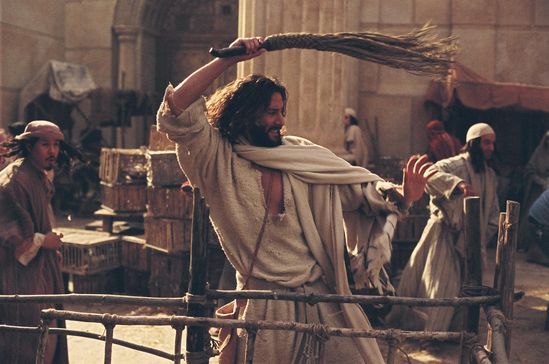
Not saying a pair of trolling billionaires are the same as Jesus.  But they certainly do take after the character of that man who was overturning the tables of the money changers and chasing out of the temple.  Lest we forget, the money changers were those who took advantage of the poor who were obligated to pay the tax.  This money was supposed to go to the upkeep of the temple and yet teams of grifters, offering a service, were being parasites:

Jesus entered the temple courts and drove out all who were buying and selling there. He overturned the tables of the money changers and the benches of those selling doves. “It is written,” he said to them, “ ‘My house will be called a house of prayer,’ but you are making it ‘a den of robbers.’” (Matthew 21:12-13 NIV)

The Gospels contain differing accounts of this event, some scholars believe it may be about two separate times when Jesus went charging in on a little ‘insurrection’ rampage, but interestingly his explanation of authority to do this cleansing was later misconstrued and used at his trial.  

Sounds familiar, doesn’t it?

The corporate media has taken fabricated tales and normal diplomacy with a foreign power—and they spun it into an incredible “Russian collusion” narrative.  Trump talked about the “very fine people” on both sides of the Charlottesville statue controversy, and he took great pains to qualify his statement—by very specifically condemning the white nationalists and Nazis in the crowd.  But it didn’t stop the media from running the story “Trump Calls Nazis ‘Fine People'” and Joe Biden, along with many other Democrat partisans, have continued to repeat this lie.

Where Trump, and MAGA, clearly delineate between legal and illegal immigration, their detractors muddy the waters.  The left takes Trump’s desire to keep America safe from the flow of Fentanyl and of unvetted foreign nationals and twists it into xenophobia and a threat to legal immigration.  It is deliberate deception.  The far-left wants to keep brown and black people terrified that’s how they’ve always won—by fear-mongering the crowd, they deceive the sheep and, when that does not work, they will imprison or assassinate their opponents.

Remember ‘kindness is everything’ my leftist friends, right?

Evil doesn’t like to have a light shown on it and when you see all of the screeching in response to DOGE taking a look behind the walls of bureaucracy you do really start to wonder why.  Why are they treating Musk as if he’s just some Nigerian scammer trying to get our information?  Is it because he’s from Africa?  It is totally ridiculous.  Lawmakers circle the wagons and tell us we have no right to know how our money is spent!  It’s time to drive out those who have used us to enrich themselves.

There is always a spy versus spy aspect to this where accusation is met with a recrimination.  Both Jesus and those elites questioning his authority claimed that their counterpart was demon possessed or of the Devil.  It would require some wisdom and discernment to know which of the two sides to believe.  But the religious frauds of our day still side with the elites against the crowd.  They defend the status quo and the corrupted established system.  It is always the beneficiaries of fraud that fight against the reform.
Seeing Behind The Veil

Standard

In storytelling, there is a plot device called a MacGuffin.  This is an object, character, or event used to push the narrative forward and yet isn’t all that important in and of itself.  In other words, a thing that creates motivation and yet never even needs to be revealed to the audience.  We are supposed to believe this is something significant or valuable and that’s all we need to be told.

The contents of the briefcase are left a mystery despite being pivotal in motivating the characters.

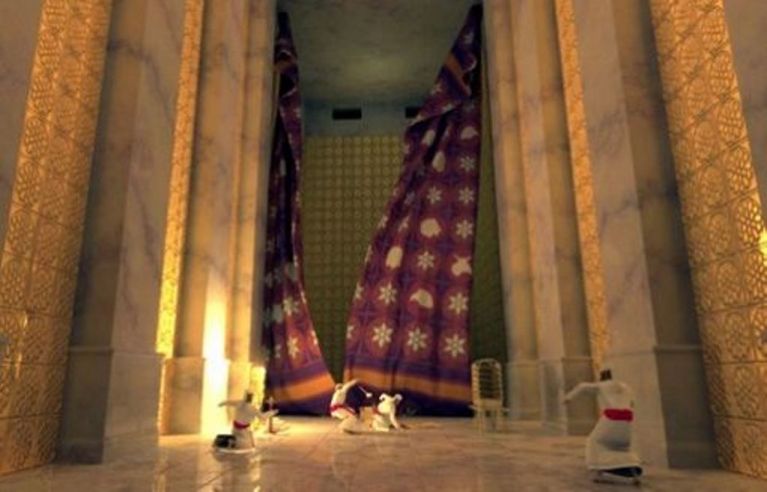
While reading through the Old Testament and pondering how temple worship worked, it is hard not to see the Ark of the Covenant as a sort of MacGuffin.  Sure, their God was not a thing.  And yet this sacred object, we’re told, contained something of God’s presence and would even strike dead those who innocently mishandled it.  Of course, most people may never have seen it, it was kept behind a veil in the temple where few had access, but all would be told of the sacredness.

“Then spake Solomon, The LORD said that he would dwell in the thick darkness. I have surely built thee an house to dwell in, a settled place for thee to abide in for ever.”

(1 Kings 8:12‭-‬13 KJV)

In fact, it was made sacred as much by this treatment as much as what actually dwelled within it.  The mythology surrounding it, as in the cultural or religious significance that was given to it, was extremely powerful.  Starting a special priestly class, Tabernacle and ritual practice, later the impressive structure of the Temple, there was a huge investment in this sacred object.  And yet, for all the attention it got, the Ark itself was usually kept hidden in darkness, guarded, within the Holy of Holies and behind a veil.

Holy Of Holies 

There are other things hidden behind a veil with significant motivational power.  One of them being the marriage MacGuffin.  For me this was a pursuit of something sacred, the church does consider the marriage bed to be sacred, and there is a whole mythology that is constructed around marriage.

This is what made it so jarring when, during my pursuit of the impossibly, a psychiatrist would classify it as “sexual attraction.”  They had just heard me describe a pure and faith-driven quest only to reframe it in such crass terms.  How dare they!  I was after love, not sex!  It really did offend me at the time.  With their clinical roughness, they had penetrated the veil of my marriage delusion.  It was an act of sacrilege.  

My childhood innocence is beyond recovery at this point.  For whatever reason, those of us born into a fundamentalist purity culture believe that we must be in denial of our own sexual urges that lead to marriage.  This is strange given how blunt St. Paul is on the topic, in 1 Corinthians 7:9, advising those who “burn with passion” to get married and basically get a room.  Why the veil of secrecy, these many euphemistic expressions to cover and mystify the bumping of uglies?

Speaking of erotic euphemism:

“Awake, O north wind; And come, thou south; Blow upon my garden, That the spices thereof may flow out. Let my beloved come into his garden, And eat his pleasant fruits.”

(Song of Solomon 4:16 KJV)

Why blush, be embarrassed or ashamed by this?

Could it be that without dressing this whole affair up with great ceremony, white bridal veils, teary-eyed parents, and such, we would have to face the reality of being creatures as hormone-driven as two ducks on a pond?  I mean, why aren’t we as honest as Solomon was in his poetry: “Roses are red, violets are blue, you have large breasts, that’s why I love you!”  Without white lies or half-truths, would our version of romance even survive?

So what is underneath the veil?

All of those things that I’ve discovered in the intervening years, that’s what…

To the extent I was in deep denial of my own sexuality, I was doubly in denial of the sexual nature of my female counterparts within the conservative Anabaptist culture.  The young lady who first propositioned, then made it all awkward and worried about somehow being ‘defiled’ if she got coffee with me has long since dropped the veil.  She has joined the others whom I had held in such high regard, revealed now as not being nearly as prudish or pure as I had once imagined.  That’s not a criticism or judgment either.  It is just the reality of the situation.

So, when the impossibly told me “I cannot not love that you the way that you wanted to be loved” what she was really saying the same thing as those Tinder girls with “must be 6′ or over to ride” in their profiles.  She wanted a guy who got her juices flowing, certainly someone a bit more rugged and traditionally masculine than me.  And, I mean, why not?  Why hide it?  Marriage is not only (or even primarily) about the high ideal that is advertised.  It is also about our scratching the itch.  Which is to say getting down and dirty with someone who meets the correct physical qualifications.

Also, perhaps it is that the fantasy is more satisfying than the act itself?  We read how Amnon, King David’s eldest son, had such an infatuation with his half-sister Tamar.  It tells us after having his way with her he despised her.  Or consider the disgust of Victorian-era art critic John Ruskin when, in marriage, he discovered that women aren’t like porcelain dolls.  You’ll have to forgive him, they put skirts over piano legs back then to keep the eyes of men safe from the unveiled feminine form.  Maybe there are some things that are better chased than caught?  If we find what we went looking for we might be shocked at what we found.

Sacred Fertility & Symbolism 

The final stop on this exploration of sacred and taboo has to do with something that I can’t unsee now that I’ve seen it.  I’m bound to lose half of my final two readers for going here. 

Nevertheless, I’m not here to please the pearl-clutching crowd. 

For me, this is not about toppling sacred cows or making people uncomfortable, it is about being honest enough to see reality for what it is and correcting our own perspectives of the cultural baggage we’ve inherited.

First, what drives much of the Old Testament Biblical narrative?  We know Abraham’s story, how he wanted an heir, and yet how Sarai, his wife, was unable to produce.  In this Genesis account we see various cases where wombs are opened or closed.  And the punishment of Michal, for rebuking her dancing husband, was that she had no child until the day of her death.  Being fruitful and multiplying was a high priority, as well as having sons to carry on the family line.

As an aside, we live in a very sterile world in comparison to our ancestors, we’ve become sheltered and sensitive to the point many do not eat meat or want their children exposed to death.  This wasn’t an option at the time when Scripture was written.  There is a kind of earthiness to their world and perspective, something more primal or real, a brutality of life difficult to stomach.  It is with this reality in mind, that we also have different sexual taboos and could be more prudish than they were about such things.

Second, I was sitting in church and taking a look at the colorful streams of light pouring through a stained glass image of Jesus pulling Adam and Eve from the grave.  My moment of appreciation for this beauty was interrupted by my noticing part of the symbolism.  Jesus is shown to be emerging from an oval shape, at the bottom of which are the covers of their opened tombs.  Requiring very little, if any, imagination, it bears striking resemblance to one Christian symbol even an iconoclastic Protestant would likely recognize, and that being a vertically arranged “Jesus fish” or Ichthys.

Light and life shining down…

However, concurrent to this, and a cause of some momentary shame, was the thought “That’s a vulva!”  I mean, how inappropriate to think that any part of the female anatomy, let alone those private nether regions, be put on prominent display or be associated with Christ!  

But is it really?

A mother, Mary, is necessary for the birth of Jesus.  Without her, and her womb that is miraculously made made more spacious than the heavens, there is no salvation for mankind.  It didn’t matter if God could have used any other way, all we know is that he used this young woman and all of the faithful since have followed the lead of Elizabeth, who full of the Holy Spirit loudly proclaimed:

“Blessed are you among women, and blessed is the child you will bear! But why am I so favored, that the mother of my Lord should come to me?”

(Luke 1:42‭-‬43 NIV)

As far as the symbolism, I would find that indeed my observation had basis in reality as the Ichthys is a version of Vesica Piscis (literally “fishes bladder” in Latin) or, in sacred geometry, the oval that two intersecting circles create an oval and said to be the place where spiritual and physical worlds interface. According to Syriac Press, in ancient Mesopotamia, it was used as a symbol of the combination of masculine and feminine energies that create a Divine Child.  Any pagan coincidence, like those with baptism, only serves to reinforce the power of the symbolism.

In a time when many settle for ‘fur babies’ over producing human offspring and the unique female contribution to the world is dismissed by feminists seeking male roles— when real women are mocked by men who pretend to menstruate—we need to start doubling down on our celebration of this reproductive role of women.  Phrases like “saved through childbearing” did not come into the Bible by accident.  The world was saved by the one who came out of Mary’s fertile womb and we ought not to downplay or be embarrassed by this.

Empty Vessel—Dying Corpse

Solomon’s Temple was destroyed in 586 BC, by the Babylonians, and the fate of the Ark within it is unknown.  This loss of sacred relics did not stop the Jewish faithful from rebuilding the temple, in 515 BC, but does make one wonder how much the contents mattered.  So long as the people were kept in awe that’s all that really seemed to be the point whether the edifice truly contained anything of real value or not.  With nothing behind the veil, the people still did the ritual and sacrifice. 

Why?

It seems sort of analogous to the US Dollar, a currency once backed by actual gold and now only by faith people continue to hold in the economic system it represents.  The harsh reality is that it has become merely a means to exploit. It is a way for a few elites to rob the value of the savings of other people by printing more money for themselves.  Those money changers Jesus chased out of the Temple were the amateurs. The real professionals never get caught.  The carefully maintained veil of secrecy around the Federal Reserve ensures that this particular scam continues for a long long time.

But, I digress.  

G. K. Chesterton once wrote, “a corpse crawling with worms has an increased vitality,” and that “a dead man may look like a sleeping man a moment after he is dead,” trying to describe the subtle yet significant difference between truly sacred tradition and a cheap gimmick version of this religion that was intended to replace it.  Perhaps this is what has me disillusioned?  With so many things, once the veil is lifted (which few ever dare to do) so much of the enticing mystery and popular mythology which propelled us forward falls apart.  And in this way some of the life I had felt early on feels more like decomposition.

Perhaps this is what is left when you’re the dog who has finally caught the car?  Nothing left to do but pee on the tire and continue on your way again.  The anticipation leading up to the day of revelation may be more exciting than the moment the veil is lifted and when all is seen.  Ruskin may have spent the rest of his life waxing eloquently about his female love interest.  Or maybe—just maybe—that MacGuffin which led us to the point we’re at today was merely a plot device to move the story forward and the only truly sacred part of the encounter is the fruit produced?

Sexual pleasure is fleeting.  We’re lured there by our imaginations, by our desire for what is beyond the veil of marriage, but it can all be a bit anti-climactic and even repulsive once you consider it after it is finally unwrapped from the flowery speech and those flawless air-brushed mental pictures.  But fatherhood, by contrast, seeing the great potential of my son, tending to his needs, pruning as needed, is something extremely fulfilling.  It is what has emerged from the womb that brings us renewed life and hope.  Pity the barren, the dying corpse who has lifted the veil and only saw the emptiness of their pursuits.

Should Christians Flee Jerusalem?

Standard

In 1630 John Winthrop, an English Puritan leader, wrote a thesis titled A Model of Christian Charity that described a spiritual vision for the new settlement in America.  He explains an ideal love that if practiced would make them “a city upon a hill” and seen by all people. 

But, Winthrop warns that with this great potential there will be great consequences if and when this ideal is abandoned.  In his words: 


“We shall open the mouths of enemies to speak evil of the ways of God, and all professors for God’s sake. We shall shame the faces of many of God’s worthy servants, and cause their prayers to be turned into curses upon us till we be consumed out of the good land whither we are going.”


America has formed into a great nation, an exceptional nation in many respects, and has become the place seen by the world.  Two Presidents (John Kennedy and Ronald Reagan) made reference to the “city upon a hill” imagery and at a time which was arguably the peak of our influence. 

I firmly believe that our lingering greatness is a reflection of the moral character of those who came before us.  However, our end will be as dramatic as our rise when we neglect love for our fellow man that Winthrop envisioned and is the true evidence of faith in God.

There was another city on a hill (seven hills actually) and that being the historical city of Jerusalem described in the Bible.  Jerusalem was a place of great importance to the Jewish religion and the location of their temple to God.  It was an impressive awe inspiring place by ancient standards and also the place where Jesus went with his disciples and made a startling prophecy about the unimaginable destruction that would soon come to that city.

Six days that marked the beginning of the end.

It was the Passover, a significant event on the Jewish religious calender, and what would turn out to be a most pivotal week for Christianity.  Jesus, after having raised Lazarus from the dead, departs from Bethany and continues with his disciples to Jerusalem despite the obvious risk to his life. 

The Scripture describes Jesus coming down from the Mount of Olives towards the great Holy City:

“As he approached Jerusalem and saw the city, he wept over it and said, ‘If you, even you, had only known on this day what would bring you peace—but now it is hidden from your eyes.  The days will come upon you when your enemies will build an embankment against you and encircle you and hem you in on every side.  They will dash you to the ground, you and the children within your walls. They will not leave one stone on another, because you did not recognize the time of Godʼs coming to you.'” (Luke 19:41-44)

This moment of emotion and prophecy marks the beginning of a tumultuous week.  Jesus was greeted as a king and yet simultaneously weeps over Jerusalem.  The week continues with him dramatically cleansing the temple of commerce.  He spends an intimate last meal with his disciples after which he is betrayed by one of them.  He is put on trial, crucified under a mocking “king of the Jews” sign.  But not before making several claims about a destruction coming and an end that was very near at hand.

In a sermon (Seven Woes of Matthew 23) Jesus severely rebuked his religious critics for their hypocrisy.  He told them that they are no better than their ancestors who murdered prophets.  Jesus warns once again of a judgment that would befall their generation, and laments:

“Jerusalem, Jerusalem, you who kill the prophets and stone those sent to you, how often I have longed to gather your children together, as a hen gathers her chicks under her wings, and you were not willing.  Look, your house is left to you desolate.  For I tell you, you will not see me again until you say, ‘Blessed is he who comes in the name of the Lord.'” (Matthew 23:37-39)

Jesus laments their unwillingness to trust him.  But also uses “desolate” (erémos) to describe their “house” (oikos) which is a strange way to describe a thriving city and is a foreshadowing statement.  He ends the sermon by saying only those who acknowledge him will see him again.

Following that, in the next chapter, we read this account:

“Jesus left the temple and was walking away when his disciples came up to him to call his attention to its buildings. ‘Do you see all these things?’ he asked. ‘Truly I tell you, not one stone here will be left on another; every one will be thrown down.'” (Matthew 24:1-2)

Wow!  Talk about shocking!

Can you imagine?

It would be like being with a group of friends taking in the sights in Manhattan and talking about the beauty of the architecture, but then in response the tour leader tells you that in forty years it would all be rubble. 

It was the temple (according to Luke 21:5) that had the disciples most captivated and Jesus tells them it will soon be destroyed.  Naturally, as we continue to read, this awful prediction provoked more questions from those who heard about when and how:

“As Jesus was sitting on the Mount of Olives, the disciples came to him privately. ‘Tell us,’ they said, ‘when will this happen, and what will be the sign of your coming and of the end of the age?’ 

Jesus answered: ‘Watch out that no one deceives you. […] Truly I tell you, this generation will certainly not pass away until all these things have happened.  Heaven and earth will pass away, but my words will never pass away.'” (Matthew 24:3-5)

Two observations: 1) These words are all spoken entirely in the context of the temple and the Jerusalem that the disciples saw with their own eyes.  2) This is the second time Jesus promises that “this generation” (to the audience with him then) would see these things happen.

So what did happen?

The end of Jerusalem and temple worship came to pass in AD 70.

It is amazing to me that this event, an astonishing fulfillment of prophecy, is not front and center for more Christians.  The destruction of the temple and sacrificial system it represented was so complete that it has lasted until this day.

Furthermore, this total destruction happened (as predicted) in the very generation that first heard the words of Jesus about the end of the age.  It is a well-documented historical event that would seem to completely fulfill the words of Jesus and yet it is hardly acknowledged.

So why is this such a secret?

Well, maybe because it throws a monkey wrench into the eschatology of many modern Bible readers who have been indoctrinated to believe Jesus is speaking of events in our own future?

Who knows?

But we do know that the historical evidence is clear.  The city of Jerusalem was destroyed, the temple of stone at the center of Jewish religion reduced to rubble, and with that came an ending of an age.  Some skeptics may dispute the details, yet one only need to go to the modern city built on the ruins of historical Jerusalem and see for themselves that the temple is gone.

The end of the former age is the beginning of something new and better.

The end of earthly Jerusalem had begun the week Jesus was crucified.  The destruction of the old way came as the beginning of a new and better way.  It is as Jesus promised:

“‘Sir,’ the woman said, ‘I can see that you are a prophet. Our ancestors worshiped on this mountain, but you Jews claim that the place where we must worship is in Jerusalem.’

‘Woman,’ Jesus replied, ‘believe me, a time is coming when you will worship the Father neither on this mountain nor in Jerusalem.  You Samaritans worship what you do not know; we worship what we do know, for salvation is from the Jews.  Yet a time is coming and has now come when the true worshipers will worship the Father in the Spirit and in truth, for they are the kind of worshipers the Father seeks.  God is spirit, and his worshipers must worship in the Spirit and in truth.'” (John 4:19-24)

There is a city spoke of by Jesus in the Sermon on the Mount.  It is a metaphor used to describe a greater reality “You are the light of the world. A city that is set on a hill cannot be hidden.” (Matthew 5:14)  It is also the likely origination of Puritan John Winthrop’s “a city upon a hill” phrase.  

We also know, in the writing of Paul, that he says the church is collectively and together is the temple of God:

“Don’t you know that you yourselves are God’s temple and that God’s Spirit dwells in your midst? If anyone destroys God’s temple, God will destroy that person; for God’s temple is sacred, and you together are that temple.” (1 Corinthians 3:16-17)

It is a funny thing how so many who claim to be Biblical literalists read that and still await a third temple built of stone.  Paul says that his audience, believers, are the temple and God dwells in them.  Believers, according to Scripture, are literally the temple of God and yet some wait for the constitution a third temple?

Perhaps those still waiting for a third temple have also missed out on the promised second coming of Jesus as well? 

Read this assurance that Jesus left for his disciples:

“‘Very truly I tell you, whoever believes in me will do the works I have been doing, and they will do even greater things than these, because I am going to the Father.  And I will do whatever you ask in my name, so that the Father may be glorified in the Son.  You may ask me for anything in my name, and I will do it.  If you love me, keep my commands.  And I will ask the Father, and he will give you another advocate to help you and be with you forever—the Spirit of truth.  The world cannot accept him, because it neither sees him nor knows him. But you know him, for he lives with you and will be in you.  I will not leave you as orphans; I will come to you.  Before long, the world will not see me anymore, but you will see me. Because I live, you also will live.  On that day you will realize that I am in my Father, and you are in me, and I am in you.  Whoever has my commands and keeps them is the one who loves me. The one who loves me will be loved by my Father, and I too will love them and show myself to them.’    

Then Judas (not Judas Iscariot) said, ‘But, Lord, why do you intend to show yourself to us and not to the world?’  

Jesus replied, ‘Anyone who loves me will obey my teaching. My Father will love them, and we will come to them and make our home with them…'” (John 14:12-23)

So there we have a new city, a better temple and a greater coming of Jesus—each of these iterations being far better than the ones replaced.  If we believe we will be the fulfillment of Scripture in the same way as Jesus and do even greater things as he promised we would.  We will not be looking forward to a new version of the old way and instead be bringing the better kingdom into our reality.

Why then do some amongst us still wait for another physical fulfilment rather than live in the fullness of the kingdom promise today?

Perhaps it is because they, like those who rejected Jesus in his first coming, do not have the truth in them and need to repent?

So, anyhow, cutting to the chase, why is the fall of Jerusalem relevant to us today?

The point of this blog post is not history or eschatology, those can be topics for another day, but it is to discuss the choice we have to learn from history or repeat it again.  We can look at the future as something set in place and beyond our own influence or we can consider that Jerusalem had a choice and that is contained in the last words of the Old Testament:

“See, I will send the prophet Elijah to you before that great and dreadful day of the Lord comes. He will turn the hearts of the parents to their children, and the hearts of the children to their parents; or else I will come and strike the land with total destruction.” (Malachi 4:5-6)

Do you see the option A and the option B?

John the Baptist, while not literally Elijah, came in the Spirit of Elijah, preaching “repent, for the kingdom of heaven has come near” (Matthew 3:2) and yet was rejected by those who expected a literal return.  Because of their refusal to repent they choose the “or else” of option B  and we too face that choice: Will we repent and bring the Lord’s prayer “thy kingdom come” to life or will we continue waiting for fulfilment on our own terms and be destroyed?

The American church today is not much different from Jerusalem.  We face an uncertain future, we have been divided into competing political factions, there are angry zealots ready to run amok railing against foreigners, oppressors, etc.  We too have become woefully arrogant and blinded by our ambitions.  It is very much the same climate Jesus lived in two millennia ago.  It is the attitudes that Winthrop warned against nearly four hundred years ago:


“But if our hearts shall turn away, so that we will not obey, but shall be seduced, and worship other Gods, our pleasure and profits, and serve them; it is propounded unto us this day, we shall surely perish out of the good land whither we pass over this vast sea to possess it.”


We are at a crossroads as a people today.

The next forty years will probably hold dramatic changes.  How we respond to opportunities today could very well define the future of our nation.  America will need to choose repentance or it will continue to slide further away from greatness and towards destruction. 

Our end as “a city upon a hill” may not be as spectacular as the fall of Jerusalem, we might simply fade from prominence like other great nations before us, but be ready.    

Be ready for the fall.

Biblical Faith vs. Bible-based Religion

Standard

Two different religious traditions use the same Scripture.  One tradition says the text points to a man named Jesus who preached in Roman occupied Judea a little over two millennia ago and was God’s only begotten son came to save people from themselves.  The other tradition rejected these claims and still waits on Elijah to return as a prelude to the arrival of the Messiah.

“See, I will send the prophet Elijah to you before that great and dreadful day of the Lord comes.  He will turn the hearts of the parents to their children, and the hearts of the children to their parents; or else I will come and strike the land with total destruction.” (Malachi 4:5-6)

Note the choices in the passage above.  There’s option a) repentance and changed hearts, or option b) face total destruction.  And, depending on perspective, there might be an option c) both. 

We know that Judaism was split in two because of Jesus (some believing him, others rejecting him) and also that Jerusalem was destroyed in the year 70CE.  The glorious temple, the very center of Jewish worship, was completely dismantled as Jesus had foretold and has never been rebuilt.

Temple #1: Symbolic, representation of truth, built out of stone and sweat of men, located in Jerusalem:

“As Jesus was leaving the temple, one of his disciples said to him, ‘Look, Teacher!  What massive stones! What magnificent buildings!’  ‘Do you see all these great buildings?’ replied Jesus. ‘Not one stone here will be left on another; every one will be thrown down.'” (Mark 13:1-2)

Clearly Jesus is referring to the destruction of buildings that the disciples were admiring and that destruction literally happened.

But, there’s more…

Temple #2: Figurative, fleshed out truth, the life work and example of Jesus, located in history:

“The Jews then responded to him, ‘What sign can you show us to prove your authority to do all this?’ Jesus answered them, ‘Destroy this temple, and I will raise it again in three days.’  They replied, ‘It has taken forty-six years to build this temple, and you are going to raise it in three days?’  But the temple he had spoken of was his body. After he was raised from the dead, his disciples recalled what he had said. Then they believed the scripture and the words that Jesus had spoken.” (John 2:18-22)

Jesus also used the temple as a metaphor for himself, predicts his own death and promises to resurrect his body.

Then at the trial of Jesus…

“Many testified falsely against him, but their statements did not agree.  Then some stood up and gave this false testimony against him: ‘We heard him say, ‘I will destroy this temple made with human hands and in three days will build another, not made with hands.'” (Mark 14:56-58)

Note, in the third passage, we are told that the witnesses at the trial of Jesus spoke falsely.  However, we see in the prior two Gospel accounts quoted above that the words they spoke were half-true—It is indeed true that Jesus spoke about the destruction of the temple and probably said something about a new temple not built with hands—The false part is where they claim he would do it by his own hand.

Jesus foretold his own death using a metaphor of himself or his body being the temple.  But he was also prophesying about the literal building of stone in Jerusalem.  His words a double entendre, one meaning of the word “temple” was figurative about his own death and resurrection and a second concrete meaning about the literal destruction of the temple built of stone.  However, there is a third use of temple and not the temple of the body of Jesus or the temple in Jerusalem built of stone.

Temple #3: Spiritual, a truth experienced, lived practically and today, located in the heart of believers:

“Don’t you know that you yourselves are God’s temple and that God’s Spirit dwells in your midst? If anyone destroys God’s temple, God will destroy that person; for God’s temple is sacred, and you together are that temple.” (1 Corinthians 3:16)

“Jesus replied, ‘Anyone who loves me will obey my teaching. My Father will love them, and we will come to them and make our home with them.'” (John 14:23)

“Now you are the body of Christ, and each one of you is a part of it.” (1 Corinthians 12:27)

That is a radical message.  It takes us from a man-made building of stone and religion.  It takes us to the man named Jesus “the stone the builders rejected” (Psalm 118:22, Matthew 21:42, Acts 4:11) and then finishes with us being the place where God dwells and being Jesus.  It is the message that got Stephen killed:

“After receiving the tabernacle, our ancestors under Joshua brought it with them when they took the land from the nations God drove out before them. It remained in the land until the time of David, who enjoyed God’s favor and asked that he might provide a dwelling place for the God of Jacob.  But it was Solomon who built a house for him.  However, the Most High does not live in houses made by human hands.  As the prophet says: ‘Heaven is my throne, and the earth is my footstool. What kind of house will you build for me? says the Lord. Or where will my resting place be?  Has not my hand made all these things?‘  You stiff-necked people! Your hearts and ears are still uncircumcised. You are just like your ancestors: You always resist the Holy Spirit!” (Acts 7:45-51)

I can imagine why that was insulting.  Stephen basically just invalidated the entire religion of his audience using their own Scripture. 

The destruction of the temple in Jerusalem marked the end of a religious system.  The life, death and resurrection of Jesus was the beginning of something very different: A chance to be a dwelling place for God, and an opportunity to be a true child (adopted, not begotten) of God.

Jesus, talking to a woman who asked about the proper place to worship, said:

“Yet a time is coming and has now come when the true worshipers will worship the Father in the Spirit and in truth, for they are the kind of worshipers the Father seeks.  God is spirit, and his worshipers must worship in the Spirit and in truth.” (John 4:23-24)

Oddly enough, many professing Christians today are waiting on a literal temple of stone and a literal bodily second coming of Jesus.  They seem to me like those who wait on a literal Elijah, who did not recognize John the Baptist as the spiritual Elijah, and rejected the Gospel of Jesus Christ.  They have a Bible-based religion, they diligently study Scripture, yet they seem to be missing something as far as understanding and faith.

Bible-centered religion and regulation is false security.  Jesus never told anyone that Scripture would replace him as teacher.  Jesus did, however, promise that the Spirit would “teach you all things” (John 14:26) and will come to all who believe.  I believe many have been deceived and believe their ‘Biblical fundamentalism’ will save them.  What they actually have is fundamental misunderstanding, they are relying on their own human religious traditions.  They have a Biblical religion only and not the true faith described therein.

“The person without the Spirit does not accept the things that come from the Spirit of God but considers them foolishness, and cannot understand them because they are discerned only through the Spirit. The person with the Spirit makes judgments about all things, but such a person is not subject to merely human judgments, for, ‘Who has known the mind of the Lord so as to instruct him?’  But we have the mind of Christ.” (1 Corinthians 2:14-16)

It is the Spirit that makes the Bible discernable.  Those who place their security in the Bible itself (or their fundamentalist book-based religion) are not fully submitted to the Spirit and cannot fully understand the things of faith that are described in Scripture.  They bind themselves up in “false humility,” create “regulations” that have “appearance of wisdom,” (Colossians 2) yet they are false and—like those who “study the Scripture diligently” (John 5:36-40) that Jesus rebuked—they do not have the word of God to discern truth from it.

“Even to this day when Moses is read, a veil covers their hearts. But whenever anyone turns to the Lord, the veil is taken away. Now the Lord is the Spirit, and where the Spirit of the Lord is, there is freedom. And we all, who with unveiled faces contemplate the Lord’s glory, are being transformed into his image with ever-increasing glory, which comes from the Lord, who is the Spirit.” (2 Corinthians 3:15-18)

The truth that brings freedom is of the Spirit.  Religions give adherents false security, but true faith that originates from the indwelling Spirit gives freedom and ability to experience God first hand.  Bible-based religion leads men to talk about Jesus.  Spirit-led faith allows men to *be* Jesus and bring salvation to a lost and hurting world. 

Religion relies on rituals, one size fits all prescriptions and manipulation through fear.  Faith is dynamic, applies grace as liberally as necessary and motivates by being an example of a love that transcends.  Religion hides behind a veil of human inadequacy and attempts to legislate morality into existence without ever changing hearts.  Faith overcomes fear and produces fruit out of passion that comes from true unity with God.

The Bible is a book that can only be understood properly by those with the “mind of Christ” and Spirit.  Knowing when the language of Scripture is figurative, metaphorical, spiritual, concrete, literal (or some ‘all of the above’ combination) requires the indwelling of the word.  Discernment through any other means but a mind renewed in Christ (be it be an old tradition or a new commentary) is incomplete.

“…without faith it is impossible to please God, because anyone who comes to him must believe that he exists and that he rewards those who earnestly seek him.” (Hebrews 11:6)

No amount of religion finagling or diligent study can replace the indwelling word.  Jesus made it possible to remove the veil of religion and experience the full presence of God.  Seek after Spirit-led faith, not Bible-based religion.

Have you experienced the promise and freedom of faith?

Or, are you still waiting on Elijah to return?