
Built for Scarcity: Why I Won’t Give My Son Everything He Wants

Standard

I’ve tried to give my son everything he needs to succeed. But that doesn’t mean I will give him everything he wants. There’s a reality in any pursuit: to be excellent, you’ll need to put in the work or delay gratification to reach your full potential. If a parent gives a child everything they want, there’s no incentive for them to learn and improve.

To a child, everything provided for them is a given, and every task required is an injustice. Why should they have to wash the dishes? The grumbling or attempts to negotiate last longer than the time it would take to finish the chore. And, honestly, the easy route is just to do it ourselves. But that deprives a child of the opportunity to learn all those transferable life skills—at the very least, to get a little practice being helpful rather than entitled.

In the West we already have abundance and the result is atrophied muscles and dull minds.

If we shower children with abundance, they will never appreciate what is given nor ever be satisfied. It seems that no matter what we have, we always want more. If given the moon, we’ll want the other planets and the stars as well—and then we still won’t be happy with that. The greatest satisfaction comes through work and accomplishment. Playing video games all day or scrolling social-media feeds may trip reward centers, but it amounts to empty calories and can’t replace substance.

I’ve watched spontaneous interviews with very wealthy men, and nearly every one of them says that their abundance did not bring happiness. At least one admitted he was suicidal despite millions in assets. Our peak enjoyment in life comes when we invest time, effort, and resources and eventually reap the fruit of our labor. Sure, going to the gym may be difficult, but the endorphins are addicting and the muscles are a reward.

Built for Scarcity—Not Utopia

I watched a video about the problems with utopia, and the framing of capitalism as a system built for scarcity was correct. We would need a radically different way of ordering ourselves if the things we wanted just grew on trees. If you could have whatever you wanted without effort, why would you pay for anything or even care who owns it? My property rights only matter because it costs something to acquire or replace the things I own. If everything we wanted was free and completely abundant, we wouldn’t need to value it at all.

The presenter, who seemed intelligent enough, made a critical flaw while talking about providers of generative AI. He claimed that those charging for the service were creating artificial scarcity “because the code is open-source or whatever.” But this totally ignores the immense computing power that’s required—the powerful microchips, massive amounts of energy, and the staff needed to keep it all running. So no, that isn’t an example of abundance.

I’m used to naïve takes coming from the religious side, but it’s fascinating to see secular thinkers stumble over the very same things. Yet it touches directly on the human condition. We are not wired for abundance. Ultimately, even if we could reduce human labor to zero, our brains were created for scarcity, and when faced with unnatural abundance we don’t actually do very well.

Wall-E is probably the best depiction of a world of abundance that goes well.  It could go in many directions, unhealthy ease the better of the many scenarios.

Material wealth, to start with, is never a cure for boredom or lust. If anything, those who have all their physical needs met are often left with a void of purpose. Their abundance never creates fulfillment or a reason to be in the world. And some appetites are basically insatiable: a man can have all the sex he wants and still desire the one he cannot have. It is often the ultra-wealthy—those who have everything we imagine would make us happy—who are also the most perverse and dissatisfied.

It reminds me how young-earth creationist (YEC) types often portray entropy as purely negative when it is as necessary for life as order. Fertile soil, for example, contains organic compounds that come from dead plants and animals. This is part of a cycle—neither good nor bad—like the weather. The same forces that bring a spring shower can also leave behind a swath of destruction. Creativity itself often lives at the edge of order and disorder. You may not enjoy a messy room that needs cleaning, but without it your life would probably feel pointless.

Furthermore, social hierarchy would be the only game left if we completely removed the need for productivity and occupation. If AI replaced all jobs, the result might be material abundance, but not utopia. As the saying goes, “Idle hands are the devil’s workshop,” and some people with nothing to do will create drama. Boredom is good when it provokes us to create something new, but bad when the “new thing” is us causing trouble for others for lack of something else to do. It is better when we need to do something productive to survive, because we’re primed for it.

Consider how an overly sterile environment can trigger autoimmune disorders; similar problems would arise in a world where struggle was fully removed. It wouldn’t solve our environmental or energy problems—there would still have to be limits and rationing to keep from stripping the planet bare. Some people will never be content with the base level of property and possessions. There will still be scarcity even if human labor is no longer a cost. Advantages will still exist. At that point a new hierarchy will form—perhaps one based solely on beauty or charisma—where many have no path to “level up.”

In capitalism, while there’s an advantage to those who go first, there are multiple paths to success. Sure, there is cost-cutting at the expense of quality (see the Campbell’s Soup controversy), but there is also genuine efficiency and a system where nothing need go to waste. Bad actors create opportunities for others. If Enzo Ferrari hadn’t been a pompous jerk, we wouldn’t have Ford’s GT40 legacy or Lamborghini. Ferrari’s rude remarks were the provocation that pushed others to build cars capable of beating his. In a free market there is a profit motive to share rather than hoard. In a post-labor AI world where elites no longer need human workers or customers, would they have any incentive to distribute limited resources?

Abundance, Unearned, Robs Good Character

The video is correct that abundance won’t lead to utopia—yet it misses the deeper reason why. It isn’t just that we’d get bored or turn to status games (true as that is). The real problem is that abundance without cost quietly deletes the only proven mechanism we have for turning a human being into a person worth becoming. 

When everything is given for free, nothing is cherished.  When nothing is earned, nobody is grateful.  When no one is grateful, no one is generous.  When no one is generous, society stops being a community and it becomes a zoo with really nice cages: no material need unmet, the trough always full, and yet we are no different from a lion removed from its natural habitat.

That’s why I won’t hand my son the life he thinks he wants. I’ll give him everything he truly needs: enough security to take risks, enough scarcity to make victories sweet, enough resistance to grow muscle around his soul. I’ll let him wash the dishes, wait for the game he saved up to buy, lose the race he didn’t train hard enough for, feel the sting of “not yet” and the glory of “I finally did it”.

That feeling of a hard fought win cannot be artificially produced.  In a world where AI leads the way can there be human thriving?

Because the cruelest thing a parent can do isn’t to let a child struggle.  The cruelest thing is to raise him in a world so padded, so instantly gratifying, so artificially abundant that he never discovers the one truth every happy adult eventually learns: The joy was never in finally getting the thing.  The joy was in finally becoming the kind of person who could get it—and still know it wasn’t the point.

Scarcity isn’t the enemy of human flourishing.  It’s the narrow gate we have to squeeze through to find out who we actually are.  And I want my son on the other side of that gate—tired, scarred, proud, alive, and deeply, durably grateful—not because he was given the universe, but because he earned his small, yet irreplaceable and fully human corner of it.
Never Meet Your Heros

Standard

I have lost all of my heroes. The expression, “Never meet your heroes, because they’re sure to disappoint you,” describes the painful realization that those great people you imagined are not as special as you believed they were.  It could be the letdown a friend had when he heard Matt Walsh speak.  It could be a family that learned their eldest brother was cheating on his wife for many years and was not some image of virtue.  For me it was a process and a very long grinding away of faith in these figures.

I was never one for human idols.  I never put posters of celebrity faces on my bedroom wall and would never be as impressed with figures like Ravi Zacharias as some of my friends.  It wasn’t a religious thing nor something just to be ornery.  I simply didn’t have a feeling of awe about these personalities that were mid.  The people I most admired tended to be local—my blue collar dad, my missionary cousin, or that perfect girl I would marry some day.  But time has removed all from the pedestals.

Those women of my youth would end up as the cheating wife or more interested in status than my sincerity.  My dad no longer looks like that man I remember who could carry me on his shoulders (with me hanging on for death life) up a silo ladder, and that zealousness of the ‘compassionate’ types tends to morph into a noxious ideological alignment that is really anything but they profess.  They say that they want the Kingdom, but have replaced faith in God with fraudulent human institutions.

And I’m not just talking about the apologists for CAM in the wake of the Jeriah Mast and years of coverup aftermath.  “Oh, but this is an organization that does such good!”  What I’m talking about is something fully revealed since the DOGE ax has fallen on USAID.  I grew up believing in the strict separation of church and state—that a colonial expansion of Christianity was tainted and this at completely odds with the teachings of Jesus about His kingdom not being of this world.  

My views have certainly evolved—having left my religious cloister—but I’m still appalled by the thoughtlessness of people who I had once thought were smart and uncompromised.

Banality of Evil: When Ends Justify the Means 

The Anabaptists, after the disaster of Münster, had committed to a quiet life of separation.  It is why those in Old Order groups have refused participation in Social Security and other kinds of government benefits.  Mutual aid should be voluntary and Christian charity is not obtained through coercion.  Sure, the power of the state is alluring, that temptation (driven by our ego) to rule over others because we know what is best or they are undeserving of the resources they have—I have had many of those “if I were king” moments—but there is no stopping point when you fail to resist the siren song.

Left-wing politics always clothe themselves in a kind of compassion.  Surely you will not oppose helping these children, right?  And I am pragmatic to the extent I’m glad starving children are fed by any means.  But opening the Pandora’s box of leftist means is always a slippery-slope to more use of state power and, inevitably, to leftist utopian cost-benefit analysis where everyone who opposes us is a literal Nazi and, therefore, we’re justified to stop them with violence.  When coercion is allowed as a means of obtaining the ends we desire there is no stopping point.

The worst form of evil has good intentions.  It is that of those who imagine themselves as the hero of their own narrative and thus allowed to bend the rules.  This explains the extreme narcissism of Luigi Mangione who saw himself as a worthy judge of a father of two and a husband to a practicing physical therapist.  There was no need for this leftist murderer to look inward, he had completely externalized evil and turned other men into caricature representatives of truly complex multi-faceted problems.  When the ends can justify the means we’ll justify any means.

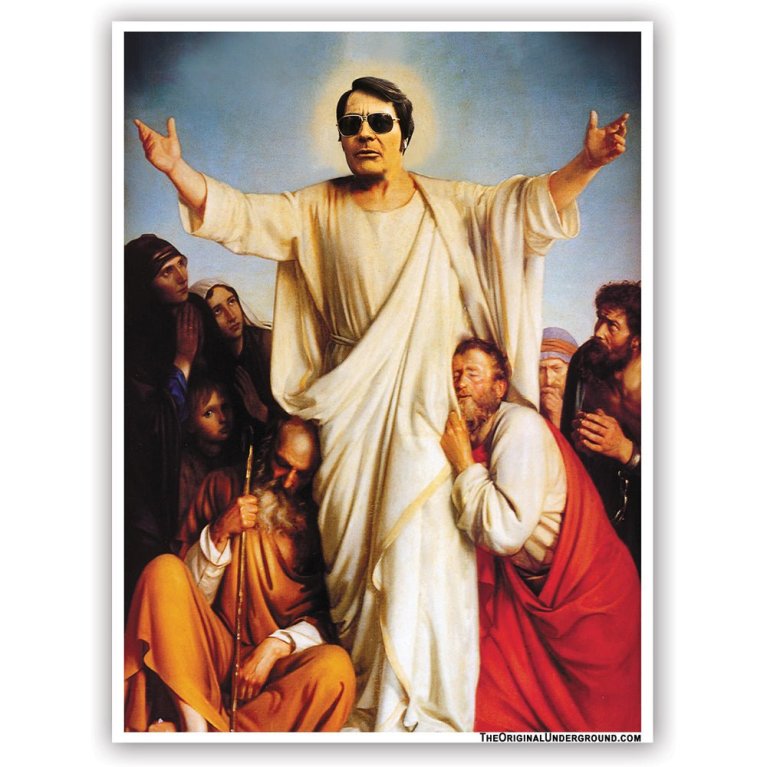
Pastor Jim Jones preaches his counterfeit Gospel before being abandoned by the US government and having to free his cult from bondage with some poison laced Kool-aid.

Seeing someone I thought was a Christian missionary lament how the United States had “abandoned” them was a reminder of how the great have fallen.  There was not a shred of gratitude expressed towards the American taxpayers who financed them nor acknowledgement of the misappropriation of funds that has wearied voters to foreign aid.  But more stunning to me was unholy alliance between this person of faith and agencies of US imperialism.  Since when has the love of Jesus become an extension of the US regime abroad?  Are they of the kingdom, as they proclaim, or agents of empire?

USAID, despite the name, is certainly not a charitable organization and was formed in 1961, at the height of the Cold War, with an aim of promoting the interests of the US political regime.  That’s fine.  But it has long ago gone off the rails even as far as what it was originally imagined.  The Soviet Union had fallen and the Federal agency created to oppose it morphed from something most would support into a beacon of wokeness—pushing transgenderism and abortion.

Break the Yoke of Fraudulence 

The reason why USAID is being dismantled is because we can’t sort the legitimate from illegitimate function of the agency.  Sure, it may help people in need, but funding it also is enabling of evil and maintained through a system of coercion we call taxes.  Anything good that it did can be done through other means.  This functional fixedness of those who depend of government, especially on the part of those professing Christ, makes me wonder where their faith lies and what their actual mission is.

The merger of a Christian charitable cause with government doesn’t purify government—it taints the witness:

Do not be yoked together with unbelievers. For what do righteousness and wickedness have in common? Or what fellowship can light have with darkness?  What harmony is there between Christ and Belial?  Or what does a believer have in common with an unbeliever?  What agreement is there between the temple of God and idols? For we are the temple of the living God. As God has said: “I will live with them and walk among them, and I will be their God, and they will be my people.” Therefore, “Come out from them and be separate, says the Lord. Touch no unclean thing, and I will receive you.” (2 Corinthians 6:14-17 NIV)

The accusations of “Christian nationalism” against those who want a government that performs basic functions were always just a smear by those in alliance with imperialism and Godless globalism.  While I’m not a fan of God and country, at least the flag waving religious patriot knows there is a difference between their Christian mission and secular state.  The left, by contrast, confuses these categories and would have social program replace true charity and community aid.  In one case you have those who may tend to overreverence nation, but in the other there are those who truly represent empire and yet tell us they their only  citizenship is the kingdom of heaven.

The truth is that the ‘Christian’ left is simply the left merely wearing the words of Christ as a disguise for ideological agenda.  Those decrying the reduction of empire and return to responsible governance never said thank you to those funding their do-gooderism.  It was, for them, all about holding those “chief seats in the synagogue” and their own glory as humanitarians.  They may speak against Trump, but then have never uttered a word against the waste, fraud and abuse that has made these broad sweeping cuts popular with common people.

The true Christian spirit is that of a Federal employee who told me about the enormous amount of inefficiency and waste in his own agency and—while making no profession of faith—supports the effort of DOGE knowing it may impact his employment.  That, to me, is someone who understands self-sacrifial love more than someone feeding the poor on another person’s dime and then going to social media to complain when their funds are cut.  They’re grandstanding.  While my Federal employee friend is a truly humble public servant who is grateful and not biting the hand that feeds him.

None of this to say this “abandoned” former hero of mine is a bad person.  They clearly are using their abilities to help other people in desperate need.  I applaud that.  And yet their public statement betrays.  There is an attitude or spirit there that is different from Christ.  I would much rather they just be a secular humanist—subscribed to partisan leftist politics—and own it.  They should just admit that they’ve abandoned faith in Jesus and are looking for a worldly system.  Judas Iscariot is the patron saint of faithless social justice, guilt trips and envy—when you betray your calling just own it.