“Why Don’t Mennonites Pay Taxes?” And Other Similar Questions…

Standard

Growing up conservative Mennonite and going to a public school opened me up to many questions about my religion. However, while these inquiries were presented in form of a question, they often came off as statements:

“Hey, don’t Mennonites have horse and buggies, where’s yours?”

“Why don’t Mennonites pay taxes?”

Understand, this wasn’t intended as obnoxious, this was in elementary school and these classmates were genuinely curious. They were trying to take what they knew about Mennonites (or thought they knew) with what they observed in me and reconcile the two. I suppose these could be called “micro-aggressions” according to the currently popular terms, but I prefer a more gracious explanation.

Still, while I prefer to be gracious, the presumptions still annoyed me. This exposure might explain my sometimes strong visceral reaction to being pigeonholed in a debate. It might also have contributed to my desire to be a non-conformist in a culture that took pride in being non-conformed and did things a little different from other Mennonites. I’ve always wanted the right to speak for myself and for that reason have tried to give others the same respect and let them speak for themselves.

Anyhow, I’m pretty sure that any conservative Mennonite who spent time outside of their own religious cloister has experienced much of the same thing. The people asking if they are Amish, those inquiring if they ever considered the possibility there is no God, etc. And presumably, this would make us more careful not to do the same others. But that’s not always the case, as I’ve discovered…

Oh No, Not Again!!!

Since becoming Orthodox I’ve encountered the same kind of presumptions in a different form. This time, rather than public school peers, it is Mennonite family and friends. And it is not that I mind the questions either, but when someone starts with “I know a Catholic…” it reminds of those who cannot distinguish conservative Mennonites from Amish or Old Order Mennonites.

So I’ll start with that one…

“Aren’t Orthodox basically Catholics?”

Yes and no.

The word “Catholic” means universal. In the words of St Paul, there is “one body” (Rom 12:5, 1 Cor 10:17, 12:20, Eph 2:16, 4:4, etc.) and that is what universal or catholic means when applied to the Church. There may be multiple denominations, differences, and divisions within the Church, but there is only one universal Christian body of believers and that is what Catholic means. So, yes, all Orthodox Christians believe in a Catholic church, in that they believe there is only one universal Christian Church—that is what Biblical tradition tells us and that is what we must believe is true.

However, no, despite some similarities, we are not *Roman* Catholic. The early church had five patriarchs, one in Jerusalem, one in Alexandria, one in Antioch, one in Constantinople and another in Rome. These were geographic centers and separate jurisdictions of the early church and all were basically in agreement. However, in a similar fashion to how Amish split from other Anabaptists, there was a “Great Schism” in 1054 between the four patriarchs of the “East” and the Roman “West” over a variety of issues—including Rome’s unilateral addition to the creed (called the “filioque“) and the elevation of Papal power.

The Roman side veered towards more authority being granted to “Peter’s seat” in Rome. The Orthodox, by contrast, put more emphasis on maintaining Church tradition both written and spoken (or Orthodoxy) and hold that Peter was the “first among equals” rather than the “Vicar of Christ” in the way that the Romans do. This is a very significant difference of perspective, yet Orthodox and Roman Catholics do recognize each other at some level despite not being in Communion together. Both the Orthodox East and Roman West are Catholic in the sense they are parts of the universal Church, but they are not the same.

“Do Orthodox worship Mary?”

One of the first things a non-Orthodox will notice when entering an Orthodox sanctuary is the many pictures. These are called “icons” (after the Greek word for “image”) and are a visual representation of various saints, scenes, etc. This is a Christian tradition back to depictions in the Catacombs, there are icons of many virtuous Biblical characters, and of those most prominently displayed are those of Jesus and Mary the mother of Jesus. There is also mention of Mary, the mother of Jesus, “with the saints” throughout the divine liturgy and special honor is given to her.

However, Mary, while venerated (or honored) as the mother of our Lord, is never worshipped by an Orthodox Christian. Worship is only for the Trinity (Father, Son, and Holy Spirit) and all others are honored for their various roles. Mary’s role is more significant because her body was quite literally the ark of the new covenant. That is why Mary knew, early on, that “all generations will call me blessed” (Luke 1:48) and why Elizabeth (who were are told was “filled with the Holy Spirit”) loudly proclaims: “Blessed are you among women, and blessed is the child you will bear!” Nowhere in Scripture do we have a similar proclamation made and it is only right that the mother of Jesus is recognized by us in the same manner that she is by Elizabeth.

For Jesus to be fully man he needed a mother and his mother was Mary and that is why we celebrate her role. But that honor is not worship. In Chrismation, one has to make agree and make clear that their recognition of Mary and the saints in form of icons is “not unto idolatry” but for sake of “contemplation” and so that “we may increase in piety, and emulation of the deeds of the holy persons represented.” It is no more idolatry to venerate Mary and the saints than it is to have pictures of your grandparents on the wall or to speak of your own mother glowingly on Mother’s day or to treat your own children or spouse differently than other people. There is a vast difference between honor and worship.

“Why aren’t there Orthodox missionaries?”

This one caught me off guard. First off, every Orthodox Christian is (borrowing the words of Charles Spurgeon) “either a missionary or an imposter” and by this, I mean every member of the body of Christ is sent into the world as his representative. Sure, not every Christian is sent abroad in the manner of Hudson Taylor, but every Christian is called to be an ambassador for Christ (2 Cor. 5:20) and should do this wherever they are in the world. Secondly, Orthodox Christians, from St Paul onward have journeyed physically to spread the Gospel to the four corners of the world. Again, not all traveled to far away places, but every Orthodox believer is a missionary and there are no exceptions.

Some of the confusion of my Mennonite friends (who more or less proclaimed that Orthodox lack missionaries) could a product of Evangelical Protestantism and the influence this movement has had on defining their current practice. It seems many under that influence see missionary service as an activity that Christians do rather than an all-encompassing lifestyle. In other words, according to this mindset, one is only a missionary when shoving a tract in the face of an unsuspecting passerby or when they go with a group to do a project in a country that could use jobs more than donated labor. And yet, while that may be a part of what missionary work entails, this too is how we are to proclaim the good news:

“Slaves, obey your earthly masters in everything; and do it, not only when their eye is on you and to curry their favor, but with sincerity of heart and reverence for the Lord. Whatever you do, work at it with all your heart, as working for the Lord, not for human masters, since you know that you will receive an inheritance from the Lord as a reward. It is the Lord Christ you are serving.” (Colossians 3:22‭-‬24 NIV)

And, as far as Orthodox being missionaries in the forms more celebrated, there are many powerful examples of wonderworkers and martyrs for the faith. Orthodox don’t just travel to tropical paradises, do fun projects, and then jet back home again (back to their privileged lifestyles) after a few days or couple years. No, the Orthodox live in some of the most hostile places for a Christian to live and many have become the truest witness of Christ—they have died as martyrs for their faith, in this century as much as any other, and not only in the history books. It was not Protestant missionaries or Evangelicals being brutalized and beheaded by ISIS.

Furthermore, having entertained (very briefly) proselytizers of a sect widely viewed as heretical (even by Protestants) and having considered the words of Jesus about missionaries that make their converts twice as damned as themselves (Matt. 23:15) or those who will cry “Lord, Lord, have we not” when standing condemned in front of Him (Matt. 7:21-23) and listing their missionary works as if that is their salvation, there is something to be said for correct teachings and practice. The Orthodox, while all over the world (including Africa, where a baptism of 556 took place), seem to be more concerned with quiet and sincere obedience than they are with loud and proud professions.

“I’ve heard Orthodox don’t believe in being ‘born again’ experience, is this true?”

Conservative Mennonites, like other Evangelicals, tend to put much stock in a “born again” salvation experience. They take a phrase out of an analogy Jesus used (while speaking to Nicodemus in John 3:1-20) to explain spiritual transformation that must take place before someone can enter the kingdom of God. He likens being born of the Spirit to the wind, it is something mysterious, and then foretells his dying on the cross by likening it to the brass serpent Moses raised in the wilderness that healed those who looked upon it. And, yes, there is an experience, at the foot of the cross, for those who look up to Jesus and cry out for God’s mercy to them as a sinner.

However, salvation is not simply saying something and having an emotional experience attached or a once and done event, there’s so much more. We are told in the letters of St. Paul to “work out your salvation with fear and trembling” (Phil. 2:12) and then also that we are saved by grace “through faith” and as a “gift from God” (Eph. 2:1-10) rather than by our righteous works, which (with many other Biblical texts) could seem to present a contradictory view of salvation—splitting Protestants into competing camps of works versus faith, eternal security versus potentially losing our salvation, or Calvinist and Armenian. Meanwhile, Orthodox Christians avoid this debate entirely with a view of salvation that transcends easy categorization. We are saved, being saved, and will be saved so long as we continue to believe.

The Orthodox see salvation as a direction, not just a destination, as an intentional alignment with God’s perfect will and the choice we make daily in following after Jesus. In other words, salvation is less about declaring oneself to be “born again” or a singular event in time that we look back on and more about taking up our cross. Salvation is not a mere once-and-done transaction for them, it is a continuous relationship and being in Communion together with the body of Christ. So, yes, we should all be “born of the Spirit” and yet we should also be connected to the vine (John 15:1-8) or we will die as spiritual babies and never bear the fruit of salvation. Ultimately salvation is not a past event or a promised future reward, it is something we choose every day in our being faithful to God and living out the commitment to love each other.

“If we make every effort to avoid death of the body, still more should it be our endeavor to avoid death of the soul. There is no obstacle for a man who wants to be saved other than negligence and laziness of soul.”

+ St. Anthony the Great, “On the Character of Men and on the Virtuous Life: One Hundred and Seventy Texts,” Text 45, The Philokalia: The Complete Text (Vol. 1)

“I know an Orthodox and…”

It is one of the most annoying statements. Annoying because it is usually followed by some sort of negative characterization which they then use their anecdote to generalize about the entire two millennia of Orthodox Christianity and a church made up of hundreds of millions of people. It is a statement many Mennonites have encountered as well, which makes it all the more annoying when the same thing in slightly different form comes from the mouth of a Mennonite. I recall a time, broke down while driving truck, when the service technician (who didn’t know I was Mennonite) went on a long rant about some Mennonites he knew and how hypocritical Mennonites are, etc. Of course, his criticisms weren’t entirely incorrect nor are many of those leveled against the Orthodox (we don’t claim to be a church of perfect people) and yet they were definitely unfair to use as a basis to judge the entire group.

This tendency to remember their worse examples and our own best is a human universal. It is something called in-group-out-group-bias which means we tend to recall good examples of our own group (minimizing our bad) and bad examples of other groups (minimizing their good) or, in a word, favoritism. But this is especially true where the perfect church myth is prevalent or there is a lack of contemplation, introspection, and ownership. The smaller a group is, the easier it is to imagine that you are not like those others—those who do not live up to your own personal standards—and forget that a judgmental, divisive and prideful spirit is as sinful as anything else. Pointing out the faults of others is never a good defense. We should recall the story Jesus told about the confident religious elitist who thought only of his own righteousness in comparison to others and the humble man who begged only for mercy in his prayer:

To some who were confident of their own righteousness and looked down on everyone else, Jesus told this parable: “Two men went up to the temple to pray, one a Pharisee and the other a tax collector. The Pharisee stood by himself and prayed: ‘God, I thank you that I am not like other people—robbers, evildoers, adulterers—or even like this tax collector. I fast twice a week and give a tenth of all I get.’ “But the tax collector stood at a distance. He would not even look up to heaven, but beat his breast and said, ‘God, have mercy on me, a sinner.’ “I tell you that this man, rather than the other, went home justified before God. For all those who exalt themselves will be humbled, and those who humble themselves will be exalted.” (Luke 18:9-14)

So, anyhow, maybe you know an Orthodox Christian and can only recall bad things about them. But I probably know a few more and can tell you that they are just as sincere as any conservative Mennonite or other Evangelical I’ve met. Maybe you know some Orthodox who do not live to your own religious standards or can point to a historical blemish or two from a thousand years ago? Well, I’ll raise you one pedophile ordained by a Mennonite church in the past decade (here’s a list of some other Mennonite sexual abusers, if that’s not enough) and the Münster rebellion. Every denominational group has their less than celebrated moments and members, I can assure you of that. And if a group is too small to have a history of mistakes, that is not a great strength, it is a weakness, it only means they are more vulnerable. So “let he who is without sin cast the first stone” or maybe we should just take the advice of Jesus to be humble about ourselves and understand our own continual need of God’s mercy?

The Orthodox do not run from their history by starting a new denomination (or ‘non-denominational’ group) every time there’s a failure, they have their greater and lesser examples like every other group. But one thing that can be said is that they have maintained their unity centered on Christ and keeping the traditions of the Church from the time of the Apostles to the present moment. Fr Anthony, the Antiochian priest who served during my Chrismation, can trace his ordination all the way back to Peter and the first Gentile church, the church of Antioch (Acts 11:19-30) where believers were first called Christian. There is a great wealth of history to draw from, some cautionary tales, and many who were faithful until the end. Like the church that Paul preached to, the Church today is by no means perfect and yet, as Jesus promised, the “gates of hell” have not prevailed against the Church he founded.

For all of my non-Orthodox friends, the door is open, all people are welcomed, and there are good answers to questions for those who have them. There is truly a wonderful diversity within Orthodoxy, and a beauty of traditions—traditions packed with deep meaning—that span thousands of years. This is not something that one can begin to summarize in a blog post. There are volumes written and many more yet to be written about the Church.

But the best way to start learning about Orthodoxy is first-hand—to come and see.

Turmoil and Theosis

Standard

There are those unsung heroes—those people to whom we owe a debt of gratitude and yet never could repay for their contribution to our lives. For me, there are many on that list. However, there is one woman in particular whose witness of few words was a seed. I wanted the peace that she embodied. But, at the time, I could not escape the turmoil in my heart. Only with the transition out of the church of my youth to a better place has the fruit of her influence has become clear.

A Bull In the China Shop

Years ago now I received an invitation to a new web forum. The site “MennoDiscuss” was created by a guy named Hans Mast and was dubbed “a place where Mennonites (and others) can discuss anything” in the tagline. I loved the idea. I was soon one of the first members of the board and was determined to make the endeavor a success.

I can’t recall exactly what I had expected going in. But early on it became very evident that MennoDiscuss would be a place where ex-Mennonites (and the otherwise) disaffected would come to argue with those of us still content with the denomination we were born into. And, being that I wasn’t afraid of debate (although, oddly enough, I dislike conflict) I jumped right in—playing the role of chief Mennonite apologist for some and being a real annoyance to others.

My zeal, both my desire to drive traffic to the site and need to defend my religious peers, led to me being one of the most prolific posters on the site and also often put me in the center of many controversies. My initial carefree (or careless) attitude soon led to a reputation and it is only a small transition from being engaged in conversation to feeling embattled. I took on the critics, yet I was not the “good Mennonite” who plays nice either, I believed turnabout was fair play and would often try to fight fire with fire.

Initially, despite being intense and a little too argumentative, my participation had mostly been fun and games for me. However that all changed when a personal tragedy knocked my spiritual feet out from under me and left me feeling betrayed by those whom I had assumed would be there for me and bitter at God. It was at that point things went very badly online as well. I was hurting and wanted answers for my pain. I needed help. But all I seemed to get was contempt and criticism.

The Calm In My Storm

There was one person different from the others. She offered me no advice. I can’t recall her saying much at all. But there was something about her spirit. She did not judge me. She let me speak without reminding me of all my past failures. I could open up and be honest with her in ways that I could not be with others for fear they might stab me in the back. She had been hurt by Mennonites yet didn’t seem to come in with an agenda.

Her name was “theosis” (or at least that was her screen name) and offline went by Martha. I do not know the details of her life, but she had been a convert to the Mennonite tradition before eventually finding a home with Orthodox Christians.

There were other Orthodox converts on the site. However, they were of the variety of converts who may have accepted Orthodox theology and practices, but have yet to grasp the attitude—or, in other words, “Ortho-fascists” as they are affectionately (or not so affectionately) known as by other Orthodox. Theosis, by contrast, was not aggressive or argumentative, she had a peaceable spirit and something quite a bit deeper than the judgmental ‘non-resistance’ or militant ‘pacifism’ of many Mennonites.

Mennonites tend to take the role of “peacemaker” and turn it into something forcible and even meanspirited. They might never pick up arms in defense of a nation or theoretically refuse to defend their families from a hypothetical attacker, but some will passive-aggressively resist and gossip about their real enemies while pretending that they have none. Mennonites are good at niceness, sometimes putting a smile on their face while harboring ill-feelings, because that is what the culture requires.

But theosis was different. She seemingly saw something in my antics others could not or at least she was peaceable. If I had to guess her perception was due to her own pain. But, unlike me, where I raged against fate, she accepted her lot in life and had faith. While fundamentalist Mennonites tend to see peace as something to shove down your throat, she embodied peace and embodied it in a way that would temporarily calm my storm.

I desperately wanted what she had and yet didn’t know how to get there.

What Theosis Means and My Journey Since

My first guess, as far as the meaning of theosis, would’ve been something like “theology” and “sister” going by the fact that the only theosis I knew was a female Christian. But silliness aside, given my respect for Martha, I finally did Google the word “theosis” and found an intriguing theological concept. Theosis, as it turns out, is the Orthodox description for the ultimate goal of Christianity and that being perfect oneness with God.

At the time the term intrigued me. But I had bigger fish to fry rather than try to sift through Orthodox theological descriptions and kept it filed under delightful (but otherwise useless) oddities. Becoming like God is a moot point when one is struggling to even believe in God. Besides that, theosis (otherwise known as “divinization” or “deification”) seemed way too tall an order for my Mennonite mind and was probably heretical. Still, it stuck in the back of my mind as a concept and that’s where it stayed percolating for years.

My turmoil began to subside as I came to terms with the unexpected loss of Saniyah and the hopes tied to her. During this time I made a brief return to MennoDiscuss (after a hiatus) and left after feeling that I had done my part to restore relationships there and could move on. And, more significantly, I had a spiritual experience, an epiphany about faith, that helped push me to this point where I could move on.

In short, I discovered faith is something God does, a gift of salvation, a mysterious “quickening” and spiritual transformation, rather than something proved through science, apologetics, and reason—it was not earned through my works of righteousness or religious efforts. I could finally rest in grace, be empowered by the Spirit and be changed from the inside out. That newfound confidence is what led me to pursue “impossibly” in faith and, after another period of turmoil when my “hope against hope” was not reciprocated, eventually took me beyond my Mennonite roots.

As I read through Paul’s writings, as one now spiritually alive and with eyes opened a bit more than before, a picture of theosis began to emerge out of the text. It was a marvelous thing, and a beautiful paradox of faith, that Jesus became man so that we could join Him in perfect oneness with God. That is what it means to be adopted as a son or daughter of God—putting on the divinity of Jesus Christ and being made into an incarnation of Him. This is not to be equal to or replace God, but rather to be in perfect Communion with Him and a true embodiment of His life-creating Spirit.

Theosis, the True Promise of Salvation

Theosis is a theological concept both simple and profound. God became man so that we could follow in the example of Jesus and go beyond what is possible through mere religious devotion:

“We are not stoning you for any good work,” they replied, “but for blasphemy, because you, a mere man, claim to be God.” Jesus answered them, “Is it not written in your Law, ‘I have said you are “gods”’? If he called them ‘gods,’ to whom the word of God came—and Scripture cannot be set aside—what about the one whom the Father set apart as his very own and sent into the world? Why then do you accuse me of blasphemy because I said, ‘I am God’s Son’? Do not believe me unless I do the works of my Father. But if I do them, even though you do not believe me, believe the works, that you may know and understand that the Father is in me, and I in the Father. (John 10:33‭-‬38 NIV)

To claim to be God’s son is essentially to claim divinity or equality with God and, unless you truly are God’s child, is blasphemous.

What Jesus promised the disciples:

“I will not leave you as orphans; I will come to you. Before long, the world will not see me anymore, but you will see me. Because I live, you also will live. On that day you will realize that I am in my Father, and you are in me, and I am in you. (John 14:18‭-‬20 NIV)

And the day he delivered:

I have given them the glory that you gave me, that they may be one as we are oneI in them and you in me—so that they may be brought to complete unity. Then the world will know that you sent me and have loved them even as you have loved me. (John 17:22‭-‬23 NIV)

How Paul explains this:

The Spirit you received does not make you slaves, so that you live in fear again; rather, the Spirit you received brought about your adoption to sonship. And by him we cry, “ Abba, Father.” The Spirit himself testifies with our spirit that we are God’s children. Now if we are children, then we are heirsheirs of God and co-heirs with Christ, if indeed we share in his sufferings in order that we may also share in his glory. (Romans 8:15‭-‬17 NIV)

That is an extraordinary claim. It is to essentially claim the same thing Jesus did and led to his being killed. And, in fact, before Jesus died to make the impossible possible, our calling God “Father” would indeed be blasphemous. This theosis, this divine adoption, is not cheap grace nor earned by our works of righteousness, it is a mysterious transformation that comes from faith and a work of the Spirit—It is partaking in the suffering, death, and resurrection of Jesus Christ.

Where is Martha Today?

Theosis, her full name Martha Ann Hays, passed from this life to the next on December 20th of 2010. She was terminally ill when I knew her and dealing with the same sense of loss all sane people feel when facing certain death. Yet despite this, and excruciating physical pain, she treated me with extraordinary kindness and a love that I did not deserve. Unlike me, constantly trying to figure everything out and win people through theological brute force, she was simply peaceable.

Her terminal illness, colorectal cancer, was very unpleasant and painful. She was still a young woman, in her thirties, when first diagnosed and was no doubt dealing with the weight of broken dreams and disappointment. That is probably why she understood me and had compassion where others did not. I knew she was not well. But she would never complain to me about the things going on in her life at the time.

Martha had never fit into the Mennonite culture and eventually moved on. She learned Russian while in university and later found Orthodoxy (Russian Orthodox) and a parish community in Toronto that loved her. She had many friends in her parish and that including a boyfriend who would be at her bedside. She died peacefully, as she had lived, surrounded by family and friends.

Her funeral, according to one non-Orthodox in attendance, had beautiful music and a worshipful atmosphere.

It is interesting how two people can see the same event through a completely different lens. Another friend (a conservative Mennonite who knew Martha) commented that her funeral was a “very sad occasion” because allegedly there were more Mennonites than Orthodox in attendance. But an Orthodox Christian knows that is not true. Yes, conservative Mennonites definitely have bodies in the pews at funerals. Yet, even if there are only a handful that can be physically present, an Orthodox funeral is always well-attended. Orthodox believe in the “Communion of saints” or basically the idea of that “great cloud of witnesses” expressed by the apostle Paul in the book of Hebrews.

[07/01: The friend who made the attendance claim has since wrote to make a retraction.]

I believe someone with Martha’s prognosis could greatly appreciate that she was not alone in her suffering and that there was that “great cloud of witnesses” there to cheer her on to the finish line. That is the beauty of Orthodoxy. The Chruch is bigger than the present suffering of those still “militant” and also includes those “triumphant” who have gone on to glory with God. The icons on the wall are there to remind us of that reality beyond us.

Being An Image (or Icon) of God

Then Jesus said to his disciples, “Whoever wants to be my disciple must deny themselves and take up their cross and follow me. For whoever wants to save their life will lose it, but whoever loses their life for me will find it. (Matthew 16:24‭-‬25 NIV)

As is well-known now, I have left my Mennonite religious culture and have become an Orthodox Christian. But until now I have not mentioned theosis and her contribution to that decision. Martha’s peaceable witness was a seed, it was later watered by Fr. Anthony with his similar spirit a and genuinely fatherly care and has been nourished by the Church. It is a life that continues to grow in me. There is a great beauty in Orthodox worship that I have not found elsewhere.

I do not go to church as a family reunion or to hang out with friends anymore. I go for healing and spiritual renewal, to experience God through worship, to be one with Jesus in body and Spirit. I go to be in that “great cloud of witnesses” of a Church that spans two millennia and those icons on the wall are there to remind us to remain faithful until the end.

Orthodoxy is not a “seeker-sensitive” church, we do not change with the winds of modern culture, we do not fill our pews with those seeking entertainment or easy answers. We believe that the Christian life is one of trials, tribulations, loneliness, hardships, suffering, and salvation by way of the cross. But we also find there is a great peace in knowing that our turmoil is temporal and eternal life awaits.

We die to self so that we can live in perfect oneness with God. Martha died, like Jesus, so that I might live. And I must die, so you whom I love may also live.

That is God’s economy at work.

That is poetic justice.

That is theosis.

Mennonite Ordinances and Anabaptist Disregard for Sacraments

Standard

A good friend of mine, a Mennonite, was quite upset with a particular social media provocateur (who self-identifies as marginally Mennonite) and his attack on Holy Communion—which he described as being “basically symbolic cannibalism” and “a man-made ritual” that “can be left on the shelf with no deleterious consequences.”

Then he goes on to say:

“I urge all liberal-minded Mennonites to just stop eating Jesus’s flesh and drinking his blood. It holds no salvific power. There’s nothing magical or mystical about it. Nor does it earn brownie points with God. Further, it’s a major turn-off to people outside the church bubble (for those who care about how the church is perceived by outsiders).”

Most Mennonites, even the mainstream ‘liberal’ types, would reject this as profane and ignorant babble. It is an attack on the very foundation of Christian practice and makes me question if this individual is truly concerned with winning people “outside the church bubble” or the future of the church. His religious ideology, having myself sampled some of his writing, seems to be: Nothing is sacred.

What is interesting about this individual is their claim to be an Anabaptist radical. This claim might rankle conservative Mennonites (especially those who see themselves as the true owners of Anabaptist identity) and yet these words spoken against sacraments are truly quite consistent with the words of a feisty Dutch Anabaptist widow (recorded in Martyr’s Mirror) in response to a question about Holy Unction. This is what she said: “Oil is good for salad, or to oil your shoes with.”

I guess nobody told her “Christ” means anointed one?

Whatever the case, most modern Mennonites do not take such a cavalier attitude towards the sacred and are a bit more Orthodox than their radical roots. In fact, Mennonites more formally reintroduced sacraments (albeit in different description) by their acceptance of the “seven ordinances” listed by Daniel Kauffman 125 years ago: Baptism with water, Communion, Footwashing, Prayer Head-Veiling for the Women, greeting with the Holy Kiss, anointing with Oil for the Recovering of the Sick and Marriage.

Kauffman’s ordinances represent a reversal of the Anabaptist woman’s hubris. He obviously saw the use of oil beyond the application to shoes and salads. But, through his use of different language and by his additions and subtractions (Women’s Head-Veils, Holy Kiss, Footwashing gave in place of Chrismation, Confession, Ordination) from the original listing of seven sacraments, he still maintained a deliberate distance from the established tradition of the Church.

What are sacraments?

Sacraments, simply put, are the “sacred mysteries” of the church. It is also important to note that Orthodox Christians, while they do recognize the seven sacraments listed by Roman Catholic, do not believe the sacraments are limited to just the seven listed and see everything the church does as a sacramental, according to to the OCA website: “All of life becomes a sacrament in Christ who fills life itself with the Spirit of God.”

“Whoever eats my flesh and drinks my blood remains in me, and I in them.” (John 6:56 NIV)

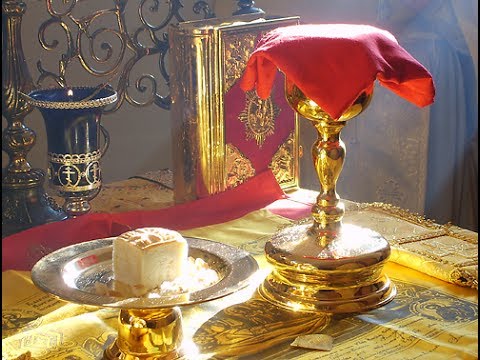
Of the sacraments, Communion (called the “Holy Eucharist” (the word ‘eucharist” means thanksgiving) is the “sacrament of sacraments” for Orthodox Christians and the center of Church life.

Holy Eucharist is simply taking Jesus at his word:

And [Jesus] took bread, gave thanks and broke it, and gave it to them, saying, “This is my body given for you; do this in remembrance of me.” In the same way, after the supper he took the cup, saying, “This cup is the new covenant in my blood, which is poured out for you. (Luke 22:19-20 NIV)

Jesus clearly calls the bread his body and describes the cup as being the “new covenant” in his blood.

It is interesting that many Protestant fundamentalists—who pride themselves in being Biblical literalists, and modern self-identifying Anabaptists—who insist that they take Jesus at his word more than others do, come to passages like that above, then suddenly start to hem-and-haw and try to explain around what is plainly said.

Perhaps their discomfort is the same as is described in the following account:

Jesus said to them, “Very truly I tell you, it is not Moses who has given you the bread from heaven, but it is my Father who gives you the true bread from heaven. For the bread of God is the bread that comes down from heaven and gives life to the world.”

“Sir,” they said, “always give us this bread.”

Then Jesus declared, “I am the bread of life. Whoever comes to me will never go hungry, and whoever believes in me will never be thirsty. But as I told you, you have seen me and still you do not believe. All those the Father gives me will come to me, and whoever comes to me I will never drive away. For I have come down from heaven not to do my will but to do the will of him who sent me. And this is the will of him who sent me, that I shall lose none of all those he has given me, but raise them up at the last day. For my Father’s will is that everyone who looks to the Son and believes in him shall have eternal life, and I will raise them up at the last day.”

At this the Jews there began to grumble about him because he said, “I am the bread that came down from heaven.” They said, “Is this not Jesus, the son of Joseph, whose father and mother we know? How can he now say, ‘I came down from heaven’?”

“Stop grumbling among yourselves,” Jesus answered. “No one can come to me unless the Father who sent me draws them, and I will raise them up at the last day. It is written in the Prophets: ‘They will all be taught by God.’ Everyone who has heard the Father and learned from him comes to me. No one has seen the Father except the one who is from God; only he has seen the Father. Very truly I tell you, the one who believes has eternal life. I am the bread of life. Your ancestors ate the manna in the wilderness, yet they died. But here is the bread that comes down from heaven, which anyone may eat and not die. I am the living bread that came down from heaven. Whoever eats this bread will live forever. This bread is my flesh, which I will give for the life of the world.

Then the Jews began to argue sharply among themselves, “How can this man give us his flesh to eat?”

Jesus said to them, “Very truly I tell you, unless you eat the flesh of the Son of Man and drink his blood, you have no life in you. Whoever eats my flesh and drinks my blood has eternal life, and I will raise them up at the last day. For my flesh is real food and my blood is real drink. Whoever eats my flesh and drinks my blood remains in me, and I in them. Just as the living Father sent me and I live because of the Father, so the one who feeds on me will live because of me. This is the bread that came down from heaven. Your ancestors ate manna and died, but whoever feeds on this bread will live forever.” He said this while teaching in the synagogue in Capernaum.

On hearing it, many of his disciples said, “This is a hard teaching. Who can accept it?”

Aware that his disciples were grumbling about this, Jesus said to them, “Does this offend you? Then what if you see the Son of Man ascend to where he was before! The Spirit gives life; the flesh counts for nothing. The words I have spoken to you—they are full of the Spirit and life. Yet there are some of you who do not believe.” For Jesus had known from the beginning which of them did not believe and who would betray him. He went on to say, “This is why I told you that no one can come to me unless the Father has enabled them.”

From this time many of his disciples turned back and no longer followed him. (John 6:32-66)

With this, Jesus went from being an interesting teacher to being some kind of mystical weirdo and possible lunatic. It is also little wonder that pagans brought accusations of child sacrifice and cannibalism against early Christians. (Sorry, Charlie, it takes no creativity whatsoever to agree with sacrilege that dates the 2nd century AD and it is not a big surprise if this “hard teaching” continues to turn people back from outside the Christian bubble.) Not everyone can believe this claim then nor do all believe now. But that is what Jesus said and is what the faithful have taught for two millennia. The bread and wine encapsulate the sacred mystery of human relationship with the life-giving Spirit and this practice of Holy Communion is a necessary part of the Church together being the incarnation of Christ.

Human knowledge and personal ideals cloud spiritual discernment.

The presumption of absolute knowledge, which is the cardinal sin of the rational spirit, is therefore prima facie equivalent to rejection of the hero—to rejection of Christ, of the Word of God, of the (divine) process that mediates between order and chaos. (“Maps of Meaning,” Jordan B. Peterson)

Unbelief takes many forms. Not everyone leaves the fold when faced with something that seems irrational to them. We know Judas remained on the margins despite his disillusionment with Jesus and his doubts eventually led to betrayal. We also know Peter’s faith seemed primarily a delusion about an earthly kingdom where he would be at the side of an important political leader and the unwillingness of Peter to accept the ultimate sacrifice (and of his personal ideals) led to denial and a sharp rebuke from Jesus:

From that time on Jesus began to explain to his disciples that he must go to Jerusalem and suffer many things at the hands of the elders, the chief priests and the teachers of the law, and that he must be killed and on the third day be raised to life. Peter took him aside and began to rebuke him. “Never, Lord!” he said. “This shall never happen to you!” Jesus turned and said to Peter, “Get behind me, Satan! You are a stumbling block to me; you do not have in mind the concerns of God, but merely human concerns. (Matthew 16:21‭-‬23 NIV)

The suffering and death of Jesus was something Peter couldn’t reconcile with his own ideals. It was a horrible ending to his hopes that would need to be fiercely resisted. Peter treats Jesus like I would a friend who is depressed and needed a pep-talk. Unwittingly he used the same reasoning that had tempted Jesus in the wilderness. Jesus faced a hard choice, he needed to be courageous, focused on his mission, and face death head-on—but Peter was encouraging him to take the easy way out in the same way Satan did earlier.

Peter was guided by his personal ideals and Judas by his human rationality—both men failed to understand the divine mystery unfolding before them—both presumed incorrectly and neglected possibilities that went outside of their own established knowledge.

The whole Gospel narrative is centered on Jesus dying on the cross and conquering death. From a rational standpoint, why couldn’t God just have forgiven our sins and granted us eternal life without sending an icon of himself in the person of Jesus? Surely God can identify with his creation without having to go through a physical manifestation for himself, right?

Was it symbolic?

Was it necessary for our salvation?

Perhaps both and more.

But, whatever the case, we don’t know why there needed to be an “image of God” (Colossians 1:15) or why our salvation is tied to Jesus having the experience of a very literal physical death. All we know is that this going through the motions was important to Jesus and therefore we should not be surprised when our faith requires our participation in rituals that we do not understand. We go through the motions of Baptism and Communion, not because of anything we can prove through human logic and reasoning, but simply because we believe in Jesus and accept a reality bigger than ourselves.

Saying something is *only* symbolic undermines the reason for doing it. One way to rationalize around sacraments is to divide the sacred from the symbol. That is to say, some attack the idea of sacraments by declaring the ritual part of them to be “only symbolic” and deny any actual value in the going through the motions. If that were true, then we should take the advice of provocateur and cease all activities that might make outsiders feel uncomfortable. I mean, if a practice is only symbolic and our ultimate goal is to win converts, why not?

Everything in our life can be deconstructed or explained away as meaningless. Why go to work when everything we accomplish will eventually vanish into dust? Why stay faithful to marriage knowing that sooner or later the end will come and the commitment is forgotten? All of the joy and purpose a person finds in life, depending on perspective, can be reduced to electrochemical activity in the brain and lacking in any true substance beyond that. Reason and logic are useful in debates, but they do not provide an antidote for feelings about the futility of the human experience nor answer the question of why to live.

To say a sacrament is only a symbol is like saying a baby is only a colony of cells or math is just numbers and nothing more. Our lack of understanding the significance of something doesn’t make it any less necessary, valuable or sacred—it only makes us ignorant and unwilling to transcend our own knowledge. From a rational perspective, does being dunked or drizzled in water do anything besides make someone different degrees of wet? Why bother to Baptize, take Communion or do anything if it is only symbolic? If salvation is not at stake and if there is no spiritual healing or real benefit, why even bother to go through the motions?

In Scripture, healing is often tied to physical objects and absurd actions. It is one of those curious patterns throughout the books of the Bible. People are saved from ailments and forgiven by God through various rituals. Like that time when the Israelites were complaining about basically everything, then started to get bitten by venomous snakes, and begged for help:

The Lord said to Moses, “Make a snake and put it up on a pole; anyone who is bitten can look at it and live.” So Moses made a bronze snake and put it up on a pole. Then when anyone was bitten by a snake and looked at the bronze snake, they lived. (Numbers 21:8‭-‬9 NIV)

There is also the story of Namaan, in 2 Kings 5:1-19, who had leprosy and to be healed he was told to do something that makes no sense:

Elisha sent a messenger to say to him, “Go, wash yourself seven times in the Jordan, and your flesh will be restored and you will be cleansed.” But Naaman went away angry and said, “I thought that he would surely come out to me and stand and call on the name of the Lord his God, wave his hand over the spot and cure me of my leprosy. Are not Abana and Pharpar, the rivers of Damascus, better than all the waters of Israel? Couldn’t I wash in them and be cleansed?” So he turned and went off in a rage. Naaman’s servants went to him and said, “My father, if the prophet had told you to do some great thing, would you not have done it? How much more, then, when he tells you, ‘Wash and be cleansed’!” So he went down and dipped himself in the Jordan seven times, as the man of God had told him, and his flesh was restored and became clean like that of a young boy. (2 Kings 5:10‭-‬14 NIV)

Both of those Old Testament cases required “skin in the game” and tied an individual’s healing or salvation to their performing a specific act. There is no rational explanation as to why someone would be healed of leprosy by dipping in a particular river nor why looking at a brass object would cure a person of anything and yet that is what we read.

So what about the New Testament?

This same pattern of healing through odd and seemingly unrelated acts continues. We read how Jesus mixed spit with dirt to heal someone’s blindness (John 9) and how a woman’s touching of his garment healed her:

Just then a woman who had been subject to bleeding for twelve years came up behind him and touched the edge of his cloak. She said to herself, “If I only touch his cloak, I will be healed.” Jesus turned and saw her. “Take heart, daughter,” he said, “your faith has healed you.” And the woman was healed at that moment. (Matthew 9:20‭-‬22 NIV)

Note: Jesus didn’t tell her she was silly for believing that touching his clothes would heal her or otherwise correct her action. No, she is commended for her faith and immediately healed. And, this pattern of healing through actions—through laying on of hands and involvement of objects—did not end with Jesus either. We read about it in the book of Acts as well:

God did extraordinary miracles through Paul, so that even handkerchiefs and aprons that had touched him were taken to the sick, and their illnesses were cured and the evil spirits left them. (Acts 19:11‭-‬12 NIV)

Perhaps we are more sophisticated than they were and thus can dispense with this kind of sacramentalism?

Truly, if there is no spiritual value to it, why should we even bother going through the motions of Baptism, Communion, etc?

We can try to turn church life into a totally rational experience and do away with all the mystical nonsense. We can re-label sacred mysteries—call them symbols, ordinances, ceremonies, signs or whatever. We can minimalize the sacraments and continue to water down their significance, condition ourselves in a way that will make the keeping of these practices optional, downplay partaking of the body and blood, do it only twice a year—eventually stop attending services altogether because it is irrational.

A church without sacraments is not a church.

The complaint of Protestants and Anabaptists was not completely invalid. Roman Catholicism had blurred the lines between sacrament and their own institutions and systems. Unfortunately, this led to an overreaction that did not always distinguish well between what was corrupted and the sacred mysteries themselves. The end result of this “reformation” has been disastrous disunity and disintegration of the church—which is not a sign of spiritual life.

One thing I’ve noticed as I’ve entered into Orthodoxy is the strong emphasis on church unity and incarnation. The emphasis is on the special spiritual connection between all Christians (past, present, and future) through partaking of the sacred mysteries together. It is, in fact, through sacraments that the church becomes necessary in the life of the individual. Baptism, Communion, Chrismation, Confession, Ordination, anointing with oil and Marriage are things we do together as a church and underscore the need for God, the things he has instituted and each other.

If the only point of sacraments were only to push against our own human rationality (which is often faulty and is always finite) and seek what is greater, then there is great value in them.

Sacraments bring us together, they give us a common identity and point us to truth beyond our own understanding. In the various examples of miraculous healing in Scripture there was often no logical connection between the action taken (or required) and the result. They didn’t know how it worked, they simply had faith, obeyed and were healed. Perhaps the only way to gain spiritual understanding is to let go, to stop depending on our own limited knowledge and start to depend on something that is greater?

Perhaps it is to counter the heresy of Gnosticism, both ancient and modern?

Whatever the case, to try to rationally explain a sacred mystery entirely misses the point. Furthermore, there is no need to separate or distinguish the healing God does in our lives from the sacraments themselves. We know that the thief on the cross was saved just for saying “remember me” and his faith in Jesus. But that doesn’t mean our own faith won’t require us to sell all we have like the rich young ruler or dip in a muddy river like Naaman. It doesn’t mean we can replace sacraments with our mere mental assent to a proposition and be healed or saved from our sins either.

The words of Jesus are useless to those who do not have faith and, likewise, sacraments are of no benefit to those who do not believe in them. The church should welcome all who wish to repent of their sins and participate in the sacred mysteries. But it does not seem at all reasonable or rational for the church to cater to those who do not hope to transcend themselves, their own experience and knowledge.

In the end, one can call sacraments by any other name and still have a church—but a church without sacraments is really only a social club and not a church.

The Need For Faithful Fathers

Standard

My memory is, generally speaking, an amorphous soup—don’t expect me to remember your name, important historical dates, or even specific events from my childhood.

However, I can remember particular moments with my father and some of those memories remain quite vivid. One such memory was of a day where I joined him on a job site. I have no idea how old I was. I was a toddler. My dad must’ve had some work up top to do. He could not leave me down below to fend for myself alone. And, therefore, I had to up with him.

So he hoisted me to his back and proceeded to climb those rebar rungs with me hanging on for dear life. I was terrified of heights even as a child. And, even if I was able to someone overcome my fears, I was too young to climb that ladder on my own at that stage. Anyhow, as tightly as I held onto his neck, he’s lucky I didn’t chock him out.

My dad was a construction worker. He built concrete silos (later water tower pedestals and smoke stacks) and as early as I can remember he was always the man in charge. He worked faithfully, out on the road for the first fifteen years of my life, to provide for my mom and us children.

This lanky “hard hat,” a big hammer in the metal loop of his leather work belt, oil and ‘mud’ splattered on his pants and T-shirt, defined manhood for me.

What would my life would have been like without my father?

I’ve recently pondered that question.

My life is completely intertwined in my father’s, determining where his influence begins or ends is impossible.

Would I have had interest in engineering and design had he not brought home blueprints?

My preferences are tied to his.

For example, and another of those childhood memories, my ride in dad’s 1969 Mach 1 Mustang (a wonderful machine powered by a rare “428 CJ” engine with a “shaker” hood scoop) and the impact it had.

It wasn’t actually his car anymore, he had sold it to his brother so he could buy a family car, and I only ever had one ride. But how could I ever forget that lopey idle giving way to a roar as that big block took a deep breath of atmosphere and gasoline?

I was pinned, wide-eyed, to the bucket seat. We accelerated to what seemed like takeoff velocity down that country road and then, when we were turning around, after the most incredible experience of my life to that point, my dad says, “Hmm, it seems to be missing…”

What!?!

It wasn’t even running right and it had redefined my understanding of physics!

Perhaps I would have been a motor head regardless—still there is little doubt that my expectations were formed, in large part, by the loyalties and interests of my father. I’ve only owned Ford powered vehicles. Love for machines is one thing that we share in common, being allowed to drive at a young age was likely a factor in later career choices, and that just one of many things that I owe to my dad’s presence in my life.

As with all hypothetical “what if” senarios, we can really only know what we have experienced and thus I cannot know what I would be without my father’s example. But undoubtedly my dad, being a good and responsible man, one who cared for those who worked under him enough to be at odds with upper management, was a role model for me.

Having no father figure correlates with many problems…

I do not know what I would be had my father decided he was not ready for a family and left. But I have reason to suspect that I would not be better off without him.

There is a strong correlation between absent fathers and poor outcomes in children. Arguably fatherlessness is a more reliable predictor of outcomes than economic status or race. An article about links between fatherlessness and violence in the Baltimore Sun drives home the point:

According to the U.S. Census Bureau, for example, children living without fathers have a 400 percent increased chance of being poor. Only about one-tenth of children living with both parents are living in poverty. The U.S. Department of Health and Human Services also states that drug and alcohol abuse is far greater among children living without fathers.

Again, statistics cannot tell us anything about individuals. There are many very successful men raised in single parent homes and ultimately every individual must choose how to play the hand they’ve been dealt. One can use their own disadvantages (perceived or real) as an excuse not to try or they can overcome and use their experience as a strength.

That said, I was privileged to have two parents, both respectable people, and I have a great deal of gratitude for my father’s choice to remain faithful to my mother and us children.

“Do I have a reason to hate dad?”

I asked my brother that the other day because I was genuinely perplexed as to why there seemed to be anger in my heart towards my dad.

Our minds are complex and thus, even after years of trying to figure out my own mind, understanding how or why my feelings come and go as they do remains a mystery beyond my grasp.

However, no man is perfect and my dad was not without his flaws. And, unlike my younger siblings, I’ve seen him grow up from obnoxious, insecure and sarcastic young man (who would rudely correct my mom’s occasional mispronunciations) to the current gentler wiser version.

My dad is a high school dropout. He was, for the most part, missing the first fifteen years of my life, out on the road working, busy around the house or exhausted. He didn’t play sports. He has never owned his own business, he was never ordained in the church, and for that reason could not pass on the pedigree to his son.

I’ve tried to take responsibility and not blame him for my own failures in romance or otherwise. Still, it only stands to reason that parental influence goes two ways, both good and bad. And, after dropping out of college (due to lack of funds and fear of debt) being out on the road seemed like a curse passed down to me from my father—a fate that I could not escape

Besides that, I couldn’t even complete with my dad in his many areas of strength. It seems my genetic inheritance in some important areas (like physical stature and personality) came from mom. We would often be at odds, me constantly asking “why” as a child and him getting frustrated with my too many questions.

I’m very different from my father and differences often lead to conflict. I’ve spent many years simultaneously respecting and also resenting of my father. While my dad, a quiet man, has offered much in the way of encouragement and praise—all of that can be outweighed by just one of his sighs, eye rolls, or other signs of disgust.

I don’t hate my dad. But there are definitely some areas where I hope to improve upon the foundation he gave me. A man who wants to maintain his status quo, who avoids tedious discussion and theological debates, doesn’t have much to offer in terms of growth in perspective. There are simply limits to how far his guidance can take me.

My longing for acceptance and fatherly pursuits…

A remarkable number of the girls I’ve had serious interest in over the years were daughters of missionaries or pastors. This was not something conscious or intentional on my part, but it seems to be indication of a deeper level awareness of my own limitations and desire to overcome.

Interestingly enough, my dad’s family has many who have traveled the world and are ordained leaders in the church. But my dad was not, he is not noteworthy as a teacher (although he has much to offer) and really could not provide an example to follow in that regard. So, as a result, I had to look outside of my own father’s example and sought someone who would help me.

My pursuit of the impossibly was as much a pursuit of a father’s approval as it was anything else. The man, whose daughter I sought friendship with, had embodied the Mennonite ideal to me and I desired his mentorship as much as his recommendation of me. Unfortunately that was not a role he was willing to fulfill and, frankly, no conservative Mennonite man I’ve met is interested in taking up.

In the Mennonite world fatherhood is reserved for the biological realm. A man feels only responsible for the welfare (spiritual or otherwise) of his own biological children and all others should go to their own parents. What I was asking for, a real mentor and advocate like a parent, was beyond their realm of possibilities—my own deficiencies were tough luck and not their problem.

If there was a time when Mennonite leaders were more open to mentoring and discipling those not their own biological children, that passed with the encroachment of individualism and the abandoning of the Anabaptist community ethic (still alive in Old Order groups) for my-family-first homeschooling cultural and patriarchalism.

A father like Paul was to Onesimus…

Therefore, although in Christ I could be bold and order you to do what you ought to do, yet I prefer to appeal to you on the basis of love. It is as none other than Paul—an old man and now also a prisoner of Christ Jesus—that I appeal to you for my son Onesimus, who became my son while I was in chains. Formerly he was useless to you, but now he has become useful both to you and to me. (Philemon 1:8‭-‬11 NIV)

Paul’s intercession on behalf of Onesimus, in the passage above, is the kind of fatherhood missing in my Mennonite experience and is something desperately needed in the church.

Onesimus wasn’t Paul’s biological son. But it is obvious that there was a depth of commitment there that went beyond talking after church on Sunday, saying “I’ll pray for you” or a few token gestures. No, Paul was clearly fulfilling a fatherly role for Onesimus and willing to be an advocate for him.

The idea of fatherhood in the church, of spiritual fathers, is something foreign to many Protestants and is a concept often met with resistance. Some would take the words of Jesus “do not call anyone on earth ‘father'” (Matthew 23:9) as a strict prohibition against a use of the term to describe a church leader. But I believe, in their legalistic approach, they are missing the point Jesus is making and forgetting that Jesus himself used the term “fathers” to describe Jewish ancestors.

It doesn’t take long, reading the New Testament, to see that the most literal interpretation of what Jesus said in his sermon against religious hypocrisy was not meant to abolish use of a term. If it was, then early church leaders, the same that gave us the Scripture, would be in direct violation to the rule and condemned by the words of Jesus. The writers of the New Testament frequently referred to other Christians as their “children” and most certainly took a fatherly role:

I am writing this not to shame you but to warn you as my dear children. Even if you had ten thousand guardians in Christ, you do not have many fathers, for in Christ Jesus I became your father through the gospel. Therefore I urge you to imitate me. For this reason I have sent to you Timothy, my son whom I love, who is faithful in the Lord. He will remind you of my way of life in Christ Jesus, which agrees with what I teach everywhere in every church. (1 Corinthians 4:14‭-‬17 NIV )

Onesimus was a slave, perhaps born into slavery, and Paul became a father to him—who freed him from both spiritual and physical bondage. That is the kind of fatherhood we need in the church.

Meeting a father…

When I first met Fr. Anthony I was curious about many things and, noting their use of a church calendar, had asked the him if the Orthodox had a day to commemorate the prophet Joel. He wrote me the very next day to tell me that the prophet Joel was on the calendar that day, an interesting coincidence, and that was the beginning of a relationship that eventually led me to the Orthodox church. Fr. Anthony’s humility (despite his academic credentials and being an encyclopedia of knowledge) and willingness to carefully answer questions was something that spoke volumes to me.

There is little doubt in my mind that Fr. Anthony is the reason why Orthodoxy was the direction I went after my Mennonite ideal disintegrated. I know very humble Mennonite leaders, I also know many who are somewhat knowledgeable as well, I have great respect for men like Frank Reed, for example, but somehow Fr. Anthony had all the right answers for my needs. Many ex-Mennonites had tried to convince me to join them and only made me upset, but Fr. Anthony explained in a way that both validated my Mennonite ideal and also took me beyond it.

My biological father is a very good man. I am privileged to be his son and grateful of his example. I could not possibly be where I am today without his faithfulness.

However, my dad is not a philosopher nor interested in many of the questions I would ask and thus left a void to be filled. My prayers for a fatherly mentor went unanswered in the Mennonite church and it is only in a journey of faith that took me beyond Mennonite possibilities that I’ve found a father in the way Paul was to Onesimus.

There are many in the church lacking good fathers and many good fathers who hoard their abilities for only their biological children. Even those who have good fathers could benefit from a concept of fatherhood that revolved around Christian faith and not only what is natural default. The church needs leaders willing to take a true fatherly role. We need men who will love, disciple and be spiritual fathers to all in need.

Do you love God’s children as much as you love your own?

Going From Point A To Point B — Ten Big Steps In the Right Direction

Standard

When I prayed, a few years ago, for the impossible to be made possible, I could not have imagined where that simple statement of faith would take me.

My problem in life has never been lack of ideals or absence of ambition; I have long had a vision for life, a heart for people around the world and desire to serve God’s kingdom. However, knowing how to get from point A (my ideals) to point B (actualization) was always the problem.

The Servant Who Buried His Talent

Some can accomplish their goals, they are able to be very directional and focused. That was my older sister. She was top of her class, all-state in violin, followed through on her vision to be a doctor, is published for her research and has her own clinic. She married while in medical school and has four wonderful children

Me, on the other hand, I quit violin lessons in frustration after a month, struggled immensely trying to concentrate in school, and felt like an underachiever. I wanted to be an engineer. However, I lacked my own ideas where to go. So, I decided to apply to the same college my sister picked from her list.

But, after being accepted, ended up deferring rather than start classes in the fall. And, other than attend my sister’s graduation, I never did go to Elizabethtown College. I continued to work. My jobs (before truck driving) really did not really pay enough for me to get ahead. My dreams had been meput on hold. I felt like the servant who buried his talents and hated it—there seemed to be no answer as to how to rectify my situation.

Spiritual Awakening and New Hope Discovered

Finally, I had an epiphany, I discovered the Holy Spirit. Scripture, the writings of the apostle Paul in particular, became alive. This new understanding made me bolder. My guilt for underachieving dissipated. I now rested in God’s grace. I had worked through the death of Saniyah and found a new hope. I also paid off my house and was now financially secure. There was momentum in my life and it felt good.

Still, with my chronic dithering and endless indecision, I also felt as if I had lost a decade of my life. I was in my thirties and somehow missed my calling in the church, didn’t have a career that felt long-term and was unmarried. To fail at one out of those things was bad enough. But all three? It was unthinkable. Sure, I had life experience, I didn’t feel bound to my past failures either, and yet I still felt held back by an invisible wall.

It was in this midst of my trying that I cried out to be “made right” and began my journey of these past several years. I knew my limitations. My desire was to be taken beyond what held me back and be fully what I was supposed to be. I told God I would crawl across a wilderness of broken glass if need be. I asked for the impossible to be made possible.

These are the things that have transpired since then…

1) I rehabbed a torn ACL. One of the problems with truck driving is that it sedentary and I had gained some weight. I was trying to start an exercise program. But it is really difficult to establish a new habit when you are out on the road and your weekly schedule is always in flux.

Well, the same day I prayed for the impossible, I tore my ACL and was off work for six months so I could do physical therapy.

An answer to prayer?

Tearing my ACL, while terribly painful and a setback, was an opportunity for a change of lifestyle. I came out of physical therapy stronger than ever and made it a priority to continue the exercise routine. I can jump higher than I could at twenty and even after reinjuring that knee.

It seemed that God had answered. That gave confidence to further pursue impossibility and go further to find my missing piece…

2) I asked an ethnic Mennonite girl, in person. Part of the reason I’ve remained single so long is because of my crippling social anxieties. It is difficult to get a date if you are unable to approach the women whom you are most interested in getting to know better and attractive unmarried Mennonite women terrified me.

But I was determined not to make the mistake of not asking in person this time. And, after a conversation with her father (in which he gave me permission to ask, but told me flat out that a relationship with her was an “impossibility” in a follow-up message) I waited for that right time. It came one day when she told me she was going to be cleaning at the church.

I was shaking like a leaf when I got to the church door. I prayed she wouldn’t be startled. She was vacuuming in the sanctuary, she turned, spotted me outside, and smiled. It was a great relief that the conversation went as well as it did. I had expressed myself clumsily and still clearly enough. She was smiling and stepping in. Amazingly enough, she did not run, she said we could talk when things settled down for her and things had gone as well as one could expect.

Ultimately her Mennonite ideals made it impossible for her to love me enough to even have some ice cream and talk with me. But I had triumphed over my fears, I had pursued the impossibility and, in faith, rejecting human understanding and calculations. I was willing to be foolish in faith in a way that those who best embodied my Mennonite ideals could not (or were unwilling to) reciprocate.

3) I wrote a book. In the throes of her rejection a few weeks later, which included the words “You’re thirty years old in Milton,” I began writing. I began writing and eventually ended up with a letter fourteen pages long which explained my thoughts on faith, the development of romantic thoughts, and how, with faith to bind us in unity, our differences would actually make us stronger together.

After weeks and weeks of effort, of writing, rewriting and fine tuning, that letter was never sent. As hostile as she was acting towards me since our talk it seemed an act of futility and the letter still sits on my desk unsent. It wasn’t the right time, I decided, and would only drive her further away. No argument I could make, no matter how sincere or reasonable, would win her heart.

However, the writing of that letter convinced me of something and that is my ability to write. Armed with a new found confidence (and a new found ability to focus thanks to the miracle of an Adderall prescription) I began to write a book. The final product was over 17,000 words long, a book about faith, “Paradox of Faith” and remains unpublished in need of a final edit that has not been completed.

4) I started a blog. The book project led to the blog. It seemed like a good idea to refine my writing and articulation of thoughts. Interestingly enough, my first blogs seemed to attract more atheist and thinkers than my Mennonite religious peers. However, as I began to open up and be more honest about my own struggles, my Mennonite audience grew. The blogs hardest to share, because of the vulnerability they required, had the most significant response.

The most amazing part is that my message went viral amongst Mennonites *after* I left the denomination. It seems quite absurd, the whole time I had held my tongue about my deeper struggles (for fear of being rejected) and my moment of greatest acceptance came with my brutal honesty and with my letting go of my fears.

5) I bought my dream car. When I had asked the ethnic Mennonite, the impossibility, I was driving a mid-90’s Ford Contour that I had pieced together. It’s a long story why, I could certainly have afforded a better vehicle, cars had always been a passion of mine, but my mode of daily transportation really didn’t matter to me at this point and I had bigger things on my mind.

But, after her rejection, and on the advice of my mom, I decided to find a newer car. I started to search the used car lots and ended up with a brand new, 2014, Ford Focus. There truly is something special about being the first owner. This car was a quantum leap over the 90’s model trade-in. Practically speaking, this might have been my best purchase ever because it gets 40mpg and I got it for the same price as two year old used cars of the same model.

That wasn’t my dream car.

Years before this the current deacon of my former church, a youth advisor then, had given me a hard time about my modified (and R-title) 1992 Mercury Cougar. A conservative Mennonite can own farms and businesses worth well over a million dollars, a fleet of trucks, an airplane, a boat, without anyone raising an eyebrow. Yet, buy anything resembling a sports car and there will be disapproval.

My entire life I had curtailed my passions to please my Mennonite peers and live by their culturally conditioned ideals. I had believed that by playing by their rules they would have my back, they would lovingly help me to bear my burdens, and would truly treat me as a brother. As the betrayal became clear, upon realizing that my fears of their disapproval didn’t matter anymore, I was free and ordered a brand new 2016 Shelby GT350.

Still, I had some second thoughts after committing to the purchase. Like Judas, the money corrupted betrayer of Jesus, I questioned the excess, “Wouldn’t that be better spent on the poor?” But decided to follow through and to dedicate this ridiculous car to God, to hold it openly as we should all our possessions, to give rides to those who ask, and sell it as soon as that is required.

You would be amazed at the friendships and opportunities that opened up as a result of my buying that car and not caring so much what a small number of religious hypocrites thought. And, truth be told, not many Mennonites actually cared one way or another anyways, I was merely a prisoner of my own people-pleasing tendencies, and my conscience is clear before God.

6) I finally got the ‘right’ job. One of those things I begged of my Mennonite peers was a chance to be off the road. Some are cut out for solitude, those long hours alone in a truck cab, far away from home, but for me it was like solitary confinement, detrimental to my mental health, and started to lead to some bizarre thoughts. You really cannot know how much you need other people, even as background noise, until they are absent.

Perhaps my nagging paid off, perhaps as a consolation prize for pursuing the impossibility, or just chalk it up to God’s provision; but it was the father of the impossibility who mentioned my name to Titus (Titus, at the time, a Facebook friend, probably the result of my blogging, and not some I had met in person) who was seeking a replacement for himself as a truss designer.

Titus contacted me and the rest is history. So I owe my current job, in part, to the man who refused to recommend me to his daughter and must always give him credit for that. And, a bit over a year in, it truly is a great fit for my natural abilities. My work environment is wonderful and I couldn’t be happier. Finally my passion for engineering has found a place where it is useful.

7) I bought a rental. I really only wanted to live a small and safe life. That was my ideal as a Mennonite. And figured that once I paid my house off I would just build some savings as cushion and kick back a bit. However, a strange thing happened when I finally reached that point where I could just relax.

I owned my home outright. I owed not a dime on that unattainable dream car purchased a year before. I had given up on the Mennonite ideals (and delusions) that had kept me captivated. I could have done nothing besides maintain a lifestyle that had seemed ideal for most of my life. But somehow I ended up buying a cute little house and decided to be a landlord.

I’m not sure where that will lead. But, for the benefit of others, I hope some day to own some land and establish a business somewhere else.

Where, you might ask?

Well, that’s next…

8) I lived entirely for someone else’s good. Ecclesiastes does contain some timeless wisdom. One of them being that everything under the sun is, of itself, vanity and meaningless. I had everything I’ve ever wanted in life. I even had some ridiculous things besides. But lacked that one thing that mattered and that being the love that would last forever.

My vision of a composite of too different individuals in faith and love seemed to have failed. The Mennonite impossibility was engaged (actually, had just started dating, but that is essentially the same as engaged in the conservative Mennonite realm) and deep despair engulfed what had remained of my hopes in the denomination of my youth. I thought to end my miserable life.

Yet, while my faith internally had been extinguished, the purest part of it had survived externally in that seed of hope I planted in someone on the complete opposite side of the world. As I sank under the waves of doubt, she grabbed hold of my hand and refused to let me slip away into oblivion. I had no reason left in myself to live. However, I could not bear to see my precious bhest—the one who had been a little lost sheep when I found her—suffer on account of me.

She asked me to be strong for her and I decided then and there that I would live if only for her good. My intentions had not been romantic when we first started talking a year before and my Mennonite ideals would have prevented a relationship with her before then. But the true impossibility was being made possible in my heart. God had provided as promised.

9) I went around the world. I don’t have the millennial urge for experience. Yes, I wanted to help those in need around the world and was extremely attracted to the missionary zeal of the Mennonite ideal. But I lacked the impetus to do it on my own and hoped that this impossibility would be made possible through a Mennonite who, like my eldest sister, did have the ability to set her objectives and reach them.

Bhest, my precious bhest, gave me that clear direction of where I needed to go. I purchased my ticket in the spring of last year, brushed off my dusty passport, and planned this trip that would take me a full twelve timezones from home. And it was an amazing trip. It was absolutely wonderful to be embedded with her family during their holiday celebration a few months ago.

There is much that needs to be worked through. It is not easy to connect two lives on the literal opposite ends of the globe. My relationship with her means a permanent divorce with my Mennonite ideals. But, with God and faith, all things are possible and that was the promise that had set me on my way a few years ago.

I had my own ideas of what impossibility was and my version required other people to change. But God’s impossibility required me to change, it required me to sacrifice my own Mennonite ideals and seek what is greater faith and love. I had to choose between my Mennonite identity and what is truly Christian ideals.

10) I’ve gone beyond Mennonite. It wasn’t my own choice. I very much understand why many remain Mennonite. Who would leave their own version of Hobbiton in the Shire and second breakfasts for a true journey of faith and self-sacrificial love, right? But circumstances beyond my control have forced me to go beyond what I know, beyond my ethnic group, and find the Jesus beyond the Mennonite tomb.

Mennonite Ideals Had Entombed My Faith

Last Sunday, the Sunday of myrrh bearing women, was about the women who went the tomb to find Jesus. These women, unlike the male disciples that had fled, had remained faithful to Jesus even in his death and had gone to his grave to find him:

On the first day of the week, very early in the morning, the women took the spices they had prepared and went to the tomb. They found the stone rolled away from the tomb, but when they entered, they did not find the body of the Lord Jesus. While they were wondering about this, suddenly two men in clothes that gleamed like lightning stood beside them. In their fright the women bowed down with their faces to the ground, but the men said to them, “Why do you look for the living among the dead?” (Luke 24:1‭-‬5 NIV)

Wow.

How profound.

My Mennonite ideals were built around my own understanding. Like those faithful women, I had entombed Jesus within my own assumptions about what is and is not possible. Even in my seeking after the impossibility I had been imprisoned by my own concepts of possibility and became extremely confused when my own limited understanding of faith died.

Many Mennonites are, likewise, prisoners to their own cultural ideals and confirmation bias. They, like Mary Magdelene, who initially didn’t recognize the resurrected Jesus, are so focused in on their own forms of devotion and so bound to their own cultural expectations, that they miss the obvious. They toil away, so faithful to their ideals, and are in denial of the greater things God has established for them by His grace.

I have traveled from point A to point B. It may not have been a straight path. I’ve spent too many years wandering the wilderness due to the limits of my own understanding and my anxieties. But the impossible becomes possible as soon we are willing to step out in faith and the promised land awaits those who do.

When is the last time you have aimed for the impossible, the truly impossible, and found God faithful in way you could not expected?

Why I Gave Up My Mother For Lent

Standard

I’ve been going to my parent’s house more often since I’ve been off the road. It sure beats spending time by myself in an empty little house or eating alone in a restaurant. And, besides that, my mom’s cooking is unmatched in the world. The usual routine was to have a meal during the week and also come home for Sunday dinner.

My plans to “leave and cleave” never came to fruition. All of my closest friends eventually married and disappeared from my life. My siblings (especially the married ones) are very independent and not usually available. Thus there is little other choice for meaningful social interaction during the week besides home. And, since my dad isn’t much for talking about much besides work, the bulk of my time talking is with my mother—who is quite similar to me in personality and temperament.

Going back a step…

Apparently, as a child, I was the only one who would cry when my mom would step out for a minute with the garbage. This separation anxiety never fully went away either. Even as an adult I’ve had a terrible fear of losing my mom. That could simply be because I’ve remained single and (besides a few online mothers who have been there for me) have really only had one significant nurturing person in my life.

In the past couple years, in particular, as my only opportunities for regular meaningful social interaction at church dried up and marriage remained unattainable, my mother was all I had. My mother is the one who has always been there for me through thick and thin. I love her despite our getting under each other’s skin sometimes.

Too much of a good thing?

As the saying goes, familiarity breeds contempt. That is suggested in Scripture where too frequently visiting neighbors is advised against: “Too much of you, and they will hate you.” (Proverbs 25:17) It does seem too much of even a good thing is bad. And, at very least, the law of diminishing returns may eventually apply to any activity and one would be better doing something else with their time.

Anyhow, with the thoughts of my over-dependency in mind, and my own terror over the thought losing this person who has been in my life longer than anyone else, and considering that Lenten season is about sacrifice, it became clear what to do:

If anyone comes to me and does not hate father and mother, wife and children, brothers and sisters—yes, even their own life—such a person cannot be my disciple. (Luke 14:26 NIV)

It is easy for those born into Christian homes to treated this teaching of Jesus as hyperbole or a command only necessary for new converts, but what if Jesus did mean it to be taken literally?

Would you literally give up your mother and father to follow after Jesus?

My mother, while imperfect as I am, was never the smothering type. Late into middle school (possibly the start of my 8th grade year) things weren’t going very well and I begged my mom to homeschool me. She denied the request. And, despite my discomfort with her decision not to give me what I wanted, she made the right call. Because, even though it is impossible to know where I would have ended up otherwise, I did eventually break past some of my shyness and am glad for that experience rare for a conservative Mennonite.

Mary and the sacrifice of motherhood…

I’ve been listening to a lot of Jordan Peterson lately and his contrast of the “devouring mom” with Mary (the mother of Jesus) caught my attention. Interestingly enough, both feminists and patriarchal men do not give Mary her due because both undervalue female contribution—both see masculine roles as superior and therefore discredit the importance of motherhood.

Mary, as a mother, was willing to sacrifice her son to the world. In fact, the first miracle of Jesus recordes in Scripture, was at the prompting of his mother:

On the third day a wedding took place at Cana in Galilee. Jesus’ mother was there, and Jesus and his disciples had also been invited to the wedding. When the wine was gone, Jesus’ mother said to him, “They have no more wine.” “Woman, why do you involve me?” Jesus replied. “My hour has not yet come.” His mother said to the servants, “Do whatever he tells you.” Nearby stood six stone water jars, the kind used by the Jews for ceremonial washing, each holding from twenty to thirty gallons. Jesus said to the servants, “Fill the jars with water”; so they filled them to the brim. Then he told them, “Now draw some out and take it to the master of the banquet.” They did so… […] What Jesus did here in Cana of Galilee was the first of the signs through which he revealed his glory; and his disciples believed in him. (John 2:1‭-‬8‭, ‬11 NIV)

That is an extremely interesting exchange between a mother and son. Based in his initial response, the miracle was out of the timeline that Jesus had in mind. Mary, for her part, totally ignores his “my hour has not yet come” protest and, without further comment, moves on to tell the servants to do what her son tells them to do.

It is important to note that the choice of “woman” by translators could give an incorrect sound of rudeness. According to various sources, the word he used was more similar to “ma’am” and might suggest he was distancing himself a bit from his mom or asserting some independence. But, despite being pushed outside of his comfort zone, he complied readily with his mother’s request.

Mary did what a good mother does for her son. She gave him a little nudge, she showed her confidence in him—first in ignoring his initial response and then by her instruction to the servants to follow his lead. And because of that we have this wonderful example of motherhood.

Before Jesus could become the ultimate sacrifice to the world he first needed a human mother willing to nurture him and then give him up. In some ways Mary shared equally in the sacrifice made by God. She, like God, sacrificed her own son—the child who grew in her womb—to be tortured and killed.

My mom…

My mom, like Mary, has always been my biggest encourager. Yes, like all good moms, there was always a push and pull. She would probably be happier if her other children not moved so far away and I may have happier to stay in her home until married. But without her push I’m not sure how much I would’ve accomplished with my life. It because of my mother that I opened a savings account as a child, it is because of her that I bought my house a decade ago, she has encouraged my writing, and her overall push has always been for my independence. She has empowered rather than enslaved me.

My mom had a good balance of empathy and necessary toughness. Unlike some parents, both she and my dad always tried to be fair (perhaps too fair) in how they presented me to the world. For better worse, we aren’t a family that is much for overselling ourselves. If asked, I would probably say that my parents are average and not without their flaws. Yet, in true fairness, saying my parents are average is a vast understatement—they are extraordinary people and I’m very grateful for them both.

So, anyhow, I have given up many things dear to me in the past year and, Lord willing, I will be completing the transition from Mennonite to Orthodox this year.

However, for all the once important things I’ve sacrificed in an unbending quest for the truth, I’ve not yet broken my dependency on my mother. My mom said goodbye to her mom last spring and, with my budding romance, it is bound to happen sooner or later—that is why I gave up my mom for Lent.

Is There Room for Both Primitive and Historical Churches?

Standard

Recently I had breakfast with an earnest young Mennonite man to hear a presentation on behalf of an organization that helps to educate pastors in India. My overall impression was good, they focused on empowerment of local leaders rather than creating dependencies, and it seemed a cause worthy of my support.

Part of the goal for this organization was to ground these new converts, who often are opposed and even persecuted by everyone, and establish them with correct doctrines. In many ways it is a ministry similar to that of Peter and Paul in the book of Acts. It is exciting to see that there is a primitive church established on the miracles Jesus promised.

However, and perhaps unfortunately, this organization and many others, while they do indeed serve in a way that I can appreciate, also promote their own theological perspective. It is founded and maintained by those who are themselves disconnected from the established tradition of the church and could likewise benefit from the council of their elders.

The Appeal and the Problems with Primitivism…

When we see new converts struggle in some foreign land we can easily see the need for increased understanding and structure.

Sadly, while we see their need, we often do not comprehend our own need.

For many years, as a child of Protestantism, I believed that my own sect had as complete an understanding of Christianity as there is and that I was individually able to discern truth. As I’ve grown into adulthood I started to become more aware of inaccurate teachings and my own fallibility as an individual.

I was raised in a denomination that promotes their own idea of primitivism. In other words, many in the church of my youth believe very sincerely that they are the spiritual successors of early Anabaptists and also the early church. Basically we assumed, based in where we were born or in our own personal interpretation, that we held a corner on the truth.

This, sadly, is a belief established on confirmation bias. It is the intellectual equivalent of comfort food and keeps many from digging a little deeper. To think the ground that you stand on is sacred because you’re standing on it is a terribly arrogant position. This often ends up like this:

I wrote to the church, but Diotrephes, who loves to be first, will not welcome us. So when I come, I will call attention to what he is doing, spreading malicious nonsense about us. Not satisfied with that, he even refuses to welcome other believers. He also stops those who want to do so and puts them out of the church. (3 John 1:9‭-‬10 NIV)

Primitivistic groups are experts at finding the evidence in favor of their perspective and pointing out the faults in other groups. They, like Diotrephes, exclude those who do not agree with them. And that is the biggest problem with primitivistic church groups, they do not all teach the same things, some are extremely heretical, and yet all believe they represent the real unadulterated truth and keep out all who disagree.

What is the Historical Christian Response to Primitivism?

Not all primitivism is bad. A person must start their journey of faith somewhere and a basic conceptual understanding of the foundations of Christianity is a good start. Note how Jesus corrects the disciples for trying to silence those who were working miracles in his name and yet were not connected directly to his ministry with the disciples:

“Master,” said John, “we saw someone driving out demons in your name and we tried to stop him, because he is not one of us.” “Do not stop him,” Jesus said, “for whoever is not against you is for you.” (Luke 9:49‭-‬50 NIV)

Jesus appears to endorse those working the miracles because they are correct in their basic understanding and doing his work. But that’s not to say we should be content to leave others ignorant and unconnected. I’m reminded of when Paul encountered some primitive believers:

While Apollos was at Corinth, Paul took the road through the interior and arrived at Ephesus. There he found some disciples and asked them, “Did you receive the Holy Spirit when you believed?” They answered, “No, we have not even heard that there is a Holy Spirit.” So Paul asked, “Then what baptism did you receive?” “John’s baptism,” they replied. Paul said, “John’s baptism was a baptism of repentance. He told the people to believe in the one coming after him, that is, in Jesus.” On hearing this, they were baptized in the name of the Lord Jesus. (Acts 19:1‭-‬5 NIV)

It is the duty of a Christian elder to disciple and instruct the young in the faith and increase their understanding of the truth in the same way Paul did. Those who are of the right Christian perspective will appreciate the help and encouragement of an elder. They have the attitude encapsulated in the words of Peter:

In the same way, you who are younger, submit yourselves to your elders. All of you, clothe yourselves with humility toward one another, because, “God opposes the proud but shows favor to the humble.” (1 Peter 5:5 NIV)

We, like those new believers in India who are eager to be taught, need to take the same attitude towards learning from those who represent the historical church. There is an established church. There is a true orthodoxy of Christian faith and practice. We, those born into a more primitive setting in particular, would be remiss not to submit to our own elders and especially when we tell others to follow our own teachings.

Leave Those Who Are Both Primitive and Proud…

There is only one option with those who are proud and unsubmissive like Diotrephes, we must leave them because their pride blinds them. We must follow the advice of Jesus when dealing with those promoting false religion:

Leave them; they are blind guides. If the blind lead the blind, both will fall into a pit. (Matthew 15:14 NIV )

There is extreme danger in relying on those who know little more than you do and who refuse to be accountable to anyone besides themselves. There are many denominations and parachurch organizations that fit that description. All have their subscribers who sip the same poisoned Kool-Aid (sometimes literally in the case of Jim Jones) and dismiss perspectives outside of their own.

We should rebuke the rebellious and those who deceive:

For there are many rebellious people, full of meaningless talk and deception, especially those of the circumcision group. They must be silenced, because they are disrupting whole households by teaching things they ought not to teach—and that for the sake of dishonest gain. (Titus 1:10‭-‬11 NIV)

Many denominations (and non-denominational groups) keep their independence for sake of being free of accountablility to others and having control in their own hands. This kind of purity based on personal preference has been the foundational principal for many cult groups and is a corrupt foundation even when it doesn’t end in a Münster Rebellion or mass suicide.

If you are part of a small group that teaches that they are the most authentic church (or excludes other Christians from fellowship who do not follow their litany of man-made regulations) be very wary. There are many people very confident in themselves, who think they have all the answers, who see themselves as pure—and are deceived by their pride.

Being Reconnected with the Historical Church…

My biggest temptation, when leaving the Mennonite denomination, was to do what many other Protestants do when disappointed with their denomination and that is to go start the “Perfect Church of Joel” or basically a new pure and primitive sect. That, of course, was a foolish impulse. Any church founded by me, while possibly strong in some areas, would also share my weaknesses and blindspots.

The impulse a “pure” church is a product of arrogance, a focus on the shortcomings of others rather than on our own, and ignorance of the historic church. The early church, believe it or not, was not exactly pristine of free from problems. Read through the Gospels, the book of Acts and Paul’s letters, there is controversy, there is disagreement and failure.

However, despite their quarrels and shortcomings, keeping unity was the refrain:

I appeal to you, brothers and sisters, in the name of our Lord Jesus Christ, that all of you agree with one another in what you say and that there be no divisions among you, but that you be perfectly united in mind and thought.(1 Corinthians 1:10 NIV)

Be completely humble and gentle; be patient, bearing with one another in love. Make every effort to keep the unity of the Spirit through the bond of peace. There is one body and one Spirit, just as you were called to one hope when you were called; one Lord, one faith, one baptism; one God and Father of all, who is over all and through all and in all. (Ephesians 4:2‭-‬6 NIV )

Finally, brothers and sisters, rejoice! Strive for full restoration, encourage one another, be of one mind, live in peace. And the God of love and peace will be with you. (2 Corinthians 13:11 NIV )

Unity of the church is a Christian imperative. Perfection on our own Mennonite, Lutheran, Mormon, Methodist or other denominational/separatist/sectarian terms is not.

There is truly no pure church, all are made of people who are imperfect, but there is a historically grounded church, one with a better claim on apostolic succession than any other, that keeps the traditions passed by word of mouth or letter, and is focused completely on Jesus Christ.

Unity should not be on our own terms. It is the responsibility of the younger to submit to the elder (according to Peter) and this is a teaching that can apply to both individuals and entire denominational structures. Those in primitive churches, therefore, as individuals or collectively, should make it their perogative to connect and be unified with the historic church.

My finding my place in the Orthodox Christian tradition was not an easy transition. It required me to think beyond my own individual preferences and perfectionistic impulses. It required me to submit to an understanding in many ways different from my own, I’ve had to sacrifice some of my primitivism, and seek unity in Christ rather than unity on my own terms.

Orthodox Christian Response to the Descendants of Anabaptism

Standard

Fr. Anthony Roeber, a priest of the Antiochian Orthodox Christian Archdiocese of North America, and a Professor of Church History, St. Vladimir’s Orthodox Theological Seminary, Yonkers, New York, and a friend of mine, had agreed to answer some questions asked by my Mennonite friends.

Before getting to those questions and his answers, I want to express my gratitude to him, to those brave enough to ask questions, and also for those of you lurking in the shadows. And, while I would much prefer that we could all meet over coffee together, I am still grateful for the opportunity to virtually introduce you and pray that this dialogue is beneficial.

So without further ado…

Question: How does Orthodox Christianity make worship more about God’s glory than Anabaptists do?

Fr. Anthony: I would not suggest that any version of Protestantism neglect’s the glory of God, but the real question that has to be asked is what is Orthodox worship all about. The central focus of the Liturgy involves hearing the Word of God “rightly divided in truth” as well as the reception of the Eucharist—which means Thanksgiving—for the gift of his continued presence in all the Mysteries of the Church, all of which are critical to our on-going journey toward union with God. Right worship always includes acknowledging our privilege as the royal and priestly people who as adopted sons and daughters of God are able to worship him in spirit and in truth. That means that right worship involves the whole person—all the senses, the intellect, the emotions, bodily postures. But that worship also, and always confesses our failures both individual and collective to respond to his grace and the gift of faith. This is why our lives, including the Liturgy, continue to involve living under the Cross—and the need for constant repentance—turning back to God—and the change of heart that is our daily struggle, both individually and collectively. The Liturgy the Orthodox believe is a participation in the eternal Liturgy that is constantly being offered before the throne of God where the bodiless powers of heaven, Mary, the mother of God, and all the saints who have been well-pleasing to him from the beginning already share in a more intimate way in that praise and thanksgiving that will achieve its final shape and fulfillment at the resurrection of the dead and the Second and Final Coming. Liturgy, for the Orthodox, is therefore always eschatological—we are looking forward to his return. And, the Orthodox can claim that this is the way we have always worshipped, even if specific customs and rituals are slightly different in different cultures and places.

Question: I’m bothered by what happened with we Anabaptists in the Reformation (rebellion) 500 years ago. As a group, is there hope for we who left to be reunited back to an ancient branch of the church? In a collective way, can what has been done be undone? Would it take individuals journeying back to a Catholic church, or could some sort of collective reconciliation be made?

Fr. Anthony: The Orthodox identify themselves as the Church that acknowledges the unbroken Tradition of the Church from the very beginning of apostolic times. The Church has been forced by error to articulate aspects of that same faith in the form of the Nicaean Creed for example, and by other general councils of the Church that had to address false versions of the Gospel—the presbyter Arius’ claim that the Son of God was a created God, that there was a time when He was not—and so on. No one in any culture and in any tradition is automatically excluded from the communion of the saints that is the Orthodox Church. But since the Anabaptists were a 16th-century innovation of how the Gospel is understood, and they broke with the Latin Church whose bishop in Rome had already left the communion of the Orthodox. So the Anabaptists were never in communion with the Orthodox, and hence it is probably not correct to talk of “reconciliation,” but rather of how and whether the Anabaptists individually or collectively can accept the unbroken Tradition of Orthodoxy which in some aspects, would understand why for example, the peace testimony of the Anabaptists attempts to do justice to the early Church’s desire to witness to Christ’s own teachings as the God who forgives, who is merciful, who does not wish the death of any sinner.

Question: Since the Reformation, Anabaptist churches have been plagued by schism. How/why is the Orthodox church free from this? What does she have that we don’t?

Fr. Anthony: It would not be honest to say that the Orthodox Church has always succeeded in keeping everyone within the one, holy, catholic, apostolic church. The Church of the East broke communion with the Orthodox by refusing to acknowledge Jesus’ mother as the “God-bearer” thereby casting doubt on whether Jesus of Nazareth was and is fully God. The Council of Chalcedon in 451 finally could not persuade the Coptics, Armenians, and some Syrians that the Church’s attempt to say that Christ is one person with two natures, one fully divine, one fully human, in perfect communion with each other, unconfused, unmixed—was correct or sufficient. And finally, the Roman Church broke communion with the Orthodox by altering the words of the Nicean Creed unilaterally—in violation of the consensus that had been arrived at in council and to which Rome had signed its support and assent. Nonetheless, the Orthodox continue as they always have, confessing, and worshipping as they always have, neither adding nor subtracting from what they have received from the witnesses of the Resurrection. It is this insistence upon an unbroken Tradition that is confessed and sustained wherever the bishop with his presbyters, deacons, and people are gathered around the Mysteries of the Church that has sustained Orthodoxy in the face of persecutions and martyrdoms that continue right into the present day.

Question: What does Orthodoxy desire from Protestants and Anabaptists? Does she have an ideal vision for us and our future? Is she OK with us being alienated from our spiritual past?

Fr. Anthony: The Orthodox pray that all people in all places and times and cultures find their true home in the Orthodox Church. No, the Church is not “okay” with the inadequate—however sincere—confession of the fullness of the faith that it sees in both Protestantism and Roman Catholicism. In short, the Church prays that those who have never been part of the Church or have strayed from it find their way home. It is the obligation of the Orthodox not to put obstacles in the way of those who wish to be members of the Church—but because the Church is made up of fallible and sinful men and women, this has not always been done as it should be.

Finally, one of my own questions: Mennonites and other Anabaptists take a firm stand against violence and cite the Sermon on the Mount as the basis for this. First, what is the Orthodox view of “non-resistance” as described in Matthew 5:39 and elsewhere in Scripture? Second, do the Orthodox have their own version of just war theory?

Fr. Anthony: There is no “just war theory” or theology in Orthodoxy. The Orthodox recognize not merely the scriptural teaching you mention but the witness of the saints, many of whom have suffered martyrdom rather than respond to violence with violence. At the same time, the Orthodox recognize that situations arise when the failure of an Orthodox Christian to defend the weak, the helpless, the innocent, would itself be hard to justify before the Judgement Seat of Christ. But the taking of human life—in any form—is sinful, and must be repented of with a firm intention not to repeat such a grave sin in the future. There may be circumstances when the individual or the community of faith feel compelled to defend themselves or others, but the Orthodox do not spend a lot of time trying to work out systems of “justification” for acts of violence, and increasingly have distanced themselves from actions of individuals, communities, or even states, that continue to commit such sins. But the Orthodox do not see a simple response to this problem nor are they prepared to reduce the entirety of the Gospel to a peace testimony only. Some Orthodox will therefore in good conscience serve “honorably” in the armed forces, or in the police, or other forms of law enforcement—and others will decline to do so. There does exist a Peace Fellowship among the Orthodox and perhaps it is with these Orthodox that Christians from the Reformation Peace Churches should take up contact.

My Visit to St. George Orthodox Church

Standard

I wrote this blog over a year ago. Originally it was one of a three-part series about different churches I had visited and was intended to be a comparison. However, much has changed since then and bringing this blog off the shelf seemed like a good way to introduce my next post.

When a friend (ex-Mennonite) invited me to attend an Orthodox baptismal service a couple years ago I had no reason to refuse. One of his college professors was the priest who would be performing the rites and had invited him to witness the event. So we met on a cool crisp October morning for the trek to St George’s, an Antiochian Orthodox Church in Altoona, PA.

Full disclosure: I’ve always considered myself to be an unorthodox guy and at one point probably wouldn’t have set foot in a liturgical church having pre-judged it as stuffy, stifling, etc. I was completely committed to my Mennonite ideals and had no intention of changing church affiliation. My visit was a nice opportunity for a different perspective and nothing more.

First Impressions: The building exterior had a foreign and very non-western appearance to my eyes. It could actually be confused with a mosque. On top of the building in a place where one might expect a pointy steeple there was a golden “onion” dome.

Inside there were three main rooms, a fellowship hall on the end where we entered, a sanctuary in the middle and then a kind of inner sanctum. There were paintings (or “icons”) of an ancient style were depicting various saints, Mary and Jesus on the walls.

We met Father Anthony, a man with glasses and a gray beard, and were warmly received by him before he went about his duties.

We had arrived a bit early and waited a few minutes for the service to begin. Soon we were worshiping as Christians had for thousands of years. Fr. Anthony leading out melodically “Blessed is the Kingdom of the Father, and of the Son, and of the Holy Spirit: now and ever, and unto ages of ages,” and the congregation giving their musical response.

The words of the liturgy were rich with meaning, the gowns, regalia, ancient rituals, intricate ceremonies, and incense burning had my mind whirling about the origination of these practices. Surprisingly, as one typically a cynic of formalities, I was oddly at peace in this service.

The Message: Be On Guard Against Spiritual Pride. (That isn’t the official title to the sermon, but it is what the message was about.) The text came from the Gospel of St Luke:

The seventy-two returned with joy and said, “Lord, even the demons submit to us in your name.” He replied, “I saw Satan fall like lightning from heaven. I have given you authority to trample on snakes and scorpions and to overcome all the power of the enemy; nothing will harm you. However, do not rejoice that the spirits submit to you, but rejoice that your names are written in heaven.” (Luke 10:17-20)

This exuberant moment for the disciples was met with the sobriety of Jesus. While listening to this passage being spoken I had a flashback that made the message especially profound.

My mind went to a vision I had during a spiritual high point a year before where I was on a ladder, having climbed far up into the clouds, and the perspective I had gained was exhilarating. However, the lofty height also made me fearful. I was afraid I would lose my grip, slip, and fall. Which was exactly what happened, I was discouraged and feeling that bitter taste of defeat.

The message spoke to me. I repented my attitude of the last while and marveled at how this text and message could reach my own heart so directly.

The Good: I was surprised. I really enjoyed the service and especially the fellowship afterward. Fr Anthony possessed a wealth of knowledge about church history and articulated Orthodoxy in a way more compelling than the explanations I’ve heard prior. For a well-educated man, he was completely humble. He has remained in communication with me since.

The Bad: The congregation was small and the church we attended at a significant distance from home. Also, as a conservative Mennonite accustomed to children and young people, there was a conspicuous absence here. I wondered where the families were. It made me a little sad because there was a depth of tradition here that makes Mennonites seem contemporary by comparison.

The Ugly: While I’m being brutally honest, the iconology did make me a bit uncomfortable. It was something completely foreign to me and it seemed like their depictions could easily become idols. However, when considering the Bibliolatry common in fundamentalist Protestant congregations, perhaps we are also guilty of ourselves? Anyhow, wherever the case, it is one of those things that made me hesitant about this most ancient of Christian traditions.

The Verdict: Ultimately our salvation depends on God and I have a great appreciation for the Orthodox acceptance of this as a mystery of God. This is a welcome relief for someone tired of the contrived (and unsatisfactory) answers of religious fundamentalists. Orthodoxy is about proper worship of God and their perspective is that worship should be about God’s glory—not our personal preference.

What questions do you have about Orthodoxy?

Should the Church Have Rituals and Traditions?

Standard

Of those traditions kept by my conservative Mennonite church, a foot-washing ritual was one of the more notable. It is a practice based on the example of Jesus who washed the feet of the disciples and then instructed them to follow his example:

When he had finished washing their feet, he put on his clothes and returned to his place. “Do you understand what I have done for you?” he asked them. “You call me ‘Teacher’ and ‘Lord,’ and rightly so, for that is what I am. Now that I, your Lord and Teacher, have washed your feet, you also should wash one another’s feet. I have set you an example that you should do as I have done for you. Very truly I tell you, no servant is greater than his master, nor is a messenger greater than the one who sent him. Now that you know these things, you will be blessed if you do them.” (John 13:12-17, NIV)

So, twice a year with Communion, after a sermon about some aspect of the sacrifice Jesus made, after partaking of some bread and grape juice together and then another short reminder of why we were doing the stuff we did, the men would be dismissed to the basement (leaving the women the upstairs to do their symbolic washing) and on the way down we men would pair up with the guy beside us or another guy that we selected for whatever reason.

We would remove our shoes and socks, then proceed to one of the plastic basins arranged in front of folding chairs, then take turns solemnly splashing water on each other’s feet and dabbing them dry again with a towel provided. Once finished with this ritual procedure most would shake hands (those less inhibited would kiss) and engage in awkward small talk or make a comment about keeping their washing partner in prayer over the next few months.

In our time, this act of foot washing is little more than a symbolic act of service. But when Jesus washed the feet of his disciples it was something of practical value to those traveling the dusty roads in sandals and a task typically reserved for the servants. In that context, it was a very significant gesture and represented a whole new approach to leadership. In the Mennonite context, this practice is sometimes nothing more than a ritual and tradition.

Is reinvention of orthodoxy the answer to dead faith?

People often equate ritual and tradition in the church to dead faith. As a result, those disgruntled with dead faith swing in the direction of innovation and spontaneity hoping to find something authentic and real. Unfortunately, while the first generation of those who discard an established tradition often experience the excitement of something new, their children do not get a temporary emotional bump from the change. It should be no surprise when these children continue down the same path and throw out practices that their parents considered to be sacred and essential.

The idiom, “Don’t throw the baby out with the bathwater,” (derived from a German proverb “das Kind mit dem Bade ausschütte”) is a warning against destroying something good in our zeal to be rid of what is bad. This saying was first recorded in 1512 and right before Martin Luther touched off a revolt against the established church. It is a phrase, frequently used by Luther himself, perhaps worried people would take what he started too far. It remains a very popular expression with Protestants (including Mennonites) who are trying desperately to retain their own children.

There is much in Scripture about the sins of fathers being transmitted to the next generation (Exodus 34:6-7, Leviticus 26:39, Deuteronomy 5:8-10) and seems to apply to our own circumstances today. Children, through genetics or behavioral patterning, often acquire the strengths of their parents. A parent’s good example can lead their children to good habits. And, in the same manner, children often also inherit the defects, blind-spots, and weaknesses of their parents as well. Children build both on the success and also on the sins and/or shortcomings of the prior generation.

So, it should not be a big surprise that the children of Protestants continue down a path of independence, reinterpretation of Scripture and departure from what was established. Protestantism, with the inordinate focus on one’s own interpretation of Scripture, has led to further division, ever-increasing individualism, and significant loss of Christian character. Many Protestants, following the example of their forefathers, assume that the path to spiritual life is found in throwing off of traditions and rituals—but I believe they are terribly mistaken.

Orthodox tradition and ritual is not at fault for abuses of the institutions of the church…

What is the basis for tradition and ritual in the church?

Many seem to forget that Jesus was a Jew and faithfully kept the Jewish religious tradition. Jesus did speak against those who “let go of the commands of God and are holding on to human traditions” (Mark 7:8, NIV) or in other words those who prioritized religious rituals over love for others.

Yet Jesus did not dismiss ritual and tradition as completely unimportant either. Jesus and early Jewish converts to Christianity (while ranking the substance of faith higher than the religious symbolism) did not totally disregard the traditions that had been established.

To truly love Jesus means to follow his example and keep his commands. This, according to the words of Jesus, is requisite to the indwelling of the Holy Spirit:

If you love me, keep my commands. And I will ask the Father, and he will give you another advocate to help you and be with you forever—the Spirit of truth. The world cannot accept him, because it neither sees him nor knows him. But you know him, for he lives with you and will be in you. I will not leave you as orphans; I will come to you. Before long, the world will not see me anymore, but you will see me. Because I live, you also will live. On that day you will realize that I am in my Father, and you are in me, and I am in you. Whoever has my commands and keeps them is the one who loves me. The one who loves me will be loved by my Father, and I too will love them and show myself to them. (John 14:15‭-‬21, NIV)

Many church rituals (like Baptism, Communion and foot washing) are directly from the Gospels and given as instruction to the disciples by Jesus. And, it is in the Gospels that we read that Jesus gave authority to his disciples. He told Peter and the disciples this:

And I tell you that you are Peter, and on this rock I will build my church, and the gates of Hades will not overcome it. I will give you the keys of the kingdom of heaven; whatever you bind on earth will be bound in heaven, and whatever you loose on earth will be loosed in heaven. (Matthew 16:18‭-‬19, NIV)

The early church clearly had a hierarchy with real authority and one that built upon the foundation of Jesus Christ. It is the writings of these early church fathers that contain their witness to the life of Jesus and also provide their reader with further divinely-inspired instruction. This is what they said:

So then, brothers, stand firm and hold to the traditions that you were taught by us, either by our spoken word or by our letter. (2 Thessalonians 2:15, NIV)

Scripture didn’t just drop out of the sky written on golden tablets. No, rather it is a collection of inspired writings compiled and later canonized by the authority of a church council. That, the Bible, is the written tradition of the church (or “letter”) and is a source widely accepted as authoritative. However, in Protestant churches, because they reject any authority besides their own, the “spoken word” of church tradition has not been firmly held—it is neglected and forgotten.

The complete disregard for the oral tradition of the church is no different from cutting a chunk out of Scripture. Sure, as a person can refrain from applying the instruction Paul gives in regards to veiling (and not veiling) in 1 Corinthians 11 and still be Christian, these things aren’t necessary to be saved. However, this represents the deterioration of church tradition and a serious problem. At some point, we cannot claim to be following after the example of Jesus and continue to abandon the practices of the church he established.

There is a real loss when the established tradition is tossed in favor of a more ‘contemporary’ program. Moreover, those leaving their religious traditions often continue to benefit from the values it helped to instill in them. Sadly, the full cost is often only felt in subsequent generations who didn’t have the unappreciated benefits of the old tradition—the children raised without tradition have lost the helpful reminders given to their parents and also an important stabilizing tie to the historic church.

What makes tradition and ritual important?

The musical “Fiddler on the Roof” contains the following monologue:

“A fiddler on the roof. Sounds crazy, no? But in our little village of Anatevka, you might say every one of us is a fiddler on the roof, trying to scratch out a pleasant, simple tune without breaking his neck. It isn’t easy. You may ask, why do we stay up here if it’s so dangerous? We stay because Anatevka is our home. And how do we keep our balance? That, I can tell you in a word—tradition!
Because of our traditions, we’ve kept our balance for many, many years. Here in Anatevka we have traditions for everything—how to eat, how to sleep, how to wear clothes. For instance, we always keep our heads covered and always wear a little prayer shawl. This shows our constant devotion to God. You may ask, how did this tradition start? I’ll tell you—I don’t know! But it’s a tradition. Because of our traditions, everyone knows who he is and what God expects him to do.

Tevye’s character is a Jewish father standing at this intersection of religious tradition and compromise in the name of progress. He points to one of the reasons why traditions are formed and that is balance. Traditions and rituals are established to help provide stability and order to our lives.

Rituals also help reduce anxiety and increase confidence even for those who do not believe they are beneficial:

Recent research suggests that rituals may be more rational than they appear. Why? Because even simple rituals can be extremely effective. Rituals performed after experiencing losses – from loved ones to lotteries – do alleviate grief, and rituals performed before high-pressure tasks – like singing in public – do in fact reduce anxiety and increase people’s confidence. What’s more, rituals appear to benefit even people who claim not to believe that rituals work. While anthropologists have documented rituals across cultures, this earlier research has been primarily observational. Recently, a series of investigations by psychologists have revealed intriguing new results demonstrating that rituals can have a causal impact on people’s thoughts, feelings, and behaviors. (“Why Rituals Work,” Scientific American)

At practice and before games my high school football team went through the same “warm-up” routine. Some of the reason for this was to physically prepare us to prevent injury through stretching and get us warmed up. But the other part, perhaps even the larger and more significant part, is what this ritual did psychologically to calm our nerves and get us mentally prepared. This practice and pre-game ritual made us better individually and also helped our cohesiveness as a team.

Beyond that, it is what Jesus taught and showed by example. Jesus did not entirely do away with his Jewish rituals and traditions. In fact, he added to them, going as far as to give the disciples a template for a simple prayer (given in contrast to the arrogant public prayers of religious elites and “babbling like pagans”) and this “Lord’s prayer” is still practiced—even in Protestant churches. If one understands the value of Baptism and Communion then there should be no argument. Rituals are important to help to pattern, influence and shape our minds.

Traditions provide us with a structure that helps us to navigate our lives. When Paul urges believers to conduct their worship “in a fitting and orderly way” (1 Corinthians 14:40) it is not intended to stifle their freedom or individuality. It is rather to free them from chaos and confusion. We are creatures of habit, we do not do well in a constantly shifting environment, and therefore ritual is even more important in these tumultuous times.

As Tevye said, traditions are reminders of who we are and what God expects from us.

So what to do with dead orthodoxy?

It is fairly obvious that people can continue in religion long after they’ve become spiritually dead. Ritual and tradition, while a benefit to the faithful, cannot preserve faith. Christianity is not as simple as checking the right boxes. As Jesus told the perplexed Nicodemus “you must be born again” and about how the Spirit works like “wind” that “blows wherever pleases” (John 3:1-21) there is a profound mystery in this that goes beyond a religious program and all human rationality.

Protestants, of all people, should know this. Every generation there is a new method that comes along, another “remnant” group shilling their own version of the Gospel, the next author trying to pump the purpose back into Christianity or yet another list of fundamentals, ordinances or doctrines, and all these movements eventually seem to end up in the same place again. Often these re-inventors end up leaving their children even more ignorant of church history and with even less to grasp onto. Some might declare themselves to be the more pure, but they are also void of any tradition with staying power and the proof is in the legacy they leave.

Dead orthodoxy is a result of dead faith. And, in the same manner, that new window dressing won’t help to stabilize a wooden structure weakened by termites, reinventing traditions and rituals will never bring spiritual life back where the church has fallen off its foundation. The foundation of faith is Jesus, his faithful church is constructed upon that foundation—with the traditions it has passed on both in written and spoken form for our benefit—and there is no spiritual life gained in throwing this legacy out.

In fact, it is arrogant to think that we would be better to start from scratch and create our own new orthodoxy rather than draw from the experience and wisdom accumulated over many generations. It is basically to say that we today are better than all those faithful Christians of the past two millennia who kept these traditions and saw fit to pass them on to us.

  • Does the ritual of Baptism ever take away repentance?
  • Can our Communion practice come at the expense of our love for Christ’s body?
  • Should we stop celebrating Christmas and Easter because they aren’t found in the Bible and have been corrupted by American culture?
  • Our ridding ourselves of these established and orthodox Christian practices will not draw us any closer to God.

Yes, the foot-washing tradition practiced at my Mennonite church is worthless if the act does not truly represent our heart. The veiling is often associated with the failures of Mennonite men to lead in the example of Christ and thus the practice of the veil is often discarded by ex-Mennonite women. But both represent cases of throwing out the baby with the bathwater. It is not the ritual of foot washing or the imperfect application of 1 Corinthians 11:2-16 that is at fault. Tradition and ritual should never be blamed for our lack of those things that should come from the heart.

True, faith is not established upon religious rituals or traditions and they certainly can be corrupted. The apostle Paul had to sternly warn early Christians against the abuse of the Lord’s Supper and had to further define the practice in an effort to prevent them from abusing it. But what he didn’t do is throw his hands up and say: “Okay, no more Communion, let’s go back to the basics and just show our love for each other through charitable acts!” No, he urged them to rediscover, not reinvent, and that is what the faithful do.

The solution to dead orthodoxy is not reinvention. The solution to dead orthodoxy is to address the real problem and renew the heart of faith that makes the tradition meaningful and allows the ritual to come alive.

What tradition should we keep?

Every denomination has rituals and traditions. The format of a Mennonite service, for example, intended to be a bit less formal, can be very dry and predictable. The song leader leads some songs, men argue our pet issues in Sunday school class while women sit in stony silence in theirs, the deacon (after pleading for us to think about the meaning of the hymns we just sang) goes through the laundry list of activities and repeat prayer requests, after another song the preacher does his thing as some doze in the pews, and finally, the congregation is dismissed to talk about farming, hunting, sports or politics.

At some point, all-new “movements” end up creating a new ritual and tradition. John and Charles Wesley introduced a radical new “methodical” approach to study and life. This eventually became the “Methodist” denomination. Mennonites take their denominational name from Menno Simons, a Catholic priest that became caught up in the Anabaptist movement, and now are mostly an ethnic church known for a “peace witness” and shoo-fly pies.

Not all religious rituals and traditions are equal in history or value. Sunday school, revival meetings, VBS, “sweetheart banquets,” mother’s day celebrations, Bible schools, and church retreats are part of the Mennonite church calendar, but they are certainly not the equivalent of Ascension day, Lent season, Paschal feast or many of the other long-established orthodox practices that some have abandoned in the past few centuries. I would rather we started to look at what was established early and has worked for many generations than try to create a dumbed-down, less historically grounded version.

The tradition of many Protestant churches has become so watered down there is little left to reinvent besides the Bible. As a result, those seeking an emotional high through change are running out of options and when their current experience isn’t satisfying anymore, some decide to toss the Bible next. That is the progressive approach. That is the approach that confuses their own temporal feelings of pleasure with spiritual gain.

In conclusion…

Faith is not created by ritual and tradition nor can it be increased by discarding them. Spiritual life comes through obedience and is also a mysterious work of God. We aren’t saved through our religious devotion. A person can go through the motions of Baptism, Communion, foot washing or any other orthodox Christian practice without ever having a change of heart.

That said, the truly faithful do benefit from the reminders, the structure, and patterns for behavior that orthodox rituals and traditions provide. In my own experience, it has helped me to worship in a manner that has been established over many generations. To join together with that “cloud of witnesses” (Hebrews 12:1) and to worship as Christians did for thousands of years has been a tremendous experience that cannot be duplicated with a new light show and smoke machine.

A person who burns down their house because they don’t like some of the decorations on the walls might be momentarily free. But the enjoyment and empowerment of this newfound simplicity and freedom will soon be a desperate struggle to protect themselves from the elements. And the same goes for those who think they gain through taking an eraser to the rituals, traditions and established orthodoxy of the church. The benefits are fleeting and the cost of trying to restore what was lost is great.

Yes, some necessary structure can be built back in a generation or two after the full loss of the change is felt, but not without slavish effort to restore it and where is the freedom in that?

A life unfettered by any established ritual and historical tradition might seem ideal for the freedom and simplicity that it promises. However, not all is as advertised, the freedom is an illusion and the reality created is often quite complicated. Taking a wrecking ball to an established order often leads to only chaos and more confusion. Worse, it robs the next generation of their religious inheritance and leaves children worse off than their perpetually dissatisfied parents.

Our faith should be founded on Jesus, our religion grounded on the truth of his word, our life lived in obedience to the Spirit, and that means keeping the traditions passed down by his church. Spiritual life is restored through genuine repentance and not by abandoning ritual. Renewed faith comes with our humble obedience and not by reinventing traditions.

Jesus did not discard all rituals and tradition nor should we. There is a place for both in the church. It is a connection that we need now more than ever in the shifting sands of our time. Perhaps it is time for some reflection, rediscovery, and restoration?