
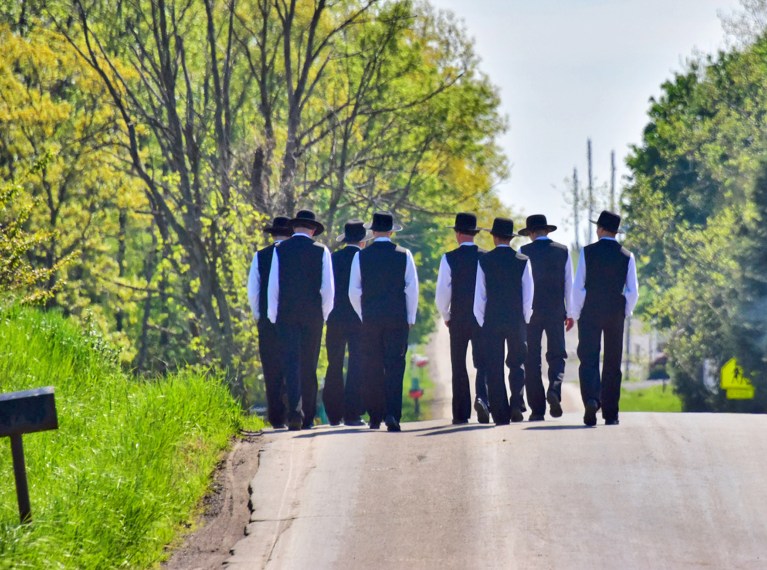
Scary Amish, Manufactured Sharia Panics, and Europe’s Demographic Reality

Standard

So, aren’t you afraid of the Amish moving in and imposing Ordnung law?

These peaceful-looking folks buy up large tracts of land, send their children to their own private schools, and even speak a strange tongue among themselves. It won’t be very long until they ban automobiles, require all women to wear bonnets, mandate beards for men, and pressure everyone to buy their discounted quilts. It’s clearly part of their long game.

If that mix of real Amish religious practice and wild extrapolation sounds completely ridiculous, good. That said, this is what propagandists do all of the time.

Anabaptist radicals—the forebearers of Amish—once aggressively seized control of the German city of Münster in 1534–1535. They established a violent theocracy, practiced polygamy, executed religious opponents, and even drove thousands of Lutherans and Catholics out into a freezing snowstorm. It is a historic episode that ended in horrific bloodshed. After defeat, the survivors gathered at the Bocholt Conference in 1536 and chose not a full rejection of violence, but only a tactical pause—force was futile “for the time being.”

Imagine someone using that bloody 16th-century event today to argue that modern Amish families, purchasing farmland in central Pennsylvania or across Ohio are secretly just biding their time, growing their numbers, and simply waiting for the perfect moment to strike and impose strict religious regulations. We’d call it fear-mongering and absurd—and rightly so.

None of us would seriously worry about Amish Ordnung (community rules) being imposed on ordinary Americans. There’s no will, capability, or realistic pathway to do so.

In the United States, religious communities have long maintained their own schools, arbitration systems, and customs. Orthodox Jewish Beth Din courts and various Christian panels are operated legally, protected by the First Amendment and always subordinate to national and state law. The Amish aren’t coming for your car or your clean shaven appearance.
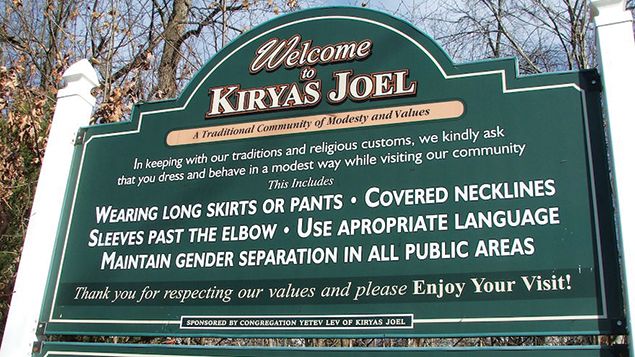

Kiryas Joel, an Orthodox Jewish settlement in upstate NY, has their own religious rules similar to Amish.
Orthodox Jews, in Brooklyn NY, have special patrols.

The Selective Sharia Panic

That brings us to Sharia.

For many, this is treated as a real and imminent threat—no-go zones, creeping theocracy, city blocks under Islamic law. The irony is thick. The loudest promoters of the “Sharia takeover” narrative often trace back to networks tied to pro-Israel advocacy, as well as major defense contractors (Boeing, Lockheed Martin, Raytheon, General Dynamics, Northrop Grumman). Figures and foundations pushing this perspective have functioned, in effect, as part of a sustained effort to maintain a boogeyman that justifies forever wars and interventionism.

David Yerushalmi—the anti-Muslim lawyer funded by pro-Zionist organizations.

Whether the fear is genuine or manufactured, the U.S. Constitution is more than sufficient to block any religious code from overriding secular law. I’m far more concerned about domestic elites—lobbyists, intelligence agencies, and the entrenched interests with real power to buy politicians and shape narratives—than about hypothetical theocracies in the American heartland. On Sharia itself, certain elements (such as the ban on usury) could even offer lessons for breaking cycles of debt slavery. At minimum, we should respect those who reject having our own exploitative financial and cultural systems imposed on them.

The Christian standard remains: treat others as you wish to be treated. Lead by the attractive power of example and love, not through bombs or domination.

There are two billion Muslims in the world, if a large percentage of them were actually out to get us we would not stop them.  But, like us, they’re all unique individuals and the extremists don’t represent them any more than the Salem Witch Trials do us.  The Islamic religion has a diversity of interpretations no different from Christianity and it seems most Muslims just want to live life like other people do.  The Sharia law panic on the right is no different from the left’s Handmaid’s Tale fantasy about Biblical fundamentalists.

Europe’s Demographic Reality

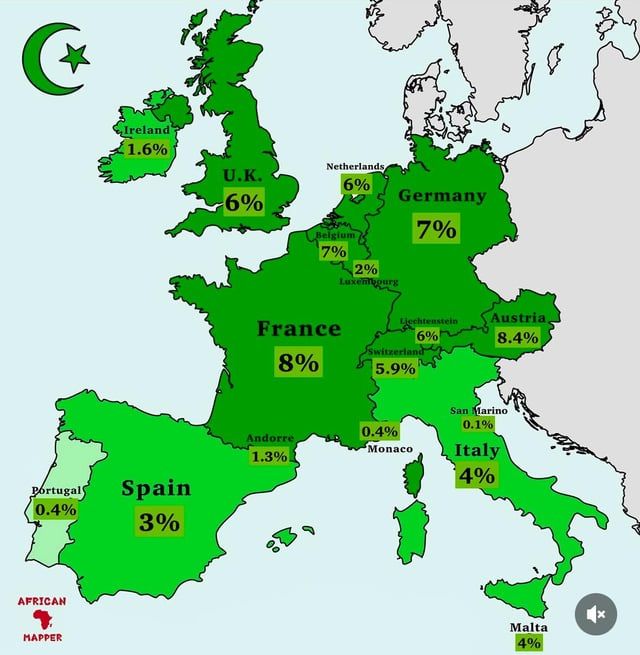
Europe faces a genuine transformation. Muslims currently make up roughly 7-8% of Europe’s population. However, while alarmist projections of a Muslim-majority continent in decades—all assume unchanging high fertility that the data contradicts. It is true Muslim immigrant fertility (around 2.6 children per woman) exceeds native rates (around 1.6), but this drops sharply by the second generation.  Assimilation?
In fact, the fastest voluntary fertility declines in modern recorded history have occurred in stable Muslim-majority countries: Iran, UAE, Tunisia, Oman, and Bangladesh.  Peace, female education, and general economic development lower birth rates across cultures—just as they do in the West.

Europe’s core problem is not invasion but its own fertility collapse well below replacement. Aging societies need workers to sustain economies and welfare systems.  Immigration is filling a vacuum created by native demographic decline.

NATO destroys Libya and this is the result.

What drives the migration waves?  Decades of destabilization—wars, regime changes, sanctions, and proxy conflicts in the Middle East and Africa. NATO’s intervention in Libya (Hillary Clinton’s “We came, we saw, he died” cackling) turned a viable country into a source of slave markets and refugees. The pattern is consistent: create chaos abroad, then face the human consequences at home. Neo-cons often cheer destruction overseas while panicking about the resulting flows.

Conflict and poverty keep fertility higher simply as a survival strategy.

Stability is the best contraceptive.

Ending endless interventions—the trillion-dollar wars, support for destabilization covert action, and regime-change cycles—would reduce the pressure to migrate. Sovereign nations should govern themselves. Saddam would’ve happily sold us oil. Iran’s original sin in Western eyes included rejecting a CIA-backed coup against its elected secular leader. Nations we’ve harmed have often shown more pragmatic forgiveness than expected when we finally stop killing their people and taking their resources.


If anyone had done to us what we did to Vietnam, world the ‘Christian’ U.S. ever forgive it?

This approach won’t magically reverse Europe’s native birth-rate collapse or cultural self-doubt, which predates recent immigration. But it would ease the crisis, allow more selective policies, and let more people thrive at home: Syrians in Syria, Palestinians to be free again on their ancestral land, and Europeans preserving their heritage without perpetual emergency.

Global diversity’s viability ultimately requires reciprocity—ending systems of domination and apartheid everywhere, allowing resource-rich countries to benefit their own populations, and fostering mutual respect over war propaganda. Second- and third-generation immigrants adopt the low-fertility patterns of developed societies. Prosperity and stability are self-correcting.

Fearing the Amish by dredging up Münster is absurd. Painting every Muslim as part of some monolithic conquest is equally so—and also is conveniently profitable for certain interests.

The real threats are internal cultural decay and the foreign policies that export chaos, and then import its victims. The saner path is to seek peace abroad and then spiritual renewal at home: lead by competence, example, and vitality of faith rather than fear and bombs.

Learning the Münster Lesson

Amish have learned, maybe through the error of their less peaceful Anabaptist forebearers, that it is better to farm than fight.  They have a greater strength than their numbers through rejection of violence than they do through arms.  We are not set free by our militarism or aggressive posture—we are bound to the military-industrial complex and state of propaganda.  A moment of real and true honest introspection may spare us a world of future pain.  Maybe we’re not those blameless heroes we imagine ourselves to be?

Is There Room for Both Primitive and Historical Churches?

Standard

Recently I had breakfast with an earnest young Mennonite man to hear a presentation on behalf of an organization that helps to educate pastors in India. My overall impression was good, they focused on empowerment of local leaders rather than creating dependencies, and it seemed a cause worthy of my support.

Part of the goal for this organization was to ground these new converts, who often are opposed and even persecuted by everyone, and establish them with correct doctrines. In many ways it is a ministry similar to that of Peter and Paul in the book of Acts. It is exciting to see that there is a primitive church established on the miracles Jesus promised.

However, and perhaps unfortunately, this organization and many others, while they do indeed serve in a way that I can appreciate, also promote their own theological perspective. It is founded and maintained by those who are themselves disconnected from the established tradition of the church and could likewise benefit from the council of their elders.

The Appeal and the Problems with Primitivism…

When we see new converts struggle in some foreign land we can easily see the need for increased understanding and structure.

Sadly, while we see their need, we often do not comprehend our own need.

For many years, as a child of Protestantism, I believed that my own sect had as complete an understanding of Christianity as there is and that I was individually able to discern truth. As I’ve grown into adulthood I started to become more aware of inaccurate teachings and my own fallibility as an individual.

I was raised in a denomination that promotes their own idea of primitivism. In other words, many in the church of my youth believe very sincerely that they are the spiritual successors of early Anabaptists and also the early church. Basically we assumed, based in where we were born or in our own personal interpretation, that we held a corner on the truth.

This, sadly, is a belief established on confirmation bias. It is the intellectual equivalent of comfort food and keeps many from digging a little deeper. To think the ground that you stand on is sacred because you’re standing on it is a terribly arrogant position. This often ends up like this:

I wrote to the church, but Diotrephes, who loves to be first, will not welcome us. So when I come, I will call attention to what he is doing, spreading malicious nonsense about us. Not satisfied with that, he even refuses to welcome other believers. He also stops those who want to do so and puts them out of the church. (3 John 1:9‭-‬10 NIV)

Primitivistic groups are experts at finding the evidence in favor of their perspective and pointing out the faults in other groups. They, like Diotrephes, exclude those who do not agree with them. And that is the biggest problem with primitivistic church groups, they do not all teach the same things, some are extremely heretical, and yet all believe they represent the real unadulterated truth and keep out all who disagree.

What is the Historical Christian Response to Primitivism?

Not all primitivism is bad. A person must start their journey of faith somewhere and a basic conceptual understanding of the foundations of Christianity is a good start. Note how Jesus corrects the disciples for trying to silence those who were working miracles in his name and yet were not connected directly to his ministry with the disciples:

“Master,” said John, “we saw someone driving out demons in your name and we tried to stop him, because he is not one of us.” “Do not stop him,” Jesus said, “for whoever is not against you is for you.” (Luke 9:49‭-‬50 NIV)

Jesus appears to endorse those working the miracles because they are correct in their basic understanding and doing his work. But that’s not to say we should be content to leave others ignorant and unconnected. I’m reminded of when Paul encountered some primitive believers:

While Apollos was at Corinth, Paul took the road through the interior and arrived at Ephesus. There he found some disciples and asked them, “Did you receive the Holy Spirit when you believed?” They answered, “No, we have not even heard that there is a Holy Spirit.” So Paul asked, “Then what baptism did you receive?” “John’s baptism,” they replied. Paul said, “John’s baptism was a baptism of repentance. He told the people to believe in the one coming after him, that is, in Jesus.” On hearing this, they were baptized in the name of the Lord Jesus. (Acts 19:1‭-‬5 NIV)

It is the duty of a Christian elder to disciple and instruct the young in the faith and increase their understanding of the truth in the same way Paul did. Those who are of the right Christian perspective will appreciate the help and encouragement of an elder. They have the attitude encapsulated in the words of Peter:

In the same way, you who are younger, submit yourselves to your elders. All of you, clothe yourselves with humility toward one another, because, “God opposes the proud but shows favor to the humble.” (1 Peter 5:5 NIV)

We, like those new believers in India who are eager to be taught, need to take the same attitude towards learning from those who represent the historical church. There is an established church. There is a true orthodoxy of Christian faith and practice. We, those born into a more primitive setting in particular, would be remiss not to submit to our own elders and especially when we tell others to follow our own teachings.

Leave Those Who Are Both Primitive and Proud…

There is only one option with those who are proud and unsubmissive like Diotrephes, we must leave them because their pride blinds them. We must follow the advice of Jesus when dealing with those promoting false religion:

Leave them; they are blind guides. If the blind lead the blind, both will fall into a pit. (Matthew 15:14 NIV )

There is extreme danger in relying on those who know little more than you do and who refuse to be accountable to anyone besides themselves. There are many denominations and parachurch organizations that fit that description. All have their subscribers who sip the same poisoned Kool-Aid (sometimes literally in the case of Jim Jones) and dismiss perspectives outside of their own.

We should rebuke the rebellious and those who deceive:

For there are many rebellious people, full of meaningless talk and deception, especially those of the circumcision group. They must be silenced, because they are disrupting whole households by teaching things they ought not to teach—and that for the sake of dishonest gain. (Titus 1:10‭-‬11 NIV)

Many denominations (and non-denominational groups) keep their independence for sake of being free of accountablility to others and having control in their own hands. This kind of purity based on personal preference has been the foundational principal for many cult groups and is a corrupt foundation even when it doesn’t end in a Münster Rebellion or mass suicide.

If you are part of a small group that teaches that they are the most authentic church (or excludes other Christians from fellowship who do not follow their litany of man-made regulations) be very wary. There are many people very confident in themselves, who think they have all the answers, who see themselves as pure—and are deceived by their pride.

Being Reconnected with the Historical Church…

My biggest temptation, when leaving the Mennonite denomination, was to do what many other Protestants do when disappointed with their denomination and that is to go start the “Perfect Church of Joel” or basically a new pure and primitive sect. That, of course, was a foolish impulse. Any church founded by me, while possibly strong in some areas, would also share my weaknesses and blindspots.

The impulse a “pure” church is a product of arrogance, a focus on the shortcomings of others rather than on our own, and ignorance of the historic church. The early church, believe it or not, was not exactly pristine of free from problems. Read through the Gospels, the book of Acts and Paul’s letters, there is controversy, there is disagreement and failure.

However, despite their quarrels and shortcomings, keeping unity was the refrain:

I appeal to you, brothers and sisters, in the name of our Lord Jesus Christ, that all of you agree with one another in what you say and that there be no divisions among you, but that you be perfectly united in mind and thought.(1 Corinthians 1:10 NIV)

Be completely humble and gentle; be patient, bearing with one another in love. Make every effort to keep the unity of the Spirit through the bond of peace. There is one body and one Spirit, just as you were called to one hope when you were called; one Lord, one faith, one baptism; one God and Father of all, who is over all and through all and in all. (Ephesians 4:2‭-‬6 NIV )

Finally, brothers and sisters, rejoice! Strive for full restoration, encourage one another, be of one mind, live in peace. And the God of love and peace will be with you. (2 Corinthians 13:11 NIV )

Unity of the church is a Christian imperative. Perfection on our own Mennonite, Lutheran, Mormon, Methodist or other denominational/separatist/sectarian terms is not.

There is truly no pure church, all are made of people who are imperfect, but there is a historically grounded church, one with a better claim on apostolic succession than any other, that keeps the traditions passed by word of mouth or letter, and is focused completely on Jesus Christ.

Unity should not be on our own terms. It is the responsibility of the younger to submit to the elder (according to Peter) and this is a teaching that can apply to both individuals and entire denominational structures. Those in primitive churches, therefore, as individuals or collectively, should make it their perogative to connect and be unified with the historic church.

My finding my place in the Orthodox Christian tradition was not an easy transition. It required me to think beyond my own individual preferences and perfectionistic impulses. It required me to submit to an understanding in many ways different from my own, I’ve had to sacrifice some of my primitivism, and seek unity in Christ rather than unity on my own terms.