I am truly impressed with this man…
Dr. Ben Carson: Baltimore Rioting Is ‘Truly Senseless’


I am truly impressed with this man…
As fires rage in Baltimore, my thoughts go to the many good people of all races harmed by those who excuse their own destructive and abusive behavior. Mob violence only adds to injustice.
A (Completely Open and Honest) Conversation About Race and Violence
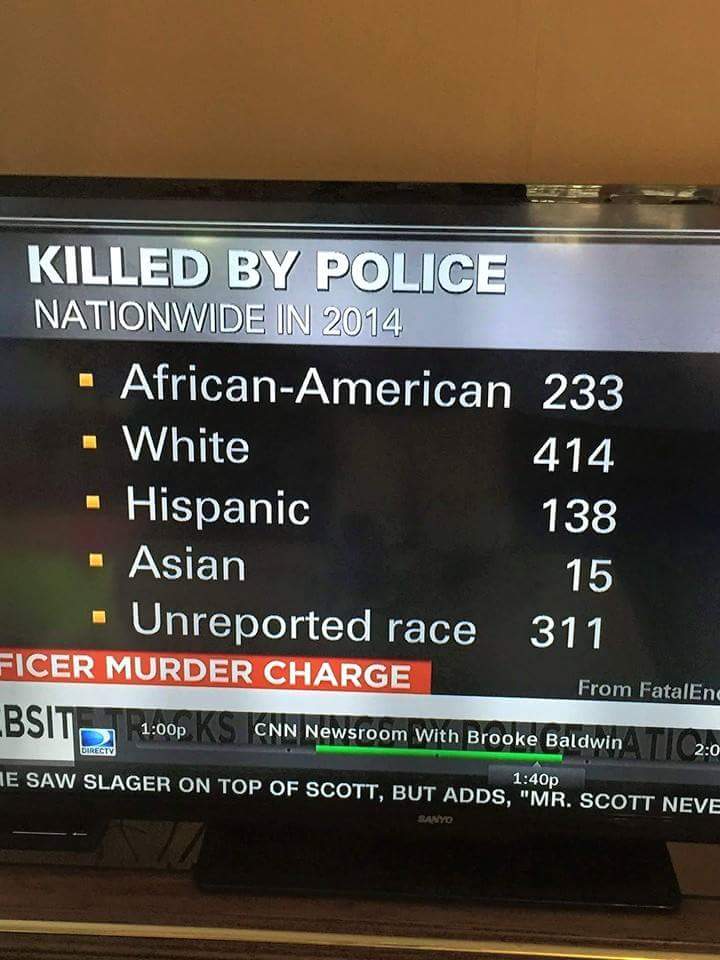
Many, including President Obama, have urged a conversation on race. I have avoided speaking in terms of black and white because I didn’t want to feed existing prejudices. Unfortunately, by my silence, I am also feeding into a dangerous ignorance about the root causes of violent behavior. There is a real elephant in the room when it comes to discussion of race and statistics, here’s a part of it:

It seems to me there could be a connection between that and the disproportionate violence here:

And this is how it breaks down as far as who is murdering who:

Media Fueled Ignorance and the Bigger Threat to Black Lives
A few weeks ago I read an article, “I Fear for Our Black Men,” and then began reading the comments in response. I was shocked. Instead of shared sympathy from other black women there was a lot of anger towards black men. From what I gather the complaint is that when a police officer harms a black man it is an outrage and a cause for civil unrest, but when a black man beats his wife or girlfriend nobody cares:

Why do we focus on stories about men being victims of police and yet ignore a far bigger problem of women and children victimized by men? Police brutality, while a matter of real concern, is a drop in the bucket of violence in general society and the black community. And the real disproportion is how much attention is focused on their failures rather than the bigger problems. It is straining on the gnat while swallowing the camel.
Which leads me to the topic of government and media complicity. Much is said about disproportionate arrest statistics or incarceration rates. But very little is mentioned about the disproportionately higher levels of violence I highlight above. Apparently we are supposed to obsess on the race only as an explanation and ignore all other factors—factors like resisting arrest, criminal records, dysfunctional homes, etc.
Why Not Build Identity Around Good Behavior Instead of Race?
I would rather talk about behaviors than race. I would rather good people of all races identify with other good people of all races. However, since shared race is how some people choose to build their identity, then I need to address the issue of racial tribalism directly: If you take the side of a person simply because they share your racial tribe identity, then you need to take complete ownership of the bad they do as well and you are a partner in it.
But I would rather we didn’t do that. I say we lose the tribalism motif. I say we stop focusing all of our attention on race and historical grievance. I say we start to address current behavior instead. That is fairer. It is fairer because the vast majority of people (all races) are not criminals. If we are not criminals we should not lump ourselves together with bad actors and defend them simply because we share their skin tone.

Words, the glorified sounds we use to describe our thoughts, are always a matter of interpretation. For the most part we are able to communicate our ideas accurately enough to have meaningful conversation. However, language also changes over time, definitions evolve and words find new uses from their original uses. Language is seldom (if ever) as simple as black and white.
Things get especially complex when we take ideas written in one language and try to translate them into another language. It is exponentially more difficult when the original language is now archaic and the exact inflection or intentions of the words lost to time. Certainly there are clues, languages follow patterns or hints from context and translators follow these leads like detectives. But there’s always that left which remains open to interpretation.
Is it a description or is it a name?
Biblical descriptions of “God” present a challenge. Here’s the attempts of various translators to take writing in an ancient Hebrew book and convert it to English that illustrate the point:
“And the angel of the Lord said unto him, Why askest thou thus after my name, seeing it is secret?” (Judges 13:18 KJV)
“He replied, “Why do you ask my name? It is beyond understanding.“ (Judges 13:18 NIV)
“Why do you ask my name?” the angel of the lord replied. “It is too wonderful for you to understand.“ (Judges 13:18 NLT)
“And the angel of the Lord said to him, “Why do you ask my name, seeing it is wonderful?” (Judges 13:18 ESV)
“The angel of God said, “What’s this? You ask for my name? You wouldn’t understand—it’s sheer wonder.“ (Judges 13:18 MSG)
So, according to the King James translation, we either have an angel named “secret” or an ‘angel’ with a name that is beyond our words. I would go with the latter judging by the context as I see it.
Taken together different translations give us wonderful, too wonderful to understand, beyond understanding, secret and means “incomprehensible” according to Strong’s concordance. I do get the impression the meaning is truly incomprehensible, truly something beyond words or human naming and mysterious.
Can God be properly named?
The three letters ‘G’ and ‘o’ and ‘d’ have come to represent the supreme being and divine entity of the Christian Bible. It is a noun, used like a proper name and a word loaded down with preconceived ideas. One of those ideas is that something that is the secret mysterious beyond comprehension power behind the entire universe is something that can actually be named. It is certainly useful to have a placeholder name or common description, but any word used is an infinite understatement.
This is why God was not named openly. Naming potentially lowers this dimensionally unlimited and timeless being that can be understood with our finite minds. But it is not blasphemy that concerns me. What bothers me is that words evolve, words can begin to carry new meaning or different assumptions and be misconstrued. It seems better that we leave God something beyond comprehension than to ignorantly ‘box in’ the infinite. At very least we would be wise to see a God beyond our own understanding of a three letter word.
God is not a noun, not a verb or a man…
“God is not human, that he should lie, not a human being, that he should change his mind. Does he speak and then not act? Does he promise and not fulfill?” (Numbers 23:19 NIV)
That “not human” in verse above is rendered “not a man” in another common translation and ome have taken issue with the New International Version for the departure from gender specific descriptions of God. But that’s straining on gnats (Matt. 23:24) and making God the equivalent of a homo sapien male is giving men infinitely too much credit and God way too little.
No, not that I’m saying the Spirit (or Word) of God could not fill the form of a man like a hand in a glove or an avatar becomes a representation of a human being on an internet forum. But making God just a man is also a vast understatement. Humanity may bear the “image of God” (Gen. 1:27) and yet we aren’t the beginning and the end, omniscient, sovereign or infinite.
God of the paradox...
Western thinking likes binaries. The logic of this is true thus that can’t be true is natural for us. A person can either be alive or dead from our perspective and never both. Yet, as science takes us to the furthermost ends of the universe, to realms of the almost incomprehensibly large to the infinitesimally small, our normal scientific assumptions break down.
The most brilliant scientific minds of our time have established with convincing theory that both logic and reason taper into oblivion at the bookends of time and space. On one end a brilliant flash of light, energy and expansion from a source beyond human comprehension. On the other end black holes both infinitely massive and infinitely small. At either end there is what appears to be irrationality of something from nothing returning to nothingness.
Matter itself is a mysterious and seemingly impossible duality when brought into focus. Not only is there is less and less as we zoom in to the level of quantum mechanics, but what is left that remains is a seemingly impossible duality where clearly distinct categories of particle and wave merge into a seemingly irrational both. It is a paradoxical dualism that demands we look beyond normal scientific assumptions.
There is something incomprehensible. There is something beyond my understanding and beyond the collective understanding of humanity. We try to name, explain, categorize the universe. We attempt to peer around the corner of space-time with theories, mathematics, scientific instruments, reason and logic. But in the end we live in the mystery of our own existence and we also can live beyond it.
God who is both/and…
Both skeptics of religion and the religious are guilty of creating a God in their own image. If you’re concept of God is an equivalent to a ‘flying spaghetti monster‘ then you have a small god perspective. If your idea of God is limited to descriptions and language found in the Bible then you too have a small God perspective. God is more than the information used to attempt to define God. God cannot be reduced to mere attributes or human moral constructs.
God is incomprehensible. Yet, God’s work is also personal, knowable and…
“Though he was God, he did not think of equality with God as something to cling to. Instead, he gave up his divine privileges; he took the humble position of a slave and was born as a human being. When he appeared in human form, he humbled himself in obedience to God and died a criminal’s death on a cross. Therefore, God elevated him to the place of highest honor and gave him the name above all other names…” (Philippians 2:6-9 NLT)
…a sheer wonder of a paradox beyond mere human words.

I went to a little BBQ restaurant for dinner. They have excellent ribs and the baked beans weren’t too bad either.
This time they had a new menu item on the menu called “potato salad” and I imagined that could taste pretty good. So I added that. I confidently ordered the larger of two container sizes too.
I had polished off the ribs and beans. Now it was time to try the much anticipated new item.
The verdict…
Well, to my palate it was awful. I took a bite and decided I would not take another. It was cheesy, that’s not what I had in mind when I ordered “potato salad…”
So I strode up to the cashier to pay for the meal. Then, while my card was being swiped, the cook turned and asked, “so how did you like that potato salad?”
What do you say to the smiling creator of something you just got done categorizing as a potential vomit inducer?
Put on the spot, I strung together a series of words, “it definitely had its own unique taste,” and seemed to avoid offending him with my brutal honesty.
He went on to proudly described his creation like a dad speaking of a beloved child.
Why not just tell him it was awful?
I mean, when someone asks for feedback they are opening themselves up to a negative opinion, right?
Was it that I sensed he was looking for my approval and I didn’t want to disappoint him?
Would actual honesty, like “awful” or “vomit inducing,” come off too strong in that situation?
I did not have time to think out a response. So I defaulted to saying something that sounded nice, that kept him smiling and would allow me to leave in peace.
I carried the potato salad with me until I was a safe distance down the sidewalk. I disposed of the offending substance in a garbage can. Then looking back to make sure nobody saw me do it.
My take away…
Flame wars may erupt amid internet anonymity. People might even be brutally honest when angry, annoyed or upset enough. But politeness reigns supreme otherwise.
Be careful not to take seemingly positive feedback as the whole story. Sometimes nobody wants to be the first to break it to the emperor that he ain’t wearing any clothes.
It is nice to dwell on the good. I think it is considerate to not want to hurt feelings. Yet, sometimes it is the best friend who tells you unapologetically that the potato salad is plain bad.
Or it could just be that I don’t know potato salad…
The one thing I did not cover in my recent post on the Good Samaritan story (and came up in a discussion with a friend afterwards) is that Jesus never did answer the question of who. The man asked who his neighbor was, but Jesus answered the question of how to be a good neighbor and told him to “go and do likewise.”
Not my neighbor, not my problem…
I was reminded of that again when discussing my frustration with social media. I’ve noticed how cute pictures and funny stories get dozens of likes or shares. However, when I posted a link to a woman with a real need and asked people who couldn’t give to like or share it the response was astonishing. It was zilch, nada, nothing…

I was lamenting that lack of response to another friend. They defended it saying that people get many requests for help and that I could sympathize with. But what was said next disturbed me coming from a person familiar with the story Jesus told about how to be a good neighbor. They suggested the “Biblical method” is that this woman’s family or local church should provide.
“If you love those who love you, what reward will you get? Are not even the tax collectors doing that? And if you greet only your own people, what are you doing more than others? Do not even pagans do that? Be perfect, therefore, as your heavenly Father is perfect.” (Matthew 5:46-48 NIV)
That doesn’t seem like the ethic Jesus was describing. I don’t think the Samaritan cared much about jurisdiction or if it was his turn to give. I believe he saw a need, saw a person who needed help and simply gave it. That’s what it means to love your neighbor. That’s the example Jesus told the legal expert to follow.
On the other hand, I assume those men who passed by the battered man along the road were in good standing in their own communities, provided for their own families and gave tithe. But doesn’t everyone do that? We take care of our own because it is natural to do so, it is reciprocal altruism and a way to ensure our own survive.
Loving beyond the tribe of race, gender or denomination…
Yet Jesus was describing something far more radical. Jesus went as far as to tell his followers to hate their own families (Luke 14:26) and give all they had to the needy. This goes beyond the normal religious obligation of his day. This goes beyond defending our own biological progeny. It is a love bigger than nation, denomination and tribe.
Jesus preached (and those who continued to carry his message) against tribalism. They forsook their own wealth and families to preach a revolutionary message about a kingdom made up of all tribes and nations. They spoke of a kingdom where allegiances didn’t fall around race, gender or economic status. A kingdom of good neighbors.
Disturbed by visions too superficial, self-interested and small…
“Disturb us, Lord, when
We are too pleased with ourselves,
When our dreams have come true
Because we dreamed too little,
When we arrived safely
Because we sailed too close to the shore.Disturb us, Lord, when
with the abundance of things we possess
We have lost our thirst
For the waters of life;
Having fallen in love with life,
We have ceased to dream of eternity
And in our efforts to build a new earth,
We have allowed our vision
Of the new Heaven to dim.Disturb us, Lord, to dare more boldly,
To venture on wilder seas
Where storms will show Your mastery;
Where losing sight of land,
We shall find the stars.We ask you to push back
The horizons of our hopes;
And to push back the future
In strength, courage, hope, and love.”
(Francis Drake)
Anyhow, it does disturb me when social media prefers a political cause (showers attention both for and against a pizza shop owner caught in an artificial controversy) and then ignores a real need. Our priorities are messed up when we are more concerned with scoring political points and fighting culture wars.
It disturbs me when millions will be poured into political campaigns rather than used to meet real needs. Frankly, if you conservatives don’t think we need socialized medicine or if you liberals truly have a heart of compassion, then prove it with more than talk. Help somebody you can help rather than wait for others to take the lead for you.
It disturbs me when churches spend thousands on missions of questionable value to give young people an experience. If you are truly zealous and motivated by love (not self-interested like a kid on spring break trip justified by a thin veneer of religion) then be a good neighbor.
It disturbs me when our love is superficial. Our love is only superficial when we like cute pictures, comment on funny stories, advocate for political ideologies, seek donations so we can go on an adventure around the world and then aren’t disturbed by unfilled needs well within our reach.
As it stands, the account for this nurse and young mother with severe neck issues stands at $360 and only a fraction of the need. Does that disturb you?
I forget the exact circumstances. I do, however, remember the feeling of humiliation and embarrassment.
I had made a crossword puzzle for my 5th grade classmates. I was moderately proud of my creation and, as copies were distributed to my peers, ready to savor the accomplishment.
But, I did not expect what came next…
As the class began to solve the puzzle there started a bit of a ruckus. There was laughter and an absurd allegation that I had misspelled one of my words.
Impossible!
I thought as my face flushed.
How could I have made a mistake so basic?
They had to be wrong…
But, as I examined the evidence, my initial denial was soon replaced by dismay, and my heart sank weighted down by the reality: I had misspelled a word. The entire puzzle was irreconcilable for those who knew correct spelling and I was an imbecile.
It was something awful. My lack of proper editing (still a weakness) had made me a laughingstock and I was absolutely devastated. I wanted to crawl under a rock to get away from the cackling in the room. But there was no escape and no recourse.
What I had hoped to be a moment of satisfaction was now a nightmarish reality of abject failure. I couldn’t hold it in. Emotions overcame me in the study hall period after and I began to cry.
Mr Berger, the shop teacher, was my comfort that day as I sobbed my pain and disappointment. I’m not sure if he said much, but I know that I felt his empathy and understanding.
My terrible mistake probably mattered very little to him. The condemnation and ridicule faded in importance. His love remained.
Humanism, the idea that people are capable of bettering themselves or society through effort, has in modern times become a term monopolized by secularists. That is probably why the words “evangelical humanism” jumped out to me when used to describe Menno Simons.
What does humanism have in common with a leader in centuries ago Christian movement?
Today many Christians (including those claiming “Menno” as their namesake) seem to have a terrible fatalistic streak. There are token forms of ‘outreach’ that appear only marginally interested in creating real lasting solutions to practical problems. There is also no shortage of negativity about the world and cynicism about our ability to change it. It could seem resignation to the current state of affairs is even view as the epitome of faith.
Dreams Beyond the Status Quo
“The future belongs to those who believe in the beauty of their own dreams.” (Eleanor Roosevelt)
It was that quote of the illustrious first lady on a motivational poster that stirred my thoughts again. What it describes could be both humanistic and evangelical faith. Secular humanism is motivated by doing good for the sake of good, while religious faith is supposed to be about doing good for the sake of God. Both are concerned with humanity and aim for a better future.
The difference could be that the religious are too often less practical in aim than their secular counterparts and this could be because the promises of eternity deadens the urge to be an agent of change in the world today. The secular humanist, on the other hand, is committed to practical change today and attempts to deliver more than just promises of future paradise.
Knocking at doors at 7:30 am to tell people about Jesus might have a ring of faithfulness to it. However, unless you show up with coffee and an egg sandwich to give, you probably just created another annoyance—a door slammed in your face might be your just reward. It could be you are getting the cart ahead of the horse.
Eternity Can Wait, Love Practically Today
Without practical love Christianity loses the strongest evangelical tool that it has. Jesus was extremely practical. Jesus was so practical that many of those following him thought he would lead a revolt against Rome. He did practical things like provide beverage for a wedding, healing sick people and feeding thousands. He promised a kingdom soon at hand that would change practically everything:
“Repent, for the kingdom of heaven has come near…” (Matthew 4:17 NIV)
The “kingdom of heaven” isn’t just some future ‘pie in the sky‘ ideal. No, it is something that must be lived out practically today. And, not as a purely informational campaign or token help either. Christianity should be about making heaven a literal reality for as many people as we can today and in as many ways as humanly possible. When we have faith and pray as Jesus did, this is not just wishful thinking:
“Our Father in heaven, hallowed be your name, your kingdom come, your will be done, on earth as it is in heaven. Give us today our daily bread. And forgive us our debts, as we also have forgiven our debtors. And lead us not into temptation, but deliver us from the evil one.” (Matthew 6:9-13 NIV)
We act on what we believe is possible. We should not wait to free ourselves from temptation, we should not hesitate to forgive others if we want to be forgiven and we certainly cannot expect bread to come to us without our own effort. So why do we assume ourselves powerless to bring to “earth as it is in heaven” and instead practice fatalism as if it is faith?
We would be much more convincing if we put our money where our mouth is and gave people a taste of heaven rather than give them hell.
Humanist and Christian Hypocrisy
Ironically secular humanism often breaks down the same way religions do, in that adherents become less practically oriented and more ideological only and lazy. People look to institutions and charismatic leaders to show the way rather than do their part by fully living their ideals.
This is how Al Gore ends up in a sprawling mansion while preaching climate change dogma. This is how Christians preach Christ Jesus and leave many sharing the same sentiments of Joe Hill or of the quote below:
“I like your Christ, I do not like your Christians. Your Christians are so unlike your Christ.” (Mahatma Ghandi)
If you want to convince others of your dreams or ideals start first by living them and if you are Christian especially. If your faith does nothing for real human needs, and is only about future rewards and glory, then it is just theory. Being like Jesus requires you to change the world for good with the talents you are given.
Be a Human Example of Good
Don’t ask anyone (including God) to do anything on your behalf. Leadership is not pointing out how others are doing wrong. Leadership is being an example and laying down our own life for sake of love for humanity and God. Be a leader for Christ’s sake.
Don’t wait on conditions to improve before acting; act to improve the conditions. Be an evangelical humanist. Endeavor to do what is impossible by acting in faith in a power greater and beyond your own comprehending. Bring heaven to earth today.
Christian humanism might or might not be an oxymoron, but faith without practically applied love for humanity is certainly an oxymoron.
Dream big, be practical.

I’m full of thoughts today.
I begin to write them, but I only get so far trying to tether them to word before they float away and then I’m on to trying to nail the next one down.
Up above my head is a canopy of these balloons of topics. The first of the day fading from sight, some with strings just escaped my fingers tips moments ago, and many in between as clumped together dots of varied color.
I started on theoretical physics. With that was a thought about coincidence, a thought about fortune and the quote “there but by the grace of God go I.” I found parallels to theology and scientific theory. I considered the evidence of extra-dimensionality of the universe and the multi-verse theories as similar to concepts of spiritual reality. I wanted to explain that science explains how and philosophy answers why. I got started.
My mind drifted…
My thoughts later turned to cycles and equilibrium. The need for both. I listed examples from nature. I wrote about the rise and fall of civilizations. I had an idea about the interplay of people and history. About the way living radical faith is eventually crowded out by dead religious tradition. I pondered three different responses of reaction, reformation or reflection and denial.
This too escaped…
Perhaps these balloons will come floating back down to where I can grab them and anchor them to explanation. But for now they remain abstractions not ready for words. Themselves the topic for their stubborn inaccessible.
I will let them play among the clouds for today, but eventually they must come down and earn their keep!
“Ignorance has no color, God doesn’t see color, why should we?”
Yesterday I had the distinct honor and privilege of a short conversation with Will Stack. You may have already seen the video of his that went viral and if you haven’t you really should. So many of the world’s problems could be solved instantly if more people shared this kind of perspective.
The good news is that there is one young man who is a real role model. The great news is that, judging by the response, there are millions of others like him who are respectful and loving of all people regardless of differences. I think his video resonates with so many people because it is the message too often missing from the front pages.
Another Story of Contrast
That same day another friend posted this video (warning: the content is vulgar) of a group seeking violent retribution against those who they describe as “devils” and was so over the top I could hardly take it serious. I debated even giving them more credibility than they deserve by linking their hatred.
I was struck by the sharp contrast. It reminded me of the two mothers I posted about the other day and I thought maybe I would do a follow-up about these two different sons. The son of hate that screams vengeance and promises only continuation of violence. Then there is this son of grace who speaks words of peace and respect.
Leadership by Example
Will Stack responded almost immediately to my friend request on Facebook. He even took the time to write back to me despite being overwhelmed with friend requests and attention. He is extraordinary, but he also represents an example of an ideal within our own reach and evidently he hit a chord with many people—myself included.
But there is still much work to be done. There are still those who only see other people through the lenses of their prejudices. However, we cannot change them, we must change ourselves and lead by example. And there is one more person I know who has demonstrated this type of leadership…
Well done, Will!
Jesus was a great story teller. Those raised in conservative Mennonite homes and communities are very familiar with his stories.
Ask any of us about ‘the parable of the good Samaritan’ (Luke 10:25-37) and we will tell you of a man who was traveling, who was attacked by bandits, left for dead, ignored by two passersby and finally helped by a good man. The man, a good Samaritan.
Some of us might even be able to explain how the Samaritans were looked down upon by the audience Jesus was addressing. And also that those two who passed this man in desperate need of help (even crossed to the other side of the road) were important religious leaders and might have not wanted to risk defiling themselves by touching a man who by appearances was dead.
The moral to the story is in the question it answered. Jesus was being questioned by a person identified as an “expert in the law” who was asking initially about how to gain immortality. Jesus asks him what the law says and the man quotes the part of their law where it says to love God and your neighbor. But, when Jesus tells the man he’s correct the man (being a legal expert) needs further definition of terms, he asks:
Who is my neighbor?
The typical definition of neighbor is those people who live next door to us. Those people with the annoying yappy dog who you might wave to while pulling out of the drive. Good Americans where I live and the kind who will offer to help push when your car is stuck in the snow.
But Jesus uses the parable to extend the definition of neighbor. When he finishes the story he asks which of the three was the neighbor and the expert tells him it was the one who had mercy. So, simple, cut and dried, we help a couple people with a broke down car or give a twenty to some homeless guy, pay our taxes on time and we are a good neighbor, right?
Well, maybe, maybe not…
Samaritan today means a helpful stranger. The Samaritans when Jesus spoke were despised people and an enemy to those listening. I think the parable might be told differently today.
If Jesus were speaking to a conservative audience he might have the story of the two responsible gun owners, the stupid irresponsible traveler (who got what he deserved) and a good illegal immigrant. If he was telling it to a liberal audience it could be about the two politically correct professors, the aborted black inner-city child and a good redneck.
More interesting is that the enemies of Israel today, Palestinians, have Samaritan blood. So even after two thousand years the story is relevant in the place and religious setting it was originally told to. In today’s language it could be told as the story of the good Palestinian or good Muslim.
It could be any scenario where a person who has a historical grievance lays it aside to care for the ‘privileged’ person who may have previously treated them like dirt. It is a story for a downtrodden and unimportant person helped a stranger when the people who should’ve helped didn’t.
So what does this have to do with Mennonite Millenials?
It is a quirky thing, but we probably have an easier time flying to the opposite side of the world than we do with being neighborly with our actual neighbors. We may travel to some far away place to spend a week or two cleaning up from a typhoon. It is exciting to experience a new culture. The more dedicated may even spend years in a remote village somewhere or some other exotic outpost.
Yet, if we were asked to do something we personally find dull or undesirable, if there were a task we considered beneath our abilities, would we do it?
The men who passed by the beaten man were probably men with vision. They had important tasks to do that could not be compromised by the needs of a person who probably should’ve known better anyhow. They were missionaries, the equivalent of church leaders and had big things on their minds. They also lived in a world of abstraction or theory and neglected practical application.
“Truly I tell you, whatever you did for one of the least of these brothers and sisters of mine, you did for me.” (Matthew 25:40 NIV)
Who’s least or greatest changes with cultural context. We probably don’t think of a Samaritan as being lower than us. We may not harbor animosity or a superior attitude to other races. But we still do have our prejudices. We still have our own religious rites or rituals that take precedent over practicality. We still look too far down the road.
Think globally, act locally!
This generation is better equipped with technology, has greater access to information and the world. But it is also a very narcissistic and self-absorbed generation. With some of us the problem is not fear, the lack of opportunity (like prior generations) or the complacency that is common today, but for us the problem could be arrogance. We need to be reminded that there is nothing too small for us to do.
Don’t be too important to do little things. Indeed, sometimes it is a small amount of humility that does the world more good than the grandest of visions or best of experiences. Don’t be aloof, don’t be a religious idealist, don’t be prejudicial against anyone, be a neighbor!
 Irregular Ideation