BAY-BEE, Identity Language and Oppression Narratives

Standard

The nurse pronounced baby as “BEE-bee” in our prenatal class and it got me thinking of how language develops.  Words will shift to reflect their usage.  The meaning eventually match with the reality when we attempt to disguise unpleasantness in flowery speech or try moral inversion.  Cultural values will shine through and snap understanding back where it was prior to the manipulation.

How did “bAy-bee” become “BEE-bee”?  

The latter evolution in pronunciation is cuter and therefore a better representation of the subject matter.  The word never will change the thing it describes.  Yes, words influence our perception, they also change to reflect a new understanding of the things that we are describing.  For example, the word “baby” only changed in pronunciation for me when considering the little human now within my wife’s belly.  It was no longer an abstraction or vague category, but a tiny vulnerable ball of loveable life.

When we experience something firsthand it is harder to deny what it is.  We can use the terms detached and technical to distance ourselves from the emotional content.  Say that a baby is just a clump of cells or some kind of parasite—up until the moment when we finally hold it in our hands.  To keep up the charade after this would be delusional or psychopathic.  It is not human to see an infant as anything other than precious.  The political lexicon becomes irrelevant.

A Tangled Ball Of Words 

Words trigger emotions.  I was thinking of this as a tear formed while the instructor in a prenatal class described the ideal of “skin to skin” and a soothing environment.  Some of this reaction may be feeling the weight of my wife’s pregnancy.  But it also has a lot to do with my own identity as the “premie” and “fighter” who struggled for life.  Discussion of baby care today compared to what it was for me.  The thing is, while my experience certainly impacted my development, I don’t have memories of the trauma.  It probably only looms large as a part of my personal identity because my mom told me what I went through and reinforced it.  The I gave further shape and form to it by attributing many of my struggles to the events of my birth—everything from my delayed growth to difficulties with focus in school.

However, it is impossible to know, outside of creating a genetic clone, if I would have been much better off with a normal birth or with more human touch rather than being in a plastic box with ‘stimulating’ music.  This had some impact, no doubt, and yet there is the bigger psychological complex I’ve built on top of this named thing.  Like an irritant in an oyster, it provided a nucleus to attach all of my insecurities to and blame for my failures and shortcomings.  With a normal birth would I have been more like my more accomplished siblings and less a mess?

However, it is very easy to reverse cause and effect to give ourselves an excuse for our being lazy and taking of exceptions.  We become the label that we apply to ourselves as much as it truly describes us.  We act the part.  Things of identity, like race, sexuality, religion, are as much a construct or fantasy as they are facts.  We live up to our name to an extent.  My mom would often tell me that my name meant “strong-willed” and it might be one of those self- fulfilling prophecies.  If we tilt confirmation bias in a direction it isn’t a big surprise if our character develops that direction.  It is like strapping a young tree to influence where it grows.

In a sense, nobody is truly “born this way,” it is a statement discredits conditioning and culture too much. But the environment itself doesn’t make us where we are as much as those descriptive words that reverberate in our heads.  A child that is called “stupid” by a parent or teacher may spend many years trying to sort through their doubts.  My dad letting me look over his blue prints and then giving some affirmation when spotted an error made by the engineers is likely what led to my being confident in my abilities and a career in design.  Our reality is influenced by use of language.

These are just personal observations, but it is also backed up by other sources that put it more succinctly:

Language is not just a medium of communication; it’s a lens through which we view the world and a mold that shapes our identity. From shaping cultural perceptions to influencing personal identities, language’s role is pivotal in constructing our social and personal realities.

Language as a Mirror and Molder of Reality and Identity

Language is more than a mere tool for communication.

It’s a portal through which we perceive and interpret the world.

Imagine how our understanding of colors evolves when we learn names for shades we previously couldn’t distinguish.

With each new word we acquire, a facet of reality emerges from obscurity, offering us a richer tapestry of experiences.

The Dynamic Relationship Between Language and Reality

 Neither of those sources are academic or truly authoritative, but do say what I’m saying in a different way and thus useful so far as my goal here which is to provoke thought.  New use of language reframes the world.  It can amplify our efforts and transform society as more people begin to see the world through the lens we provided.  Memes do this, as do pounding of propaganda headlines, it is why “fact-checkers” exist—all to reinforce a particular narrative.

With so much power in our words there is plenty of reason for cunning and conniving people to exercise this for their own selfish ends. 

They take advantage of insecurities and level accusations to shame or confuse the innocent. 

Wordsmiths, they could turn a baby into a villain and murderer into a saint—beware. 

His talk is smooth as butter, yet war is in his heart; his words are more soothing than oil, yet they are drawn swords. 

(Psalms 55:21 NIV)

There are some use the guise of compassion to gain control.  Their promises are about attaining power.  They seek only to bind us and yet many people are blinded to these motives because their identity has been hijacked by these nefarious actors.

Categories Are Social Constructs 

The structures and constructs of language are entirely fabricated.  There is no person who is “black” or “white” by birth, no, rather these are categories we create, clans that we join, and always artificial divisions.  We are often grouped by others using various label words and internalize the divisions as being inseparable from our own experience, in that we identify with other “rednecks” or “blue-collar” types as those ‘like us’ and yet also *become* like that.  Nothing requires a rural person to use country slang or go buy a massive diesel pick-up truck, some of the markers of this lifestyle (chewing tobacco or dress) can impact opportunities.  This is about politics, not genetics.  It is about the strength of an identity group that helps us gain power for ourselves.  Being a victim of an “ism” is a lever, a social tool or means to build a coalition against others.  

The individual without these groups, that is denied the right to put their fist in the air in solidarity with others ‘like them’ is weakest and most disadvantaged in this game.  That is the irony of the “systems of oppression” language.  Those who describe this kind of problem are actually creating it more than they are simply observing.  In the same way that observation in quantum mechanics is an influence of reality (collapses the wave function), the ‘study’ of human interaction is an interaction and is a product of our bias as much as it has basis in reality.  Those who are concerned with the existing ideas (of racism, sexism, or heterosexism) steal attention (and thus disenfranchise) victims of systemic heightism and those who lack privileges in ways not discussed, defined or even recognized.  The individual is the most vulnerable, a minority of one, and frequently abused by recognized groups.  Bullies travel in big groups—victims are often alone.

This line of questions quoted below is most likely well-intended, but is exploitative:

1) “Language both mirrors reality and helps to structure it” (2). Explain and give an example.

2)Racism, sexism, heterosexism, and class privilege are all interlocking systems of oppression that ensure advantages for some and diminish opportunities for others, with their own history and logic and self-perpetuating relations of domination and subordination (3). Explain what this means. Do you agree/disagree? Why?

3)What are the economic impacts of constructing race, class, and gender?

Sandwiched between the lines of this effort to build awareness (indoctrinate) are a pile of assumptions that, in the end, only serve to darken these artificial dividing lines. 

It is rewarmed class warfare rhetoric, Marxism, and is basically designed to feed envy or feelings of being an other and disenfranchised.  No, this is not to say that prejudice or abuse is entirely a social construct.  What it is to say, rather, is that their worldview, segregated by these simple binaries, is too compartmentalized and minimizing of other factors.

There isn’t one group of oppressor and one group of oppressed. 

There is no hierarchy of victimhood. 

Everything depends on the context or situation.  A Jewish student that is harassed on a college campus because of the IDF dropping bombs on Gaza is not privileged in this moment even if they are ‘white’ and rich.  Nor is it anti-Semitic to characterize the decades long campaign against the Palestinian people as an ethnic cleansing.  Labeling terms like “terrorist” or “occupier,” while useful to an extent, rarely explain accurately and are dehumanizing ends of conversation.

The whole point of claiming the existence of “interlocking systems of oppression” is to make anyone who dares to question their narrow perspective a part of a monolithic enemy rather than an individual with life experience to be respected.  It is truly the educated left’s own version of a conspiracy theory where anything they don’t like is part of some invisible system that can teased out of the statistical categories they created to emphasize identities based on color and physical features.  If some in one of these groups lag behind then some other group must be at fault.

Building humanity requires the de-emphasis of meaningless boundaries and formation of bonds based on behavior.  Skin color is not synonymous with culture or the choices one makes that shape their outcomes.  Yes, we must identify mistreatment of people on the basis of appearance, but this isn’t black and white, nor is it oppression to apply the same standard to all.  Indeed, some people are treated unfairly, but many end up being marginalized for antisocial behavior and yet claim to be victims of oppression when the chickens come home to roost.

Call A Turd a Baby…

Bringing this full circle, the word “baby” is cute (and the pronunciation of the word is becoming cuter) because babies are cute.  The language of description is merging more and more with the reality adorableness that we perceive in a human child by our instincts.  Using the word “baby” to describe an adult does not make them cute.  Albeit pet names, used to convey fondness, do imdue the quality a bit or at least will hijack some of the sentiment that associated with babies.  However, this is something that can only be stretched so far before the absurdity is too obvious.  

In this regard language that is used in an attempt to counter popular perspective, or overrule accurate description, will eventually take on the meaning that it was supposed to erase.   The language police can only temporarily remove a stigma (albeit never long enough to make the effort worthwhile) and it is because the unpleasant reality will always bubble to the surface again.  In fact, “special needs” today probably carries more negative baggage than the use of the words slow or retarded in the past.  

Likewise when a person is accepted at the university or get your job simply as a result of the particular identity group they belong to rather than only on the basis of equal qualifications this leads to an asterisk with the accomplishment—even when equally earned.  New terms like “diversity hire” will spontaneously and organically come into existence as a result of need to delineate between identity and merit based.  These, sadly, are far more damaging stereotypes applied to minorities who are outstanding by their own right.

Just as one cannot relabel a turd as a baby and expect people to cradle it once the truth is revealed, one can’t just apply credentials or distinguished titles to someone thinking this will change a lack of qualifications.  It will only degrade the meaning of words and in the long-term will do nothing to solve the socio-economic divide. 

Calling someone a fisherman and giving them a pile of fish is not the same thing as teaching them how to fish.  You can’t simply declare reality as the left believes they can.  Turds are only cute when the term is used ironically to describe something truly cute.

The Three Different Kinds Of Mechanics

Standard

We tend to lump things together that shouldn’t be. In other words, there is plenty of diversity within categories and this is something true of those whom we call mechanics. And the significant difference in mechanics is analogous to other professions, which is where this essay will end up.

The other week my old reliable Ford Focus began to act up. I had traveled, with my family, to a company picnic and everything was fine on the way out. However, on the trip home there was something that was not right. The power delivery was rough when trying to accelerate but smooth enough while cruising and immediately my mind went to the trick this 2.0 L had up its sleeve.

The ‘Duratec 20‘ has Mazda DNA. It uses direct injection and variable valve timing (or Ti-VCT) to make 160 hp while still delivering decent fuel mileage. With a 12.1:1 compression ratio, it has a decent torquey feel for a 4-banger, and—paired up with a five-speed—it is fast enough to be fun.

And to the point that a week prior to this, on the way to church, a late 90s Honda Civic with a loud pipe did the customary flyby, and we just so happened to line up at the next red light. So, as was necessary, to the slight embarrassment of my wife and great amusement of my son, I do the hard launch. It bogged a bit, despite my loading up a bit prior to releasing the clutch, so I dumped it down completely, the tires chirped, I hit second hard and I was grinning a couple of car lengths ahead before they knew what had happened. Not an actual race, but I’m pretty sure I had the edge even if they were ready for me.

The engine light would eventually come on in the next day or two. And, sure enough, checking the code at AutoZone, it came up as a camshaft sensor. That was something I could handle. I swapped in the new part. But it didn’t fix the problem. I noticed that the negative battery terminal had some corrosion and, with the help of a cousin, we cleaned that. Still, no dice. The issue persisted.

Shop #1: The Inspection Garage

With the help of a mechanic friend of mine, who sent me the applicable page of the diagnostics manual, I determined that the problem was now beyond my shadetree abilities. It was potentially a crank sensor fault (that for some reason shows up as being the cam sensor) or involved some sort of wiring issue. I took it to the garage, within walking distance, which had given me a better deal for vehicle inspection than the dealer could offer.

I left them with the page of the manual. I returned to a vehicle with a drained battery and still acting up despite their efforts. They had cleaned the throttle body, changed the air filter, and not overcharged me for that service. However, the problem was not fixed, and the explanation he gave—that the car (with over 230,000 miles) was old and probably down on compression—did not satisfy me.

I had assumed that they had run down the diagnostics checklist, as I had basically told them to do, and that weekend decided to take a look again with the aid of a mechanically inclined brother-in-law at our family summer get-together. My sister has a 2016 Focus, which had corrected the wiring harness issue, and immediately, while looking at her engine bay, I noticed how the Ford had moved these wires from where they were on my own 2014.

So I took another look at that, I lifted the harness on my car where it was against the engine and, sure enough, I could see the cover was worn through and a little copper was shining. Uh-oh. With a small piece of electrical tape and a spirited tested drive, the diagnosis was clear—that was the problem and I would need to take it to a shop that was capable of following my instructions.

Shop #2: The Technician

After pricing my options, I decided on a garage that had helped me with another mystery issue years ago with my Jaguar XJR. Jake, the owner, was an expert at diagnostics and, in a conversation with Jason who he trained as his replacement, it was clear that this guy knew his stuff. Now, granted, in this case, I had already provided the diagnosis. However, I could tell that he understood the systems of the vehicle far better than the guy at the inspection garage.

This is the kind of mechanic you need when the issue is more than an alternator or something obvious that only needs to be removed and replaced. Anyone can turn a wrench. Quite a few can go down the diagnostics checklist and eventually find the solution. But the actual technician type is a different breed, he is the guy who writes the manual and can even feel what is going on after a short test drive. These are the Ken Miles, can-improve-what-already-is kind, who in different circumstances may have become an engineer or even a doctor.

The technicians are professionals. They have a high IQ and a wealth of knowledge. And it is about much more than having the correct certifications or a toolbox full of Snap-On tools. Some simply do not have the aptitude even if they went through years of training and others do. The technician could be working in the back alley of Manila or at the dealership down the road. There are different levels even within this group, but what sets them apart is their intuitions and ability to model the complex systems of a vehicle in their heads. He’s as smart as your cardiologist.

Shop #3: The Scam Artist

Years ago my brother took his Ford Tempo in for a routine inspection. This was his first car and basic transportation for a teenager. And only cost a few thousand dollars, which was basically all he could afford at the time. The tire shop is in the middle of town and looks decently professional. I think of this incident each time I see their advertising two decades later.

The bill he got was more than the value of the car. Apparently, they decided that every suspension part was out of tolerance and maybe they were technically correct, who knows?

What I do know is that my dad took severe issue with this and helped my brother negotiate a slightly better price for the work. Still, they soaked him for a huge amount of money and have lost our business since then. They were at the level of the inspection shop, or your local Walmart Auto Care Center, as far as their abilities and yet telling us with absolute conviction that the car was not safe to drive without the laundry list of parts with labor they installed without so much as a phone call to my brother.

Dealerships can overcharge. But usually, they are more reputable and not just replacing parts because they have you over the barrel and have a bonus to make. These are the types who would convince your grandma she needs the blinker fluid filled and muffler bearings replaced. They aren’t technicians (they would too be ashamed of themselves if they were) and are basically just swindlers with a wretch to use as part of the scheme. Their diagnosis is always something expensive.

What Kind Of ‘Mechanic’ Is Your Doctor?

This understanding of different types of mechanics applies to all professions. Not every college graduate with the right credentials is equally qualified. Some engineers are really good at the classroom stuff, they know the code and can be completely anal about largely irrelevant or unimportant details. Others really get what makes structure work, it is intuitive to them, and what they build is likely safer than the variety that dots all of the I’s and crosses all the T’s according to the IBC 2021.

Doctors come in many varieties as well. There are those types who get into things like cosmetics or reconstructive surgeries, chasing after the big bucks, and then there are the others who want to run a clinic or set up a family practice to help as many people as possible. The country ‘doc’ driving the F-150 is a different breed than the one with a BMW or Porsche. One is practicing medicine, and the other has a profitable business that requires some medical skills. And, in both cases, competency is not strictly a matter of gathering the right diploma or getting through the board requirements.

My own hunch is that most doctors are more like the inspection shop mechanic. They’re not out to screw you over and they also do good work for the most part. However, they got where they did because they were at least of slightly average intelligence and good at navigating the system. This doesn’t mean that they are actually doing the real number crunching of the diagnostics themselves. No, it means that they can match a list of symptoms with what they can find in the Merck manual and write a (barely legible) prescription. This could mean that they miss things, over-prescribe, or basically share in the same failures as the entire medical establishment.

So, how reliable is the system?

Well, I’m not sure.

When I read things like, Why Most Published Research Findings Are False, and how the Lancet published (then later retracted) studies that cautioned against the use of Hydroxychloroquine or how Ivermectin was skewered as being “horse dewormer” despite being an effective anti-viral medication, it seems that politics may be dictating the science. And we all know that politics is heavily influenced by cold hard cash. So, let’s think, who benefits from keeping these kinds of cheap widely available therapeutics from the market? There was an industry that made $90 billion from the pandemic and also has connections to the corporate media apparatus. Who knows how far this big money penetrates government agencies and impacts regulations or policies.

But I do know this has been said…

“It is simply no longer possible to believe much of the clinical research that is published, or to rely on the judgment of trusted physicians or authoritative medical guidelines. I take no pleasure in this conclusion, which I reached slowly and reluctantly over my two decades as editor of The New England Journal of Medicine”

Marcia Angell, MD

And this…

“The case against science is straightforward: much of the scientific literature, perhaps half, may simply be untrue. Afflicted by studies with small sample sizes, tiny effects, invalid exploratory analyses, and flagrant conflicts of interest, together with an obsession for pursuing fashionable trends of dubious importance, science has taken a turn towards darkness”

Richard Horton, editor of The Lancet

I’m assuming these two would know a little about the current state of science and medicine.

So how does a doctor separate the wheat from the chaff?

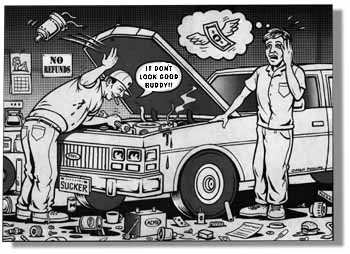
It is not right that some see the failures of some as a reason to dismiss it all. Getting taken advantage of by one repair shop doesn’t make all mechanics crooks. Still, how does a patient know if their doctor is doing a high-level analysis of the evidence, is capable of critical thinking and going beyond the book, or if he’s just following the pack without doing any truly independent diagnostics? It really takes someone a bit removed from the profession, who doesn’t share their biases or bad remedies, to give the corrective treatment. Maybe a car mechanic turned doctor (the guy in the featured picture) would have some useful perspective on the topic?

Whatever the case, if we can’t trust everyone who is licensed by the state to inspect vehicles, we should be even more skeptical of those who want to put things into our bodies. They don’t even have to be bad or intend harm, it could simply be that they are asleep at the wheel, putting trust in institutions that have been compromised and corrupted. At the very least, the body is extremely complicated and even our most advanced methods are crude. We may not know that our modern versions of bloodletting are of negligible value or even harmful for another century or two. This is why we customers, the patients, should never be pressured one way or another even if the science is supposedly settled.

Yes, even those at the top of the profession today may be tomorrow’s quacks…

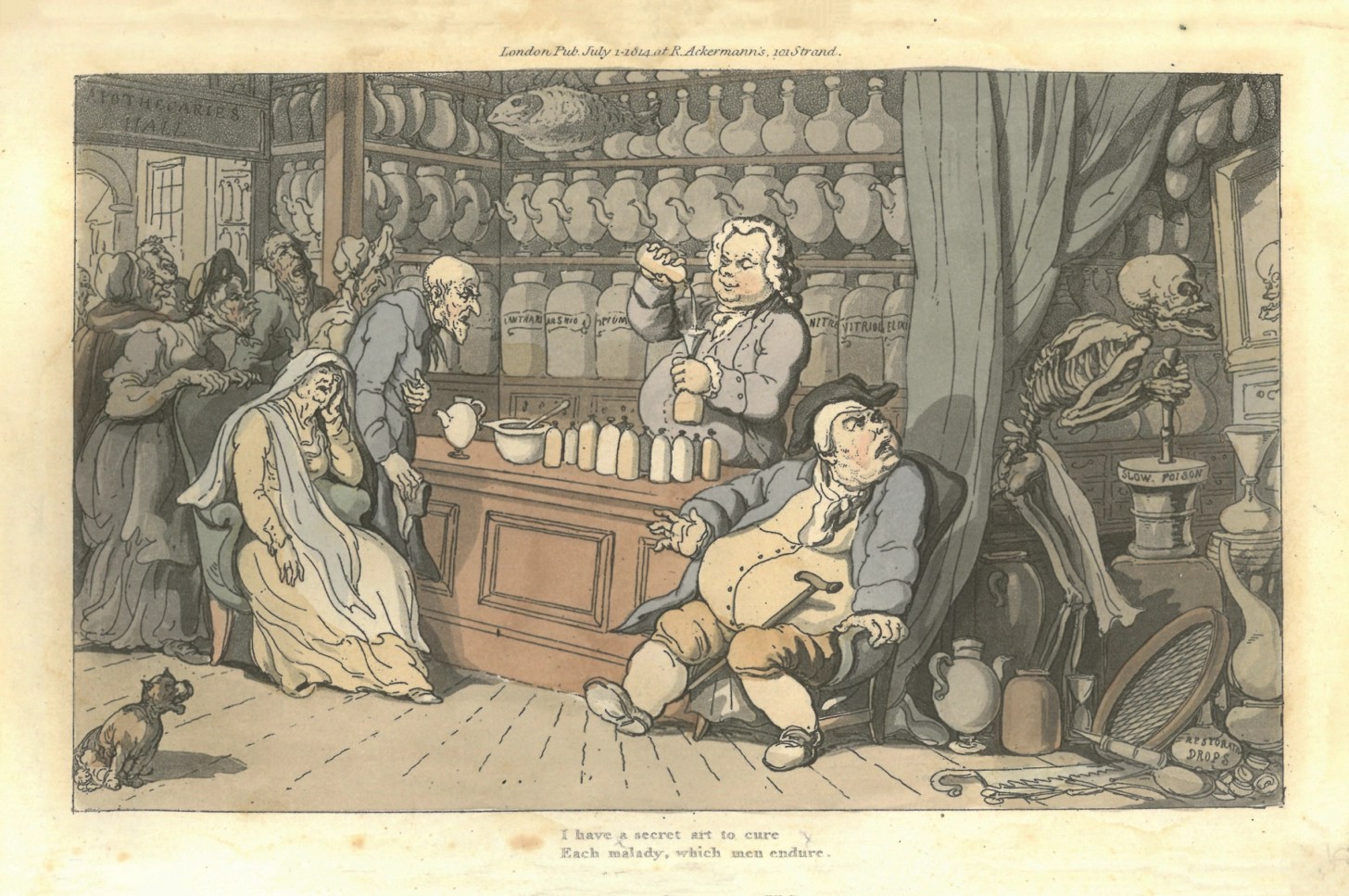
Note the “slow poison” written on the mixing device.

An Affirmative Reaction

Standard

The Supreme Court has finally ruled against the practice of blatant racial discrimination in university admissions.  This, after Harvard and other schools, in pursuit of filling quotas, would find means to select against qualified Asians to meet an ideal for diversity based on skin color.

The Affirmation Fairy… 

African Americans, at least as a collective whole, have suffered disproportionately and this is a historical injustice that is not easily solved.  Much of our success later in life has to do with the homes and communities that we were born into.  The values we receive via our culture make a huge difference so far as outcomes.

I remember a viral video, a few years back, that lines up a bunch of young people on a grassy field.  The announcer asked various questions, such as “Take two steps forward if both of your parents are still married,” and those who could answer yes advanced.  The results of this survey were framed as ‘white privilege’ and yet none of the statements had anything to do with race.

Social inequality is certainly not a black-and-white issue, many children of European and Asian ancestry lacked a father in the home, worried about fitting in, did not feel safe at night in their neighborhood, worried about having enough to eat, and lacked access to private education or tutors.  I once begged my mother to take me out of public school after a rough patch.  I changed my hairstyle as a response to classmates who made note of my ‘Mennonite’ side part.  I decided to quit college rather than go deep into debt.  

Am I underprivileged?

Exactly how much am I disadvantaged as a learning-disabled child of two high school dropouts, with a father who had to be away all week to support our family?

There problem with all “affirmative action” is that it is a vast oversimplification of a very complex and multi-layered problem that may be more about culture than color.  We simply cannot account for every factor or rate every single subcategory of ethnicity and culture for statistical disadvantage.  For example, do we know the college graduation rates of Americans of German ancestry or Irish and Italian?  Are a proportional amount of these ethnic groups represented?

Furthermore, our own disadvantages can be advantages, in that they can provide u much-needed motivation.  Sure, having money may mean a trip to Harvard and a certain level of success.  However, the same is true of those who are tall and athletic.  Jeff Bezos, at 5′-7″ tall, may have benefitted from having some ‘short man syndrome’ or that extreme desire some have to compensate for the discrimination they faced for physical characteristics that were beyond their control.

Affirmative action is wrong in that there is no way to rank hardships.  It is wrong because it isn’t addressing the root causes of social inequalities, even as defined by the privilege police, in that we’re not talking about things like fatherless homes or inner-city violence and cultural forces that discourage the behaviors that aid in academic achievement.  You can’t wait until a person is eighteen, then wave a wand of university education and credentials as a solution to these underlying issues.

Asterisk Graduates…

The true underlying message of affirmative action was that minorities, specifically those of African descent, couldn’t be successful without the help of the government.  As liberal arts universities continue to seek to fulfill a narrow color-obsessed definition of diversity, using quotas rather than qualifications, they unintentionally degrade all of their minority graduates—even those equal in merit to the non-minority graduates.

The idea of a “diversity hire” or a person not equally qualified to others who applied and yet are given preference only because of their special category of race or gender, is a direct consequence of discriminatory affirmative action programs.  People know how to read between the lines (albeit often unfairly) and will diminish accomplishments that weren’t actually earned or can be perceived as being unearned.  It is why we do not see the work of those ‘born into wealth’ as being equal to that of those who are self-made.

A classic example of the patronizing white saviorism that is lurking behind divisive equity campaigns.

Just as a university degree would lose value if everyone were simply given a diploma for breathing, admitting some primarily on the basis of skin color devalues the effort even in the eyes of those who benefit.  It only serves to feed an idea of black inferiority, that they need a ‘white savior‘ to swoop in and rescue them from their plight, and is grossly unfair to all who were truly qualified on the basis of merit—but will still deal with the asterisk due to systemic compensatory color preferences or racially discriminatory quotas.

You cannot defeat unfair discrimination with a new kind of unfair discrimination.  It is not right that overqualified Asian students were being overlooked because of their race or on some kind of subjective basis that the worth of their own “lived experience” is less than a person of African origin.  Many Asians have overcome extreme hardship, faced intense pressure at home and hate crimes (often underreported for going against the typical racial narrative), yet won’t ever express this due to cultural reserve—why should they be punished for the success of their peers?

Two-tiered or lower standards for some will never achieve the goal of equal outcomes.

Favouritism Forbidden…

We’re living in a time of moral inversion, a time when those who lived a life of crime and abuse are treated as victims simply on the basis of their outward appearance.  It is as wrong as the favoritism of preferring the wealthy over the poor for the potential benefits:

Do not pervert justice; do not show partiality to the poor or favoritism to the great, but judge your neighbor fairly.

Leviticus 19:15 NIV

The problem was favoritism, preferring one party based on who they are (what they can provide for us) rather than the actual merit of the case.  Fairness of judgment, not equality of outcome, is the goal.

Christians were told not to judge by a person’s outward appearance:

My brothers and sisters, believers in our glorious Lord Jesus Christ must not show favoritism. Suppose a man comes into your meeting wearing a gold ring and fine clothes, and a poor man in filthy old clothes also comes in. If you show special attention to the man wearing fine clothes and say, “Here’s a good seat for you,” but say to the poor man, “You stand there” or “Sit on the floor by my feet,” have you not discriminated among yourselves and become judges with evil thoughts?

James 2:2-4 NIV

Many, trying to make a show of their own righteousness, take a Scripture like that above and turn it into a call for social justice or a special preference for the poor or otherwise disenfranchised.  However, this kind of reverse favoritism totally misses the point.  Trading one kind of perverse judgment for another is not a virtue.  No, it is a virtue signal and something people do for the social benefit of merely appearing to be an advocate for those recognized as being disadvantaged.  Even if sincere, this is a misguided approach that goes against the instruction not to show favoritism.

Affirmative action, in the end, is just a new form of white supremacy that is expressed as patronization.  It frames differences in outcomes solely in terms of identity groups while neglecting to correct the factors causing the inequal results or truly helping people to cross over these unhelpful, artificial, and arbitrary divisions.  Jesus taught more of a gracious meritocracy, where our behavior did matter and we would ultimately be judged on how we treat other people irrespective of their deserving or appearance.  In this regard, our equality comes only in repentance and our obedience to the law of Christ—not by force of courts or legislation.

We do not save the world by trying to force others into compliance or control outcomes. Rather we change ourselves and become an example of impartiality and love to all people. Honest and fair equal opportunity is having the same requirements for all and not preferences tailored to some at the expense of others. You cannot rob Peter to pay Paul. We shouldn’t love bomb some, even to make them feel better about themselves, by removing opportunities for those who truly have earned their place.