Too Cruel To Be Coincidence

Standard

There is this sort of silly thought I have had, which has some legs, about the true nature of the universe and how unlikely it seemed that our friend’s daughter would fall victim to the currents of the Susquehanna river.  I realize this is more just a hiccup of my own mind than an actual reality, but what are the chances?  What are the actual probabilities we would know another Filipino-American couple with so many similarities and has a tragedy like this happen?

I ran my hunch through Grok.  What are the chances that another couple, one of them a German-American with neck or back issues (like me) the other a recent immigrant from the Philippines who came with a child and has also (like my wife) recently given birth to a second child, losing their ten-year-old daughter in a drowning incident just a week prior to Mother’s Day?  And how likely is it that I would have experienced the loss of a close friend’s child twice?  The probabilities are so infinitesimal that the very existence of life is more likely than this:

The probabilities of the specific scenarios you described—knowing an ethnic German man in Pennsylvania with a Filipino wife and children matching your family’s profile (0.00462%), his 10-year-old daughter drowning in the Susquehanna River on a specific weekend (1 in 2.82 trillion), and being friends with two women who lost children tragically (0.566%)—are all significantly lower than the probability of life existing in the universe, which is nearly certain (1) due to the vast number of planets (10²²). Even in an extreme pessimistic scenario where life is exceedingly rare (0.36%), only the third scenario approaches or slightly exceeds it, while the others remain far less likely. The universe’s immense scale makes life’s existence highly probable, whereas the hyper-specific nature of your scenarios, especially the drowning event, drives their probabilities to near-zero.

All this is just an extended version of that age-old question: “Why me?”  

This weird feeling of this being a tragedy too perfectly scripted to be real is simply the hallucination of a mind searching for meaning where there is none.  

It is no different from when I—in delusion of religion and looking for answers—had assigned meaning to the ‘impossibility’ (a romantic interest) randomly picking up a paper, leftover from Sunday school class in the same location, and then reading from it “with God all things are possible” right as she walked past me—renewing my hope to continue my foolish pursuit of faith and love.  Belief in a divine plan only led to more disappointment.  It is what it is—as she told me as an answer.  A coincidence is no more meaningful than we have made it.  
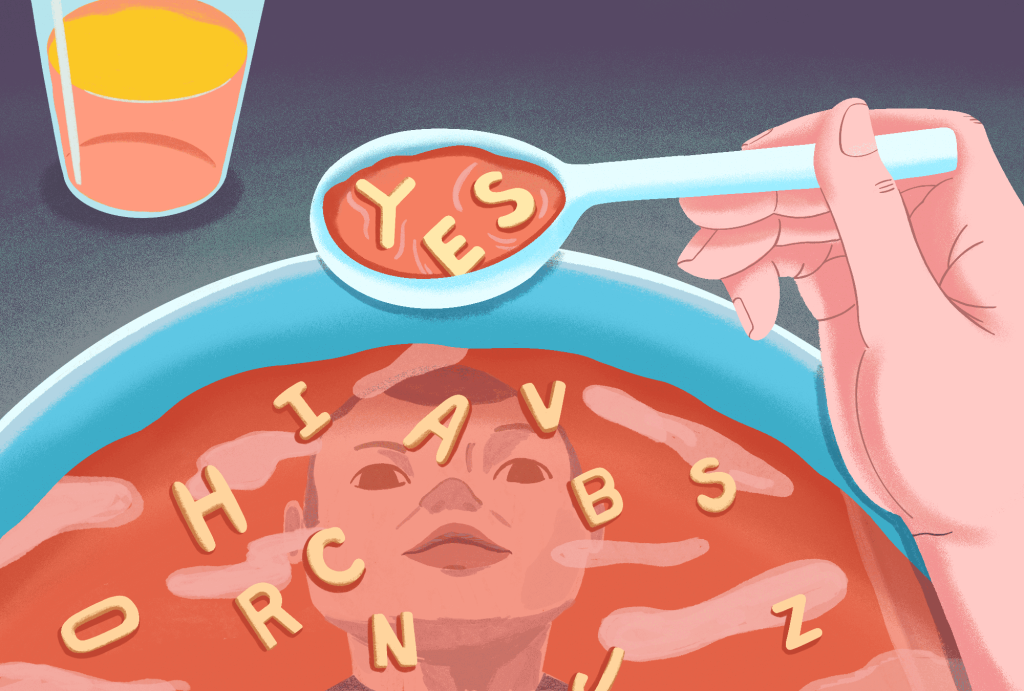
apophenia

Truly, we could throw our lasso around any circumstance, any set of facts, and find it to be highly improbable.  But, after the fact, if it has happened, the probability is always 100%.  Basically everything is unlikely right before it has happened and this why those Lee Strobel type of apologetic ‘cases’ aren’t very compelling for a critical thinker.  They are too based on assumptions and deciding what matters based on our own window of understanding—never considering the other possibilities.  

It is actually very likely that I know another Filipino-American couple, involving a single mother and a lonely guy similar to me, given that we deliberately connected to the local Pinoy community for sake of my wife.  And it was our similarities that always gave us something to talk about.  He was employed in an engineering related field, same as me, and going through the visa process.  As far as the tragedy, around 4000 unintentionally drown in the US per year (900 children) and spring weather (near Mother’s Day) is just likely to bring people to the river.

My foreign-born friends, in retrospect, were more vulnerable.  Those who grew up in the Susquehanna valley have a bit more fear of the river.  The waters may appear to placid, but we also know about those floods which have ripped through communities and how it respects nobody.  You’ll try to pet a bison up until you see the first person gored.  We simply don’t know risk until we have seen it for ourselves.  But then I also know that the mother, in this case, was always extremely cautious and only looked away for seconds before hearing the commotion.

What is so hard to accept is that reality that this world is full of danger.  Both conspiracy theorists and left-wing control freaks refuse to deal straight up with a world where death can occur without some dark plot and that this won’t be solved with politics.  I’ve never been under that delusion.  However, I have had this good things happen to good people expectation going in to life.  My Pollyannish hopes have been rebuffed too harshly and consistently to continue holding to them.  In truth, the natural world does not care about your morality—if you follow all the rules or are evil incarnate—the universe is utterly indifferent.  It just is what it is.

There is no evidence of a grand design, as I had been indoctrinated to believe, and fully embraced—before falling flat.

It is pareidolia, a mirage or projection of our own desire to find explanation or reason for everything.  People want this singular thing to blame for all bad things and yet there is not in the case of this drowning.  The mom was not negligent, the water is neutral and neither good nor evil.  Trying to find design is only me choking on a reality we all should face: We all leave this world the same as we entered it—dust to dust.  Some depart on a different schedule than expected.  But many children have died before their parents and long before history recorded it.

To have no cosmic force orchestrating our suffering is a big comfort.  It eliminates the cognitive dissonance of the loving God that then subjects Creation to torment.  Pain is a survival mechanism.  It helps to correct our behavior and train us, but also misfires (ask those with chronic pain) and hurts us for no good reason.  There is no need for a perfect system, one where only those who deserve punishment are punished, merely one that functions well enough.  There is no intent to be cruel, no special message to glean from the loss of a precious daughter a weekend before Mother’s Day—she slipped on a rock and that’s all there is to it.

We desire a director behind all events good or bad to make it easier to understand.

If fantasy helps you cope with grief then by all means embrace it.  We could theorize it was part of a hidden divine plan to gain the salvation of her parents, a punishment for lack obedience to Allah, and that she is playing up in heaven with those millions of aborted fetuses Evangeli-cons care about (or the children of Gaza they don’t) and if the thought comforts then pull it up over your head like a warm blanket.  Nature can be cruel, cruel in a way that seems very much too improbable to be unplanned, but good people suffer just as the wicked do, and the universe offers no explanation or apology for it.

The Myth of an Indestructible Building

Standard

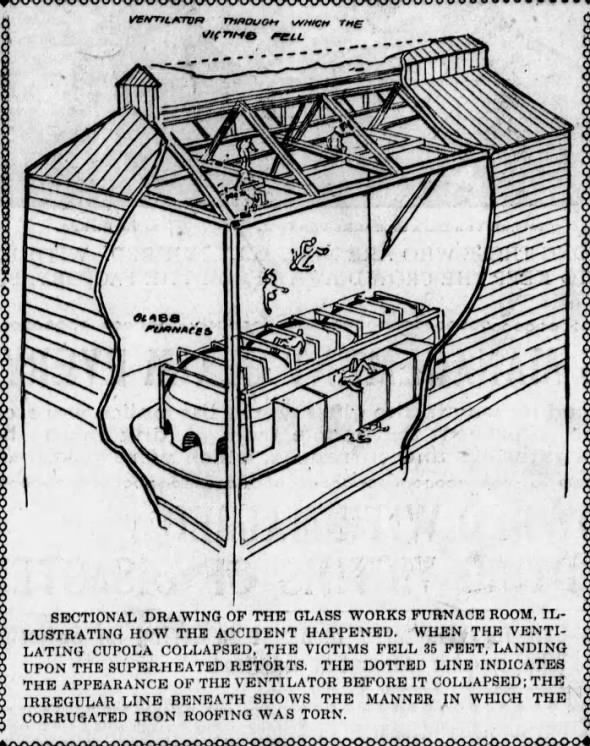
It was November 29, 1900, and fans filled the stadium in San Francisco for the annual Thanksgiving Day game between California Golden Bears and Stanford Cardinal. Some, not wanting to pay the entry fee (one dollar then, $40 in today’s money), climbed on a nearby glass factory roof to get their view of the action on the field.

The newly built factory roof collapsed about twenty minutes into the game. One hundred people fell as it gave way and plunged four stories down—many landing on the 500° F oven below. It was a horrific scene. Young people being cooked alive. What happened? The building roof wasn’t designed to hold a mass of spectators. It failed. Those who had climbed up were oblivious or did not have enough concern for the stress they were adding to the structure.

This tragedy wasn’t just a failure of design; it revealed a deeper misconception that buildings should be invincible, a myth that shapes our reactions to collapses even today. It goes further than engineering or physical buildings as well. Our models of reality are oversimplified at best and flat-out wrong in too many cases.

There is a common misconception and an unrealistic expectation about structures—many people seem to assume they are like blocks of granite. From those who believe that every building collapse is a conspiracy to those who think every failure demands stricter government regulations, the myth of an indestructible building continues due to a lack of understanding of engineering and the limitations.

Design Limits Are Not Defects

One key misunderstanding is design limits. Engineering is not about making a building too strong to ever fail. Unless we’re talking about the Great Pyramids, it’s all about trying to meet certain established parameters. An engineered building is designed to meet the expected conditions as defined by regional building codes. If the wind, snow, or loads exceed the designated standards, then there will likely be a collapse.

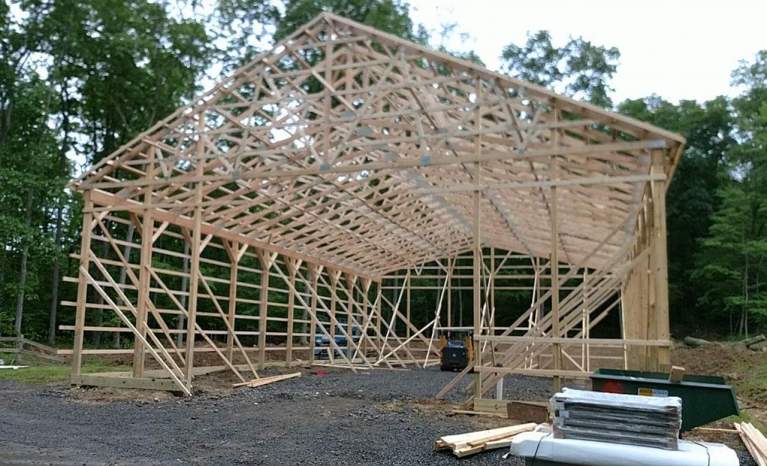
Earlier this year, after a heavy snowfall in upstate New York, many buildings had their roofs cave in (including this fire hall) because the weight of the snow was that much greater than the design weight. Sure, most engineers build an extra safety margin into their components, but eventually these limits are too far exceeded and you’ll end up with a tangled mess. This is why there are sideline roof shoveling businesses in these places where large snow accumulations are a regular occurrence.

Sure, code could force people to build to a much higher standard, making a collapse due to snow load virtually impossible. But this would increase the costs so much that it would price many people out of building a new house or barn. Engineering is all about compromise, more precisely about making the right compromises given the expected conditions. Yes, there is a case for making adjustments based on observation or after studies, but ultimately we build for what will work most of the time.

More Is Not Always Better

In the aftermath of the earthquake that had struck Myanmar and neighboring Thailand, there was a comment made to me in a chat hoping for more layers of regulation. This is a sentiment, in the specific context of rapid development of Bangkok, that seems more reflexive than reflective. It is a progressive impulse to believe that more interventions and rules are the answer.

The collapse of an unfinished tower in Bangkok, during the earthquake, sparks questions about building codes.  Was it missing sheer walls?  Did the contractor rush to ‘top it off’ quickly?  I want to know what the investigation finds.

But, for me, as someone who works in the construction industry and has occasionally needed to sift through these layers, I could not disagree more. Sure, better regulations may be needed. However, legalism doesn’t work in building standards any better than it does in churches. Sure, you need a code of some kind. And yet onerous regulation will add to the cost of construction, not necessarily improving the end results, and only making new housing less accessible.

It is, at best, the same trade-off discussion we can have about self-driving cars and the need for LIDAR. Sure, this expensive laser ranging system may marginally improve the results, but at what cost? Self-driving cars with cameras alone are already safer than human drivers. Keeping these systems at a price that is affordable will save more lives than pricing them out of reach for average people. It is, therefore, optimal to rollout the less expensive and safer tech even if it could be slightly improved.

At worst there is only more expense and no benefit to more layers of red tape. The real problem with rules is that they are written in language that needs interpretation. Unlike a classroom theoretical setting, in the real world you can’t just memorize the correct answers and pass the test. The ability to make a judgment call is far more important than adding to the pile of regulations. More rules can mean the more confusion and the truly critical matters get lost in the mess.

I see it over and over again, when different customers send the same job for a quote and all of them interpreting the engineering specifications their own way. It is the tire swing cartoon, a funny illustration of when the customer wants something simple and yet the whole process distorts the basic concept until it is unrecognizable. That is where my mind goes when we talk about adding layers. Is it increasing our safety or merely adding more points of failure?

This one stuck with me and should be standard equipment in every design department.  I first saw it as a child while visiting the engineering department of the construction company my dad worked for.

Some of it is just that some people are plain better at their jobs than others with the very same credentials. I am impressed by some engineers, architects, contractors, and code officers—not so much by others. I’m willing to bet the intuition of some Amish builders is probably more trustworthy than a team of engineering students’ textbook knowledge, full of theory, with no real or practical world experience. In the end any system is only ever as good as the users.

Theory Is Not Reality

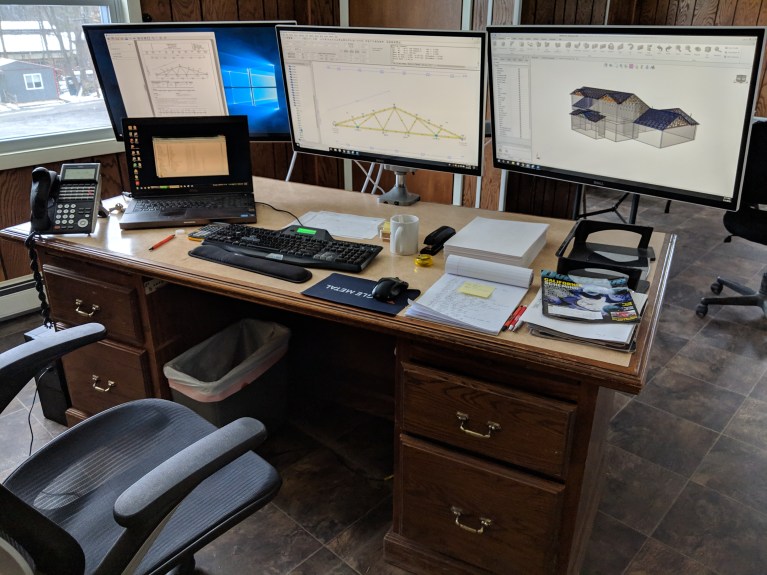
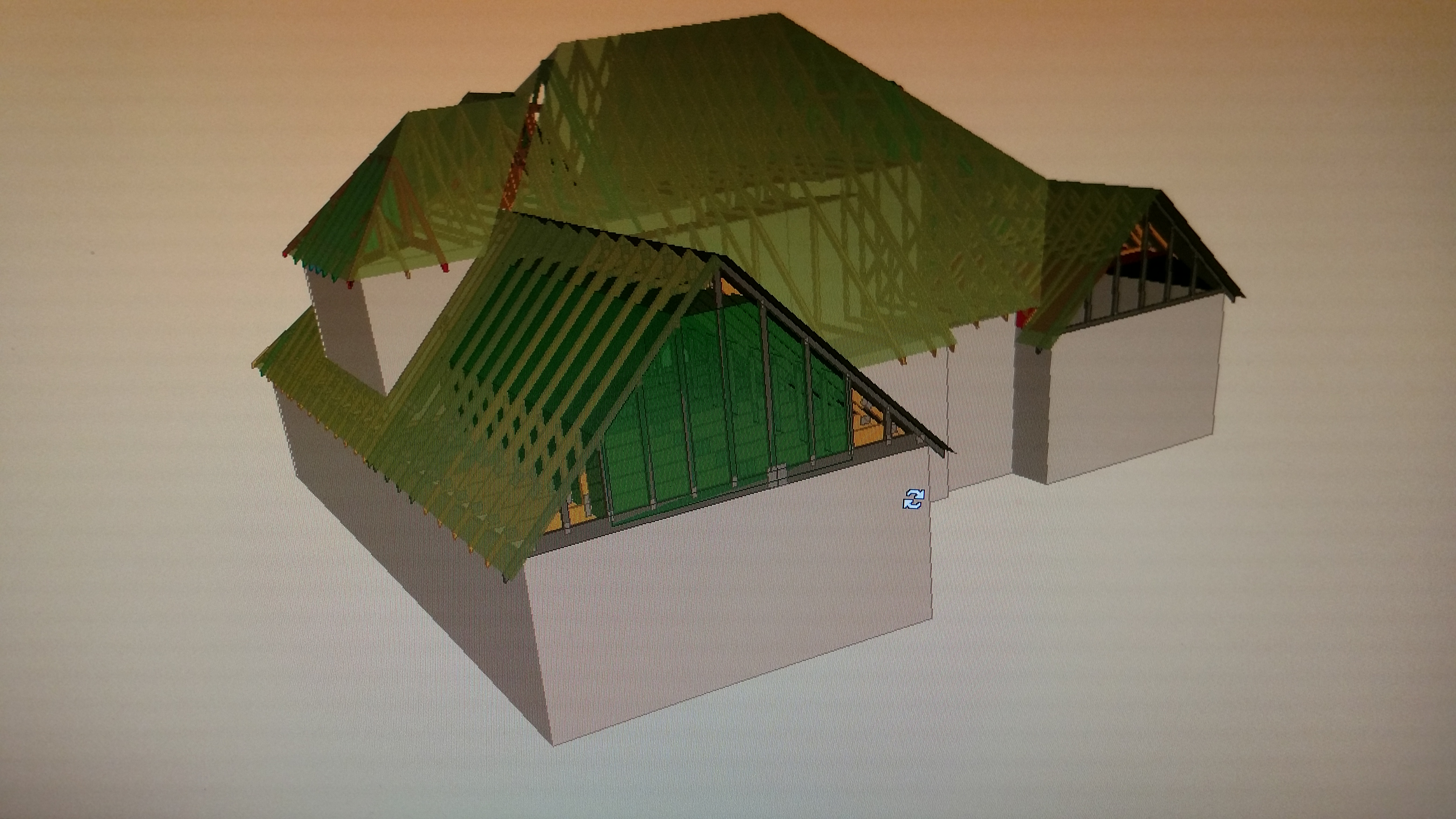
My work relies on truss design software. I enter information and it does those boring calculations. When I started, I assumed that it was more sophisticated than it really is. I thought every load was accounted for and nothing assumed. But very soon the limits of this tool started to reveal themselves. It is only as accurate or true to reality as the engineers and developers behind it—and on the abilities of the user (me) understanding the gaps in the program.

When it comes to mental models—the kind of physics involved in engineering—only a few people seem able to conceptualize the force vectors. Things like triangulation, or compression and tension loads, are simply something I get. Maybe from my years of being around construction or that curiosity I had, as a child, that made me want to learn what holds a stone arch up or why there are those cables running through that concrete bridge deck. My model was built off of this childhood of building Lincoln Log towers (arranging them vertically) and occasionally making mini earthquakes.

I’m exasperated by this expectation that people have for skyscrapers to be indestructible or to topple over in the same manner of a tree—as if they’re a solid object. It also seems that the big difference between static and dynamic loads is lost on most people. They don’t understand why a building could start to pancake, one floor smashing the next, or how twisting due to extreme heat could undermine the structural integrity of a building without ever melting the steel. Of course this has to do with their beliefs or mistrusts that are not related to engineering—nevertheless it shows their completely deficient understanding of how the science works.

The concept in their head is off, their brain modeling is inaccurate, and their resolution may be so low they simply can’t grasp what the reality is. You try to explain basic things and their eyes glaze over—sort of like when Pvt. John Bowers tried to explain why the plants need water, and not the electrolytes in Brawndo, in the movie Idiocracy. Ignorant people will scoff before they accept a view different from their model of the world. The theory they believe rules over all evidence or better explanation.

On the other side are those who trust every established system without understanding it. They “believe science” and see more as an answer to every question. More rules, a larger enforcement apparatus, faith in their experts, without any feel for the problems encountered by the professionals or those in the field. If they had, they would question much more than they do. Human judgment is still at the base of it all. Or at least that is what the lead engineer told me while we discussed the limits of software and the need to be smarter than the tool.

Not even AI can give us the right balance of efficiency in design versus safety factor or what should be written in the code. It may be a better reflection of our own collective intelligence than any individual, but our own limits to see the world how it actually is are not erased by the machines we create. We are amplified, never eliminated, by the tools we create. So we’ll be stuck wrestling with our myths and theories until we take a final breath—only our flaws are indestructible.

Models of a Messy World

If truss software taught me anything, it’s that no model nails reality perfectly—not beams, not buildings, not life. We lean on these frameworks anyway, because the world’s too wild to face without a map. But just like those fans on that San Francisco roof in 1900, we often climb onto flimsy assumptions, mistaking them for solid ground. The myth of an indestructible building is just one piece of a bigger distortion: we think our mental models—of faith, of power, of people—are unshakable truths, when they’re really sketches, some sharper than others, of a reality we’ll never fully pin down.

Take religion. For some, it’s a cathedral of certainty, every verse a load-bearing beam explaining why the world spins. Others see it as a rickety scaffold, patched together to dodge hard questions. Both are models—ways to grapple with life’s big “why.” Politics is messier still. It’s like designing a city where everyone’s got their own codebook. One side swears by tight regulations, convinced they’ll keep the streets safe. Another group demands open plans, betting that freedom builds stronger foundations. Both sides act like their own ideological model is bulletproof, shouting past each other while the ground shifts—economies wobble, climates change, and people clash.

Then there’s prejudice, the shoddiest model of all. It’s like sizing up a beam by its color instead of its strength. Prejudice, always a shortcut to save us from the effort of real thought, fails because it’s static, blind to the dynamic load of human individuals. Good perception, like good engineering, adjusts to what’s real, not what’s assumed.

All these—religion, politics, prejudice—come down to how we see. Perception’s the lens we grind to make sense of the blur. Some folks polish it daily, questioning what they’re fed. Others let it cloud over, stuck on a picture that feels safe but warps the view. I think of those fans in 1900, not asking if the roof could hold them. They didn’t mean harm—they just saw what they wanted: a free seat, a clear view. We do the same, building lives on models we don’t test, whether it’s a god we trust, a vote we cast, or a snap judgment we make. The distortion isn’t just in thinking buildings won’t fall—it’s in believing our way of seeing the world is indestructible.

What makes a model reliable? Not that it’s right—none are. It’s that it bends without breaking, learns from cracks, holds up when life piles on the weight. In construction, we double-check measurements because we know plans lie. In life, we’d do well to double-check our certainties—about the divine, the ballot, the stranger next door. The San Francisco collapse wasn’t just about a roof giving way; it was about people trusting a picture that didn’t match the world. We’re still climbing those roofs, chasing clear views on shaky frames. Maybe the only thing we can build to last is a habit of asking: what’s holding this up? And what happens when it falls?

My New Normal, For Now…

Standard

It is official.

I cooked my first meal using a gas oven.

Well, that’s if you don’t count those canned soups that I heated.

Anyhow, it was in the midst of my dinner preparation that I discovered that I had accidentally purchased “angel hair” rather than my normal “thin spaghetti” noodles, which there was also a box of the latter as well and, besides that, another box of regular spaghetti.

So, apparently, in my panic buying “just buying a few things” (to use the words of a classmate I bumped into stayed a safe six foot away from at the grocery store) I had grabbed a couple of different spaghetti noodle varieties from my usual. So this apocalypse I will have to deal with the mix up and be more careful in my panic buying routine restocking for next apocalypse.

But, as a general rule, I’ve been pretty lucky throughout this Covid-19 event. First, I’m not dead yet. Second, I had purchased a pack of eighteen “mega rolls” of toilet paper before the hoarders emptied the shelves. I also got a haircut while it was still safe and legal. Add to that, my having a D-Link router installed weeks prior made the shift to working at home rather than forty-minutes drive away a smoother transition.

Truly, the timing of everything has been fortuitous, so far, and I hope that streak continues.

Things had been overwhelming at work.

Now, with an extra hour of sleep at night and some flexibility to meet obligations during the day (by making up for the time lost in the evening) I feel more productive and relaxed.

Sure, I do miss my three big screens at work. But nothing beats rolling out of bed and getting right to work. And I’m not really sure how I would’ve gotten through all of the necessary steps to get a renter into my old house had I needed to run back and forth from the office right now, it would be next to impossible and, considering my current workload, completely stressful at very least.

Oh, and did I mention that my new renters (recently unemployed) are awesome???

Yeah, they spent last week raising the value of my property and are anxious to do more. They do great work, he can do the laundry list of small items the home inspector found, and I’ll consider keeping them employed to help me get some projects in my new house wrapped up. I mean, it just so happens that they’re currently unemployed.

I honestly don’t know how I would’ve gotten everything done there without them and hope they are as happy with the arrangement as I am. It will be interesting to see how long we are off work, I’ve already told them there would be flexibility as far as move-in dates, given the current unforeseen circumstances. yet (given Congress finally did get their act together) they are set to receive a check for the US Treasury soon and their state compensation, so we should be good to go.

My anxiety-prone nature also gives me an advantage in times of crisis when the confident people are feeling lost. I mean, it is a sort of “welcome to my world” type of scenario for me. When your whole life is basically a crisis there’s no big adjustment needed for the end of the world, it’s just another day and you know you’ll figure out a way through or die.

And, so long as I don’t get a bad strain of Covid with my Dunkin coffee, I’m not dead yet!

Anyhow, it was nice to at least get a practice run working remotely, I think I might take my work on the road this winter, at least if we get that far, and make my second trip to the Phillippines to visit my bhest again…

What is a bhest, you might ask?

That is a topic for another blog…

The Anatomy of a Truss Design Failure

Standard

Since day one I’ve kept an anecdote about a competitor’s failure in the back of my head as motivation to do better. This company, believed by some to make a high-quality product, had sent out a truss package that was plagued with problems and I made it my own goal to avoid this sort of thing as much as possible.

Truss designer may be my job description. However, things aren’t always as they seem, high-level creativity is not a requirement for most of what I do on a daily basis and, in reality, my job is loss prevention. My role is, first of all, to make an effective and efficient design that doesn’t waste material or add unnecessary cost. However, second, and more importantly, I must always meet the specifications of the customer and avoid truss design failure.

In an ideal world, my work would be spread out evenly, revisions after quotes (especially involving complex layouts) would be punishable by death, there would be no phone to interrupt, and I would have all day to create perfection. In the real world, unfortunately, there are trade-offs, it is deluge or drought (all deluge lately), and things do not always go as they should.

Anticipating an Opportunity to Impress

Anyhow, the office where I work has an open design and this feature, combined with my eavesdropping, gives me a preview of what is to come. I overheard the phone conversation, someone needed trusses yesterday, apparently, they were a loyal customer to one of our competitors and someone over there had dropped the ball. The salesman (my boss) assured him that we could make the trusses in the next couple days.

Upstairs I anticipated an opportunity to knock one out of the park and geared myself up for the fast turnaround time. The quicker I could finish the design work, the sooner the saw guys could get cutting, everything would hinge on my ability to churn something out quickly and I was determined not to be the gum in the works.

But what I (along with my boss) did not anticipate was that this was not a simple run of common trusses. No, it was an extremely complex design, a flat roof with angled walls, equipment loads, parapets, and something that would normally take a day or two to design. And, adding to the mess, was the fact that I had to match the competitor’s prints—which is not actually ideal.

Some customers lack appreciation for the design process and seem to think that we can just click a couple keys *bee-boop* out pops a truss layout. In reality, for things to go well, everything must be entered in a particular order (using a program that takes pleasure in crashing at the most inopportune times) and thus it actually is easier to work from scratch than to try to copy individual trusses from another manufacturer.

The Ace Up My Sleeve

Fortunately, I recognized this layout as something I had done before when contractors were bidding on the job. However, my own design had been true to the architect’s drawings, which is probably why we didn’t get the project to begin with, so I stripped off the trusses that I did before and went to work duplicating the cheaper (incorrect) version of the layout brought in by this contractor.

The competition’s webbing was atrocious, they obviously did nothing to optimize the generic web pattern spit out by the software and could be vastly improved with a little effort. It is amazing to me how many other truss company prints I see like this where clearly the ‘designer’ let the programming do all the work and take pride in my ability to go above and beyond. If I could not take a bit of pride in my work I would find something else to do.

I was halfway through my masterpiece, trying to work at warp speed while also checking all the right boxes and then realized something. Oh no! The trusses on the competitor’s prints were all an inch shorter than mine! Some contractors prefer it this way so that the trusses are easier to position in the field (or maybe because they hate truss designers?), for me this was simply another thing that could go wrong and meant going back through every truss I had already designed.

Finally, about an hour after lunch, I finished the last of the individual truss designs, took one last look at the profiles in the printer queue, and sent them down. My coworkers, the guys in sales, generally do a good job reviewing my work and having the plans confirmed with the customers before production.

Pride Cometh Before the Fail

However, it was at that time I made a terrible mistake. I went on Facebook and, with a slight amount of tongue-in-cheek, crowed:

I would be embarrassed to send out the truss prints that I’ve seen from some of our competitors, plain embarrassed.

Just saying…

I was feeling very good about what I had just accomplished. I had prints ready to go in record time and they were aesthetically pleasing to me. The contractor, I hoped, would appreciate my work and maybe reconsider his allegiances as well. I mean, we bailed him out. He had somehow been dropped off the schedule of our competitor, we got him what he needed and that was something to be proud about—not to mention that we beat them at price as well.

But pride cometh before the design failure and my moments of reveling were short-lived. After the trusses went out, a day or later, my boss received a call and it wasn’t good. I had screwed up. The truss lengths were not correct, some had to be cut down and would need repair prints. Apparently, in my haste, I had trimmed some of the trusses twice, I had done some once, and others not at all. That was something that I could have easily seen had I taken one look down the line of trusses in 3D rendering and reflected poorly on my efforts.

Besides that, the plans he gave had a small note near a dimension for the angled wall. For whatever reason, the architect (without changing the actual dimension) decided to change the angled wall slightly and that’s where the really big mess was. That would require specially engineered repair prints from Dallas. I feverishly went to work to determine what each new length would be on the dozen different length trusses on that wall.

Fortunately, the competitor’s truss prints, that I was supposed to copy, were wrong as well. Evidently, they too had missed the amendment made in a note on the plans. Unfortunately, I also missed the note and made a serious mistake myself besides. Yes, they were able to use the trusses, an inch difference isn’t a big deal ultimately, but it was the mental mistake that kept me up at night days later and soured my mood for the next week. It was a mistake and a missed opportunity to impress.

There is certainly always blame to go around for a failure like this. The contractor should have checked the prints, my boss could have insisted on this precaution before producing and shipping these trusses as well. But in the end, what matters as far as I am concerned is what I did wrong and how to ensure that it does not happen again. It is my job, as truss designer and loss prevention specialist, to ensure that this problem is solved—to make the changes necessary to the process to guarantee that there is no repeat of the same mistake.

A Final Analysis of the Failure

In short, I bungled my part because I rushed Taking one more look at the wall dimensions may have been enough to spot the note about the change of angle and lead to a clarifying question. An extra thirty seconds of review at the end of the design process would have been enough to find my own mistake. I should not expect my coworkers or the contractor to cover for my own incompetence and especially not on a complex layout where they lack the same resources. Design is my job, not theirs, and that means doing it right the first time.

Furthermore, design is a process that should never be rushed and it is my job to push back against pressure as needed. Sure, the sale’s guys do sometimes over-promise. And, yes, it is always my great pleasure to deliver results on or ahead of schedule. But it is also my responsibility to set a pace where I am comfortable working, where I am able to do things correctly the first time, and where the company avoids the cost and embarrassment of a truss design failure.

In my work, one small mistake can outweigh the hundreds of things done right. For instance, on this particular layout, I had all but two details right out of dozens of parameters. But the customer will only ever remember the hassle that came as a result of those two things overlooked. We will likely never get a second chance with this contractor after what happened and that’s on me—for failing at my most basic duty as truss designer.

From Truck Driver To Truss Designer

Standard

Trucking paid well, but being on the road all week, like a vagabond, was not ideal—especially not for someone who wants to marry and have a family someday.

So, after seven years (going on eight) I had resolved to find another job by the end of the year.  After being off for an extended period of time to rehab a torn ACL I figured that I owed my employer one more year, but after that my plan was to find something else.

However, the whole year had almost passed and nothing opened up.  Finally, after hearing of another driving opportunity and decided that a job change would be sufficient enough, I decided to change companies for what seemed like a better gig and keep on truckin’…

Well, God must be a comedian, almost immediately after signing the papers for the new driving job the right opportunity came along.  My friend, Titus Kuhns, was vacating his position as truss designer and that presented a unique opportunity for me.

But, I had a bit of a quandary…

Was it right to quit a job I had just taken?

The first day on my new trucking job, when things weren’t quite as anticipated, was enough to convince me to make the jump right then.  I sent a text to Titus expressing my interest in the design job and stopped in for a visit at Triple D Truss later that week—I pretty much committed on the spot.

My training would start a few months later in the beginning of April.  My old boss agreed to take me back until then (no point in me learning a new trucking job when I was already an expert at hauling commodities) and so I had my encore in the old blue Pete.

First impressions…

I’ve never worked in an office before, let alone for an Amish business, and didn’t really know what to expect.

Office hours started at 6:30am and, after a thirty-eight mile commute, I was a few minutes early.  So, figuring there was safety in numbers, I waited for Titus to arrive and then followed him in.

The office has a friendly and relaxed atmosphere.  That morning (and every morning since) my coworkers in the office all greet me with a pleasant “good morning, Joel!”  That day, not really knowing the program, I mumbled my reply and followed Titus to his desk upstairs.

John, one of the co-owners, seems to set the tone for the office.  He is upbeat, energetic, generous, and most importantly (for a fledging designer) a reassuring voice.  He sort of bounces up the stairs, often has a broad smile on his face, and hardly has anything bad to say about anyone.

The other part of the partnership, Dan, is a bit more awkward on the surface, but is also every bit as friendly and understanding as John.

Next in line is ever cool and collected Nathaniel, his charisma makes him a great dispatcher and excellent salesman—he possess youthful enthusiasm that is contagious and a curiosity that will likely take him far.

And the newbie of the group (besides yours truly) is Norman, who does some of the random office tasks (with Mary and Linda who work part time) and is only sixteen.

Oh, and did mention that everyone in the office, including the bosses) is ten years younger than me?

Yup, somehow I’m the old guy now, not sure how that happened…

Anyhow, let the training begin!

Titus seemed to be playing game of Tetris, except one that involved designing an endless variety of trusses, while juggling the phone, and doing a multitude of other small tasks—like creating their office forms.  The pile of stuff was overwhelming to my novice eyes and I worried that I wouldn’t be able to keep up.

What would happen when Titus left in a month?

I designed trusses on my first day.  The design software, I learned, is occasionally cantankerous and will crash if you do things out of sequence or in what appeared to be random intervals to a complete rookie.  But my natural aptitudes combine with a good teacher meant that I learned quickly.

The highlight that month—besides wonderful home cooked meals with Titus, his wife Daisy and adorable baby Rowan—was the week of training in Dallas Texas.  Everything was paid, I ran around in my blaze orange Dodge Challenger rental (a free upgrade) and was taught to use the 3D layout software.  I even had time to connect with an old friend, Richard Miller, and ate some of the best BBQ I’ve ever had.

Then it was back to Mill Hall.  Titus was moving to Ohio at the end of the week and would leave me as the solo truss designer.  I had many questions about how the next few weeks would transpire and didn’t entirely share the confidence of my trainer and co-workers.

Time to sink or swim…

My hope was to start Monday with a clear desk.  I was slightly terrified by the layouts leftover from Friday and were now entirely my responsibility.

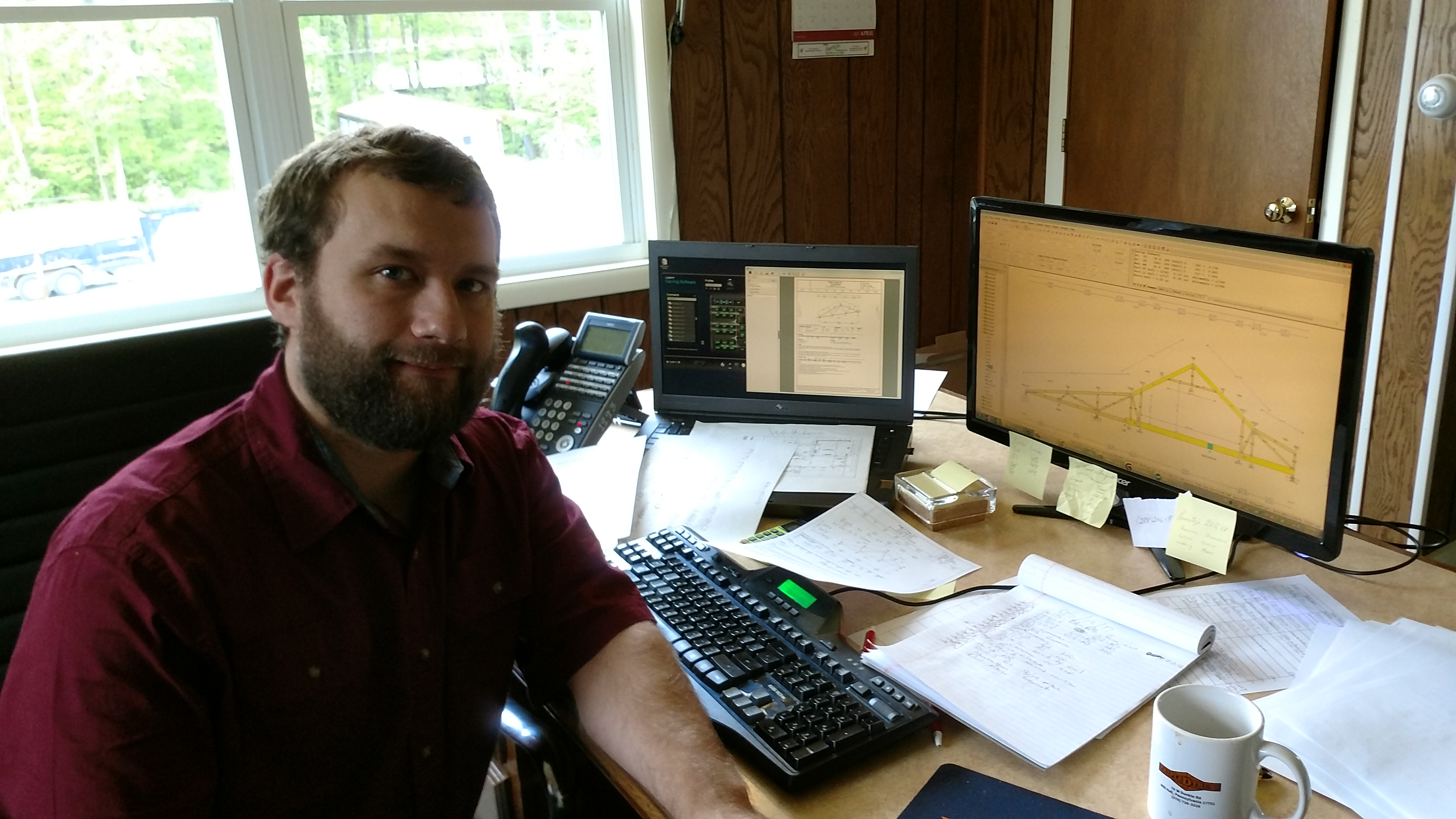
It my job to ensure that the quotes arrived to the customers and truss prints made it to the shop in a timely manner.  The designers desk is at an important crossroads in the office.  If I don’t get my work done production would grind to halt.

The first couple weeks were stressful, I was swamped, and my neck was sore because I was so tense.  My brother Kyle described my job as “speaking order into chaos” and chaos seemed inevitable in the absence of my concentrated efforts.

Fortunately Titus was only a phone call away and, if things got too out of control, the metal plate vendor (whose software I was using) has designers and engineers on staff to take the overflow.  Still, it was my job to coordinate the effort and keep chaos at bay.

After a few more weeks (and some overtime hours) I was fully in control of my work environment.  It was nice to end the day with a desk clear of work.  I had encountered the full range of what would be required of me and came out with my head still above water.

With each passing week keeping up has gotten easier and easier and more recently I have another problem.

The new problem?

Not being challenged.

Lately I’ve found myself facing a clean desk and blank screen.  This partly the result of things slowing down from the spring rush, but also because I am getting better at knowing where to start and also when a truss is basically as good as it will get and, more importantly, how to avoid the time consuming pitfalls of the software.

“An expert is someone who knows some of the worst mistakes that can be made in his subject, and how to avoid them.” (Werner Heisenberg)

I might not be a truss design expert yet, but I’ve made good progress and have gained plenty of confidence in my abilities.

It is great finally getting paid to do something that I’m especially gifted to do.  I love when I’m described as “the engineer” (my work is backed up by someone certified) and especially enjoy walking through the yard seeing completed projects knowing my part in the process.  

It is even more rewarding when your trusses end up installed in your uncle’s new truck shop.

Being on top of things has afforded me the opportunity to work beside the guys on the truss shop floor, which is fun.  It is also fun being the only non-Amish employee (other than the truck drivers) and especially that I share a last name with three in the office including one of the owners.

Overall the transition from gear jamming to desk jockey has been a smooth one.