Dismantling of the Penn State Colossus

Standard

Growing up, college sports, or even sports in general, were not part of my world. My father didn’t toss a football with me in the backyard or gather us around the TV for games—work was his recreation, and that was our normal. I had no reason to care. But something shifted later in high school, culminating in my going out for football my senior year, and I found myself very drawn to Penn State, captivated by the legacy of Joe Paterno and the blue-and-white pride that defined it.

In the years just prior to my tuned in, Penn State had soared to new heights, claiming two national championships and cementing its place as a powerhouse. For that fleeting moment, the Nittany Lions were the best in the gane. State College, just to the west of me, was the heart of this empire—a house that Paterno, a son of Italian immigrants from Brooklyn, had built. He was not just a coach; he was a living legend, embodying the loyalty, community, and tradition that made Penn State more than a football team—it was a shining symbol of our American values at their finest.

I didn’t love Paterno because he won every game. In fact, other than a Rose Bowl win, the program had definitely taken a half step back from the prominence of the 1980s. It was their “success with honor” mantra and Paterno’s commitment to the “kids” as part of his “Grand Experiment” philosophy that had attracted me. Paterno’s stated mission was not only to win on Saturday, but to build men through the game. At least according the brand, the win at all costs attitude was anathema. We are Penn State meant being at a higher standard on and off the field.

The Scandalous End of an Era

There are many good things that Paterno is rightfully remembered for. But history is not kind to those not true to their values and the legacy of “success with honor” is not what any of us wanted as fans from a distance. The man who lived in a very modest house adjacent to the campus—and had donated $4.2 million to the university library—was embroiled in a situation completely at odds with the character of his program. This, of course, being the horrific revelations about Jerry Sandusky—a former Paterno assistant—who was found guilty of sexual abuse of children and was for years according to the allegations.

Shock and denial are a natural response as a defense mechanism. Penn State fandom was more part of our identity where the “We are” was supposed to be a call to a certain moral code and standard. It was supposed to be about more W’s on Saturday and thus it was unthinkable that there was a sexual predator potentially being protected by the program. Those of us who accepted that it happened still wanted to minimize and keep it separate from the man who had preached excellence on and off the field. To this day this is something to be wrestled with—what did he really know and when?

My current stance is that Paterno prioritized the program over everything else. Similar to how religious institutions (like CAM or the Catholic church) too often try to deal with embarrassing issues internally—as a way to minimize fallout—there’s always the desire to save the ‘mission’ by undermining pursuit of the full truth or actual justice. In the end this little leaven of a moral compromise for sake will leaven the whole lump. However, expediency often trumps principles and the putting of reputation first started with Todd Hodne, in the 1970s, when the rapes of the prized Long Island football recruit began to be known. Paterno wanted to deal quietly with these kinds of ‘problems’ and it would blow up in his face at the end.
Hodne was a violent and vile predator.  Initially the rape allegations were hushed.

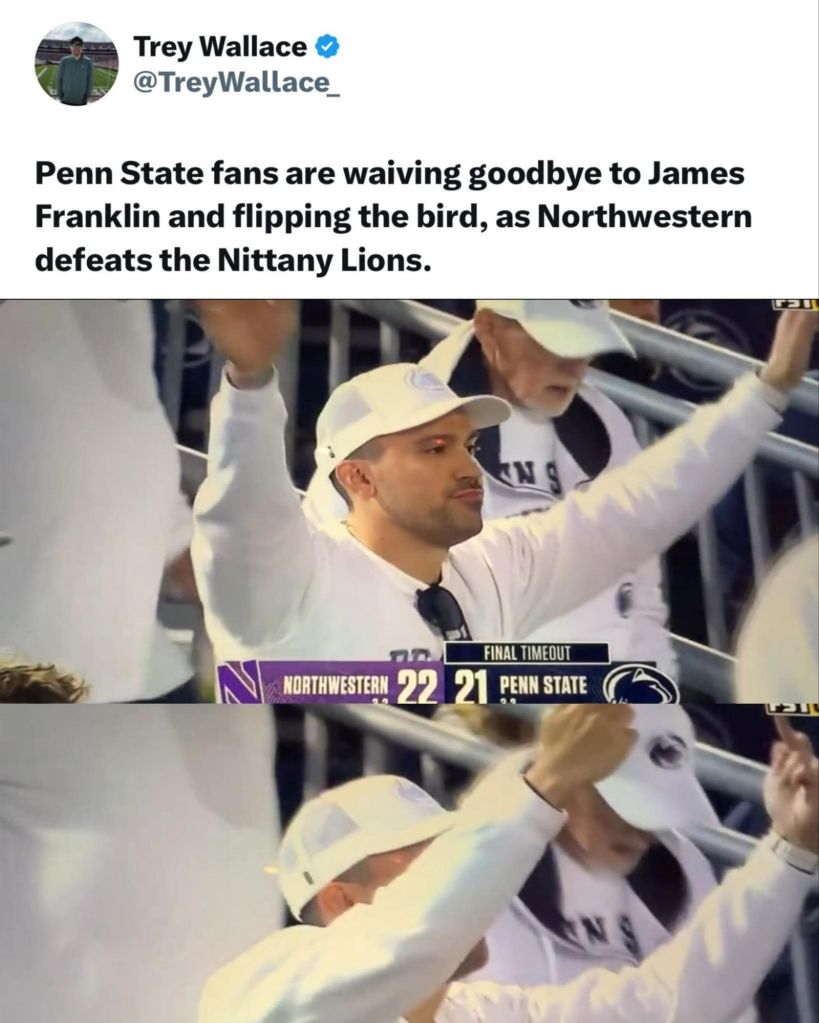
In my conversations with a cousin, who is a generation younger than me and far less of an idealist, my being completely appalled at fan behavior in the wake of coach Franklin’s collapse is silliness. He says the toxicity is everywhere and, basically, that I should not expect the Penn State football community to be exceptional. Even in response to my own posts on social media some of my friends believe that it is okay to make their vicious attacks against players and future prospects—because apparently sportsmanship is not a goal in the era of NIL money?  To me there has been something we have lost in our dignity and self-respect when we pile on young athletes and those who have invested far more than most in the bleachers ever did.

It feels like the culture has been hollowed out. An ethos has been lost. And my own disappointment with the sudden realization of the total absence of anything that actually distinguishes Penn State today, other than a few symbols and slogans, the final dismantling of the Paterno legacy that I’ve protected so long is complete. Why pretend? Integrity was neglected. And the thin veneer of The Grand Experiment philosophy has long ago worn away, we are not what we’ve claimed to be, we’re just another sports ball brand—class and character a mere facade.

Penn State peaked in the 1980s and has been in a ‘wilderness’ of ten win seasons since. 

Demystifying is the first step in dismantling the Colossus. With the transfer portal and NIL the era of loyalty and commitment to a higher ideal is over. But this shifting is one that goes beyond the football field or Penn State fan base. This is just a microcosm of the failure of the United States of being this “city on a hill” that was imagined by Puritan preacher John Winthrop. The “We are” is a localized flavor of American exceptionalism or the declaration of our unique quality and superiority over others. It is delusion.

It is also decay…

Reclaiming Lost American Values

The erosion of American values, particularly those intangible qualities that once defined community, loyalty, and collective spirit, is vividly reflected in the current state of college football, the influence of Name, Image, and Likeness (NIL) deals, and the broader societal shift toward prioritizing money over meaning. These three threads—Penn State’s football struggles, the commodification of college athletics, and the personal lesson of a child fixated on monetary rewards—converge to reveal a deeper cultural loss that is harder to pinpoint but profoundly felt.

At Penn State, the football program’s collapse mirrors a broader unraveling of shared purpose. The team’s 3-3 record in 2025, with losses to Northwestern, UCLA, and Oregon, has extinguished playoff hopes, compounded by the season-ending injury to quarterback Drew Allar. The program, once ranked #2, has been plagued by self-inflicted wounds—stupid penalties, turnovers, and a lack of team chemistry despite returning key players. The toxic “fire Franklin” narrative, fueled by fans and possibly amplified by wealthy alumni, has created a vicious cycle of negativity. This environment, where success is taken for granted and loyalty to coach James Franklin is eroded, reflects a loss of the communal spirit that once defined college football.

The fans’ inability to appreciate last year’s achievements, coupled with the pressure of high expectations, has turned a storied program into a cautionary tale of how a community’s values—patience, unity, and resilience—can erode under the weight of entitlement and short-term thinking. The prospect of rebuilding under new leadership may spark a recruiting bounce or an influx of NIL funds, but it also risks perpetuating a cycle where only wins and money matter, leaving little room for the intangible pride that once fueled rivalries like the one against Ohio State.

The field at Beaver Stadium is now “West Shore Home Field” after a large donation.  How long before Penn State’s no-name jerseys are replaced with corporate sponsors?

This shift is starkly evident in the rise of NIL, which has transformed college football from a bastion of amateurism into a billionaire’s playground. The purity of the sport, where loyalty to a program and the concept of the student-athlete once held sway, has been supplanted by a system where, as Mark Cuban’s “big number” donation to Indiana University athletics illustrates, wealth dictates outcomes. Fans no longer celebrate players who stay an extra year out of commitment; instead, they view them as paid mercenaries, unworthy of respect or admiration unless they deliver victories.

This also mirrors a broader societal decline in volunteerism and good sportsmanship—values that once rivaled capitalism in shaping America’s identity. The community spirit that made school sports a unifying force has been replaced by a transactional mindset, where loyalty is bought, not earned. This shift reflects a deeper cultural loss: the unquantifiable sense of duty to others or something greater than oneself, whether a team, a school, or a nation.

As the current system prioritizes individual profit over program or principle, it signals a collapse of the traditions that made college football a symbol of American unity, leaving behind a hollow pursuit of wins at any cost.

Now billionaires and corporations rule college athletics in the age of NIL.

This same erosion of values plays out on a personal level for me, where my tying my son’s chores to cash rewards has instilled a mindset in him that everything must have an immediate reward or monetary payoff. This mirrors the broader societal trend where wealth is the sole measure of success, undermining the concept of family as a unit bound by mutual care rather than financial transactions.

In cultures like the Philippines, where my wife is from, multigenerational support is just a given, but in America, the collapse of family unit and community has fueled reliance on pay based systems like elderly care, which often exploit the most vulnerable and leave little for future generations.

This shift away from communal responsibility toward an extreme individualism and personal profit reflects a loss of the intangible values—selflessness, duty, and shared burden—that once made America redeemable, if not great. And the rise of socialism, decried by conservatives, is less a cause than it is a symptom of this deficiency, as needy people seek external systems to replace the community support that has faded.

These threads—Penn State’s demoralized and debased fanbase, commodification of college sports through NIL in general, and my own struggle as a father of a teenager to instill non-monetary values—point to a broader cultural decay. The current loss of American values like loyalty, community, and tradition is not easily quantified, as they were woven into the fabric of what it meant to be American, and never before required definition or separate designation.

NIL, like the toxic fan culture or a child’s fixation on cash, is a symptom of a deeper disease: a society that prioritizes money and winning over the unmeasurable qualities that once held it together. This shift, felt more than seen, leaves us grappling with a question: if we cannot identify what we’ve lost, how can we hope to reclaim it?

Records Come and Go—Family Is Forever

After the Northwestern game, a third loss this year, Franklin waited until everyone else—including his daughter—had gone through the tunnel before he strode through. This is likely because he knew what awaited him—taunts and trash being hurled.

Father and daughter.  Franklin was determined to be a better father than his own.

In comparison to the stupid entitled clowns, Franklin is a class act. He is the father protecting his family. A standard bearer for Paterno (an Italian surname that means father) or at least the commendable part of the late coach’s legacy. I have seen some of the comments online, one claiming Franklin was arrogant because he had only answered one of their emails or something of similar entitled quality—as if he could just sit responding to every moron harassing him. But the players who played for him are unanimous in their support.

In fact, one of the saddest things I’ve seen is the current Penn State roster expressing their guilt over his firing for “not playing well enough” to please the raving lunatics. They didn’t fail Franklin, the fans failed them and the Penn State tradition.

The players taking responsibility is a sign of a relationship with a man who told them his demands of them as players start with love and end with love. In other words, this was a high pressure environment, expectations were high, and yet it was for their good that he challenged them to be better. And, truth be told, Franklin’s teams punch above their weight. He was a player’s coach and that is why Penn State is bleeding top recruits who were coming to State College for something different under his leadership.

The “fire Franklin” types love to talk about how he “couldn’t win the big game” and yet neglect to mention his teams were almost always coming in as the underdog and with less talent and depth than their top ranked rivals. Or, in basic English, he was coaching them up to the level of the elites. And this a testament to his philosophy that had built on the positive part of Paterno’s legacy—he valued the players for more than the wins or losses and they responded with loyalty and inspired football.

Nobody will ever say Franklin was the best game manager or play caller. But then the online critics keep going back to a couple plays a decade ago. A run on 4th and five against Ohio State or kicking a field goal in a 28-0 Michigan game ending the shutout. But ultimately they were one play from the national championship game last year and Franklin was third behind two other coaches from 2022–2024 with a 34-8 overall record during that span—trailing only Kirby Smart (Georgia, 39-5) and Ryan Day (Ohio State, 36-7) for wins. Good luck finding the guy who will top that after we cut the soul out of the program that drew the talent that we did have. Who will come to State College to be nitpicked and unappreciated?

I loved a family man arriving at Penn State and to see it end as it has just makes me think we don’t deserve what we have.

The toxic part of the Penn State fan base is transactional. They believe their watching a game entitles them to perfection execution and results. I mean, imagine that, a howling mass of ingratitude made of mostly grown men who are apparently that unhappy with how their own life went that everything now is a matter of wins on Saturday. Most did not go to The Pennsylvania State University nor do they have any real investment in any tradition of excellence—like that which was upheld by Franklin’s family approach.

Franklin deserved better. He was not a DEI hire. He is certainly not a terrible coach. It is his players—who carry on his legacy—that actually matter. Penn State football should never be about pleasing drunk Uncle Ricos who failed at life, it should continue to be oriented towards success in life. Truly the few Saturdays under the lights are not a measure of a man. Franklin’s tenure should be remembered as a battle against wider societal decay—where the development of moral character and the building of community are too often sacrificed for the fleeting victories or short-term financial gains.

Pattern recognition isn’t for everyone.
Twelve teams with the most National Championships

Both Nick Saban and Urban Meyer, who are legendary coaches, expressed their support for Franklin. And to think delusional Penn State fans believed that they could replace Franklin with one of these two (already past retirement age) by waving a little money in their faces. No, nobody is coming to State College to be unappreciated for producing one winning season after another. We will be lucky to find any successful coach who is tempted by the job—let alone replace all of those who decommitted or will transfer now that James Franklin is gone.

Values Beyond the Scoreboard

In this blog—Irregular Ideation—my struggle with the disconnect between stated values and the values they truly live out. People claim to believe one thing and yet live something else. I’ve dealt with this in the religious and romantic sphere, the disappointment, this false notion that virtue would always win over mere physical or economic superiority. Mennonites teach that the meek shall inherit the Earth or that the first shall be last—these being Christian concepts about the kingdom of Jesus. But the reality lived is always different from that ideal preached.

The reality is that everyone is in it to win it. Yes, even that sweet and submissive young woman doesn’t date no scrubs. Sure, maybe a pious individual will adjust some language or settle on one rather than playing the field, but ultimately they’re going for the status or strength and attractiveness everyone else in the world pursues. Some overestimate the market value they have, but even in love we are being self-sacrificial or altruistic. We’re motivated by hormones and sexual desires—often things we’re not even totally aware of behind our wall of moral rationalizations and narratives.

With denial of this is the delusion that good things will happen to good people. We tend to confuse physical beauty with virtue as it serves our own carnal desires to see them as one and the same. I mean, who wants to say the quiet part out loud by admitting they picked Joe over Bob because he was taller or had charisma? We may say things about nurturing or character traits but this is code for nice breasts and big biceps. So what I am getting at is that we dress all this stuff up as something it is not and revelation of what is underneath is not debasement—it simply exposes what always existed.

From Paterno trying to bury the truth about Todd Hodne to the firing of Franklin, the true ruthless nature of college football culture is revealed.

Beaver Stadium rises out of the valley floor, an edifice, a temple where sacrifices were made in the name of success.

Beaver Stadium rises up from the farm fields of Happy Valley, a monument to Pennsylvania pride, like the “city on a hill” of American exceptionalism. But success was not built on anything different here as it was anywhere else. What is buried is the reality it is always about aggression, financial gain, and wins. The Grand Experiment failed and Penn State had to be like everyone else if it wanted to reach the top. Furthermore, there is a sense in which every program becomes a sort of family or builds men—Paterno was only unique for highlighting this.

Are there values beyond the scoreboard?

Is it a zero-sum game?

Yes and no. Friedrich Neitzsche describes “slave morality” or a system of ethics that reverses what we naturally value and then says this denial of reality is virtue. Woke is a manifestation of this, where they attempt to turn the world on its head and celebrate obesity, ugliness, criminal behavior or lack of ambition—and create an artificial reality—rather than deal squarely with the world as it is. Body positive isn’t going to spare you health consequences if you’re obese. Fair or not we must at some point deal with the cards we’ve been dealt and rise above our station or accept what we are. Mutilation of yourself to be something you’re not ends as badly as well. There really are no shortcuts to success or Uno Reverse cards to play—it is what it is on the scoreboard that matters to the world in the end.

Ultimately we also have our limits. We need expectations to match our abilities or we’ll end up in a spiral—always chasing what is beyond our reach rather than just building on what we have. I’ve seen it many times, those who leave a consistent and reliable partner, thinking they’ll do better out in the market, only to find out that (yet never will admit) that their discontentment played a trick on them and they had it better before than after. Not everyone can be a National Champion every year—it just isn’t possible—but we can have a family or community that respects all members and seeks only their best rather than tear them down.

Symbolic?

So maybe Penn State football does need to be dismantled and rebuilt to be great again?

It could be that, like the children of Israel in the wilderness, we’ll need this generation to pass so our children can enter the promised land?

If the foundation laid has led to this ugly spirit of entitlement then it was flawed. We might need to decide if football is so important we will lose our humanity or the immeasurable qualities not displayed on a scoreboard—for a “big game” win that won’t matter in a year or two. What does it truly matter if we gain the and lost our soul?

A race to the lowest common denominator is the end of civilization. Despite my lament above, I don’t believe life is all about money, sex and power—which ever order they come in. I still believe my elderly grandma had a beauty that was unsurpassed and morality is not just a smokescreen for our failure to be the best. Maybe the impossibility for me is possibility for my children. I cannot stay disillusioned. But, like I did in finally leaving my religious roots, I may need to also bury that delusion of Penn State excellence both on and off the field.
Not the tradition that made Penn State great.

Maybe the failure of The Grand Experiment was all Paterno’s own personal failure? Or maybe the message never went beyond the young men who loved him like players love Franklin today. But the Colossus now lies in ruins making me wonder if it was ever great to begin with. They didn’t just fire Franklin—they pushed over what remained of an ideal for sportsmanship, they’ve fully demolished the mythology that so inspired me. A giant ‘moral’ idol is gone—will something real rise up in its place?

The Anatomy of a Truss Design Failure

Standard

Since day one I’ve kept an anecdote about a competitor’s failure in the back of my head as motivation to do better. This company, believed by some to make a high-quality product, had sent out a truss package that was plagued with problems and I made it my own goal to avoid this sort of thing as much as possible.

Truss designer may be my job description. However, things aren’t always as they seem, high-level creativity is not a requirement for most of what I do on a daily basis and, in reality, my job is loss prevention. My role is, first of all, to make an effective and efficient design that doesn’t waste material or add unnecessary cost. However, second, and more importantly, I must always meet the specifications of the customer and avoid truss design failure.

In an ideal world, my work would be spread out evenly, revisions after quotes (especially involving complex layouts) would be punishable by death, there would be no phone to interrupt, and I would have all day to create perfection. In the real world, unfortunately, there are trade-offs, it is deluge or drought (all deluge lately), and things do not always go as they should.

Anticipating an Opportunity to Impress

Anyhow, the office where I work has an open design and this feature, combined with my eavesdropping, gives me a preview of what is to come. I overheard the phone conversation, someone needed trusses yesterday, apparently, they were a loyal customer to one of our competitors and someone over there had dropped the ball. The salesman (my boss) assured him that we could make the trusses in the next couple days.

Upstairs I anticipated an opportunity to knock one out of the park and geared myself up for the fast turnaround time. The quicker I could finish the design work, the sooner the saw guys could get cutting, everything would hinge on my ability to churn something out quickly and I was determined not to be the gum in the works.

But what I (along with my boss) did not anticipate was that this was not a simple run of common trusses. No, it was an extremely complex design, a flat roof with angled walls, equipment loads, parapets, and something that would normally take a day or two to design. And, adding to the mess, was the fact that I had to match the competitor’s prints—which is not actually ideal.

Some customers lack appreciation for the design process and seem to think that we can just click a couple keys *bee-boop* out pops a truss layout. In reality, for things to go well, everything must be entered in a particular order (using a program that takes pleasure in crashing at the most inopportune times) and thus it actually is easier to work from scratch than to try to copy individual trusses from another manufacturer.

The Ace Up My Sleeve

Fortunately, I recognized this layout as something I had done before when contractors were bidding on the job. However, my own design had been true to the architect’s drawings, which is probably why we didn’t get the project to begin with, so I stripped off the trusses that I did before and went to work duplicating the cheaper (incorrect) version of the layout brought in by this contractor.

The competition’s webbing was atrocious, they obviously did nothing to optimize the generic web pattern spit out by the software and could be vastly improved with a little effort. It is amazing to me how many other truss company prints I see like this where clearly the ‘designer’ let the programming do all the work and take pride in my ability to go above and beyond. If I could not take a bit of pride in my work I would find something else to do.

I was halfway through my masterpiece, trying to work at warp speed while also checking all the right boxes and then realized something. Oh no! The trusses on the competitor’s prints were all an inch shorter than mine! Some contractors prefer it this way so that the trusses are easier to position in the field (or maybe because they hate truss designers?), for me this was simply another thing that could go wrong and meant going back through every truss I had already designed.

Finally, about an hour after lunch, I finished the last of the individual truss designs, took one last look at the profiles in the printer queue, and sent them down. My coworkers, the guys in sales, generally do a good job reviewing my work and having the plans confirmed with the customers before production.

Pride Cometh Before the Fail

However, it was at that time I made a terrible mistake. I went on Facebook and, with a slight amount of tongue-in-cheek, crowed:

I would be embarrassed to send out the truss prints that I’ve seen from some of our competitors, plain embarrassed.

Just saying…

I was feeling very good about what I had just accomplished. I had prints ready to go in record time and they were aesthetically pleasing to me. The contractor, I hoped, would appreciate my work and maybe reconsider his allegiances as well. I mean, we bailed him out. He had somehow been dropped off the schedule of our competitor, we got him what he needed and that was something to be proud about—not to mention that we beat them at price as well.

But pride cometh before the design failure and my moments of reveling were short-lived. After the trusses went out, a day or later, my boss received a call and it wasn’t good. I had screwed up. The truss lengths were not correct, some had to be cut down and would need repair prints. Apparently, in my haste, I had trimmed some of the trusses twice, I had done some once, and others not at all. That was something that I could have easily seen had I taken one look down the line of trusses in 3D rendering and reflected poorly on my efforts.

Besides that, the plans he gave had a small note near a dimension for the angled wall. For whatever reason, the architect (without changing the actual dimension) decided to change the angled wall slightly and that’s where the really big mess was. That would require specially engineered repair prints from Dallas. I feverishly went to work to determine what each new length would be on the dozen different length trusses on that wall.

Fortunately, the competitor’s truss prints, that I was supposed to copy, were wrong as well. Evidently, they too had missed the amendment made in a note on the plans. Unfortunately, I also missed the note and made a serious mistake myself besides. Yes, they were able to use the trusses, an inch difference isn’t a big deal ultimately, but it was the mental mistake that kept me up at night days later and soured my mood for the next week. It was a mistake and a missed opportunity to impress.

There is certainly always blame to go around for a failure like this. The contractor should have checked the prints, my boss could have insisted on this precaution before producing and shipping these trusses as well. But in the end, what matters as far as I am concerned is what I did wrong and how to ensure that it does not happen again. It is my job, as truss designer and loss prevention specialist, to ensure that this problem is solved—to make the changes necessary to the process to guarantee that there is no repeat of the same mistake.

A Final Analysis of the Failure

In short, I bungled my part because I rushed Taking one more look at the wall dimensions may have been enough to spot the note about the change of angle and lead to a clarifying question. An extra thirty seconds of review at the end of the design process would have been enough to find my own mistake. I should not expect my coworkers or the contractor to cover for my own incompetence and especially not on a complex layout where they lack the same resources. Design is my job, not theirs, and that means doing it right the first time.

Furthermore, design is a process that should never be rushed and it is my job to push back against pressure as needed. Sure, the sale’s guys do sometimes over-promise. And, yes, it is always my great pleasure to deliver results on or ahead of schedule. But it is also my responsibility to set a pace where I am comfortable working, where I am able to do things correctly the first time, and where the company avoids the cost and embarrassment of a truss design failure.

In my work, one small mistake can outweigh the hundreds of things done right. For instance, on this particular layout, I had all but two details right out of dozens of parameters. But the customer will only ever remember the hassle that came as a result of those two things overlooked. We will likely never get a second chance with this contractor after what happened and that’s on me—for failing at my most basic duty as truss designer.

Are You Too Busy To Read This Blog?

Standard

I’ve been wanting to do a blog on Mary and Martha, but I’ve been…well…busy…

It seems appropriate, with the bustle of the holiday season soon to be upon us, to talk about distraction and keeping our focus on what actually matters.  There are two Biblical characters who are notable for being in the presence of Jesus and yet too caught up in the wrong way of thinking to care.

Jesus, in defense of impractical love, confronts Martha’s distraction and disillusionment of Judas.

There are several different Biblical accounts where we see a woman (not always identified as Mary) who pours out her adoration in a way that seems irresponsible.  She is rebuked by others for it, but defended by Jesus.

Here’s the first account:

“As Jesus and his disciples were on their way, he came to a village where a woman named Martha opened her home to him. She had a sister called Mary, who sat at the Lord’s feet listening to what he said. But Martha was distracted by all the preparations that had to be made. She came to him and asked, ‘Lord, don’t you care that my sister has left me to do the work by myself? Tell her to help me!’ ‘Martha, Martha,’ the Lord answered, ‘you are worried and upset about many things, but few things are needed—or indeed only one. Mary has chosen what is better, and it will not be taken away from her.'” (Luke 10:38-42)

Hosting a large group of people is not easy and it is completely understandable that Martha would be annoyed.  I can imagine her, hands on hips, showing her indignation and I can also see Jesus smile as he answers.  She was so wound tight that she was not enjoying life or appreciating the moment.  Martha was stumbling through her life blinded by distractions.  Jesus gently tries to redirect her attention from the multitude of tasks that cluttered her vision back to what was truly important.

Mary, in contrast to her sister Martha, was in the moment and focused on what mattered.  It is interesting that in another Gospel account Mary is also criticized by Judas Iscariot for her use of resources, he asks: “Why wasnʼt this perfume sold and the money given to the poor? It was worth a yearʼs wages.” (John 12:5)  And Jesus, seeming to prefer the impractical display of affection, rebukes Judas as he did Martha.  In both cases Jesus is endorsing the fanciful over what we would call good stewardship of time and resources.

The disillusionment of Judas leads to betrayal of Jesus.

The Gospel accounts captured a feeling of distain for this man, the writers making sure to inform us that Judas was a thief and stealing from the common purse he carried for the disciples.  He’s obviously a complex character, he was chosen as a disciple and evidently had some interest in what Jesus taught.

But we do know that Judas, whether a disenchanted social justice warrior unhappy with the lack of progress or plain greedy and in it for his own gain, was distracted by money.  He betrayed his relationships, he was stealing from his friends (hence thier distain) and ultimately died miserable, taking his own life, after betraying Jesus for a little silver.

Many men today are similarly distracted by money and betray family for business and trade true faith for some numbers in a bank account.

The judgment against men who make an idol of money or financial security at the expense of relationships will be severe.  They will lose the hearts of their children, love of their wife, and possibly forgo their only chance for salvation.

Martha was simply too busy to enjoy life and too distracted to fully appreciate Jesus.

Unlike Judas (who was serving himself despite his altruistic rationalizations) we see Martha was very busy serving others.  She seems to be an extremely duty bound person and was probably completely exhausted.  She takes out her frustration on those around her, including sister Martha and even Jesus.

We are not told how Martha responds to the correction offered by Jesus.  If she’s like some of the industrious Mennonite women I know she probably scoffed at the suggestion before scurrying away to do all those other things that couldn’t wait.  But I can also see her later contemplating what was said, learning to worry less and relax a little.

In Martha I see my own mother (sorry mom, yes I do appreciate all you do and I can’t wait for thanksgiving day) who tends to stress out about hosting people.  The house must be perfect.  She scrubs, scours, cleans, and frets, often to the perplexed amusement of other inhabitants of the household who don’t mind a little dirt so long as the food tastes good—and it always does.

In conclusion, be a Mary, do not be distracted by things that do not matter and focus on what does. 

We to live in a time packed full of activities and work more hours than generations before us so we can afford more stuff that doesn’t satisfy us in the end.  Those who aren’t successfully distracted in their business can become bitter when others seem oblivious to their own concerns.

Most of us have our heads spinning because of smart phones, work obligations and social commitments.  Even good things, things that are good in their proper place, can keep us preoccupied and spiritually disconnected.

Dutiful religious devotion, reading a few Bible verses or going Christmas carolling and volunteering at the local food bank, is not always connection with the giver of life.  To be in the presence of Jesus is to be rested fully in the Spirit of God.  It could mean quiet contemplation alone.  It could also mean putting aside that carefully arranged schedule and really listening to someone who needs a friend.

Our devotedness to God truly is not measured by the amount of tasks we complete ritualistically.  True devotion is to love as God loves—to love the sparrow that falls and love the poor child without a father even more.

The first Christmas started with an impromptu visit of a pregnant woman to a stable in Bethlehem and yet things seemed to turn out just fine.  Keep that in mind.

Show devotion by trusting God—trusting God both with the minutia of details that you can’t ever control and also with the ‘big’ things that we delude ourselves to believe are secure and really are not.  Science can’t even tell us what keeps the universe glued together, nobody is guaranteed tomorrow, so stop banking on your own abilities and…

“Humble yourselves, therefore, under Godʼs mighty hand, that he may lift you up in due time. Cast all your anxiety on him because he cares for you.” (1 Peter 5:6-7)

With the holiday season upon us, be sure to contemplate where real security is found, remember what is truly important to remember, and experience the real presence of Jesus!

For Sale: 2001 Jaguar XJR and a duty to impress…

Standard

Little brothers must be impressed.  It is a rule of being a big brother.

Several years ago my brother Brent, still in school, had a fixation with jaguars.  He was both a fan of the NFL franchise of that name and also the automobiles of that same denomination.

Brent had mentioned a Jaguar for sale and wanted me to check it out.  But I really had no need of another vehicle, I had two already and felt that was plenty.  However, one day I was in town with some spare time and then spotted this beautiful machine at a used car lot.

“Hmm, that must be the Jaguar Brent has been talking about…”

I decided to inquire about it.  The salesman ended up tossing me the keys just in time for me to pick up my little brother at the school bus platform.  The look on his face was priceless and enough to convince me to do my big brotherly duty to impress him. 

I purchased that Jaguar XJR a few weeks later.  The “Grace, Pace, Space” slogan of the brand fit this car.  Classic lines, the power of a muscle car and luxury combined perfectly.  It is a supercharged 370hp beast that beat out the Beemers, Benzes and Porsches of It’s day—it is still faster than most.

It has served me well.  It has been the source of many grins.  It possess every bit of the charm and sophistication of Daniel Craig playing James Bond.  It is an impressive machine.  I have not regretted my decision to do my big brotherly duty.

Seasons have come and gone.  I have decided it is time to part with the XJR in order to free up garage space.  It is in excellent condition and I will probably regret selling it. 

But Brent is now married and away, so maybe it is time?

image

image

image

Faith: I Believe, So Help Me To Believe!

Standard

The Pharisees were content because they were successful and could afford to believe they were righteous.  They were people who studied the law carefully and followed it diligently.  They had no lack of missionary zeal and devotion, they had titles, love of families and other wealth.

But these religious people with all the answers lacked one thing and it seems something that is still missing in religious traditions.  Everything they did they had accomplished on their own strength.  There was no room in their life for radical faith that believes the impossible.  No, they were content with only what they could understand and rejected anything more.

As I look around the Christian religious landscape today I could ask the same question Jesus did at the end of this story in Luke 18:1-8:

“Then Jesus told his disciples a parable to show them that they should always pray and not give up. He said: “In a certain town there was a judge who neither feared God nor cared what people thought.  And there was a widow in that town who kept coming to him with the plea, ‘Grant me justice against my adversary.’  “For some time he refused. But finally he said to himself, ‘Even though I don’t fear God or care what people think,  yet because this widow keeps bothering me, I will see that she gets justice, so that she won’t eventually come and attack me!’”  And the Lord said, “Listen to what the unjust judge says.  And will not God bring about justice for his chosen ones, who cry out to him day and night? Will he keep putting them off?  I tell you, he will see that they get justice, and quickly. However, when the Son of Man comes, will he find faith on the earth?

I am certain Jesus would find many religiously devoted today.  I sure he would find those confident in their theology, their ‘Biblical’ standards and dogmas.  There are plenty of self-proclaimed experts with all of the right answers who pound pulpits and fill pews.  But would Jesus find faith real and unadulterated?

What is faith?

I believe this account in Mark 9:14-29 describes it:

“When they came to the other disciples, they saw a large crowd around them and the teachers of the law arguing with them. As soon as all the people saw Jesus, they were overwhelmed with wonder and ran to greet him.  “What are you arguing with them about?” he asked.  A man in the crowd answered, “Teacher, I brought you my son, who is possessed by a spirit that has robbed him of speech. Whenever it seizes him, it throws him to the ground. He foams at the mouth, gnashes his teeth and becomes rigid. I asked your disciples to drive out the spirit, but they could not.”   “You unbelieving generation,” Jesus replied, “how long shall I stay with you? How long shall I put up with you? Bring the boy to me.”  So they brought him. When the spirit saw Jesus, it immediately threw the boy into a convulsion. He fell to the ground and rolled around, foaming at the mouth.  Jesus asked the boy’s father, “How long has he been like this?”  “From childhood,” he answered. “It has often thrown him into fire or water to kill him. But if you can do anything, take pity on us and help us.”   “‘If you can’?” said Jesus. “Everything is possible for one who believes.”    Immediately the boy’s father exclaimed, “I do believe; help me overcome my unbelief!”  When Jesus saw that a crowd was running to the scene, he rebuked the impure spirit. “You deaf and mute spirit,” he said, “I command you, come out of him and never enter him again.”  The spirit shrieked, convulsed him violently and came out. The boy looked so much like a corpse that many said, “He’s dead.”  But Jesus took him by the hand and lifted him to his feet, and he stood up.  After Jesus had gone indoors, his disciples asked him privately, “Why couldn’t we drive it out?”   He replied, “This kind can come out only by prayer.”

I am not certain if the ailment of the boy would be considered a medical condition today.  But Jesus does seem to indicate that it was an incurable condition by any means other than prayer (or prayer and fasting) and therefore the healing was a miracle.

This is not a case for “faith healing” as a prescription for all illness.  It was a special circumstance where there was a condition that was impossible to cure by any other means.  So to turn this story into a reason to shun modern medicine is to vastly miss the point. 

If the light bulb burns out at church it only requires a budget or funds to replace it and not necessarily faith.  Faith is not about forcing God to do what is clearly within our own power to do.  Faith is doing all we can, investing our everything in something unseen, and having the outcome uncertain.

Faith is More than Reasonably Committed

There was the widow at Zarephath (1 Kings 17: 7-24) who used the last of her supplies to make bread for the prophet Elijah and had her needs supplied miraculously for her faithfulness.  The poor woman mentioned in Mark 12:41-44 is also an example of radical faith in action:

“Jesus sat down opposite the place where the offerings were put and watched the crowd putting their money into the temple treasury. Many rich people threw in large amounts. But a poor widow came and put in two very small copper coins, worth only a few cents.  Calling his disciples to him, Jesus said, “Truly I tell you, this poor widow has put more into the treasury than all the others.  They all gave out of their wealth; but she, out of her poverty, put in everything—all she had to live on.”

It requires very little faith for a wealthy business person to give of his millions when their needs are already supplied abundantly.  But faith, radical faith, is when a person is able to commit their all to an unbelievable promise.  Most would only contribute their all to a sure thing and not gamble it all on something unseen.

However, faith, according to Hebrews 11:5-6, is an essentially component, even the backbone of the message of the Gospel:

“By faith Enoch was taken from this life, so that he did not experience death: “He could not be found, because God had taken him away.” For before he was taken, he was commended as one who pleased God. And without faith it is impossible to please God, because anyone who comes to him must believe that he exists and that he rewards those who earnestly seek him.

A religiously devoted person could go their entire life without need of faith.  If they only ever ask or achieve what is readily within their reach they have proven their dedication.  For some they put in their duty, but they don’t truly believe in a God of the impossible and live solely in their own understanding.

I am not content with religious devotion.  There is no sensible middle ground of belief without faith or it is falsehood.  For me, and according to the Bible, true faith is all or nothing proposition: It is radical faith or none at all. 

And yet, because we can never have enough faith to save our own selves, faith is a paradoxical product of grace.

Do you have faith?