
Path of [Least] Resistance…

Standard

One of my favorite players, while coaching ‘semi-pro’ was a guy named Jerry. The league knew him as this out-of-control and sort of dirty player. He would get wound up with his asthma attacks and get into verbal altercations on the field. But to me, despite his reputation as a loose cannon, he was actually more coachable than many on the team. The guy could’ve easily ripped my head off, he was a fairly large guy (playing defensive end) and a physical force on the field. However, in the few times when I did need to directly to intervene, he was surprisingly respectful. I mean, he would address me as “coach” and, every time, after a few mumbles, he would back down. He would even often apologize later.

Only once, with a little alcohol involved, did I catch a small glimpse of what was driving him. At the time, in his late forties or early fifties, he recalled how his own dad had pushed him. He was abusive and never satisfied. And football was the direction his dad was pushing him in. Jerry had D-1 offers as a younger man. Yet, ultimately, he walked away from the sport at that level and much to do with the pressure he had felt. Obviously, he was still very conflicted over all of this. He played as if a demon were biting at his ankles, a man on fire, and probably pushing a little too hard for a man his age. I’ve lost contact with him, not even sure if he lives in the area anymore, but his story is a cautionary tale for me as I try to navigate my son’s current involvement in athletic endeavors.

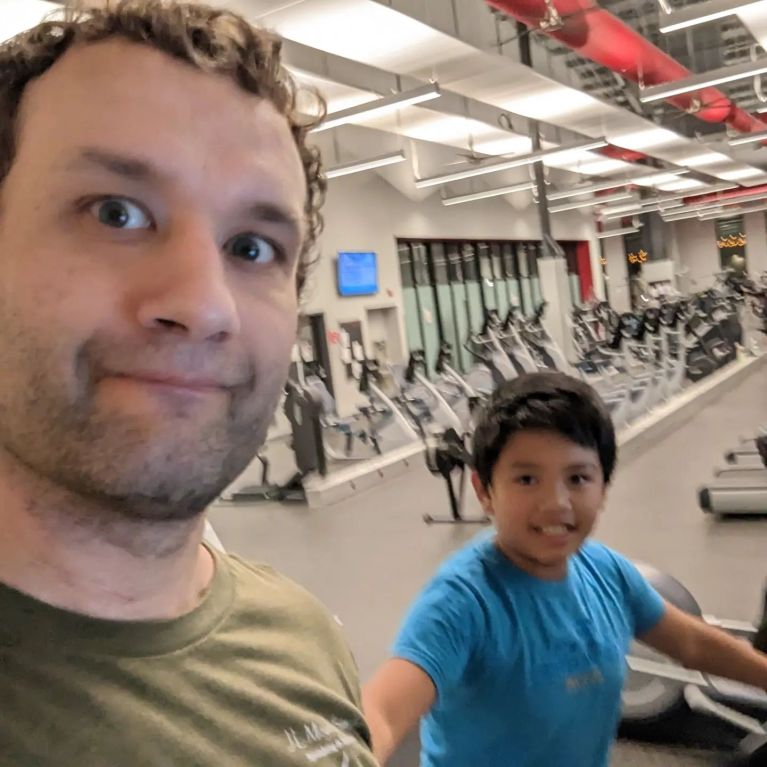
I love sports as a training ground for life. It is an opportunity for character development, to learn lessons about work and reward, teamwork, etc. I had my own regrets for having started competing only very late in high school and, therefore, have been very pleased that my own son wrestled over the winter and has been practicing for football season. He’s an amazing athlete for his age. He won his bracket in wrestling, his first year out, with a combination of will, natural strengths, and things learned from his coaches. It has not taken much encouragement to keep him going. He is an enthusiastic participant and seems to really enjoy himself with other kids his age. There have been a couple of times when he was upset and seemed ready to quit, but the next day he has always come back for more.

Desirous Distractions

Of the things I hate most, his tablet is probably in the top ten. We had successfully hidden it away (he didn’t miss it after a week or two) and yet brought it back out due to some current circumstances that make it better to keep him occupied. The result has been like an addict, or binge, where he would use the device non-stop if we allowed it. It turns him from an active and engaged kid, who loves to swim in the local pool and requires a ton of attention, to a slug barely moving for hours. It’s not healthy and that’s the reason why I’ve fought back against this and haven’t minced my words on this topic with him either. I’ve been glad that we had football practices to give that indisputable non-negotiable reason to separate him from the screen. However, the other day, after practice, he confessed that he wished that he didn’t play football so he could be on his tablet more!

One of my successes, so far, as a parent was to keep sports as his idea. Sure, I want him to play, I have done my part to facilitate his involvement as well, but I’ve mostly let him lead in what direction he wanted to go and was glad that his own desires lined up with my own. I’m sure my own hopes and expectations have found their way to influence, children likely know their parents better than their parents know them and generally want to please them. He knows that I’m a Penn State football fan and that, Charlie, the elementary wrestling coach was an old teammate. So it isn’t really surprising that he went down this path similar to my own. Still, I didn’t want to be one of those dads, the kind living vicariously through their son and putting undue stress on him. It does seem we’re too sports-obsessed, where youth leagues are year-round, there is this camp and that camp, which is driven by parents with glowing ambitions more than it is by the children themselves. I wouldn’t be all that surprised if many of these overworked and pushed too hard will quit. At the very least, it won’t be enjoyable.

The big question for me is what would I do if my son said “I don’t want to play anymore.” I’ve already assured him that not playing doesn’t mean he would get more time with his tablet and that he would probably be bored. And he seems to understand that he needs to finish what he started as far as the current season. Nevertheless, the chill I felt, all of my own dreams of watching him now threatened, could easily lead to my being more controlling. It is scary to me that a tablet, this path of least resistance, has so much appeal that he would sacrifice all for it. I’ve also had to question my own motives. Am I doing what is best for him? When I restrict access, when I push him to do things that make him uncomfortable, that’s the reason why I do. But as a parent, we really need to be careful not to project our own desires onto our children so much that they are stifled and not free to be themselves.

The Elusive Balance

My son would likely be completely happy if I just let him play on his tablet nonstop. Maybe he would eventually get over it on his own if we didn’t interfere? I mean, I doubt it. There are always new games to download and more distractions to occupy for hours and hours. And that’s my concern, that the hours he spends vegging out could be put to much better use. It would be negligence, on my part, to simply give him what he wants and never resist his short-sighted perspective. It is my job to develop him, to make him ready for life and sports are one of those tools used towards that end. I don’t want him to develop character, not to be a character in a video game. I want him to get exercise, experience the tactile and real world, and not just live in the fantasies that others created for him. I must resist him.

That said, football is also just a game. I don’t want to be that dad who ended up putting so much pressure on his son to be successful that it ruined our relationship and he quits in frustration. There is much more to life than statistics or the accomplishments that the world will notice. Yes, I would beam with pride if my son were to score a touchdown, be on a state championship team, and be good enough to compete at the next level. A college scholarship, of course, would be great. He doesn’t seem to be the type that will get that in the classroom, so why not encourage the path that he does have? Still, that is exactly the problem. I quickly get way out ahead of reality and with that could quickly destroy even my own enjoyment of the moment. He should, as a child, be involved because it is fun. Certainly, I must coach a little, put some restrictions here and incentives there, but ultimately he needs to choose.

I don’t want my son to go down the path of least resistance. I want him to be resilient, a leader, involved, pushing back, and growing his abilities rather than comfortable. I truly want him to be better than me in all regards. Or, at the very least, to be better for having had me be a part of his life. Sometimes this will require me to bump against his will, dig in my heels a bit, and not let him rest on his laurels or waste the opportunities he has. Other times I will need to step back, let him go his own way, learn at his own pace, and accept that his goals for life may not align with my own. The real struggle is the wisdom to know when to intervene and how. Hopefully, he knows my heart is oriented towards his good even if my execution is flawed. And, actually, I’m okay if we’re not always friends so long as what I’m offering him is a way to go beyond my own limits and reach his full potential as a man, that’s my reward.

Filipino Christians Forced To Convert, Raped.

Standard

In an article, “Filipino Diaspora: Modern-day Missionaries of the World,” the plight of Overseas Filipino Workers (OFWs) is put in a positive light as a way that the Gospel is being spread throughout the word:

Mary Jane Soriano, a 25-year college-graduate Filipino domestic worker, has been working in Hong Kong for some years. During her stay there, she always made a point to attend the Sunday Mass in a local church, even if her employer and his family belonged to another religion. Besides Mary’s humility, simplicity, hard work, honesty and other human qualities that inevitably impressed her employer is her indomitable Catholic faith the way she practiced—simple ways to keep her life and faith going and always trusting in God and pray daily, and be good and do good to others.

Indeed, God moves in mysterious ways, Christianity swept through the Roman empire as “a religion of woman and slaves” (probably because it gave hope to these disenfranchised people) and in that way this diaspora of Filipinos is bringing Christianity to the world. The message of Jesus, and the cross, is that we will suffer for the sake of his kingdom—but that, in the end, the sacrifice we make is going to be rewarded:

“So the last shall be first, the first last.” (Matthew 20:16 KJV)

I have deep respect for those who aren’t missionaries as an extension of their privilege, living in behind compound walls, and entirely supported by the generosity of others. OFWs may indeed be the greatest missionaries of our time.

However, there is also a flipside, according to AsiaNews.it, in an article from 2010:

“In my tens in Saudi Arabia, I have witnessed several Catholic or Christian Filipino migrants accept Islam under duress,” said Joselyn Cabrera, a Filipino Catholic nurse working at Riyadh hospital. Because of high unemployment levels in the Philippines, more than ten million Filipinos have left to seek jobs abroad. Every day, about 3,000 leave the country. Recently, a majority has gone to Arab countries—some 600,000 in all, 200,000 in Saudi Arabia alone.

And continues:

The most recent case involves a woman who was raped at work. Because of the incident, Saudi authorities accused her of unlawful extramarital sex and on 11 September jailed her in the capital.

That doesn’t sound much like missionary service. It sounds like the vulnerable being exploited, forced to convert under duress, and is unacceptable.

Yes, the New Testament is full of stories of Christians ensuring terrible persecution for their faith. Yes, by their example of suffering example Christianity did spread to the world. But, no, that reality does not mean there is not a terrible cost nor does it absolve us of our own responsibility to intervene.

Suffer With Those Who Suffer

We should never allow our brothers and sisters to continue to endure hardships due to our own negligence or lack of compassion. No, as Christians, we are called to be their advocate, to care for them as we would for a member of our own families, and act on their behalf of them—like St Paul did in pleading for Onesimus:

Therefore, although in Christ I could be bold and order you to do what you ought to do, yet I prefer to appeal to you on the basis of love. It is as none other than Paul—an old man and now also a prisoner of Christ Jesus— that I appeal to you for my son Onesimus, who became my son while I was in chains. (Philemon 1:8‭-‬10 NIV)

St Paul, in taking action on behalf of this runaway slave, was practicing what he preached:

If one part suffers, every part suffers with it; if one part is honored, every part rejoices with it. (1 Corinthians 12:26 NIV)

This is what it means to be Christian:

Love must be sincere. Hate what is evil; cling to what is good. Be devoted to one another in love. Honor one another above yourselves. Never be lacking in zeal, but keep your spiritual fervor, serving the Lord. Be joyful in hope, patient in affliction, faithful in prayer. Share with the Lord’s people who are in need. Practice hospitality. Bless those who persecute you; bless and do not curse. Rejoice with those who rejoice; mourn with those who mourn. Live in harmony with one another. Do not be proud, but be willing to associate with people of low position. (Romans 12:9‭-‬16 NIV)

Incidentally, the description “low position” in the passage above means those who do menial tasks. That is to say the domestic worker, the migrant laborer, and all those toiling away in the factories, that make our electronic gadgets, for wages a fraction of our own. We should love them, suffer with them, and share out of our own abundance as need be. Those of us living in peace and prosperity have an obligation to help those who are currently endure terrible circumstances and especially those of the household of faith.

To be a part of the body of Christ means not being too busy with our own lives to care. It means being willing to intervene in love on behalf of OFWs around the world, to carry their cross and be an example of Christ.

Carrying the Cross of the Overseas Worker

We live in a culture that has been Christianized to the point that even secular artists now encourage Christian values. We now act as if compassion for those who are not part of our own biological families, national identity or ethnic tribe and race is something normal. That we should care about these others rather than use them as had been common prior to Christ. Take the lyrics of Pink Floyd’s, “On the Turning Away,” for example:

On the turning away
From the pale and downtrodden
And the words they say
Which we won’t understand
“Don’t accept that what’s happening
Is just a case of others’ suffering
Or you’ll find that you’re joining in
The turning away”

A Christian should never turn away from those in desperate need. We should feel the loneliness of an OFW, as those who are far from home and are separated from their families (including their own young children) for years at a time, and share their sadness. We should think about their fears, mourn the trauma of those who have been sexually assaulted and are being held captive, as slaves, by their abusive employers. We should pray, encourage and absolutely—by all means available to us—work to deliver them from their captivity and bring them home to the families they love.

Sure, it may be the job of the OFW to be a witness to the world of Christ’s love. But it is also our responsibility as fellow Christians, their brothers and sisters in Christ, to be a witness of the Gospel to them by helping to carrying their cross. If Christ himself, according to Scripture, needed help to carry his cross—then how much more does an OFW need our intervention for them? It is for this very purpose that Jesus told the disciples he would go, so that we (who are part of his body and filled with the Holy Spirit) will do greater things in his name.

But What Can We Do?

Many do have compassion. However, the problem is, how do we effectively do anything to change the circumstances for millions of people on the opposite side of the world? Even if we spent every nickel and dime we earned trying to support them and their families it would only help a fraction of those who are in need and it would do absolutely nothing to solve the actual underlying causes of this grim reality for countless Filipino people.

There is not much we as individuals can do as individuals. However there is much we can do in our working together towards a particular end. It is my hope that in my bringing awareness to this issue that others will partner with me, willing to contribute in their own small part, and together we can bring an end to the abuse.

That is why I’ve started the Filipino American Coalition of Trade (FACT) to give opportunity to those who want to make a difference for those who bear the cross as the truest missionaries of our time.

Like and follow FACT both on Facebook and also at the new blog site.

Pray for those who will spend this Christmas as slaves, sojourners in foreign lands, and victims of circumstances beyond their own control. Pray for the well-being of the OFW and their families, pray for their freedom from the economic conditions that keep them bound and separated from their loved ones, and may God be glorified in us all.