
Morality as a Fluid Mess: Conditioning, Conflict, and the Mirage of Universality

Standard

We cling to morality like it’s a lighthouse in the fog—steady, universal, guiding us home. But it’s a lie. It’s a battered flag, flapping in whatever wind our tribe’s blowing, stitched from the yarns we’re spun by family, faith, or flag. Raised Mennonite, I drank in peace and love for the outsider as if they were carved in my bones—until I saw they weren’t. Nature doesn’t whisper “thou shalt not kill”; it shrugs while we slit throats or swipe bread when the need hits. History’s littered with it: Biblical Israel butchered Canaanites—whole towns, babies dashed on rocks—‘cause God handed them the deed (Deuteronomy 7:1-2), and the faithful sang psalms over the ashes. 

Fast-forward to 2025: Israel pounds Gaza, kids buried in rubble, and the justification’s “security”—Hamas tunnels, rockets, survival. Insiders nod; it’s moral, necessary. Morality’s no fixed star—it’s a mirror, reflecting who we’re with and what we want.Look around today, and it’s the same mess. Russia rolls tanks into Ukraine, March 2025 still grinding on, flattening Mariupol redux—schools, hospitals, grandmas in the crosshairs. Putin’s line: “denazification,” protecting Russian speakers, historical destiny. His people buy it, or enough do—state TV’s been marinating them in it for years. The West screams “war crimes!”—sanctions pile up, Zelensky’s a saint on X—but that’s the outsider’s perch. Kyiv’s got its own blood on the slate: shelling Donbas for a decade, shrugging at Russian-speaking dead. Both sides sanctify their kills; morality bends to the banner. Or take the U.S.: Trump loyalists storm Capitol Hill in ‘21, “stolen election!” on their lips, while Biden’s crew locks ‘em up, crowing “democracy!” Same act—violence for a cause—flips from treason to justice depending on the lens. It’s not universal; it’s us-versus-them, conditioned to the core.

Look around today, and it’s the same mess. Russia rolls tanks into Ukraine, March 2025 still grinding on, flattening Mariupol redux—schools, hospitals, grandmas in the crosshairs. Putin’s line: “denazification,” protecting Russian speakers, historical destiny. His people buy it, or enough do—state TV’s been marinating them in it for years. The West screams “war crimes!”—sanctions pile up, Zelensky’s a saint on X—but that’s the outsider’s perch. Kyiv’s got its own blood on the slate: shelling Donbas for a decade, shrugging at Russian-speaking dead. Both sides sanctify their kills; morality bends to the banner. Or take the U.S.: Trump loyalists storm Capitol Hill in ‘21, “stolen election!” on their lips, while Biden’s crew locks ‘em up, crowing “democracy!” Same act—violence for a cause—flips from treason to justice depending on the lens. It’s not universal; it’s us-versus-them, conditioned to the core.

Objections bubble up like clockwork. The optimists—call ‘em Pinker’s crowd (2011)—say genocide’s revulsion proves we’ve got a moral spine, empathy baked in from caveman days. Hunter-gatherers shared meat, Confucius preached kindness—see, we’re wired for good! But that’s a half-truth, and a flimsy one. Those old tribes cared for their own; strangers got the club. Same with today’s wars: Ukraine’s defenders weep for Bucha’s mass graves but gloss over their own artillery sins. Israel’s critics howl at Gaza’s death toll—over 40,000 by late 2024, per UN counts—yet Hamas rockets barely dent their outrage. Why? Fundamental attribution error: outsiders slap “evil” on the doer—Russia’s a monster, Israel’s a bully—while ignoring the stew they’re boiling in: encirclement fears, decades of tit-for-tat bombs. Insiders don’t see villainy; they see survival, righteousness, their conditioning kicking in. Evolution’s no saint—it’ll cheer cooperation or carnage, whichever keeps the clan breathing.

Objections bubble up like clockwork. The optimists—call ‘em Pinker’s crowd (2011)—say genocide’s revulsion proves we’ve got a moral spine, empathy baked in from caveman days. Hunter-gatherers shared meat, Confucius preached kindness—see, we’re wired for good! But that’s a half-truth, and a flimsy one. Those old tribes cared for their own; strangers got the club. Same with today’s wars: Ukraine’s defenders weep for Bucha’s mass graves but gloss over their own artillery sins. Israel’s critics howl at Gaza’s death toll—over 40,000 by late 2024, per UN counts—yet Hamas rockets barely dent their outrage. Why? Fundamental attribution error: outsiders slap “evil” on the doer—Russia’s a monster, Israel’s a bully—while ignoring the stew they’re boiling in: encirclement fears, decades of tit-for-tat bombs. Insiders don’t see villainy; they see survival, righteousness, their conditioning kicking in. Evolution’s no saint—it’ll cheer cooperation or carnage, whichever keeps the clan breathing.

Zoom out, and the pattern’s stark. Morality’s a tool, not a truth—always has been. Libertarians’ll shoot to guard their patch, Marxists’ll guillotine for the proletariat, U.S. elites’ll drone-strike weddings to keep oil flowing—all cloaked in principle, all serving their pack. Russia’s “special operation” is Ukraine’s genocide; Israel’s “self-defense” is Palestine’s ethnic cleansing. The outsider’s gasp—those viral X posts of Kyiv’s ruins or Rafah’s craters—ain’t proof of a moral bedrock; it’s just a rival script, misreading situation as sin. We’re not debating ethics to polish some eternal gem; we’re wrestling over whose story rules. Take the Houthi strikes in Yemen, 2025 heating up: U.S. bombs “terrorists,” Saudis cheer, while aid workers tally starved kids—same act, split morals. Conditioning calls the shots.

The rebuttal’s got one last kick: if morality’s so fluid, why bother refining it? They say it’s progress, not just haggling—reason taming our beastly side. But that’s wishful polish on a cracked hull. Ukraine’s Zelensky begs for NATO jets, Israel’s Netanyahu quotes scripture for settlers, Trumpers and progressives sling “fascist” like mud—reason’s just a megaphone for the tribe. Authenticity’s the only anchor: own the bias, ditch the sanctimonious dance. Russia’s generals don’t lose sleep over Bucha; Israel’s brass don’t flinch at Gaza’s toll—they’ve got their why, and it’s enough. Outsiders clutch pearls—#WarCrimes trending—because they’re not in the fight. Morality’s a fluid mess, shifting with the players, not a lighthouse. Stop pretending it’s more.

Stepping back from the fray—whether it’s Putin’s moves in Ukraine or Hamas’s salvos from Gaza—offers an authenticity that sidesteps the knee-jerk noise and stares down our own fundamental attribution error. Take Putin: some tag him as a ruthless tyrant, others see a strategist pushing back—NATO’s ring of bases and war games from Poland to the Baltics isn’t exactly a welcome mat, but Russia’s leveling cities isn’t a handshake either. Hamas gets the same split: outsiders call them terrorists, yet in Gaza—two million penned in, scrappy and stubborn—they’re fighting a chokehold, though rockets don’t win halos. My Mennonite roots nudge me to judge NATO’s chest-thumping ‘values’ or Hamas’s bloodshed, but I’ve got my own baggage—my folks kept the world at arm’s length too, just with hymns, not guns. Seeing that, owning how my lens twists the view, points a pragmatic way forward: not crowning heroes or villains, but cutting through the sanctimony—NATO’s not spotless, Gazans aren’t pawns, and I’m no referee, just a guy sorting his own slant in the mess.
The People Want a King, Part II: The Idolatry of the State and the Call to Self-Rule

Standard

A decade ago, in “The People Want a King, Part I,” I wrestled with the ancient cry of Israel—“Give us a king!”—from 1 Samuel 8, seeing in it a mirror to our own craving for centralized power. I cast Trump, then a looming figure on the horizon, as a Saul-like pretender—brash, self-absorbed, a king unfit for the throne. The heart of man, I argued, is frail and fearful, ever eager to trade liberty for the illusion of security. Now, ten years on, we revisit that cry, turning the lens inward and upward: what happens when the king we demand becomes a god we worship? And what might it mean to cast down that idol and govern ourselves under a higher law—one that admits no rival?

Let us begin with a heresy: government is not sacred. It is not a divine institution bestowed from on high, nor are its stewards a priestly caste anointed with heavenly oil. Scripture offers no such mandate. The state is a human construct—a tool, a mechanism, a servant of necessity. It is not the ekklesia, the called-out assembly of God’s people, nor the Kingdom of Heaven breaking through the veil. It is, at its core, a business: a transactional entity exchanging services for tribute. When it ceases to serve—when it grows fat and lazy, a Blockbuster Video in a Netflix world—it deserves no reverence, only replacement. To treat it otherwise is to fashion a golden calf from the scraps of bureaucracy.

Yet the cry persists: “The nation is too complex for such simplicity!” I encountered this objection recently, a rebuttal to my call for radical restructuring. The argument, draped in the garb of sophistication, insists that governance transcends mere commerce—that its intricacies demand a permanence beyond critique. This is a shade thrown at those, like the DOGE reformers, who dare to wield the axe of efficiency against the overgrowth of empire. It is a plea for the status quo, cloaked as concern for “public trust.” But trust in whom? The regime that has ruled longer than memory, entwined with corporate titans and special interests, bleeding the commons dry? The trust was shattered long before any billionaire CEO took the helm; it crumbled under tax rates that plunder and wars that pulverize the defiant.

Here lies the theological crux: complexity is not a virtue—it is a veil. In 1 Samuel 8, Samuel warned Israel that their king would take and take—sons, daughters, fields, flocks—until they were slaves in all but name. The modern state has fulfilled this prophecy with chilling fidelity, its mission creep a slow idolatry. What begins as a servant becomes a lord; what promises order delivers oppression. The labyrinthine bills, the thousand-page tomes of legislation—these are not signs of wisdom but of deceit, a Sanhedrin of scribes hiding corruption behind the law’s letter. To call this sacred is to confuse the Temple with the moneychangers’ tables.

Government as business is no mere metaphor—it is a functional truth. It trades protection and infrastructure for our coin and consent, a covenant not unlike the marketplace. Yet unlike the agora, where competition hones the blade of excellence, the state resists renewal. Private enterprise, for all its flaws, bends to the will of the consumer: Sears falls, Amazon rises. Governance, enthroned as monopoly, calcifies. Its priests—elected or appointed—crown themselves with divine right, decrying reform as sacrilege, a “threat to democracy.” But democracy is not their god; power is. And power, unchecked, builds altars to itself.

This is the sin of the political establishment: they have conflated the nation with their institution, the people with their rule. The nation is not the state, nor the state the nation—just as Israel was not its kings, nor its kings Israel. Government should reflect the imago Dei in its people, a stewardship of justice and flourishing. Instead, it mirrors Baal, demanding sacrifice from the many for the feast of the few. How is this sustained? Through a catechism of control—children reciting pledges, citizens taught to venerate the machine as eternal. To question it is to court excommunication.

Yet Scripture beckons us elsewhere. The restoration of governance requires a return to first principles: simplicity as clarity, transparency as righteousness, accessibility as the leveling of pride. The state’s convolution is no accident—it is a shroud for sin, a “you wouldn’t understand” that echoes the serpent’s whisper. To dismantle it is not anarchy but exorcism, a stripping back to the studs to expose what festers. The old guard, like Saul clinging to his throne, shriek at the loss of their sacred monopoly. But their divinity is a lie, and their temple must fall.

The Stagnation of the External, the Promise of the Internal

Consider the contrast: a business that squanders its capital dies; a government that squanders ours endures. This is the curse of external governance—its inertia defies the natural law of adaptation. Were it subject to the crucible of choice, only the fittest form would stand. Instead, it grows sclerotic, a Leviathan too holy to slay. And the people, seduced by its permanence, make it their idol. They crave a king to think for them, a mediator to absolve their agency. Politicians—prostitutes of the soul—oblige, peddling promises they half-believe, deluded into messiahs of their own making. Zelensky’s advisors call him mad with grandeur; Washington’s geriatrics are no different, mistaking their tenure for providence.

This is not governance but bondage, a learned helplessness masquerading as piety. The privately employed know their limits—life persists beyond their shift. But the state’s acolytes preach indispensability, as if only they can wield the scepter. Contrast this with self-governance: a people ruled not by fleshly lords but by principle, by the law written on their hearts. Jeremiah 31:33 whispers of such a day; Hebrews 8 seals it in Christ’s blood. At the civic level, this need not mean chaos but discernment—shuffling roles, pruning branches, trusting that micromanagement by fools yields only thorns.

Why, then, the sanctity of the status quo? It is the coward’s theology: easier to bow to mystery than to wrestle truth. As Israel preferred a king to the uncertainty of judges, so we prefer bureaucracy to responsibility. Samuel’s warning rings anew: the king takes, and we cry too late. External governance is not our salvation—it is our stagnation, a false god promising safety while forging fetters.

The Myth and Monuments of the Federal Cult

To cement this idolatry, the Federal government has woven a mythology and erected monuments rivaling the temples of old. Consider the Capitol, that domed sanctum of marble and myth, its steps ascending like an altar to a civic deity. The Lincoln Memorial, a brooding Parthenon, gazes over a reflecting pool as if to baptize the nation in its own reverence. These are not mere buildings—they are shrines, designed to awe, to whisper: “This is eternal, this is beyond you.” Like the ziggurats of Babylon or the temples of Rome, they fuse power with divinity, demanding obeisance from the pilgrim and the peasant alike. The Founding Fathers, recast as demigods, stare down from friezes and statues, their words carved into stone as if they were Moses descending Sinai. Big Brother is not God—yet here he looms, a surveillance state cloaked as savior, its all-seeing eye promising protection while its fist tightens the leash.

This cultic architecture is no accident—it sells the lie that the state is sacrosanct, its form immutable. The pledge of allegiance, recited by schoolchildren, is a liturgy; the flag, a totem; the Constitution, a holy writ too sacred to amend save by the high priests of amendment. Yet this is a sleight of hand. The Constitution, for all its brilliance, is a human document, not a divine oracle—its framers knew it, urging vigilance against its abuse. The Federal cult inverts this, turning a tool into a god, a means into an end. As the temples of Baal housed idols to blind the masses, so these monuments obscure the state’s frailty, its susceptibility to rot.

Enter January 6th, 2021—a day branded as a desecration, a violation of the “sacred ground” of democracy. The narrative drips with priestly indignation: rioters stormed the Capitol, profaned its halls, threatened the holy order. Politicians clutched their vestments, decrying the “insurrection” as an assault on the nation’s soul. But let us parse this claim with a smirk—how many have died at the hands of this government, overseas and at home, in the name of “protecting democracy”? Millions, if you tally the wars and drones, yet the single death of that day gets the sackcloth and ashes. If the Capitol is sacred, what makes it so? Not its service to the people—its corridors have long echoed with the clink of corporate coin and the murmur of self-interest. Not its fidelity to justice—its laws have sanctioned plunder at home and terror abroad, not least against Argentina, whose people still bear the scars of U.S.-backed meddling and economic strangulation. The sanctity, then, is a projection, a mythos guarding the idol. January 6th was chaos, yes—ugly, reckless, and lawless—but to call it a sacrilege assumes the temple was holy to begin with. It wasn’t. It was a house of power, not of God.

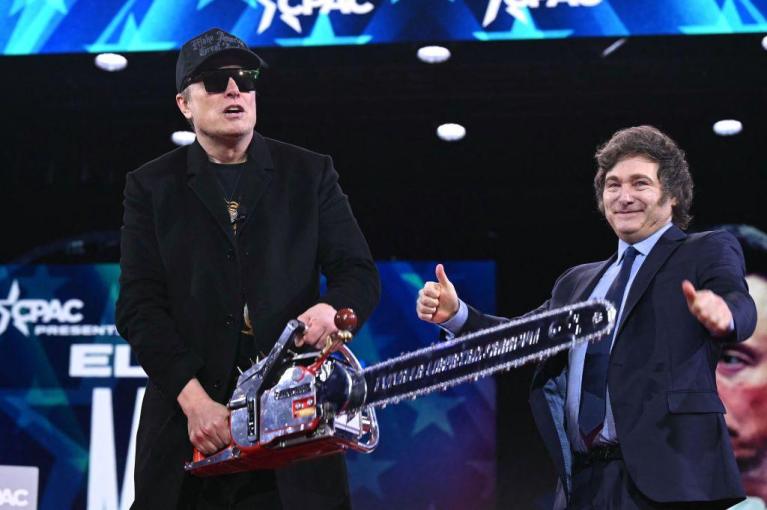
The true violation predates that day: the slow consecration of a bureaucracy into a deity, the elevation of marble over morality. Ancient temples hid their emptiness behind splendor; the Federal cult does the same, crying “blasphemy” when the curtain is pulled. January 6th didn’t defile a sacred space—it exposed a hollow one, a monument to a king the people demanded but never needed. And here’s where Argentina’s President Javier Milei enters, grinning like a Cheshire cat as he handed Elon Musk a chainsaw in 2025, etched with “Viva la libertad, carajo” (“Long live liberty, damn it”). Milei, who’s taken his own chainsaw to Argentina’s bloated state, wasn’t just gifting Musk a tool for bureaucracy—he was practically dancing with glee to see Musk turn it on the U.S. regime that’s bullied his nation for decades, from IMF debt traps to covert coups. It’s less a symbol of shared efficiency and more a middle finger to the empire, wrapped in a libertarian bow.

Trump’s Mandate and the Singular King

So where does Donald Trump fit in this unholy pantheon? In Part I, I cast him as a flawed Saul—brash, impulsive, a king more enamored with his own mirror than his people’s good. I stand corrected, or at least refined. Trump is no savior, nor should he be—Christians have but one King, enthroned above all earthly powers (Colossians 1:16-17). Yet he wields a mandate, both legal and theological, to tear down these idols, and therein lies his purpose—not as messiah, but as iconoclast.

Legally, Trump’s authority stems from the Constitution itself—a document that vests executive power in a president elected by the people (Article II, Section 1). His 2024 victory, a roar against the entrenched cult, grants him the democratic right to wield that power against inefficiency and corruption. The Federal government, swollen beyond its constitutional bounds, has no divine charter to resist pruning. The framers envisioned a lean state, not a Leviathan; Trump’s DOGE-inspired axe—however blunt—aligns with that original intent. He can shutter departments, slash budgets, and fire the high priests of waste, all within the law’s letter. The shrieks of “threat to democracy” from the old guard are the death rattles of a dethroned idol, not a defense of principle.

Theologically, his warrant runs deeper. Scripture abhors idolatry—Exodus 20:4-5 commands no graven images, no bowing to crafted gods. The Federal cult, with its temples and myths, is precisely that: a false deity usurping allegiance owed to Christ alone. When Jesus declared, “Render to Caesar what is Caesar’s, and to God what is God’s” (Matthew 22:21), He drew a line—Caesar gets coins, not worship. Trump, for all his bombast, serves as a wrecking ball to this blasphemy. He need not be pious to smash Baal’s altars; Gideon was a coward before he toppled the poles (Judges 6:27). If Trump’s tenure exposes the state’s hollow sanctimony—January 6th as symptom, not sin—then he fulfills a divine irony: a flawed vessel breaking a greater folly.

Yet here’s the correction to my 2015 take: Trump is not the point. I overstated his flaws as disqualifying, missing the forest for the trees. He’s no king to crown—Christians must reject all earthly thrones save one. “My kingdom is not of this world,” Christ said (John 18:36), and Paul echoed, “Our citizenship is in heaven” (Philippians 3:20). Trump’s role is transient—permitted, not ordained—to dismantle a false god, not to replace it. The Christian’s allegiance lies with the King of Kings, whose rule brooks no rival, be it Trump, Biden, or the marble gods of DC. Self-governance, then, is not just civic—it’s spiritual, a refusal to outsource our souls to any throne but His.

The Eschatological Hope

The people want a king, but the King we need refuses a throne of stone. To cling to the state as sacred is to repeat Israel’s folly, to trade the Spirit’s freedom for Saul’s spear. Self-governance is not utopia—it is obedience to a higher call, a shedding of idols for the stewardship God demands. Complexity is a liar’s refuge; trust is a martyr of our making. Let Trump tear down the temples—legally, he can; theologically, he should—but let us not crown him in their place. Overturn the tables, tear the veil, and build anew—not a kingdom of men, but a commonwealth of the free, under no crown but His.

The Church In the Age of Narcissism

Standard

The idea of individual rights and liberty has evolved into a defiant “nobody can tell me what to do” attitude. This toxic individualism can be in reaction to abuse, a response to the failures of authority figures or simply a person’s naturally narcissistic disposition.

As a product of American culture, I’ve always believed that people should be free and still believe this. It seems that totalitarian states, while certainly able to build great monuments and copy the innovation of their rivals, do often stifle creativity and limit the potential of individuals. A right to self-determination has enabled many to pursue their passions and helped in bringing about progress in terms of technology and medicine.

However, there does seem to be a point where unchecked individualism begins to be a threat to our collective advancement. And we are now to the point that it is not safe to so much as assume an individual’s gender based on the evidence without potentially triggering a violent, over-the-top and completely abusive backlash.

In this age of narcissism, it does not matter what has been established for centuries. It also doesn’t matter what the consensus is on a given topic or what the various authorities tell us. No, all that matters is how the individual imagines themselves.

Narcissism Enters the Church

In the church, this narcissism is often hidden under a mask of spirituality and sanctimonious blather. Sure, many will claim the Bible as their ultimate authority, yet they will reject anything it says about respect for the elder and submission when it is convenient for them and their own ends.

It is absurd, truly, that people are rejecting the very foundation of the rights that they assume. They tear down structures and institutions without realizing that they are unraveling the very things that have produced and protected the concepts they take for granted. They are dangerous in that they are too dumb to realize that everything they believe currently did not originate within them. Everything, even their ingratitude, and resentment of authority is a product of the times they are in,

They are not free, they are just ignorant of the collective consciousness that nourished and created their grand delusion of independence. Or, worse, they only recognize the negative contributions of the system without ever considering the benefits. They are not so pure or undefiled either, they have their own motivations and are woefully lacking in self-awareness. It is only a lack of humility, an idea that there is nothing to be gained in deferral to an elder or expert, that the individual knows all simply because they have basic reading comprehension and elementary knowledge.

Sadly, the erosion of confidence in the collective, mistrust of authority in general, does not make the individual any more competent than the system that created them. It doesn’t mean that they are themselves better qualified to be arbiters of truth than the hierarchies of flawed individuals that they aim to replace with their papacy of one. But it does destroy our chance for unity, it does make individuals extremely vulnerable to the deceptions of their own ego (“The heart is deceitful above all things and beyond cure.” Jeremiah 17:9 NIV) and boiled down is nothing more than self-worship.

How the West Was Lost

In the West, this ego trip may have started with the Pope asserting his own authority over the church, to unilaterally decide matters for himself without counsel and led to the Great Schism. But eventually, it trickled to ordained men doing the same in protest, relying on their own individual authority and understanding of church tradition to start their own denominations—before their attitude spread to the laity who rejected their authority as well.

The reformers, in their exuberance, eventually denied the very tradition that established the canon of Scripture and yet, through circular reasoning, still clung to the book as being authoritative simply because they believed it to be so. This led to others, more enlightened, who saw the irrationality, went a step further, rejected even the book as written by men and written by men whose authority they could not accept. The cold might be preferable to those lukewarm, at least they can’t use “well, the Spirit led me to [insert whatever]” and must attempt a rational argument instead.

At least the secular scientist is subject to peer review. They can’t simply declare something for themselves or rely on their cohort of like-minded advisors, like king Rehoboam who reject the advice of the elders, ran with that of his unwise cronies, and ended up creating division. A biologist, unlike the windbag pontificator in the men’s Sunday school class, has at least had to earn his credentials and must carefully make a case with evidence or will be treated as a joke by colleagues. Those feeding their own individual tastes from the Biblical smorgasbord, oblivious to their own biases being read into the text, can’t be made accountable.

Unfortunately, science and human rationality have also reached their limits. The intellectual enterprise could never answer questions of why we exist, an accumulation of facts could never fill the void left by religion, most people can’t keep up with the brightest minds in various fields and yet many (on both sides of any issue) speak more boldly than those who have spent years of rigorous study, confident because they read something on the internet. There is a growing mistrust of all authority and structure. Political ideologies push the research and echo chambers have replaced serious discussion.

For example, in climate science, there is plenty of grey area between Greta Thunberg’s emotional alarmism and the actual evidence. Sure, there may be some consensus on a current temperature trend and human contribution, but there is no such thing as settled science. At very least there is no reason to assume that warmer weather is automatically a catastrophe or the cause of all things bad. And there’s definitely some hysteria involved when you have a CNN anchor speculating, on-air, about a possible connection between an asteroid and climate change. Is it any wonder that more are dismissing the whole thing as nonsense?

On the opposite side of the coin are those who use the above, the misuse of science by media sensationalists and political activists, as a reason to dismiss all science. I’m talking, of course, of those (often religious fundamentalists) who deny what is well-known about the general shape of the planet and physics. They use a form of reasoning, they are not wholly irrational individuals and yet seem to be motivated more by their mistrust of all authority and undying trust in themselves. They are much like the far-leftist who refuse to see gender differences as real (while, in contradiction to themselves, claiming that a man with feminine traits is transgendered), they have made their own opinion an article of faith.

Eventually, if things do not change, we may soon not be able to hold civilization together and return to our roots of tribalism. Christendom was the force that once brought Jew and Greek, man and woman—people of vastly different social status—into fellowship with each other through their allegiance to Christ. From the beginning, the church had a definite structure and also ordained leaders to decide the weightier matters. But that order has dissolved, often in reaction to abuses and always to be replaced with increasingly arrogant smaller entities. The current narcissism is only the final step before the total collapse.

How To Break the Trend Towards Narcissistic Chaos

Groups of people, institutions, can certainly fall victim to their own collective confirmation bias. Again, authoritarian regimes that stifle independent thought destroy innovation and limit potential. But the individual, especially the individual who resists all authority, is even more vulnerable to being blinded their own biases.

Yes, certainly authorities do fail, alas even the President of the United States is human and makes mistakes, but that does not mean that individuals are all equally qualified for every role. It is always good to question the experts. Doctors, lawyers, and engineers can miss the obvious, laypeople are not all total idiots because they lack a degree. At the same time, this overreaction to abuses and failures is even more dangerous.

No, the Titanic disaster does not mean engineering is untrustworthy nor does the 737 MAX being certified by the FAA before a couple of deadly crashes make the whole institution a waste. The alternative of everyone being right in their own eyes, being their own expert, will do absolutely nothing to improve the quality of life. The reality is that we are better off with authorities, those who have made a career trying to understand specific issues and can be held accountable. Sure, even the professionals can be wrong, but there are greater consequences that go along with their license.

The church also needs elders and examples. The church should have those ordained and more respected. The idea that spirituality is a free-for-all is utter nonsense, not founded in Scripture nor the church tradition that canonized and established what is Scripture. The person who sees no need for any authority in their lives besides their own understanding or that of their cohort are the dumb beasts condemned by Peter:

This is especially true of those who follow the corrupt desire of the flesh and despise authority. Bold and arrogant, they are not afraid to heap abuse on celestial beings; yet even angels, although they are stronger and more powerful, do not heap abuse on such beings when bringing judgment on them from the Lord. But these people blaspheme in matters they do not understand. They are like unreasoning animals, creatures of instinct, born only to be caught and destroyed, and like animals they too will perish. (2 Peter 2:10‭-‬12 NIV)

True Christianity starts with repentance. Repentance comes with an attitude willing to voluntarily sacrifice some self-determination and take advice. It means humility and realizing that the universe does not revolve around your own individual understanding of things nor is truth a matter of your own personal opinion. It isn’t so hard to submit to an elder—even when you do not fully agree on everything—when one realizes their own fallibility and need of a savior.

Sure, hierarchies do fail and especially when they cease to be accountable to the bodies that they represent. A Christian leader always had authority, like Peter or Paul who spoke in a manner that commanded respect, but was never supposed to be a tyrant like Diotrephes. Leaders, like individuals, can be terrible failures and must be disciplined or removed as needed. But to overreact, to pretend everyone is on the same level, is no different than the pride that led to the fall of heaven’s highest-ranking angel. To reject authority besides one’s own is to repeat that same sin.

We need order, we thrive when we are able to specialize and let individuals reach their full potential, and that requires us to acknowledge our own limitations. We need an order that keeps authorities even more accountable than others, that does not give them a free pass as part of a good ol’ boys club, and actually requires that they are more submissive (as an example) than those who they hold charge over. Ultimately a church with no submission to others is a church without love, only self-love, and will offer nothing to those trying to escape the narcissism of our age.

The Customer Is (not) Always Right

Standard

Colorado courts are inconsistent.  Either it is discrimination for a baker to refuse to provide a product that goes against their own moral conscience or it is not.  The courts have ruled two different ways and this seems to reflect the mixed logic (aka hypocrisy) of the general public.

Last year Masterpiece Cakeshop was effectively sued out of the cake making business for refusing to make a cake that was morally offensive to them.  But last week the courts ruled in favor of a bakery that refused a religious customer who wished for a cake to celebrate his own views that offended them.  In both cases an intolerant customer and an intolerant business person clash over services, but only one was ruled as discrimination.

The Right To Moral Conscience

It should not become a lawsuit if a Red Sox fan refuses to bake a “I love Yankees” cake. It not discrimination against a person to refuse to make anything but pro-Boston cakes.

It is not discrimination against a person to refuse to endorse a personally offending message.  A gay placard maker should have every right to turn away Westboro Baptist if they ask for a “God loves Aaron McKinney and Russell Henderson” sign.  An atheist book printer should not be legally pressured into printing Bibles or other Christian literature either.

The idea that a business must provide any service that a customer demands is absurd.  It would be plain ignorant for me to go into a Jewish or Muslim restaurant and tell them they must serve me pork.  It would be even more ridiculous if I were to take them to court accusing them of discrimination against me.  But that is essentially what is happening in these various cases.

True Love and Tolerance is Respectful

Tolerance needs to be a two-way street. If we do not wish to be forced to do things against our own moral conscience, then we should be tolerant of those who refuse to go against their own moral conscience and not force them.

Another blogger, a religious business owner who abstains from drinking alcohol, shared a story about how they dealt with a brewer that wanted their services.  The conflict between desired services and moral conscience was solved amicably without legal fees and any unnecessary drama.  That is the model of tolerance more people should copy.

I believe everyone has a right to their own views (offensive, unpopular or otherwise) and should have freedom to share them.  That, however, does not mean anyone has the right to force another person to violate their own moral conscience.  Love and tolerance means respecting those who disagree with us enough to not force them against their will.

“Do to others as you would have them do to you. If you love those who love you, what credit is that to you? Even sinners love those who love them. And if you do good to those who are good to you, what credit is that to you? Even sinners do that.” (Luke 6:31-33 NIV)

Those are some words that apply equally to all people. If you are against intolerance don’t be intolerant. If you love greater then love enough to not offend those who offend you. Love by the example you want others to follow and not by force of law.