
Never Meet Your Heros

Standard

I have lost all of my heroes. The expression, “Never meet your heroes, because they’re sure to disappoint you,” describes the painful realization that those great people you imagined are not as special as you believed they were.  It could be the letdown a friend had when he heard Matt Walsh speak.  It could be a family that learned their eldest brother was cheating on his wife for many years and was not some image of virtue.  For me it was a process and a very long grinding away of faith in these figures.

I was never one for human idols.  I never put posters of celebrity faces on my bedroom wall and would never be as impressed with figures like Ravi Zacharias as some of my friends.  It wasn’t a religious thing nor something just to be ornery.  I simply didn’t have a feeling of awe about these personalities that were mid.  The people I most admired tended to be local—my blue collar dad, my missionary cousin, or that perfect girl I would marry some day.  But time has removed all from the pedestals.

Those women of my youth would end up as the cheating wife or more interested in status than my sincerity.  My dad no longer looks like that man I remember who could carry me on his shoulders (with me hanging on for death life) up a silo ladder, and that zealousness of the ‘compassionate’ types tends to morph into a noxious ideological alignment that is really anything but they profess.  They say that they want the Kingdom, but have replaced faith in God with fraudulent human institutions.

And I’m not just talking about the apologists for CAM in the wake of the Jeriah Mast and years of coverup aftermath.  “Oh, but this is an organization that does such good!”  What I’m talking about is something fully revealed since the DOGE ax has fallen on USAID.  I grew up believing in the strict separation of church and state—that a colonial expansion of Christianity was tainted and this at completely odds with the teachings of Jesus about His kingdom not being of this world.  

My views have certainly evolved—having left my religious cloister—but I’m still appalled by the thoughtlessness of people who I had once thought were smart and uncompromised.

Banality of Evil: When Ends Justify the Means 

The Anabaptists, after the disaster of Münster, had committed to a quiet life of separation.  It is why those in Old Order groups have refused participation in Social Security and other kinds of government benefits.  Mutual aid should be voluntary and Christian charity is not obtained through coercion.  Sure, the power of the state is alluring, that temptation (driven by our ego) to rule over others because we know what is best or they are undeserving of the resources they have—I have had many of those “if I were king” moments—but there is no stopping point when you fail to resist the siren song.

Left-wing politics always clothe themselves in a kind of compassion.  Surely you will not oppose helping these children, right?  And I am pragmatic to the extent I’m glad starving children are fed by any means.  But opening the Pandora’s box of leftist means is always a slippery-slope to more use of state power and, inevitably, to leftist utopian cost-benefit analysis where everyone who opposes us is a literal Nazi and, therefore, we’re justified to stop them with violence.  When coercion is allowed as a means of obtaining the ends we desire there is no stopping point.

The worst form of evil has good intentions.  It is that of those who imagine themselves as the hero of their own narrative and thus allowed to bend the rules.  This explains the extreme narcissism of Luigi Mangione who saw himself as a worthy judge of a father of two and a husband to a practicing physical therapist.  There was no need for this leftist murderer to look inward, he had completely externalized evil and turned other men into caricature representatives of truly complex multi-faceted problems.  When the ends can justify the means we’ll justify any means.

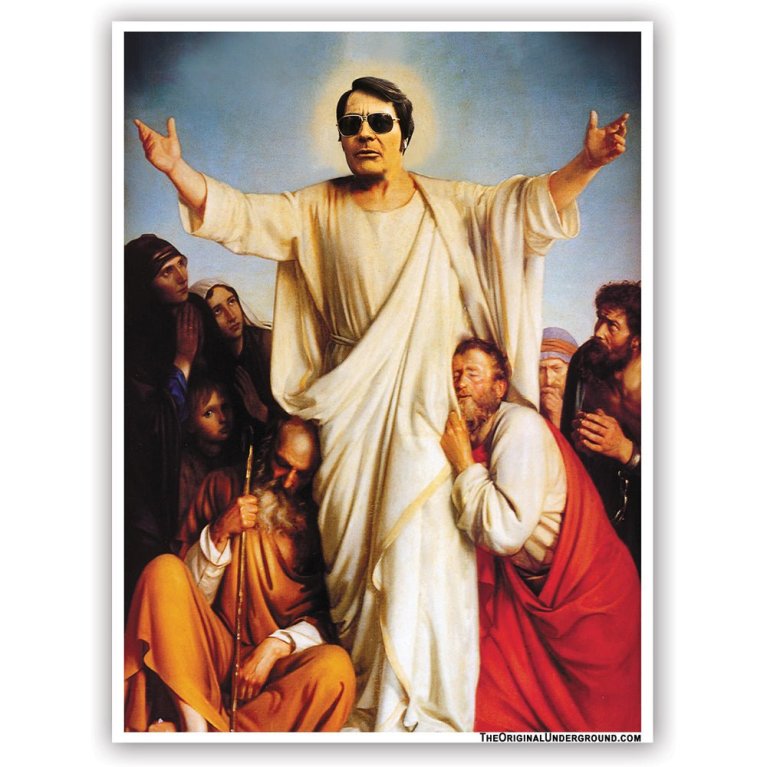
Pastor Jim Jones preaches his counterfeit Gospel before being abandoned by the US government and having to free his cult from bondage with some poison laced Kool-aid.

Seeing someone I thought was a Christian missionary lament how the United States had “abandoned” them was a reminder of how the great have fallen.  There was not a shred of gratitude expressed towards the American taxpayers who financed them nor acknowledgement of the misappropriation of funds that has wearied voters to foreign aid.  But more stunning to me was unholy alliance between this person of faith and agencies of US imperialism.  Since when has the love of Jesus become an extension of the US regime abroad?  Are they of the kingdom, as they proclaim, or agents of empire?

USAID, despite the name, is certainly not a charitable organization and was formed in 1961, at the height of the Cold War, with an aim of promoting the interests of the US political regime.  That’s fine.  But it has long ago gone off the rails even as far as what it was originally imagined.  The Soviet Union had fallen and the Federal agency created to oppose it morphed from something most would support into a beacon of wokeness—pushing transgenderism and abortion.

Break the Yoke of Fraudulence 

The reason why USAID is being dismantled is because we can’t sort the legitimate from illegitimate function of the agency.  Sure, it may help people in need, but funding it also is enabling of evil and maintained through a system of coercion we call taxes.  Anything good that it did can be done through other means.  This functional fixedness of those who depend of government, especially on the part of those professing Christ, makes me wonder where their faith lies and what their actual mission is.

The merger of a Christian charitable cause with government doesn’t purify government—it taints the witness:

Do not be yoked together with unbelievers. For what do righteousness and wickedness have in common? Or what fellowship can light have with darkness?  What harmony is there between Christ and Belial?  Or what does a believer have in common with an unbeliever?  What agreement is there between the temple of God and idols? For we are the temple of the living God. As God has said: “I will live with them and walk among them, and I will be their God, and they will be my people.” Therefore, “Come out from them and be separate, says the Lord. Touch no unclean thing, and I will receive you.” (2 Corinthians 6:14-17 NIV)

The accusations of “Christian nationalism” against those who want a government that performs basic functions were always just a smear by those in alliance with imperialism and Godless globalism.  While I’m not a fan of God and country, at least the flag waving religious patriot knows there is a difference between their Christian mission and secular state.  The left, by contrast, confuses these categories and would have social program replace true charity and community aid.  In one case you have those who may tend to overreverence nation, but in the other there are those who truly represent empire and yet tell us they their only  citizenship is the kingdom of heaven.

The truth is that the ‘Christian’ left is simply the left merely wearing the words of Christ as a disguise for ideological agenda.  Those decrying the reduction of empire and return to responsible governance never said thank you to those funding their do-gooderism.  It was, for them, all about holding those “chief seats in the synagogue” and their own glory as humanitarians.  They may speak against Trump, but then have never uttered a word against the waste, fraud and abuse that has made these broad sweeping cuts popular with common people.

The true Christian spirit is that of a Federal employee who told me about the enormous amount of inefficiency and waste in his own agency and—while making no profession of faith—supports the effort of DOGE knowing it may impact his employment.  That, to me, is someone who understands self-sacrifial love more than someone feeding the poor on another person’s dime and then going to social media to complain when their funds are cut.  They’re grandstanding.  While my Federal employee friend is a truly humble public servant who is grateful and not biting the hand that feeds him.

None of this to say this “abandoned” former hero of mine is a bad person.  They clearly are using their abilities to help other people in desperate need.  I applaud that.  And yet their public statement betrays.  There is an attitude or spirit there that is different from Christ.  I would much rather they just be a secular humanist—subscribed to partisan leftist politics—and own it.  They should just admit that they’ve abandoned faith in Jesus and are looking for a worldly system.  Judas Iscariot is the patron saint of faithless social justice, guilt trips and envy—when you betray your calling just own it.

JD Vance’s Theological Take: Directionally Right, Semantically Shaky

Standard

Great theology is not something I expect out of our politicians.  Or at least not in the manner of a Western theologian.  Theology, in the Protestant West, where Christianity is more about the mental exercise than about practical application.  Unfortunately there are many great moral thinkers who are not good people.  For example, John Howard Yoder, once the go-to Anabaptist pacifism explainer later disgraced by the many credible allegations of sexual abuse.  Our theology is what we practice, not what we preach.

Needless to say, we won’t be reviewing “The Politics of Jesus” any time soon (although it may be fun at some point) and what we will do instead is parse a curious statement that was made by Vice-president JD Vance:

There is a Christian concept that you love your family and then you love your neighbour, and then you love your community, and then you love your fellow citizens, and then after that, prioritise the rest of the world.

My first impression is mixed.  Vance should probably stick to politics rather than delving into theology.  I’m not sure he has a perfect understanding of what “neighbor” actually means in the Gospel sense.  But his point that love starts local has merit.  It is also important to note that the context of this is a moment of history where the second term of Trump administration, his America-first doctrine, and the dismantling of USAID and other arms of US imperialism.

Rather than disagree or agree with Vance, it is my intention to go through his statement line by line and, after that determine if he’s directionally right even if a bit wrong about semantic details.  Where does Christianity (or the Gospel) teach us to love first?

“There is a Christian concept that you love your family…”

Objection, your honor!  Jesus specifically taught us to hate our family (Luke 14:26) and, therefore, this JD Vance guy is just another Christian nationalist.  Crucify him, crucify him!  Oh, wait, you mean Jesus, on the cross no less, was assigning care for his mother (John 19:25-29) and had bashed the religious elites who neglected their own parents (Mark 7:11-12) claiming that their money was being set aside for God?

If there is any uncertainty left, the Epistle makes clear:

Anyone who does not provide for their relatives, and especially for their own household, has denied the faith and is worse than an unbeliever. (1 Timothy 5:8 NIV)

Care for our families is a first and foremost priority and should be.  What Vance did not make clear is what my high school coaches summarized better, in regards to priorities as, “Faith, family and then football.”  Jesus, in saying to “hate” our family was employing a bit of hyperbole, his point was that we first follow him and after that put everything else in our lives.  It is not one or the other, but it is getting the correct order.

“…and then you love your neighbour…”

This probably is the weakest part, in terms of rhetoric, that the Vice-president said and it is because of how Jesus so radically had reframed the Jewish discussion of his day and broadened the term “neighbor” to pretty much mean anyone we cross paths with.  I am talking about his story which involved a good Samaritan and an immediate need.

When asked by a religious law expert, “And who is my neighbor?” Jesus, sensing the man was trying to justify himself (or his lack of compassion for those outside the Jewish tradition) changes the question.  Instead of asking who to love, Jesus reframed to make it about how to love.  The punch of using a Samaritan as the good guy of the account would be similar to telling a story, in Israel today, about a good Palestinian or going to the DNC and using an example of a good MAGA hat wearing redneck.

Vance appears to be using “neighbor” in the more conventional sense.  He’s not talking about the stranger, in need of help, that we meet along the road.  Nor how to be a good neighbor, as Jesus did in response to a man trying to justify his own narrow exclusionary take on who is a neighbor, which is actually reflective of the Jewish law:

“‘Do not hate a fellow Israelite in your heart. Rebuke your neighbor frankly so you will not share in their guilt. “ ‘Do not seek revenge or bear a grudge against anyone among your people, but love your neighbor as yourself. I am the Lord. (Leviticus 19:17-18 NIV)

Neighbor is clearly qualified, by context, as a “fellow Israelite” or “your people” and not the broader use.  Nevertheless, what Jesus does is turn the question around on the one asking for sake of an exemption.  The true message is that we correct our own heart and fix our attitude towards those we hold in low regard.  Americans should learn to love their neighbors no matter who they’ve voted for last election.  Love starts local, it isn’t about ethnicity, race or politics, and is all about what we personally are doing for those whom we meet along the way.

“…and then you love your community…”

Community, in the Biblical sense, would be the community of believers.  A Christian is supposed to be devoted to fellowship (Acts 2:42, 1 John 1:7) carry each other’s burdens (Gal 6:2), maintain unity (Eph 4:3) and love one another so that the world knows that you follow after Christ (John 13:5), which is local and also not ahead of obligation to our own families.  Charity is a provision for both Godly widows and orphans.  It doesn’t make mention of free condoms for foreigners nor giving to those outside the Church:

Give proper recognition to those widows who are really in need. But if a widow has children or grandchildren, these should learn first of all to put their religion into practice by caring for their own family and so repaying their parents and grandparents, for this is pleasing to God.

[…]

No widow may be put on the list of widows unless she is over sixty, has been faithful to her husband, and is well known for her good deeds, such as bringing up children, showing hospitality, washing the feet of the Lord’s people, helping those in trouble and devoting herself to all kinds of good deeds. (1 Timothy 5:3-4;9-10 NIV)

As we see above, Christian community aid is conditional.  No, this does not mean we cannot extend compassion to the broader community beyond the Church—only that it is an obligation within the body of believers first—starts with our brothers and sisters in Christ (James 2:15-16) before it goes out to the community beyond.  As St Paul told the church in Galatia, we should “do good for all people,” but “especially to those who belong to the family of believers.” (Gal 6:10)

So, God, family, church community, and then…

“…and then you love your fellow citizens…”

This is probably the concept that is most difficult to find.  On one hand the Church did send missionaries from Judea throughout the Roman Empire.  But, probably drawing on my Anabaptist roots (where there is this tendency to over-literalize everything but the body and blood of Christ), we are told we’re “citizens of heaven” and so loving citizens is not necessarily about the country, state or nation.  However, we are told to submit to our human authorities and institutions:

Submit yourselves for the Lord’s sake to every human authority: whether to the emperor, as the supreme authority, or to governors, who are sent by him to punish those who do wrong and to commend those who do right. For it is God’s will that by doing good you should silence the ignorant talk of foolish people. Live as free people, but do not use your freedom as a cover-up for evil; live as God’s slaves. Show proper respect to everyone, love the family of believers, fear God, honor the emperor. (1 Peter 2:13-17 NIV)

Where many from my religious background go wrong is by putting worldly government and citizenship at odds with the heavenly kingdom.  This is wrong.  No early Christian renounced their citizenship.  St Paul did not and there are many places where they tell us to respect even secular government as being ordained by God.  A Christian should not opposed to the punishment of evil (Rom 13:17) and should be a model citizen.

So it does make sense that this expanding bubble of love, from God to family to church to community would continue to growing to also include our fellow citizens.  No, nation should never come before obedience to our moral conscience.  But it is important that we respect institutions and the people they represent.  It is appropriate to show a little respect to the flag, to remember those who died to fighting for an ideal, and to love the people of our own nation—like Jesus who spent his entire ministry amongst his own people that he loved first and foremost.

…and then after that, prioritise the rest of the world.”

So now we’ve come to the final part of the expanding arc Vance described.  Once we have fulfilled our commitment to our other priorities, then we should go beyond these borders to save the world.

The Great Commission is probably better described as the great omission the way it is used by those who fail to read carefully and miss the “wait, then” at heart of this—they rush forward, so full of answers, full of themselves and feelings of being superior to their peers.  They can be Evangelicals or they can be young Marxists, but they have been indoctrinated and do not realize what they’ve missed while running out to prove their phony virtue has no bounds.

On one occasion, while he was eating with them, he gave them this command: “Do not leave Jerusalem, but wait for the gift my Father promised, which you have heard me speak about. 

[…]

But you will receive power when the Holy Spirit comes on you; and you will be my witnesses in Jerusalem, and in all Judea and Samaria, and to the ends of the earth.” (Acts 1:4-8 NIV)

First in Jerusalem, their own city or people, then to Judea their state and neighbors—then on to Samaria, a region inhabitated by their enemies and then, finally they were to go to the whole world.  That order is not a mistake.  And those who ignore it are going on their own power, their own authority, and often contribute to hell more than they ever do salvation.  Grandiose visions are so nice, such a comfort for the delusional, we want to believe we are better for our having more stamps on our passports and these global ambitions.  

So, maybe Vance didn’t articulate it well or use terms in the same exact manner of as a doctor of theology, but lets not nitpick him or play semantic games, his concept of our help starting local (the need along our path or a Lazarus lying literally at our front gate), before going out from there, has very solid basis in Biblical texts.  That is the pattern we see in the disciples Jesus taught.  They didn’t travel the world trying to find greater needs—they started with their own people and worked out from there.  

Jesus, the ultimate Christian example, never went beyond Judea, Samaria and Galilee. 

Telescopic Philanthropy and Liberal Elites

Charles Dickens describes a phenomenon of globally-minded do-gooders who missed the needs right in front of their noses.  This is a way the modern elites try to distinguish themselves from common people.  And the same thing that religious elites did and was rebuked very severely by Jesus (Matt 23) as hypocrisy.  Running an NGO certainly gets more attention than helping your neighbor across the street, but the latter better fits with a “do not let your left hand know what your right hand is doing” (Matt 6:3) ethic of the Gospel.  Telescopic philanthropy is the opposite of what a Christian does.

Rory Stewart, attacking Vance’s perspective as being tribal pagan, decrying a million in additional funding being cut off from his wife’s NGO is a prime example of disconnect between the globalist elites and those forced to support their efforts.  They’re good people, in their own minds, for using piles of our tax dollars to teach modern art to Afghani villagers.  To them Vance is a rube.  But I seriously doubt their massive virtue-signals are of much or any practical long-term value.  Charity does not take from one to give to another.  It truly makes no sense that British socialites get a dime of our money for their pet projects.  It makes even less sense that any professing Christians would defend USAID.

Not a theologian.

JD Vance’s commentary, for all its semantic stumbles, offers a grounded counterpoint to this telescopic philanthropy. His emphasis on starting with family, neighbors, and citizens before tackling the world’s woes challenges the elite obsession with grand, distant causes that often serve more as status symbols than solutions. While the globalist set may scoff at his provincial framing, they’d do well to heed the Gospel’s call to tend first to the needs at hand—quietly, humbly, and without fanfare. Vance may not be a theologian, but his instinct to root love in the local cuts through the hypocrisy of those who’d rather save the world on someone else’s dime than lift a finger for the suffering next door. In a culture dazzled by far-off heroics, his words remind us that genuine charity begins where our feet are planted.

My Departure From the Ethnic Church

Standard

Like many other things not appreciated until they are gone, there was a time when the unique character of the church of my youth was something I had mostly taken for granted.

You see, that church, unlike some other Mennonite churches, had many surnames not typically found within the denomination.  We had Cordermans, Gelnetts, Fiedlers, Schrocks, Schooleys and Rovenolts—all of them “community” people who decided to become Mennonites.

Over the years that near even split of Mennonite-borns and “community” people has slowly faded.  The non-Mennonite names displaced and replaced as more transplants arrived following cheaper land prices and a better place than Lancaster County to raise their families.

The original church, started a few decades before my birth, had been the result of a Summer Bible School program.  A group from Lancaster County drove several hours north and set up camp on the grounds of a small one room public school.

Eventually several young couples involved decided to move into the area where they held the summer program.  They purchased the little old school house and started the “East District Mennonite Church” with Lester Miller ordained as pastor.

That church, the one with Lester at the helm, is the one that had a greater focus on the local community and was basically a family of misfits.  As far as Mennonite churches go it was a very welcoming place and I believe still retain that reputation today.

However, over the years (since the time Lester moved back to Lancaster and with the influx of “cradle Mennonites” who didn’t necessarily share that original vision of outreach) there has been a subtle shift—a reverting back to a mostly ethnic church full of those who cater only to their own families.

What is an ethnic church and when is it a problem?

It used to irk me, coming from the mixed background congregation that I did, when people would describe Mennonites as being an “ethnic church” and unwelcoming to outsiders.  My response would be that Mennonites aren’t the only church with a distinct ethnic flavor and that my own church was diverse.

Truth be told, ethnic diversity isn’t a necessary ingredient for a vibrant local church either.  I would expect that a church in China would have mostly those of ethnic Chinese background and a church in central Pennsylvania to have mostly German or other Caucasian origin.  Most historical churches were made of those who shared an ethnic identity and there’s nothing wrong with a bit of local flavor.

Unfortunately these ethnic lines, when they come at the expense of a universal and united church, become antithetical to the Christian tradition left to us by the Apostles.  We are supposed to all be one in Christ Jesus (Galatians 3:28) rather than divided up by differences of gender, social status and ethnic background.

Ethnic division, very often linked together with sectarian or denominational distinctions, is a great weakness of the North American church.  Instead of local community is being unite into one church, as was the case in the early church, we hold onto our own racial and cultural identities.  We put ourselves first, our own ethnic families, over unity in the Spirit.

American churches are “intellectual ghettos” as well.  We separate over political ideologies, theological perspectives, traditional versus contemporary preferences and, in the case of Mennonites at least, over the most trivial bits of application.  This multitude of churches all claim to Jesus as Lord and yet each prioritize preservation of their own cultural “echo chamber” and focus on insulating themselves from any real challenge of their ideas.

What would Jesus say about ethnic churches in diverse communities?

“If anyone comes to me and does not hate father and mother, wife and children, brothers and sisters–yes, even their own life–such a person cannot be my disciple.” (Luke 14:26)

That might be hyperbole.  It was addressing an audience that place great value on ethnic and family identity.  It seemed to contradict prior teaching that put emphasis on tribe and caring for one’s own first.  Nevertheless it is something Jesus said and something we ought to contemplate as it applies to our own times.

Did Jesus come to establish a church divided in so many ways?  Would he approve when people living in the same geographic area drive past multiple churches to find one that suits their own personal preferences?  At very least, is it appropriate to “plant” a new church in a town where there are already multiple options?

At some point there needs to be some introspection.  If the church you are in does not reflect the demographics of the local community you should ask why that is.  Was the true Gospel of Jesus Christ was about people congregating with people ethnically and otherwise similar to themselves?  Were newly converted Greeks required to live by traditional Jewish religious standards?

I’ll let this be the answer to that last question…

Mark my words! I, Paul, tell you that if you let yourselves be circumcised, Christ will be of no value to you at all. Again I declare to every man who lets himself be circumcised that he is obligated to obey the whole law. You who are trying to be justified by the law have been alienated from Christ; you have fallen away from grace. For through the Spirit we eagerly await by faith the righteousness for which we hope. For in Christ Jesus neither circumcision nor uncircumcision has any value. The only thing that counts is faith expressing itself through love.  You were running a good race. Who cut in on you to keep you from obeying the truth? […] Brothers and sisters, if I am still preaching circumcision, why am I still being persecuted? In that case the offense of the cross has been abolished. As for those agitators, I wish they would go the whole way and emasculate themselves! (Galatians 5:2‭-‬7‭, ‬11‭-‬12 NIV)

Strong words.

When we put our own ethnic and religious tribe above loving as Christ taught then we are like those whom Paul wished would cut themselves off completely.

Finding the universal church…

“There is one body and one Spirit, just as you were called to one hope when you were called; one Lord, one faith, one baptism; one God and Father of all, who is over all and through all and in all. “ (Ephesians 4:4‭-‬6 NIV )

The divided western church does not represent the ideals expressed by Jesus or the Apostles.  What it does represent is our cultural value of independence over unity in Christ.  It is because we value our own ethnic groups and our own idiosyncrasies of practice over the love for the whole family of God.  It is because we are unwilling to “hate” our own families in order to find greater unity together in the Spirit.

There would no doubt be a blessing for those who gave up their own religious cultural and personal hang ups in obedience to their Lord who said to put love for his church first.  My own will to do that was crippled for many years by my want to feel loved, accepted and desired in my ethnic church.  In had placed being Mennonite above being Christian and truly loving my neighbors despite our differences.

I’ve recently started to go to a church that has members from many denominational backgrounds.  Yes, there are some of the “cradle” types who bring their own ethnic and cultural flavor to the group.  And, yes, I do need to drive past a couple other churches to get there.  But the mix is more representative of the surrounding community and the welcome I’ve received there reminds me of a little church that I once knew.